The first thing Marin Halloway remembered about the auction was the laughter.
Not the auctioneer.
Not the smell of manure and old sawdust.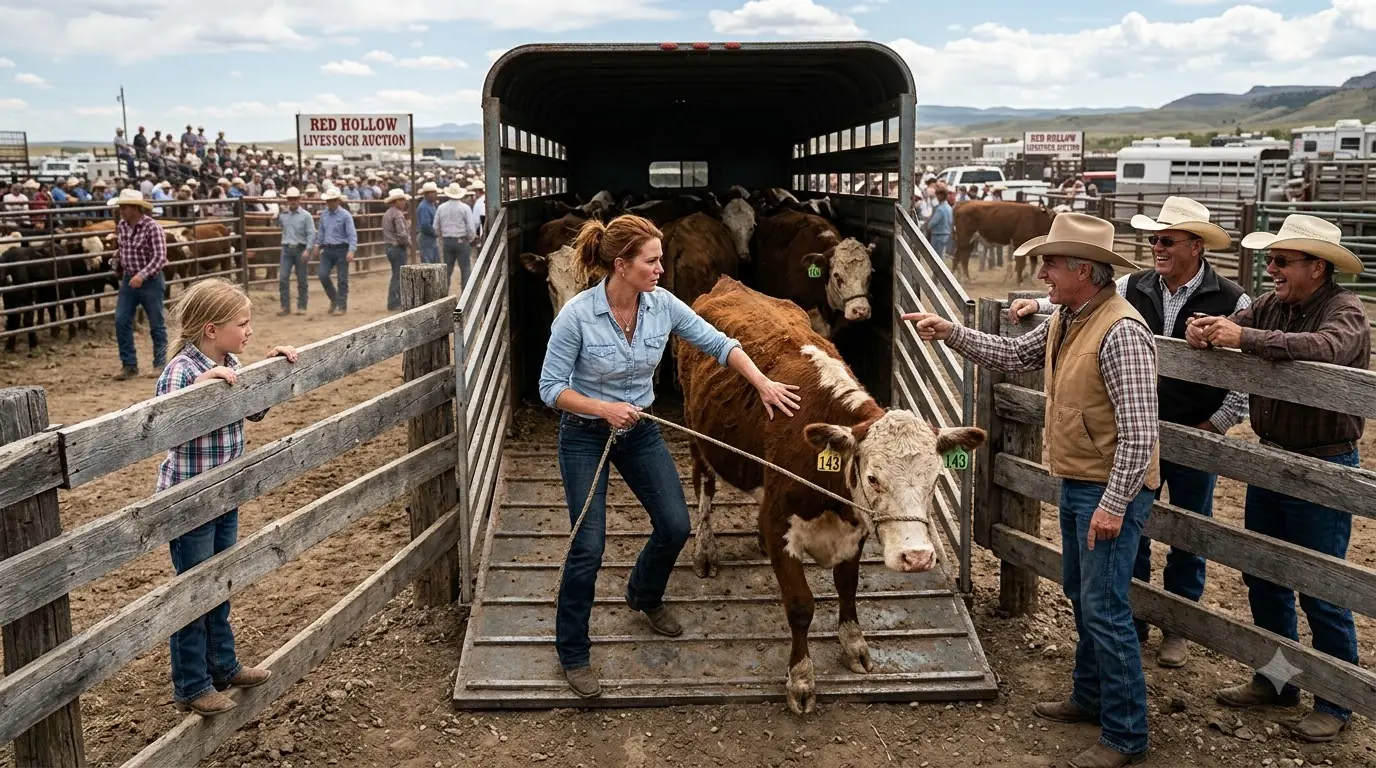
Not even the forty-seven cattle standing behind the back rail with their ribs showing through coats bleached dull by neglect.
The laughter stayed.
It rolled across the warped wooden bleachers at Red Hollow Auction Barn after Marin raised her bidding card and said:
“Nine hundred.”
For half a second, the room went quiet.
Then nearly every rancher in the barn seemed to decide at once that she had lost her mind.
At the front rail stood Emmett Crane.
Fifty-five years old.
Broad shoulders.
Silver beginning around his temples.
Expensive charcoal jacket over a pressed shirt.
Boots polished enough to reflect the dusty lights overhead.
Crane Cattle and Land was the biggest operation in the county, and Emmett wore that fact the way some men wore a badge.
He looked toward the starving cattle.
Then toward Marin.
“Forty-seven veterinarian bills with legs.”
More laughter.
Marin did not respond.
She was thirty-eight, a single mother trying to keep her late father’s Wyoming ranch from slipping into foreclosure.
Her auburn hair had escaped the low knot she had tied before sunrise.
Her jacket was buttoned incorrectly at the collar.
Her boots were dusty.
And the nine hundred dollars she had just bid represented almost every usable dollar remaining in the Halloway ranch account.
Emmett leaned against the rail.
“Three months, Halloway.”
Marin finally looked toward him.
“What?”
“That’s how long before you sell me your land.”
His smile widened.
“Maybe less after buying those skeletons.”
The auctioneer looked toward Marin.
“Any other bids?”
Nothing.
“Nine hundred once.”
Silence.
“Twice.”
Marin’s stomach tightened.
“Sold.”
The gavel fell.
Forty-seven cattle became hers.
The room laughed again.
Marin lowered her card.
She walked toward the loading pens without looking at Emmett.
The cattle shifted when she entered.
They did not run.
They simply moved away with the tired caution of animals that had learned not to expect anything good from human hands.
Marin approached slowly.
Her father, James Halloway, had taught her that much.
Never force frightened cattle when patience will move them.
She placed one hand against the nearest cow.
Thin.
Too thin.
She could feel ribs beneath her palm.
But beneath the ribs was a frame that interested her.
Moderate shoulders.
Good leg structure.
Strong feet despite cracking.
Deep body.
Not large cattle.
Efficient cattle.
The sort her father used to point out when she was a girl.
“The flashy ones sell first,” he used to say.
“The useful ones stay longest.”
Marin moved her hand lower across the flank.
Then stopped.
Something moved beneath the hide.
Her breath caught.
She waited.
Another movement.
Not digestion.
She knew exactly what it was.
Marin had worked veterinary clinics before returning home after her father died.
She had palpated enough pregnant livestock to recognize the shape.
She moved to another cow.
Then a third.
Then a fourth.
Different stages.
Different bellies.
The same unmistakable possibility.
Marin looked back toward the auction ring.
Emmett was laughing with two men.
Nobody was looking at the cattle anymore.
Everybody had already decided what they were worth.
Marin placed both hands against the fifth cow.
A strong movement pressed beneath her palm.
She whispered:
“Well.”
For the first time that morning, she smiled.
Buying forty-seven cattle was easier than getting them home.
The first livestock hauler Marin called claimed a broken axle.
The second said his schedule was suddenly full.
The third did not bother inventing anything.
“Can’t help you, Marin.”
“Why?”
Silence.
She already knew.
Emmett Crane did business with nearly every livestock hauler around Red Hollow.
Marin hung up.
She drove to the house of seventy-two-year-old Silas Redgrave.
Silas had worked cattle beside her father for thirty years before bad knees reduced his ranching to advice given from porches.
He opened the door before Marin knocked twice.
“You bought them.”
News traveled quickly.
“Yes.”
“All forty-seven?”
“Yes.”
Silas looked toward the road.
“How bad?”
“Thin.”
“Disease?”
“Not that I can see.”
“You already have a vet coming?”
“Tomorrow.”
He nodded.
“Pregnant?”
Marin looked at him.
Silas smiled.
“Your father taught me that look.”
“I think several.”
“How many?”
“I don’t know yet.”
Silas reached for his coat.
“Come on.”
Behind his barn sat an old stock trailer beneath a gray tarp.
The tires were aged.
The hitch rusted.
The floorboards needed checking.
Silas slapped the side.
“She’ll go.”
“Silas—”
“Take her slow.”
“I can’t pay you.”
“Did I ask?”
Marin looked at him.
“No.”
“Then stop wasting daylight.”
Two exhausting days later, the last load finally rolled onto Halloway property.
It was nearly midnight.
Marin’s nine-year-old daughter Sadie waited beside the gate in boots and a nightgown, a wool blanket around her shoulders.
“Mama!”
Marin lowered the truck window.
“What are you doing outside?”
“Waiting.”
“You should be asleep.”
Sadie looked toward the trailer.
The cattle inside shifted weakly.
Her expression changed.
“Are they going to die?”
Marin stopped.
She had made herself a promise after her husband died and again after her father died.
She would not tell Sadie comforting lies merely because the truth was painful.
“I don’t know.”
Sadie stared at the cattle.
Marin continued.
“I can’t promise every one will live.”
“But I can promise somebody is finally going to give them a real chance.”
Sadie nodded.
Then opened the gate.
Dr. Corley Whitfield arrived after sunrise.
Sixty.
Silver hair tucked beneath a stained hat.
Small, quick hands.
A lifetime spent reading livestock with her fingertips.
She worked through the herd with Marin.
Parasites.
Mineral deficiency.
Malnutrition.
Cracked hooves.
Dull eyes.
No obvious infectious disease.
Corley stood beside one of the weakest cows.
“You feed them too rich too quickly, you’ll kill them.”
Marin nodded.
“Slow recovery.”
“Very.”
“Hay first.”
“Clean water.”
“Minerals.”
“Gradual grain.”
“Exactly.”
Corley looked at her.
“You spent your last money, didn’t you?”
Marin did not answer.
Corley sighed.
“That means yes.”
Marin glanced toward the herd.
“I think some are bred.”
“How many?”
“I don’t know.”
Corley ran a hand along one flank.
Then another.
Her face changed.
“You may be right.”
Marin looked toward her.
Corley added:
“Doesn’t make this safe.”
“I know.”
“But it makes it interesting.”
That afternoon Marin began building the feeding program.
She divided cattle by body condition.
The weakest received carefully measured hay.
Mineral supplements came before heavy calories.
She negotiated with a grain mill outside town for wheat straw and inexpensive byproduct feed.
The mill foreman had known her father.
“You paying cash?”
“I need thirty days.”
He stared at her.
Then wrote terms on the back of a receipt.
“Your daddy paid me for thirty years.”
“That gets you thirty.”
Marin swallowed.
“Thank you.”
“Don’t thank me.”
“Pay me.”
“I will.”
“I know.”
Emmett Crane drove past the ranch twice that week.
The second time, he lowered his window.
“Picked your liquidation date yet?”
Marin kept walking along the north fence.
“Halloway!”
She wrote something in her notebook.
Emmett shouted again.
“You deaf?”
Marin still did not turn.
She finished recording the water intake of cow number nineteen.
Emmett laughed.
His truck disappeared down the road.
Marin closed the notebook.
She was discovering that ignoring him felt better than arguing.
Several days later, Marin began cleaning old ear tags.
One tag revealed letters beneath years of dirt.