“You sacrificed your job for a soaked beggar. Sign this and get out.”
Darren Cole slammed the termination form onto the desk so hard that a cup of cold coffee jumped beside the keyboard. Twenty-nine-year-old Maya Reynolds stood across from him in the cramped management office of Bellweather’s, still wearing the fitted black dress and low heels required of every hostess. Her hands were trembling, but she kept them folded around the name badge she had already removed from her chest.
“I fed a freezing woman,” Maya said. “And I’d make that choice again.”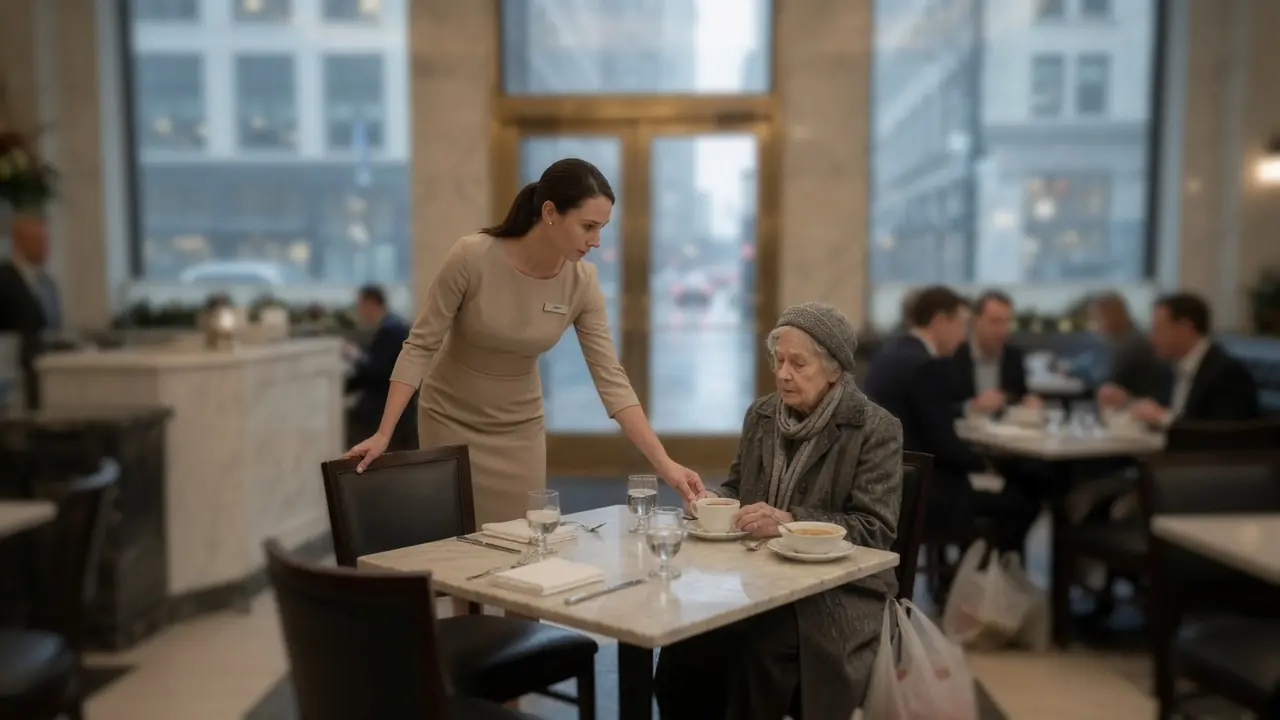
Darren leaned back and looked at her with the satisfaction of a man who believed fear had finally done its work. Through the open office door, two waitresses stood near the supply shelves, pretending to sort menus while listening to every word. Neither dared speak because Darren controlled their schedules, their hours, and whether one bad week became a missed rent payment. Maya understood their silence because she had lived inside the same fear for two years.
“Then stay poor somewhere else,” Darren said, pointing toward the door. “You’re fired.”
Maya looked down at the termination form. Under Reason for Dismissal, Darren had written: Insubordination, unauthorized complimentary service, and conduct damaging to the guest experience. He had not written that the guest was a seventy-eight-year-old woman shivering inside a rain-soaked coat. He had not written that Eleanor had offered to pay for tea with coins she could barely hold because her fingers were numb.
The previous afternoon had begun like every difficult shift at Bellweather’s. Rain struck the marble-fronted restaurant from morning until evening, turning downtown Columbus into a maze of gray water and reflected headlights. Maya stood near the entrance welcoming hotel guests, answering reservation calls, and smiling at customers who blamed her for the weather. She had twelve dollars in her purse and a daughter waiting at after-school care.
Sophie was seven and possessed the dangerous belief that her mother could solve every problem. Each morning, she drew purple stars on a napkin and slipped it into Maya’s lunch bag as protection against “mean customers and boring grown-ups.” Maya carried the latest one in her pocket as Darren fired her. She pressed her thumb against the paper through the fabric and wondered how she would explain that kindness had cost them their income.
Eleanor had appeared outside the restaurant shortly after two thirty. She wore a thin gray coat, a damp knitted cap, and worn shoes that had absorbed more water than they could hold. Two plastic grocery bags hung from her trembling hands, one torn along the bottom. The hotel doorman told her she could not remain beneath the entrance awning.
Maya crossed the lobby before caution could stop her. She found Eleanor pale, exhausted, and apologizing for taking up space on a public sidewalk. The elderly woman said she wanted only somewhere dry to sit and believed she had enough money for tea. When she attempted to search one bag, her frozen fingers could not separate the handles.
Maya led her inside.
Darren intercepted them near the host stand and ordered Maya to remove Eleanor immediately. He called her a distraction, a liability, and exactly the kind of person Bellweather’s could not allow near wealthy guests. Maya thought about rent, Sophie’s winter shoes, and the electricity notice waiting on the kitchen counter.
Then she saw Eleanor preparing to return to the rain.
“You haven’t been moved along from me,” Maya said.
She seated Eleanor in the quietest corner, paid for the tea with six of her last twelve dollars, and added soup and bread from the kitchen. Eleanor held the hot cup with both hands while color slowly returned to her face. She explained that her daughter used to fold napkins into swans and smiled when Maya mentioned Sophie’s purple stars.
Darren arrived before Eleanor finished eating. He stood beside the table and announced publicly that Bellweather’s was not a shelter. When Maya refused to remove the old woman, he fired her in front of the dining room. Customers watched from expensive tables, yet not one person challenged him.
Maya left with her coat, work bag, and six dollars.
Before they separated, Eleanor gave Maya a worn handkerchief embroidered with the letter E. Maya gave Eleanor her umbrella, though one rib was bent and the fabric leaked near the handle. The old woman touched Maya’s cheek and promised she would remember her face.
Maya spent the night applying for jobs while Sophie slept. When she unfolded the handkerchief, a small oval pin fell onto the kitchen table. It had a gold edge, a dark-blue stone, and the initials E.W. engraved on the back.
The pin looked valuable.
Maya’s first thought was not how much it might be worth. Her first thought was that Eleanor might believe she had lost another piece of her life. Maya placed it in a small bowl beside the sink and planned to return to Bellweather’s the next morning in case the old woman came looking for it.
Instead, Darren summoned her first.
“You understand that yesterday embarrassed this restaurant,” he said now, tapping the termination paper. “Customers pay for a refined environment. They should not be forced to eat beside someone carrying garbage bags.”
“She carried groceries.”
“You don’t know what was inside them.”
“Neither do you.”
His mouth tightened. “This attitude is why you will never move beyond a host stand.”
Maya looked around the office she had cleaned after him countless times. File cabinets leaned against one wall, schedules covered the bulletin board, and employee complaints disappeared beneath untouched paperwork. Darren had spent years convincing workers that survival depended on tolerating whatever he chose to do.
“You’re right,” Maya said.
The answer surprised him.
“I’ll never move beyond a host stand while men like you decide whose dignity is bad for business.”
Darren reached for the form. “Sign it.”
“No.”
“Refusing does not preserve your job.”
“It preserves my right to challenge the reason you fired me.”
His face darkened. “You have no lawyer, no savings, and no influence. What exactly do you imagine you’re going to challenge?”
A low engine sound rolled through the street outside.
Then another.
One of the waitresses stepped away from the storeroom window and whispered, “There are four black SUVs at the curb.”
Darren glanced toward the lobby but quickly dismissed the interruption. Bellweather’s sat beneath the Whitmore Grand Hotel, where politicians, athletes, and executives arrived regularly. A convoy probably meant an important guest, and important guests always improved Darren’s mood. He straightened his jacket and pushed the form toward Maya again.
“Sign and leave through the employee entrance,” he said. “I have real business to handle.”
Maya picked up the paper, folded it once, and placed it in her bag without signing. “I entered through the front for two years. I’ll leave through the front.”
Before Darren could answer, footsteps approached.
A tall man in a charcoal suit appeared in the doorway. Two hotel executives followed him, along with the regional director whose emails Darren treated like royal commands. The man in front carried a leather folder and wore a small earpiece.
“Ms. Reynolds?” he asked.
Maya turned. “Yes?”
“My name is Daniel Price. I represent the Whitmore family office.” His expression softened slightly. “Mrs. Eleanor Whitmore would like to speak with you.”
Darren stopped moving.
Maya heard the name but needed several seconds to understand it. Whitmore Hospitality Group owned the hotel, Bellweather’s, and more than forty properties across the country. Employees saw the family name on contracts, training documents, insurance forms, and polished plaques near the lobby fireplace.
“Eleanor?” Maya whispered.
Daniel nodded. “The woman you assisted yesterday.”
Darren’s face drained of color. “There must be some confusion.”
“No,” a woman’s voice said from the lobby. “The confusion ended yesterday.”
Eleanor Whitmore stood beyond the office doorway.
The thin gray coat was gone. She wore a deep navy dress beneath a cream wrap, a pearl necklace, and polished shoes. Her silver hair had been brushed neatly away from her face, but her clear blue eyes were exactly as Maya remembered.
“Good morning, Maya,” Eleanor said.
Maya stared at her. “You own this place?”
“My family does.”
Darren stepped forward immediately. “Mrs. Whitmore, I wish someone had informed us you were visiting. We would have arranged appropriate service.”
Eleanor looked at him. “Would you have served me soup?”
“Of course.”
“Because I was cold?”
“Because you are Mrs. Whitmore.”
The words escaped before Darren understood the trap.
Silence filled the office.
Eleanor entered slowly and stopped beside Maya. “Yesterday, I arrived wearing an old coat, carrying ordinary bags, and asking only for a cup of tea. You decided I did not belong before you knew anything about me.”
Darren attempted a nervous smile. “We maintain standards to protect our paying guests.”
“I offered to pay.”
“You appeared unable to.”
“So dignity is available only after a credit check?”
“That is not what I meant.”
“It is exactly what you practiced.”
Maya opened her handbag and removed the gold pin. “You left this inside the handkerchief.”
Eleanor’s expression changed when she saw it.
“My mother’s pin.”
“I found it last night. I was coming back to return it.”
Eleanor accepted the pin carefully. “Do you know what this is worth?”
“No.”
“Several thousand dollars.”
Darren looked sharply toward Maya.
She felt uncomfortable under the sudden attention. “It wasn’t mine.”
Eleanor faced the employees gathered near the office. “Yesterday, this woman lost her job because she bought me tea with the last money in her purse. She went home to a child and overdue bills. Then she discovered something valuable belonging to me, and her only concern was returning it.”
Darren spread his hands. “Mrs. Whitmore, Maya violated direct instructions. Regardless of your identity, managers must maintain authority.”
“My identity should never have mattered.”
“Certainly not.”
“Yet you just admitted it would have changed your behavior.”
He had no answer.
Eleanor asked Daniel to open the folder. Inside were printed emails, employee complaints, payroll summaries, and photographs. Maya recognized the names of workers who had disappeared from the schedule after questioning unpaid closing duties.
“For eight months,” Eleanor said, “my office has received reports about this property. Staff were ordered to work without clocking hours. Employees requesting medical leave lost shifts. Guests judged unlikely to spend enough were discouraged from entering.”
Darren’s expression became defensive. “Anonymous complaints are often exaggerated.”
“That is why I came personally.”
“You disguised yourself to provoke a response.”
“I wore my oldest coat and carried groceries. If ordinary clothing provokes cruelty, the problem is not the clothing.”
The regional director stepped forward. “Mr. Cole, you are being placed on immediate administrative leave. Your building access, financial permissions, and scheduling authority are suspended pending a full investigation.”
Darren looked from him to Eleanor. “You cannot remove me because I enforced policy.”
“No written policy ordered you to fire an employee for serving tea,” the director replied.
“I protected the restaurant.”
Eleanor’s voice remained calm. “No. Maya protected the restaurant from becoming exactly what you tried to make it.”
Darren turned toward Maya with sudden desperation. “Tell them this is being exaggerated. I said the termination paperwork wasn’t complete. Your job is still available.”
Maya thought about the night before. Six dollars, noodles with peas, Sophie asking why money had become quiet, and the fear of losing their apartment. Yesterday, Darren expected that fear to make her obedient.
Today, he needed the same frightened woman to rescue him.
“You told me to stay poor somewhere else,” Maya said.
“I was upset.”
“You told me no one would listen because I had no lawyer, savings, or influence.”
His eyes widened slightly. He had forgotten the witnesses in the doorway.
One waitress spoke at last. “I heard him.”
The second nodded. “So did I.”
A cook appeared behind them. “He deducted a broken plate from my paycheck last month.”
Another server stepped forward. “He cut my hours after I asked why we were cleaning off the clock.”
The silence that once protected Darren began breaking from every direction. Employees spoke carefully at first, then with growing confidence. One described being denied leave for her father’s funeral. Another said Darren instructed staff to hide discarded food rather than donate it because hungry people might return.
Darren looked around the room. “You’re all ungrateful.”
Eleanor turned to the regional director. “End his access now.”
Security escorted Darren through the lobby.
He passed the host stand where Maya had stood for two years and the table where Eleanor drank her tea. Wealthy guests looked up from breakfast as his authority disappeared in public. Maya felt no satisfaction watching him leave.
She felt only exhausted.
Eleanor noticed. “Would you like to sit?”
Maya laughed weakly. “I’m usually the one pulling out chairs.”
“Then today someone can pull one out for you.”
They sat near the lobby fireplace. Daniel brought water, while executives remained at a respectful distance. Maya kept expecting someone to ask her to perform gratitude because powerful people had arrived.
Eleanor asked only one question.
“What do you need right now?”
Maya almost answered automatically: nothing.
Single mothers learned to say nothing because needs frightened people. Nothing sounded manageable, grateful, and unlikely to become a burden. Then she remembered telling Eleanor that cold and hunger mattered more than permission.
“I need to know how I’m paying rent,” Maya admitted. “And I need to pick up my daughter by five.”
Eleanor nodded. “Both can be arranged.”
“I don’t want charity.”
“Neither did I yesterday.”
Maya looked at her.
Eleanor continued, “You did not ask whether I had earned the soup. You saw what I needed and helped without making me feel small. Allow me the same courtesy.”
Daniel handed Maya a document guaranteeing six months of salary whether she returned to Bellweather’s or chose another job. The company would also cover the wages she lost and reimburse the money used for Eleanor’s tea and soup.
Maya read the page twice. “Why six months?”
“Because one morning should not determine whether a child loses her home,” Eleanor said.
“I still don’t know whether I want to return.”
“You should not decide while afraid.”
Maya placed the paper on her lap. For years, every decision had been urgent. Which bill waited, which meal stretched, which need disappeared because another mattered more. The idea of choosing without immediate fear felt almost suspicious.
Eleanor opened a second folder.
“There is another possibility.”
The role did not yet have a formal department. Eleanor called it Guest and Community Care Coordinator, though she admitted the title might change. The employee would develop procedures for assisting elderly, disabled, distressed, or financially vulnerable visitors without humiliating them.
Maya looked at the salary and stopped breathing for a moment.
It was nearly twice what she earned as a hostess.
“I don’t have a degree for this.”
“You have experience.”
“I greeted people and managed reservations.”
“You recognized need while trained managers recognized inconvenience.”
“That is not the same as running a program.”
“No,” Eleanor agreed. “So we will train you.”
Maya studied the job description. It included predictable weekday hours, health insurance, management education, and authority to create partnerships with shelters and senior-support organizations. The final line stated that her schedule would end by four each afternoon unless she voluntarily approved otherwise.
“You changed the hours because of Sophie?”
“I listened when you told me she needed you.”
Maya’s eyes filled.
She thought of all the managers who praised single mothers for being dependable while punishing them for having children. Eleanor had known Sophie’s name for less than one day and already understood that work could not demand every part of a parent’s life.
“I need time to think.”
“Take it.”
“And I want the staff involved.”
Eleanor smiled. “In what?”
“Whatever changes happen here. The people who worked under Darren know where the problems are.”
The executives glanced toward one another.
Eleanor looked pleased. “That sounds like your first recommendation.”
Maya picked Sophie up early that afternoon.
The child ran from the classroom wearing her backpack crookedly and carrying a construction-paper rainbow. She stopped when she saw Maya’s face.
“Did something bad happen again?”
“Something strange happened.”
“Strange bad or strange good?”
“Both.”
At home, Maya explained the story in pieces. The cold old woman owned the hotel. Black SUVs came to the restaurant. Darren lost his job, and Maya had been offered a new one.
Sophie listened with both hands pressed against her cheeks.
“So Eleanor was a secret queen.”
“Not exactly.”
“She has cars and people in suits.”
“That does not make someone a queen.”
“Did she fire the mean boss?”
“Yes.”
Sophie nodded. “Queen.”
Maya laughed until tears returned.
That evening, they did not eat noodles with peas. Maya ordered pizza and cheese sticks, though Sophie warned her not to become reckless with sudden wealth. The guaranteed salary had not arrived yet, but for once Maya allowed herself to spend twenty dollars without imagining catastrophe.
She accepted the new position five days later.
The first months were harder than the title suggested. Some employees welcomed her, while others believed she had become management through luck. One bartender whispered that Maya cried in front of a rich woman and received a promotion.
Maya faced him calmly.
“I was promoted because everyone considered a cold old woman someone else’s problem,” she said. “The question is why basic humanity looked exceptional inside this building.”
The whispering stopped.
Maya interviewed housekeepers, servers, cooks, doormen, desk clerks, and guests. She learned that cruelty rarely appeared in company manuals. It grew through unofficial habits, unchallenged comments, and managers who knew exhausted employees feared losing hours.
Bellweather’s changed slowly.
Workers received clear schedules and payment for every required minute. Safe leftover food entered a local donation program. Staff were trained to offer help without making assumptions about poverty, age, clothing, disability, or confusion.
A small community-meal fund allowed employees to provide food during genuine need without paying personally. The program required documentation afterward, not permission beforehand. Maya insisted that emergency compassion should never depend on whether a frightened worker could locate a manager.
She also redesigned part of the dining room for easier wheelchair access and created large-print menus. Hotel staff developed procedures for helping lost elderly visitors contact family without immediately treating them as security threats. Each change seemed small until Maya remembered that one bowl of soup had once cost her a job.
Sophie met Eleanor three months later.
She arrived in a purple sweater carrying a drawing of an old woman wearing a crown and holding a soup bowl. Eleanor examined it seriously.
“Is this me?”
“Yes,” Sophie said. “Mom says you’re not a queen, but she’s being technical.”
Eleanor laughed. “Your mother is frequently technical.”
“Do you have secret tunnels?”
“Not yet.”
“Can you buy them?”
“Possibly, but adults ruin everything with permits.”
Sophie nodded. “That sounds true.”
Maya watched them from across the table. The happiness frightened her because stability had always felt temporary. Yet week after week, it remained.
Rent was paid before the due date.
Sophie began art classes.
Maya replaced the worn shoes she had once hidden beneath the host stand. She bought groceries without adding every item in her head and returned the coins taken from Sophie’s aquarium jar.
A year after the rainy afternoon, Maya stood near Bellweather’s entrance while a new hostess greeted an elderly man moving slowly with a walker. Rather than rushing him or looking past him toward wealthier guests, she asked whether he preferred a chair near the door and offered a large-print menu.
No one stared.
No manager intervened.
Nothing dramatic happened.
Eleanor stepped beside Maya. “Do you see it?”
Maya nodded. “The ordinary moment?”
“The ordinary dignity.”
Maya smiled.
Before leaving, Eleanor took the embroidered handkerchief from her bag. The gold-and-blue pin had been fastened carefully in one corner.
“I want you to keep this.”
Maya shook her head. “It belonged to your mother.”
“My mother believed wealth mattered only when it carried memory forward. She opened a kitchen during the Depression and fed people who could not pay.”
“That is your family memory.”
“And now you are part of it.”
Maya accepted the handkerchief with both hands.
She framed it inside her office beside Sophie’s purple-star napkin. Each morning, she looked at those objects before opening the restaurant doors.
Years later, new employees heard several versions of the story. Some said a powerful owner disguised herself to test the hotel. Others said black SUVs arrived to rescue a heroic single mother from an evil manager.
Maya always corrected them.
The important moment did not happen when Eleanor revealed her name.
It happened before anyone knew she was wealthy.
A cold old woman asked for somewhere dry, and nearly everyone decided her discomfort was less important than the appearance of the room. Maya helped while believing the decision might cost her rent, her security, and Sophie’s trust in a mother who promised everything would be fine.
She did not know Eleanor possessed influence.
She knew only that Eleanor was hungry.
That was why her choice mattered.
Darren had asked what Maya could possibly challenge without money, savings, or power. He believed people became significant only after someone important recognized them.
Maya learned the opposite.
She had been powerful the moment she pulled out a chair.
Not because Eleanor Whitmore owned the restaurant.
Because Maya Reynolds refused to let anyone convince her that dignity belonged only to those who could afford it.