The rain was falling so hard that Laya Thompson could barely see the road.
It struck the windshield in silver sheets, turning the streetlights into blurry halos and making every traffic signal look farther away than it was.
Her old sedan groaned each time she turned the wheel, and the wipers squealed across the glass as if they were tired too.
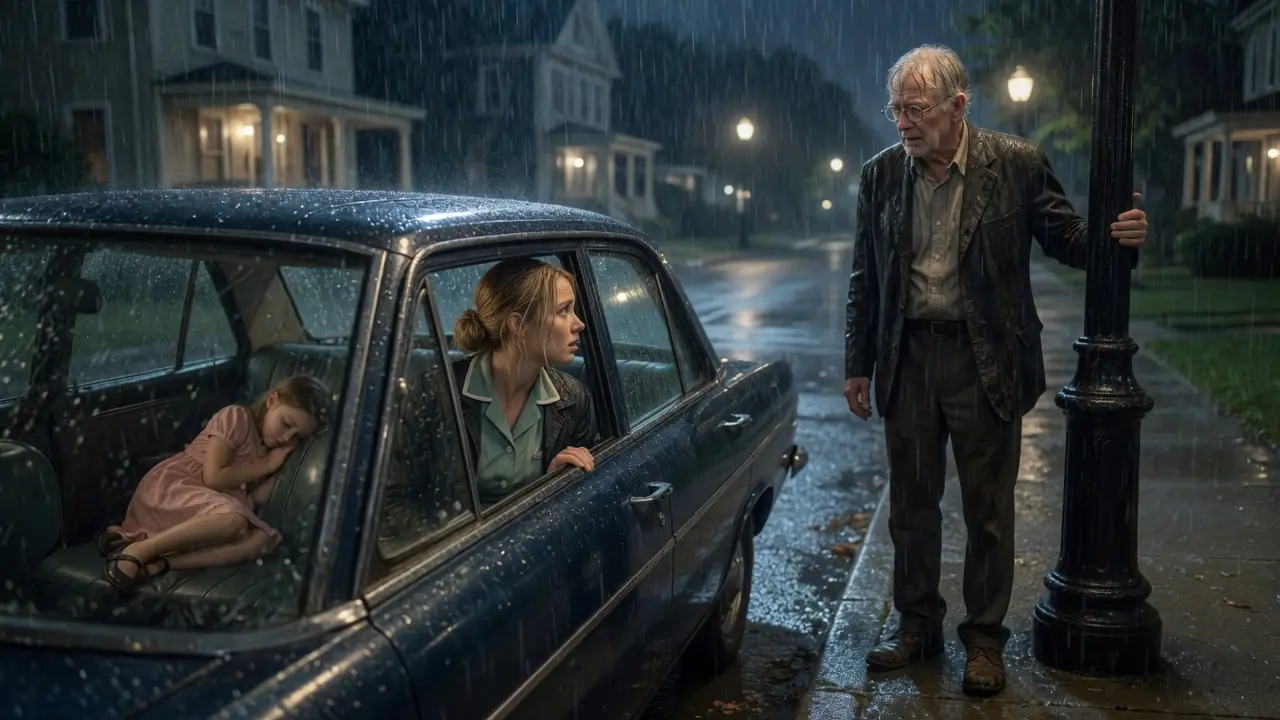
In the back seat, her five-year-old daughter Maya slept curled sideways in her pink dress, one small shoe dangling from her foot.
It was almost midnight.
Laya’s blonde hair was pulled into a tired knot at the back of her neck, and her waitress uniform still smelled faintly of coffee, fryer oil, and the all-night diner where she had spent the last ten hours on her feet.
Her back ached. Her shoulders felt heavy. All she wanted was to get home, carry Maya upstairs, and sleep for a few hours before life asked everything of her again.
Then she saw him.
At first, he was only a shape near the sidewalk, half swallowed by the rain. As Laya slowed, the shape became an elderly man leaning against a lamppost, his soaked wool blazer clinging to his thin frame. He had no umbrella, no coat heavy enough for the weather, and one trembling hand held a phone that was either dead or useless.
Laya’s foot eased off the gas.
She should have kept driving. That was what caution said. She was a single mother alone at night with a sleeping child in the back seat, and the world had taught her not to trust every stranger in the rain.
But then the man’s shoulders shook.
Not just from cold. From exhaustion. From the kind of fear people try to hide when they do not want to become anyone’s burden.
Laya sighed, pulled to the curb, and lowered the passenger window halfway. Rain blew into the car at once.
“You okay out here?” she called.
The man turned slowly, blinking through the water running down his face. His voice was polite, but weak.
“I got turned around,” he said. “My phone died. I thought I could make it on foot, but I am not as young as I used to be.”
Laya studied him for a second.
His shoes were muddy. His face was pale. But there was something dignified in the way he tried to stand straight, even while leaning on the lamppost for balance.
She unlocked the passenger door.
“Get in,” she said quietly. “Let me take you home.”
He hesitated, as if he could not quite believe the offer was real.
Then he nodded once and climbed carefully into the seat. Rainwater pooled on the floor mat beneath him. Laya turned the heater up, though she knew it barely worked, and pulled back onto the road.
For a few blocks, neither of them spoke.
“You did not have to stop,” the man said at last.
“I know,” Laya replied, keeping her eyes on the road. “But I couldn’t just drive past someone’s grandpa melting in the rain.”
A faint laugh escaped him.
“Walter,” he said. “My name is Walter.”
Walter turned carefully and smiled at the little girl curled up under her thin jacket. “She reminds me of someone from a long time ago.”
When he gave his address, Laya’s eyebrows lifted before she could stop herself. It was in one of the wealthiest neighborhoods at the edge of town, a quiet area of gated streets, old brick homes, and lawns that looked like they had never known weeds.
She said nothing.
She followed Walter’s soft directions until they reached a large brick house behind trimmed hedges and glowing porch lights. The rain had not let up. A wide puddle had formed at the foot of the front steps, and Walter was already reaching for the door handle.
“Wait,” Laya said.
She stepped out first, rain soaking through her hair immediately, then hurried around and opened his door. She helped him out, guided him around the puddle, and walked him up the steps with one hand steady under his arm.
At the front door, Walter turned to her.
His eyes were tired, but kind.
“You never asked who I was,” he said.
Laya shrugged. “Didn’t seem important.”
For a moment, Walter looked as though the simple answer had touched something old and tender in him.
“Thank you, Laya.”
She nodded once, then ran back to her car through the rain. When she looked in the rearview mirror, she saw the porch light behind him and the door opening into warmth. Only then did she drive away.
She did not know that one small act of kindness had just changed the direction of her life.
The next morning came far too soon.
Laya had gotten home close to two, carried Maya to bed, peeled off her damp uniform, and slept only a few restless hours before the alarm dragged her back into the day. By 6:45, she was walking Maya to daycare under a pink umbrella, kissing her forehead a little longer than usual at the door.
By the time Laya reached the diner, she was fifteen minutes late.
She came through the back entrance with wet hair clinging to her cheeks and her apron bunched in one hand. The kitchen smelled of bacon grease and burnt toast. Before she could tie the apron around her waist, her manager’s voice cut across the room.
“Carter.”
Laya froze.
Steve Simmons stood near the counter with his arms folded, his mouth already shaped into a scowl. He was the kind of man who liked having authority mostly because it gave him someone to humiliate.
“I warned you,” he said.
“I know. I’m sorry.” Laya rushed forward, breathless. “There was an older man last night. He was lost in the rain, and I couldn’t just—”
Steve lifted one hand. “Save it.”
A few customers turned in their booths.
“You think helping someone gives you a pass to stroll in whenever you want?” he snapped. “This is a job, Carter. Not a charity.”
“I’ve never been late before,” she said quietly. “Please. It was one time.”
“I said save it.” Steve’s voice rose, as if he wanted the whole diner to hear him. “You want to tell sad stories, go tell them somewhere else. You’re done here.”
The words hit her so hard that for a moment she could not speak.
“I’ve worked here four years.”
“Exactly,” Steve said. “And in four years, I’ve seen plenty of people who actually take this job seriously. Hand over the apron.”
Laya’s fingers trembled as she untied it.
She laid it on the counter carefully, refusing to let him see her break. She turned to leave, her face burning, her throat tight.
Steve called after her with a smirk. “Try not to be late to your next charity project.”
Some customers looked away.
One woman in a booth lowered her fork, ashamed to have witnessed it.
But Laya did not notice the elderly man sitting alone in the far corner, watching silently from behind silver-rimmed glasses.
Walter Weston stirred his tea slowly, his gaze fixed on Laya as she walked out of the diner with nothing but her dignity and a broken morning. He had come to thank her. Instead, he had watched her lose her job because she had helped him.
He placed money on the table, far more than the tea cost.
Then he stood and walked out.
Near noon, Laya was home in faded jeans and a gray T-shirt, trying to pretend she was not scared.
Maya colored at the kitchen table, humming softly, unaware that her mother had just lost the job that paid for groceries and rent. Laya rinsed a spoon that was already clean because standing at the sink gave her hands something to do.
Then came a knock.
Firm, polite, unexpected.
Laya dried her hands and opened the door.
A man stood on the porch, tall, early thirties, wearing a navy coat with rain still clinging to the shoulders. His hair was dark, his face clean-cut, and his calm presence made him seem older than he was.
“Miss Thompson?”
“Yes,” she said carefully.
“I’m Julian Weston. Walter is my father.”
It took her a second.
“The man from last night.”
Julian gave a small smile. “That’s the one.”
Laya looked past him, unsure what to expect. “Is he okay?”
“He is, thanks to you.” Julian’s voice softened. “He told me what you did. Then this morning, he saw what happened at the diner.”
Laya’s face tightened with embarrassment. “He saw that?”
“Yes.”
“I didn’t mean to cause a scene.”
“You didn’t,” Julian said. “Your manager did.”
Maya peeked from behind her coloring book.
Julian glanced at her and smiled gently before looking back at Laya. “My father asked me to find you. He wants to invite you and your daughter to lunch. And he also hoped you might consider working with us part-time.”
Laya blinked. “Doing what?”
“Nothing medical,” he said quickly. “He doesn’t want a nurse. He wants someone kind. Someone who will sit with him, make tea, read to him sometimes, remind him to take his medication, keep him company a few afternoons a week.”
“I don’t have credentials for that.”
“You don’t need a degree to make someone feel cared for.”
The apartment went quiet except for Maya’s crayon scratching against paper.
Julian added, “We would pay you properly. Flexible schedule. Three afternoons a week, if that works for you.”
Laya looked at Maya, then at the little stack of bills on the counter.
She had lost her job that morning. Rent was due soon. The fridge was not empty, but it was close enough to make her think before opening it.
Still, it was not only the money that made her consider it.
It was the sincerity in Julian’s voice. No pity. No condescension. Just a door opening where one had closed.
“Three afternoons a week,” Laya said slowly. “I can try.”
Julian’s relief was visible. “Thank you. He’ll be very happy.”
From the kitchen table, Maya raised her hand like she was in school. “Can I come too?”
Laya let out a tired laugh. “We’ll have to ask Mr. Walter.”
Julian looked at Maya warmly. “I have a feeling he already hopes you will.”
That Saturday, Laya and Maya arrived at the Weston home as invited guests.
The house looked grand from the outside, covered in ivy and framed by old trees, but the moment Walter opened the door in a cardigan and soft slippers, it felt less intimidating. His smile was bright and almost childlike.
“You came,” he said.
Julian stood behind him with his sleeves rolled up and a dish towel over one shoulder. The smell of rosemary, roasted chicken, and fresh bread drifted from the kitchen.
“I cooked,” Julian said, sounding slightly self-conscious.
Walter chuckled. “He supervised the oven.”
The dining room had a long oak table, but only four places were set. Fresh flowers sat in a mason jar at the center. Maya climbed into her chair without hesitation, her pink shoes swinging above the floor.
Julian served her first, checking that the food was not too hot before placing it on her plate. Laya noticed the small attentions: the way he filled everyone’s water before his own, the way he pulled Walter’s chair closer without making it seem like help, the way he listened more than he spoke.
Midway through the meal, Walter reached across the table and placed his hand gently over Laya’s.
“You reminded me who I was before the money,” he said.
Laya did not know what to say.
After a moment, she answered honestly. “Sometimes all you can offer is a ride home. But maybe that is everything to someone standing in the rain.”
Walter’s eyes misted.
After lunch, the work began simply.
Laya read aloud from Walter’s favorite book of short stories. She helped him fold linens. She made chamomile tea and sat with him in the sunroom while he talked about his late wife, Eleanor, about raising Julian mostly alone, and about how wealth could fill rooms but not silence.
He listened too.
He listened when Laya talked about Maya’s fear of thunder, the garden she wished she had, and the nights after Maya’s father left when she had sung softly just to keep herself from crying.
Julian came home each evening just as the sun lowered.
He never interrupted. He would pause near the study door, catch Laya’s eye, and ask with a quiet look how the day had gone. She always answered with a small smile.
Then one evening, he heard laughter.
Real laughter.
He stopped in the hallway and looked into the study. Walter was laughing so hard he had one hand pressed to his chest, while Laya read a ridiculous passage from an old book about a stolen canoe and an angry swan. Julian stood there unseen, listening.
His father had not laughed like that in years.
Slowly, the Weston house changed.
Maya began coming after daycare. She brought drawings, pink cupcakes from the corner bakery, and endless questions that Walter answered with the patience of a grandfather.
The house that once felt like a museum became scattered with crayons, small shoes, folded blankets, and the sound of a child singing off-key in the hallway.
Julian found himself waiting for the gate bell.
He wondered what story Laya would read, what drawing Maya would bring, whether his father would laugh again. Something gentle entered the house and settled there, not all at once, but steadily.
It felt dangerous only because it felt like hope.
Then came the bracelet.
It happened on a bright Saturday afternoon when Laya and Maya came to the Weston estate for lunch, not work. Julian had said it would be casual, but the sunroom table was set with cloth napkins, flowers, fresh lemonade, and warm scones under a linen cover.
Maya twirled in her pink dress and ran to Walter, who opened his arms as if she had lived there all her life.
After lunch, Maya wandered into Julian’s study with Walter following slowly behind. The room smelled of old books and cedarwood. On Julian’s desk sat a small wooden box, simple and polished, with tiny etchings along the side.
Maya reached up to touch it.
The lid was loose.
Her fingers slipped.
The box fell.
It hit the floor and cracked open, scattering a string of worn green-blue beads across the hardwood with a sharp, brittle sound.
Walter froze.
Maya gasped. “I didn’t mean to.”
Julian rushed in from the hallway. His steps slowed the moment he saw the beads, the broken string, the cracked box.
He knelt and picked up one bead between his fingers.
His face did not show anger. That almost made it worse. It showed pain, deep and old and suddenly uncovered.
“It’s okay,” he said quietly. “She didn’t know.”
Laya had entered behind him. Her heart sank the moment she saw his expression.
“I’m so sorry,” she whispered, pulling Maya close. “We’ll replace it, or we’ll have it repaired, or—”
Julian shook his head.
“It was my mother’s,” he said, his voice rough. “She made it for me when I turned ten. Her hands were shaking by then, but she told me the stones were strong. She said they would carry what she couldn’t.”
The room became terribly still.
Walter placed a hand on Julian’s shoulder, but Julian only nodded tightly.
“It’s all right,” he said. “Really.”
But the warmth had left his voice.
Laya offered to help clean up. Julian declined with painful politeness. He did not ask them to stay for the food waiting in the sunroom.
That was answer enough.
In the car, Maya looked up at her mother with wet eyes.
“Mommy, did I do something bad?”
Laya pulled over, unbuckled, and hugged her daughter tightly. “No, sweetie. You made a mistake. It was an accident.”
But she knew some accidents still hurt.
That night, she texted Walter.
I think it is best if you find someone else to assist you. Maya did not mean to break it, but I understand what it meant. I am truly sorry.
Walter did not answer right away.
When he finally did, there were only two words.
You matter.
Still, Laya did not return.
For four days, the Weston house became quiet again.
Julian told himself it was better that way. He told himself the bracelet was irreplaceable. He told himself he needed space.
But every afternoon, he found himself looking toward the window at the time Laya and Maya usually arrived.
Walter noticed.
“You’ve been staring out there for twenty minutes,” he said one afternoon.
Julian looked down at his coffee. “Just thinking.”
“About the bracelet?”
Julian did not answer.
“Or about the people who left after it broke?”
That evening, rain tapped gently against Laya’s apartment windows. Maya sat cross-legged on the living room rug, threading plastic beads onto a stretchy string with fierce concentration.
Laya watched from the kitchen doorway.
“What are you making, honey?”
Maya did not look up. “You said we can’t fix the old bracelet.”
“That’s true.”
“But maybe I can make him a new one.” Maya selected a bright yellow bead and pushed it onto the string. “It won’t be shiny like his, but it can still have love in it.”
Laya knelt beside her, eyes soft. “You don’t have to do that.”
Maya’s voice was small. “He looked so sad. I want to make him smile again.”
When the bracelet was finished, it was a messy rainbow loop of mismatched plastic beads. Maya held it up proudly. Then she took a scrap of paper and a purple crayon.
Her letters were large and uneven.
I am sorry I broke your shiny bracelet. I made this one for you. It is not shiny, but it is full of love. Love, Maya, age 5.
Later that evening, Walter came to Laya’s apartment himself.
She opened the door, startled.
“Maya asked me to bring something,” Laya said, handing him a small paper bag. Inside was the bracelet and the folded note.
Walter held it carefully.
“I’ll give it to him.”
Julian was alone in his study when Walter entered and placed the bag on the desk.
“What’s this?” Julian asked.
Walter nodded toward it. “Something from a child who still believes broken things can be made whole.”
Julian opened the note first.
He read every word slowly.
By the time he reached “it is full of love,” his hands were trembling.
Then he lifted the plastic bracelet from the bag. Bright, cheap, imperfect. A child’s apology. A child’s offering. A child’s way of saying she understood sadness, even if she did not yet have the words for it.
Julian sat back in his chair and covered his mouth.
A single tear slid down his cheek.
For years, he had cried because he missed his mother. This time, he cried because love had come into his life again wearing the shape of a little girl with plastic beads and a purple crayon.
It was dark when Julian arrived at Laya’s apartment.
She opened the door, surprised.
“Julian?”
He did not try to make a speech.
“I was angry,” he said. “Not at Maya. Not even really at the bracelet.” He looked down, then back at her. “It mattered, but people matter more.”
Laya’s eyes filled.
“I missed you,” he admitted. “Both of you.”
Small feet padded down the hall.
Maya appeared behind her mother, eyes wide and hopeful.
Julian crouched and pulled the bracelet from his pocket.
“I’m wearing it tomorrow,” he said. “And every day after that.”
Maya’s face lit up.
She threw her arms around his neck.
Laya turned away, but not fast enough to hide her tears.
This time, she was not crying from fear or guilt. She was crying because something that had seemed lost had found its way back.
The rain returned weeks later on a Sunday afternoon, soft and warm against the windows of the Weston estate.
The house no longer felt too large. Maya’s drawings were pinned near Walter’s study. Laya’s favorite mug had a place in the kitchen cabinet. A small basket of toys sat in the sunroom, and no one pretended it was temporary anymore.
That afternoon, Julian, Laya, and Maya sat on a blanket in the backyard under the covered patio, watching clouds move across the sky. Walter sat nearby with a book open on his lap, though he had not turned a page in twenty minutes.
Julian still wore Maya’s plastic bracelet.
It stood out against his watch and button-down shirt, bright and childish and priceless.
Maya leaned her head on his shoulder.
Julian stilled for a second, then gently brushed a strand of hair from her forehead.
“If we stayed here forever,” Maya asked quietly, “would you be my daddy?”
The question landed softly, but it changed the whole air around them.
Laya opened her mouth to gently correct her daughter, but no words came.
Julian turned to Maya.
Her eyes were wide, but certain.
He cupped her cheek with one hand.
“That would be an honor,” he said.
Maya grinned and hugged him tightly.
Laya looked away toward the rain, blinking fast.
Later that evening, Julian drove Laya and Maya home. The streets shimmered under the glow of wet lamps, and Maya fell asleep in the back seat before they reached the apartment.
Julian parked but did not immediately turn off the engine.
“You know,” he said quietly, “you two didn’t just walk into our house. You brought it back to life.”
Laya turned to him. “I think we needed each other more than we realized.”
He nodded, looking at Maya in the rearview mirror.
“See you tomorrow?” Laya asked.
Julian smiled. “I wouldn’t miss it.”
Months passed.
Walter grew stronger, not younger, but steadier. Laya found work that did not leave her exhausted and unseen. Maya began spending weekends at the Weston house, where she helped Walter water plants, asked Julian impossible questions, and insisted everyone taste her imaginary soup made from flower petals and pebbles.
Then, one evening, Walter invited a few friends and relatives to dinner.
The dining room glowed with warm light. The long table was full of food, laughter, and voices. Walter sat at the head of it, watching Julian, Laya, and Maya together with a quiet smile that made him look younger than he had in years.
When the meal was nearly over, Walter tapped his glass gently with a spoon.
The room quieted.
“I know people usually save toasts for holidays and weddings,” he began. “But tonight matters to me. Because my son has found something rarer than wealth.”
He looked at Laya and Maya.
“He has found a family.”
Laya lowered her eyes, overcome.
Julian stood slowly and took her hand.
“You walked into our lives during a storm,” he said. “You helped my father when no one else was there. You brought warmth back to a house that had forgotten how to feel like home.”
Maya sat between them, watching with wide eyes.
Julian continued, voice steady. “You changed our lives, Laya. Let me spend the rest of mine making yours better.”
Maya gasped, then shouted, “Say yes, Mommy!”
The room burst into laughter.
Laya laughed through tears, then nodded because she could not speak.
Julian pulled her close, and Maya wrapped both arms around them, turning the proposal into a three-person embrace. Walter wiped his eyes with a handkerchief he pretended not to need.
A week later, Julian drove Laya and Maya to a modest sunlit house with ivy along the porch railing and a small garden gate. It was not as grand as the Weston estate, but it was warm, bright, and chosen with them in mind.
Julian opened Laya’s door and smiled.
“Get in,” he said softly, echoing the words she had spoken to his father in the rain. “This time, let me take you home.”
Laya smiled through fresh tears. “Does this ride come with snacks and bedtime stories?”
“Only if you sit up front.”
Maya squealed from the back seat. “I call the room with the window!”
They walked up the path together, hand in hand, toward a door that opened not into wealth, not into rescue, but into something better.
A real home.
And all of it had begun on a rainy night when a tired single mother saw an old man standing alone under a streetlight and chose not to drive past.