“Are you alone out here?”
Grace Whitaker stood behind the half-open front door, one hand gripping the brass knob and the other holding back the frightened eight-year-old boy peering around her hip. Snow swept across the porch in white sheets, collecting on the shoulders of the elderly woman standing beneath the weak yellow light. Her gray coat was soaked, her thin shoes were buried nearly to the ankles, and a blue scarf covered most of her silver hair. She carried one worn leather handbag and looked too exhausted even to knock again.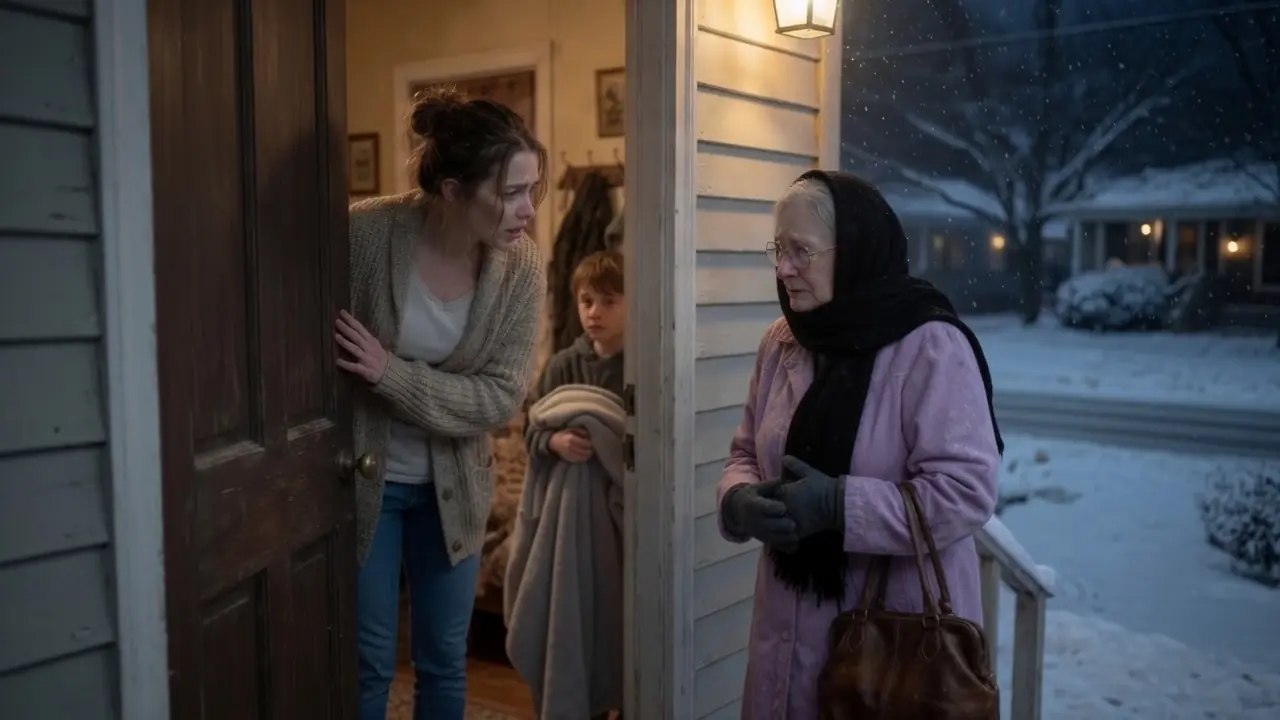
The woman lowered her eyes. “My family said I had become a burden. Then they drove away with everything I owned.”
Grace felt Noah’s fingers tighten around the back of her cardigan. Her first instinct was fear, because single motherhood had taught her to measure every stranger against the safety of her son. Her second instinct was practical: the temperature was already below freezing, the road had disappeared beneath snow, and the woman’s lips were turning blue. Whatever danger existed in opening the door, leaving her outside carried a certainty Grace could not accept.
“Come inside,” Grace said, opening the door wider. “My son and I don’t have much, but you won’t freeze alone.”
The elderly woman stared at her as though kindness had become a language she no longer understood. Tears gathered behind her wire-framed glasses, but she blinked them away and stepped carefully over the threshold. Noah moved backward while still clutching his dinosaur blanket, watching the stranger shake snow from her sleeves. When Grace closed the door against the wind, the woman whispered, “I’ve never seen anyone show such kindness to a complete stranger.”
Grace helped her remove the wet coat and guided her toward the small living room. The house was modest, with worn wooden floors, a couch repaired twice along one seam, and a heating vent that rattled whenever the furnace started. A secondhand Christmas tree stood near the window even though December had passed two weeks earlier. Grace had promised Noah they could keep it until the final paper snowflake fell from its branches.
“My name is Grace,” she said. “This is my son, Noah.”
The woman gave the boy a hesitant smile. “I’m Eleanor.”
Noah studied her soaked clothing, then held out the dinosaur blanket. “It’s the warmest one. The green dinosaur looks angry, but he isn’t.”
Eleanor accepted it with trembling hands. “Thank you.”
Grace led her to the kitchen and filled the kettle. The refrigerator held half a carton of eggs, three carrots, a jar of mustard, and the pot of potato soup she had stretched through two dinners already. She added water, a little milk, and the remaining slice of ham before placing the pot on the stove. Noah watched quietly because he knew enough about their finances to understand when food was being made larger.
Grace worked mornings at a bakery and cleaned offices three evenings a week. Noah’s father had left when the boy was two, sending promises more consistently than money. Grace had stopped waiting for either after the first year. She learned to repair loose cabinet doors, negotiate payment plans, cut her own hair, and smile when Noah asked whether they were poor.
They were not homeless, hungry, or without love, she always told him. They were simply careful.
Eleanor sat at the kitchen table with both hands around a chipped mug of tea. Her eyes moved over the room, pausing on Noah’s school drawings, the jar labeled HEATING BILL, and a photograph of Grace wearing a waitress uniform while holding her newborn son. She asked no intrusive questions, but she noticed everything. Grace recognized the habit because she had developed it too.
“Where did your family leave you?” Grace asked.
“At a service station near the highway.”
“In this weather?”
Eleanor nodded. “My niece said she needed to use the restroom. When I came outside, the car was gone.”
Grace stopped stirring the soup. “Did you call the police?”
“My telephone was in the car.”
“What about the station clerk?”
“The store had closed early because of the storm. I walked until I saw your porch light.”
Grace imagined the elderly woman moving alone along the dark road while snow covered her footprints. Anger rose beneath her fear, hot and immediate. “They abandoned you.”
“They would say I misunderstood.”
“Did you?”
Eleanor looked directly at her. “No.”
Noah climbed onto the chair beside her. “Why would your family do that?”
Grace started to correct him, but Eleanor shook her head. “Because I own something they want, and I refused to give it to them.”
The kitchen became quiet except for the bubbling soup. Eleanor explained that she had lived for forty-six years in a large farmhouse outside Stillwater. Her husband had died six years earlier, and her only son, Daniel, worked overseas managing medical construction projects. After Eleanor fell and broke her wrist, her niece Rebecca moved into the house to “help.”
At first, Rebecca cooked meals and drove Eleanor to appointments. Then she began opening mail, questioning expenses, and telling neighbors that Eleanor was becoming confused. She brought documents transferring the farmhouse and surrounding acreage into a family trust controlled by Rebecca and her husband. When Eleanor refused to sign, affection became irritation, and irritation became threats.
“They told me Daniel wanted the transfer,” Eleanor said. “But my son would have called me himself.”
“When did you last speak to him?” Grace asked.
“Three weeks ago. Rebecca said the international connection had become unreliable.”
Grace did not believe that explanation. “Do you know his number?”
“Not from memory. It was stored in my telephone.”
“Do you know anyone else we can call?”
“My attorney. His number is inside my handbag, but I’m afraid Rebecca searched it.”
Eleanor opened the worn bag and removed a wallet, a handkerchief, a small pill case, and a photograph of a younger man beside her. The inner pocket had been cut open, leaving loose threads where something had been removed. Her identification and bank cards were gone.
Grace placed the soup bowls on the table. “You can stay tonight. In the morning, we’ll call the police and find your attorney.”
“I cannot bring this into your home.”
“It’s already here.”
“You have a child.”
“That’s why I’m not sending someone’s mother back into a storm.”
Eleanor’s face folded briefly beneath the weight of those words. She lowered her head and pressed the handkerchief to her eyes. Noah reached across the table and pushed the larger piece of bread toward her without speaking. Grace pretended not to notice that he had kept only the crust.
After dinner, Grace prepared the couch with two pillows and every spare blanket she owned. Eleanor protested until Noah informed her that guests were required to accept blankets because “Mom gets bossy about freezing.” That drew the first genuine laugh from the elderly woman. It was quiet and rusty, like a door opening after years without use.
The storm worsened near midnight.
Wind struck the windows while tree branches scraped against the roof. Grace lay awake in her bedroom, listening for unfamiliar movement from the living room. She hated feeling suspicious of a woman who appeared so vulnerable, but Noah’s safety came before politeness.
At one in the morning, she heard Eleanor speaking softly.
Grace left the bed and found her standing near the window, staring into the snow. The dinosaur blanket covered her shoulders, and a folded piece of paper rested in her hand. She looked smaller than she had at the kitchen table.
“I didn’t mean to wake you,” Eleanor said.
“You didn’t.”
“That is a kind lie.”
Grace leaned against the doorway. “Are you afraid they’ll come here?”
“I’m afraid they’ll hurt someone who helped me.”
“Rebecca doesn’t know where you are.”
“She knows how to make people afraid of me. By tomorrow, she may tell the police I wandered away because I’m confused.”
Grace crossed her arms. “Then we tell them first.”
Eleanor looked toward Noah’s closed bedroom door. “You are very brave.”
“No. I’m tired and worried about next month’s gas bill.”
“That doesn’t sound brave.”
“Brave people in stories never seem to calculate whether courage will make them late for work.”
Eleanor smiled faintly. “Real courage probably checks the clock.”
Grace walked closer. “What is on the paper?”
“A letter I began writing to Daniel after Rebecca moved in. I hid it inside the lining of my bag.”
“Then he needs to see it.”
“He deserves to know I tried to reach him.”
“You’ll tell him yourself.”
Eleanor looked at Grace for a long moment. “I hope so.”
Morning arrived beneath a sky the color of steel. Grace woke at six and found the living room empty. The blankets had been folded neatly on the couch, Eleanor’s wet coat was gone, and the front door stood closed but unlocked.
Panic struck immediately.
Grace pulled on boots without socks and rushed onto the porch. Snow covered the yard, but a trail of shallow footprints led toward the road. No vehicles were visible through the trees.
“Mom?”
Noah stood behind her in pajamas and one slipper.
“Go inside.”
“There’s a letter.”
A white envelope rested beneath the porch lantern, protected from the snow by the overhanging roof. Noah picked it up before Grace could stop him. Written across the front in careful handwriting were the words:
FOR GRACE AND NOAH WHITAKER
Inside were three pages and an old brass key taped to the final sheet.
Grace read aloud.
Dear Grace,
I left before my problems became another weight on your shoulders. You shared food you could barely spare and gave me a blanket your son clearly loved. You did not ask whether I was wealthy, important, or able to repay you. You saw an old woman freezing and opened your home.
I have not felt safe in months, but last night I did.
Grace paused because her vision had blurred.
Noah pressed closer. “Keep reading.”
The key belongs to a safe-deposit box at North River Bank. My attorney’s name is Samuel Price. The number is written below. Inside the box are copies of my property deeds, medical records, and the original power-of-attorney documents Rebecca tried to replace.
Please call Samuel before contacting anyone else. Tell him Eleanor Mercer is alive, competent, and asking for Daniel.
The final paragraph was written more shakily.
Do not mistake this letter for repayment. Kindness is not a debt. But if the truth protects me, I hope it may also open a fair door for the woman who protected a stranger.
Thank you for reminding Noah what goodness looks like.
Grace read the attorney’s number twice, then reached for her phone.
Samuel Price answered on the third ring.
The moment Grace said Eleanor’s name, his voice changed. “Where is she?”
“She left before dawn.”
“Is she safe?”
“I don’t know.”
Samuel asked Grace to remain inside and not contact Rebecca. He explained that Daniel Mercer had been searching for his mother for eleven days. Rebecca told him Eleanor had entered a private memory-care facility and could not receive international calls while adjusting to treatment. No facility matching the description existed.
Thirty minutes later, two police vehicles entered Grace’s driveway.
Samuel arrived behind them in a dark sedan, accompanied by a tall man in a wrinkled coat whose face carried several sleepless nights. Before he introduced himself, Grace knew he was Daniel. He had Eleanor’s eyes.
“My mother was here?” he asked.
Grace handed him the letter.
Daniel read the first page while standing in the entryway. His hands began trembling near the sentence about the highway service station. By the time he reached the final paragraph, tears had fallen onto the paper.
“I should have come home sooner.”
Grace shook her head. “You believed someone who had access to her phone and house.”
“I heard something was wrong in her voice weeks ago. I let Rebecca tell me it was medication.”
“Regret won’t find her.”
Daniel looked up. “You’re right.”
Security footage from a gas station seven miles away showed Eleanor entering a warming shelter shortly after sunrise. She had walked nearly two miles from Grace’s home before a county snowplow driver offered her a ride. Police found her there drinking coffee beneath a donated blanket.
Daniel reached her first.
Grace watched from a distance as he crossed the shelter and knelt before his mother. Eleanor touched his face with both hands, as if confirming he was real. Daniel buried his head against her shoulder and cried without caring who watched.
Rebecca and her husband were arrested that afternoon.
Investigators found Eleanor’s identification, bank cards, phone, and unsigned property-transfer documents inside their vehicle. Messages revealed they planned to claim Eleanor had become mentally incompetent and place her in a facility once the farmhouse was transferred. Abandoning her during the storm was meant to frighten her into cooperation, but they had not expected her to reach anyone.
Grace gave a formal statement.
She described Eleanor’s physical condition, her clear memory, and the details she provided about her home and attorney. Noah also spoke to a child-services interviewer and proudly explained that Eleanor knew the angry dinosaur blanket was actually kind. The interviewer wrote it down with a straight face.
Three weeks passed before Grace saw Eleanor again.
By then, the storm had melted, the roads were clear, and Grace had returned to balancing work, bills, and Noah’s school schedule. She expected a thank-you card, perhaps a telephone call. She did not expect Daniel’s car to stop outside the bakery where she worked.
Eleanor entered first, wearing a dark blue coat and walking with a polished cane. Daniel followed carrying a leather folder. Grace removed her apron and met them near the back table.
“You look better,” Grace said.
“I feel like myself again.”
Noah, who was completing homework in a corner booth, ran toward her. Eleanor opened her arms, and he hugged her carefully.
“Did you find your son?”
“I did.”
“Was he mad?”
“At himself mostly.”
Daniel smiled sadly. “Children are direct.”
“They save time,” Grace said.
Eleanor asked the bakery owner whether they could speak privately. When they were seated, Daniel placed the folder on the table. Grace’s shoulders tightened immediately.
“If this is a check, I can’t accept it.”
“It is not,” Eleanor said.
“Money can still hide inside folders.”
Daniel almost smiled. “My mother warned me you would say that.”
The Mercer farmhouse was not merely a residence. Eleanor and her late husband had spent decades operating a small nonprofit that provided temporary housing for widowed seniors, displaced women, and families recovering from financial crises. After her husband’s death, the program weakened because Eleanor could no longer manage residents, maintenance, and partnerships alone.
Rebecca had encouraged her to close it.
“She said people only came because they wanted something,” Eleanor explained. “Then I met you.”
Grace looked at the folder but did not touch it.
Daniel opened the first page. Inside was a job description for a resident-services coordinator. The role included a salary, health insurance, predictable weekday hours, and a small two-bedroom cottage on the property at below-market rent.
“You’re offering me a house because I made soup?” Grace asked.
“No,” Eleanor replied. “I’m offering you a ninety-day paid trial because you made careful decisions under pressure, protected your child, recognized elder abuse, and treated me with dignity when you believed I had nothing.”
“I’ve never managed a housing program.”
“You have managed hunger, work schedules, childcare, debt, emergencies, and a household alone,” Daniel said. “Those skills are not invisible simply because no company gave them official names.”
Grace read every page.
The position required real work, training, documentation, and performance reviews. If she failed the trial, the arrangement ended without penalty. If she succeeded, the nonprofit board would vote on a permanent contract.
It was not charity.
It was a fair door.
“I need time,” Grace said.
Eleanor nodded. “Take it.”
Noah leaned across the table. “Does the cottage have a porch?”
Daniel checked the property sheet. “A small one.”
“Can angry dinosaurs visit?”
“I believe they are welcome.”
Grace laughed before she could stop herself.
She accepted the trial three days later.
The work was difficult. Grace coordinated medical transportation, negotiated with utility companies, helped residents replace stolen documents, and created emergency plans for winter storms. She made mistakes, asked questions, and refused to pretend compassion could replace clear boundaries.
Within ninety days, resident complaints decreased and three local organizations agreed to provide food, legal support, and childcare referrals. Grace earned the permanent position based on documented results. Eleanor remained chair of the nonprofit, but she gave Grace authority rather than treating her as a grateful recipient.
The cottage became home.
Noah’s dinosaur blanket remained on the couch, ready for visitors. Grace planted herbs beside the porch, and Eleanor visited every Sunday for soup. Daniel came when his work allowed, though he transferred most of his projects closer to Minnesota so his mother would never again face danger through distance.
One snowy evening a year later, Grace stood in the doorway while a frightened young mother held a sleeping child beneath her coat. The woman apologized repeatedly and said she had nowhere safe to go.
Noah appeared behind Grace carrying the dinosaur blanket.
Grace opened the door wider.
“Come inside,” she said. “You won’t freeze alone.”
Across the room, Eleanor watched with tears in her eyes.
A year earlier, she had arrived believing she had become a burden that family could discard. Grace had sheltered her without knowing her name, her property, or what opportunity might follow. That single night did not create a debt between them.
It created proof.
Proof that strangers could become protectors.
Proof that accepting help did not erase dignity.
And proof that the smallest porch light could guide someone back to the life others had tried to steal.