The clock on the cracked kitchen wall read 3:47 a.m.
Aaliyah Brooks sat alone at her small kitchen table in rural Kentucky, counting the last few dollars she had left to survive.
Three wrinkled one-dollar bills. Four quarters. Two dimes. A nickel.
Some pennies she did not even bother counting because pennies had become more like insult than money.
Outside, a freezing winter night pressed against the thin walls of her isolated home, turning every breath near the windows into a pale mist. Wind moved through the cracks in the old farmhouse with a sound like someone whispering warnings through their teeth. The heater had stopped working two nights ago, and the little electric space heater near the kitchen gave off more worry than warmth.
Her two-year-old son, Micah, slept in the next room wrapped in three old blankets and wearing his blue winter hat with bear ears. He did not know the power bill was overdue. He did not know an eviction notice sat folded under the sugar jar because Aaliyah could not bear to see it every time she walked past the counter. He did not know his mother had eaten only toast that day so he could have scrambled eggs and the last cup of milk.
Children slept through collapse if their mothers stood between them and the sound.
Aaliyah was twenty-eight years old, a Black single mother with tired eyes, strong hands, and a heart that had been forced to become older than her face. She had worked since she was fifteen. Grocery cashier. Nursing home aide. House cleaner. Gas station clerk. Kitchen helper. Overnight stocker. Any job that paid honestly, she took it.
But honest work did not always mean stable work.
Two weeks earlier, the small diner where she worked mornings had closed without warning after the owner fell behind on taxes. Then the cleaning company that gave her evening shifts cut her hours. That night, at 3:39 a.m., her phone lit up with the message she had been dreading.
Aaliyah, we’re sorry, but the Harper office contract is canceled effective immediately. No shifts available this week. We’ll call if something opens.
Another job gone.
Another door closed.
Another polite message that meant her son might soon sleep in a car.
Aaliyah placed the phone face down and pressed both hands against her eyes.
She did not cry.
Not because she was strong in the pretty way people liked to talk about. She was simply too tired. Tears required energy, and all of hers had already gone into keeping one small child warm.
The house had belonged to her grandmother, Odessa Brooks, though belonged was a generous word for a place the bank still had a claim on and the county kept threatening to tax beyond mercy. Odessa had raised Aaliyah there after Aaliyah’s mother disappeared into addiction and bad men. The farmhouse sat off a two-lane road outside town, surrounded by fields, an old barn, and woods that looked endless at night.
Odessa had died four years ago, leaving behind three things: the house, a Bible full of notes, and a recipe box.
That recipe box sat on the kitchen table now.
Aaliyah opened it with fingers stiff from cold.
Inside were cards written in Odessa’s careful hand.
Chicken stew for hard days.
Cornbread for company.
Red beans when money is low.
Honey cakes for church.
Pepper soup for sickness.
Odessa had believed food could not fix everything, but it could hold people together long enough for God to work on the rest.
“Baby,” she used to tell Aaliyah, “when the world gets mean, feed somebody. A full stomach can remind a person they are human.”
Aaliyah used to laugh at that.
Now she stared at the cards and wondered whether one old family recipe could save her life.
For three days, she had been thinking about cooking meals to sell. There was a truck stop twelve miles away, and drivers were always complaining that the food there tasted like cardboard and regret. If she could borrow money for ingredients, maybe she could make Odessa’s chicken stew and cornbread, sell plates, and earn enough to keep the house a little longer.
But borrowing required someone willing to lend.
Aaliyah had no one left for that.
Her best friend had moved to Atlanta. Her church had already helped with the electric bill once. Her landlord, Mr. Granger, had started every recent phone call with “I’m sorry, but business is business.” Micah’s father, Terrence, had not sent child support in five months and had blocked her number when she asked.
So Aaliyah sat in the freezing kitchen with three dollars, four quarters, two dimes, a nickel, and a recipe box.
She was about to close it when she heard something outside.
At first, she thought it was the wind.
Then came another sound.
Low.
Mechanical.
Growing louder.
Aaliyah lifted her head.
Motorcycles.
Not one.
Many.
She stood slowly and moved toward the window, careful not to step on the loose floorboard near the sink. At first, all she saw was darkness and the weak yellow glow of the porch light swinging in the wind. Then headlights appeared through the snow, one after another, turning off the county road and crawling toward her driveway.
Aaliyah’s heart began to pound.
Nobody came out that way at night by mistake.
She grabbed her phone.
No signal.
The storm had knocked it out again.
She crossed the kitchen, checked the lock on the back door, then hurried to the small bedroom where Micah slept. He stirred when she touched his blanket.
“Mommy?” he mumbled.
“Sleep, baby,” she whispered. “Mama’s right here.”
The motorcycles stopped outside.
Engines rumbled, then cut off one by one until the silence afterward felt even louder. Aaliyah stood in the hallway, holding the old fireplace poker she kept near the door. She listened to boots crunch through ice on the porch steps.
Then came a knock.
Not hard.
Not threatening.
Three knocks.
Aaliyah did not move.
The knock came again.
A man’s voice called through the door.
“Ma’am? We don’t mean any harm. We got riders freezing out here. Road’s blocked. One man’s hurt. We saw your light.”
Aaliyah closed her eyes.
Fear and conscience fought inside her.
She was alone with a toddler.
There were men outside her house in leather vests.
Dozens of them, from the sound of it.
Every warning she had ever been given rose in her mind.
Do not open the door.
Think of your child.
Nobody is coming to save you if this goes wrong.
Then another voice came, weaker this time.
“Please, ma’am. Just need shelter from the wind.”
Aaliyah looked toward Micah’s room.
She thought of her grandmother.
When the world gets mean, feed somebody.
She moved to the front door and looked through the small side window.
There were bikers on her porch, their leather jackets dusted white with snow, faces red from cold, beards frozen at the edges. Behind them, motorcycles lined the driveway all the way to the road. Some riders were standing bent over against the wind. Others were helping a man who appeared unable to stand on his own.
The man closest to the door was older, maybe in his sixties, with a gray beard, dark skin, and a faded vest over layers of winter clothing. His hands were raised where she could see them.
Aaliyah cracked the door open with the chain still on.
“How many?” she asked.
“Twenty-five,” the man said. “We were riding back from a charity run in Knoxville. There’s a pileup on the main road. We tried to cut through and got caught in the storm. My name is Vernon Malone. Folks call me Preacher.”
Aaliyah’s eyes moved over his vest.
There were patches, road names, symbols she did not understand. Some riders behind him wore different patches, but the old man’s vest carried a name she recognized from movies, whispers, and fear.
Hells Angels.
Her grip tightened on the poker.
Vernon saw her eyes change.
“I know what that vest makes people think,” he said quietly. “But tonight we’re just cold men asking not to die in a ditch.”
Behind him, a younger biker groaned and slumped against another man.
Aaliyah looked at the man’s lips.
Blue.
Not pale.
Blue.
She slid the chain free.
“Bring the hurt man in first,” she said.
Vernon stared at her for half a second, as if he had expected the door to close.
Then he turned.
“Rico! Get Danny inside. Slow. Boots off at the mat if you can feel your feet enough to care.”
The first five bikers entered like men stepping into church. Big bodies, heavy boots, leather, snow, cold air, and the smell of gasoline and winter followed them into the little front room. Aaliyah pointed to the old rug near the couch.
“Lay him there.”
The injured man, Danny, was young, maybe twenty-five. His cheek was cut, his hands shook violently, and one boot was soaked through. Aaliyah knew enough from her nursing home work to recognize dangerous cold.
“Get his wet jacket off,” she said. “Not fast. Carefully. You, close that door. You, find blankets in the hall closet. Don’t touch the room on the left. My son is sleeping.”
The bikers obeyed.
That surprised her.
Men rarely obeyed women in kitchens unless they had already decided she mattered.
Within ten minutes, her small house held twenty-five freezing bikers.
They stood shoulder to shoulder in the living room, kitchen, hallway, and mudroom, trying not to drip on anything, trying not to frighten her, trying to shrink bodies that could not shrink. Some were white. Some Black. Some Latino. Some old enough to be grandfathers and some barely older than boys. They looked rough, exhausted, and half-frozen.
Aaliyah kept the fireplace poker within reach anyway.
Vernon noticed and nodded once.
“Smart.”
“I didn’t ask for approval.”
“No, ma’am.”
Aaliyah pulled blankets from closets, old quilts from trunks, towels from the laundry basket, and socks from the clean pile she had folded but not put away. She heated water on the stove and made coffee so strong it could have lifted a truck. The house, cold minutes ago, became crowded with breath, steam, and the low murmur of men trying not to complain.
Micah woke when someone dropped a boot.
Aaliyah rushed to his room, but he was already sitting up, rubbing his eyes.
“Mommy, who’s loud?”
“Nobody bad,” she whispered. “Some people got stuck in the storm.”
“People?”
“Yes, baby.”
He looked toward the hallway.
“Dinosaurs?”
Despite everything, Aaliyah almost laughed.
“No. Bikers.”
Micah frowned sleepily.
“Bikers cold?”
“Very cold.”
He thought about that, then picked up his stuffed giraffe and held it out.
“This can help.”
Aaliyah kissed his forehead.
“You stay in bed. I’ll tell them.”
When she came back, Vernon was kneeling beside Danny, checking his breathing while another rider rubbed warmth into the young man’s hands.
“My son offered his giraffe,” Aaliyah said.
The room went quiet.
Then Vernon smiled, and something in his hard face softened.
“That’s generous.”
“He’s two. Giraffe is serious business.”
One of the younger riders, a thin white man with red ears, whispered, “Tell him thanks.”
Aaliyah nodded.
She moved to the stove and looked at the pot from dinner.
Barely enough chicken stew remained for one woman and a child.
Not enough for twenty-five men.
She looked at Odessa’s recipe box still sitting on the table.
Then she looked at the bikers.
Some had their hands around coffee mugs, trying to stop shaking. Some sat on the floor because there were no chairs. One man had removed his gloves, revealing fingers swollen and cracked from cold. Another had blood frozen near his eyebrow.
Aaliyah opened the pantry.
Rice.
Two cans of beans.
A bag of cornmeal.
Onions.
Half a sack of potatoes.
Three carrots.
A small chicken carcass she had saved for broth.
Flour.
Salt.
Hot sauce.
Not much.
But Odessa had built meals from less.
“Preacher,” she said.
Vernon looked up.
“Yes, ma’am?”
“You got any food in those bikes?”
A few men exchanged glances.
Vernon turned.
“Empty your saddlebags. Anything edible goes on the table. Don’t be proud.”
Within minutes, the kitchen table held a strange offering.
Jerky. Crackers. Two cans of chili. A pack of tortillas. A bruised apple. Half a bag of peanuts. Instant coffee. A chocolate bar. Three protein bars. One sad gas station sandwich wrapped in plastic.
Aaliyah stared at it.
Then she tied her hair back.
“All right,” she said. “We can work with this.”
Vernon watched her.
“You planning to feed us?”
“I’m planning to keep you from passing out on my floor.”
“That’s feeding us.”
She pointed at two riders.
“You and you. Wash your hands. Peel potatoes. Thin. Don’t waste what we can eat.”
They moved at once.
She pointed to another.
“You. Cut onions.”
“I cry when I cut onions,” he said.
“You’ll cry warm.”
The room laughed softly, the first sound that did not carry fear.
Aaliyah turned to a tall biker with a gray ponytail.
“You know how to stir without burning the bottom?”
“My ex-wife said no.”
“Tonight you learn.”
In that little kitchen, with snow striking the windows and twenty-five motorcycles buried outside beneath white wind, Aaliyah Brooks cooked like her grandmother had taught her.
She stretched broth with water and patience. She browned onions in the last spoonful of oil. She crushed crackers to thicken the stew. She added beans, potatoes, rice, bits of jerky, chili, hot sauce, and spices from Odessa’s tins. She made cornbread in two pans, then another when someone found more cornmeal in a saddlebag because apparently one biker carried cornmeal for reasons no one wanted to explain.
The smell filled the house slowly.
Chicken.
Pepper.
Cornbread.
Coffee.
Warmth.
The bikers stopped looking like strangers in leather and started looking like tired men waiting for a bowl.
Aaliyah served Danny first.
He was awake now, wrapped in three blankets, face still pale but less blue. Vernon lifted his head while Aaliyah spooned stew into his mouth because his hands were shaking too hard to hold the bowl.
Danny swallowed, closed his eyes, and whispered, “Ma’am, that tastes like being alive.”
Aaliyah looked away quickly.
Compliments were dangerous when a woman was too tired. They could make her cry.
She served the rest in mismatched bowls, mugs, and one measuring cup when the dishes ran out. The men ate sitting on the floor, on the steps, against the wall, anywhere there was room. No one complained. No one asked for more before everyone had some. When the cornbread came out, they passed pieces carefully from hand to hand like communion.
Vernon sat at the kitchen table across from Aaliyah after everyone had eaten.
“You saved us tonight,” he said.
“I gave you stew.”
“No,” he replied. “You opened the door.”
She looked down at her hands.
They were cracked from soap, cold, and work.
“I almost didn’t.”
“I wouldn’t have blamed you.”
“I would have blamed me.”
Vernon studied her.
“You here alone?”
Aaliyah’s walls rose immediately.
“With my son.”
“I didn’t mean anything by it.”
“People rarely do until they do.”
He accepted that.
“Fair.”
Aaliyah looked toward the living room, where bikers were sleeping upright, leaning against walls, wrapped in quilts her grandmother had sewn. Micah had fallen asleep again, and no one had gone near his room.
She exhaled.
“I lost my job tonight.”
Vernon’s expression changed.
“The message came right before you knocked. I was sitting here counting dollars like they might multiply if I stared hard enough.”
“I’m sorry.”
Aaliyah laughed softly, without humor.
“Everybody’s sorry. Landlord’s sorry. Jobs are sorry. Bills are sorry. Sorry doesn’t keep the lights on.”
“No,” Vernon said. “It doesn’t.”
She touched the recipe box.
“My grandmother used to cook for church suppers. People still talk about her stew. I was thinking maybe I could sell plates at the truck stop.”
“You cook like that, you could sell plates anywhere.”
She looked at him sharply.
“Don’t say kind things just because I helped you.”
“I don’t waste kind things.”
Something in his voice made her believe him.
“Your grandmother teach you?” he asked.
Aaliyah nodded.
“Odessa Brooks. She could feed fifty people with one chicken and make them thank God for it.”
Vernon smiled.
“Sounds like my mama.”
For a moment, they sat in the dim kitchen like two people who had known different hardships but recognized the same language.
Then Vernon reached into his vest and pulled out a small notebook. The pages were bent and stained from weather.
“What are you doing?” Aaliyah asked.
“Writing down your name.”
“Why?”
“So I don’t forget who opened the door.”
“I didn’t do it for anything.”
“I know.”
“That means no debt.”
Vernon looked at her.
“Some debts ain’t chains. Some are reminders.”
Aaliyah did not know what to say to that.
By dawn, the storm had weakened.
The road was still dangerous, but the wind had calmed enough that the bikers could assess the damage. A few bikes would not start. One had a cracked line. Danny needed a clinic. Vernon made calls from the porch once the signal returned.
Aaliyah expected them to leave quickly.
Men who received help often hurried away from the discomfort of owing it.
But they did not.
They cleaned.
One rider washed every dish. Another swept the floor. Two shook out wet rugs on the porch. A woman rider named Marisol fixed the loose cabinet door with a pocket tool while muttering that “no cabinet should live like this.” Someone stacked firewood by the back door. Someone else repaired the latch on the mudroom entrance.
Aaliyah watched them with growing confusion.
“You don’t have to do all that.”
Marisol looked up from the cabinet.
“Honey, twenty-five bikers slept on your floor. We’re not leaving it looking like a bear fight.”
By eight o’clock, the riders were ready.
Danny was stable enough to ride in a support truck that one of the men had called from town. The motorcycles started one by one, rumbling outside the farmhouse like thunder returning to the road.
Vernon stood on the porch with his helmet under one arm.
Micah, awake now, stood behind Aaliyah holding his giraffe.
Vernon crouched.
“Thank you for offering backup, little man.”
Micah hid his face in Aaliyah’s leg.
Vernon smiled, then looked up at her.
“You got a phone?”
“Sometimes.”
“Number?”
She hesitated.
He did not push.
Finally, she gave it to him.
He wrote it carefully in the notebook.
“Take care of that recipe box,” he said.
Aaliyah folded her arms.
“You take care of that young man. Danny.”
“I will.”
He stepped off the porch, then stopped.
“Ms. Brooks.”
“What?”
“If a lot of noise comes this way later, don’t be scared.”
She frowned.
“What does that mean?”
Vernon only smiled.
“It means the road carries word fast.”
Then he rode away with the others, the line of motorcycles disappearing down the thawing road until the sound faded into the gray morning.
Aaliyah stood on the porch for a long time after they left.
The house was quiet again.
Too quiet.
Micah tugged her sleeve.
“Bikers gone?”
“Yes, baby.”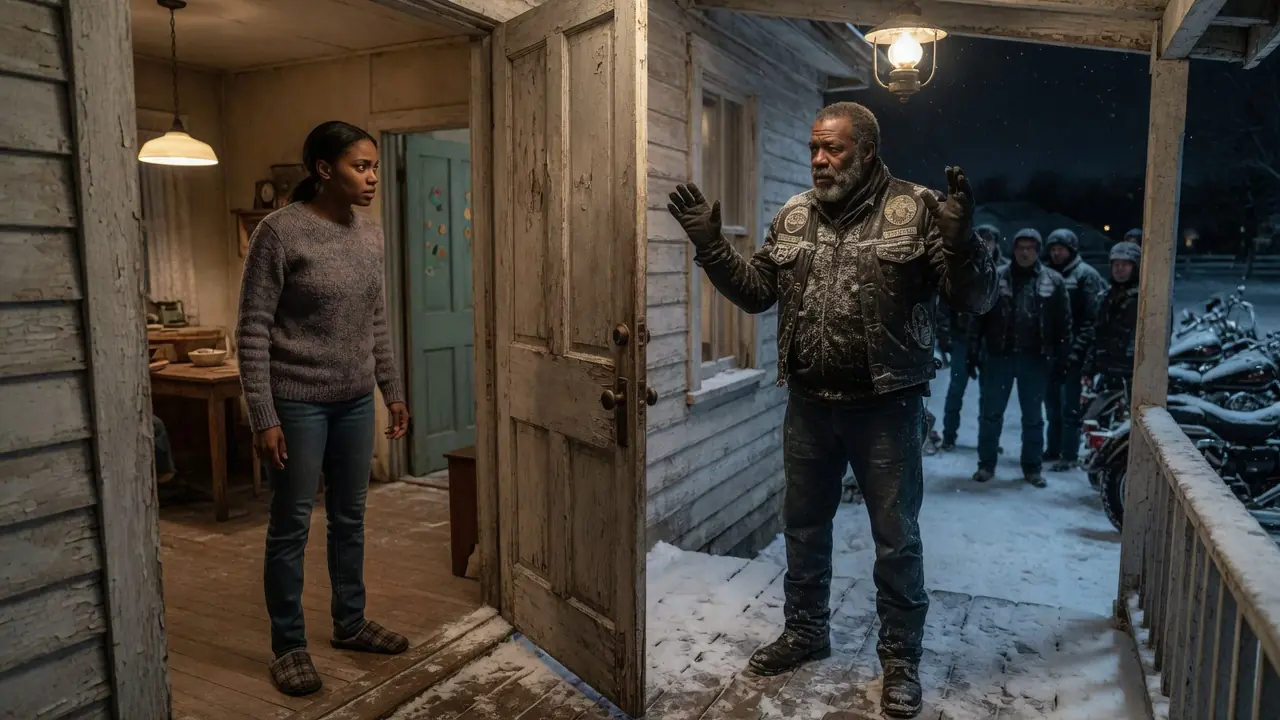
“They cold?”
“Not anymore.”
Inside, the kitchen smelled of coffee, cornbread, and twenty-five men who had somehow left it cleaner than they found it. The floor was dry. The dishes were stacked. The cabinet closed properly for the first time in six months.
Then Aaliyah noticed something on the table.
A pile of cash.
Not huge.
But to her, enormous.
Twenties, tens, fives, and crumpled singles weighed down by Vernon’s coffee mug. Beside it was a note written in blocky handwriting.
For the stew. Not charity. Payment overdue to Odessa’s granddaughter.
Aaliyah sat down hard.
She counted it twice.
Nine hundred and forty-three dollars.
Enough to pay part of the power bill.
Enough to buy groceries.
Enough to breathe for a week.
She covered her mouth and cried then, quietly, while Micah patted her knee with sticky fingers and said, “Mommy sad?”
“No,” she whispered. “Mommy’s just tired.”
She did not know that the money on the table was only the beginning.
At 10:18 a.m., the first motorcycle returned.
Aaliyah heard it before she saw it.
Then another came.
Then another.
Then the sound grew until it no longer sounded like motorcycles but like weather.
Deep.
Rolling.
Endless.
Aaliyah stepped onto the porch with Micah in her arms.
At first, she thought Vernon had returned with the twenty-five riders.
Then she saw the road.
Motorcycles stretched as far as she could see.
Lines of them.
Hundreds.
Then more behind them.
Black leather, chrome, flags, patches, helmets, headlights, engines. Riders came over the hill and down the road in a slow, disciplined procession. They filled the shoulder. They filled the field entrance. They parked along the fence line and down the lane, careful not to block emergency access because someone had clearly thought of everything.
Aaliyah’s breath caught.
Micah clapped his hands over his ears.
“Loud!”
“I know, baby.”
The first group stopped outside her house.
Vernon rode at the front.
Beside him was an older white man with a long silver beard and a Hells Angels patch across his vest. Behind them rode men and women from different chapters and clubs, some local, some clearly from farther away, all moving with strange quiet respect once the engines shut off.
The silence after 1,500 motorcycles stopped outside her home felt impossible.
Aaliyah stood frozen on the porch.
Vernon removed his helmet and walked toward her.
She found her voice.
“What did you do?”
He looked almost guilty.
“I made a few calls.”
“A few?”
The silver-bearded man stepped forward.
His face was weathered, stern, and deeply lined, but his eyes were gentle.
“Ma’am,” he said, removing his gloves. “My name is Harold Bishop. Riders call me Saint. We heard twenty-five of ours got caught in the freeze and a woman with a baby opened her home instead of turning them away.”
Aaliyah could not speak.
Harold looked past her at the little house.
“We also heard you lost your job and you cook like the Lord personally seasoned the pot.”
Vernon coughed.
“I may have said that.”
Aaliyah stared at them.
“I didn’t tell you that so you could—”
“Help?” Vernon asked.
She went silent.
Harold smiled faintly.
“Ms. Brooks, last night you sheltered twenty-five freezing bikers. This morning, riders came to return respect.”
He turned and raised one hand.
The line behind him moved.
Not chaotically.
Organized.
A pickup truck pulled forward first. Then another. Then a van. Then a trailer.
Aaliyah watched as riders began unloading supplies.
Firewood.
Groceries.
Diapers.
Blankets.
A new space heater.
Toolboxes.
Lumber.
Roofing materials.
A generator.
Canned goods.
Bags of rice.
Flour.
Cornmeal.
Oil.
Chicken.
Cases of water.
One woman brought children’s winter clothes in Micah’s size. Another carried a box of toys, then stopped at the porch and asked Aaliyah’s permission before giving anything to him. A group of riders walked toward the broken fence. Another group gathered near the old barn. Two men in work jackets inspected the roof. A woman with a clipboard introduced herself as a contractor from Knoxville.
Aaliyah stepped down from the porch.
“No,” she said, overwhelmed. “Wait. I can’t pay for this.”
Harold turned.
“No one asked you to.”
“I don’t take charity.”
A ripple moved through nearby riders, not mocking, but understanding.
Vernon approached gently.
“Then don’t call it charity.”
“What else is it?”
He nodded toward the house.
“Investment.”
“In what?”
“In the woman who fed men when she had almost nothing.”
Harold added, “We’re not here to make you small, Ms. Brooks. We’re here because last night you showed us the size of your heart. People like that should not be crushed by a broken heater and a landlord’s notice.”
At the word landlord, Aaliyah’s face changed.
Vernon noticed.
“How much do you owe?”
“That’s not your business.”
“No. It isn’t.”
She expected him to push.
He did not.
That made it harder.
Tears rose hot in her eyes.
“Two months,” she whispered. “Plus late fees.”
Harold looked at the woman with the clipboard.
She wrote something down.
Aaliyah shook her head.
“No. Please. I can’t owe strangers.”
Harold’s voice softened.
“Then owe us stew.”
She blinked.
“What?”
“Preacher says you wanted to sell plates. We’re going to help you start.”
Aaliyah looked from him to Vernon.
Vernon grinned.
“I told you the road carries word fast.”
By noon, her yard had become something between a work site, a church picnic, and a motorcycle rally.
The noise was unbelievable, but no one was careless. Riders directed traffic at the road. Others set up tables. Someone brought portable heaters. A group of women took over one side of the yard to organize groceries. A retired electrician fixed two bad outlets in the kitchen and scolded the wiring like it had personally disappointed him.
Aaliyah tried to help everywhere at once until Marisol gently took her by the shoulders.
“Baby, stop spinning.”
“This is my house.”
“Then stand still long enough to tell us what it needs.”
That question undid her.
No one had asked what the house needed.
People had asked what she owed, what she could pay, when she would move, why she was behind, why she chose bad men, why she did not have help, why she looked tired.
No one had stood in front of her broken life and asked what it needed.
Aaliyah looked at the roof.
“The laundry room leaks.”
A man raised his hand.
“Roof crew.”
“The heater’s broken.”
“HVAC crew,” Marisol called.
“The back steps are loose.”
“Carpentry.”
“The pantry is empty.”
“Already fixing that.”
Aaliyah laughed through tears.
“You people are insane.”
Vernon smiled.
“Frequently.”
Micah became the unofficial king of the day.
A rider named Big Lou gave him a small toy motorcycle after asking Aaliyah first. Nadine, a grandmother with tattooed hands and purple glasses, made him a sandwich cut into triangles. Harold Bishop let him sit on a parked motorcycle while holding him securely and making engine sounds with his mouth until Micah shrieked with laughter.
Aaliyah stood nearby, watching her son laugh in the middle of 1,500 people she had been afraid to let through the door the night before.
Fear had not been foolish.
But neither had mercy.
That afternoon, a black SUV pulled up slowly at the edge of the road.
Mr. Granger, the landlord, stepped out.
He was a thin white man in his fifties who always wore shiny shoes and spoke in a tone that made every sentence feel like a warning. He stopped when he saw the motorcycles, the workers, the supplies, and the crowd outside the house.
Aaliyah’s stomach dropped.
Of course he would come today.
Of course humiliation would arrive with witnesses.
He walked toward the porch holding a folder.
“Aaliyah,” he said, forcing a smile. “I see you’ve got company.”
Vernon moved slightly, but Aaliyah lifted a hand.
“I’ve got it.”
Mr. Granger looked around uneasily.
“I sent notices. We need to discuss your overdue rent.”
The yard grew quieter.
Not silent.
But attentive.
Aaliyah wiped her hands on her jeans.
“I know.”
“You’re two months behind, plus late fees. I’ve been patient, but patience doesn’t pay my bills either.”
Before Aaliyah could answer, Harold Bishop stepped forward.
“How much?”
Mr. Granger looked at him.
“Excuse me?”
“How much does she owe?”
“That’s between me and my tenant.”
Aaliyah surprised herself by speaking.
“Three thousand four hundred with the fees.”
Harold turned to a rider near the table.
The rider handed him an envelope.
Harold held it out to Mr. Granger.
“Here’s four thousand. That covers the balance and next month. You’ll write a receipt.”
Mr. Granger stared at the envelope.
Aaliyah’s cheeks burned.
“I said no charity.”
Harold looked at her.
“And I said stew.”
Mr. Granger reached for the envelope quickly.
Vernon stepped closer.
“Slow.”
The landlord froze.
Vernon smiled without warmth.
“You heard the man. Receipt.”
Mr. Granger’s hand shook as he opened his folder, pulled out a receipt book, and wrote. Harold took the receipt and handed it to Aaliyah.
Then Mr. Granger cleared his throat.
“Well, that settles the immediate issue. But this property still needs—”
“A lot of repairs,” said the woman with the contractor clipboard.
Mr. Granger looked at her.
She held up her business card.
“Dana McBride. Licensed contractor. We’re documenting all habitability issues today. Roof leaks, unsafe steps, faulty heat, electrical concerns. Since rent is paid current, I’m sure you’ll want your property brought to legal standard.”
Mr. Granger’s face paled.
“I’ve been meaning to address—”
“Good,” Dana said. “We’ll send a written list.”
Harold smiled politely.
“Community support is powerful, Mr. Granger. Keeps everybody honest.”
Mr. Granger left ten minutes later looking as if he had aged five years.
Aaliyah stood on the porch holding the receipt.
For the first time in months, the paper in her hand did not feel like a threat.
By evening, the repairs were not finished, but the house had changed.
The heater worked.
The roof had a temporary patch and a scheduled repair.
The pantry was full.
The back steps were sturdy.
The woodpile was stacked high.
The old barn had been swept and cleared.
And on the kitchen table sat a plan.
Not a fantasy.
A plan.
Dana’s sister owned a food truck that needed a weekend cook. Harold knew a man who ran events for motorcycle rallies across the state. Vernon had already called three truck stops, two churches, and a veterans’ hall. Marisol had created a handwritten menu using Odessa’s recipes.
Odessa’s Stew Plates.
Chicken stew.
Cornbread.
Red beans and rice.
Honey cakes.
Coffee.
Aaliyah stared at the paper.
“This is too much.”
Vernon shook his head.
“No. This is one door opening.”
“What if I fail?”
Harold answered this time.
“Then you adjust and cook again.”
Aaliyah looked toward the living room, where Micah slept on the couch with his giraffe, surrounded by warmth she had not been able to afford that morning.
“What if people don’t come?”
Vernon looked outside at the rows upon rows of motorcycles.
“They already did.”
For the first time, Aaliyah laughed fully.
Not from politeness.
Not from nerves.
From a place inside her she thought poverty had buried.
The next Saturday, she sold her first plates from a borrowed food truck parked near the truck stop.
The line began with bikers.
Then truckers joined.
Then locals who had heard the story.
Then a reporter from a small paper who asked Aaliyah how it felt to have 1,500 Hells Angels and allied riders show up at her house. Aaliyah did not like the way the question made it sound like a spectacle, so she looked straight into the camera and corrected it.
“They did not show up to scare anyone,” she said. “They showed up because twenty-five of them needed help, and the next morning, they decided my son and I did too.”
The reporter asked if she had been afraid that night.
Aaliyah looked toward Vernon, who was carrying a tray of cornbread badly but sincerely.
“Yes,” she said. “But I was more afraid of becoming the kind of person who could leave somebody freezing outside.”
Her business grew slowly at first, then quickly.
Odessa’s Kitchen became known along the highway. Truckers recommended it over radio channels. Bikers made it a regular stop. Church ladies bought honey cakes for Sunday gatherings. Nurses from the county hospital ordered stew on cold nights. Eventually, Aaliyah rented a small kitchen space in town.
Six months after the storm, Mr. Granger offered to sell her the farmhouse.
He said it was because he was tired of managing old properties.
Aaliyah suspected it had more to do with Dana McBride’s repair list and the way motorcycles still occasionally appeared in her driveway whenever contractors were late.
Harold connected her with a credit union.
Vernon helped her review the papers.
Marisol watched Micah during the signing.
Aaliyah bought the house.
Not all at once.
Not easily.
But legally, honestly, with her name on the deed and Odessa’s recipe box sitting in her bag like a witness.
One year after the freezing night, riders returned to the farmhouse.
Not 1,500 this time.
Only a few hundred.
Aaliyah stood in the yard beside a new sign fixed to the old barn.
ODESSA’S KITCHEN
Hot Meals. Honest Prices. Nobody Leaves Cold.
Micah, now three, wore a tiny leather-style vest Marisol had made from denim. On the back was a patch shaped like a bowl of stew with steam rising from it. He ran between folding tables while riders pretended to be too tough to let a toddler boss them around.
Vernon stood beside Aaliyah, holding a cup of coffee.
“You ever think about not opening that door?” he asked.
She looked at him.
“Every day.”
“Regret it?”
She watched Micah climb onto Harold Bishop’s lap while the old biker made motorcycle sounds again.
“No.”
Vernon nodded.
“Me neither.”
Aaliyah looked at the house.
The roof no longer leaked. The heater worked. The pantry stayed stocked. The eviction notice was gone from under the sugar jar, replaced by a photograph of Odessa smiling in her church hat.
“I thought that night was going to break me,” Aaliyah said.
Vernon sipped his coffee.
“Maybe it broke something else.”
“What?”
“The part of your life that made you think you had to survive alone.”
Aaliyah did not answer at first.
The winter wind moved softly across the field, not cruel tonight, just cold enough to make the stew smell better. Riders laughed. Children played near the barn. People lined up for cornbread. The farmhouse glowed with warm light behind her.
She thought of herself at 3:47 a.m., counting dollars with numb fingers.
She thought of the knock.
The fear.
The door.
The twenty-five freezing bikers.
The 1,500 riders who came the next morning not to intimidate, but to honor a kindness most of the world would never have seen.
Then she thought of Odessa.
When the world gets mean, feed somebody.
Aaliyah smiled.
“Maybe Grandma was right,” she said.
Vernon looked at her.
“About what?”
She picked up a tray of cornbread and carried it toward the long line of waiting riders.
“A full stomach can remind a person they’re human.”
Vernon laughed.
And under the wide Kentucky sky, outside the little farmhouse that had once felt like the edge of ruin, Aaliyah Brooks fed everybody.
Not because she had nothing to lose anymore.
But because she had learned what her grandmother had known all along.
Sometimes survival begins with a recipe.
Sometimes rescue arrives wearing leather and road dust.
Sometimes the people the world tells you to fear become the people who stand between you and losing everything.
And sometimes, at 3:47 in the morning, when your life feels one breath from collapsing, a knock at the door is not the end.
It is the beginning.