Maya Reynolds had twelve dollars in her purse, half a tank of gas, and a seven-year-old daughter waiting at after-school care across town. She also had a manager who believed kindness was useful only when wealthy customers could see their own names attached to it. At twenty-nine, Maya had become skilled at hiding exhaustion behind a polished smile. She could carry three plates on one arm while calculating whether she had enough money left for milk.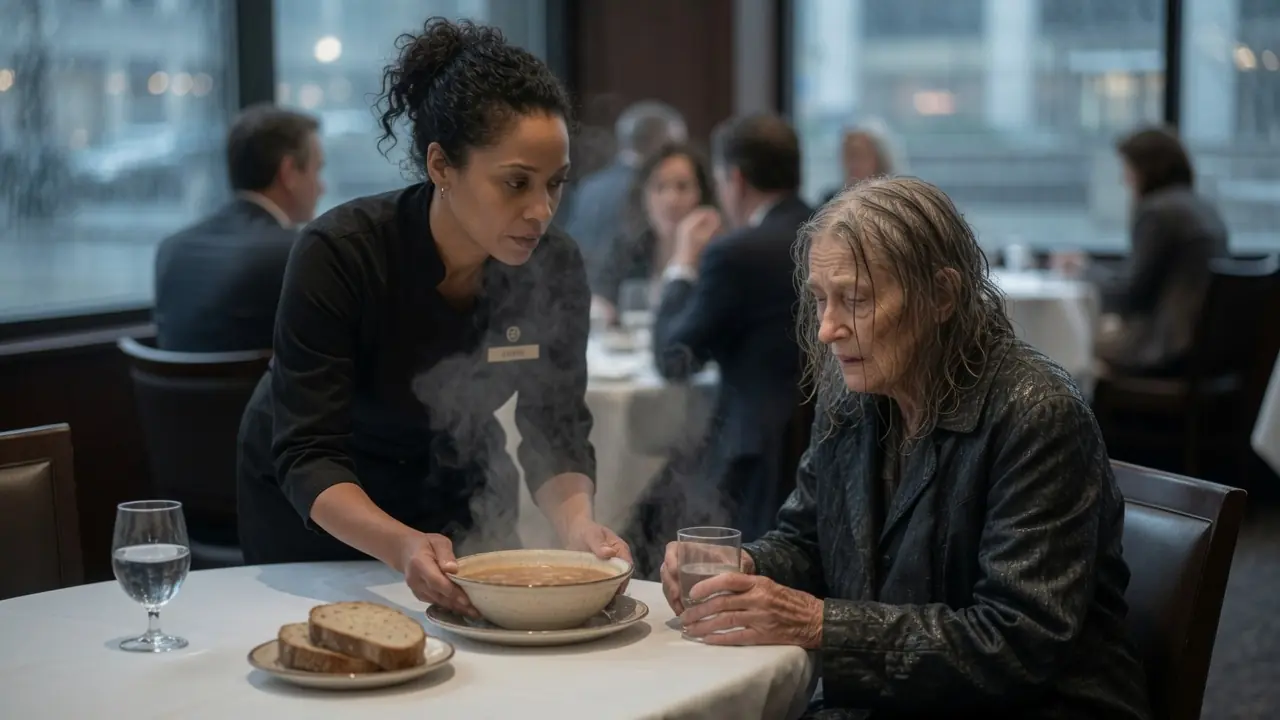
The restaurant was called Beaumont House, though it occupied the ground floor of a modern hotel rather than an old mansion. Its white marble entrance, brass-framed doors, and dark wood dining room made customers feel richer before they even opened the menu. Lunch for two could cost more than Maya spent on groceries in a week. Employees were expected to treat every guest as though the restaurant had been waiting all day for that person alone.
Maya had worked there for fourteen months. She arrived early, stayed late, and accepted every extra shift offered because her daughter, Lily, needed asthma medication that insurance did not fully cover. Maya’s former husband had disappeared shortly after Lily’s second birthday and sent money only when legal notices frightened him. She had stopped planning her life around promises that rarely arrived.
That December afternoon, freezing rain struck the windows hard enough to sound like handfuls of gravel. Pedestrians hurried along the Chicago sidewalk with scarves pulled over their faces, while black cars stopped beneath the hotel awning and released customers in expensive coats. Inside, the pendant lights glowed above spotless tables. The room smelled of roasted garlic, fresh bread, and beef simmered in red wine.
Maya noticed the elderly woman because everyone else was pretending not to.
She sat alone at a small table near the entrance, still wearing a knitted gray hat and a thin coat darkened by rain. Two plastic shopping bags rested beneath her chair, stuffed with clothing, newspapers, and what appeared to be an old framed photograph wrapped in a towel. Her shoes were splitting near the toes. Water dripped from the hem of her skirt onto the polished floor.
The hostess had not seated her.
The woman had simply entered behind a departing couple and lowered herself into the nearest chair before anyone stopped her. She was perhaps seventy-eight, though hunger and cold made age difficult to judge. Her face was pale, her lips almost colorless, and both hands shook around an empty water glass. She looked at the bread baskets passing through the room but never asked for one.
Several customers began whispering.
A man near the window called a server over and asked why a homeless person had been allowed inside. His wife pressed a napkin beneath her nose as though poverty carried a smell stronger than roasted food. Another guest requested a different table, claiming the woman made him uncomfortable. Nobody asked whether she was sick.
Maya approached slowly.
“Why are you sitting here shaking without food or a warm place to go?” she asked.
The woman looked up with frightened blue eyes. “The shelter was full, and I haven’t eaten since yesterday.”
Her voice was barely louder than the rain.
Maya crouched beside the table so the woman would not need to look up at her. “What’s your name?”
“Evelyn.”
“Evelyn what?”
The woman hesitated. “Grant.”
Maya recognized nothing in the name. She only noticed that Evelyn’s fingers were too stiff to hold the glass properly. When Maya touched the back of her hand, the skin felt dangerously cold. She stood and walked toward the kitchen before caution could argue with her.
Chef Daniel Cho was ladling tomato-basil soup into shallow white bowls. Maya asked whether one serving had been entered incorrectly and might otherwise be discarded. Daniel glanced toward the dining room, saw Evelyn through the service opening, and understood immediately. He filled a deeper bowl and placed two thick slices of bread beside it.
“You didn’t get this from me,” he said.
Maya carried the food to Evelyn.
“Eat this,” she said. “I’ll pay for it.”
Evelyn’s eyes filled with tears. “They’ll fire you for helping someone like me.”
“Then eat before they decide.”
Evelyn lifted the spoon, but her hand shook so violently that soup spilled onto the saucer. Maya sat beside her and steadied the bowl while she drank. The first few spoonfuls disappeared quickly, almost painfully. Then Evelyn slowed, as though forcing herself to remember that food should be tasted rather than feared.
Maya brought tea with honey and a clean towel for her wet hair. She asked the maintenance worker to find a blanket from the hotel’s emergency cabinet. He returned with one but warned that their manager, Richard Sloan, had already noticed. Maya wrapped the blanket around Evelyn’s shoulders anyway.
Richard appeared beside the table less than a minute later.
He was forty-four, tall, carefully groomed, and permanently concerned with how the dining room looked from the entrance. His suit fit perfectly, but his smile never reached his eyes. He looked at Evelyn’s bags, the soup, and Maya sitting beside her. His expression tightened as though Maya had placed garbage on a banquet table.
“What is this?” he asked.
“A customer needed food,” Maya replied.
“She is not a customer.”
“She is eating.”
“Who authorized the meal?”
“I did.”
Richard looked around the room, aware that several guests were watching. “Stand up.”
Maya remained beside Evelyn. “She’s too cold to go outside.”
“That is not our responsibility.”
“She could collapse.”
“Then call a shelter.”
“She said the shelters are full.”
Richard lowered his voice. “You are making paying guests uncomfortable.”
Maya looked toward the man who had complained. He avoided her eyes while cutting into a steak that cost sixty-eight dollars. Evelyn held the bread with both hands, protecting it against her chest as though someone might take it away. The image made Maya’s fear turn into anger.
“She’s not threatening anyone,” Maya said.
“She is damaging the atmosphere.”
“She’s hungry.”
“That does not make her our guest.”
Maya stood slowly. “Then charge the soup to me.”
Richard laughed without humor. “With what money?”
The question struck harder because he knew exactly how little she earned. He had denied her request for more hours twice, then called her unreliable when Lily’s school sent her home with a fever. He used poverty as a leash, confident that Maya would tolerate anything because she could not afford to leave.
“I have enough for soup,” Maya replied.
Richard took the plate from the table.
Evelyn flinched.
Maya reached out and caught the edge before he could remove it. Soup moved dangerously close to spilling across Evelyn’s lap. For several seconds, manager and waitress held opposite sides of the dish while the room fell silent.
“Let go,” Richard said.
“No.”
“You are refusing a direct instruction.”
“I’m stopping you from taking food from an elderly woman who hasn’t eaten since yesterday.”
His face reddened. “Go to my office.”
“I’m staying until she finishes.”
“You’re finished here.”
Maya’s hand loosened around the plate.
Richard set it down, not from compassion but because every customer now seemed interested in the confrontation. He announced that Beaumont House maintained strict standards and that employees could not distribute products without authorization. Then he told Maya to remove her apron and leave immediately.
Evelyn pushed the bowl away.
“No,” she whispered. “Please don’t lose your job because of me.”
Maya looked at the older woman’s frightened face and understood that Evelyn had spent too many years believing her survival caused trouble for others. Maya sat down again, moved the soup closer, and placed the spoon in her hand. She would not allow Richard’s cruelty to become another reason Evelyn blamed herself.
“Finish eating,” Maya said.
Richard called hotel security.
Two guards arrived but slowed when they saw the scene. One of them, a middle-aged man named Marcus Hill, had a mother close to Evelyn’s age. He quietly asked Richard whether police or medical assistance might be more appropriate. Richard ordered him to escort both women outside.
Marcus refused to touch Evelyn.
Instead, he called emergency services and reported an elderly woman showing signs of hypothermia. That decision made Richard furious, but the arrival of paramedics prevented him from forcing Evelyn back into the storm. They wrapped her in a heated blanket and checked her blood pressure.
It was dangerously low.
The paramedics recommended hospital transport. Evelyn refused at first because she believed she would be charged money she did not have. Maya told her the emergency department would treat her and promised to keep her bags safe. Only then did Evelyn agree.
As the stretcher passed through the restaurant, several customers lowered their eyes.
The man who had complained about her presence left a fifty-dollar bill beneath his plate, though he did not apologize. A woman near the bar walked to Maya and pressed cash into her hand. Maya returned it, saying the money should go with Evelyn’s bags to the hospital. Richard watched every gesture with visible disgust.
“You are no longer employed here,” he said after the ambulance left.
Maya removed her apron.
Her hands shook as she folded it because reality had begun replacing anger. She had eleven days until rent was due. Lily’s inhaler needed replacing the following week. The daycare center charged twenty dollars for every fifteen minutes a parent arrived late, and Maya was already behind schedule.
Chef Daniel came from the kitchen and placed an envelope in her coat pocket. “Your final tips,” he said.
Richard ordered him back to work.
Daniel remained long enough to look Maya directly in the eyes. “You did the right thing.”
The words did not solve anything.
They kept her from collapsing.
Maya collected Evelyn’s plastic bags and left Beaumont House through the front doors. The freezing rain had turned to wet snow, and her cheap shoes allowed water inside within half a block. She rode in a taxi she could not afford because carrying the bags on two buses would make her too late for Lily.
Her daughter sat alone beside the after-school supervisor when Maya arrived.
Lily wore a purple coat and held a drawing of two stick figures beneath an enormous yellow sun. She ran toward her mother, then stopped when she saw the plastic bags. Her curious brown eyes moved from the wet clothing inside them to Maya’s face.
“Whose things are those?”
“A woman named Evelyn.”
“Why do you have them?”
“Because she needed to go to the hospital.”
Lily studied her mother. “Did something bad happen?”
Maya forced a smile. “Something hard happened.”
At home, Maya heated canned soup and divided it between two bowls. Lily noticed that her mother’s portion was smaller and moved several noodles across with her spoon. Maya nearly cried at the gesture. She had spent years trying to hide scarcity from her daughter, but children often understood what adults worked hardest to conceal.
After Lily fell asleep, Maya opened Evelyn’s bags to make sure nothing wet would be ruined.
There were two dresses, three sweaters, socks, toiletries, and several envelopes tied with string. The framed photograph showed a much younger Evelyn standing beside a smiling Black man in front of a small roadside motel. Between them stood two boys, perhaps ten and thirteen, both wearing matching red sweaters.
On the back, someone had written: The first Grant Motor Lodge, 1978.
Maya set the picture aside.
One envelope contained newspaper clippings. The first article described Thomas and Evelyn Grant opening a motel on Chicago’s south side after banks repeatedly refused them loans. Another showed the couple beside a newly completed hotel in Detroit. A later headline announced the death of hospitality entrepreneur Thomas Grant and the appointment of his eldest son as chief executive.
The Grant family owned Grant Meridian Hotels.
Maya recognized the name immediately.
The company controlled luxury hotels, apartment towers, and restaurants throughout the Midwest. Beaumont House operated inside a Grant Meridian property. The woman Richard called damaging to the atmosphere was connected to the family owning the building.
Maya looked at the photograph again.
Evelyn had not merely shared the founder’s surname.
She was the founder.
The final envelope held legal papers, medical bills, and a handwritten letter. Maya did not read the private document, but the first visible line contained a name: To my sons, if either of you still remembers I exist. She returned everything carefully and called the hospital.
Evelyn had been admitted overnight.
Maya explained that she had the patient’s belongings and left her number with the nurse. She considered calling Grant Meridian directly, but something in Evelyn’s letter stopped her. If the family had allowed their mother to become homeless, informing them without permission might place her in greater danger.
The next morning, Maya woke before sunrise and began searching for jobs.
By eight, she had submitted applications to three diners, two hotels, and a grocery store. At eight thirty, the hospital called. Evelyn was stable and asking for Maya.
Maya took Lily to school, then rode two buses to the hospital.
Evelyn looked smaller beneath white sheets. Her gray hair had been washed, and a nurse had found warm clothing from the donation closet. She smiled when Maya entered, then looked toward the plastic bags with visible relief.
“You kept everything.”
“Of course.”
“Did you open them?”
“Only enough to dry the clothes.”
Evelyn looked at her carefully. “Then you know who I was.”
“I know your name is connected to Grant Meridian.”
“Was.”
Maya sat beside the bed.
Evelyn explained that she and Thomas built the company together. He handled construction, financing, and negotiations, while she designed rooms, trained staff, and managed their first properties. When Thomas died, the company shares were divided between Evelyn and their two sons, Malcolm and David.
Grief weakened her judgment.
Malcolm persuaded her to sign temporary management authority while she recovered. The document transferred more control than he admitted. David supported him because both sons believed their mother was too emotional to remain involved.
“They said I needed rest,” Evelyn said. “Then they made sure I had nothing else.”
Her home was moved into a trust controlled by the company. Her personal accounts were restricted after Malcolm produced a physician’s statement claiming cognitive decline. The physician had never examined Evelyn properly.
She challenged everything in court.
The fight lasted three years and consumed most of the cash she could access. Evelyn eventually won the right to an independent medical evaluation, which found no dementia, but by then her sons had isolated her from friends, sold her personal property, and closed the apartment they had arranged for her.
She spent months moving between shelters and temporary rooms.
“Why didn’t you go to the police?” Maya asked.
“Because they had papers.”
“Wrong papers.”
“Official papers make wrong things look respectable.”
Evelyn turned toward the window.
“The company still tells people I am receiving private care in Connecticut.”
Maya felt anger return.
“Your sons know you’re homeless?”
“Malcolm knows I disappeared from the apartment. David may believe whatever his brother tells him.”
“What do you want to do?”
Evelyn looked at her.
“I want my name back.”
Maya found an attorney through a women’s legal-aid organization. Her name was Naomi Bennett, and she agreed to visit the hospital after reviewing several of Evelyn’s documents. Naomi immediately recognized evidence of guardianship abuse, fraudulent asset transfer, and possible elder exploitation.
More importantly, Evelyn still owned voting shares that her sons had failed to eliminate.
Those shares had been placed in escrow during the legal challenge.
If Evelyn proved competence and coercion, she could reclaim control over a significant part of Grant Meridian.
Naomi began filing emergency motions.
Maya returned home that evening and found two missed calls from Richard Sloan. She ignored them. A third call came from the hotel’s human-resources office requesting a meeting about her termination.
She expected a formal attempt to protect the restaurant.
Instead, the woman on the phone sounded frightened.
Security footage of Richard removing the soup had circulated online after a customer posted it. The video showed Maya defending Evelyn, Richard firing her, and paramedics reporting signs of hypothermia. Thousands of people had shared it overnight.
Beaumont House faced public outrage.
Richard claimed Maya staged the event for attention.
The hotel wanted her statement.
Maya agreed to speak only if Evelyn’s privacy was protected. She refused to reveal the older woman’s identity, medical condition, or connection to Grant Meridian. The human-resources director offered temporary reinstatement.
Maya declined.
She would not return while Richard remained in control.
The following morning, black SUVs began arriving outside Beaumont House.
The first three stopped beneath the hotel awning shortly before lunch. Then two more occupied the curb, followed by a private security vehicle and a news van. Employees gathered near the windows while customers photographed the line of dark vehicles.
Richard walked into the lobby believing corporate executives had come to manage the scandal.
He straightened his suit.
The first SUV door opened.
David Grant stepped out.
He was fifty-two, tall, gray at the temples, and visibly shaken. Behind him came Naomi Bennett and two court-appointed investigators. Malcolm emerged from another vehicle with his own attorneys, anger already visible across his face.
The final car brought Evelyn.
She wore a navy coat provided by the hospital and walked with a cane, but she entered the building under her own strength. Maya walked beside her, holding no uniform and wearing no name badge. When the hotel staff recognized the homeless woman from the video, the lobby became completely silent.
Richard stared.
Malcolm crossed the floor.
“Mother, this is not the place.”
Evelyn stopped several feet from him. “You made every place unsafe for me.”
He lowered his voice. “We can discuss this privately.”
“You discussed my life privately for three years.”
David stepped forward with tears in his eyes.
“Mom?”
Evelyn looked at her younger son.
He appeared genuinely shocked by her condition. Malcolm had told him she lived in a private residence outside Hartford and refused family contact. David had signed documents without questioning them because accepting his brother’s story was easier than confronting their mother’s disappearance.
“I thought you were receiving care,” David whispered.
“I needed a son.”
The words broke him.
Malcolm attempted to end the confrontation, but Naomi produced a court order. A judge had frozen several Grant Meridian accounts, restored Evelyn’s communication access, and authorized an independent review of all transactions connected to her shares and personal property.
Company security no longer answered solely to Malcolm.
The SUVs carried directors, auditors, investigators, and attorneys.
Not rescuers.
Witnesses.
Evelyn turned toward Richard.
“This is the manager who fired Maya?”
He began explaining that restaurant policy prohibited unauthorized service and that he had been protecting guests. Evelyn listened until he finished.
“My husband and I opened our first motel because Black travelers were often refused rooms,” she said. “We promised our company would never confuse wealth with human worth.”
Richard’s face reddened.
“I did not know who you were.”
“That is why your behavior matters.”
He glanced toward Malcolm for protection.
Malcolm looked away.
The board suspended Richard immediately. A later review found repeated complaints about his treatment of elderly guests, low-income customers, and employees with family emergencies. He had buried the complaints by describing them as misunderstandings.
His employment was terminated.
The investigation into Grant Meridian lasted four months.
Auditors found that Malcolm had diverted Evelyn’s dividends, sold property from her private trust, and paid the physician who described her as cognitively impaired. He also used company money to fund the legal strategy isolating her.
Malcolm resigned before the board could remove him.
Criminal charges followed for fraud, elder exploitation, and falsification of medical records. David surrendered his board position temporarily and entered mediation with his mother. Evelyn did not excuse his silence, but she believed his failure came from cowardice rather than deliberate cruelty.
“You believed what was comfortable,” she told him.
“Yes,” he answered.
“That choice left me hungry.”
“I know.”
Forgiveness did not arrive quickly.
Responsibility did.
Evelyn returned to an apartment she legally owned but refused to move back into her former mansion. She said too many rooms had learned how silence sounded. Grant Meridian restored her shares, repaid the diverted income, and appointed an independent elder-rights advocate to the board.
Maya received an offer as director of guest dignity and employee welfare for the hotel group.
She nearly rejected it.
“I’m a waitress,” she told Evelyn.
“You are a woman who understood hospitality better than the people running my hotels.”
Maya accepted only after negotiating clear authority, childcare support for hourly employees, and a policy allowing staff to provide emergency food without risking termination. Every hotel created a discreet meal system for people in immediate need. Employees were trained to respond to vulnerability with safety procedures rather than humiliation.
Chef Daniel became culinary operations supervisor for the Chicago property.
Marcus Hill was promoted to hotel security manager.
Neither advancement was called a reward.
It was recognition of the judgment they had shown before knowing Evelyn’s identity.
Maya did not become wealthy overnight. Her salary improved, Lily received reliable medical coverage, and rent stopped feeling like a monthly threat. More importantly, Maya no longer had to teach her daughter that survival required accepting cruelty.
One evening, Lily asked Evelyn why so many black cars had come to the restaurant.
Evelyn smiled sadly.
“Because powerful people often arrive late.”
“Mom came first,” Lily said.
“Yes.”
“Did she save you?”
Evelyn looked toward Maya.
“She saw me.”
Years later, Beaumont House kept one table near the entrance unreserved during winter. Anyone who needed warmth could sit there, receive soup, and speak with a trained outreach worker without being photographed or publicly identified. A small brass plaque beneath the table carried no names.
It read: Dignity is served before the meal.
Maya passed it each morning on her way to the corporate offices upstairs. Sometimes she remembered the twelve dollars in her purse, the shaking bowl, and the moment Richard reached for Evelyn’s food. She had believed that decision destroyed the only security she possessed.
Instead, it revealed which kind of security had never been worth keeping.
The black SUVs made people pay attention.
But they were not the most important arrival in the story.
The most important arrival had been a frightened elderly woman entering from the freezing rain with everything she owned inside two plastic bags. She had sat at a table where no one wanted her and met one tired single mother willing to risk being poor rather than become cruel.
Maya gave Evelyn soup.
Evelyn later gave Maya an opportunity.
Neither gift created ownership or debt.
Each simply told the other woman the same thing in a different language.
You still matter.