The first thing Adrian Cole noticed was not the flashing lights.
It was the timing.
He had been driving west for forty-three minutes along County Route 18, a narrow two-lane road cutting through dry West Texas ranch country, when the patrol cruiser appeared in his rearview mirror.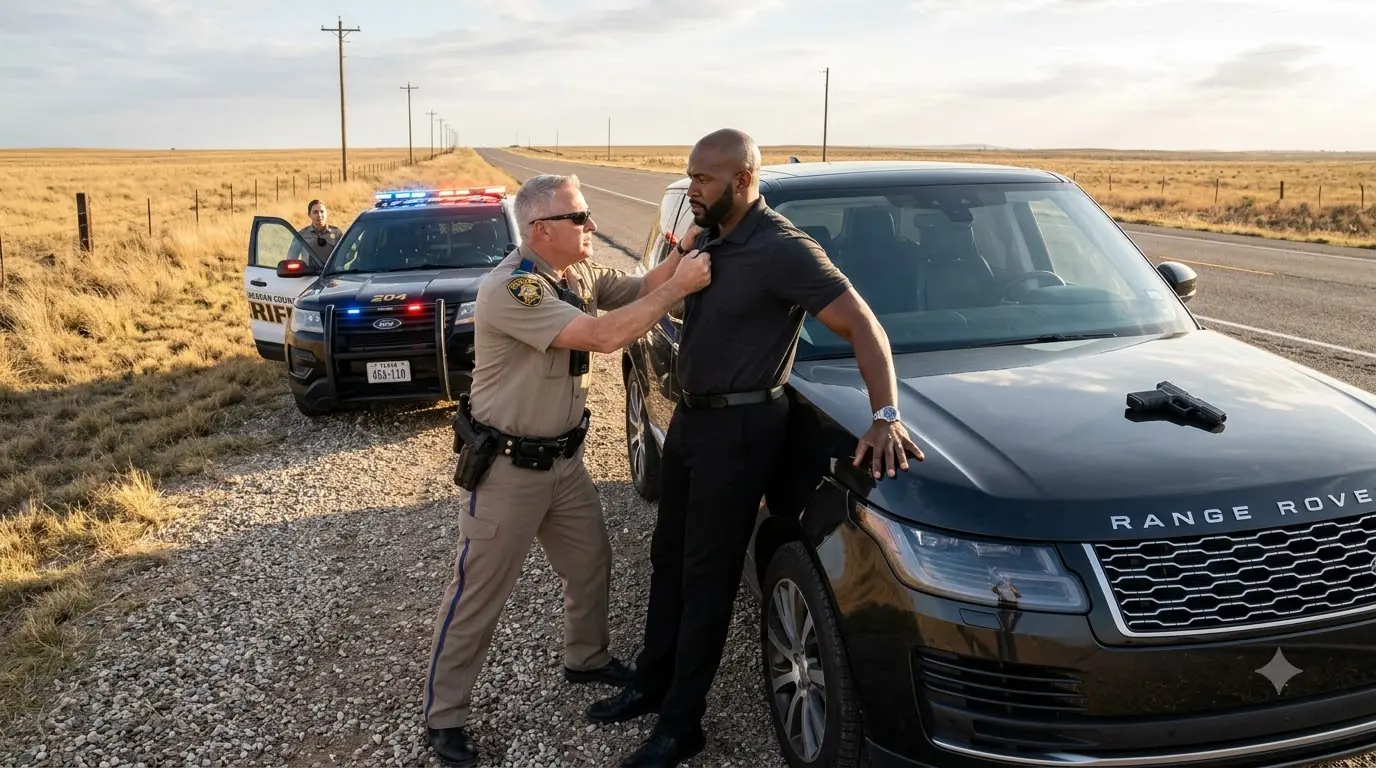
No traffic around him.
No intersection.
No recent speed change.
No reason he could immediately identify for the cruiser to have suddenly accelerated from nearly a quarter mile behind.
Adrian glanced at the speedometer.
Fifty-six.
Posted limit was sixty.
He checked his lane position.
Centered.
Both hands remained on the steering wheel.
The dark rental SUV had functioning lights, current registration, and nothing hanging from the rearview mirror.
Then the cruiser’s light bar came alive.
Red.
Blue.
Red again.
Adrian exhaled slowly and activated his turn signal.
He did not pull over immediately.
The shoulder was narrow where they were, barely wide enough for one tire before dropping into loose gravel and dry grass.
He continued another four hundred yards until the road widened beside an old ranch access gate.
Then he eased onto the shoulder and stopped.
The cruiser settled behind him.
Adrian looked at the time on the dashboard.
4:17 p.m.
He remembered it automatically.
Twenty-three years of federal service had trained him to remember details before he consciously decided they mattered.
Weather.
Location.
Vehicle position.
Time.
Distances.
Names.
Words.
Tone.
People often remembered dramatic moments badly.
Adrian had learned to remember the boring parts.
Those were usually the parts that held up later.
He lowered the driver window halfway.
Then he placed both hands high on the steering wheel.
The afternoon sun was still hard and bright, throwing sharp reflections across the hood.
Wind moved through the tall yellow grass along the fence line.
Telephone poles marched toward the horizon.
Behind him, the patrol cruiser idled.
The driver door opened.
A white male officer stepped out.
Adrian watched in the side mirror.
About fifty.
Stocky.
Tan short-sleeve uniform shirt.
Dark brown trousers.
Duty belt.
Dark sunglasses.
No campaign hat.
His walk was quick and heavy, carrying more irritation than caution.
The nameplate became visible when he reached the window.
HOLLIS.
Adrian already knew the name.
That was the second important thing.
Officer Grant Hollis did not know Adrian.
But Adrian knew Grant Hollis.
Not personally.
Not yet.
Through reports.
Eleven complaints in five years.
Nine closed internally.
One withdrawn.
One referred to the county attorney and quietly returned without action.
Most did not involve force.
They involved stops that stretched too long.
Vehicle searches after vague claims of nervousness.
Questions about cash.
Questions about firearms.
Questions about where drivers were going and why.
Several complainants described the same phrase.
My road. My rules.
Adrian had read it three separate times.
The repetition was what caught his attention.
Now Hollis reached the SUV.
He stood slightly behind the driver door, using the frame for cover.
Reasonable enough.
“License and insurance.”
No greeting.
Adrian looked at him.
“Afternoon, Officer.”
Hollis waited.
Adrian kept hands visible.
“Can you tell me why you stopped me?”
The officer tilted his head.
“License and insurance.”
“I’ll provide them.”
Adrian spoke evenly.
“I’m asking for the reason for the stop.”
Hollis leaned slightly closer.
“Are we gonna start with games?”
“No.”
“Then hand me your license.”
Adrian studied him.
He could have ended most of this in seconds.
His federal credential wallet sat in his back pocket.
Another identification card rested in his regular wallet.
His lawfully carried sidearm remained concealed beneath the right side of his polo.
A second federal vehicle was less than six miles away.
Adrian was not alone.
But the people following him had been instructed not to reveal themselves unless necessary.
This trip had a purpose.
And Officer Hollis was unexpectedly making himself part of it.
Adrian slowly moved his right hand toward the center console.
Hollis’s posture tightened instantly.
“Stop.”
Adrian froze.
“My documents are in the console.”
“Use your left hand.”
Adrian did.
He opened the compartment.
Registration.
Rental agreement.
Insurance.
He removed them slowly.
Hollis took them.
“License.”
“In my wallet.”
“Where?”
“Back right pocket.”
Hollis nodded.
“Get it.”
Adrian kept his left hand visible as he carefully reached back.
He pulled out a slim black leather wallet.
Not the credential wallet.
His personal one.
He opened it and removed Texas driver license.
Hollis took it.
His sunglasses remained pointed at Adrian for another second.
Then he looked down.
“Adrian Cole.”
“Yes.”
“Where you headed?”
“West.”
Hollis looked toward empty road.
“I can see that.”
Adrian said nothing.
“Where west?”
“San Angelo.”
That was not his final destination.
It was enough.
“What for?”
“Meeting.”
“With who?”
Adrian looked at him.
“Is that relevant to the stop?”
Hollis smiled faintly.
There it was.
Not friendly.
Recognition of resistance.
“I’m trying to figure out what you’re doing out here.”
“Driving.”
“You always answer questions with questions?”
“Only when I don’t understand why they’re being asked.”
Hollis lowered license.
“You know what I noticed about you?”
Adrian waited.
“You’re awfully calm.”
“I’m supposed to be nervous?”
“Most people are when police pull them over.”
“That isn’t evidence of anything.”
Hollis gave a short laugh.
“You a lawyer?”
“No.”
“Then don’t lecture me about evidence.”
Adrian looked straight ahead for a moment.
This stop had already shifted.
He could feel it.
Not because of one comment.
Because Hollis had stopped investigating a traffic violation he still had not identified.
Now he was investigating Adrian.
There was a difference.
“Officer Hollis.”
Hollis stiffened almost imperceptibly.
“You read my name tag?”
“Yes.”
“Good.”
“What is the reason for the stop?”
Hollis looked down at documents.
“You crossed center line back there.”
Adrian knew he had not.
More importantly, the federal vehicle behind had dash video.
He said only:
“I don’t believe I did.”
Hollis’s jaw moved.
“So now I’m lying?”
“I said I don’t believe I crossed the line.”
“I watched you.”
“Then your camera should show it.”
Silence.
Hollis stepped backward.
“Stay in vehicle.”
He returned cruiser.
Adrian watched through mirror.
At 4:20, he saw Hollis sit behind steering wheel.
At 4:21, another sheriff’s office vehicle appeared from east.
It slowed.
Turned.
Pulled behind first cruiser.
That was not the federal SUV.
Different profile.
Local unit.
Driver stepped out.
Young deputy.
Early thirties.
Lean.
Tan uniform.
Nameplate would later identify him as Evan Price.
Adrian knew that name too.
Price had worked county three years.
No complaints.
Two commendations.
One body-camera report that had quietly contradicted Hollis during a disputed search nine months earlier.
That report had never become public.
But it was part of why federal investigators were paying attention.
Price approached Hollis’s cruiser.
They spoke briefly.
Then both walked forward.
This time Hollis came to driver side.
Price stopped near passenger quarter panel.
Hollis held Adrian’s license.
“Step out.”
Adrian looked at him.
“Why?”
“Because I’m telling you.”
“Am I under arrest?”
“Not yet.”
“What changed?”
Hollis rested one hand near belt.
“Step out.”
Adrian’s eyes shifted toward Price.
The deputy looked uncomfortable.
Adrian opened door slowly.
Before moving, he said:
“I want you both aware that I am lawfully armed.”
Everything changed at once.
Hollis’s hand moved to his duty weapon.
Price’s shoulders tightened.
Adrian kept hands visible.
“The firearm is concealed on my right side.”
“Hands up!”