Nobody inside the Rusted Halo expected the small boy to survive more than a minute.
Not because anyone wanted to hurt him.
Because children did not walk into that place unless the world outside had become worse.
The Rusted Halo sat on the industrial edge of Tulsa, wedged between an abandoned tire plant and a freight yard where trains screamed through the night like metal animals.
The windows were blacked out, the neon sign buzzed in red, and the parking lot was always crowded with motorcycles that looked like they had crossed every angry road in America.
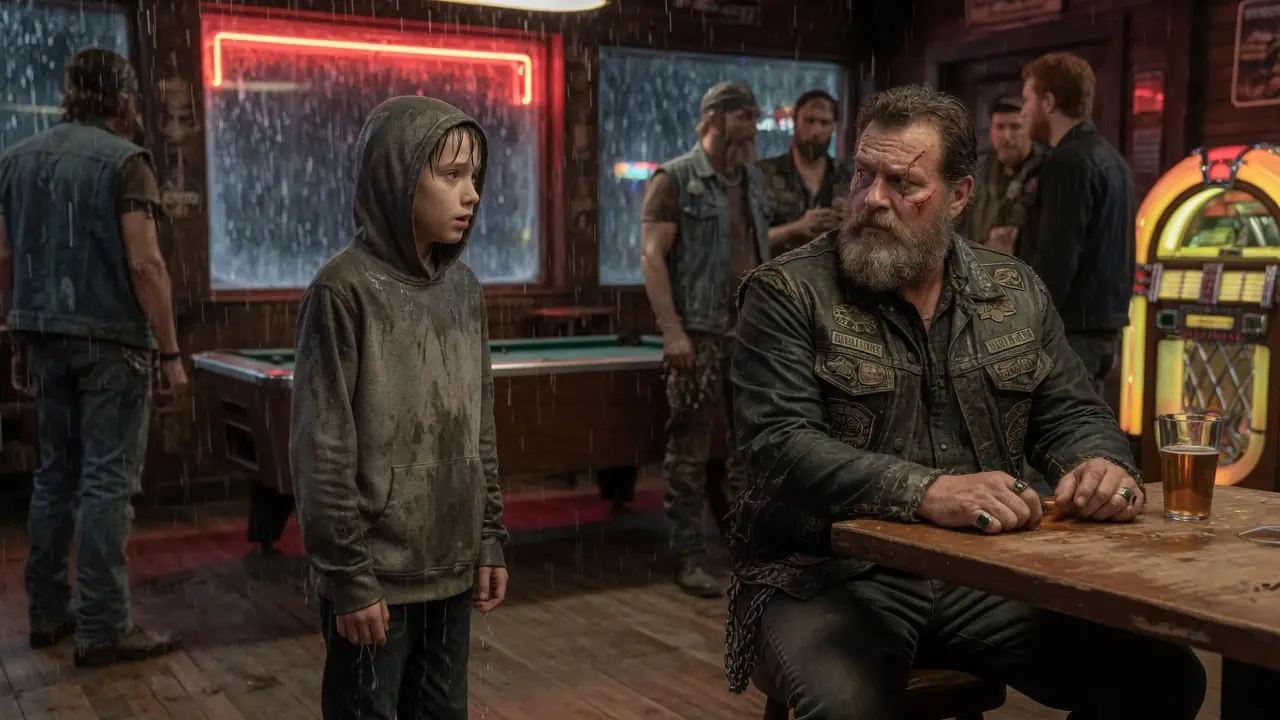
Inside, the air smelled of old beer, engine grease, rain-soaked leather, and cigarette smoke that had sunk into the walls long before city ordinances told anyone to stop. The jukebox played low near the back. Pool balls cracked under hanging lamps. Men in worn cuts leaned over tables, speaking in voices rough enough to make outsiders keep their eyes down.
Then the front door slammed open.
Wind and rain swept in.
Every head turned.
A small boy stood in the doorway, dripping water onto the floor.
He was maybe ten, though hunger and fear made him look younger. His brown hair was plastered to his forehead, his hoodie was soaked through, and one of his sneakers had come untied. He was breathing hard, one hand pressed against his side like he had been running for blocks.
But he was not looking at the bartender.
He was not looking for the phone.
He was not looking for the exit.
His eyes were fixed on the back table.
The table no one approached unless invited.
At the center sat Silas Cain.
People called him Judge, not because he was fair, but because when he made a decision, men usually treated it like a sentence. He was sixty-one years old, broad as a doorway, with gray in his beard, a scar under his left eye, and hands that looked too heavy for ordinary work.
He led the Iron Saints Motorcycle Club, a club that had once been feared for the wrong reasons and was now feared mostly because old reputations died slower than old men.
The boy began walking toward him.
The room went quiet in layers.
The jukebox still played, but the conversations died.
A man at the pool table lowered his cue.
The bartender, Red Mallory, stopped wiping a glass and watched the child cross the room.
The boy’s footsteps sounded tiny against the old wooden floor.
Silas did not move.
His eyes narrowed as the child came closer.
Two bikers at the table shifted slightly, not threatening the boy, only watching the door behind him.
One was Moose, a massive man with a shaved head and a beard like steel wool.
The other was Finch, thin and sharp-eyed, with old prison ink on his knuckles and the nervous stillness of someone who noticed everything.
The boy stopped beside Silas’s table.
His lips trembled.
“They’re following me,” he whispered.
Silas leaned back slowly.
His voice was low.
“Who is?”
The boy swallowed.
“Men in a black truck.”
Moose looked toward the window.
Finch stood immediately and moved to the front blinds without being told.
Silas kept his eyes on the boy.
“Why would men in a black truck follow you?”
The boy’s face twisted like he had been holding the answer in his mouth for too long.
“My father told me you’d protect me.”
Silas stared at him.
The room seemed to tighten around those words.
“What’s your father’s name?” Silas asked.
The boy hesitated.
His eyes flicked once toward the door, as if expecting it to burst open behind him.
Then he whispered, “Charles Harrelson.”
In that instant, every biker at the back table froze.
Moose’s hand tightened around his coffee mug until the ceramic cracked.
Finch turned from the blinds, his face drained of color.
Red’s glass slipped slightly in her hand, but she caught it before it fell.
Silas did not move at all.
For a moment, he looked less like a dangerous man and more like someone staring at a grave that had just spoken.
“Kid,” Silas said carefully, “Charles Harrelson is dead.”
The boy shook his head.
“No.”
Silas’s face hardened.
“Yes.”
“No,” the boy said again, this time with tears filling his eyes. “He said you would say that.”
That hit harder than the name.
Silas slowly placed both hands flat on the table.
“What is your name?”
“Evan.”
“Evan what?”
The boy lifted his chin a little, as if the name cost him something.
“Evan Harrelson.”
Moose whispered, “That’s not possible.”
Silas looked at the boy’s face.
The small jaw.
The dark eyes.
The stubborn line of the mouth.
There was no denying it.
Not fully.
The child carried Charles in pieces.
Not enough to prove anything to a court, maybe.
But enough to make old men remember.
Silas’s voice dropped.
“Who told you to come here?”
“My father.”
“When?”
The boy reached into the front pocket of his soaked hoodie and pulled out a plastic sandwich bag. Inside it was a folded letter, a small brass key, and a photograph so worn the edges had turned soft.
He placed the bag on the table.
“My mother gave me this before she died,” he said. “She said if men ever came asking about the box, I had to run to the Rusted Halo and find Judge.”
Silas stared at the bag.
He had not heard that name from someone innocent in a long time.
Judge.
Not Silas.
Not Cain.
Not old man.
Judge.
Only Charles had called him that when the two of them were young enough to believe rules mattered if you made your own.
Silas picked up the plastic bag and opened it carefully.
He unfolded the letter.
The handwriting hit him first.
Slanted.
Precise.
Too familiar.
Silas,
If a child comes to you with this letter, then the people I ran from finally found what they were looking for.
His name is Evan.
He is my son.
He was never supposed to exist on paper.
That was the only way to keep him alive.
Do not trust the first story anyone tells you.
Do not trust the police report.
Do not trust the file with my name on it.
Follow the blue ledger.
Start where Mercy Road ends.
Tell the boy I am sorry.
Tell him I tried.
Charles
Silas read the letter once.
Then again.
Nobody at the table spoke.
Rain hammered against the roof.
Somewhere outside, a truck engine passed slowly along the street, then faded.
Silas folded the letter with a care no one expected from hands like his.
“Red,” he said.
The bartender was already moving.
She locked the front door, killed the neon sign, and pulled a baseball bat from under the bar.
“Finch,” Silas continued.
“At the blinds,” Finch said. “Black pickup across the street. Two men inside. Engine running.”
The boy stiffened.
“That’s them.”
Moose stood.
“I’ll go ask nicely.”
“No,” Silas said.
Moose stopped.
Silas looked at Evan.
The boy was shaking harder now, not from cold alone.
“You’re safe in here,” Silas said.
The child looked around the bar at the scarred faces, the leather vests, the thick arms, the men no teacher would ever describe as safe.
Then he looked back at Silas.
“My dad said you don’t lie.”
Silas’s eyes changed.
Something old and wounded moved through them.
“He was wrong about plenty,” Silas said. “Not that.”
Red came from behind the bar with a towel and a dry club sweatshirt. She knelt in front of Evan, not touching him yet.
“Can I help you get warm, sweetheart?”
Evan looked to Silas first.
Silas nodded.
“It’s all right.”
Only then did the boy let Red wrap the towel around his shoulders.
Moose looked restless.
“What do we do about the truck?”
Silas looked toward the window.
“We let them think they’re watching a scared kid in a bar.”
Finch’s mouth twitched.
“And while they think that?”
Silas placed the letter on the table.
“We find out why Charles Harrelson stayed dead for eight years.”
Charles Harrelson had died on paper on October 17, eight years earlier.
The official story was simple.
Too simple, Silas had always thought.
A vehicle fire outside Pawhuska. One body burned beyond recognition. Charles’s wallet found near the driver’s seat. His ring recovered from the ash. Dental records confirmed by a county medical examiner who retired six months later and moved to Arizona.
The file said accident.
The club never believed accident.
But they had believed death.
That had been the wound.
Charles had been the Iron Saints’ bookkeeper once, though calling him that was like calling a lockpick a piece of wire. He had a mind for numbers and secrets. He knew where money had moved in the old years, who had paid whom, which politicians took donations through which shell companies, and how dirty money dressed itself as charity before walking into banks clean.
Silas had spent fifteen years dragging the club away from that life.
Charles had helped him.
Then Charles vanished.
Three days later, the car burned.
A week later, federal agents raided two old club properties with warrants built from information only Charles could have known.
Men went to prison.
Families broke.
Businesses closed.
The Iron Saints survived, but barely.
Some called Charles a traitor.
Silas never did.
Not out loud.
He had known Charles too well to believe the easy story.
But knowing something in your gut and proving it in the world were different wars.
Now proof was standing in front of him wearing wet sneakers.
Evan sat in the office behind the bar while Red made him hot chocolate on the old stove and found dry socks from a donation bin they kept for stranded travelers.
The office walls were covered with yellowed photographs, old rally posters, and a framed newspaper clipping about a charity ride the Iron Saints had run for a children’s hospital fifteen years earlier.
Evan stared at one photo.
A younger Silas stood beside a man with dark hair, sharp eyes, and a grin that looked too alive to be trusted.
“That’s him,” Evan whispered.
Red looked over.
“Charles?”
Evan nodded.
“He had that picture.”
“Your dad did?”
“My mom.”
Red set the mug of hot chocolate in his hands.
“What was her name?”
“Maribel.”
Red’s expression changed.
She tried to hide it.
Evan noticed anyway.
“You know her?”
Red sat down across from him.
“I knew a woman named Maribel once. Maribel Cruz. She sang at a roadside bar near Amarillo. Had a voice like smoke and honey.”
Evan’s eyes widened.
“My mom sang.”
Red looked toward the closed office door.
“Of course she did.”
Outside, at the back table, Silas spread the contents of the plastic bag under the light.
The letter.
The brass key.
The photograph.
On the back of the photo were three words written in Charles’s hand.
Mercy Road ends.
Moose leaned over it.
“What the hell does that mean?”
Finch answered before Silas could.
“Mercy Road was the old charity route.”
Silas looked at him.
Finch tapped the photo.
“Before my time, but I heard stories. Club used to run supplies from Tulsa to small towns after storms. Food, medicine, fuel. Charles managed the donations.”
Silas nodded slowly.
“Mercy Road ended at St. Agnes.”
“The church?” Moose asked.
“Not just the church,” Silas said. “There was an old storage house behind it. We used it after the tornado season. Charles kept records there.”
Moose’s face darkened.
“Records like the blue ledger?”
Silas looked at the key.
“Maybe.”
Finch glanced toward the front blinds.
“Truck’s still there.”
“Good,” Silas said.
“Good?”
“If they’re watching the front door, they won’t see who leaves through the cellar.”
The Rusted Halo had been a speakeasy once, long before bikers, neon, and pool tables. Beneath the bar was a cellar that connected to an old service tunnel running toward the freight yard.
Most people did not know that.
The Iron Saints did.
Fifteen minutes later, while Red kept Evan in the office and Moose remained visible by the front window, Silas and Finch slipped through the cellar door.
They emerged behind the abandoned tire plant in hard rain.
A black van waited there with its lights off.
At the wheel sat Nora “Switch” Delaney, the club’s unofficial investigator, though she preferred the term “professional finder of things men bury badly.”
Switch was forty-two, sharp-eyed, and dressed in a black raincoat over jeans and boots. She had once worked skip tracing for insurance companies before deciding criminals were easier to understand than executives.
Silas got in.
Finch climbed into the back.
Switch looked at them.
“Tell me this isn’t as ugly as your voice sounded.”
“It’s uglier.”
Silas handed her a copy of the letter.
Switch read it under the dashboard light.
Her expression shifted line by line.
“Charles Harrelson had a kid?”
“Looks like.”
“And someone chased the kid here?”
“Black pickup out front.”
Switch handed the letter back.
“Then either Charles left something worth killing for, or someone thinks he did.”
“St. Agnes,” Silas said. “Old storage house.”
Switch put the van in gear.
“Of course the dead man sends us to a church in a storm. Very tasteful.”
St. Agnes sat twelve miles south, at the edge of a neighborhood that had been shrinking for twenty years.
The church itself was still active, but barely. The white paint had peeled from the steeple, the side steps sagged, and the cemetery behind it leaned under old trees. Beyond the cemetery stood a small brick storage house with boarded windows and a rusted padlock on the door.
Switch killed the headlights before turning into the service lane.
“Fresh tire tracks,” Finch said from the back.
Silas saw them too.
Mud cut deep near the storage house.
Someone had been there recently.
The brass key fit the lock.
That bothered Silas more than if it had not.
Inside, the storage house smelled of damp wood, old paper, and mice.
Switch used a flashlight, sweeping it across shelves stacked with broken folding chairs, hymnals, storm supplies, and boxes labeled with years long past.
Finch found the first clue.
Not the ledger.
A scrape mark.
Fresh.
On the floor beneath a metal shelving unit.
“Someone moved this.”
Silas and Finch pulled the shelf aside.
Behind it was a square panel cut into the brick, painted to blend with the wall. Switch knelt, ran her fingers along the edge, and found a tiny keyhole.
The brass key did not fit.
“Different lock,” she said.
Silas looked around.
“Charles wouldn’t leave one key for the wrong door.”
Switch stood.
“No. He left us the first step.”
Finch moved the flashlight over the shelves again.
“Mercy Road ends,” he murmured. “Start where Mercy Road ends.”
Silas looked at the back of the photograph again.
Mercy Road ends.
Not ended.
Ends.
Present tense.
Then he saw it.
An old wooden sign leaning upside down behind a stack of cracked plastic bins.
MERCY ROAD SUPPLY DRIVE.
The word ROAD had faded badly.
The final letter, D, had a small brass nail driven through it.
Silas pulled the nail.
Something clicked inside the sign.
A narrow compartment opened along the back.
Inside was a tiny silver key.
Switch smiled despite herself.
“Charles, you paranoid genius.”
The silver key fit the wall panel.
Inside was a metal box.
Empty.
For one moment, nobody spoke.
Then Finch shined the light into the box.
“No ledger.”
Switch looked closer.
“Not empty.”
She reached in and pulled out a small strip of blue cloth caught on a jagged edge.
Silas took it.
Blue canvas.
Ledger cover material.
“Someone beat us here,” Finch said.
Switch turned the flashlight toward the fresh tire tracks outside.
“Not by much.”
Silas stared at the empty box.
Charles had hidden the ledger for eight years.
Someone had found it the same day Evan ran.
That was not coincidence.
That meant someone had been waiting for the child to move.
Or someone had finally found Maribel.
Silas’s phone buzzed.
Red.
He answered immediately.
“Talk.”
Her voice was tight.
“The black truck is gone.”
Silas closed his eyes.
“Evan?”
“Still with me. But Judge, there’s something else.”
“What?”
“Kid says his mom died two weeks ago.”
Silas waited.
Red continued.
“He says men came to the motel after the funeral looking for a blue book.”
The storage house seemed colder.
Silas looked at the empty metal box.
“Tell Moose nobody leaves the bar. Nobody comes in. Lock it down.”
“Already did.”
“And Red?”
“Yeah?”
“Do not let that boy out of your sight.”
Red’s voice hardened.
“They’ll go through me first.”
The investigation truly began that night.
Not the way police investigations begin, with forms and clean evidence bags.
This began at the Rusted Halo, under yellow bar lights, with bikers, old maps, burner phones, coffee, and a frightened boy asleep on a couch in Red’s office with Moose sitting outside the door like a guard dog pretending not to cry.
Switch built the timeline on the pool table using napkins, tape, and a marker she stole from Red.
Charles Harrelson died on paper eight years ago.
Maribel Cruz disappeared from Texas two months before that.
Evan Harrelson was born seven years and four months ago under the name Evan Cruz in a clinic outside Santa Fe.
Maribel moved six times in seven years.
Cash rentals.
No social media.
No stable address.
Two weeks ago, she died of pneumonia after refusing hospital care because, according to Evan, “hospitals ask for papers.”
Three days after the funeral, men came to the motel.
They searched the room while Evan hid in a laundry cart.
They found nothing.
The next night, Evan opened the emergency envelope his mother had left him.
Inside was the letter, the key, and the photograph.
He followed her instructions.
Bus to Tulsa.
Walk to the Rusted Halo.
If followed, do not stop.
Do not call police first.
Find Judge.
Finch read that line and looked at Silas.
“She knew you’d still be here.”
Silas did not answer.
He was looking at the photograph again.
Charles and him, younger, standing outside the old charity truck.
Mercy Road Supply Drive.
In the background, half hidden behind Charles’s shoulder, was a man Silas had not noticed earlier.
Dark suit.
County badge clipped to his belt.
Deputy Paul Wexler.
Now Sheriff Paul Wexler.
Silas tapped the photo.
“There.”
Switch leaned in.
“Wexler?”
“He was deputy back then. Worked the accident.”
“The accident that made Charles dead?”
“Yes.”
Switch’s eyes sharpened.
“Convenient.”
“It gets worse,” Finch said.
He had been searching on his laptop at the edge of the pool table.
“Guess who signed off on transferring Charles’s personal effects after the crash?”
Silas already knew.
“Wexler.”
“Wexler,” Finch confirmed. “And guess who’s running for county commissioner next spring with donors tied to shell companies Charles used to track?”
Switch’s smile vanished.
“Wexler.”
The room went quiet.
Moose spoke from near the office door.
“So the sheriff is dirty.”
Silas looked at Evan sleeping through the half-open office door.
The boy had curled around the dry sweatshirt Red gave him. His face looked younger in sleep. His lashes rested against cheeks still marked with exhaustion.
“No,” Silas said. “The sheriff might be dirty. We prove it before we move.”
Moose looked annoyed.
“When did we become patient?”
“When a child became evidence,” Silas said.
That silenced him.
By morning, the black pickup had been found.
Not by police.
By a tow-yard cousin of a club member who called Switch after seeing a truck parked behind a closed car wash with mud on the tires and plates that did not match the registration.
Switch and Finch got there before anyone else.
They did not touch the truck.
They photographed everything.
Tires.
Mud.
A fast-food receipt from a town near St. Agnes.
A parking ticket from outside the motel where Evan and Maribel had stayed.
The passenger window had a tiny handprint in mud, low on the glass.
Evan’s hand, maybe.
Or another child’s.
That possibility made Silas feel cold.
Switch sent everything to a private attorney, Alina Cross, who had handled enough cases for the Iron Saints to understand that “hypothetically” usually meant “start documenting before someone gets framed.”
Alina’s advice was immediate.
“Do not call Wexler. Do not hand him the boy. Do not hand him original evidence. Bring me copies of everything and get the child to a mandated reporter outside Wexler’s county.”
So they did.
Evan did not want to leave Red’s office.
When Silas stepped inside, the boy was awake, sitting with hot chocolate untouched in his hands.
“Are they here?” he asked.
“No.”
“Are they coming back?”
“Probably.”
Evan’s face tightened.
Silas sat across from him.
“I won’t lie to you. Your father asked me not to.”
The boy looked at him.
“My mom lied sometimes.”
“To keep you calm?”
“To keep me alive.”
Silas nodded.
“That is a different kind of lie.”
Evan looked down.
“Did my dad really do bad things?”
The question hurt more than Silas expected.
The easy answer would have been no.
The honest answer was harder.
“Your father lived in a world where good and bad got tangled,” Silas said. “He made mistakes. So did I. So did most men in this building.”
Evan’s fingers tightened around the mug.
“But was he bad?”
Silas leaned forward.
“No. Not where it counted.”
The boy’s eyes filled.
“My mom said he was trying to make something right.”
“I believe her.”
“Did you love him?”
The room seemed to still.
Silas looked at the old photograph on the desk, the one Red had placed there from the bar wall.
Charles grinning like trouble had personally invited him to dinner.
“Yes,” Silas said. “He was my brother.”
Evan nodded slowly.
“Then I can trust you.”
Silas felt the weight of that sentence settle on his shoulders.
Trust from a child was not a compliment.
It was a responsibility.
They took Evan to a children’s advocacy center in another county that afternoon.
Not in a roaring pack.
Not with twenty bikes.
One quiet van.
Red beside Evan in the back.
Silas in front.
Switch driving.
At the center, a woman named Dr. Lena Morris interviewed Evan gently while a legal advocate sat nearby. Evan told the story of the men, the motel, the black truck, the blue book, the letter, and the name his mother told him never to say unless he reached the Rusted Halo.
Charles Harrelson.
Everything was recorded properly.
Everything had timestamps.
Everything Wexler could not easily bury.
While Evan was interviewed, Alina Cross met Silas in the waiting room.
She was fifty, Black, immaculately dressed, and carried herself like a woman who had never needed to raise her voice because she made people regret not listening.
“I pulled sealed court fragments,” she said, sitting beside him.
“On Charles?”
“On Wexler.”
Silas turned.
Alina opened a folder.
“Eight years ago, Deputy Paul Wexler was under internal review for evidence irregularities. The review stopped after Charles Harrelson’s death because key documents disappeared in the fire.”
“The car fire.”
“Yes.”
Silas’s jaw tightened.
Alina continued.
“Charles was not just tracking old club money. He was tracking payments to Wexler, a prosecutor, two contractors, and a charity foundation that appears to have been washing bribes through disaster relief funds.”
“Mercy Road.”
“Exactly.”
Silas looked through the glass window toward the room where Evan sat with Dr. Morris.
“So Charles hid the ledger.”
“And faked his death?”
Silas shook his head.
“No. Charles would never put us through that unless he had no choice. Someone else staged it. He survived or escaped after.”
“Then why stay gone?”
Silas thought of Maribel.
A hidden woman.
A hidden child.
A letter written by a man who knew death might come back for him.
“Because if the people who staged his death knew he was alive, they would hunt whatever he loved.”
Alina’s face softened by one degree.
“And they did.”
The blue ledger surfaced three days later.
Not in Tulsa.
In a pawn shop in Wichita Falls, Texas.
Switch found it by following the brass key.
That was what made her good.
Most people focused on the lock. Switch focused on why Charles would choose a brass key for a silver-key trail.
The brass key had a number scratched near the teeth.
Not a room number.
Not a locker.
A pawn ticket prefix.
Charles had once used pawn shops as dead drops because pawn shops kept records but rarely asked moral questions.
Switch called seventeen shops before a tired owner named Manny admitted he had recently received “an old blue notebook” from a man who wanted cash and no receipt.
Manny had been suspicious enough to photograph the seller’s license plate.
The plate traced back to a deputy in Wexler’s department.
Not Wexler.
A man named Aaron Pike.
Pike had taken the ledger from St. Agnes.
Pike had followed Evan.
Pike had panicked and sold the ledger for quick cash when he realized people were looking.
Manny still had it because no one bought old ledgers from pawn shops unless they were made of gold or belonged to dead men.
Alina obtained it through proper legal channels.
Silas hated proper channels.
He also respected that they kept Evan safer than rage did.
The ledger was worse than anyone expected.
Names.
Dates.
Amounts.
Initials matched to shell companies.
Payments tied to disaster relief contracts.
Kickbacks.
Evidence tampering.
The staged death.
A page near the back had one sentence written in Charles’s hand.
If I disappear, start with Wexler, but end with Harlan.
Switch stared at the name.
“Judge Everett Harlan?”
Alina’s mouth tightened.
“Now retired. Back then, he signed search warrants tied to the raids after Charles died.”
Silas sat very still.
The raids that had nearly destroyed the Iron Saints had been built on evidence planted by the same network Charles had been trying to expose.
That meant men had gone to prison because Charles got too close.
That meant Charles had been branded a traitor by people who were using him as a corpse.
Moose found out and punched the side of the Rusted Halo’s old freezer hard enough to dent it.
Red made him pay for the repair.
The next part moved quickly.
Not because justice was fast.
Because the ledger gave the right people permission to stop pretending.
Alina brought in state investigators outside Wexler’s control.
Dr. Morris’s recorded interview established threat against a child.
The black pickup evidence connected Pike to the motel and St. Agnes.
Manny’s pawn shop photographs connected Pike to the ledger.
The ledger connected Pike to Wexler.
Wexler connected to Harlan.
Harlan connected to the old charity foundation.
And the foundation connected back to the night Charles Harrelson died on paper.
Sheriff Paul Wexler was arrested on a Thursday morning outside the county courthouse.
The local news called it a corruption scandal.
Silas called it late.
Pike turned first.
Men like Pike usually did.
He had no loyalty to Wexler, only fear. Once fear changed direction, his mouth opened.
He confirmed Charles had survived the crash.
He confirmed Rourke’s men had taken him first.
He confirmed Wexler ordered the false identification because Charles had evidence against them all.
He did not know where Charles had gone after escaping years later.
But he knew this:
Three months before Maribel died, Charles had returned to Oklahoma under a false name to retrieve the ledger and move Evan somewhere safer.
He never made it.
His body was found two counties away under another name, recorded as an unidentified vagrant, buried in a public cemetery without ceremony.
Silas received that news in Alina Cross’s office.
For a long time, he said nothing.
Evan sat beside Red in the waiting room, eating crackers from a vending machine and reading a comic book Finch had bought him.
He did not know yet.
Silas looked at Alina.
“You’re sure?”
She nodded.
“Dental confirmation came back this morning. It was Charles.”
The room did not move.
But something inside Silas did.
For eight years, he had believed Charles dead.
Then for three days, he had believed maybe, somehow, the man was alive.
Now death had returned again.
This time with proof.
This time with a son waiting outside.
Silas stood.
“I’ll tell him.”
Red offered to come.
He shook his head.
“No. He asked me if I lied.”
The advocacy center had a small garden behind it, mostly winter-brown grass and a few benches under bare trees.
Silas took Evan there.
The boy knew before Silas spoke.
Children who live with danger learn to read adults too well.
“My dad is dead, isn’t he?” Evan asked.
Silas sat beside him.
“Yes.”
The boy’s face tightened.
“When?”
“Months ago.”
Evan stared at the ground.
“But he wrote the letter.”
“Yes.”
“So he knew this might happen.”
“Yes.”
Evan’s lips trembled.
“Did he try?”
Silas closed his eyes briefly.
Then he looked at the child.
“Yes,” he said. “He tried harder than any man I ever knew.”
That was when Evan broke.
He did not scream.
He folded forward like something inside him had been cut loose.
Silas pulled him close awkwardly at first, then fully, one large hand on the back of the boy’s head.
Evan cried into his shirt.
Silas looked over the boy’s shoulder at the gray sky.
He thought of Charles.
The grin.
The ledger.
The letter.
The child he had hidden from the world.
Tell the boy I am sorry.
Tell him I tried.
Silas bent his head.
“He was sorry,” he said quietly. “And he tried.”
Evan cried harder.
Silas held on.
That was the first promise fulfilled.
The second came at the courthouse six months later.
The case against Wexler, Pike, and Harlan spread through county records like fire through dry grass. Old convictions were reviewed. Former club members were released or cleared. Families who had been told their husbands and fathers were criminals received letters full of formal language that could not carry the weight of stolen years.
Moose kept one of those letters folded in his vest.
His brother had died in prison two years before the review.
A piece of paper could not resurrect him.
But truth still mattered, even when it arrived late.
Evan testified only once, in a closed hearing, with Dr. Morris beside him and Silas waiting outside. He spoke clearly. He described the motel. The men. The truck. The blue book. His mother’s instructions.
When he came out, he looked pale but steady.
“Did I do okay?” he asked.
Silas crouched in front of him.
“You did more than okay.”
Evan nodded.
Then he asked, “Can we go home?”
Silas froze.
Home.
Not the motel.
Not the safe house.
Not the advocacy center.
The Rusted Halo.
The apartment above it, where Red had put glow-in-the-dark stars on the ceiling and Moose had built a bookshelf that leaned slightly left.
Silas had not meant for it to happen.
None of them had.
But somewhere between legal meetings, nightmares, school enrollment, and Evan refusing to sleep unless he could hear motorcycles outside, the boy had become theirs.
Alina made it legal by spring.
Guardianship.
Temporary at first.
Then permanent.
The judge, a new one with no connection to Harlan, looked over the file and asked Evan where he wanted to live.
Evan looked at Silas.
Then Red.
Then Moose, who was pretending not to be emotional and failing.
“With them,” Evan said.
The judge smiled.
“Then with them.”
Outside the courthouse, Red cried openly.
Moose claimed he had allergies.
Finch said, “To what, feelings?”
Moose threatened to throw him into a fountain.
Evan laughed.
It was the first real laugh Silas had heard from him.
That night, the Iron Saints gathered at the Rusted Halo.
No roaring celebration.
No chaos.
Just food, coffee, men speaking too softly, and a boy sitting at the back table where he had first whispered, “They’re following me.”
Red brought out a cake.
It said WELCOME HOME EVAN in crooked frosting.
Moose had done the lettering.
Nobody was surprised.
Evan looked at the cake for a long time.
Then he looked at Silas.
“Can I keep my last name?”
Silas’s throat tightened.
“Harrelson?”
Evan nodded.
“It was my dad’s.”
Silas placed one hand over the boy’s shoulder.
“You better keep it.”
“But can I still belong here?”
Red answered before Silas could.
“Sweetheart, names don’t limit family. They just tell us which ghosts loved you first.”
Evan smiled a little.
“I think my mom would like you.”
Red wiped her eyes with the back of her hand.
“I would’ve liked her too.”
Silas cut the cake because his hands needed something to do.
Later, after everyone had eaten and the bar had settled into a softer kind of noise, Evan came to the back table carrying the folded letter.
Charles’s letter.
The original was now sealed safely in evidence records, but Alina had made a copy for him.
Evan placed it in front of Silas.
“You should keep one too.”
Silas looked at it.
“No. That’s yours.”
“I know what it says now.”
His voice was quiet.
“But I think he wrote it to both of us.”
Silas did not touch the paper at first.
Then he picked it up.
The handwriting hurt less now.
Not because grief had faded.
Because it had somewhere to go.
“I failed him,” Silas said.
Evan shook his head.
“He sent me to you.”
“That doesn’t mean I didn’t fail.”
“My mom said people can fail each other and still come when it matters.”
Silas looked at him.
“You’re too young to say things like that.”
“I had weird parents.”
For one second, Silas stared.
Then he laughed.
A real laugh.
Rough and startled and rusty from disuse.
The entire bar turned to look.
Moose whispered, “Well, I’ll be damned.”
Life did not become easy after that.
Detective stories end with the truth revealed.
Real life continues with laundry, school forms, court dates, nightmares, and breakfast.
Evan had bad dreams.
Sometimes he woke calling for Maribel.
Sometimes for Charles.
Sometimes he did not call for anyone, which Red said was worse.
Silas learned to keep the hallway light on.
Red learned which foods Evan would eat when anxiety stole his appetite.
Moose learned how to pack school lunches, though his first attempt included beef jerky, three donuts, and a pocketknife, which Red removed immediately.
Finch helped Evan with math and pretended not to enjoy it.
Switch taught him how to notice exits without being afraid of every room.
Alina visited monthly, always claiming it was for legal follow-up and always bringing books.
At school, Evan told people his guardians owned a bar.
That led to questions.
He answered only the ones he wanted.
One boy asked if the bikers were criminals.
Evan said, “Some used to be. Now they mostly make chili and argue about spark plugs.”
That became school legend by lunch.
On the anniversary of the night he arrived, Evan stood outside the Rusted Halo under the red neon sign.
Rain fell lightly, not like that first storm, but enough to make the pavement shine.
Silas stood beside him.
Neither spoke for a while.
Then Evan said, “I thought I was going to die that night.”
Silas looked down.
“I know.”
“I thought they’d catch me before I got to the door.”
“But they didn’t.”
“No.”
He looked at the bar.
“Why did everybody go quiet when I came in?”
Silas thought about the truth.
Then gave it.
“Because you looked like a child carrying a message from the dead.”
Evan nodded.
“That’s kind of what I was.”
“Yes.”
“Do you still miss him?”
“Every day.”
“Me too.”
They stood in the rain.
Then Evan reached into his jacket and pulled out a small patch.
It was blue canvas, cut from the ruined cover of the old ledger after the courts no longer needed the damaged strip. Red had stitched it into a square and embroidered three words on it.
HE TRIED.
Evan handed it to Silas.
“For your vest.”
Silas stared at it.
His eyes burned.
“He was more than that.”
“I know,” Evan said. “But that’s the part he wanted me to know.”
Silas closed his hand around the patch.
The next morning, Red sewed it inside his vest, near the heart, where patches that mattered most were never displayed for strangers.
Years later, people still told the story of the boy who walked into the Rusted Halo.
They got details wrong.
They said he kicked the door open.
He had not.
They said Silas Cain pulled a gun.
He had not.
They said twenty bikers chased a black truck into the night.
They had not.
The truth was quieter and stranger.
A soaked boy walked into a biker bar because his dead father had left him a letter.
A room full of hard men listened.
A hidden ledger came to light.
A sheriff fell.
A judge was exposed.
A dead man’s name was cleared.
And a child who was never supposed to exist on paper became the reason the truth finally did.
The Rusted Halo changed after that.
Not on the outside.
The sign still buzzed red.
The windows stayed black.
The parking lot still filled with bikes.
But behind the bar, Red placed a framed copy of a line from Charles’s letter.
Do not trust the first story anyone tells you.
Below it, in smaller letters, she added:
Find the truth. Protect the child. Then decide.
Evan grew taller.
He learned to ride dirt bikes before Silas was emotionally prepared for it.
He learned to make chili from Red, to fix engines from Moose, to research records from Switch, and to read people’s faces from Silas.
On his thirteenth birthday, he asked for one thing.
A visit to Charles and Maribel’s graves.
They were buried side by side now under a cottonwood tree in a quiet cemetery outside Tulsa. Charles’s real name had been restored. Maribel’s stone carried a line from an old song she used to sing.
Silas drove Evan there on a clear morning.
No bikes.
Just the old truck.
Evan stood between the graves for a long time.
Then he placed three things on the grass.
A blue flower for the ledger.
A brass key.
And a small toy motorcycle Moose had given him the first week he lived above the bar.
Silas stood back, giving him space.
After a while, Evan turned.
“Do you think he knew I’d make it?”
Silas looked at Charles’s name carved in stone.
“I think he hoped.”
“Is hope enough?”
Silas thought about the night at the Rusted Halo.
The rain.
The black truck.
The trembling boy.
The letter.
The way the room had gone still when Charles’s name came back from the dead.
“No,” Silas said. “Hope isn’t enough by itself.”
Evan looked disappointed.
Then Silas continued.
“But hope can point you toward the door. You still have to walk through it.”
Evan looked down.
“I walked through.”
Silas placed a hand on his shoulder.
“Yes,” he said. “You did.”
They stood there together under the cottonwood tree.
A dead father.
A hidden letter.
A child who had survived by following instructions written in fear and love.
And an old biker who had once thought promises died with the men who made them.
He knew better now.
Some promises wait.
Some promises hide in envelopes, keys, ledgers, and names no one dares speak.
Some promises walk into a biker bar soaking wet and trembling, whispering that men are following.
And if you are lucky, or brave, or simply not dead inside yet, you recognize the promise when it arrives.
You sit the child down.
You lock the door.
You read the letter.
Then you spend the rest of your life proving the dead man was right to send him to you.