The laptop bag struck the metal trash can with enough force to crack the computer inside. The sound echoed across Gate B24 at JFK Airport, silencing conversations, stopping rolling suitcases, and turning dozens of passengers toward the first-class waiting area. Caroline Hoffman lowered her manicured hand with a satisfied smile, certain she had removed an unwanted woman from the seat she believed belonged to her. Serena Marshall remained beside the chair, staring at the broken leather case and the scattered documents containing the final terms of a $50 billion aerospace acquisition.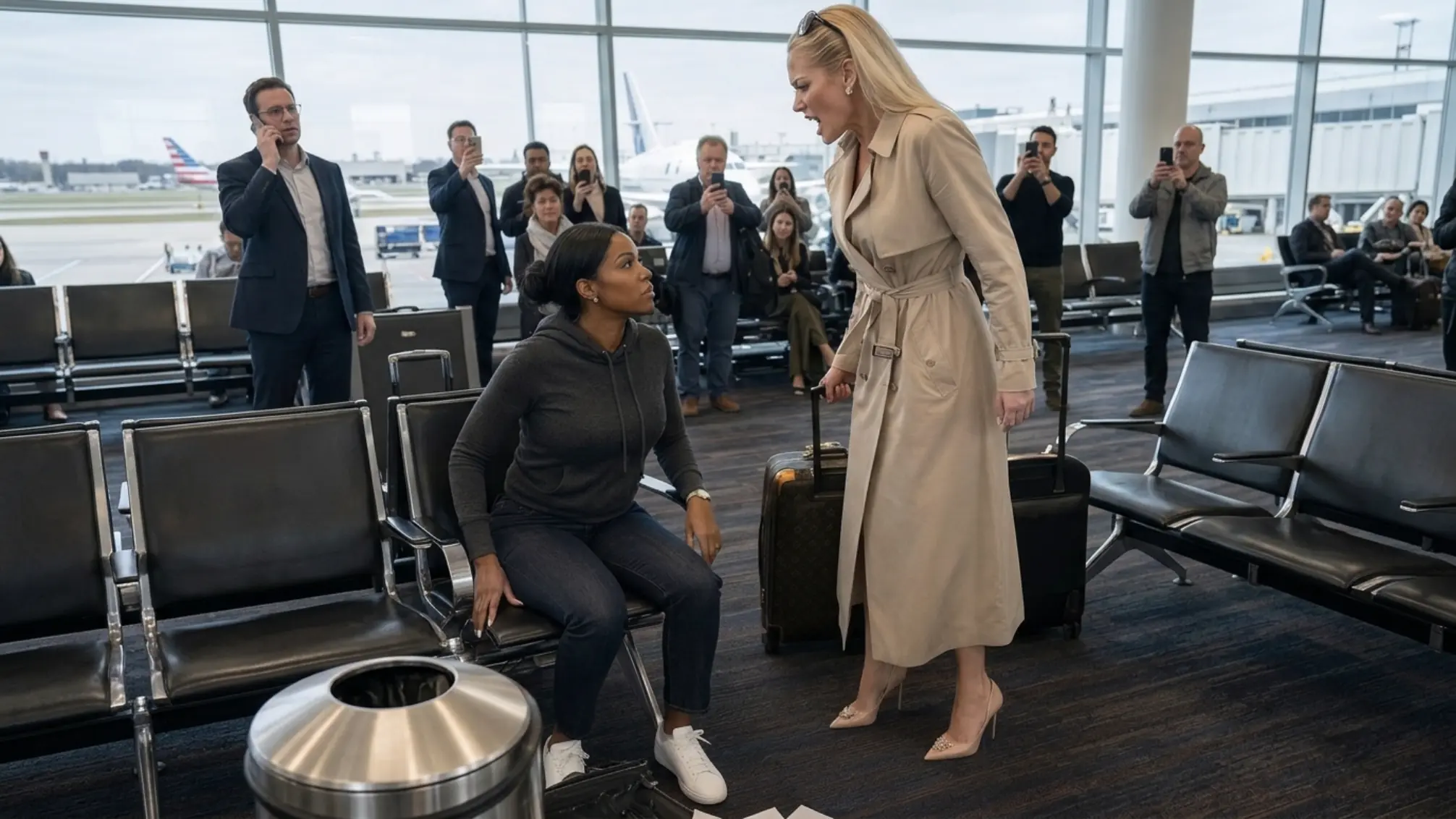
“There,” Caroline said, lowering herself into Serena’s seat. “Now your junk can wait with you in coach.”
Serena slowly raised her eyes. She was forty-two, breathtakingly beautiful, and composed in a way that made her stillness more intimidating than shouting. Her glossy black hair was secured in a neat low bun, and she wore dark designer jeans, spotless white sneakers, a slim platinum watch, and a charcoal cashmere hoodie that Caroline had mistaken for cheap clothing. “You have absolutely no idea what you just did,” Serena said.
Caroline crossed her legs and rested one hand on the handle of her luxury suitcase. “I know exactly what I did. I removed your things from a section reserved for people who actually paid to sit here.” Her blonde hair remained perfectly arranged despite the chaos gathering around her, and oversized sunglasses rested above her head like a crown. “You people sneak into places, show a fake boarding pass, and then become aggressive when someone catches you.”
A low murmur passed through the surrounding passengers. Several phones were already recording, including one held by a college student near the charging station who had captured Caroline grabbing the bag and throwing it. Serena glanced toward the terminal cameras, then toward the damaged laptop lying half outside the torn satchel. Three years of negotiations, confidential engineering reports, and final acquisition documents had been stored on that device, though secure backups existed elsewhere.
The financial loss was recoverable.
Caroline’s decision was not.
Serena stepped forward until she stood directly before the seated woman. “You destroyed my property because you decided I did not belong beside you.”
Caroline laughed, though the sound lacked its earlier confidence. “Don’t turn this into one of your little discrimination performances. You were in my seat.”
Serena held up her phone. The boarding pass displayed her name, the flight number, and Seat 2A in first class. “This is my assigned seat.”
“You could have created that yourself.”
“Then ask the gate agent.”
“I don’t need some employee explaining what I can see.”
Behind Caroline, her husband Robert Hoffman looked as if he wanted the terminal floor to open beneath him. He was fifty-one, pale and visibly exhausted, dressed in a wrinkled cream linen suit that had been expensive before a long day of delays. His eyes moved from Serena’s face to the platinum watch at her wrist, then to the aircraft visible beyond the terminal windows.
Something about Serena seemed familiar.
He could not remember why.
“Caroline,” he said quietly, “get up.”
She turned toward him. “What?”
“Give her the seat and apologize.”
Caroline stared at him as though he had betrayed their marriage in public. “You watched her take it.”
“No, I watched you walk over here and demand it.”
“I told you this section was full.”
“There are other seats.”
“I am not moving because she decided she deserves special treatment.”
Serena looked toward Robert. “Your wife assaulted me and destroyed my equipment. This stopped being about a chair the moment she touched my bag.”
Caroline jumped to her feet. “Assaulted you? I never touched you.”
“You seized property from beside my body and threw it across the terminal.”
“That is not assault.”
“It may be criminal damage, interference with interstate travel, and destruction of confidential corporate material.”
Caroline scoffed. “Corporate material? You were probably doing homework.”
Two Port Authority police officers pushed through the gathering crowd. Officer Daniel Miller, an experienced patrol supervisor with silver beginning at his temples, took in the damaged equipment, the phones, and the two women facing each other. Beside him, a younger officer activated his body camera.
“Everyone step back,” Miller ordered. “Who owns the damaged bag?”
“I do,” Serena said.
Caroline spoke over her. “This woman entered a restricted seating area with a fake ticket and became threatening when I asked her to leave.”
Serena did not react. “Ask the gate employees to scan my boarding pass. Then obtain the terminal video before she invents anything else.”
The younger officer looked at Caroline. “Did you throw the bag?”
“I moved it.”
“Across the floor?”
“She refused to move it herself.”
A passenger raised his phone. “Officer, I recorded the whole thing.”
“So did I,” another woman said.
Within seconds, seven people offered videos.
Caroline’s posture stiffened. “Everyone is twisting this because they want attention.”
Miller crouched beside the damaged laptop without touching it. The aluminum body was bent near one corner, and the screen had shattered into a dark web of glass. Printed contracts lay across the carpet, several bearing confidentiality warnings and the logo of Astra Global.
Robert finally saw the name.
His face drained of color.
He looked at Serena again, remembering the financial magazine covers, investor conferences, and private presentation his employer had conducted two months earlier. The clothing and hairstyle were different, but the eyes were unmistakable.
“Serena Marshall,” he whispered.
Caroline glanced at him. “Who?”
Robert did not answer her. His breathing became shallow as he looked through the terminal windows at the white aircraft parked beyond the gate. A discreet silver emblem near the forward door matched the symbol on the documents scattered across the floor.
Serena heard him.
“So you recognize me.”
Robert swallowed. “Ms. Marshall, I am deeply sorry.”
Caroline’s irritation increased. “Why are you apologizing to her?”
Robert gripped his wife’s arm. “Because that is Serena Marshall.”
The name meant nothing to Caroline for another second. Then recognition arrived slowly, followed by disbelief. Astra Global appeared regularly in financial news, though Caroline paid more attention to celebrity families and society pages than corporate leadership. Serena’s firm owned major stakes in aerospace manufacturers, airport technology companies, and private aviation services.
Caroline removed her arm from Robert’s grip. “That doesn’t mean she owns the seat.”
“No,” Serena said. “My boarding pass means I own the seat.”
Officer Miller requested Serena’s identification. She handed him a federal travel credential, her passport card, and the digital boarding pass. He examined each carefully before asking the gate agent to verify them.
Maria Delgado, the young employee who had been speaking urgently into her radio, approached with a tablet. “Ms. Marshall is confirmed in Seat 2A.”
Caroline looked toward the screen. “Then why is this flight delayed?”
Maria’s eyes widened. “The flight is delayed because of mechanical review and crew-hour limits.”
“You told us it was weather.”
“The original delay was weather.”
“So you lied.”
Serena looked at Maria. “You do not need to defend airline operations to someone under investigation for damaging my property.”
The gate agent nodded gratefully.
Officer Miller asked Caroline to step away from the seat. She refused until Robert lowered his voice and told her that resisting would make the situation worse. The officer then separated the women while another patrol unit arrived to gather witness statements.
Serena called her chief operating officer.
“Naomi, the primary device is damaged.”
A sharp voice answered through the phone. “How?”
“Someone threw the bag into a trash receptacle.”
There was a pause. “Are you injured?”
“No.”
“Are the German files exposed?”
“Several printed schedules are visible, but the most sensitive material remains encrypted. Initiate remote lockdown and move the closing team to the secondary data room.”
“Done. What about London?”
Serena looked beyond the windows. “Prepare the Astra aircraft.”
Robert overheard the words and closed his eyes.
Caroline leaned toward him. “What is happening?”
“That plane outside belongs to her company.”
“That is ridiculous.”
“The Astra emblem is on the tail.”
“So she has access to a corporate plane. That does not make her important enough to ruin our trip.”
Robert looked at his wife with disbelief. “Astra Global is one of my company’s largest prospective investors.”
Caroline’s confidence disappeared for the first time.
Robert served as senior vice president of strategic partnerships at Halcyon AeroSystems, a manufacturer that had spent the last year fighting falling orders and rising debt. His team had pursued Astra Global’s investment because Serena’s support could stabilize the company, protect thousands of jobs, and secure a ten-year airline contract.
He had never met Serena personally.
He had only seen her in confidential briefings.
“What exactly does she control?” Caroline asked.
“Enough to decide whether my division exists next year.”
Caroline glanced toward Serena. “Then explain that I didn’t know who she was.”
Robert stared at her. “That is not helping.”
“What do you mean?”
“You are saying you would not have done it if you knew she was wealthy.”
“I would not have touched a billionaire’s computer.”
“You should not have touched anyone’s computer.”
Caroline’s face tightened. “Whose side are you on?”
“I am on the side trying to survive what you just did.”
Officer Miller returned after reviewing two witness videos. “Mrs. Hoffman, I need you to come with us while we complete the report.”
“I have a flight.”
“So does Ms. Marshall.”
“You cannot remove me from first class because she is famous.”
“This is not about fame. The video shows you taking her bag and throwing it hard enough to destroy the computer.”
“It was an accident.”
The college student raised his phone. “You said, ‘Now your junk can wait with you in coach.’”
Caroline turned toward him. “Mind your own business.”
“It became everyone’s business when you shouted across the terminal.”
The younger officer asked her to surrender her boarding pass temporarily. Caroline demanded a supervisor, airline management, and an attorney. Miller calmly explained that she was not yet under arrest but was being detained during an investigation.
Serena watched without satisfaction.
She had survived business competitors, hostile boards, political investigations, and executives who assumed a Black woman could not control rooms they had inherited. Caroline was not the most powerful person who had underestimated her. She was merely the loudest person to do it in front of dozens of cameras.
Maria returned with an airline executive named Thomas Reed. His expression carried the controlled alarm of someone who had been awakened by a crisis message involving one of the company’s most influential investors.
“Ms. Marshall, on behalf of the airline, I apologize.”
“The airline did not throw my equipment.”
“No, but our staff should have intervened sooner.”
Serena looked toward Maria. “Your employee contacted security immediately. Do not punish her for a passenger’s conduct.”
Thomas nodded. “Of course.”
“Preserve every camera angle from Gate B24 and restrict access to authorized investigators. Some of the documents may contain confidential transaction information.”
“We have already isolated the footage.”
“Good.”
Thomas lowered his voice. “Your aircraft has been cleared for departure from the private apron. Ground transportation can take you there within ten minutes.”
Robert stepped closer before police could stop him. “Ms. Marshall, please.”
Serena turned.
“My wife’s conduct was indefensible,” he said. “I am not asking you to ignore it.”
“Then what are you asking?”
“I work for Halcyon AeroSystems.”
“I know.”
The answer frightened him more than surprise would have.
“Our investment presentation is scheduled for Wednesday,” Robert continued. “Thousands of employees depend on that capital. Please do not connect their futures to something Caroline did.”
Serena studied him. “Did your wife know you were pursuing Astra?”
“She knew I had an important negotiation.”
“Did she know my name?”
“I mentioned it, but I don’t think she remembered.”
Caroline moved closer despite the officer’s warning. “Robert, stop begging her.”
He turned. “You destroyed the laptop of the woman deciding whether to invest $4.8 billion in my company.”
“That is not my fault. She dressed like she belonged in a bus station.”
The entire group became silent.
Robert looked as though she had struck him.
Serena’s eyes hardened. “And there it is.”
Caroline realized too late what she had said. “I meant she wasn’t dressed for first class.”
“You mean I did not look wealthy enough for your respect.”
“You are twisting my words.”
“They required no assistance.”
Officer Miller instructed Caroline to place her hands behind her back.
Her head snapped toward him. “What are you doing?”
“Based on the video evidence, witness statements, and the value of the destroyed property, you are being placed under arrest pending formal review.”
Caroline backed away. “Robert!”
He did not move.
The officer closed handcuffs around her wrists while dozens of phones recorded the moment. The socialite who had demanded Serena leave first class now stood beneath the gate sign without her suitcase, boarding pass, or control over the room.
“This is because she is rich!” Caroline shouted.
Officer Miller shook his head. “It is because you destroyed someone else’s property in front of fifty witnesses.”
Serena gathered the remaining documents while Maria found a secure container. The shattered laptop was photographed, sealed, and transferred to airport investigators. Its preliminary value was listed at $6,800, but the confidential business material raised the potential consequences significantly.
Before leaving, Serena stopped beside Robert.
“I will not punish Halcyon’s employees for your wife’s conduct.”
Relief moved across his face.
“But I will review your leadership role.”
His relief vanished.
“Why?”
“Because you stood behind her from the moment she approached me.”
“I asked her to stop.”
“Quietly, after she escalated.”
“I was trying not to provoke her.”
“You were protecting your comfort while she attacked someone else’s dignity.”
Robert looked toward Caroline being escorted away. “You do not understand my marriage.”
“No,” Serena replied. “But I understand leadership. When someone with influence behaves destructively, silence is participation.”
She walked toward the private-aircraft transfer corridor.
Outside, a black car waited to take her across the secured apron. The white Astra jet stood under the evening sky, its engines being prepared while Serena’s London team moved the acquisition closing to a secure onboard system.
The aircraft had originally been scheduled as a backup. Serena preferred commercial flights whenever possible because they allowed her to work anonymously and avoid unnecessary expense. Caroline had assumed that anonymity signified inferiority.
Instead, it had exposed her character without warning.
Naomi met Serena at the plane’s stairs. She was a forty-five-year-old attorney with short silver-streaked hair and a reputation for turning corporate disasters into settlements before competitors understood what happened.
“I saw the videos,” Naomi said.
“They are already online?”
“Millions of views.”
Serena exhaled. “Of course.”
“The German team is secure. The device was remotely wiped before airport technicians handled it.”
“The printed pages?”
“Mostly scheduling and public financial data. Nothing capable of damaging the acquisition.”
Serena entered the aircraft. “Then proceed.”
Naomi followed. “What about Halcyon?”
“Freeze tomorrow’s investment committee vote.”
“Because of Robert Hoffman?”
“Because I want his division reviewed.”
Naomi sat across from her. “You said you would not punish the employees.”
“I won’t. But a man responsible for strategic partnerships watched his wife attack a stranger because he feared upsetting her. I need to know whether he displays the same cowardice when executives mistreat employees.”
Within hours, Astra’s review team reopened Halcyon’s internal culture reports. They found complaints involving discrimination, retaliation, and procurement favoritism inside Robert’s division. He had not personally committed the worst violations, but he repeatedly encouraged employees to “resolve matters informally” rather than document powerful managers.
His pattern at Gate B24 was not new.
He avoided confrontation until someone more powerful forced him to act.
Two days later, Halcyon removed Robert from the investment negotiations. Astra did not cancel the deal. Instead, Serena required new employee protections, independent reporting systems, and leadership changes before releasing capital.
The agreement closed in London for $4.8 billion.
The larger $50 billion robotics acquisition also succeeded before the deadline. The destroyed laptop delayed nothing except Serena’s sleep.
Caroline’s case moved more slowly.
Her attorneys claimed emotional distress caused by repeated flight delays and argued that she believed Serena’s bag had been abandoned. Passenger videos destroyed both explanations. They showed Caroline speaking directly to Serena, reading her boarding pass, and throwing the bag after being calmly corrected.
The airline banned her indefinitely.
A judge ordered restitution for the destroyed equipment, legal costs, and disruption caused at the gate. Caroline accepted a plea involving criminal damage and harassment, avoiding jail in exchange for probation, community service, and mandatory behavioral counseling.
The greatest damage came from the videos.
Luxury charities removed her from boards. Social clubs suspended her membership. Friends who had laughed at similar behavior privately distanced themselves once the public could see it.
Robert filed for separation three months later.
Caroline accused Serena of destroying her marriage.
Serena never responded.
Almost a year after Gate B24, Serena returned to JFK for another London flight. She wore the same charcoal hoodie, dark jeans, and white sneakers. Maria Delgado was now an assistant gate manager, promoted after Serena wrote to airline leadership praising her quick response and professionalism.
“You kept the hoodie,” Maria said.
“It is comfortable.”
“People recognize you now.”
“Some do.”
A family occupied several first-class seats nearby. When Serena approached, the father moved a briefcase and apologized for blocking the chair marked 2A.
No confrontation followed.
No one demanded proof that she belonged.
Before boarding, Maria handed Serena a small package. Inside was a protective laptop case made from reinforced aerospace material. The engineering team at the German robotics company had built it after hearing what happened.
A note was attached:
For negotiations, airports, and people who mistake quiet for weakness.
Serena smiled.
Beyond the glass, her commercial aircraft waited at the gate. Her private plane was available if needed, but she had chosen Seat 2A again.
Ownership had never been the point.
Caroline believed first class represented human value. She saw a woman in a hoodie and decided clothing gave her permission to humiliate, accuse, and destroy.
Minutes later, she learned Serena owned the aircraft outside.
But the lesson had nothing to do with planes.
Serena deserved dignity before anyone knew her name, her wealth, or the amount of power waiting behind one phone call.