The first thing Jake Morrison noticed about Willow Creek was the cage.
He had ridden into town expecting nothing more memorable than hot coffee, sacks of flour, and a place where his horse could drink before the long trail north. Instead, he found half the town gathered in the middle of the dusty street beneath a white Montana sky. Children balanced on hitching rails. Ranch hands stood shoulder to shoulder outside the saloon. Women leaned from the mercantile porch, whispering behind gloved hands.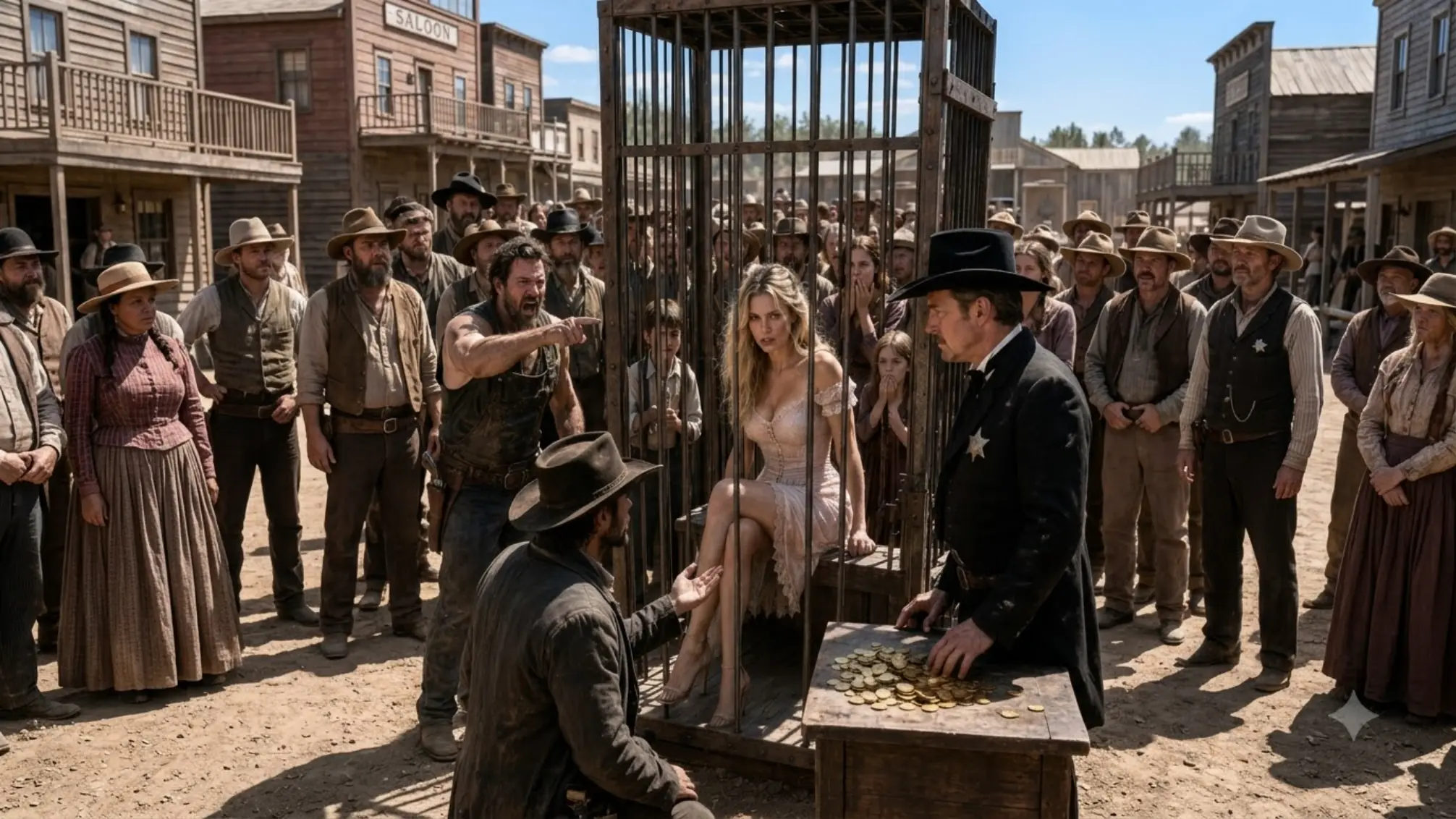
At the center of them all stood an iron cage tall enough for a man to stand inside.
A crooked wooden board hung across its front.
TEN DOLLARS TO TOUCH THE GIANT WIDOW.
Jake stopped his horse.
For several seconds he believed he had misread it.
Then a boy tossed a pebble through the bars.
It struck the wooden bench inside.
The crowd laughed.
The woman in the cage did not move.
Jake slowly dismounted.
She was not a giant.
Tall, yes.
Broad-shouldered too, with the build of a woman who had probably lifted grain sacks, split wood, hauled water, and worked beside men who would later pretend strength made her less feminine. Long blonde hair hung around her face in tangled waves. Dust clung to the pale pink dress she wore, and the delicate lace near the shoulders looked absurdly out of place against black iron bars.
But it was her eyes that stopped him.
Pale blue.
Exhausted.
Still.
Jake knew those eyes.
He had seen something similar in his own mirror after fever took his wife Sarah and the child she had been carrying.
Not emptiness.
Something worse.
The disciplined decision not to feel where other people could watch.
A heavyset blacksmith stood near the cage, already red-faced from drink.
“Come on, Martha!” he shouted. “Give us one word!”
The woman stared at the dirt.
A coin hit the bars.
Another laugh.
The sheriff stood behind a rough wooden table near the cage door. Gold and silver coins lay scattered across it beside a ledger.
He wore a black coat despite the heat, a broad hat, and a polished star that seemed cleaner than anything else in town.
Jake walked toward him.
The sheriff noticed.
“Passing through?”
“That was the plan.”
The sheriff smiled.
“Then Willow Creek has given you something worth remembering.”
Jake looked back toward the woman.
“How long has she been in there?”
“Two years.”
Jake thought he had heard wrong.
“Two years?”
“Territorial sentence.”
“For what?”
The sheriff’s smile became thinner.
“Murder.”
The blacksmith heard them.
He pushed through the crowd.
“She killed my brother.”
Jake looked at him.
The man pointed toward the cage.
“Thomas Bell. Best blacksmith this valley ever had. She put him in the ground and never showed an ounce of regret.”
Martha did not look up.
Jake turned toward the sheriff.
“She convicted?”
“Town council ruled.”
“That wasn’t my question.”
The sheriff’s expression shifted.
Jake had spent enough years around county courts, ranch contracts, livestock disputes, and territorial officers to recognize the moment a man realized the stranger speaking to him understood more than expected.
“She was found responsible.”
“By a judge?”
“Willow Creek handles its own problems.”
Jake looked toward the iron cage again.
“A woman sits behind bars for two years while you charge people money to touch her, and you call that handling a problem?”
Several townspeople stopped smiling.
The sheriff’s voice cooled.
“You passing through or looking for trouble?”
Jake stepped toward the table.
“How much?”
The sheriff blinked.
“Ten dollars.”
Jake shook his head.
“How much to buy the woman in the cage?”
The street went silent.
Martha’s head lifted.
For the first time, her eyes met his.
Sheriff Harlan laughed loudly.
A few others joined him.
Jake did not.
The laughter faded.
Harlan leaned against the table.
“She isn’t livestock.”
“You priced touching her.”
The sheriff’s smile disappeared.
“I said she isn’t for sale.”
Jake pulled a leather pouch from beneath his coat.
He emptied it onto the table.
Gold coins rolled across the wood.
The crowd gasped.
Harlan stared.
Jake said, “Everything seems to have a price in Willow Creek.”
The sheriff’s fingers twitched.
Jake saw it.
Greed.
Not justice.
Not outrage.
Greed.
“Name yours.”
Harlan looked toward the crowd.
Then toward the coins.
Then at Martha.
“Five hundred dollars.”
Martha’s eyes widened.
Jake began counting.
The blacksmith shoved forward.
“You can’t do this!”
Jake did not look at him.
“One hundred.”
More coins.
“Two.”
Sheriff Harlan’s expression changed with every piece of gold.
“Three.”
The blacksmith pointed toward Martha.
“She murdered Thomas!”
“Then a territorial court can prove it.”
“Four.”
Someone whispered that Jake was insane.
Jake placed the final coins on the table.
“Five hundred.”
Harlan swallowed.
The money represented more than most men in Willow Creek earned in several years.
Jake looked at him.
“Open the cage.”
The sheriff hesitated.
“You hand that money over, she becomes your responsibility.”
Jake’s gaze sharpened.
“She becomes nobody’s property.”
Harlan glanced at the gold.
“Fine.”
He took the key.
The iron lock gave a hard metallic click.
Nobody spoke.
Jake walked toward Martha.
He stopped outside the open door.
She remained seated.
Up close, he saw how thin her wrists were despite the strength in her frame. There were old marks along her hands from work and weather. Her pale pink dress had once been beautiful but had been washed too many times, repaired too many times, and exposed to too many months of dust.
Jake removed his hat.
“What’s your name?”
Nothing.
The blacksmith laughed.
“She doesn’t talk.”
Jake ignored him.
He crouched.
“You don’t have to come out until you’re ready.”
Martha studied him.
Her lips moved.
At first, no sound came.
Then, rough and almost broken from disuse:
“Martha.”
The crowd reacted like they had heard thunder.
Somebody whispered, “She spoke.”
Jake remained still.
“Martha what?”
Her throat worked painfully.
“Martha Cain.”
“I’m Jake Morrison.”
She looked toward the gold on Harlan’s table.
“You paid for me.”
“No.”
“You gave him money.”
“I paid to open a door.”
A tear appeared in one of her eyes.
She wiped it away immediately.
Jake reached into his vest.
The blacksmith stepped forward.
Jake pulled out a plain gold ring.
It had belonged to Sarah.
He had carried it for two years without knowing why.
Martha stared at it.
Jake held it in his open palm.
“I’m going to ask you something strange.”
The sheriff laughed.
“Strange?”
Jake looked only at Martha.
“You can say no.”
Her eyes moved between him and the ring.
“Why?”
“Because no one should leave a cage with nowhere safe to go.”
She stared.
Jake continued.
“I own a ranch north of here. Small place. Quiet. Nobody there will put you behind bars.”
Martha’s voice trembled.
“You don’t know what I did.”
“No.”
“You don’t know me.”
“That’s true.”
“Then why offer marriage?”
Jake paused.
“Because Willow Creek will try to drag you back the moment I leave.”
The sheriff stiffened.
Jake had understood immediately.
Harlan’s “sale” meant nothing legally.
A marriage, however, would create witnesses, property interests, and a reason for territorial authorities to become involved if a sheriff tried to seize a married woman from her husband’s land without warrant or court order.
Martha understood too.
“You’re protecting me.”
“For now.”
“Pity?”
“No.”
Her eyes searched his face.
“Then what?”
Jake looked at the cage.
“Recognition.”
A roar came from behind him.
The blacksmith charged through the crowd but stopped several feet away.
“She murdered my brother!”
Jake stood.
“Then explain how.”
The blacksmith’s face twisted.
“She pushed him down Miller’s Ravine.”
Martha closed her eyes.
“He was found at the bottom.”
Jake asked, “Anyone see her push him?”
The man hesitated.
“She was there.”
“That isn’t the same thing.”
“She admitted they fought!”
Martha’s hands tightened.
The sheriff stepped forward.
“Enough. She served her sentence.”
Jake turned.
“Interesting sentence.”
Harlan frowned.
“Meaning?”
“No prison record. No judge. No transportation to territorial custody. Instead, you put her on display and kept the money.”
Harlan’s jaw tightened.
“Careful.”
Jake slipped the ring back into his hand.
Martha suddenly stood.
The movement silenced everyone.
She stepped through the cage door.
Her legs shook.
Jake offered his hand.
She looked at it.
Then took it.
The crowd began shouting.
“Put her back!”
“She killed Thomas!”
“That woman belongs in the cage!”
Martha flinched.
Jake tightened his grip.
Then she turned toward the crowd.
Her voice came out louder this time.
“I did not kill Thomas Bell.”
Silence dropped.
The blacksmith stared.
“You liar.”
Martha looked straight at him.
“Your brother was alive when I left the ravine.”
Sheriff Harlan immediately stepped forward.
“That’s enough.”
Jake noticed it.
Not anger.
Fear.
Martha noticed too.
She turned toward Harlan.
“You never wanted me to speak.”
Harlan’s face hardened.
“You refused to speak.”
“You refused to listen.”
The sheriff reached toward her.
Jake moved between them.
“Don’t.”
Harlan stared.
“You’re interfering with lawful authority.”
Jake nodded toward the cage.
“Show me the law.”
Harlan said nothing.
Jake looked toward Martha.
“Tell me what happened.”
Her eyes moved across the crowd.
Two years of silence sat inside her.
Then she began.
Thomas Bell had not been simply a blacksmith.
He had owned several parcels of land near Miller’s Creek and had spent years trying to expand his holdings. Martha’s husband, Daniel Cain, owned a narrow strip along the water, land valuable because nearly every ranch downstream depended on access through it.
When Daniel died from pneumonia, the property passed to Martha.
Thomas offered to buy it.
She refused.
He offered again.
She refused again.
Then came threats.
Fences were cut.
A barn door was damaged.
Cattle disappeared.
Martha went to Sheriff Harlan.
Nothing happened.
“I knew Thomas was behind it,” she said. “But I couldn’t prove it.”
The blacksmith shouted.
“You’re lying!”
Martha looked at him.
“Your brother asked me to meet him at Miller’s Ravine.”
“Why would you go?”
“Because he said he had my missing cattle.”
The crowd murmured.
Martha continued.
“When I arrived, there were no cattle.”
Thomas wanted her signature on a deed.
She refused.
They argued.
He grabbed her arm.
She shoved him away.
He fell but did not go over the ravine.
“He was standing when I left.”
The blacksmith’s face had gone pale beneath the anger.
Martha turned toward Harlan.
“I told him that the next morning.”
The crowd looked toward the sheriff.
Harlan folded his arms.
“She changed her story.”
“No.”
Martha’s voice strengthened.
“You changed my statement.”
A ripple moved through the crowd.
Jake looked at Harlan.
“Where’s the original?”
“Destroyed.”
“Why?”
“Records get lost.”
“Convenient.”
Harlan stepped toward him.
“You’ve been here twenty minutes.”
“Long enough to see you made money off a woman you claim was convicted.”
Someone in the crowd laughed nervously.
Harlan turned sharply.
Nobody met his eyes.
Jake looked toward Martha.
“Who saw Thomas after you left?”
Her face changed.
“One person.”
The blacksmith whispered, “Who?”
Martha looked past him.
Toward the mercantile.
“Samuel Reed.”
An elderly man standing near the porch froze.
Every head turned.
Samuel Reed owned Willow Creek’s livery stable.
He was nearly seventy, thin and stooped, with white whiskers and hands bent by arthritis.
Harlan’s voice snapped.
“Samuel.”
The old man looked toward the sheriff.
Martha said, “You saw him.”
Samuel’s face collapsed.
“He told me not to speak.”
The street erupted.
Harlan barked, “That man is confused.”
Samuel stepped off the porch.
“No.”
His voice shook.
“I’ve been afraid.”
The sheriff moved toward him.
Jake stepped in the way.
Samuel continued.
“I saw Thomas after Martha left.”
The blacksmith stared at him.
“You saw my brother?”
“Yes.”
“Alive?”
Samuel nodded.
The blacksmith staggered backward.
Martha closed her eyes.
For two years, she had lived inside iron because one frightened old man had remained silent.
But Samuel was not finished.
“I saw someone else ride toward the ravine.”
Jake asked, “Who?”
Samuel looked at Harlan.
The sheriff’s face drained.
“Deputy Cole.”
Everyone turned toward a young deputy standing near the jailhouse.
Cole stepped backward.
Harlan shouted, “Get inside!”
Cole did not move.
Jake watched the deputy.
“You want to tell us something?”
Cole’s lips parted.
The sheriff reached for him.
Cole backed away.
“Don’t touch me.”
Harlan froze.
The deputy’s voice cracked.
“Thomas and Sheriff Harlan had a deal.”
The blacksmith stared.
“What deal?”
Cole looked sick.
“Land.”
Thomas intended to obtain Martha’s property, combine it with his parcels, and sell water access to a mining company moving into the county.
Harlan would receive a share.
Martha’s refusal blocked everything.
The day Thomas died, Harlan had sent Cole to follow him.
“Did you kill him?” Martha asked.
Cole shook his head violently.
“No.”
“Who did?”
Cole looked toward Harlan again.
Harlan’s hand dropped toward his belt.
Jake’s voice hardened.
“Don’t.”
The sheriff stopped.
Cole swallowed.
“I don’t know.”
People shouted.
The blacksmith grabbed Cole by the shirt.
“Then what are you saying?”
Jake pulled them apart.
“Let him finish.”
Cole stared at the dirt.
“When I reached the ravine, Thomas was arguing with someone.”
“Who?”
“I couldn’t see clearly.”
“Man or woman?”
“Man.”
The crowd fell silent.
Cole continued.
“I heard Thomas shout about money.”
Then a struggle.
Cole had been frightened.
He rode away.
The next morning, Thomas was dead.
Sheriff Harlan learned Martha had argued with him hours earlier.
The solution came immediately.
Blame her.
Take her land into temporary county control.
Quietly finish Thomas’s proposed sale through another buyer.
Jake turned toward Harlan.
“What happened to Martha’s property?”
Harlan said nothing.
Martha answered.
“They took it.”
The words nearly failed in her throat.
“The sheriff said a convicted murderer couldn’t hold land.”
Jake looked around.
“Who owns it now?”
Nobody answered.
Then the mercantile owner spoke.
“Harlan Land Company.”
The street exploded.
Harlan shouted for everyone to be quiet.
No one listened.
Jake realized the cage had never been punishment.
It had been evidence management.
Keep Martha visible.
Keep her disgraced.
Keep everyone convinced they already knew the truth.
Turn her suffering into entertainment so that asking questions felt like defending a monster.
And profit from her land while she remained unable to challenge anything.
Jake looked at Martha.
“How long have you known?”
“Most of it.”
“Why stay silent?”
Her expression broke slightly.
“The first three weeks, I screamed.”
Her voice weakened.
“I told everyone.”
Nobody looked at her.
“I begged people to find Samuel. I begged them to check the deed.”
She stared at the cage.
“They laughed.”
A woman in the crowd lowered her head.
Martha continued.
“Then I realized every word gave them another reason to call me mad.”
So she stopped.
Two years.
No defense.
No begging.
No entertainment.
Jake looked around at the townspeople.
Many could no longer meet Martha’s eyes.
The blacksmith stood completely still.
He had spent two years screaming that she murdered his brother.
Now he looked at Harlan.
“You took her land?”
The sheriff backed toward the table.
“Nothing has been proven.”
Jake pointed toward the ledger.
“What’s in that book?”
Harlan glanced at it.
That tiny movement betrayed him.
Jake reached.
Harlan grabbed the ledger first.
Cole stepped forward.
“Sheriff.”
“Stay out of this.”
Harlan tucked the book under his arm.
Jake did not try to take it.
Instead he looked toward the crowd.
“Anybody here know who the territorial judge is?”
The mercantile owner answered.
“Judge Whitmore. Helena circuit.”
“When does he come through?”
“Every six weeks.”
A woman near the saloon said, “Three days.”
Harlan’s face changed.
Jake smiled slightly.
“Good.”
The sheriff pointed at him.
“You think I’m going to let you remain here stirring up trouble for three days?”
Jake looked toward Martha.
“That depends.”
He pulled the gold ring out again.
The crowd went silent.
Jake knelt.
Martha stared.
“Martha Cain.”
Her lips trembled.
“This is madness.”
“Probably.”
A faint sound escaped her.
Almost a laugh.
Jake continued.
“I can’t promise you an easy life.”
Her eyes filled.
“My ranch roof leaks over the north room.”
Another almost-laugh.
“My cooking is worse than prison food.”
Someone in the crowd coughed.
Jake looked directly into her eyes.
“But nobody will put you behind bars.”
Martha whispered, “Jake.”
“I’m not asking because you need saving.”
He held the ring toward her.
“I’m asking because when I looked at that cage, I recognized someone who had survived what should’ve broken her.”
She stared.
“And I’d like to know the woman who survived.”
Martha began crying.
Quietly.
Not like the crowd had wanted for two years.
These tears belonged to her.
“Ask me when I’m free.”
Jake nodded.
“That’s fair.”
He stood.
Then Martha reached through the open cage door and caught his sleeve.
“Wait.”
Jake turned.
Her voice was barely audible.
“If I’m free when the judge leaves Willow Creek…”
“Yes?”
“Ask again.”
The territorial judge arrived three days later.
Willow Creek had changed by then.
Nobody paid to touch the woman in the cage because the cage stood empty.
Jake rented a room for Martha above the boardinghouse.
The owner initially refused.
Six townspeople who had watched the revelations in the street threatened to move their business elsewhere.
The room appeared.
Sheriff Harlan tried twice to arrest Jake for obstruction.
Deputy Cole refused to participate.
So did the second deputy.
Samuel Reed signed a written statement.
Then three more people came forward.
A clerk remembered seeing Harlan alter Martha’s original interview.
A rancher confirmed Harlan had attempted to purchase Martha’s property months before Thomas died.
The county recorder produced the transfer paperwork.
Judge Whitmore read it in silence.
Martha sat across from him wearing a borrowed blue dress.
Jake waited near the back wall.
Harlan stood beside an attorney from Helena.
The hearing lasted six hours.
The judge asked one question repeatedly.
“Where is the conviction order?”
Nobody had one.
“Where is the sentence?”
None.
“Where is the judicial finding establishing Martha Cain killed Thomas Bell?”
Nothing.
The cage had not been a legal sentence.
It had been something Willow Creek allowed because Sheriff Harlan told everyone it was lawful.
Judge Whitmore ordered Martha’s detention record voided immediately.
Then he froze all transfers concerning her property.
The territorial marshal took custody of Harlan’s ledger.
Inside were payment records.
Land transfers.
Money from the cage.
And repeated references to Thomas Bell.
The blacksmith, Aaron Bell, sat in the gallery while the ledger was read.
His anger had disappeared.
Afterward, he approached Martha outside the courthouse.
Jake stepped closer automatically.
Martha raised one hand.
She wanted to hear him.
Aaron removed his hat.
“I don’t know what to say.”
Martha waited.
“I hated you.”
“I know.”
“I said things.”
“I remember.”
He looked destroyed.
“I threw things at that cage.”
“Yes.”
His eyes filled.
“I thought you killed my brother.”
Martha looked toward the street.
“And I told you I didn’t.”
Aaron lowered his head.
“You did.”
She did not forgive him.
Not then.
But she also did not punish him.
“Find out who killed Thomas,” she said.
Aaron looked up.
“That’s what you can do.”
The investigation took three months.
The final truth surprised nearly everyone.
Sheriff Harlan had not killed Thomas.
Neither had Martha.
Thomas’s own business partner, Nathan Crane, had.
Thomas had secretly promised the same mining access rights to two different investors. Crane discovered the deception and confronted him at Miller’s Ravine after Martha left.
The argument turned physical.
Thomas fell during the struggle.
Crane panicked.
When he learned Harlan was blaming Martha, he remained silent.
Harlan discovered the truth weeks later.
But by then, Martha was already inside the cage and Harlan controlled her property.
Exposing Crane would expose everything else.
So he buried the truth.
Crane confessed after investigators confronted him with Samuel’s statement, Cole’s timeline, and financial records from Thomas’s office.
He was convicted of manslaughter.
Harlan faced charges involving unlawful confinement, fraudulent land transfers, falsified public records, and misuse of authority.
The cage was dismantled.
Not by a mob.
Judge Whitmore ordered it removed as evidence.
Martha watched workers unbolt the first iron bar.
Jake stood beside her.
“Want to watch?”
“Yes.”
“You sure?”
“I spent two years looking at it from inside.”
She folded her arms.
“I’d like to see what it looks like coming apart.”
So they stayed.
One bar.
Then another.
Then another.
When the final wall came down, Martha closed her eyes.
The wind touched her face without passing through iron first.
She cried again.
Jake said nothing.
He simply stood near enough that she could take his hand if she wanted.
Eventually, she did.
Her land was returned.
That created another problem.
Everyone expected Martha to keep it.
She did not.
The memories attached to Miller’s Creek were too heavy.
She sold part of the property to neighboring ranchers under contracts guaranteeing public livestock access to the water.
The remainder she placed in trust for a school.
Not because Sheriff Harlan had ever deserved to claim his cage money funded education.
Because Martha wanted to decide what happened to something that belonged to her.
She chose.
That difference mattered.
Then came the morning Jake prepared to leave Willow Creek.
His horse was saddled outside the boardinghouse.
Martha came downstairs carrying one travel bag.
Jake stared at it.
“What’s that?”
“My belongings.”
“I can see that.”
“You said your ranch roof leaks.”
“It does.”
“And your cooking is terrible.”
“Criminally.”
“I suppose somebody should investigate.”
Jake smiled.
Martha stepped closer.
“You forgot something.”
“What?”
“The question.”
He became serious.
“You sure?”
“No.”
He laughed softly.
“Neither am I.”
Martha looked at him.
“That might be why I trust you.”
Jake removed the ring.
This time there was no crowd.
No sheriff.
No cage.
Just morning sunlight, two horses, a dusty street, and a woman standing exactly where she chose to stand.
Jake held out the ring.
“Martha Cain, would you come north with me and see whether two people who thought their lives were finished might be wrong?”
She smiled.
“You make terrible proposals.”
“I’ve only practiced twice.”
“You need work.”
“Is that a yes?”
Martha held out her hand.
“Yes.”
He slipped the ring onto her finger.
It was slightly loose.
Sarah had been smaller.
Martha noticed his expression.
“She was your wife.”
“Yes.”
“You loved her.”
“Yes.”
Martha looked at the ring.
“Then I’ll take care of it.”
Jake’s eyes filled.
Martha smiled.
“Love doesn’t insult the dead by continuing.”
He looked at her.
“Where did you learn that?”
“Two years in a cage gives a person time to think.”
They left Willow Creek that morning.
Jake’s ranch sat north beneath a line of dark mountains where the grass rolled for miles beneath enormous skies.
The house was smaller than Martha expected.
The roof did leak.
His cooking truly was terrible.
And for the first month, they slept in separate rooms.
Jake never asked Martha for more than she wanted to give.
That mattered.
Some nights she woke believing she could hear coins striking iron bars.
Other nights she could smell rust.
Once she woke screaming after dreaming the cage door would not open.
Jake sat outside her bedroom door until sunrise.
He never entered without permission.
Healing did not happen because a man offered her a ring.
Martha knew that.
It happened slowly.
The first time she rode alone into town without wondering who was staring.
The first morning she sang quietly while making bread and realized she had not sung since before Daniel died.
The afternoon Jake asked her opinion about moving a fence and actually changed the fence after hearing it.
The evening she laughed so hard at his ruined biscuits that she had to sit down.
Those were the things that rebuilt her.
Not rescue.
Choice.
Spring arrived.
They married properly beneath a cottonwood tree behind the ranch house.
Only eight people attended.
Samuel Reed came from Willow Creek.
So did Deputy Cole, who had resigned his badge and begun working freight between towns.
Aaron Bell came too.
Martha had not invited him.
He stood at a distance with his hat in both hands.
Before the ceremony, he approached.
“I brought something.”
He handed her a small wooden box.
Inside was a new lock.
Martha stared at it.
Aaron swallowed.
“I made it myself.”
“What for?”
“Your front door.”
She looked at him.
He struggled for words.
“I thought maybe it ought to be something you choose when to lock.”
Martha’s eyes softened.
“Thank you.”
That was the closest they came to forgiveness.
Perhaps it was enough.
Jake waited beneath the cottonwood.
When Martha reached him, he smiled.
“You came.”
She raised an eyebrow.
“I live here.”
“Still worth noticing.”
The preacher began.
Wind moved through the grass.
There were no bars.
No coins.
No crowd paying to watch.
When Jake placed the ring on her finger, Martha looked toward the open plains behind him.
Two years earlier, an entire town had decided she was a monster.
Then one stranger had looked at the same woman and asked a different question.
Not what had they called her?
Not what did the sign say?
Not what story was easiest to believe?
He had asked what happened.
That question had opened the first door.
Everything after that, Martha opened herself.
Years later, travelers passing through Willow Creek occasionally heard the story of the iron cage.
The town remembered it differently depending on who told it.
Some said Jake Morrison bought a murderess and discovered she was innocent.
Others said a widow fooled an entire town.
Children preferred the version where a mysterious stranger scattered gold across a sheriff’s table and carried the imprisoned woman away.
Martha disliked all of them.
“They always make you the hero,” she told Jake one evening.
They sat together on their porch while sunset turned the Montana sky orange.
Jake considered this.
“I did spend five hundred dollars.”
“You overpaid.”
He laughed.
Martha smiled.
Then she became serious.
“You opened the cage.”
Jake shook his head.
“Harlan opened it.”
“You made him.”
“No.”
He looked at her.
“I paid for a door.”
His hand covered hers.
“You walked through it.”
Martha looked across the ranch.
She understood the distinction.
It was why she loved him.
Not because he had rescued her.
Because from the first moment, he had never confused helping her with owning her.
The woman in the iron cage had once believed silence was the only thing nobody could take from her.
She had been wrong.
They could take neither her truth nor her future.
And when she finally understood that, Martha Cain never allowed anyone to decide her story for her again.