Maya Carter had been on her feet for nearly twelve hours when she saw the wheelchair tilted beside the curb. Snow swept through the narrow Chicago street, collecting against brick steps, parked cars, and the wheels of the delivery cart she dragged behind her. Every muscle in her back begged her to keep walking toward the small apartment where her seven-year-old son, Eli, was waiting with their elderly neighbor. Then the woman in the wheelchair lifted one trembling hand, and Maya stopped.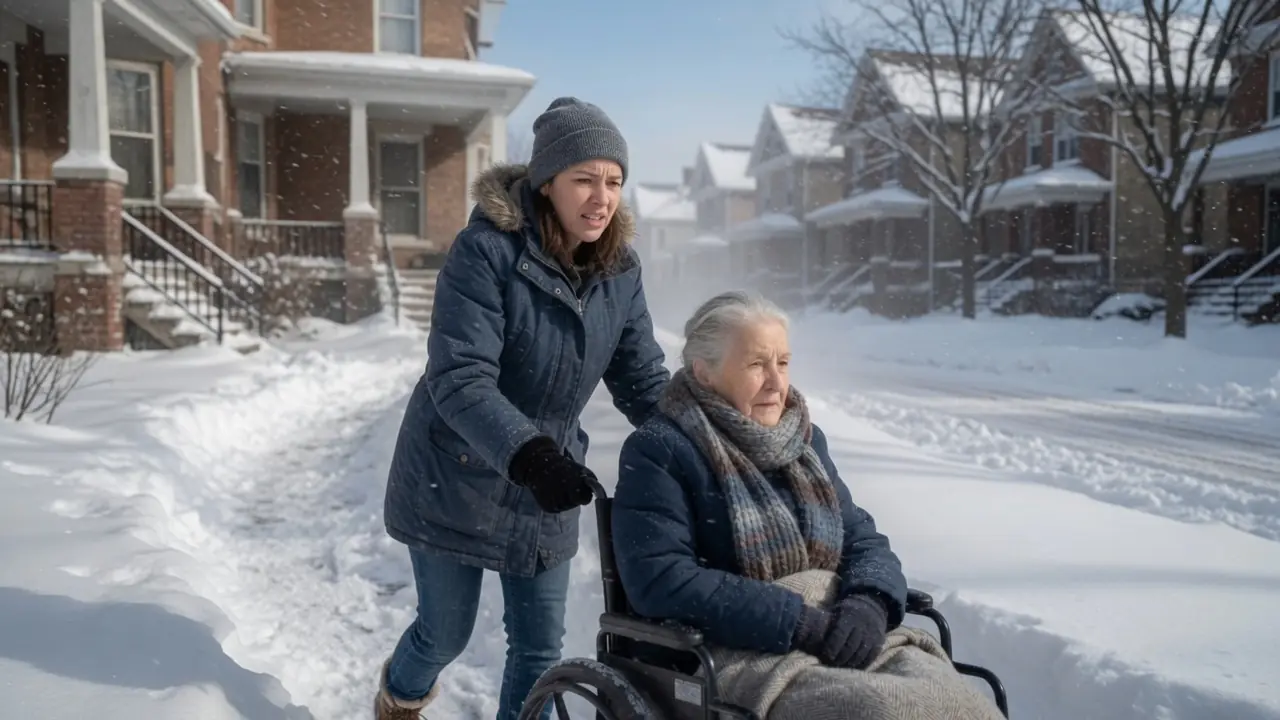
The stranger looked at least eighty, with a deeply wrinkled face, hollow cheeks, and watery blue eyes made brighter by fear. Thin silver hair showed beneath a knitted cap, while a faded navy coat and thick plaid scarf barely protected her from the wind. One front wheel of the chair had collapsed sideways, leaving the metal frame stuck in a ridge of dirty snow. Cars passed at the end of the block, but no one slowed down.
Maya pushed her delivery cart toward the curb and crouched beside the damaged chair. She was thirty years old, strikingly beautiful despite exhaustion, with warm brown skin, expressive dark eyes, short natural curls, and a face that hardship had sharpened without making unkind. Her faded brown work jacket carried the logo of a grocery-delivery service, while patched jeans and snow-covered boots revealed how long she had been outside. The elderly woman watched her remove a small multitool from the delivery bag.
“You don’t have to do this,” the woman said through chattering teeth.
“My son is waiting,” Maya replied, examining the wheel. “But I’m not leaving you alone in this cold.”
“Everyone else walked past.”
“Then hold still. I’m going to see what broke.”
The axle bolt had loosened, allowing the wheel to slide away from the frame. Maya found a bent washer trapped beneath the chair and used the pliers on her multitool to straighten it as much as possible. The repair would not last forever, but it might support the woman long enough to reach a safe place. Maya tightened the bolt until her fingers went numb inside her gray gloves.
The woman looked down at her. “Do you repair wheelchairs?”
“I repair whatever I can’t afford to replace.”
A surprised laugh escaped the woman, though it turned quickly into a cough. Maya tested the wheel, pressed her weight against the handles, and watched the chair move forward without collapsing. She stood, collected the delivery cart, and asked where the woman lived.
“Three blocks uphill,” the woman answered.
Maya looked toward the steep street disappearing into the snow. “Of course it is.”
“You can leave me at the bus shelter.”
“The bus stopped running twenty minutes ago.”
“I don’t want to make you late.”
“You already told me everyone else walked past. I’m not joining them now.”
Maya secured the delivery cart behind the chair with a spare strap and began pushing. The first block was manageable, but the hill became steeper as snow thickened beneath the wheels. Her boots slipped twice, and the cold air cut into her lungs each time she leaned forward. Still, she kept the wheelchair moving.
The woman introduced herself as Eleanor Whitmore. She was eighty-two and had lived in the neighborhood before most of the new apartment buildings appeared. That afternoon, she had attended a community meeting about accessible transportation, but the paratransit vehicle assigned to collect her never arrived. Determined not to miss an appointment, she tried to travel home alone and reached the hill before the wheel failed.
“My name is Maya Carter,” Maya said. “My son is Eli.”
“How old is he?”
“Seven.”
“And he’s waiting alone?”
“With Mrs. Alvarez upstairs. She watches him when my shifts run late.”
Eleanor noticed the guilt in Maya’s voice. “Working to care for a child is not abandoning him.”
“Try explaining that to a boy who has already reheated dinner twice.”
The wheelchair caught in a patch of deep snow. Maya planted both boots, pulled the frame backward, and pushed again until the wheel climbed free. Eleanor offered to get out and walk, but her legs were too weak to support her safely. Maya told her to remain seated and wrapped the loose delivery strap around her own waist for extra leverage.
They reached Eleanor’s building almost forty minutes later. It was an old three-story residence with a narrow ramp beside the front stairs and an entrance door that required more strength than Eleanor could manage alone. Maya pushed her inside, located the elevator, and accompanied her to the second floor. Eleanor’s apartment was modest but clean, filled with books, framed photographs, and several carefully maintained houseplants.
Maya helped her remove the wet coat and checked whether she had food, heat, and a working telephone. Eleanor insisted she was fine, though the shaking in her hands had not stopped. Maya heated water for tea and found a blanket folded across the sofa. Only when color returned to Eleanor’s face did Maya prepare to leave.
Eleanor opened a small purse and removed several folded bills. “Please take this.”
Maya shook her head. “No.”
“You lost time because of me.”
“I lost time because a wheelchair broke.”
“I can afford to pay you.”
“I didn’t ask whether you could.”
Eleanor held the money out again. “At least let me cover your transportation home.”
“My bus pass is already paid for.”
“Then for your son’s dinner.”
Maya zipped her jacket. “Eli would be upset if he knew I charged someone for not leaving her in the snow.”
Eleanor slowly lowered the money. “You are proud.”
“I’m tired.”
“That was not an insult.”
“I know.”
Before Maya reached the door, Eleanor asked for her full name again. Maya repeated it and explained that she worked for the delivery service covering the neighborhood. Eleanor wrote the information on the back of an envelope with a hand that still trembled slightly. Maya assumed the old woman wanted to send a thank-you card.
“You don’t owe me anything,” Maya said.
Eleanor looked up. “That is exactly why I intend to remember you.”
Maya reached home almost an hour later than expected. Eli sat at the kitchen table wearing dinosaur pajamas, his chin resting on both hands while Mrs. Alvarez stirred soup on the stove. He tried to look angry, but relief appeared before he could hide it. Maya hugged him tightly and apologized.
“Did someone need help?” Eli asked.
Maya looked at Mrs. Alvarez, who smiled as though the boy knew his mother too well. “An old woman’s wheelchair broke.”
“And you fixed it?”
“Temporarily.”
“Did she get home?”
“Yes.”
Eli accepted the delay immediately. “Then it’s okay.”
Maya wished the rest of life could forgive so simply. Their rent was nine days late, her electricity bill carried a final warning, and the delivery company had reduced earnings after changing its payment system. The apartment heater worked only when struck lightly on the side, and Eli’s winter boots were already too small.
She ate the remaining soup after he went to bed and calculated the money in her account. If she completed every available shift and nothing unexpected happened, she could pay the rent before the landlord added another fee. That plan depended on Eli staying healthy, the old car starting, and no appliance breaking. Maya’s life was a bridge built from conditions she could not control.
The next morning, she returned to work before sunrise. She delivered groceries to penthouses, medicines to elderly tenants, and expensive desserts to people who complained when traffic added five minutes to their wait. By evening, her shoulders burned from carrying bags up buildings with broken elevators. She thought about Eleanor only once, wondering whether the repaired wheel had held.
Eleanor thought about Maya constantly.
The old woman had not always lived in the modest apartment on the hill. Her late husband, Samuel Whitmore, had founded Whitmore Mobility Services after a construction accident left him dependent on a wheelchair at thirty-nine. What began as a small repair workshop grew into a nonprofit organization that restored mobility equipment, provided home modifications, and operated transitional apartments for older adults and disabled residents.
After Samuel died, Eleanor chaired the organization while professional managers handled daily operations. In recent years, however, the service had expanded too quickly and lost some of the humanity that created it. Clients complained of unanswered calls, rushed assessments, and employees who treated broken chairs as inventory rather than someone’s ability to leave home. Eleanor had attended the community meeting because she wanted to hear those complaints without staff filtering them first.
The failed paratransit pickup confirmed how serious the problem had become. The broken wheel was not staged, and Eleanor had not gone into the snow to test strangers. Yet while sitting helplessly beside the curb, she saw exactly what the organization lacked. Dozens of people noticed her difficulty; only one exhausted woman stopped.
The following day, Eleanor contacted the delivery company and asked for Maya Carter. The supervisor refused to disclose an employee’s personal information, which Eleanor respected. She left her own number and asked that Maya call regarding an item left behind during a recent delivery.
Maya never received the message.
The third day after the rescue, Whitmore Mobility held interviews for a newly created neighborhood-services coordinator. The role required someone who could visit isolated clients, evaluate urgent needs, organize repairs, and rebuild trust between residents and the organization. The board had already interviewed applicants with degrees, management experience, and carefully prepared presentations.
Eleanor rejected every recommendation.
“They understand systems,” the executive director said. “That is necessary.”
“So is understanding what happens while the system is failing.”
“We cannot hire a person because she assisted you once.”
“I agree.”
The director looked surprised.
Eleanor continued, “Find her work record. Speak with people who have actually depended on her. Then decide whether stopping for me was unusual.”
A staff investigator contacted the delivery company, which confirmed that Maya had one of the highest customer ratings in the district despite completing difficult routes. She had never been accused of dishonesty, had refused extra cash accidentally added to orders, and often carried deliveries inside for elderly customers without requesting additional payment. Her supervisor described her as dependable, direct, and sometimes too willing to help people at her own expense.
Mrs. Alvarez told them that Maya cared for neighbors’ children during emergencies and brought groceries to residents who could not afford delivery fees. The public-school office confirmed she attended every meeting involving Eli, even when it meant losing wages. None of those facts guaranteed she could manage a community program, but they suggested her kindness on the snowy hill had not been a performance.
Eleanor asked to meet her.
On Friday evening, Maya returned to her apartment building and found the elderly woman waiting beside the entrance. Eleanor sat in a new wheelchair, wearing a charcoal wool coat and the same plaid scarf. A black accessible van stood near the curb, and a professional-looking woman waited several feet away with a folder in her hands.
Maya stopped on the sidewalk.
Eleanor smiled. “Hello again, sweetheart.”
“Ma’am, what are you doing here?”
“I’m waiting for you.”
Maya looked toward the van. “Did the wheel break again?”
“No. This one is behaving perfectly.”
“Then why are you waiting outside my building?”
“Because you refused my money, and I wanted to make sure what came next could not be mistaken for payment.”
Maya’s expression became guarded. “I don’t need a reward.”
“Good. I did not bring one.”
Eleanor introduced the woman beside her as Nadia Lewis, executive director of Whitmore Mobility Services. Nadia offered Maya the folder, but Maya did not take it immediately. She assumed they wanted publicity, perhaps a photograph of the struggling delivery worker who had rescued the wealthy founder.
“I don’t speak to reporters,” Maya said.
“There are no reporters,” Nadia replied.
“Then what’s inside?”
“A job description and an invitation to interview.”
Maya stared at Eleanor. “You came here to offer me a job because I pushed your wheelchair home?”
“No. I came because I learned how you behave when no one is rewarding you.”
Maya finally opened the folder. The neighborhood-services coordinator position paid more than twice her delivery income and included medical insurance, regular daytime hours, paid training, and an after-school program for employees’ children. The responsibilities involved visiting elderly and disabled residents, coordinating emergency repairs, and making sure requests did not disappear inside office systems.
Maya closed the folder. “I’m not qualified.”
Nadia answered before Eleanor could. “That is what an interview determines.”
“I’ve never managed a nonprofit program.”
“You have managed delivery routes, customer emergencies, childcare, medical appointments, and an unstable household budget,” Nadia said. “Those skills count, though they do not replace training.”
Maya looked down at her stained work jacket. “You already have professional applicants.”
“We do.”
“And they probably have degrees.”
“Several.”
“Then why involve me?”
Eleanor’s voice became firm. “Because one of our clients recently waited sixteen days for a replacement wheelchair wheel. The employee handling the request had excellent qualifications and never once asked how the woman was leaving her apartment during those sixteen days.”
Maya remembered Eleanor stranded beside the curb. “You need someone who asks.”
“We need someone who notices,” Eleanor said.
The interview took place the following Monday. Maya borrowed a navy blazer from Mrs. Alvarez and wore black trousers that were slightly too long. She entered the Whitmore Mobility building convinced everyone would see a delivery worker pretending to belong in an office. Instead, the receptionist greeted her by name and offered directions without looking at her clothes.
The interview panel included Nadia, a repair supervisor, a social worker, and a board representative. Eleanor did not attend. She believed Maya deserved the opportunity to succeed or fail without gratitude influencing the decision.
They asked how Maya would handle too many urgent requests and too little equipment. She said she would separate inconvenience from danger, contact every affected client personally, and never promise a deadline she could not meet. When asked how she would respond to an angry family, she explained that anger often meant someone had already spent days feeling ignored.
The repair supervisor placed a damaged wheelchair caster on the table. “Would you try to fix this yourself?”
Maya examined it. “Only if leaving it broken created immediate danger and no trained technician was available.”
“Why not repair it permanently?”
“Because knowing how to tighten a bolt does not make me a mobility engineer.”
The supervisor nodded.
The final question came from Nadia. “Why did you stop for Mrs. Whitmore?”
Maya thought carefully. “Because she was cold and the chair was broken.”
“That’s all?”
“What else would there be?”
Nadia smiled for the first time.
The committee offered Maya the position two days later. It included a six-month probationary period, professional certification courses, and weekly supervision. Eleanor made clear that Maya could be dismissed if she failed to meet the same standards as anyone else.
Maya appreciated that condition more than the salary.
She accepted.
Her first weeks were overwhelming. She learned equipment terminology, accessibility regulations, documentation requirements, and the limits of what the nonprofit could legally provide. She made mistakes, asked questions, and carried a notebook everywhere.
What she understood immediately were the clients.
She recognized the tone people used when they expected to be dismissed. She knew that “I’m fine” sometimes meant “I cannot afford another problem.” During home visits, she looked beyond the repair request and noticed empty refrigerators, dangerous steps, unpaid heating bills, and family members approaching exhaustion.
Maya did not promise to solve everything.
She connected people with those who could.
Her first major case involved a seventy-six-year-old man named Arthur whose motorized chair failed while he lived on the fourth floor of a building with an unreliable elevator. The standard replacement process required ten business days. Maya called every partner workshop, located a compatible temporary chair, and arranged delivery before evening.
She then asked why the original request had been classified as routine.
“Because he has a manual chair,” an employee explained.
“He has arthritis in both shoulders and cannot propel it.”
“That wasn’t written in the file.”
“Then we need to ask better questions.”
Nadia added that question to the intake process.
Three months later, Whitmore Mobility promoted the change across every branch. Emergency classifications began considering not only whether backup equipment existed, but whether the client could actually use it. Complaints decreased, and response times improved.
Maya’s life changed slowly rather than magically. The salary allowed her to pay bills on time, but old debts did not disappear. She remained in the same apartment until the lease ended, then moved into a modest two-bedroom unit closer to the office.
Eli finally had space for a desk.
The employee health plan covered new glasses and dental work Maya had postponed for years. She bought him winter boots before the first snow instead of waiting until the old pair hurt. On her first paid vacation day, they stayed home, made pancakes, and watched movies without Maya checking her phone for available shifts.
Eleanor became part of their lives, though she resisted being treated as a rescuer. She invited them to lunch, attended Eli’s school play, and told him stories about Samuel building the first wheelchair-repair bench inside their garage. Eli began calling her Miss Eleanor and regularly asked whether her wheels were properly tightened.
One afternoon, he handed her a small wooden sign made during school workshop.
It read: NO ONE GETS LEFT IN THE COLD.
Eleanor hung it inside the mobility center’s reception area.
A year after Maya’s hiring, she became senior coordinator for emergency services. The promotion followed a formal performance review rather than Eleanor’s personal recommendation. She supervised five employees and trained them to begin every request with a simple question.
“What can this person not do safely until we help?”
That question changed conversations. A broken wheel was no longer a maintenance ticket; it might mean someone could not reach the bathroom, attend dialysis, or leave during a fire. A delayed ramp repair could trap a parent inside with a child. A missed transport could place an eighty-two-year-old woman alone in a snowstorm.
Eleanor’s health declined during the second year. She reduced her public duties and moved into an accessible apartment connected to one of the organization’s senior communities. Maya visited often, sometimes for work and sometimes because both had become family to each other.
During one winter visit, snow began falling outside Eleanor’s window. She watched it silently for several minutes.
“Do you ever regret stopping?” she asked.
Maya laughed softly. “I regretted the hill.”
“I mean afterward. Everything that followed.”
“No.”
“You worked hard enough to earn opportunities without helping me.”
“Maybe. But people work hard their whole lives and still never meet someone willing to open the right door.”
Eleanor turned toward her. “I did not give you the ability.”
“No. You recognized it.”
“That matters to you?”
“It matters to everyone.”
Eleanor died peacefully at eighty-six, four years after the day Maya found her stranded. Most of her estate passed into the nonprofit foundation Samuel created. She left no secret mansion or enormous personal inheritance to Maya.
She left her first wheelchair.
It had been repaired, polished, and displayed inside the organization’s training center. Attached to it was a small envelope containing the bent washer Maya had straightened in the snow.
Eleanor’s letter contained only a few lines.
Dear Maya,
This chair carried me into the moment when I learned our organization had forgotten why Samuel built it. You repaired more than a wheel that evening. You reminded me that care must reach people before paperwork does.
Keep the washer. Let it remind you that small things can hold more weight than anyone expects.
Maya framed the washer beside Eli’s wooden sign.
Years later, she became executive director of Whitmore Mobility Services. Under her leadership, the organization expanded its emergency-repair teams, created paid apprenticeships for struggling parents, and established mobile workshops in neighborhoods where residents had waited too long for help.
Maya never required employees to be saints.
She expected them to notice.
On the tenth anniversary of Eleanor’s rescue, Maya attended the opening of a new community mobility center. Eli, now seventeen, stood beside her wearing a volunteer badge and holding a toolkit. Snow covered the sidewalks outside.
During the ceremony, someone asked Maya which moment changed her life.
She looked toward Eleanor’s restored wheelchair displayed near the entrance.
People expected her to describe receiving the job offer three days after the rescue. Instead, she remembered the deserted hill, her aching back, Eli waiting for dinner, and an old woman insisting she did not have to stop.
“My life changed before I knew anyone would come looking for me,” Maya said. “It changed when I decided being tired was not a good enough reason to leave someone helpless.”
After the ceremony, she and Eli walked toward their car.
Across the street, a man using a walker struggled with a snow-covered curb. Several people passed without noticing.
Eli was already moving before Maya said anything.
He crossed the sidewalk, introduced himself, and offered his arm.
Maya watched from beneath the falling snow.
Eleanor had once said that kindness should not return as a debt. It should move forward as responsibility. Maya finally understood what that meant.
Three days after she helped a stranded woman, someone came looking for her.
Years later, countless people found help because Maya had once stopped.