Arrogance turned into absolute terror the moment Brandon Collins, the town’s most feared bully, tried to force an elderly stranger out of his favorite diner booth.
He expected a pathetic, cowering victim. Instead, he unleashed a storm he could not escape.
When a tactical convoy swept into the parking lot and a four-star general stepped out to salute the man Brandon had just dragged through the mud, the entire town watched in stunned silence as the Collins family’s empire began crumbling within seconds.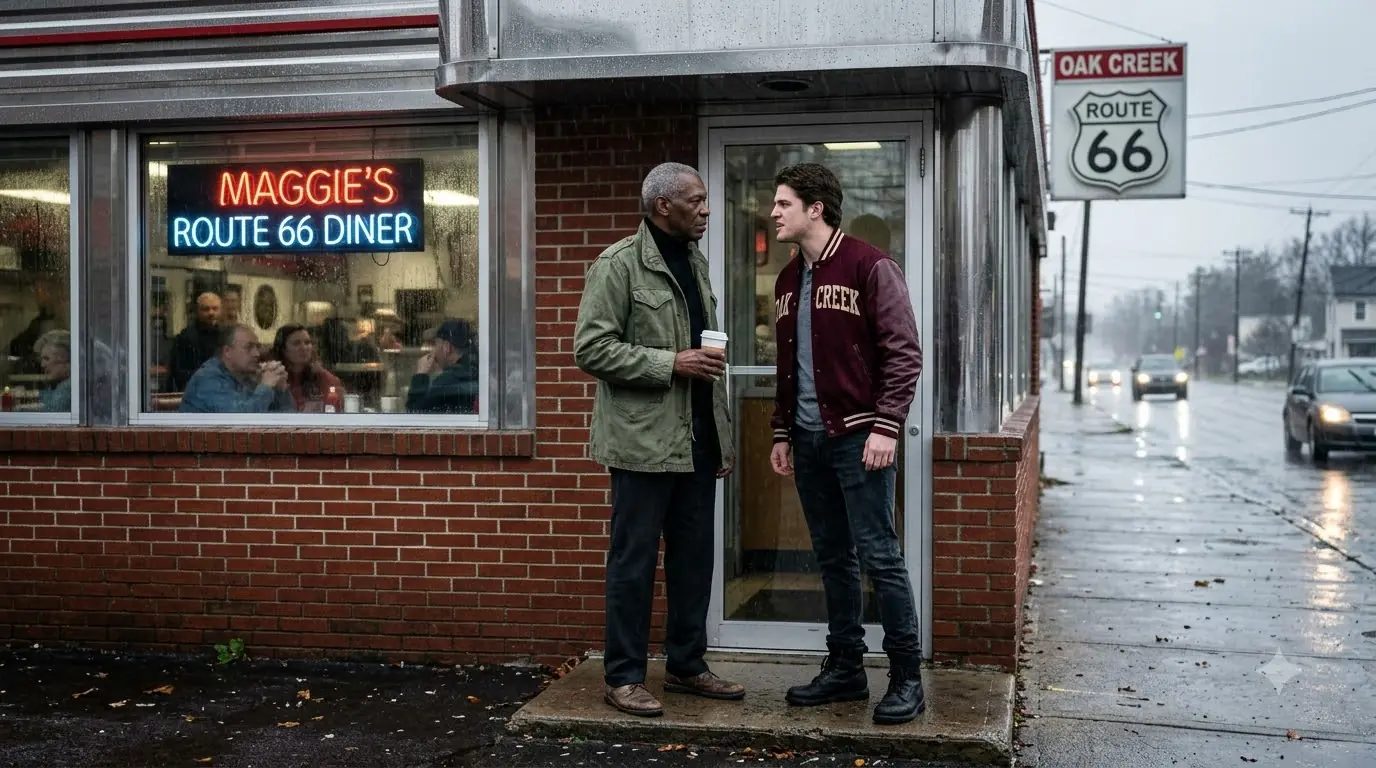
The town of Oak Creek, Pennsylvania, was the kind of place that looked picture-perfect on a postcard but held dark, suffocating secrets beneath its manicured surface. It was a town where everyone knew everyone and, more importantly, everyone knew their place.
At the very top of that unspoken hierarchy was Police Chief Richard Collins.
For nearly two decades, Chief Collins had run Oak Creek less like a public servant and more like a feudal lord. His word was law, his grudges were permanent, and his son Brandon was the crown prince who enjoyed every benefit of his father’s unchecked authority.
It was a damp, gray Tuesday afternoon in late October when the fragile peace of Oak Creek was irrevocably shattered.
The setting was Maggie’s Route 66 Diner, a chrome-and-neon relic sitting near the county line. The diner was a local institution, famous for its cherry pie, bottomless black coffee, and the weary but warm demeanor of its owner, Margaret “Maggie” Sullivan.
On that particular afternoon, the diner was half full. A few long-haul truckers occupied the stools at the counter, while two local farmers sat in the corner discussing the unseasonable frost.
Sitting alone in Booth Four, the best booth in the diner, with a clear view of both the highway and the front door, was a stranger.
His name was Lewis Hayes.
Lewis was a Black man in his late sixties, although his posture suggested someone much younger. His hair was cropped close to his scalp and heavily peppered with gray. His face was marked by the deep, defining lines of a man who had spent a lifetime making difficult decisions in harsh environments.
He wore a faded olive-drab field jacket without patches or insignia over a simple black turtleneck.
Lewis sat perfectly still. He was not staring at a telephone or reading a newspaper. He was simply eating his eggs and drinking his coffee, his dark eyes calmly scanning the room with a quiet, observant intensity that most people would never notice.
A trained professional, however, would have immediately recognized it as situational awareness.
Lewis had been driving across the country, taking the back roads and enjoying the silence of retirement. He had stopped in Oak Creek purely by chance, needing a hot meal and a break from the monotonous interstate.
He knew nothing about the town’s politics. He did not understand its unwritten rules, and he certainly did not know that Booth Four was unofficially reserved for the Collins family.
The brass bell above the diner’s glass door chimed loudly, cutting through the low hum of the jukebox.
Brandon Collins walked inside, flanked by his two usual followers, Trent and Logan.
Brandon was twenty-two years old, built like a linebacker, and wore his arrogance like heavy cologne. He was dressed in an expensive letterman jacket from a nearby university, an institution he attended largely because his father had made generous donations to its athletic department.
Brandon was notorious throughout Oak Creek.
He had a history of driving offenses that mysteriously vanished from official records. He had been involved in bar fights where the other person always ended up in handcuffs. He possessed a vicious temper that the townspeople had learned to avoid at all costs.
Brandon shook the rain from his hair while laughing loudly at a crude joke Trent had made. He strutted into the diner expecting the usual reaction, hushed conversations, lowered eyes, and Maggie rushing toward him with a fresh pot of coffee.
Maggie tensed behind the counter.
She grabbed a rag and wiped a spotless section of Formica, her eyes darting nervously toward Booth Four.
Brandon’s laughter died in his throat when he noticed Lewis.
He stopped in the middle of the diner, his heavy boots scuffing against the black-and-white checkered linoleum. His jaw tightened.
He looked at Trent, then Logan, and a cruel, predatory smile slowly spread across his face.
“Maggie,” Brandon called, his voice booming over the soft country song playing from the jukebox. “Why is there a stray sitting in my booth?”
The diner fell silent.
The farmers stopped talking. The truckers lowered their forks.
Tension spread through the room instantly, thick and suffocating.
Maggie swallowed hard and stepped out from behind the counter.
“Brandon, please. There are plenty of other booths available. He’s only passing through. Let him finish his meal.”
Brandon ignored her.
He did not break eye contact with Lewis, who had not even flinched at the insult. Lewis continued slowly cutting his toast, his movements deliberate and unhurried.
“I don’t think you heard me, Maggie,” Brandon said, taking a slow, heavy step toward Booth Four. “I said there’s a stray in my booth. You know I don’t like eating where vagrants have been putting their dirty boots.”
Lewis paused.
He placed his knife and fork on the porcelain plate. The clinking sound was soft, but in the dead silence of the diner, it echoed through the room.
Lewis picked up his coffee mug, took a slow drink, and returned it to the table.
He did not look at Brandon. He merely stared through the rain-streaked window.
“Hey!” Brandon barked, closing the distance until he towered over the table. “Old man, are you deaf? I’m talking to you.”
Lewis slowly turned his head.
His expression was completely blank. There was no fear in his eyes and no visible anger. It was a look of cold, calculating assessment.
He regarded Brandon the way a scientist might regard a mildly irritating insect.
“I’m eating,” Lewis said.
His voice was deep and gravelly, carrying an immediate and undeniable authority. He did not speak loudly, but the words seemed to resonate in the chest of everyone listening.
Trent and Logan exchanged shocked looks.
No one in Oak Creek spoke to Brandon Collins that way.
Not ever.
Brandon’s face turned a deep crimson. The veins in his thick neck became visible.
He was not accustomed to defiance, especially from an outsider and certainly not in front of his friends and the townspeople he regularly intimidated.
His smile vanished, replaced by a twisted mask of rage.
“Son?” Brandon hissed.
He leaned over the table and pressed both hands against the Formica.
“Do you have any idea who you’re talking to? My father is Chief Richard Collins. This town belongs to us. This diner belongs to us, and this booth belongs to me.”
He brought his face closer to Lewis.
“You have exactly three seconds to get out of that seat before I throw you through the front window.”
Lewis did not blink or shift his weight.
He looked at Brandon’s hands, then raised his gaze to the young man’s furious eyes.
“One,” Brandon counted.
Maggie hurried forward with her hands trembling.
“Brandon, stop. I’ll pay for your meal. Just leave him alone, please. He doesn’t understand.”
“Two,” Brandon sneered, ignoring her.
Lewis released a quiet sigh.
It was not a sigh of fear. It was the sigh of profound exhaustion, the sound of a man who had spent a lifetime watching boys pretend to be men and already knew how such confrontations usually ended.
“Three.”
Brandon did not wait for Lewis to move.
Driven by wounded pride and blind entitlement, he swept his arm across the table, knocking Lewis’s plate, coffee mug, and silverware onto the floor.
The ceramic shattered loudly. Hot black coffee splashed across the legs of Lewis’s faded olive trousers.
Maggie screamed.
The truckers flinched, but fear of Chief Collins’s retaliation kept them in their seats. Their knuckles turned white as they gripped the counter.
Lewis looked down at the shattered dishes and the coffee staining his trousers.
Then, very slowly, he stood.
Despite his age, Lewis was six feet two inches tall. When he straightened fully, he cast an imposing shadow across Brandon.
He did not expand his chest or raise his fists. Yet the sheer, immovable presence he projected caused Brandon to take an instinctive half step backward.
For a fraction of a second, uncertainty crossed the young bully’s face.
But Brandon could not retreat, not in front of Trent, Logan, and the town.
“You think you’re tough, old man?” Brandon spat, struggling to recover his bravado. “You think standing up means I can’t put you right back down?”
Lewis looked directly into his eyes.
“You have made a severe miscalculation, young man. I strongly suggest that you pay for the dishes, apologize to the lady, and walk away.”
The calmness of his delivery infuriated Brandon more than a shouted threat would have.
Lewis sounded dismissive.
Almost pitying.
With an angry grunt, Brandon lunged forward and grabbed the lapels of Lewis’s faded field jacket with both hands.
To an untrained observer, it looked like a strong, aggressive young man overpowering a vulnerable elderly stranger.
To someone with professional experience, a completely different confrontation was unfolding.
As Brandon grabbed him, Lewis subtly shifted his center of gravity. His hands moved almost imperceptibly, guided by deeply ingrained muscle memory.
For the briefest moment, Lewis prepared to disable Brandon and end the confrontation immediately.
Then he stopped himself.
In a fraction of a second, he made a tactical decision.
Lewis possessed the training and speed to defend himself. He also saw the terrified expressions of the patrons and Maggie weeping near the counter.
He understood that if he seriously injured the police chief’s son, Oak Creek’s corrupt police force would descend upon the diner. Maggie’s livelihood could be destroyed, and the innocent witnesses could face retaliation.
Lewis chose to absorb the indignity.
He decided to let Brandon expose himself.
Lewis relaxed his body and offered no resistance.
Brandon, fueled by adrenaline and entirely unaware of how close he had come to being effortlessly restrained, yanked Lewis forward.
“Get out of my diner!” Brandon roared.
He released a manic laugh as he dragged the older man out of the booth.
“Brandon, please!” Maggie cried as she reached for the telephone. “I’m calling the police.”
“I am the police, Maggie!” Brandon shouted, jerking Lewis toward the door.
Trent and Logan laughed and encouraged him as though they were attending a college party.
Lewis allowed himself to be pulled. His boots dragged across the checkered floor and squeaked against the linoleum.
He kept his hands at his sides and his face hidden behind an impenetrable mask of calm.
Lewis continued assessing the environment. He noted the security camera in the corner, the placement of the exits, and the positions of every person in the diner.
He remained detached from the humiliation being inflicted upon him.
Brandon shoved the glass door open with his shoulder and dragged Lewis into the cold, drizzling rain.
The gravel parking lot was slick with mud.
“Look at this!” Brandon shouted toward the nearly empty parking lot, spinning Lewis around. “Look at the tough guy now.”
He shoved Lewis backward.
Lewis controlled his fall, rolling his shoulder to absorb the impact as he struck the wet gravel and came to rest on one knee in a muddy puddle.
Brandon stood over him, his chest heaving and a triumphant grin spread across his face.
Trent and Logan ran outside, cheering and congratulating Brandon.
Inside the diner, the patrons watched through the large neon-lit windows. Their faces were pale with guilt and horror.
“You see that, old man?” Brandon taunted, kicking wet gravel toward Lewis’s face. “That’s what happens when you don’t know your place. The next time you come through Oak Creek, keep your head down and keep driving.”
Lewis did not wipe the gravel from his cheek.
He remained on one knee in the rain and looked up at Brandon.
“Are you finished?” he asked.
His voice was as calm and steady as it had been inside.
Cold rain dripped from Lewis’s short gray hair and washed the dirt down his jawline.
Brandon’s smile faltered.
The absence of fear and begging unsettled him.
“I’ll be finished when I say I’m finished,” he growled.
He lifted his boot, preparing to strike the kneeling man.
The blow never came.
Before Brandon could shift his weight, the ground beneath them began to vibrate.
It was not a subtle tremor. It was a deep, rhythmic rumble that seemed to shake the rain from the air.
It sounded like a freight train approaching along the county highway, although there were no railroad tracks for miles.
Brandon lowered his foot and frowned toward the road.
Trent and Logan stopped laughing.
Inside the diner, patrons moved closer to the windows.
Through the gray mist and pouring rain, headlights pierced the gloom.
Not two headlights.
Dozens.
They appeared over the crest of the hill in a perfectly spaced formation.
Two heavy-duty police interceptors led the convoy. They were not Oak Creek cruisers. They belonged to the Pennsylvania State Police, their red and blue lights flashing silently through the dreary afternoon.
Directly behind the state troopers came the source of the deep rumbling.
Six matte-black, heavily armored Chevrolet Suburbans moved down the highway. They carried no civilian license plates, only federal government markings on their bumpers.
The vehicles were massive and intimidating, moving with synchronized precision.
Two olive-drab military transport vehicles followed the Suburbans, their heavy tires churning across the wet asphalt.
The convoy did not pass the diner.
Every vehicle turned into the parking lot.
Brandon froze.
His heart began pounding against his ribs. The smug arrogance disappeared from his face and was replaced by profound confusion.
He stepped away from Lewis and instinctively retreated toward his friends.
The state police cruisers positioned themselves near the highway entrances, securing the parking lot.
The six black Suburbans spread into a semicircle, surrounding Brandon, Trent, Logan, and the kneeling Lewis.
Their engines idled with a low, steady rumble.
For several seconds, the only sound was the rain striking the armored roofs.
“What is this?” Trent stammered, backing toward the diner’s brick wall.
Brandon straightened his shoulders and tried to recover his confidence.
“It’s probably a federal motorcade or some task force. My father said they were conducting exercises upstate. They probably need directions or want to use the diner.”
He wiped rain from his eyes and stepped forward, adjusting his expensive jacket.
Brandon prepared to introduce himself as the police chief’s son.
He expected deference. He believed he belonged to the same class of authority represented by the convoy.
The doors of the Suburbans opened simultaneously.
The coordination was flawless.
More than a dozen men and women stepped out in tactical military uniforms. They did not carry umbrellas or appear to notice the rain.
They were broad-shouldered, alert, and efficient. Without drawing their weapons, they established a secure perimeter around the parking lot.
Then the rear door of the lead Suburban swung open.
A man stepped out.
He appeared to be in his late fifties, with sharp features and neatly parted silver hair. He wore the immaculate dress uniform of a four-star United States Army general.
The dark green fabric stood out against the gray afternoon.
Four silver stars gleamed on his shoulders.
General Thomas Harrington, commander of United States Strategic Command, was a man whose name carried enormous respect throughout the Pentagon. He had commanded major operations and advised national leaders during international crises.
The general did not look toward the diner.
He did not acknowledge the rain.
He certainly did not look at Brandon Collins, who stood with his mouth open in disbelief.
General Harrington’s attention was fixed entirely on the elderly Black man kneeling in the mud.
Brandon misunderstood the situation through the lens of his own enormous ego. He assumed the general regarded the stranger with the same contempt Brandon did.
He stepped forward and raised one hand.
“General, sir!” Brandon shouted over the rain. “I’m Brandon Collins, the police chief’s son. I apologize for the mess. I was just clearing this vagrant off the property so you and your men could use the facilities.”
General Harrington did not acknowledge Brandon’s existence.
He walked directly past the twenty-two-year-old bully as though Brandon were nothing more than dirty water on the asphalt.
The parking lot became completely silent, except for the steady rain.
Inside the diner, Maggie and the patrons held their breath, unable to understand what they were witnessing.
General Harrington stopped three feet from Lewis.
He stood perfectly straight and brought his boots together with a sharp sound that echoed against the armored vehicles.
He squared his shoulders and deliberately raised his right hand in a flawless military salute.
He held it there.
“Colonel Hayes, sir,” General Harrington said, his voice clear and powerful. “It is an honor to finally find you. The Joint Chiefs have been searching across the Eastern Seaboard.”
Brandon’s blood turned colder than the Pennsylvania rain.
His eyes moved from the saluting four-star general to the man he had dragged through the mud.
Lewis Hayes, the quiet elderly man in the faded jacket, the person Brandon had called a vagrant and shoved into the gravel, did not immediately rise.
Lewis slowly wiped the wet gravel from his cheek.
He looked at the mud on his hands, then raised his eyes toward the four-star general.
He sighed with profound, world-weary annoyance.
“Thomas,” Lewis said quietly from the mud, “I told the Pentagon I was retired. I specifically requested no parades.”
General Harrington maintained the salute. A slight smile appeared at the corners of his mouth.
“With respect, Colonel, when the President of the United States requests your advice on a matter of national security, your retirement is considered temporarily suspended. Allow me to help you stand, sir.”
“I can stand on my own, Thomas,” Lewis replied.
With a fluid grace that contradicted his age, Colonel Lewis Hayes rose from the mud.
He did not dust off his knees or inspect his clothing.
He stood at his full height, looked General Harrington in the eye, and sharply returned the salute.
Only then did the general lower his hand.
Brandon Collins felt his knees weaken.
His arrogance had disappeared, replaced by suffocating terror.
He backed into Trent, who was visibly shaking.
Lewis finally turned away from the general and looked at Brandon.
His expression had not changed.
It was the same cold, calculating assessment he had given the bully inside the diner, but the presence of the federal convoy now gave that gaze an entirely different weight.
“General,” Lewis said without looking away from Brandon.
“Yes, Colonel?” Harrington replied, turning his attention toward the pale young man.
“This young man was explaining that this town belongs to him and his father,” Lewis said, pointing one mud-stained finger at Brandon. “I believe he also claimed that he is the police.”
General Harrington’s eyes narrowed.
He studied Brandon’s expensive jacket, trembling hands, and rapidly collapsing courage.
The general’s expression filled with disgust.
“Is that so, Colonel?”
“Indeed,” Lewis replied, stepping closer to Brandon. “He also owes the lady inside for a broken plate and spilled coffee.”
Brandon opened his mouth.
He wanted to apologize, scream, or run, but no sound emerged.
The crown prince of Oak Creek had realized that his father’s badge could not protect him from the authority he had recklessly provoked.
The wail of a police siren cut through the rain and echoed across the Pennsylvania hills.
A heavily modified Ford Explorer police cruiser roared down the two-lane highway, its light bar flashing red and blue through the afternoon mist.
The cruiser turned sharply into the parking lot and stopped near one of the military Suburbans.
The driver’s door opened.
Chief Richard Collins stepped out.
Richard Collins wore his authority like a loaded weapon.
He was built like a wall, with a uniform tailored tightly across his broad chest and heavy stomach. His face was ruddy, his jaw thick, and his eyes carried the permanent suspicious squint of a man accustomed to finding reasons to punish people.
He rested one hand against the holster on his hip while surveying the scene.
Maggie had called the police when Brandon began dragging Lewis outside. She had hoped the chief might stop his son or at least prevent the confrontation from becoming worse.
Chief Collins looked at the federal vehicles, state police cruisers, and tactical personnel standing in the rain.
His confusion quickly transformed into defensive anger.
“Brandon!” Chief Collins shouted. “Get over here.”
Brandon, frozen with fear, scrambled toward his father and nearly tripped over his boots.
He moved behind the chief’s broad shoulder, his former bravado completely gone.
“Dad,” Brandon stammered. “I didn’t know. They…”
Chief Collins pushed his son behind him and marched forward, his boots crunching across the wet gravel.
He ignored the four-star general standing in the middle of the parking lot.
His attention settled on Lewis, whose trousers and field jacket were stained with mud.
In Richard Collins’s mind, Oak Creek remained his town, his jurisdiction, and his domain.
“I don’t know what kind of federal circus this is,” Chief Collins said, stopping several feet from the military detail. “But I am the chief of police in Oak Creek, and nobody conducts an operation in my jurisdiction without my authorization.”
He glared at General Harrington.
“I suggest that you load your people back into those vehicles and move along. I have a vagrant to arrest for assaulting my son.”
The silence that followed was absolute.
None of the tactical operators moved. They did not even shift their weight.
They simply stared at Chief Collins through the rain.
General Harrington, who had spent his career negotiating with international leaders and managing global crises, regarded the small-town police chief with clinical disbelief.
Lewis merely sighed.
He reached into his pocket, removed a neatly folded white handkerchief, and began wiping the mud from his hands.
“Assaulting your son?” General Harrington repeated, his voice low and controlled.
“You heard me,” Collins snapped, stepping closer. “This stranger came into my town, caused a disturbance in Maggie’s diner, and laid his hands on my boy. That’s aggravated assault. He’s going to a holding cell, and you federal boys can conduct your exercises somewhere else.”
General Harrington turned toward Lewis.
“Colonel Hayes, did you assault this man’s son?”
Lewis folded his handkerchief and returned it to his pocket.
He looked at Chief Collins, then at Brandon hiding behind him.
“Thomas,” Lewis said, “if I had chosen to injure that boy, this conversation would look very different. I allowed him to drag me outside because it seemed the most efficient way to de-escalate the situation and protect the civilians inside from his temper.”
Chief Collins’s face turned purple with rage.
“You lying…”
He lunged forward, one hand moving toward his holster.
He did not complete the movement.
Two tactical operators stepped between the chief and Colonel Hayes with astonishing speed. Several others shifted into protective positions.
Chief Collins froze with his hand hovering near his sidearm.
“Chief Collins,” General Harrington said, his voice now carrying the full authority of his command, “you are reaching for a weapon in the presence of the commander of United States Strategic Command and a highly decorated former commander of a special operations unit.”
The general’s eyes hardened.
“Remove your hand from your hip immediately, or my protective detail will respond with necessary force.”
The words hung in the rain.
Inside the diner, several veterans among the truckers exchanged stunned looks.
Chief Collins slowly raised his hands and stepped backward. The color drained from his face.
“You don’t know who this man is, do you?” General Harrington asked, gesturing toward Lewis. “Allow me to educate you.”
He stepped closer to Collins.
“Colonel Lewis Hayes is a two-time recipient of the Distinguished Service Cross. He holds three Silver Stars. He led critical operations during some of the most dangerous conflicts of his generation.”
General Harrington’s gaze remained fixed on the corrupt chief.
“He spent thirty-five years accepting missions in hostile environments so that men like you could sleep safely and pretend that intimidation was the same thing as power.”
Harrington glanced toward Brandon.
“Your son did not overpower Colonel Hayes. Your son is standing unharmed because Colonel Hayes possesses extraordinary discipline and mercy.”
Brandon began quietly sobbing behind his father.
The reality of what he had done, and how badly the encounter could have ended, was finally reaching him.
The nightmare for the Collins family, however, was only beginning.
Chief Collins attempted to recover whatever fragments of dignity he had left.
“Fine,” he said, although his voice trembled. “You federal people want to protect your own? Take him. Get him out of my town. But don’t let me find him passing through Oak Creek again.”
Lewis stepped forward.
The tactical operators moved aside.
He walked directly to Chief Collins until the two men stood face-to-face.
Despite the mud covering his clothes, Lewis radiated absolute authority.
“You misunderstand the situation, Mr. Collins,” he said quietly. “I am not the person leaving this town.”
“You are,” Collins replied, but uncertainty had entered his voice.
Lewis looked toward General Harrington.
“Thomas, I noticed two Pennsylvania State Police cruisers accompanying your convoy. Were they present only for traffic control, or did Agent Miller finally receive authorization?”
General Harrington smiled.
It was not a warm smile.
“Agent Miller has been waiting patiently for a secure federal perimeter around this town. Your incident provided the perfect opportunity, Colonel.”
Before Chief Collins could understand the meaning of those words, the doors of the state police interceptors opened.
Four state troopers stepped out, followed by a tall man in a dark suit carrying a thick manila folder.
He was Special Agent David Miller, the lead investigator in a joint state and federal corruption inquiry.
Agent Miller crossed the wet gravel, ignoring the rain soaking his suit.
His attention remained fixed on Chief Richard Collins.
“Richard Collins,” Miller announced, “you are hereby relieved of your duties as chief of police for Oak Creek.”
Collins took a step backward. Genuine fear finally broke through his arrogant expression.
“Miller, what is this? You can’t do this. I have the mayor. I have the judges.”
“Not anymore, Richard,” Miller interrupted.
He opened the folder.
“As of six o’clock this morning, a federal grand jury unsealed a forty-two-page indictment against you. We have recorded conversations, financial accounts, extortion records from local businesses, evidence of interference in your son’s driving cases, and racketeering charges covering more than a decade.”
Agent Miller gestured toward the diner.
“We also have testimony from Margaret Sullivan regarding the weekly protection payments you forced her to make simply to keep her business open.”
Inside the diner, Maggie covered her mouth.
Tears streamed down her face.
She was no longer crying from fear.
She was crying from overwhelming relief.
The nightmare that had held Oak Creek hostage for nearly twenty years was finally ending.
“You have no jurisdiction without a local warrant!” Collins shouted, losing control. He reached for the radio attached to his uniform. “I’m calling my deputies. Every officer in Oak Creek will be here within minutes.”
“I doubt that,” Agent Miller said calmly. “Federal teams are currently executing search warrants at your precinct and your residence. Several of your deputies are already in custody. Others are cooperating with investigators.”
Collins stood paralyzed.
The empire he had built through fear and intimidation was dissolving before his eyes.
“Arrest him,” Miller ordered.
The state troopers moved forward.
Brandon panicked.
The twenty-two-year-old bully understood that his shield was gone. For the first time, he would face the consequences of years of cruelty.
He made the worst decision available to him.
Brandon shoved his father toward the approaching troopers and ran toward the woods behind the diner.
“Run, Brandon!” Trent and Logan yelled.
A second later, both men dropped to their knees and placed their hands behind their heads, too frightened to move.
Brandon sprinted across the wet gravel, his heavy boots slipping in the mud.
He did not make it ten yards.
One of the protective operators stepped into his path and used a controlled maneuver to bring him safely to the ground.
Before Brandon could recover, the operator restrained his arms behind his back.
“Suspect secured,” the operator said.
A state trooper moved forward and placed Brandon in restraints.
Near the cruisers, Chief Collins was positioned against the hood of his own vehicle. He shouted and cursed while the troopers removed his badge and service weapon.
The metallic sound of handcuffs closing around his wrists echoed across the parking lot like a judge’s final gavel.
Lewis watched with quiet satisfaction.
He turned toward General Harrington.
“A little theatrical, Thomas,” Lewis observed dryly. “But effective.”
“We do what we must for national security, Colonel,” Harrington replied. “Removing local corruption was an additional benefit.”
The general’s expression became serious again.
“We have a secure aircraft waiting at Andrews Air Force Base. The presidential briefing is scheduled for eighteen hundred hours. Will you come with us?”
Lewis looked at the armored Suburbans, then back toward the diner.
Maggie stood in the doorway with her hands clasped together. She looked at him with awe and gratitude.
“Give me five minutes, Thomas,” Lewis said. “I still owe a lady for a broken plate.”
Lewis walked back toward the diner.
The patrons moved aside to let him pass.
He approached Maggie and removed a leather wallet from inside his jacket. He placed a crisp one-hundred-dollar bill on the counter.
“For the dishes, ma’am,” Lewis said softly. “And the coffee. It was excellent.”
Maggie shook her head as tears spilled down her cheeks.
“No, sir. Please. Your money is no good here. Not today and not ever.”
She looked through the window at Richard and Brandon Collins being placed into separate police vehicles.
“Thank you for what you did.”
Lewis offered a small smile, the first one he had shown all afternoon.
“I didn’t do anything, Maggie. The truth finally caught up with them.”
He turned and walked back into the rain.
The citizens of Oak Creek watched as the quiet stranger they had mistaken for a helpless vagrant climbed into the back of a heavily armored federal vehicle.
The convoy left behind a town that would never be the same.
The heavy door of the Suburban closed, sealing Lewis inside a soundproof, climate-controlled cabin that smelled faintly of gun oil and polished leather.
Outside the tinted ballistic glass, the shocked citizens of Oak Creek and the handcuffed remains of the corrupt police department faded into the rainy distance.
The convoy moved smoothly onto the highway.
General Harrington pressed a button on the center console. The privacy partition separating them from the driver rose, and the soft interior lighting shifted.
“I apologize for interrupting your drive, Colonel,” Harrington said as he opened a secured box built into the floor. “I know you were enjoying the scenic route to nowhere in particular.”
“I was eating a surprisingly good plate of eggs, Thomas,” Lewis replied, leaning back against the leather seat.
He no longer resembled the weary elderly traveler from the diner. His posture changed, and his eyes sharpened.
The experienced strategist the military had spent decades developing had returned.
“You didn’t mobilize a protective detail and coordinate a major state operation merely to give me a ride,” Lewis said. “What’s the situation?”
Harrington removed a thick classified folder from the secure compartment and handed it across the cabin.
“Forty-eight hours ago,” Harrington began, his tone shifting into the grave cadence of an operational briefing, “a highly sensitive intelligence extraction failed in the Chechen borderlands.”
Lewis opened the folder.
“An American operative was moving a defecting Russian biological weapons engineer toward a safe location in Tbilisi. Their convoy was ambushed. The engineer died during the attack.”
The first page contained a high-resolution satellite image of a damaged convoy in a snow-covered mountain pass.
“The operative was captured alive,” Harrington continued. “An unauthorized mercenary group is holding him inside a fortified, decommissioned Soviet radar station. We have satellite surveillance, but the position is deep inside hostile territory.”
Lewis turned to the next page.
It showed a bruised man staring defiantly into a camera held by his captors.
Lewis’s expression hardened.
The captive was Samuel Bennett.
Samuel had once been among Lewis’s most promising recruits, an Ohio farm boy with an exceptional mind and remarkable composure under pressure.
Lewis had personally trained him, taught him how to endure severe conditions, and treated him like the son he had never had.
“They sent a proof-of-life recording directly to Langley this morning,” Harrington continued, watching Lewis carefully. “They don’t want money. They want to exchange him for three high-value prisoners.”
“The President refuses to negotiate,” Lewis said.
“He refuses to negotiate,” Harrington confirmed. “But he also refuses to abandon Bennett.”
Lewis looked at Samuel’s photograph.
“Who commands the mercenary group?”
Harrington slid another photograph across the table.
It was a grainy surveillance image of a tall, scarred man smoking a cigar.
“Grigori Volkov,” Harrington said. “The same Volkov you encountered in Beirut in 1998.”
Lewis stared at the image.
The ghosts of his past had collided violently with the present.
Volkov was a brutal man who remembered every humiliation and carried grudges for decades.
If Volkov knew that Samuel Bennett had been trained by Lewis Hayes, he would make the captivity deeply personal.
“The Joint Chiefs presented three possible rescue plans,” Harrington said. “Each carries an unacceptable risk to Bennett and the recovery team.”
“And the fourth option?” Lewis asked, closing the folder.
“The President asked what Colonel Lewis Hayes would do.”
Harrington leaned forward.
“We have an aircraft waiting at Andrews with specialized equipment and a handpicked team from your former unit. They refused to proceed until you reviewed the operation.”
“You need my assessment.”
“We need your mind, Lewis. You understand Volkov’s defensive instincts better than anyone still alive. We need you to identify the weakness in his perimeter.”
Lewis looked through the window.
The rain had stopped, giving way to a bruised purple twilight.
He thought about Brandon Collins, a young man who believed power consisted of a badge, a famous father, and a loud voice.
Then he thought about Samuel Bennett, a man who understood that true power required sacrifice.
“Tell the pilot at Andrews to begin the preflight inspection,” Lewis said, unbuttoning his soiled field jacket. “Get me a secure connection to Langley. I want every available satellite image and structural record related to that facility.”
General Harrington smiled, genuine relief passing across his weathered face.
“Welcome back, Colonel.”
While Lewis prepared to help direct a rescue operation halfway across the world, Oak Creek experienced its own upheaval.
Maggie’s diner became the center of the corruption investigation. Federal and state agents entered the town, seized records from the police precinct, audited municipal offices, and interviewed deputies eager to cooperate.
Local news stations learned about the raids.
By nightfall, helicopters circled above Oak Creek.
The story was sensational.
A deeply entrenched police chief and his tyrannical son had been arrested during a sweeping corruption investigation, all following an altercation with a mysterious stranger at a roadside diner.
Maggie Sullivan found herself surrounded by reporters holding microphones and asking about the man whose arrival had coincided with the fall of the Collins empire.
Maggie smiled.
“He wasn’t a vagrant,” she said, looking directly at the cameras. “He was a gentleman, and he was exactly what this town needed.”
Six months later, the bitter chill of October had surrendered to the bright warmth of a Pennsylvania spring.
Oak Creek looked almost unchanged on the surface. The rolling green hills, quiet streets, and vintage storefronts remained.
But the atmosphere was entirely different.
The suffocating cloud of fear that had hung over the town for two decades had disappeared.
In a federal courthouse two hundred miles away, Judge Harrison Caldwell had delivered the final judgments against the Collins family.
Former Chief Richard Collins was sentenced to twenty-five years in federal prison for racketeering, extortion, corruption, and serious civil rights violations.
Brandon Collins faced the driving and assault charges his father had concealed for years, in addition to charges arising from the diner confrontation. He received an eight-year sentence.
When the sentence was read, Brandon wept.
He looked around the courtroom for a father who could no longer protect him and a town that no longer feared him.
Back in Oak Creek, Maggie’s Route 66 Diner was thriving.
Without the burden of Richard Collins’s weekly protection demands, Maggie could finally afford the renovations she had dreamed about.
The faded neon sign had been fully repaired and now glowed a vibrant cherry red. The cracked linoleum had been replaced, and the jukebox was filled with new records.
It was another busy Tuesday afternoon.
The diner was packed with locals laughing freely and talking without nervously glancing over their shoulders.
At exactly 1:15 p.m., the brass bell above the glass door chimed.
The usual conversations continued, but Maggie, who was pouring coffee behind the counter, looked up.
She froze with the coffee pot suspended in midair.
Lewis Hayes stood in the doorway.
He looked different.
The faded, mud-stained field jacket was gone, replaced by a sharply tailored charcoal-gray suit that suggested quiet wealth and respect.
His posture remained perfectly straight, and his eyes were still sharp and observant. But the heavy, world-weary exhaustion appeared to have lifted from his shoulders.
The diner gradually became quiet as several regular customers recognized the man from the news reports, the mysterious colonel whose arrival had marked the end of the town’s long nightmare.
Lewis offered the room a subtle nod, then looked at Maggie.
He smiled.
“I hope I’m not interrupting the lunch rush,” he said, his deep voice carrying warmly through the diner.
Maggie quickly set down the coffee pot and wiped her hands against her apron.
She hurried around the counter.
She did not offer Lewis a handshake.
She wrapped her arms around him and hugged him tightly.
“You are always welcome here, sir,” Maggie said, her voice thick with emotion as she stepped back. “Always.”
“Lewis, please. Just Lewis.”
“Well, Lewis,” Maggie said, smiling broadly, “your booth is waiting.”
Lewis walked toward Booth Four.
It was spotless.
The invisible atmosphere of dread that once surrounded it was gone. It was simply a booth with a comfortable red vinyl seat and the best view of the highway.
Lewis sat down and looked through the clean window.
Before Maggie could ask for his order, a fresh cup of black coffee and a generous slice of cherry pie appeared on the table.
Maggie had not delivered them.
A young man in a crisp, immaculate Oak Creek law enforcement uniform stood beside the booth. A gold star was pinned to his chest.
His name was Sheriff Thomas Dalton, an honest, reform-minded officer appointed after the department’s restructuring.
Sheriff Dalton stood straight, removed his campaign hat, and held it respectfully against his chest.
“Colonel Hayes,” he said, his voice filled with genuine respect. “I’m Thomas Dalton. I took responsibility for the department after the investigation.”
Lewis studied the young officer in a single, quiet glance.
He noticed clean fingernails, steady eyes, and a posture rooted in duty rather than ego.
Lewis nodded approvingly.
“It’s difficult work cleaning up another man’s mess, Sheriff,” he said. “But this town looks as though it can breathe again. You’re doing good work.”
Dalton flushed with pride.
“Thank you, sir. I wanted to tell you that the coffee and pie are being provided by the department today. If you ever need anything while you’re in Oak Creek, my personal number is on this card.”
Sheriff Dalton placed a business card on the table, nodded respectfully, and stepped away to let Lewis eat in peace.
Lewis looked at the card, then through the window toward the quiet, sunlit parking lot.
Six months earlier, he had knelt in the mud at that exact location.
He took a drink of the hot black coffee.
It tasted like victory.
Lewis had recently returned from a classified overseas operation.
Samuel Bennett had been successfully recovered.
Grigori Volkov’s mercenary organization had been dismantled and reduced to classified records.
Lewis had completed his duty, protected his country, and saved the man he regarded as family.
His retirement had finally been permanently reinstated.
There would be no more emergency motorcades or unexpected generals.
There would only be the open road, the quiet hum of an engine, and the satisfaction of knowing that sometimes life placed a person exactly where he needed to be.
Lewis picked up his fork and cut into the warm cherry pie.
He watched the cars move along the highway and, for the first time in a long while, felt completely at peace.
The story of Lewis Hayes and the arrogant police chief’s son was a reminder that true strength did not need to shout and real power did not demand to be feared.
Bullies relied upon intimidation because they assumed patience was weakness. They failed to understand that the quietest person in the room might possess the greatest resilience, discipline, and capability.
Brandon Collins mistook Lewis’s restraint for helplessness.
He discovered too late that the elderly stranger he humiliated had chosen mercy, not because he lacked power, but because he understood how to control it.
Justice had been delayed in Oak Creek for many years.
But when the Collins family finally pushed too far, it arrived with a force that no badge, threat, or corrupt connection could stop.