On a freezing winter night, a young man stood in a run-down kitchen, staring at unpaid medical bills for his sick mother.
Just then, a frantic knock broke the silence.
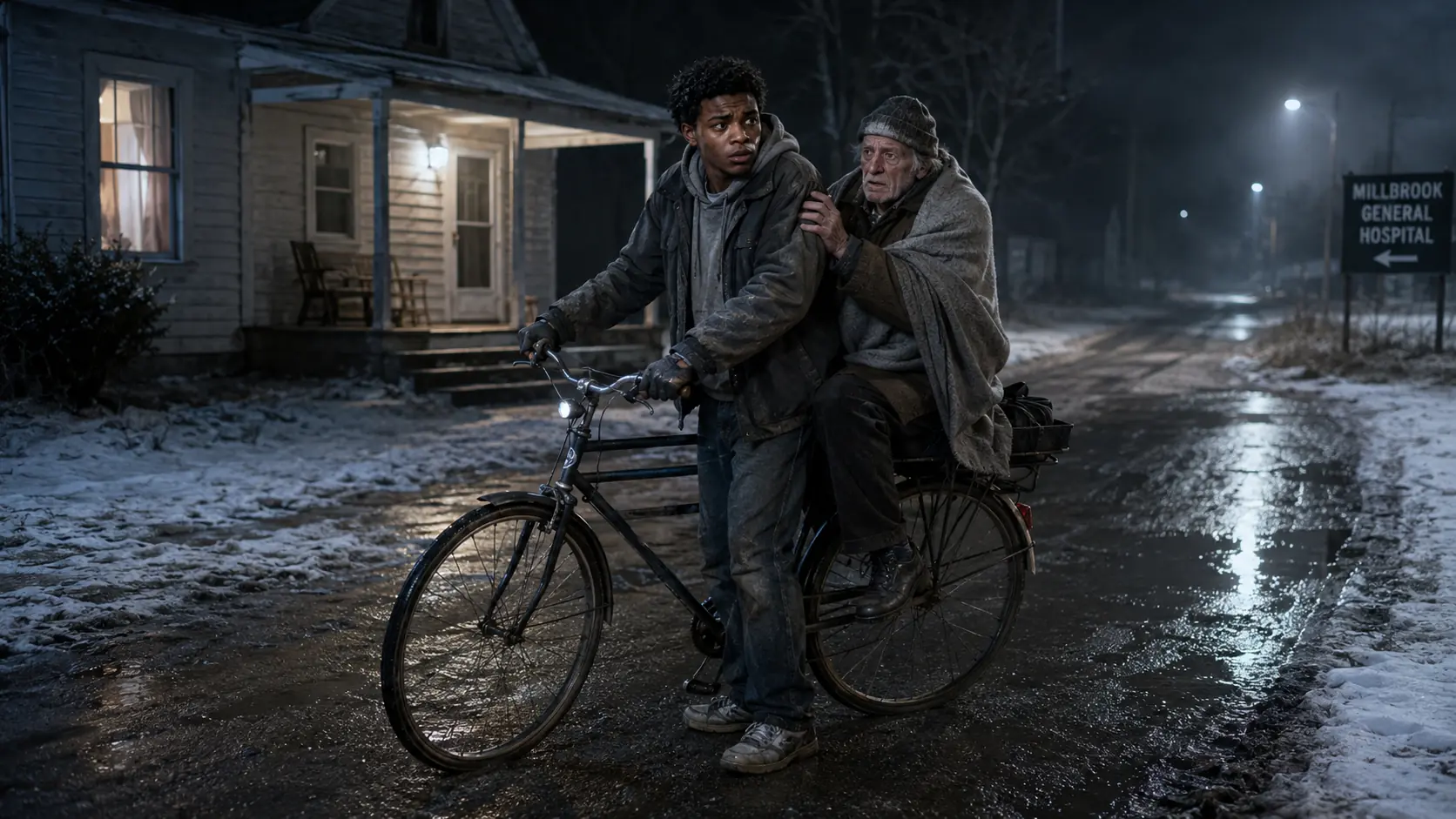
When he opened the door, an elderly man stood outside, shaking from the cold. The old man begged to be let inside to warm himself. After catching his breath, he explained that his wife was in critical condition at a hospital far away, with no way for him to get there.
With no car, no money, and only an old bicycle, the young man made a choice.
He rode the stranger through the freezing night, unaware that this moment would change his life forever.
The old wooden floorboards creaked as Marcus Coleman stood at the stove, stirring a pot of watered-down chicken soup. At 17, he had learned to stretch a single can into three meals. The kitchen light flickered, another bulb threatening to die, casting uneven light across his mother’s face as she sat at the table, sorting through a stack of medical bills with trembling hands.
“Mama, you need to eat something,” Marcus said, ladling the thin broth into a chipped bowl.
Patricia Coleman looked up, her eyes rimmed with exhaustion. At 42, she looked a decade older. The double shifts at the packaging plant had taken their toll. And now the diabetes she had been ignoring for years was demanding payment. The insulin alone cost more than their monthly rent on the drafty rental house on the outskirts of Millbrook, Georgia.
“I’m not hungry, baby,” she said, her voice barely above a whisper. “We need to talk.”
Marcus set the bowl down harder than he intended.
“If this is about the hospital bills again…”
“The pharmacy called,” Patricia said. “They won’t refill my prescription until we pay down the balance. Three hundred and forty dollars, Marcus. And Mr. Henderson came by today. We’re two months behind on rent.”
Marcus pulled out the chair across from her, the legs scraping against the linoleum.
“Then it’s decided. I’m dropping out. Tom’s Auto Shop said they’d take me on full-time. It’s forty hours a week, Mama. Real money.”
“Absolutely not.” Patricia’s voice gained strength, the same tone she had used when he was little and tried to cross the street without holding her hand. “You’ve got one semester left, Marcus. One semester until graduation. You’ve got that acceptance letter from Georgia Tech.”
“A letter doesn’t mean anything if we’re on the street,” Marcus shot back. “That scholarship only covers tuition, Mama. Not books, not living expenses. And you need medicine now, not in six months.”
“Your education is not negotiable.” Patricia reached across the table, gripping his hand. Her palm felt hot, too hot. The fever again. “I didn’t raise you to throw away your future because things got hard. Your daddy would have wanted…”
“Daddy’s been gone for ten years,” Marcus said immediately, regretting the words when he saw his mother flinch.
He softened his voice.
“I’m sorry, Mama. But we’ve got to be realistic. You can’t work right now. Someone has to provide.”
Patricia opened her mouth to respond when a sound stopped them both.
A frantic pounding on the front door.
Rapid, desperate knocks echoed through the small house.
Marcus and his mother exchanged glances. It was past eleven. Their neighborhood wasn’t dangerous exactly, but it was isolated, a forgotten pocket of rural Georgia where the houses sat far apart and the streetlights had stopped working years ago.
Nobody knocked on doors this late unless something was very wrong.
The knocking came again, more urgent this time.
“Stay here,” Marcus whispered.
Standing slowly, he grabbed the old baseball bat they kept by the door. His father’s Louisville Slugger, one of the few things they hadn’t pawned.
“Be careful,” his mother said, rising despite her weakness.
Marcus approached the door, his heart hammering. Through the thin curtain covering the window, he could see a silhouette, a man hunched and swaying slightly.
“Please,” a voice called from outside, rough with age and exhaustion. “Please, I need help.”
Something in that voice, the raw desperation, made Marcus lower the bat slightly. He unlatched the chain and opened the door a crack.
An elderly white man stood on their crooked porch, his face pale in the dim light from inside. He wore a wool overcoat that had probably been expensive once, but now hung on his thin frame like it was three sizes too big. His white hair was disheveled, his lips had a bluish tint, and he was shaking so hard his teeth chattered.
“I’m so sorry to bother you,” the old man said, his words tumbling out between gasps for air. “I’ve been walking for miles. My car ran out of gas. My phone’s dead. I saw your light, and I just… I didn’t know what else to do.”
Marcus felt his mother’s presence behind him.
She had always been the one to help stranded motorists, to give money to panhandlers his friends mocked. Even now, when they had almost nothing, she pushed past him and opened the door wider.
“Lord have mercy,” Patricia said. “Come inside before you freeze.”
The man stumbled across the threshold, and Marcus caught him by the elbow, surprised by how light he felt, all bone and sinew, like he hadn’t eaten properly in weeks.
“Sir, are you okay?” Marcus asked, guiding him to the couch.
“I don’t… I’m not sure.” The old man’s eyes were unfocused. “I need to get to Millbrook General. My wife is there. She had a seizure. They called me and I…” His voice cracked. “I was visiting our daughter’s grave. It’s the anniversary, and I always go, even in winter. When I got the call, I drove as fast as I could, but the car just died on me. Route 47. About five miles back.”
Patricia wrapped their only spare blanket around the man’s shoulders while Marcus filled a glass with water from the tap.
“Drink this slowly,” Marcus instructed, handing over the glass. “And breathe. You’re safe now.”
The old man took the water with shaking hands, sipping carefully. As color began to return to his cheeks, Marcus got his first good look at him. Late seventies, maybe early eighties. Expensive watch, a Rolex on his wrist, though the leather band was cracked. Wedding ring worn thin from decades of wear.
This was someone who had once had means, Marcus realized. But something had changed.
“Thank you,” the old man whispered. “Thank you so much. I know it’s late and I’m a stranger.”
He looked around the modest room, taking in the patched furniture, the water-stained ceiling, the space heater working overtime in the corner.
“You’ve been so kind when you have every reason not to be.”
“Everyone deserves help when they need it,” Patricia said simply, lowering herself into the armchair.
Marcus noticed the way she gripped the armrest, steadying herself.
“Millbrook General,” Marcus said. “That’s twelve miles from here. There’s no taxi service out this way, and it’s too late for the bus.”
The old man’s face crumpled.
“I have to get there. Eleanor, my wife, she’s all I have left. If something happens and I’m not there…”
He pressed his palms against his eyes.
Marcus looked at his mother. She was already nodding.
“No,” Marcus said firmly. “Mama, you’re thinking about that bike out back. It’s twelve miles in February, in the dark.”
“It’s a bicycle or nothing,” Patricia said. “The truck’s been dead for three months, baby. You know that.”
“Then I’ll call someone. Mr. Henderson has a car.”
“Mr. Henderson, who we owe two months’ rent?” Patricia raised an eyebrow. “You think he’s going to do us favors?”
The old man looked between them, understanding dawning in his pale blue eyes.
“I can’t ask you to do that. It’s too much. If you could just let me rest here until morning, maybe I could walk.”
“You’d collapse before you made it two miles,” Marcus said, the words coming out before he could stop them.
He thought of his father, dead from a heart attack at 40 because he had ignored chest pains. Thought he could push through.
He thought of his mother sitting at that table with bills she couldn’t pay because medicine cost more than anyone poor should have to bear.
He thought about the kind of person his father had wanted him to be.
“I’ll take you,” Marcus said quietly.
“Marcus,” his mother started.
“I’ll take you, sir,” Marcus repeated, louder this time. “It’ll take a while, but I can do it. That bike’s got a rack on the back. It’s not comfortable, but it’ll work.”
The old man stood shakily.
“Son, I can’t let you do this. It’s the middle of the night. You don’t know me.”
“My name’s Marcus Coleman. This is my mother, Patricia. Now you know us.”
He extended his hand.
The old man gripped it, his handshake still firm despite his condition.
“Robert Thornton,” he said. “And I’ll never forget this, Marcus. Never.”
Ten minutes later, Marcus was bundling himself in every warm layer he owned, his father’s old work jacket over his hoodie, two pairs of socks, gloves with holes in the fingertips. His mother had found Robert a knit cap and wrapped him in the blanket like he was a child.
The bicycle was a rusted relic from Marcus’s middle school days, but he had maintained it obsessively. In a neighborhood without reliable transportation, it was his lifeline to school, to the grocery store, to anywhere beyond walking distance.
“You got your phone?” Patricia asked, though she knew it was charged.
They couldn’t afford Marcus’s data plan anymore, but he could still use it for emergencies with Wi-Fi.
“Yes, Mama.”
“And you’ll be careful.”
“Always am.”
She pulled him into a tight hug, whispering in his ear.
Marcus blinked back unexpected tears.
“Get some rest, Mama. I’ll be back before sunrise.”
Robert Thornton climbed carefully onto the back rack, holding on to Marcus’s shoulders. He was lighter than Marcus expected. Maybe 140 pounds, nothing compared to the bags of concrete Marcus had hauled during his summer job.
“Hold on tight, Mr. Thornton,” Marcus said. “And if you need me to stop, just say so.”
“Please,” the old man said, “call me Robert.”
Marcus pushed off, wobbling slightly under the unaccustomed weight, then found his rhythm. The night was brutally cold, the kind of dry February cold that stole the moisture from your lungs. Their breath came out in white clouds as Marcus pedaled down the dark country road, guided only by the bike’s weak headlight and the occasional glimpse of stars between clouds.
Neither of them spoke for the first mile. Marcus focused on the road, avoiding potholes and debris. Robert clung to his shoulders, silent except for his labored breathing.
Then somewhere in the darkness between mile markers, Robert spoke.
“My daughter’s name was Sarah. She died thirty-two years ago today. Leukemia. She was sixteen.”
Marcus didn’t respond, sensing the old man needed to talk.
“Every year, Eleanor and I visit her grave. Every single year, no matter what. We bring yellow roses. Sarah loved yellow.” Robert’s voice was steady, but Marcus could feel him trembling, and not from the cold. “After Sarah died, Eleanor fell apart. I thought she’d never recover. It took years, but eventually we found a way to live with the grief. We dedicated ourselves to helping other people. It became our purpose.”
“That sounds like a good way to honor her,” Marcus said, pedaling harder as they reached an incline.
“It was. We ran a charity foundation. Helped families with sick children. Medical bills, transportation, housing, whatever they needed. For twenty-five years, it was our life.”
Robert paused.
“But three years ago, my business partner embezzled everything. Took every penny and disappeared to the Cayman Islands. By the time the authorities finished investigating, the foundation was destroyed. Our savings were gone defending ourselves in court. We lost almost everything.”
Marcus felt a shock of recognition. This man understood loss. Real loss. Not the kind you saw in movies, but the grinding daily losses that accumulated until you looked around and barely recognized your own life.
“I’m sorry,” Marcus said. “That’s not right.”
“No, it’s not,” Robert agreed. “But Eleanor kept saying that everything happens for a reason. That we’d been blessed for so long. Maybe this was our time to learn what it felt like to need help instead of give it.”
He laughed, a bitter sound.
“I’ll be honest, Marcus. I’ve been angry. So angry at God, at the universe, at everyone who had more than us. When you have money and lose it, people treat you differently. Like it’s your fault. Like you’re contaminated.”
“I know that feeling,” Marcus said quietly.
They fell into silence again as Marcus navigated around a fallen branch. The lights of Millbrook were beginning to appear on the horizon. Just a faint glow, but it meant they were getting closer.
“Can I ask you something?” Robert said.
“Sure.”
“Back there, when I knocked on your door, I heard you and your mother arguing about school.”
Marcus’s jaw tightened.
“You heard that?”
“I did. And I need to tell you something, Marcus. Don’t quit school. No matter how hard it gets, don’t quit.”
“It’s not that simple.”
“I know it’s not simple. Nothing ever is.” Robert’s grip on Marcus’s shoulders tightened slightly. “But I’ve lived long enough to see how these choices ripple out. My father made me drop out of high school to work in his hardware store during the Depression. Took me twelve years to get my diploma at night school. Twelve years of watching opportunities pass me by because I didn’t have that piece of paper. I built a successful business eventually, but I always wondered what I could have done if I’d had those years back.”
Marcus didn’t respond, but something in his chest felt tight.
“Whatever I can do to help you stay in school, I will,” Robert said. “That’s a promise.”
“Robert, you don’t owe me anything.”
“Maybe not. But I’m going to help anyway.”
They reached the hospital forty-five minutes after leaving the house. Marcus’s legs burned. His lungs ached from the cold air, and his fingers were numb despite the gloves.
But they had made it.
He helped Robert climb off the bike, steadying him when his legs nearly gave out.
“Thank you,” Robert said, reaching into his coat pocket.
He pulled out a wallet and extracted several bills.
“Please take this for your mother’s medicine.”
Marcus looked at the money. Three hundred dollars, maybe more. It would solve their immediate problem. The pharmacy. The rent. Everything.
But his father’s voice echoed in his head.
We don’t take payment for doing the right thing.
“I can’t,” Marcus said, gently pushing Robert’s hand away. “You need it more than we do. And I didn’t do this for money. I did it because it needed doing.”
Robert’s eyes filled with tears.
“You’re a remarkable young man, Marcus Coleman.”
“I’m just me,” Marcus said, uncomfortable with the praise. “Come on. Let’s find your wife.”
The emergency room was quiet at this hour, just a tired nurse at the desk and a janitor mopping floors. Robert gave his wife’s name, and the nurse directed them to the fourth floor.
“You don’t have to come up,” Robert said in the elevator. “You’ve done enough.”
“I want to make sure she’s okay,” Marcus said.
The truth was, after forty-five minutes of hearing Robert’s story, he felt invested. He needed to know this man’s wife was all right.
Eleanor Thornton was in room 412, sleeping peacefully under thin hospital blankets. She was a tiny woman, probably barely five feet tall, with silver hair spread across the pillow. A heart monitor beeped steadily beside her bed.
Robert moved to her side immediately, taking her hand.
“Eleanor, sweetheart, I’m here.”
Her eyes fluttered open, focusing on her husband’s face.
“Robert,” she whispered. “How did you? They said you were all the way out at the cemetery.”
“This young man brought me,” Robert said, gesturing to Marcus. “His name is Marcus. He saved me tonight.”
Eleanor looked at Marcus, her expression clearing as she took him in. A tall, skinny African American teenager in worn clothes, standing awkwardly in the doorway of her hospital room.
“Come here,” she said, her voice weak but warm.
When Marcus approached, she reached out and took his hand. Her skin felt papery, fragile.
“Thank you for taking care of my husband. He doesn’t always take good care of himself.”
“I was happy to help, ma’am,” Marcus said.
“You have kind eyes,” Eleanor said. “Your parents raised you right.”
Marcus thought of his mother alone in that cold house, sorting through bills she couldn’t pay.
“My mama did her best.”
He stayed a few more minutes, but exhaustion was setting in. The adrenaline that had carried him through the ride was fading, leaving him shaky and hollow.
“I should head back,” he said. “My mama will worry.”
“Of course,” Robert said, walking him to the door. “Marcus, please give me your address. I want to send you something to thank you properly.”
Marcus hesitated, then recited their address. It wasn’t like Robert would have trouble finding them anyway. Theirs was the only house with lights for miles.
He made his way back downstairs, retrieved his bike from the rack where he had locked it, and started the long ride home.
The hospital was in a better part of town. Streetlights actually worked there, and the roads were smooth. As he pedaled through the sleeping neighborhoods, Marcus found himself thinking about what Robert had said about school.
He was so close.
One semester.
Four months.
The acceptance letter from Georgia Tech sat in a drawer in his room, a ticket to a different life.
But tickets didn’t matter if you couldn’t afford the fare.
Lost in thought, Marcus didn’t notice the car following him at first.
Dawn was breaking by the time Marcus reached the outskirts of the nicer neighborhoods. Pink and gold bled across the horizon. He had been riding for over an hour, and his body was starting to protest. The bike wobbled slightly as he navigated a turn, his exhausted muscles struggling to maintain balance.
That was when he heard it.
A car engine close behind him.
Marcus glanced back and saw headlights. His first thought was relief. Maybe someone was heading in his direction and would offer him a ride.
But the car didn’t pass.
It slowed, matching his pace.
His heart began to pound for a different reason.
This part of town, on the border between Millbrook proper and the rural outskirts, had a reputation. Marcus had heard stories from his classmates about police harassment, about cars that followed kids who didn’t “belong” in certain neighborhoods.
The car’s window rolled down.
“Hey,” a voice called out. “Young man. Nice bike.”
Marcus kept his eyes forward, pedaling faster.
“Don’t engage. Get home.”
“I’m talking to you.”
“Not interested,” Marcus called back, his voice steadier than he felt.
The car accelerated slightly, pulling up alongside him. Marcus risked a look.
Three white teenagers, probably college age, sat inside a BMW that cost more than his mother would make in five years. The driver wore a Georgia State sweatshirt and had the kind of smug expression Marcus had learned to recognize, someone who had never been told no in his life.
“Where’d you steal the bike?” the driver asked, his friends laughing.
“It’s mine,” Marcus said through gritted teeth. “Leave me alone.”
“Sure it is. You know there have been a lot of thefts around here lately. Maybe we should call the cops. Let them sort it out.”
Marcus’s hands tightened on the handlebars. He knew what this was. Harassment, plain and simple. They were bored, probably drunk or high, looking for entertainment at his expense.
The smart thing was to keep quiet, keep moving, don’t give them ammunition.
But he was exhausted. His mother was sick. He had just spent two hours biking through the cold night, and he had had enough.
“I’ve got better things to do than deal with you,” Marcus said, taking a sudden turn down a side street.
Bad decision.
The car followed.
The street was darker, more isolated. Marcus’s pulse hammered in his ears as he pedaled harder, but the BMW accelerated, cutting in front of him. He slammed on the brakes, the bike skidding.
“Whoa, careful there,” the driver said, climbing out. His friends followed. “You don’t want to hurt yourself.”
Marcus dismounted, putting the bike between himself and the three young men. He was tall for his age, but they were bigger, older, and there were three of them.
“Look, I don’t want any trouble,” Marcus said, hating how his voice wavered slightly. “Just let me go home.”
“You know what’s funny?” the driver said, circling around. “Rich people always think their stuff won’t get stolen. They leave their bikes unlocked, their cars running. Makes it too easy.”
“I didn’t steal anything,” Marcus said. “This is my bike. I’ve had it for five years.”
“Prove it.”
“I don’t have to prove anything to you.”
Marcus started to mount the bike again, but one of the friends, a stocky guy with a buzz cut, grabbed the handlebars.
“Not so fast.”
What happened next came down to instinct and desperation.
Marcus yanked hard on the bike, catching Buzz Cut off guard. The bike came free, but Marcus overbalanced. He stumbled back, catching himself just before he fell.
And that was when the driver pulled out his phone.
“I’m calling the police,” he announced. “Tell them we caught some thug trying to steal a bicycle in our neighborhood.”
“Do it,” Marcus said, his fear crystallizing into anger. “Call them. Let’s see what they say when they check the serial number and it matches my purchase receipt at home.”
The driver hesitated. His friends exchanged glances. They had been expecting Marcus to run, to give them the chase they wanted. His refusal to play their game had thrown them off script.
“Whatever,” the driver finally said. “Keep your piece-of-crap bike. It’s not worth my time.”
They piled back into the BMW and sped off, tires squealing.
Marcus stood there shaking, not from cold, but from the adrenaline dump of confrontation. His father’s baseball bat was at home, useless. He had been completely vulnerable.
He remounted the bike and rode away quickly, constantly checking over his shoulder.
The encounter had rattled him more than he wanted to admit. In that moment, facing those three men, he had felt utterly powerless.
Just like he felt every time his mother struggled to breathe.
Just like he felt opening bills they couldn’t pay.
Just like he felt reading that acceptance letter from Georgia Tech, knowing it might as well be a rejection.
By the time Marcus reached the turnoff to the rural road leading home, the sun was fully up. He was bone tired, emotionally drained, and wanted nothing more than to collapse in his bed.
That was when he realized the bike was making a strange sound.
Marcus stopped and examined it. The rear tire was flat, not just low, completely deflated. In the scuffle with those guys, something must have punctured it.
“No, no, no,” Marcus muttered, checking his phone.
Dead.
He had forgotten to charge it last night.
He was still five miles from home. Five miles of walking, pushing a broken bike after having already ridden more than twenty-four miles round trip.
Marcus wanted to scream. Wanted to throw the bike into the ditch. Wanted to sit down in the middle of the road and just give up.
Instead, he started walking.
His legs ached with each step. The bike was awkward to push with the flat tire dragging. Cars passed occasionally, but none stopped.
Why would they?
He was just another kid with a broken bike on the side of a rural road.
Invisible.
Marcus thought about Robert’s story, about losing everything, about his daughter’s grave and yellow roses and a foundation that helped people until the money ran out. He thought about Eleanor in that hospital bed, reaching out to take his hand with her papery skin.
Good people dealt bad hands.
Just like his mother.
Just like him.
The sun climbed higher. Marcus’s throat was dry, his stomach empty. He hadn’t eaten since that watery soup last night. Each step felt heavier than the last.
He almost missed it when the car pulled up beside him.
A cream-colored Lexus, older model, but well maintained.
The passenger window rolled down.
“Marcus.”
He turned, startled.
Robert Thornton sat in the driver’s seat, Eleanor beside him. They both looked exhausted but alert, concern written across their faces.
“What happened?” Robert asked, pulling the car onto the shoulder. “Why are you walking?”
“Flat tire,” Marcus said, the words coming out scratchy. “Got a puncture somehow. It’s fine. I’m almost home.”
“You’re five miles from home,” Eleanor said firmly. “And you look ready to collapse. Robert, help him get that bike in the trunk.”
“Really, I’m okay,” Marcus started, but Robert was already out of the car.
“Son, we’ve been looking for you for an hour,” Robert said, taking the bike from Marcus’s grip. “When I went downstairs and saw your bike still in the rack, I got worried. Hospital security footage showed you leaving forty-five minutes before we found the bike. I thought something terrible had happened.”
Together, they wrestled the bike into the Lexus’s trunk, bungee cords holding it partially closed. Marcus climbed into the back seat, his body sagging with relief the moment he sat down.
“Drink this,” Eleanor said, handing back a bottle of water and a granola bar.
Slowly, Marcus obeyed. The cold water felt like a miracle on his parched throat. The granola bar disappeared in four bites.
“What happened to your bike?” Robert asked, pulling back onto the road.
Marcus hesitated, then told them about the three men in the BMW. As he talked, he saw Robert’s hands tighten on the steering wheel, his knuckles going white. Eleanor’s expression darkened.
“Did you get their license plate?” Eleanor asked.
“No, ma’am. I wasn’t exactly thinking about that at the time.”
“Of course not.” Eleanor turned to look at him, her eyes fierce despite her frailty. “You were trying to survive. I’m so sorry that happened to you, Marcus.”
The simple acknowledgment, the absence of any suggestion that he had done something wrong or provoked it, made Marcus’s throat tighten with unexpected emotion.
“Thank you for coming back for me,” he said quietly.
“We could hardly leave you stranded after what you did for us,” Robert said. “Besides, Eleanor wanted to meet your mother. She’s been talking about it all morning.”
Marcus felt a flutter of panic. Their house in daylight looked even more rundown than at night. The peeling paint, the sagging porch, the yard full of weeds.
What would these people think?
But when they pulled up, Robert and Eleanor didn’t react to the condition of the house. They simply helped Marcus carry his bike to the side yard and followed him to the front door.
Patricia opened it before they could knock. Her eyes were red. She had been crying.
“Marcus, thank God,” she said, pulling him into a hug.
Then she seemed to register the two elderly white people standing on her porch.
“I’m sorry. Can I help you?”
“Mrs. Coleman, I’m Robert Thornton. This is my wife, Eleanor. Your son saved my life last night.”
“He did?”
Patricia looked at Marcus, who suddenly found the floorboards very interesting.
“He did,” Eleanor confirmed. “And then someone damaged his bicycle, and we found him walking home. May we come in? We’d like to talk with you both.”
Patricia hesitated. The house was a mess. She hadn’t cleaned. There were medical bills still scattered across the kitchen table.
But she stepped back and let them enter.
They all settled in the small living room. Marcus and Patricia on the couch, Robert and Eleanor in the mismatched armchairs. For a long moment, no one spoke.
Then Eleanor leaned forward.
“Mrs. Coleman, your son told Robert about the conversation you were having when he knocked on your door last night. About school.”
Patricia shot Marcus a look, but he shook his head slightly.
“I didn’t volunteer it.”
“That’s a private family matter,” Patricia said carefully.
“Of course it is,” Eleanor agreed. “But Robert and I would like to make you an offer. We’d like to help.”
“We’re not a charity case,” Patricia said, her spine straightening despite her exhaustion.
“We’re not offering charity,” Robert said. “We’re offering gratitude. Mrs. Coleman, your son spent over two hours in the freezing cold riding twelve miles to get me to my wife. He refused payment. He helped me find Eleanor’s room. He waited to make sure she was okay. And then on his way home, he was harassed and his property was damaged.”
Robert’s voice grew thick with emotion.
“That boy has more integrity in his little finger than most people have in their entire body. If you think I’m going to watch him throw away his education because of medical bills and rent, you don’t know me very well.”
“Mr. Thornton,” Patricia started.
“Please let me finish,” Robert said. “Eleanor and I ran a charitable foundation for twenty-five years. We helped families just like yours. Good people dealt bad circumstances. When we lost everything, we thought that part of our lives was over. But meeting Marcus last night reminded me why we started the foundation in the first place.”
Eleanor took over.
“We still have our house. It’s paid off. One of the few things we managed to keep. We also have Robert’s Social Security and my pension. We’re not rich anymore, but we’re comfortable. And we have something more important than money. We have time, and we have purpose.”
“What are you saying?” Patricia asked, her voice wavering.
“We’re saying we want to help Marcus finish school,” Robert said. “We’ll cover your medication and medical expenses. We’ll help with rent until you’re back on your feet. And when Marcus graduates, if he still wants to go to Georgia Tech, we’ll make sure he can.”
The room fell silent.
Marcus couldn’t breathe.
His mother sat frozen, tears streaming down her face.
“Why?” Patricia finally whispered. “Why would you do this for strangers?”
“Because thirty-two years ago, our daughter died, and we learned that the only way to survive that kind of loss is to honor it by helping others,” Eleanor said, her own eyes glistening. “And because last night your son could have turned Robert away. He could have called 911 and let them handle it. Instead, he gave up his sleep, his comfort, and his safety to help someone he had never met. That kind of character is rare, Mrs. Coleman. It should be nurtured, not crushed by circumstance.”
Marcus found his voice.
“I can’t let you do this. You’ve already lost so much.”
“Which is exactly why we understand how much these things matter,” Robert interrupted. “Marcus, when I was twenty-three, a man named Ernest Okafor lent me five thousand dollars to start my business. He was a Nigerian immigrant who worked three jobs to send money home to his family. He had no reason to trust me, but he did. I paid him back within two years, and that loan changed my entire life.”
Robert continued.
“I never forgot Ernest. Forty years later, when he got sick with cancer, Eleanor and I made sure he had the best care money could buy. We flew his entire family over from Nigeria to be with him at the end. Not because we owed him. We paid back every penny with interest. But because kindness deserves to be repaid.”
Eleanor nodded.
“That’s what our foundation was about. Not just giving people money, but investing in them, showing them their worth, giving them dignity along with help.”
Patricia covered her face with her hands, her shoulders shaking with silent sobs. Marcus moved closer, wrapping an arm around her.
“Mama,” he said softly.
“I’m just so tired,” Patricia said through her tears. “I’ve been trying to hold everything together for so long, and I’m just so tired.”
Eleanor stood and moved to the couch, sitting on Patricia’s other side. She took the younger woman’s hand.
“Then let us help you rest for a while,” she said gently. “Let us carry some of this weight.”
Over the next three days, Marcus kept waiting for the catch. For the moment when Robert and Eleanor would reveal what they really wanted, what they expected in return.
Because in his experience, nobody gave without expecting something back.
But the catch never came.
On Tuesday morning, Robert showed up with a check for the pharmacy. Patricia’s insulin prescription was filled that afternoon.
On Wednesday, Eleanor arrived with groceries. Not charity food from a food bank, but real groceries from the Kroger in town. Fresh vegetables, chicken, bread that wasn’t day-old.
“You didn’t have to do this,” Patricia said, staring at the bags covering their kitchen counter.
“I know,” Eleanor said, already putting things away with the efficiency of someone who had raised children. “But I wanted to. Besides, Robert’s bringing Marcus’s bike back this evening. He took it to a shop to get fixed.”
“He’s fixing the bike, too?” Patricia’s voice cracked slightly.
“Of course. That bike is Marcus’s transportation. Can’t have him walking everywhere.”
Eleanor paused, a can of soup in her hand.
“Patricia, may I ask you something?”
“Sure.”
“When did you last see a doctor for yourself? I mean, not the emergency room.”
Patricia looked away.
“Three years ago.”
“Can’t afford the co-pays?”
“I thought so. You need a full workup. Blood tests, kidney function, eye exam. Diabetes doesn’t just affect your blood sugar. It affects everything. I already called Dr. Reynolds at Millbrook Family Practice. She’s expecting you Friday at ten.”
“Mrs. Thornton…”
“Eleanor, please.”
“Eleanor, I can’t accept all this. It’s too much.”
Eleanor turned to face her fully.
“Can I tell you something? When Robert and I lost our foundation, lost our savings, I wanted to die. Not dramatically. I didn’t try anything. But I stopped caring about living. What was the point? We had spent twenty-five years helping people, and one person’s greed had erased all of it.”
She sat down at the kitchen table, gesturing for Patricia to join her.
“But then I got sick. The seizure that brought me to the hospital. And lying in that emergency room, I realized something. The people we had helped over the years, they were still out there living their lives. Raising their children. Building businesses. Going to college. Our foundation was gone, but the impact of it wasn’t. That was still real.”
Patricia listened, her hands wrapped around a mug of coffee Eleanor had made.
“Meeting Marcus reminded me that we still have something to give,” Eleanor continued. “Not money, not the way we used to, but time, experience, connection. The things that money can’t buy anyway. So please don’t think of this as charity. Think of it as legacy building. You’re helping us as much as we’re helping you.”
That evening, Robert returned with Marcus’s bike. It looked better than it had in years. New tires, fresh grease on the chain. Even the rust had been cleaned off.
“Mr. Thornton, this must have cost…”
“Bobby at the bike shop owed me a favor,” Robert said, waving off the concern. “He’s been using my old workshop space for free since I had to sell my building. This is nothing.”
“Still,” Marcus insisted. “Thank you.”
“You’re welcome. Now, I have something to discuss with you. Can we talk?”
They sat on the porch, the evening air crisp but not as brutal as it had been a few nights ago.
Robert pulled out a folder.
“I’ve been doing some research on Georgia Tech,” he said. “Specifically, their work-study programs and additional scholarship opportunities. There’s something called the President’s Scholarship Program that covers full tuition, room, board, and books. Applications are due March 1st.”
Marcus felt his stomach sink.
“I can’t apply for that. You need a minimum 3.8 GPA and leadership experience. I’ve only got a 3.6, and I haven’t had time for extracurriculars. I’ve been working.”
“What if you did have time?” Robert asked. “What if, for the next four months, your only job was school? No part-time work. No worrying about bills. Just focus on getting those grades up and building a strong application.”
“That’s not realistic.”
“It is if we’re helping your mother with expenses.”
Robert opened the folder, showing Marcus a spreadsheet.
“Eleanor and I sat down and worked out a budget. We can comfortably cover your rent, utilities, and your mother’s medical costs for the next six months. That gives her time to get healthy enough to work again. Reduced hours, desk work instead of physical labor. It gives you time to finish strong.”
Marcus stared at the numbers. It was all there. Every bill, every cost, calculated and accounted for.
“Why are you doing this?” he asked quietly.
Robert was silent for a long moment.
“Do you know what I regret most about my life, Marcus? Not the money we lost. Not the betrayal. I regret the years I spent being angry at the world for not being fair. After Sarah died, after the foundation collapsed, I became bitter. I stopped seeing the good in people. I started thinking everyone was out for themselves.”
He looked at Marcus directly.
“Then you opened that door. You could have turned me away. Most people would have. It was late. You didn’t know me. You had your own problems. But you helped anyway. You reminded me that goodness still exists. That’s worth more than any amount of money.”
“I just did what anyone would do,” Marcus said.
“No,” Robert said firmly. “You did what you would do. That’s the difference. And I’ll be damned if I let financial stress prevent you from becoming whoever you’re meant to become.”
Thursday afternoon, Marcus was working on his calculus homework when Eleanor knocked on the door. Patricia had started her shift at the plant. Reduced hours, light duty, but working again now that she had her medication. So Marcus was alone.
“I hope I’m not interrupting,” Eleanor said. “I brought something for you.”
She handed him a leather-bound journal, the pages cream-colored and thick.
“What’s this for?” Marcus asked.
“Writing,” Eleanor said simply. “Robert told me you’re planning to study engineering at Georgia Tech. That’s wonderful. But I also noticed the books on your shelf. Langston Hughes, James Baldwin, Ta-Nehisi Coates. You’re a reader.”
Marcus felt embarrassed.
“Those are just for fun.”
“Just for fun.” Eleanor smiled. “Marcus, do you know what Robert studied in college?”
“Engineering?”
“Business. And he was good at it. Built a successful company, made a lot of money. But his passion was always woodworking. He used to spend weekends in his shop building furniture by hand. Beautiful pieces, museum quality.”
She sat on the couch and Marcus joined her.
“After we lost the foundation, Robert stopped woodworking. Said it reminded him too much of better times. But last night, after we got home from bringing you your bike, I found him in the garage. He was sketching out plans for a bookshelf. Said he wanted to make something useful again.”
Eleanor handed him another item, a photograph. It showed a younger Robert in a workshop surrounded by half-finished furniture, grinning at the camera with wood shavings in his hair.
“He looks happy,” Marcus observed.
“He was. Because he was doing something he loved, even if it wasn’t his job.” Eleanor looked at Marcus steadily. “I’m not saying don’t study engineering. I’m saying don’t forget the other parts of yourself. The parts that read poetry. The parts that think about the world. Those parts matter, too.”
“I’ll try,” Marcus said, taking the journal.
“Good. Now, I need your help with something.”
“What’s that?”
“Teaching me how to use this confounded smartphone. Robert got me an iPhone for Christmas, and I can barely make calls. My granddaughter says I should learn to text, but all these tiny buttons…”
She pulled out the phone, looking helplessly at it.
Marcus laughed, genuinely laughed for the first time in months.
“I can definitely help with that.”
They spent the next hour going through the phone’s features. Eleanor was a quick learner once she understood the logic behind the interface. She was particularly delighted by the camera feature.
“You mean I can just point and click? No film to develop?”
“Welcome to 2025, Mrs. Thornton.”
“Eleanor,” she corrected with a smile. “And don’t you dare make me feel older than I already do.”
As the lesson wrapped up, Eleanor’s expression grew more serious.
“Marcus, can I tell you something about your mother?”
“What about her?”
“She’s scared. Not of being sick. She’s scared of burdening you. When we talked yesterday, she kept apologizing for not being able to provide more, for you having to worry about her, for the possibility of dying and leaving you alone.”
Marcus felt his chest tighten.
“She said that?”
“Not in so many words, but I could tell. I’ve been where she is. Helpless, dependent, terrified of failing the people I love. It’s a horrible feeling.”
“I don’t know how to help her with that,” Marcus admitted.
“Just keep being yourself. Keep showing her that her son turned out to be a good man. That’s what she needs to see. That even if she worries she hasn’t given you enough, she has given you something more important than money. She has given you character.”
That night at dinner, a real dinner with pot roast and vegetables and enough for everyone, Patricia seemed lighter than Marcus had seen her in months. She actually smiled when he told her about teaching Eleanor to use her phone.
“Sounds like you made a friend,” Patricia said.
“I guess so,” Marcus said. “They’re nice people, Mama. Really nice.”
“I know. I just keep waiting for something to go wrong.” Patricia set down her fork. “I’m not used to things going right.”
“Maybe we’re due for some good luck.”
“Maybe.”
Patricia reached across the table and took his hand.
“Your daddy would be proud of you, baby. The way you helped that man, the way you’ve taken care of me, he’d be so proud.”
Marcus squeezed her hand.
“I learned from the best.”
They sat there for a moment, mother and son in their run-down kitchen with its flickering light and water-stained ceiling. But for the first time in a long time, it felt like home instead of just a place they were trying to survive.
Outside, the February night was cold.
But inside, something warmer was growing.
The fragile beginning of hope.
By the end of February, Marcus’s life had developed a new rhythm. Monday through Friday, he focused entirely on school. His grades, freed from the constant anxiety about money, began to climb. The calculus that had frustrated him suddenly made sense when he had time to actually study.
His English teacher, Mrs. Patterson, noticed the change.
“Marcus, can I speak with you after class?” she asked one afternoon.
He waited as the other students filed out, anxiety creeping back. Had he done something wrong?
“I’ve been reviewing your recent essays,” Mrs. Patterson said, pulling out his last three assignments, all marked with A’s. “There’s been a significant improvement in your work. Not just the grades, the depth. You’re engaging with the material differently.”
“I’ve had more time to focus,” Marcus said carefully.
“I can tell, which is why I want to talk to you about something.”
She leaned against her desk.
“Every year, our school nominates one senior for the President’s Scholarship at Georgia Tech. The deadline is March 1st, and I’d like to nominate you.”
Marcus’s heart jumped.
“Mr. Thornton mentioned that scholarship, but Mrs. Patterson, I don’t have the GPA.”
“You need a 3.8 minimum, and you’re at 3.75 as of this morning,” she interrupted. “I checked with guidance. If you maintain your current trajectory, you’ll hit 3.8 by mid-March. The application says minimum 3.8 at time of enrollment, not application.”
“But the leadership experience…”
“You’ve been working twenty hours a week since you were fifteen. You’ve been the primary caretaker for your mother. You organized that canned food drive sophomore year. That’s leadership, Marcus. It doesn’t have to come from being student council president.”
Mrs. Patterson pulled out a packet of papers.
“The application requires three essays, two letters of recommendation, and a personal statement explaining why you deserve the scholarship. I’ve already agreed to write one recommendation. Do you have someone else in mind for the second?”
Marcus thought immediately of Robert.
“I think so. Yes.”
“Good. Then let’s talk about these essays.”
Over the next week, Marcus discovered that writing scholarship essays was its own unique torture. The first prompt seemed simple enough.
Describe a challenge you’ve overcome and what it taught you.
He stared at the blank page of the journal Eleanor had given him.
Where did he even start?
His father’s death. His mother’s illness. Their poverty.
Each challenge felt too big, too raw to fit into five hundred words.
Finally, he began to write.
The hardest thing I’ve learned is that you can do everything right and still lose.
He wrote about his father, a man who worked hard, loved his family, never missed a day even when he was tired, and died anyway at 42, leaving them with medical debt and no life insurance.
People act like poverty is a moral failure, like if you’re struggling, you must have made bad choices. But my father’s only bad choice was being born without money and dying without it. That taught me that the world isn’t fair and kindness doesn’t guarantee reward. But it also taught me that kindness still matters. Because on the night I helped a stranger find his wife, I wasn’t thinking about rewards. I was thinking about the kind of man my father was and the kind of man he would want me to be. Sometimes the lesson isn’t that goodness pays off. Sometimes the lesson is that goodness is worth doing even when it doesn’t.
He showed the draft to Eleanor during one of her visits. She read it silently, then looked up with tears in her eyes.
“This is beautiful, Marcus. And honest. But I think you need to go deeper on one point.”
“Which one?”
“You write about your father’s death like it was just bad luck. But there’s more to it than that, isn’t there? The reason he didn’t go to the doctor sooner. The reason he didn’t have insurance. Those weren’t accidents. They were systemic failures.”
Marcus frowned.
“I don’t want it to sound like I’m making excuses.”
“You’re not making excuses. You’re providing context.” Eleanor leaned forward. “One of the most dangerous things our society does is pretend that poverty is individual rather than structural. Yes, individual choices matter, but those choices happen within systems that make some choices impossible for some people. Your father didn’t have the luxury of taking a sick day. That’s not a personal failing. That’s a failure of our health care system, our labor laws, our entire approach to worker protection.”
“But won’t the scholarship committee think I’m just complaining?”
“The right committee will understand that you’re demonstrating critical thinking, that you can analyze systems, not just experiences. That’s what college is about, Marcus. Learning to see the bigger picture.”
With Eleanor’s guidance, Marcus revised the essay. It became sharper, more analytical, but retained its emotional core. Mrs. Patterson reviewed it and made a few small edits for grammar, but otherwise approved.
“This is strong work,” she said. “Now, let’s tackle the second essay. Describe your academic and career goals and how Georgia Tech will help you achieve them.”
This one was easier in some ways. Marcus had been thinking about engineering since middle school, when a teacher brought in a civil engineer to talk about bridge design. The idea that you could build something that would last for generations, that would serve thousands of people, had captivated him.
But as he wrote, he found himself incorporating things Robert had told him about the foundation, about using business skills for social good.
His goals expanded beyond just being an engineer. He wanted to work on infrastructure projects in underserved communities, to design affordable housing, efficient public transportation, accessible public spaces.
“You want to help people,” Robert observed when Marcus shared this draft. “That’s good. But make sure you’re specific. Don’t just say, ‘I want to help people.’ Explain exactly what you want to build and why.”
The revision included details about Atlanta’s public housing challenges, about how many families like his lacked access to reliable transportation, about the correlation between infrastructure quality and economic opportunity. It was more ambitious than the first draft, but also more grounded.
The third essay was the hardest.
Describe a time when you demonstrated leadership in your community.
Marcus stared at the prompt for two days. He didn’t feel like a leader. Leaders were student body presidents, team captains, club founders.
He was just a kid who tried to survive.
Finally, he went to his mother.
“Mama, do you think I’m a leader?”
Patricia looked up from the book she was reading, a library copy of The Warmth of Other Suns that Eleanor had recommended. Her health had improved dramatically with consistent medication, and she had started reading again, something she hadn’t had energy for in years.
“Why are you asking?” she said.
“One of the scholarship essays. They want me to write about leadership, but I don’t know what to say.”
Patricia set the book down.
“You remember when Mrs. Chen’s house flooded two years ago, and you organized all the teenagers in the neighborhood to help her clean up?”
Marcus had forgotten about that.
Mrs. Chen was an elderly widow three streets over. After a pipe burst, her basement had filled with water, destroying boxes of photographs and belongings. Marcus had simply knocked on doors, gathered whoever was available, and they had spent a weekend hauling waterlogged items out and helping her sort through what could be saved.
“That was just being neighborly,” Marcus said.
“Leadership isn’t always about having a title, baby. Sometimes it’s about seeing what needs doing and making sure it gets done.” Patricia smiled. “You’ve been doing that your whole life. When your daddy died, you stepped up. When I got sick, you figured out how to keep us afloat. When Mr. Thornton needed help, you helped him. That’s leadership. Taking responsibility when no one’s making you.”
Marcus returned to the essay with new perspective. He wrote about Mrs. Chen, about organizing the neighborhood cleanup. But he also wrote about the less visible leadership: managing their household budget as a teenager, coordinating his mother’s medical appointments, teaching younger kids in the neighborhood how to fix their bikes.
Leadership doesn’t always look like standing on a stage, he wrote. Sometimes it looks like showing up, doing the work, and bringing others along with you. It’s about recognizing that your actions affect others and choosing actions that help rather than harm.
By February 28th, all three essays were complete. Mrs. Patterson submitted her recommendation letter. Marcus wasn’t allowed to read it, but she assured him it was strong.
Robert submitted his as well, though he did share one paragraph with Marcus.
In thirty years of business and philanthropy, I’ve met countless young people. Marcus Coleman stands out not because of what he’s accomplished, though his accomplishments in the face of significant obstacles are remarkable, but because of who he is. He possesses that rare combination of intellectual capability, moral courage, and genuine humility that cannot be taught. If I were building a team to solve the world’s most challenging problems, Marcus would be my first call.
Marcus read it three times, each time feeling more unworthy of such praise.
“You don’t see yourself clearly,” Robert said when Marcus expressed this. “That’s not unusual. But trust me, I wouldn’t have written it if I didn’t believe it.”
The application was submitted at 11:47 p.m. on March 1st, thirteen minutes before the deadline. Marcus hit submit and immediately felt a wave of anxiety.
What if it wasn’t good enough?
What if he had made a mistake?
“What’s done is done,” Patricia said, appearing in his doorway. “Come eat something. You’ve been staring at that computer for hours.”
In the kitchen, they found that Eleanor and Robert had let themselves in. Patricia had given them a spare key. They were making grilled cheese sandwiches.
“We figured you’d need brain food after all that work,” Eleanor said, flipping sandwiches in the pan with practiced ease. “Did you submit it?”
“Just now,” Marcus confirmed.
“Then we celebrate,” Robert announced, pulling out a bottle of sparkling cider. “To Marcus, for taking the first step toward his future.”
They toasted with mismatched glasses, and Marcus felt something shift in his chest. This moment, sitting in their shabby kitchen with his mother and these two people who had become something like family, was worth more than any scholarship.
But he still really hoped he got the scholarship.
March arrived with the kind of weather that couldn’t decide what season it wanted to be. Sixty degrees one day, thirty the next.
Marcus settled into a new normal that still felt surreal. His mother was working part-time at the plant’s administrative office, a desk job that Robert had helped her secure through a connection. The pay was better than packing-line work, and it didn’t destroy her body.
Eleanor had become a regular fixture at their house, often arriving in the afternoon with some excuse. She needed help with her phone again, or she had made too much soup and didn’t want it to go to waste, or she just wanted company.
Marcus suspected the real reason was that she was lonely. Robert kept busy with various projects, but Eleanor’s health limited her activities. Marcus and Patricia had become her social outlet.
“Tell me about your friends at school,” Eleanor said one Thursday afternoon.
They were sitting on the porch, watching storm clouds gather in the distance.
Marcus shrugged.
“Don’t really have many. I was always working or taking care of Mama. Didn’t have time for hanging out.”
“That’s going to change at Tech,” Eleanor said. “College is about more than classes. It’s about building a community, finding your people.”
“If I get in.”
“When you get in,” she corrected firmly. “I have a good feeling about this.”
Marcus wasn’t so sure. The waiting was agony. Decisions wouldn’t come until late April, which felt like a lifetime away.
The first crack in their new stability appeared on March 15th.
Marcus came home from school to find his mother sitting at the kitchen table, staring at a letter. Her face was pale, her hands shaking.
“Mama, what’s wrong?”
She slid the letter across to him. It was from the Georgia Department of Revenue.
This is to inform you that your 2023 tax return has been flagged for audit. You are required to provide documentation of all income sources and deductions claimed.
Marcus felt his stomach drop.
“An audit? But we don’t have any money. What are they auditing?”
“The earned income tax credit,” Patricia said, her voice hollow. “Last year I claimed it based on my income. It was eighteen hundred dollars. We used it to pay bills.”
“That’s what it’s for, isn’t it? Helping working families?”
“Yes, but…” Patricia pressed her hands against her eyes. “Marcus, when you were working last year, you didn’t file your own taxes. I claimed you as a dependent. If they decide your income should have been reported separately, or if they think we claimed too much, they could demand that money back, plus penalties, plus interest.”
Marcus did the math in his head. If they owed eighteen hundred dollars plus penalties, it could easily be twenty-five hundred or more.
Money they absolutely didn’t have.
“There has to be a mistake,” Marcus said. “We didn’t do anything wrong.”
“I know that. But audits don’t care about intent. They care about documentation. And Marcus…” Her voice cracked. “I didn’t keep all the receipts. I didn’t think I needed to. Some of your pay was cash under the table from that landscaping job. I didn’t report it because I didn’t think…”
“It’s okay, Mama. We’ll figure this out.”
But panic was rising in his chest. Just when things were starting to work, this happened. It felt like the universe was punishing them for daring to hope.
He called Robert immediately.
“I’m coming over,” Robert said without hesitation.
Twenty minutes later, Robert was sitting at their kitchen table, reviewing the audit letter with the careful attention of someone who had dealt with the IRS before.
“Okay,” he said finally. “First thing, don’t panic. Audits sound scary, but most of them get resolved without major penalties if you cooperate and provide documentation.”
“But we don’t have all the documentation,” Patricia said miserably.
“Then we reconstruct. Marcus, you worked for Tom’s Landscaping last summer, correct?”
“Yes, sir.”
“How many hours per week approximately?”
“Twenty to thirty, depending on the week.”
“And what was your pay rate?”
“Ten dollars an hour for most jobs. Twelve for the harder ones.”
Robert pulled out a notepad and started calculating.
“So, roughly two hundred to three hundred and fifty per week for about twelve weeks. That’s approximately three to four thousand total, some cash, some by check.”
“About half and half,” Marcus confirmed.
“Good. We can work with that. Patricia, do you have any bank statements showing the checks being deposited?”
“Maybe. I’d have to look.”
“Look. Also find any text messages or emails with Tom confirming work schedules or payments. Marcus, same for you. Any proof of employment helps.”
For the next two hours, they dug through Patricia’s limited records. She had kept some bank statements, and they found three deposit slips that matched checks from Tom’s Landscaping. Marcus’s phone had text message threads confirming various job schedules and payment amounts.
“This is a start,” Robert said. “Now, you’ll need to respond to the IRS within thirty days. I’m going to connect you with an accountant I know, Charles Kim. He specializes in helping low-income families deal with tax issues. Pro bono work, mostly.”
“Mr. Thornton. We can’t keep accepting help,” Patricia said, her voice tight with emotion. “You’ve already done so much.”
“Patricia,” Robert said gently, “when Eleanor and I lost our foundation, we had to accept help too. From friends, from former colleagues, from people we had helped years before. It was humbling. It was hard. But it taught us that accepting help isn’t weakness. It’s wisdom. You can’t do everything alone, and you shouldn’t have to try.”
Patricia covered her face with her hands, shoulders shaking.
Marcus moved to her side, wrapping an arm around her.
“We’re just so tired of being one crisis away from disaster,” she whispered.
“I know,” Robert said. “But you’re not in this alone anymore. That’s what I’m trying to tell you. You have people now. Let us help.”
The meeting with Charles Kim happened three days later. He was a Korean American man in his fifties, efficient and thorough, who reviewed their documentation and the audit letter with professional calm.
“This is pretty standard,” he said. “The IRS has been cracking down on EITC claims, and your situation, single mother, dependent child with some income, fits their audit profile. Not because you did anything wrong, but because it’s a common area for errors.”
“So what happens now?” Marcus asked.
“We respond to the audit with all the documentation we’ve gathered. We show that Patricia’s EITC claim was legitimate based on her income and Marcus’s status as a dependent. The cash income from Marcus’s landscaping work is a complication, but since it was under six thousand dollars for the year, it doesn’t disqualify Patricia’s claim.”
“Will we owe money?” Patricia asked.
“Possibly a small amount if they recalculate the credit based on Marcus’s total income, but I don’t think it’ll be more than a few hundred. And we can request a payment plan if needed.”
It wasn’t the disaster Marcus had feared, but it was still another weight added to an already heavy load.
The second complication arrived on March 22nd in the form of a phone call from Georgia Tech’s financial aid office.
“Is this Marcus Coleman?” a woman’s voice asked.
“Yes, ma’am.”
“This is Jennifer Walsh from Georgia Tech financial aid. I’m calling about your President’s Scholarship application.”
Marcus’s heart stopped. It was too early for decisions unless…
“Is something wrong with my application?” he managed to ask.
“Not with the application itself. However, we’ve received an anonymous complaint alleging that one of your recommendation letters contains false information. Specifically, the letter from a Robert Thornton claiming you saved his life.”
The room tilted.
“That’s not false. That happened.”
“I’m sure it did. However, we’re required to investigate all complaints. I need to verify the details of this incident. Can you provide me with any documentation? Police reports, hospital records, anything that corroborates the events described in the letter?”
Marcus’s mind raced.
“There’s no police report because nothing illegal happened. But the hospital would have records of Mr. Thornton’s wife being treated that night and of him arriving later.”
“That would be helpful. I’ll also need to speak with Mr. Thornton directly. Can you provide his contact information?”
Marcus gave her Robert’s number, then immediately called him after hanging up.
“Someone reported me to Georgia Tech,” Marcus said, the words tumbling out. “They’re saying your recommendation letter is fake.”
“What? Who would…” Robert’s voice hardened with anger. “Don’t worry, Marcus. I’ll call this Jennifer Walsh right now and clear this up.”
But as Marcus sat on his bed staring at his phone, a sick feeling grew in his stomach.
He knew who had made that complaint.
The three men in the BMW.
They had seen him that night riding his bike through their neighborhood. One of them must have recognized him, maybe looked him up, somehow found out about his Tech application.
It felt like the universe was actively working against him.
That evening, the entire group gathered at Marcus’s house: Patricia, Robert, Eleanor, and even Charles Kim, who had heard about the new crisis.
“This is harassment,” Charles said flatly. “Whoever filed that complaint is trying to sabotage Marcus’s chances.”
“But can they?” Marcus asked. “Can they actually get my application rejected?”
“Not if we document everything properly,” Robert said. “I’ve already spoken with Jennifer Walsh. She was very professional, very fair. She just needs proof that the events I described actually happened. So we’re going to the hospital tomorrow to request records.”
“They might not release them,” Eleanor pointed out. “Privacy laws.”
“They’ll release records showing that I was admitted to the ER that night with my wife and that we checked out the next morning. That’s not private medical information. That’s public record anyone can verify.”
“What about the bike ride?” Marcus asked. “How do we prove that?”
“We don’t need to prove every detail,” Charles said. “We just need to establish that the general outline of Robert’s letter is accurate, that you did help him, that the incident was real, that his gratitude is genuine.”
Robert pulled out his phone and opened his photo gallery.
“I have this,” he said, showing them a picture.
It was from the hospital that night, a blurry selfie of Robert and Eleanor in her hospital bed, with Marcus visible in the background, looking exhausted.
“When did you take this?” Marcus asked, surprised.
“When you weren’t looking,” Robert said. “Eleanor wanted to remember the young man who had helped us. I didn’t think we’d need it for evidence, but I’m glad I have it.”
The photo was timestamped 4:27 a.m., February 23rd. It showed exactly what Robert had described: Marcus at the hospital in the middle of the night, clearly having just arrived.
“This might be enough,” Charles said, examining the image. “Combined with hospital records showing Eleanor was admitted, it establishes the credibility of the letter.”
“But why are they even investigating?” Patricia asked. “Why would Tech listen to an anonymous complaint?”
“Because they have to,” Jennifer Walsh explained when she called back the next day. “We receive dozens of anonymous complaints every application season. Most are frivolous, but we’re required to investigate all of them. If we didn’t, and it turned out someone had falsified their application, we’d be liable.”
“I understand,” Robert said. He was on speakerphone in Marcus’s kitchen. “I’ve emailed you the hospital records and the photograph. Is there anything else you need?”
“No, this should suffice. The photo is particularly helpful. It corroborates both the timeline and the relationship between you and Marcus. I’ll note in my report that the complaint appears to be unfounded.”
“How long will the investigation take?” Marcus asked.
“I’m closing it today. Your application will proceed through normal evaluation. I’m sorry you had to deal with this, Marcus. For what it’s worth, your application is strong. The essays are excellent.”
After she hung up, Marcus felt his body sag with relief, but the relief was mixed with anger.
“I know who did this,” he said quietly.
Everyone looked at him.
“Those guys in the BMW. The ones who harassed me on the way back from the hospital. They must have found out somehow that I applied to Tech.”
“Can we prove it?” Patricia asked.
“No,” Charles said. “And honestly, even if we could, it wouldn’t help. The complaint has been dismissed. Moving forward, the best revenge is living well. You get into Tech, you succeed, you build the life you want. That’s how you win.”
But Marcus couldn’t shake the feeling of violation. Someone had tried to destroy his future over a perceived slight, racism, boredom, cruelty. Whatever the reason, it had happened.
That night he couldn’t sleep. He kept thinking about those three men, about their smug faces, about how easily they could try to ruin someone’s life and face no consequences.
Around midnight, he heard a soft knock on his door.
“Marcus, you awake?”
It was his mother.
“Yeah, Mama.”
She came in and sat on the edge of his bed, just like she had done when he was little and had nightmares.
“I know you’re angry,” she said.
“How do you not be? Those guys tried to sabotage my application for no reason, and they’ll get away with it because we can’t prove it was them.”
“You’re right. It’s not fair.” Patricia took his hand. “But baby, you can’t let them live in your head rent-free. That’s what they want. To make you bitter. To make you doubt yourself. To take away your peace.”
“I don’t know how to just let it go.”
“You don’t let it go. You transform it. You take that anger and you use it as fuel. You get into that school. You work harder than anyone else. And you become someone who builds a world where fewer people have to deal with this kind of garbage. That’s how you honor yourself, and your daddy, and everyone who has been where you are.”
Marcus felt tears prickling his eyes.
“What if I’m not strong enough?”
“Then we’ll be strong together. Me, you, Robert, Eleanor, everyone who loves you. You don’t have to carry this alone.”
She stayed with him until he finally fell asleep, her hand holding his, just like when he was small and the world felt too big and scary to face alone.
In the morning, Marcus woke with renewed determination.
They wanted to break him.
Fine.
He would show them what breaking actually looked like.
The breaking open of a seed to become something new and stronger.
April arrived with the kind of slow burn that made every day feel like a week. Decision letters from Georgia Tech were scheduled to be released April 28th at 5:00 p.m. Marcus tried not to obsess over the date, but it hovered in the back of his mind constantly, a deadline that could change everything.
School continued. His GPA had climbed to 3.82, beyond the minimum requirement for the President’s Scholarship. Mrs. Patterson said his final research paper on infrastructure inequality in American cities was the best work she had seen in her twenty years of teaching.
“You should be proud of this,” she said, handing back his paper with an A+ marked in red ink. “Seriously, Marcus, this is graduate-level analysis.”
But Marcus found it hard to feel proud of anything when his future hung in limbo.
Robert tried to keep him distracted with projects. Together, they renovated the front porch of Marcus’s house, replacing rotted boards, painting the railings, installing a new light fixture. Physical work helped quiet Marcus’s anxious thoughts.
“You know what I love about building things?” Robert said one Saturday afternoon as they measured lumber. “There’s something honest about it. You put in the work and you see the result. It’s not like business, where success can be arbitrary. If you build a good porch, you have a good porch.”
“I wish getting into college worked that way,” Marcus said.
“In a sense, it does. You’ve done the work. The grades, the essays, the recommendations. Now you have to trust that the work speaks for itself.”
“Easier said than done.”
Eleanor, meanwhile, had become obsessed with teaching Patricia to cook more elaborate meals. Their kitchen had transformed into a testing ground for recipes from Eleanor’s late mother: pot roast, chicken and dumplings, peach cobbler.
“My mother was from South Carolina,” Eleanor explained, rolling out pie dough while Patricia watched and took notes. “She believed food was love made visible. Every Sunday she’d cook for twenty people. Family, neighbors, whoever needed feeding.”
“My mama was the same way,” Patricia said. “Sunday dinners were sacred. I wish I had learned more from her before she passed.”
“It’s not too late to learn. And when Marcus goes off to college, you’ll want to send him care packages. Nothing says I love you like homemade cookies.”
“If he goes,” Patricia said quietly.
“When,” Eleanor corrected firmly. “Have faith, Patricia.”
But Marcus noticed that even Eleanor seemed anxious. She checked her phone more frequently, always asking if he had heard anything, if there were any updates.
It was oddly comforting to know that other people were as invested in his future as he was.
The tax audit resolved on April 10th.
Charles Kim called with good news. The IRS had accepted their documentation and determined that Patricia’s EITC claim was legitimate. They owed $127 in additional taxes due to Marcus’s unreported cash income, but no penalties.
“That’s it?” Patricia asked, incredulous. “Just $127?”
“Just $127,” Charles confirmed. “And you can set up a payment plan for twenty-five dollars a month if needed. This is the best possible outcome.”
One crisis averted, but the big one still loomed.
Marcus tried to distract himself with plans for the future. Both futures, the one where he got in and the one where he didn’t. If he didn’t get the scholarship, he could still attend the local community college for two years, then transfer. It wouldn’t be the same, but it was a path forward.
But every time he tried to convince himself that community college would be fine, his heart rebelled.
He wanted Georgia Tech.
He wanted to study engineering at one of the best programs in the country.
He wanted the opportunity to become the person he believed he could be.
On April 15th, something unexpected happened.
Marcus was in the school library working on a physics problem when his phone buzzed with an email from an address he didn’t recognize.
Dear Marcus,
You don’t know me, but I know about you. My name is James Wilson, and I was one of the original donors to the Thornton Family Foundation.
Robert and Eleanor helped my daughter fifteen years ago when she was diagnosed with leukemia. Their foundation paid for her treatment, housed our family near the hospital, and supported us through the worst year of our lives.
My daughter survived. She’s now twenty-three, graduated from medical school last year, and is starting her residency in pediatric oncology. She exists because of Robert and Eleanor.
When I heard what happened to them, the embezzlement, the loss of the foundation, I was devastated. I tried to help financially, but they refused. Too proud, too hurt.
But I’ve kept tabs on them, checking in occasionally to make sure they’re okay.
Last week, Robert called me. He told me about you. About the night you helped him, about your application to Georgia Tech, about the anonymous complaint that tried to sabotage you.
He called because he wanted my advice on how to help you with your college expenses beyond the scholarship.
I want to help too. Not because Robert asked, but because helping people like you, people who help others despite having every reason not to, is the best way I know to honor what Robert and Eleanor did for my family.
If you receive the President’s Scholarship and attend Georgia Tech, I’d like to cover your additional expenses: textbooks, transportation, personal costs, anything not included in the scholarship.
I know you don’t know me, and this offer might seem strange, but I’ve learned that kindness creates ripples. You threw a stone into a pond when you helped Robert. I’m just one of the ripples coming back.
Please think about it. Robert has my contact information if you want to discuss this further.
With admiration,
James Wilson
Marcus read the email three times, each time feeling more overwhelmed.
How many people were invested in his future now?
His mother, Robert, Eleanor, Mrs. Patterson, Charles Kim, and now this James Wilson, who he had never met.
It was humbling and terrifying.
What if he let all of them down?
That evening at dinner, Marcus showed the email to his mother. She read it silently, then looked up with tears in her eyes.
“Do you see what you’ve done, baby?”
“I just helped someone. That’s all.”
“No, you helped someone, and they told someone else. And now it’s spreading. That’s how change happens, Marcus. Not through big dramatic gestures, but through small acts of kindness that ripple outward.”
“But what if I don’t get in? What if all these people are counting on me and I fail?”
Patricia set down the phone and took both his hands.
“Then you’ll try again and again until you succeed. Because failure isn’t about getting rejected from one school, Marcus. Failure is about giving up. And Coleman men don’t give up.”
The final two weeks of April crawled by with agonizing slowness. Marcus developed a routine.
Wake up, check email, nothing.
Go to school, come home, check email, still nothing.
Do homework, help with dinner, check email, nothing.
Go to bed.
Robert noticed his obsessive checking and tried to intervene.
“Marcus, you need to step away from the computer,” he said on April 25th, three days before decision day. “Come help me with something.”
“Help with what?”
“You’ll see.”
Robert drove them to an address on the other side of Millbrook, a modest house with a workshop in the back. The sign on the workshop read Thornton & Son Woodworking, though the “& Son” had been painted over.
“This used to be my shop,” Robert explained, unlocking the door. “I sold the building but kept the equipment. The new owner lets me use the space sometimes.”
Inside the workshop was exactly what Marcus had imagined from Eleanor’s descriptions. Rows of tools organized with meticulous care. Half-finished projects on every workbench. The smell of sawdust and varnish.
“What are we making?” Marcus asked.
Robert pulled out a set of blueprints.
“A bookshelf for your dorm room at Tech.”
“Mr. Thornton…”
“Robert. And don’t argue. You’re getting in, Marcus. I know you are. And when you do, you’ll need somewhere to put all those engineering textbooks.”
They spent the afternoon cutting and sanding wood. Robert taught him how to use the table saw safely, how to check measurements twice before cutting, how to feel the grain of the wood to know which direction to plane.
“Woodworking is like life,” Robert said, running his hand along a board. “You have to work with the grain, not against it. If you try to force wood to do something it doesn’t want to do, it splits. But if you understand its nature, you can create something beautiful.”
“Is that your way of telling me to relax?”
“It’s my way of telling you that you’ve done everything you can. The rest is out of your hands, so you might as well make something useful while you wait.”
Marcus found himself relaxing into the rhythm of the work. Measure, mark, cut, sand. Each step required focus, leaving no room for anxiety about the future.
By the time they finished for the day, they had the frame of the bookshelf assembled.
“We’ll finish it after you get your acceptance letter,” Robert said, surveying their work with satisfaction. “Then we’ll stain it whatever color you want.”
“What if…”
“When,” Robert interrupted firmly. “When you get your acceptance letter. Have some faith, son.”
On April 27th, the day before decisions came out, Marcus couldn’t focus on anything. School was a blur. Dinner tasted like cardboard. He tried to do homework, but ended up just staring at the pages.
His mother noticed. Of course, she noticed.
“Come on,” she said, pulling on her jacket. “We’re going for a drive.”
“Mama, I’m not in the mood.”
“I didn’t ask if you were in the mood. I said we’re going for a drive.”
They drove to the cemetery where Marcus’s father was buried. Patricia parked, and they walked to the grave together, the evening air cool against their skin.
“You know what your daddy used to say when things got hard?” Patricia asked, standing before the simple headstone.
“What?”
“He’d say, ‘Tomorrow’s a new day.’ Like it was that simple. Like no matter how bad today was, tomorrow was a fresh start.”
“That’s not very profound, Mama.”
“No, it’s not. But it’s true. Tomorrow, you’ll know whether you got into Tech or not. And either way, the sun will still rise. Either way, you’ll still have people who love you. Either way, you’ll still have a future worth fighting for.”
Marcus felt something break loose in his chest.
“I’m scared, Mama.”
“I know, baby. I’m scared, too. But we’re scared together.”
They stood there for a long time, mother and son in the fading light.
And Marcus felt his father’s presence, not literally, but in the values he had instilled, the example he had set, the love that didn’t end with death.
“Okay,” Marcus said finally. “I’m ready.”
“Ready for what?”
“Tomorrow. Whatever it brings.”
That night, Marcus slept better than he had in weeks.
And when he woke on April 28th, he felt something he hadn’t felt in a long time.
Hope.
April 28th dawned clear and bright, the kind of spring day that Georgia did perfectly. Warm sun, light breeze, dogwoods blooming white and pink along every street.
Marcus spent the morning in a strange state of calm, accepting that whatever happened would happen. Patricia took the day off work, claiming she had an appointment.
Eleanor and Robert showed up around noon with lunch sandwiches from the good deli in town, not the cheap submarine place Marcus usually went to.
“We thought you might need company,” Eleanor said, setting out food on their kitchen table.
“The decision comes out at five,” Marcus said. “That’s five hours away.”
“Then we’ll keep you busy for five hours,” Robert replied. “Eleanor brought her iPad. She wants you to teach her how to use Netflix.”
“It’s not ‘the Netflix,’” Marcus said, already smiling despite his nerves. “It’s just Netflix.”
They spent the afternoon in comfortable companionship. Marcus taught Eleanor how to navigate streaming services while Patricia and Robert worked on a crossword puzzle.
Around three, Mrs. Patterson showed up with Charles Kim, both claiming they just happened to be in the neighborhood.
“This is ridiculous,” Marcus said, looking around his living room at all these people who had somehow become family. “Y’all don’t need to babysit me.”
“We’re not babysitting,” Mrs. Patterson said. “We’re bearing witness. Whatever happens at five, you shouldn’t be alone.”
At 4:30, Marcus’s phone started buzzing with texts from classmates. Other seniors who had applied to various colleges were starting to freak out as decision times approached. Marcus muted his phone.
“Want to check early?” Robert asked at 4:45. “Sometimes they release decisions a few minutes before the official time.”
“No,” Marcus said firmly. “I’ll wait until five.”
The last fifteen minutes were torture. Everyone tried to act normal, to keep conversations going, but the tension was palpable. Patricia kept checking her watch. Eleanor folded and refolded a napkin. Robert pretended to read a magazine, but Marcus noticed he hadn’t turned a page in ten minutes.
At 4:59, Marcus pulled out his laptop and opened it to the Georgia Tech admissions portal. His finger hovered over the refresh button.
“Wait,” his mother said. “Before you check, I want to say something.”
Everyone turned to look at her.
“No matter what that letter says, we’re proud of you. You’ve worked so hard, overcome so much, and become such an incredible young man. Your daddy would burst with pride if he could see you now. So whatever happens next, we celebrate you. Understood?”
Marcus nodded, not trusting his voice.
At exactly 5:00 p.m., he refreshed the page.
A new message appeared.
Your admissions decision is now available.
Marcus’s hand shook as he clicked the link. The page loaded with agonizing slowness.
And then words appeared.
Dear Marcus Coleman,
Congratulations. It is our pleasure to inform you that you have been selected as a recipient of the President’s Scholarship and have been admitted to Georgia Institute of Technology for the fall 2025 semester.
Marcus stopped reading. The words blurred as tears filled his eyes.
“I got in,” he whispered. “I got the scholarship. I got in.”
The room erupted.
Patricia pulled him into a fierce hug, sobbing into his shoulder. Eleanor was crying too, clutching Robert’s hand. Robert’s eyes shone with unshed tears. Mrs. Patterson and Charles were clapping and cheering.
“I knew it,” Eleanor said. “I knew it. Let me see. Let me see.”
Patricia took the laptop, reading the letter over and over as if the words might change.
“Full scholarship,” she whispered. “Room and board. Books. Everything. Oh my God, Marcus. Oh my God.”
Marcus felt like he was floating, like none of this could be real. Four months ago, he had been ready to drop out of school to work full-time at an auto shop, to give up on his dreams.
And now he was going to Georgia Tech on a full scholarship.
“Speech,” someone called out, probably Charles.
“I don’t… I can’t.” Marcus looked around at all these faces, all these people who had believed in him when he had stopped believing in himself. “Thank you. That’s all I can say. Thank you.”
“Now we celebrate,” Robert declared. “Everyone to our house. Eleanor made a cake this morning just in case.”
“You made a cake before we knew?” Marcus asked.
“Of course I did. I had faith,” Eleanor said simply.
They caravanned to Robert and Eleanor’s house, a modest ranch-style home on the north side of Millbrook. Marcus had never been inside before. It was filled with photographs of their daughter Sarah, frozen forever at sixteen. Yellow silk roses sat in a vase on every table.
The cake was chocolate with vanilla frosting, and Eleanor had decorated it herself.
Congratulations, Marcus. Georgia Tech, Class of 2029.
“You even got the year right,” Marcus said, amazed.
“I did my research,” Eleanor said with satisfaction.
They ate cake and talked about the future. Marcus would need to submit his acceptance by May 15th. Orientation was in August. Robert had already been researching dorm options and meal plans.
“You’ll want to join some student organizations,” Mrs. Patterson advised. “Engineering students can get siloed. Make sure you branch out. Meet people from different majors.”
“Join a service organization,” Patricia said. “Something that gives back. That’s important.”
“Join whatever makes you happy,” Eleanor countered. “This is your time, Marcus. Your chance to discover who you are outside of taking care of others.”
As the evening wore on, people gradually left. Mrs. Patterson had papers to grade. Charles had an early morning meeting. Eventually, it was just Marcus, Patricia, Robert, and Eleanor sitting in the living room, the remains of the celebration scattered around them.
“I need to tell you something,” Robert said, his tone growing serious. “Eleanor and I have been thinking about the future.”
“Our future,” Eleanor added.
Marcus and Patricia exchanged worried glances.
“We’re not getting any younger,” Eleanor continued. “And we don’t have children to take care of us as we age. We’ve been talking to our lawyer about our estate planning.”
“You don’t have to talk about this now,” Patricia said quickly. “Today is about celebrating.”
“Today is the perfect day to talk about it,” Robert countered. “Because part of what we’re celebrating is the idea that kindness creates lasting connections. Patricia, Marcus, you’ve become family to us. The family we thought we had lost when Sarah died.”
He pulled out a folder. Of course, there was a folder. Robert always had folders.
He opened it.
“We’ve updated our will. When we die, our house goes to you, along with our remaining savings. About two hundred thousand dollars. We know it’s not the fortune we once had, but it’s enough to provide some security.”
Marcus felt like the air had been knocked out of his lungs. Patricia looked equally stunned.
“You can’t. We can’t accept,” Patricia stammered.
“You can, and you will,” Eleanor said firmly. “We don’t have anyone else. Our extended family is scattered, barely in touch. You two have given us purpose, joy, and love in our final years. This is our way of ensuring that our lives meant something beyond ourselves.”
“But what if…” Marcus tried to find words. “What if something happens and you need that money for medical care?”
“We have long-term care insurance and Medicare. This is carefully planned, Marcus. Our lawyer made sure everything is in order.”
Robert’s expression softened.
“We’re not doing this to burden you with obligation. We’re doing it because it brings us peace knowing that our home, the home where Sarah grew up, will shelter people we love.”
Patricia was crying again. But these were different tears.
“I don’t know what to say.”
“Say you’ll visit us often once Marcus is at school,” Eleanor said. “Say you’ll call when you need someone to talk to. Say you’ll remember us fondly when we’re gone. That’s all we ask.”
They talked late into the night about plans and dreams and the strange way life connects people. How a knock on a door in the middle of the night could change everything. How kindness given freely creates bonds stronger than blood.
When Marcus and Patricia finally drove home around midnight, they rode in silence for a while.
Then Patricia spoke.
“Your daddy would have loved Robert and Eleanor.”
“Yeah,” Marcus said. “He would have.”
“He’d be so proud of you, Marcus. Not just for getting into Tech, but for the kind of man you’ve become. The kind who helps strangers in the night. The kind who works hard without complaining. The kind who honors his family while building his future.”
Marcus felt the familiar sting of tears.
“I miss him, Mama.”
“I know, baby. I do, too. Every single day.”
They pulled into their driveway, the porch light Robert had installed shining bright and welcoming.
“This is a good day,” Patricia said. “One of the best days of my life.”
“Mine too, Mama. Mine too.”
That night, Marcus lay in bed unable to sleep. But for the first time in months, it wasn’t from anxiety. It was from excitement, from possibility, from the overwhelming realization that his life was about to change in ways he had barely let himself imagine.
He thought about his father, about that last conversation they had before the heart attack. His dad had been fixing the kitchen sink, cursing at a stubborn pipe.
“You know what I want for you, Marcus?” he had said, looking up from his work. “I want you to have choices. Real choices. Not the kind where you pick between two bad options, but the kind where you get to choose what kind of life you want to live. That’s what freedom really is. Having choices.”
Now Marcus had choices.
He could study engineering at one of the best schools in the country. He could build a career helping people through infrastructure and design. He could honor his father’s memory by living a life of purpose and integrity.
He pulled out the journal Eleanor had given him and began to write.
Today I got into Georgia Tech. But more than that, I learned something about the world. I learned that even when things seem hopeless, even when you’re one crisis away from disaster, kindness can change everything. Not just receiving kindness, but giving it.
I opened the door for Mr. Thornton thinking I was helping him. But really, he helped me remember who I wanted to be. He and Mrs. Thornton showed me that losing everything doesn’t mean you’ve lost what matters most. That dignity and purpose can survive any loss. That family isn’t just about blood. It’s about who shows up for you when things get hard.
I don’t know what the future holds. I don’t know if I’ll succeed at Tech or if I’ll become the engineer I want to be or if I’ll make my parents proud. But I know I’ll try, and I know I won’t be trying alone.
Marcus closed the journal and turned off his light.
Outside, the Georgia night was alive with crickets and distant traffic. Somewhere out there, other kids were getting acceptance letters or rejection letters, starting their own journeys into uncertain futures.
But Marcus wasn’t thinking about them.
He was thinking about tomorrow, about going to school and telling his classmates he had gotten in. About helping Robert finish building that bookshelf. About teaching Eleanor more about her iPad. About all the small, ordinary moments that make up a life worth living.
And for the first time in longer than he could remember, Marcus fell asleep smiling.