Snow had been falling over the city since late afternoon, soft at first, then thicker and more determined as evening settled in.
By nine o’clock, the park paths were nearly empty, the benches dusted white, and the street lamps glowed through the storm like tired lanterns refusing to go out.
Most people had already gone home, pulled indoors by heaters, blankets, and the good sense to stay out of the cold.
Caleb Wright had nowhere to go.
At twenty-one, Caleb had learned that winter felt different when you belonged nowhere. For some people, snow meant holidays, hot drinks, and warm windows.
For Caleb, it meant sharper hunger, longer nights, frozen hands, and the constant question of where he could sit without being chased away.
That night, he sat alone on a bench near the center path of Riverside Park, his hood pulled low over messy dark blond hair damp with snow.
His jacket was too thin, his hoodie worn, and his jeans had small tears at the knees that let the wind through no matter how hard he tried to curl into himself. He had pulled his arms tight across his chest, shoulders hunched, trying to keep in what little warmth his body still had.
His stomach had been empty since early morning.
He had managed to get a paper cup of coffee from a church volunteer just after noon, and later someone had left half a sandwich in a trash bin near a bus stop. He had eaten it anyway. Hunger had a way of grinding down pride until survival was the only principle left standing.
Across the path, the bare trees looked black against the pale sky. Snow clung to the branches in soft ridges, and every gust of wind sent a shimmer of powder down to the frozen ground. Caleb watched the flakes gather on his shoes and thought, not for the first time, that he should get up and keep moving.
But he was tired.
Not sleepy tired.
Life tired.
The kind of tired that settled behind the eyes and made the whole world feel heavier than it looked. He had spent the previous two nights moving between a subway station, a laundromat that stayed open late, and the narrow overhang behind a closed flower shop. His body ached from cold and from the hard places it had learned to rest.
He leaned back against the bench and closed his eyes for a moment.
When he opened them again, he saw someone walking down the path.
At first, Caleb thought it was just another late pedestrian hurrying home. But the figure moved strangely, too slowly and without direction, swaying a little with every step. As the man came closer, the street lamp caught him fully, and Caleb sat up straighter.
He was old. Seventy-five, maybe older.
He wore a thin gray cardigan over a button-up shirt, slacks that were already damp at the cuffs, and shoes that looked far too light for weather like this. His white hair was messy and wet with snow. His face was pale, and even from a distance Caleb could see that the man looked frightened and disoriented, as if he had walked into the storm and forgotten why.
Caleb frowned.
Nobody dressed like that should have been out there alone.
The old man kept coming until he was only a few steps away from the bench. Then he stopped suddenly. His eyes widened. His mouth trembled. For one long second, he simply stared at Caleb as though he had found something impossible.
Then, to Caleb’s complete shock, the old man rushed forward.
“Daniel,” he whispered.
Before Caleb could react, the man wrapped both arms around him and held on tightly.
Caleb froze.
The old man’s body was shaking, not from emotion alone but from the cold. His cardigan was wet. His cheek was icy against Caleb’s shoulder. For a startled instant, Caleb nearly pushed him away, but then he heard the sound coming from the man’s throat. It was not joy exactly. It was relief so desperate it almost sounded like pain.
“Oh, Daniel,” the man said again, voice breaking. “I found you. I knew I would find you.”
Caleb’s hands hovered awkwardly in the air.
He looked around the empty park path as if someone else might explain this. But no one was there. Only falling snow, the bench, the quiet storm, and the old man clinging to him like he was the answer to a prayer he had been repeating for years.
“I think you got the wrong person,” Caleb said gently.
The man pulled back just enough to look at his face. His eyes were wet and wide with confusion. Up close, Caleb could see how red his nose was from the cold, how deeply the fear had settled into the lines around his mouth.
“No,” the man said softly. “No, you came back.”
Caleb’s chest tightened.
He had seen confusion before. He had seen it in hospital waiting rooms when his mother was getting sicker. He had seen it in the eyes of a man at a shelter once who kept asking where his wife was even though everyone knew she had passed away months earlier. This was not drunkenness. This was something sadder. Something more fragile.
The old man gripped Caleb’s sleeves with trembling hands.
“They said you were gone,” he murmured. “But I told them they were wrong. A father knows. A father knows.”
Caleb swallowed hard.
He had not heard someone say the word father with that much feeling in a very long time. His own father had disappeared when Caleb was six, leaving behind little more than a first name, a few unpaid bills, and a silence that stretched through the rest of Caleb’s childhood. His mother had done everything after that. She had worked, worried, stretched every dollar, and somehow still found enough warmth to kiss his forehead at night and call him her good boy.
She had been gone almost two years now.
And ever since, Caleb had belonged to no one.
The old man’s fingers were stiff with cold. Caleb could feel it through the thin fabric of his jacket. Whatever confusion had brought this stranger to him, one thing was clear. The man should not be outside.
“Sir,” Caleb said softly, steadying him by the elbows, “you’re freezing. You need to sit down.”
The man looked at him with frightened eyes.
“Don’t leave again.”
“I’m not leaving right now,” Caleb replied.
That seemed to calm him. Caleb guided him down onto the bench beside him. The old man sat carefully, breathing hard, as though even the short effort had taken more strength than he had left.
“What’s your name?” Caleb asked.
The man blinked a few times.
“Martin,” he said. “Martin Reynolds.”
“Okay, Martin.” Caleb kept his voice low and even. “My name is Caleb. Not Daniel. Caleb.”
Martin’s expression flickered. For a moment, it seemed the name reached him. He looked at Caleb more closely, taking in the hollow cheeks, the thin face, the tired eyes. Then the clarity slipped again.
“You look like him,” Martin whispered. “In the snow, you look just like my boy.”
Caleb turned his face slightly, hiding the emotion that sentence stirred in him.
“What happened?” he asked. “Why are you out here?”
Martin looked toward the path ahead as if trying to remember. Snow gathered on his shoulders while he searched his own mind.
“I was going to the station,” he said at last. “Daniel was supposed to come home. He always hated when I was late.”
Caleb’s heart sank a little.
Something was wrong far beyond simple confusion. Either Daniel was gone, or far away, or grown and no longer coming home to any station in any weather. Whatever the truth was, Martin was lost inside it.
Caleb glanced at the empty park. He had no phone. His fingers were already numb. But a coffee cart near the west entrance usually stayed open late, and there was a security booth beyond that. If they could get Martin there, someone could call for help.
He stood carefully.
“Martin, can you walk?”
Martin immediately looked alarmed.
“Are we going home?”
Caleb hesitated, then answered the only way he could.
“We’re going somewhere warm first.”
Martin seemed to consider that. Then he nodded.
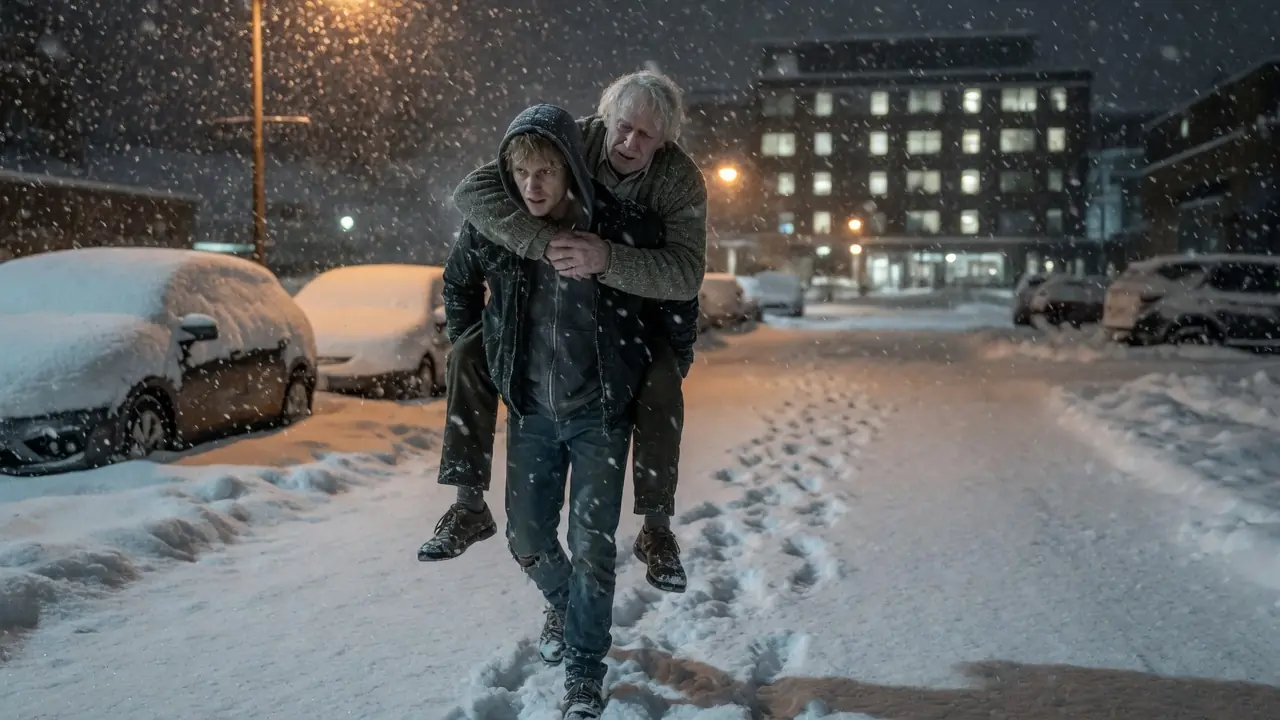
Caleb helped him to his feet. The older man leaned more heavily on him than Caleb expected, and for a moment Caleb nearly lost his balance. Martin was not large, but dead weight in snow was still weight, and Caleb’s own legs were weak from cold and hunger. Still, he adjusted, wrapped one arm around Martin’s back, and began guiding him slowly down the path.
The walk that should have taken five minutes felt much longer.
Snow crunched under their shoes. Martin stumbled more than once. Each time, Caleb tightened his grip and steadied him. His own hands were stiff, and the wind kept cutting through his jacket, but he focused on the yellow pool of light ahead near the park entrance.
Martin kept talking in fragments.
“Your mother made peach pie every Christmas.”
A few steps later, “You wanted a red bicycle when you were nine.”
Then, after a longer silence, “I should not have yelled at you that day.”
Caleb listened without interrupting.
There was something heartbreaking in it, the way a person’s mind could hold love and regret so tightly that they survived even when everything else blurred. Caleb had no idea what Martin’s real story was, but he could hear the shape of it in those broken sentences. A son. A mistake. A loss that had never stopped living inside him.
By the time they reached the coffee cart, Caleb’s teeth were chattering.
The vendor, a woman in a thick green coat, looked up in surprise as the two of them approached through the storm.
“Oh my goodness,” she said. “Sir, are you all right?”
“He’s lost,” Caleb said. “And freezing. I think he needs help.”
The woman immediately came around from behind the cart. “Come under here,” she said, pulling aside the flap of the small covered area beside her stand. “Get him out of the wind.”
Together they helped Martin onto a folding chair. The woman handed him a wool blanket she kept for emergencies and then looked at Caleb more carefully.
“You need one too,” she said.
“I’m fine,” Caleb lied.
She gave him the kind of look only older women seemed able to perfect, a look that said she knew nonsense when she heard it. But she did not argue yet. Instead, she reached for her phone.
“Do you know who he is?”
“His name’s Martin Reynolds,” Caleb said. “He thought I was his son.”
Martin looked up then, suddenly distressed. “Where’s Daniel?”
The woman knelt beside him. “We’re going to call someone who can help, Mr. Reynolds. Do you have family?”
Martin’s hands tightened around the blanket. He looked as though he might drift again, deeper into confusion.
Then, from inside his cardigan pocket, a small leather wallet slipped halfway out. Caleb noticed it first.
“Maybe there’s something in there,” he said gently.
The woman opened the wallet carefully. Inside was an ID card, some folded bills, and a small card tucked behind the license. She pulled it free and read aloud.
“Martin Reynolds. If found wandering or disoriented, please contact Emily Reynolds.”
Her eyes lifted quickly to Caleb. “His daughter, I’m guessing.”
She tapped the number into her phone and turned slightly away to speak. Caleb stayed beside Martin, one hand lightly resting on the old man’s shoulder so he would know someone was there.
A minute later, the woman returned.
“She’s on her way,” she said. “She sounded terrified.”
Caleb nodded.
Martin turned his head toward him, eyes clearer for just a moment. “You stayed.”
The words were simple, but they hit Caleb harder than they should have.
“Yeah,” he said quietly. “I stayed.”
The vendor handed him a cup of hot chocolate without asking whether he could pay. When he hesitated, she pressed it into his hands and said, “Take it before your fingers stop working.”
He took it.
The warmth hurt at first.
Then it spread slowly into his palms.
Martin watched the steam rise from the cup and smiled faintly. “Your mother used to blow on yours first,” he murmured, still half in some older memory. “Said you always drank too fast.”
Caleb looked away so the woman would not see his eyes fill.
Twenty minutes later, a dark SUV pulled up near the curb. A woman in her mid-forties hurried out, coat half-buttoned, her face pinched with worry. Behind her came a younger man in hospital scrubs under a winter jacket.
“Dad!”
Martin looked up at the sound of her voice.
The woman dropped to her knees in front of him, hands gripping his shoulders. “Dad, what were you thinking? We’ve been looking everywhere.”
Martin blinked at her. “Emily?”
“Yes, Dad. It’s me.”
For a second, his confusion thinned. He touched her face as though reassuring himself she was real. “You were crying.”
“I still am,” she said, trying to laugh through it.
Then her attention shifted to Caleb. She stood slowly, taking him in fully now. The thin jacket. The worn hoodie. The snow still melting in his hair. The empty look of someone too young to already know this much cold.
“Were you the one who helped him?” she asked.
Caleb shrugged slightly. “He found me, really. He thought I was his son.”
At that, Emily closed her eyes for a moment.
“My brother Daniel passed away eight years ago,” she said softly. “Some nights Dad remembers. Some nights he doesn’t. When he gets confused, he goes looking for him.”
Caleb felt something ache in his chest.
So that was it.
The grief had stayed so alive inside Martin that on a snowy park path, it had mistaken a stranger for someone it loved and lost.
Emily stepped forward. “Thank you,” she said, and her voice shook. “You may have saved his life tonight.”
Caleb lowered his eyes. “He shouldn’t have been out here alone.”
“No, he shouldn’t have.” She glanced at her father, then back at Caleb. “But he was lucky you were there.”
The young man in scrubs, who turned out to be Emily’s husband, gently helped Martin toward the SUV. Martin paused once and looked back.
“Goodbye, Daniel,” he said.
Caleb opened his mouth, then closed it again.
He simply nodded.
After they settled Martin into the car, Emily returned to the coffee cart with her gloved hands buried deep in her coat pockets. She looked at Caleb for a long moment, as though deciding how to say something without making him run.
“Do you have somewhere to go tonight?” she asked.
Caleb’s first instinct was to lie.
“Yes.”
But the word would not come out. Maybe because he was too tired. Maybe because the storm had stripped away whatever energy he usually spent protecting himself. Maybe because Martin had hugged him like he mattered, and something about that had cracked open a place he kept guarded.
So he said the truth.
“Not really.”
Emily’s face changed.
Not with pity.
With pain.
She understood more than he wanted to explain.
“There’s a twenty-four-hour shelter clinic three blocks from here,” she said carefully. “My husband volunteers there. It’s clean, and no one is going to bother you. You can warm up, eat something, and sleep indoors.”
Caleb hesitated.
The younger man stepped forward. “No pressure,” he said gently. “But if you want, we can drive you.”
The vendor added quietly, “Go, honey.”
Caleb looked from one face to another.
For so long, he had lived inside the rule that kindness always had conditions attached. But there was no push in their eyes, no hidden demand, no impatience. Just concern. Real, steady concern.
He nodded once.
“Okay.”
That one night turned into more than one night.
At the clinic, Caleb slept in a real bed for the first time in months. The next morning, he expected to leave before anyone could ask questions. Instead, Emily came back.
She brought a winter coat.
New socks.
Gloves.
And something wrapped in tissue paper.
When Caleb opened it, he found a dark blue wool scarf.
“My father asked me to bring that,” Emily said. “He said if Daniel was cold, someone should have covered him better.”
Caleb did not know what to say.
So he said the only true thing. “Tell him thank you.”
Emily smiled softly. “You can tell him yourself, if you want.”
Over the next few weeks, Caleb met Martin again, this time in the warm sitting room of the assisted living residence where Emily had moved him after realizing he could no longer be left alone at home. Some days Martin recognized Caleb as Caleb. Some days he called him Daniel. Some days he did both in the same conversation.
But every time, he was glad to see him.
Caleb began visiting once a week.
At first, it was awkward. Then less so.
Martin liked old jazz records, crossword puzzles, and stories about city baseball teams Caleb had never really followed. Caleb discovered that Martin had once been a high school art teacher. That surprised him. It surprised him even more when Martin noticed a small drawing in Caleb’s notebook and said, with sudden clarity, “You have a good eye for shadows.”
No one had said something like that to Caleb in years.
Not since his mother.
Emily noticed too. Little by little, she learned more about Caleb’s life than he had intended to tell anyone. She learned about the shelters he avoided, the jobs he had almost gotten but lost for lack of an address, the mother he still missed every single day, and the way drawing was the only thing that quieted his mind when everything else felt too loud.
Then one afternoon, while Martin dozed in his chair near the window, Emily said, “My father spent forty years helping students get into art school. If he were fully himself, he would already be trying to boss you into applying somewhere.”
Caleb almost smiled. “I don’t think art school is exactly in my budget.”
“No,” she said gently. “Maybe not yet. But a stable place to sleep, some work, and a portfolio class might be.”
He looked at her carefully. “Why are you helping me?”
Emily glanced toward her father.
“Because you helped him when no one else was there,” she said. “And because my father spent one terrible winter carrying the grief of losing his son. The fact that he found you that night by mistake does not feel like a mistake to me anymore.”
Months passed.
Spring came.
The snow melted from the park paths where they had first met. Green returned to the trees. Caleb found part-time work through one of the clinic’s employment programs, first stocking shelves at a small grocery store, then helping at a community art center with children’s classes. He moved into transitional housing. It was not much, but it had a door, a bed, and a key that belonged to him.
Martin’s memory continued to drift in and out.
But he had bright days too. On one of those days, Caleb showed him a sketch he had made of the snowy bench, the lamp above it, and two figures in the storm. Martin looked at it for a long time, then tapped the page.
“You drew the night we found each other,” he said.
Caleb looked up sharply.
Not found you.
Found each other.
“Yes,” Caleb said.
Martin nodded once, as if that settled something important.
That summer, the community art center held a small exhibit of student and local work. Emily insisted Caleb submit three pieces. He did. One of them was the drawing of the snowy bench.
He titled it The Night He Called Me Daniel.
A local paper wrote a small feature about the exhibit. Then a larger publication picked up the story, interested in the painting and the human story behind it. People responded. Some bought prints. A donor offered Caleb a scholarship for a one-year foundation program in illustration and design.
When Caleb told Martin, the old man stared at him proudly.
“I knew you had a good eye for shadows,” he said.
Caleb laughed softly. “You did.”
Martin leaned back in his chair. “Then promise me something.”
“What?”
“When life gets warmer, don’t forget the cold nights. They teach you who you are. But they are not where you’re meant to stay.”
Caleb never forgot that.
A year later, on the first snowy night of winter, Caleb went back to the same park bench. Not because he had nowhere to go, but because now he did. He stood beneath the street lamp with a better coat on his back, gloves in his pockets, and a sketchbook under his arm.
The path was quiet again. Snow fell softly again. The bench looked smaller than he remembered.
He sat for a moment and thought about hunger, loneliness, and the old man who had once walked out of grief and into his life by mistake.
Martin had passed away peacefully three months earlier.
At the memorial, Emily had placed one of Caleb’s sketches beside the flowers. It was a drawing of Martin smiling in his cardigan, one hand lifted as if he had just remembered something kind. Under it, Caleb had written a single line:
He was looking for his son. Instead, he reminded a stranger he still mattered.
That night in the park, Caleb opened his sketchbook and began to draw again.
Not the storm this time.
Not the loneliness.
But the moment after.
The moment an old man, confused and frightened, had hugged a stranger with all the love he had left.
The moment a homeless young man, exhausted and hungry, had chosen not to walk away.
The moment two lost people had recognized something human in each other.
And the moment one winter night, cold as it was, had quietly changed both of their lives forever.