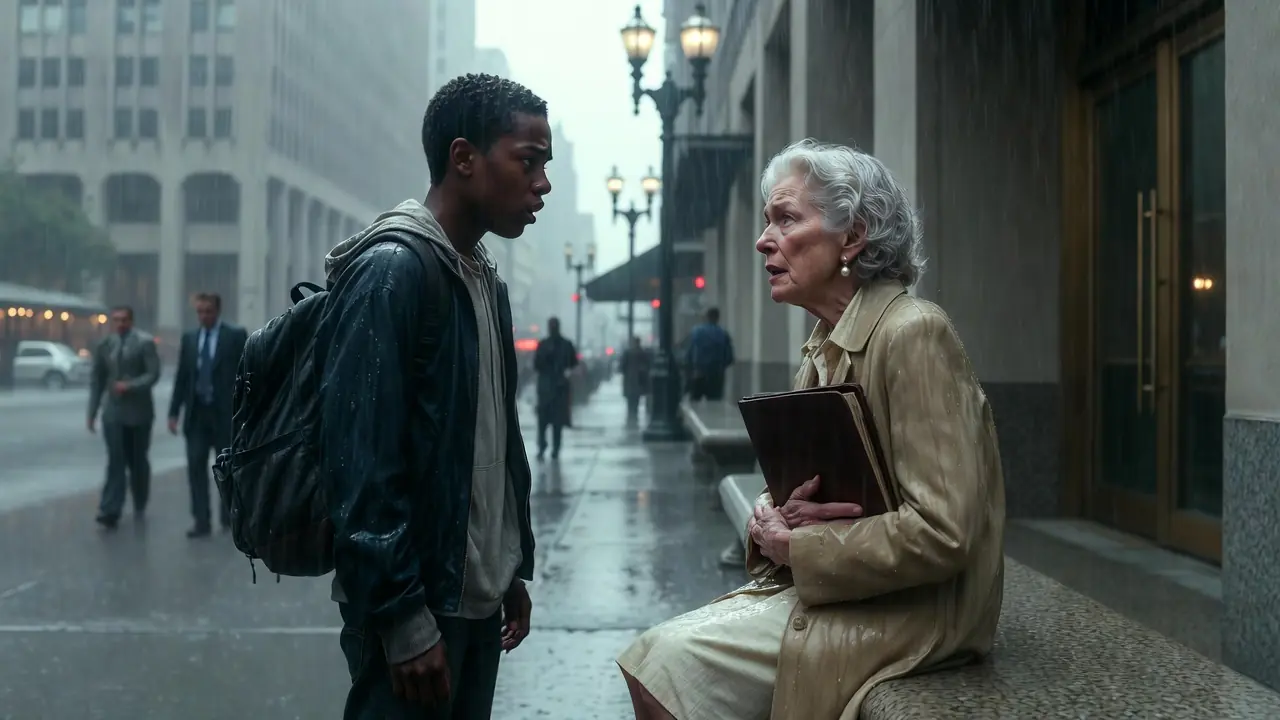
In the middle of a downpour in downtown New Orleans, Marcus, a poor teenager, is rushing to a scholarship seminar.
But suddenly, he sees a confused old woman sitting on a bench, shivering and lost.
A few men in suits mock her, and not a single person steps in to help.
Out of kindness, Marcus walks over, helps her into a warm cafe, and shares with her the few spare dollars he has.
What he doesn't realize is that the confused old woman he just helped is the CEO of a billion-dollar corporation, and she is about to change his destiny forever.
The elderly woman huddled on the weathered stone bench.
Her gaze, distant and clouded, held a fortune approaching $950 million.
Yet her own name had utterly escaped her grasp.
Across the bustling square, 18-year-old Marcus Evans had a mere $45 clinking in his pocket, and only four agonizing days left to secure the $500 his mother desperately needed for their rent.
The very last thing he could afford in his already precarious existence was to become entangled with a bewildered stranger in the vibrant yet sometimes unforgiving heart of downtown New Orleans.
Especially not when he was already running critically late for the university scholarship seminar.
A singular luminous beacon that represented perhaps his only viable pathway to a future beyond the daily grind.
But something, an almost imperceptible pull about her solitary figure amidst the hurried throng, compelled him to stop cold.
Her frail fingers clutched a leather-bound folio with a desperate intensity, as if her entire world resided within its pages.
The incessant rain, a relentless tropical downpour, was soaking through her exquisite wool coat, a garment that he instinctively knew likely commanded a price tag far exceeding his family's combined earnings for half a year.
Polished business magnates adorned in bespoke suits costing thousands deftly navigated around her, treating her as if she were an inconvenient, invisible obstruction.
"Ma'am, are you quite all right?"
He ventured, his voice a soft inquiry against the cacophony of the city.
She lifted her eyes, wide and brimming with profound fear.
"I... I am meant to be somewhere of great importance," she stammered, her voice thin. "But the very name of the place, it eludes me completely."
What transpired in the moments that followed would, in an unforeseen twist of fate, indelibly alter the trajectories of both their lives.
Though neither could possibly have foreseen the monumental shift awaiting them.
Had Marcus possessed even the faintest premonition of the profound significance this particular Tuesday would unleash, he might, in a fit of weary resignation, have chosen to remain in his bed.
But at the ungodly hour of 5:00 a.m., his phone had vibrated with the familiar chilling dread of the nightmare that had relentlessly haunted his family for what felt like an eternity.
The landlord, a spectral voice of impending doom, had called once more.
"Need $500 by Friday, or we're out."
The stark, unyielding message from his mother struck him with a force far more potent than any alarm clock ever could.
Marcus lay there, staring at the familiar cracks snaking across the ceiling of their cramped one-bedroom apartment.
His mind was futilely performing mental arithmetic that had always refused to yield a hopeful sum.
His meager part-time earnings from the community garden, at $15 an hour, were only dispersed when there was work available.
A paltry 25 hours a week if fortune smiled upon them.
A mythical 40 hours if miracles were, in fact, a tangible reality.
His younger sister, Sophia, lay peacefully asleep on the ancient pullout couch a mere three feet away.
Her cherished acceptance letter to the state university, adorned with a hopeful inscription, was taped above her pillow like a silent, fervent prayer.
Tuition for her social work program was due in three short weeks.
It had been Sophia's unwavering ambition since she was eight years old, watching their mother return home utterly spent from relentless double shifts at the hospital, murmuring, "Someone, my dear, must care for our community. It might as well be us, beginning with our own."
Yet noble dreams, Marcus knew with a heavy heart, carried an exorbitant price tag, one their family simply could not afford.
Marcus, with the practiced stealth of someone intimately familiar with the fragility of sleep, rolled off his floor mattress, meticulously careful not to disturb Sophia's slumber.
The apartment, with each passing day, seemed to constrict, feeling smaller and more suffocating.
One bedroom.
A solitary bathroom.
A kitchen barely expansive enough for two people to stand abreast.
The ancient radiator clanked with a mournful, dying rattle, a sound that probably foreshadowed its imminent demise.
The incessant drone of their neighbor's television bled through walls so thin they might as well have been constructed from mere cardboard.
In the dim light of the kitchen, Marcus meticulously prepared two slices of toast, carefully dividing them into three meager portions.
Breakfast for himself.
For Sophia.
And for their mother, who had already departed, commencing her shift at 3:00 a.m.
Tuesday mornings, he knew, were dedicated to the meticulous inventorying of medical supplies, and someone unfailingly had to be there at the break of dawn.
As Marcus made his way to school, his route inevitably led him past the local community center, where he had submitted an application last month.
Through the grimy window, he could discern the manager, a woman who had offered him a polite yet utterly dismissive smile.
"We'll be in touch."
It was the kind of saccharine smile that conveyed an unmistakable subtext.
"Do not, under any circumstances, hold your breath."
Three other establishments had delivered the identical, courteously veiled rejection.
"Too young, regrettably. No experience. Not quite the right fit."
The phrase "the right fit" resonated with bitter irony, as if poverty itself were a deliberate, conscious choice.
At school, Marcus' stomach emitted a series of pathetic growls throughout his first-period urban history class.
By the time lunch arrived, he was light-headed with the gnawing pangs of hunger.
Yet he unhesitatingly divided his single sandwich with his friend Damon.
Anyway, Damon's mother, just the previous week, had tragically lost her job, a casualty of layoffs at the recycling plant where she had diligently toiled for 18 long years.
"Man, you've barely got enough sustenance for your own self," Damon protested, his voice laced with concern.
But Marcus merely offered a nonchalant shrug.
"We both, my friend, have to eat, don't we?"
It was an automatic, ingrained kindness, a deeply embedded reflex learned from observing his mother.
With almost miraculous ingenuity, she invariably managed to conjure enough space for just one more at their humble dinner table.
Even when dinner consisted solely of ramen noodles generously laced with hot sauce to imbue them with some semblance of flavor.
After school, Marcus endured two interminable bus rides to reach Mr. Jeanluke's community garden and urban farm.
Mr. Jeanluke, with quiet understanding, paid him under the table $15 an hour to impart invaluable knowledge and skills that might one distant day genuinely make a substantive difference.
Today's task involved rebuilding a small, dilapidated greenhouse structure for a local elder.
The workspace was cramped, earthy, and decidedly unlike the elegant sustainable housing models Marcus meticulously sketched in the margins of his worn notebooks.
"You possess remarkably skilled hands, young man," Mr. Jeanluke observed, his gaze following Marcus' movements. "A born steward of the earth. But you're contemplating a canvas far too expansive. My friend, endeavor to focus on the immediate, tangible reality directly before your eyes."
Mr. Jeanluke, however, could not possibly comprehend that Marcus found it utterly impossible to cease thinking about the grand, overarching picture.
Instead, Marcus permitted himself to dream of designing resilient, affordable homes that working families could genuinely afford.
Structures with robust, sustainable systems that wouldn't crumble every few seasons.
Energy-efficient designs that wouldn't devour precious grocery money.
Homes meticulously constructed for people like his mother, who drove a 20-year-old minivan with over 25,000 miles on its odometer, offering a silent prayer each morning that it would, against all odds, cough to life.
Mr. Jeanluke, during their break, discovered Marcus engrossed in YouTube videos pertaining to permaculture and ecological engineering.
"University-bound dreams, huh?" Mr. Jeanluke teased, his tone devoid of malice. "Just remember, my young friend, dreams, however grand, do not regrettably pay the rent."
Home by 8:00 p.m., Marcus diligently assisted Sophia with her environmental science homework while their mother toiled away at her night shift.
Sophia, a beacon of brilliance, consistently achieved straight A's, garnering acceptance letters to three distinct social work programs.
However, only one meagerly offered financial aid, and even that tragically left their family significantly short of the required funds.
"I could perhaps take a gap year," Sophia suggested quietly, eraser shavings forming delicate constellations across her homework. "Work full-time. Diligently save up some money."
"No," Marcus' voice was firm, resolute. "You are going to college. We shall somehow figure this out."
But as he lay upon his floor mattress that night, Marcus harbored profound uncertainties about the how.
He stared at the fractured screen of his phone, idly scrolling through his classmates' Instagram posts.
Frivolous spring break excursions to the sun-drenched beaches of Miami.
Gleaming new cars for their sweet 16 celebrations.
Extravagant college acceptance parties adorned with cakes that likely cost more than his family's entire weekly grocery budget.
He didn't precisely feel the sharp sting of jealousy.
Rather, an overwhelming, bone-deep weariness permeated his being.
Weary of perpetually donning the same three shirts to school.
Weary of politely declining invitations because he simply could not afford the luxury of movies or pizza.
Weary of feeling an enforced gratitude for hand-me-downs, all while observing other adolescents lamenting the acquisition of an iPhone in the incorrect hue.
But capitulation, a surrender to circumstance, was a concept utterly alien to his vocabulary.
His mother had meticulously instilled within him the profound conviction that character, in its purest essence, held far greater import than the capricious whims of circumstance.
That performing the righteous act still fundamentally counted, even when no discerning eye bore witness.
Even when the righteous act failed to settle outstanding bills or satiate the gnawing emptiness of hungry stomachs.
Tuesday morning dawned with an unexpected, relentless deluge of rain, its cold tendrils swiftly soaking through Marcus' single threadbare jacket before he had even traversed two city blocks.
By the time he eventually arrived in downtown New Orleans for the university scholarship seminar, a mandatory requirement for his advanced placement English class, he was thoroughly drenched and acutely self-conscious.
He paused, catching his reflection in the polished glass of a storefront window.
A wrinkled shirt clinging damply.
Hair disheveled and plastered down.
Scuffed shoes offering a testament to countless miles.
The university representatives, he imagined, would be impeccably polished, overtly professional, accustomed to students who arrived in comfortable automobiles rather than via the circuitous routes of public buses.
"Feigning it until one achieves it," he whispered to himself, the familiar mantra his mother repeated each morning like a hallowed prayer.
What Marcus, in his present state of unknowing, could not possibly fathom was that this particular Tuesday, in its unfolding, would validate his mother's unwavering philosophy in ways he could never have conceived.
The scene that brought Marcus to an abrupt, unyielding halt was one that the vast majority of people would, with practiced indifference, pretend not to perceive.
Traversing the perimeter of the formidable Vance Financial Tower, a gleaming monument to corporate power, Marcus immediately discerned her.
An elderly, seemingly affluent white woman perched precariously on a low decorative wall between two colossal office buildings, appearing utterly dislocated from her opulent surroundings.
Her silver hair, once meticulously coiffed, was now disheveled, and clinging mascara streaked in mournful rivulets down her pallid cheeks.
Yet her attire unequivocally proclaimed immense wealth.
A designer linen suit.
Italian leather pumps.
A Hermes clutch clutched fiercely in her trembling lap.
The rain, far from abating, had intensified its relentless assault, weaving a shimmering, opaque curtain between her isolated figure and the ceaseless torrent of business professionals hurrying past.
Wisps of steam ascended from the grates, mingling the pungent aroma of wet concrete with the rich, luxurious scent of expensive coffee wafting from the lobby cafe a mere 25 feet away.
She sat directly beneath a grand architectural overhang, offering only partial shelter, yet still receiving the relentless brunt of the downpour.
And everyone, every single soul, was with a chilling unanimity, pretending she simply did not exist.
A man clad in a $4,000 Italian suit sidestepped elegantly around her, a phone pressed firmly to his ear.
"The Dubois acquisition," he barked, his voice devoid of empathy. "Must finalize by noon."
He did not even deign to cast a downward glance.
A woman, her designer heels clicking imperiously, noticed her.
A frown of obvious distaste marred her perfectly composed features, and she accelerated her pace as if confusion itself might be a contagious malady.
Two uniformed security guards positioned near the grand lobby entrance were engaged in a hushed yet heated discussion.
Their gestures pointed unmistakably in her direction.
Neither expressed the slightest inclination to address the escalating situation.
"It falls outside the purview of our responsibilities," one declared. "Someone else's burden."
Always, perpetually someone else's burden.
Marcus, torn by a profound internal conflict, slowed his stride.
He was already running 25 minutes late for the scholarship seminar, and his guidance counselor had meticulously underscored the paramount importance of impeccable first impressions with admissions officers.
His sodden garments certainly did nothing to bolster his rapidly eroding confidence.
The woman, he reasoned, could potentially be homeless, suffering from mental illness, or even dangerous, all the urban perils his mother had tirelessly cautioned him about in the sprawling, unpredictable city.
Yet she continued to cast her gaze about with a desperate, almost frantic air, as if utterly lost within the very metropolis she inhabited.
Her agitated movements conjured vivid recollections of his own beloved grandmother before her passing.
Proud yet increasingly bewildered, valiantly striving to preserve her dignity while the world spun with alarming velocity around her.
"Excuse me, ma'am."
Marcus' voice, when it emerged, was gentle, utterly non-threatening.
He deliberately crouched to her eye level, consciously disregarding the murky puddle that was now steadily soaking through his already damp jeans.
Up close, he discerned subtle details that others, in their haste, had undoubtedly overlooked.
Her hands trembled not from the chill, but from genuine, profound fear.
Her leather portfolio, undeniably costly, exhibited faint, telling signs of wear.
This, he realized with sudden clarity, was not an individual posing for attention.
"I'm... I'm supposed to be somewhere," she uttered, her voice barely audible above the relentless rumble of city traffic. "But I cannot, for the life of me, recall where or precisely how I came to be here."
Her eyes darted anxiously between the faces in the ceaseless crowd, frantically searching for some flicker of familiarity.
"Everyone, it seems, just keeps walking past as though I am utterly invisible."
"You are not, in any sense, invisible," Marcus stated firmly. "What if you recall your name?"
She hesitated, pressing her slender fingers to her temple as if attempting to physically coax forth recalcitrant memories.
"Eleanor, I believe. Yes, Eleanor Vance."
The name emerged uncertainly, as if she were gingerly testing its resonance.
A sudden gust of wind laden with rain swept directly under the architectural overhang, thoroughly drenching both of them.
Eleanor, with a sudden jerky movement, attempted to rise but wobbled precariously, her balance utterly compromised.
Marcus, with instinctive swiftness, caught her elbow, gently steadying her against the cold, unyielding concrete pillar.
"Whoa, take it easy, ma'am," he said, his voice laced with concern. "When was the last time you managed to eat something?"
Her profound silence served as a stark, undeniable answer.
A city bus, its behemoth frame rattling, pulled up at the nearby stop.
Its noxious exhaust mingled with the rain to concoct a thick, almost palpable cloud of urban pollution.
Eleanor immediately succumbed to a fit of coughing, harsh wheezing sounds that betrayed a delicate constitution and hinted at a history of expensive underlying medical conditions.
"I desperately need to get inside," she managed to articulate between racking coughs. "But I... I cannot, for the life of me, recall where I truly belong."
Marcus checked his phone, its cracked screen displaying the grim truth.
10:20 a.m.
The university scholarship seminar had commenced a full 20 minutes prior.
He knew with a sinking certainty that the most promising booths, the ones representing prestigious institutions like Tulane University, Louisiana State University, and even the more accessible community colleges that might offer him a fragile foothold, would already be teeming with eager students.
They were all there at this very moment, engaging with students who had arrived punctually.
Students who impeccably looked the part.
This, he knew, represented potentially his only tangible opportunity to converse with admissions counselors face to face.
To eloquently articulate his worth beyond his daunting circumstances.
To, in essence, irrevocably alter the very fabric of his future.
But Eleanor was now visibly shivering, and her pervasive confusion appeared to be deepening with alarming rapidity.
Her hands repeatedly patted her expensive handbag, a frantic, repetitive gesture, as though she were searching for some specific, elusive item, yet utterly incapable of recalling its nature.
Her breathing was shallow, rapid, fraught with palpable anxiety.
"Come on," Marcus declared, standing and extending his arm in a gesture of unwavering support. "Let us find you somewhere warm, and together we shall unravel this mystery."
She gazed up at him, her eyes brimming with such profound gratitude that it pricked his heart with a small, tender ache.
How long, he wondered, had she been seated here, a solitary figure in the downpour?
How many countless individuals had simply walked past, granting her not even the most fleeting of second glances?
As they began to move slowly toward the nearest cafe, Eleanor abruptly halted and directed her gaze squarely at him.
For a fleeting instant, her eyes cleared with startling brilliance, becoming sharp, intelligent, utterly focused.
"You possess exceedingly kind eyes," she articulated with surprising, unwavering certainty. "Precisely as my grandson's would have been, had he lived."
Then, with an almost physical presence, the confusion returned, enveloping her like a dense, rolling fog.
But something in her tone, a resonant tremor, suggested that this fleeting moment of clarity held a profound significance.
Far more momentous, Marcus intuitively sensed, than he could possibly comprehend.
He noticed, for the first time, her portfolio bore an elegant logo embossed in shimmering gold: Vance Innovations Group.
But the name, he admitted to himself, failed to evoke any recognition.
Merely another corporation, he mused, in a city teeming with countless others.
What he failed to notice, however, was the way Eleanor's grip involuntarily tightened on that distinctive portfolio when she uttered her grandson's name.
Or how her other hand instinctively reached for something nestled deep within her coat pocket.
A small silver object that caught the dim light for a brief, elusive moment before vanishing once more.
Some moments, he would soon discover, irrevocably transform everything.
This was undeniably one of those pivotal moments.
What transpired next, in its swift and unexpected unfolding, would be meticulously replayed on the omnipresent security cameras spanning across three contiguous buildings.
Marcus, with quiet determination, guided Eleanor into the opulent confines of the Crescent City Cafe.
It was an upscale establishment where a single cup of coffee commanded a price tag far exceeding his entire lunch budget.
The hostess, a statuesque young woman in her mid-20s, her blonde hair impeccably coiffed, her makeup applied with surgical precision, cast a fleeting, suddenly disdainful glance in their direction.
A drenched teenager.
A bewildered elderly woman.
Decidedly not their customary clientele.
But Marcus, with a newfound reservoir of inner strength, did not flinch.
"A table for two, if you please," he requested, his voice calm and self-assured. "Somewhere quiet, perhaps."
He articulated the words with an innate confidence, a poised self-possession he had unconsciously absorbed from years of observing his mother deftly navigating dismissive receptionists at the hospital.
From years of steadfastly refusing to permit mere circumstances to dictate his intrinsic worth.
The hostess, after a brief, almost imperceptible hesitation, led them to a secluded corner booth strategically positioned away from the bustling main dining area.
A silent, unspoken act of damage control.
Marcus, without a moment's reservation, ordered Eleanor a steaming hot tea and a delectable blueberry muffin, expending the majority of his remaining lunch money without a second thought.
She wrapped her frail hands around the warm ceramic cup.
With each comforting sip, a faint blush of color slowly, perceptibly began to return to her pale, drawn cheeks.
"Feeling a little better now?" he inquired, his voice gentle.
She nodded, and some of the profound fear he noticed began to recede from her eyes.
"You are truly remarkably kind," she murmured.
Marcus, his fingers flying across his phone, composed a quick text to his guidance counselor.
"Running considerably late. Unforeseen family emergency. We shall endeavor to be there as soon as circumstances permit."
The lie, he realized, flowed effortlessly.
This, in this quiet moment, felt undeniably like family.
While Eleanor slowly savored her tea, Marcus gently and carefully began to examine her leather-bound portfolio.
The clasp, he observed, was a heavy silver creation, undoubtedly expensive and meticulously crafted.
Inside, he discovered intricate architectural blueprints for what appeared to be an enormous urban development project complex.
Financial documents adorned with numbers that boasted far too many zeros.
And a collection of sleek business cards from prominent law firms whose names he had seen emblazoned on towering billboards throughout the city.
Everything, he noted, bore the identical, elegant logo: Vance Innovations Group.
"Eleanor," Marcus asked, his voice soft and measured, consciously striving not to overwhelm her. "Do you, by any chance, recognize any of these papers?"
She studied them with an intense, furrowed brow, as if they were inscribed in an utterly unfamiliar language, struggling to decipher their meaning.
"A meeting," she whispered, fragments of memory slowly coalescing. "There was meant to be a meeting, one of considerable importance."
Her voice, as more pieces returned, gained a fragile strength.
"Something concerning children and schools."
Eleanor's purse contained a high-end smartphone, the very latest model of iPhone encased in a shimmering gold shell, but it was regrettably password protected.
The screen repeatedly illuminated with a cascade of incoming calls.
The numbers were listed as boardroom, security, and Antoine, assistant.
"It appears," Marcus observed, a faint smile playing on his lips, "that a great many people are actively searching for you."
Eleanor stared at the phone with bewildered apprehension, as though it might, at any moment, bite her.
On his own cracked phone screen, Marcus initiated a Google search for Vance Innovations Group New Orleans.
His weak data connection struggled, loading the results with agonizing slowness.
But his eyes widened perceptibly as the information began to manifest.
Major sustainable development corporation.
A multi-billion-dollar enterprise.
Recently prominent in the news for a massive Green Haven community project.
The CEO's photograph loaded last.
A poised, confident businesswoman in her early 70s, her silver hair impeccably styled, standing proudly before a groundbreaking ceremony banner.
"Eleanor Vance," Marcus stated softly, his voice laced with a gentle question as he carefully turned his phone to display the search results. "Does this, by any remote chance, resemble you?"
Eleanor stared intently at the photograph.
At her own composed visage.
Confusion and a dawning recognition warred fiercely on her aged face.
"That's... that's me," she whispered, her hand instinctively reaching up to touch her now disheveled hair, a gesture of profound self-consciousness. "But I appear so, so remarkably put together there."
"Ma'am, I strongly suspect you might be experiencing some form of medical episode," Marcus articulated with careful deliberation. "The confusion, the memory issues. We should perhaps transport you to a medical professional."
Eleanor, with a surprising surge of strength, clasped his wrist.
"No hospitals," she declared urgently, her voice sharp with renewed fear. "They will, without a doubt, believe I am... They will assert that I cannot..."
The fear, he realized, had returned with a vengeance.
Sharp and desperate.
"The project," she whispered. "Today's decisive vote. It determines absolutely everything. Thousands of families are in desperate need of those living spaces."
Through a series of patient, general inquiries, Marcus meticulously pieced together the fragmented narrative.
Eleanor had been scheduled to present the final comprehensive proposal for a $900 million Green Haven affordable community development to the city council at precisely noon.
Without her authoritative signature and compelling testimony, the entire project would inevitably languish and die.
The land, instead of becoming a beacon of hope, would be sold to luxury condominium developers.
A devastating outcome for the 3,000 families whose futures hung in the balance.
"Gone," he murmured, the weight of the word heavy in the air.
Marcus, utilizing Eleanor's high-end smartphone, dialed the number prominently labeled Antoine, assistant.
"This is Eleanor Vance's phone," he announced when a frantic, harried voice answered on the other end. "She is safe, but she is in dire need of assistance."
The profound relief in Antoine Dubois' voice was almost palpably audible.
"We have had security personnel searching every conceivable location," he explained. "The board meeting commenced an hour ago, and Mrs. Vance never materialized. The council members are now threatening to arbitrarily postpone the crucial vote."
"She is, I believe, experiencing some form of memory issue," Marcus elaborated. "But she is fundamentally all right. Where should we endeavor to meet you?"
Antoine arrived in a sleek, corporate-issued vehicle within a mere 10 minutes.
He was a kind-faced man in his late 30s, worry lines etched deeply around his solicitous eyes.
He rushed into the cafe with almost desperate urgency, as though Eleanor were his own beloved grandmother.
"Mrs. Vance, thank the heavens," he breathed, sliding into the booth beside her.
But Eleanor still presented a fragile, profoundly uncertain demeanor.
"I do not believe I possess the capacity to do this, Antoine," she confessed, her voice barely a whisper. "I cannot, for the life of me, recall the numbers, the precise talking points."
She wrung her hands.
"What if I can assist?" Marcus interjected, surprising even himself with the boldness of his offer.
Both Eleanor and Antoine stared at him, their expressions a mixture of astonishment and curiosity.
"I have," Marcus continued, his voice gaining a quiet confidence, "been diligently studying the papers while we awaited your arrival. The project provides homes for 3,000 families. It generates 1,000 green jobs, and it thoughtfully incorporates an on-site community hub and a sustainable energy clinic. The financing, I note, originates from a judicious combination of municipal green bonds and private impact investment offered at a competitive 3.5% interest rate."
Eleanor's eyes widened perceptibly.
"You genuinely comprehend this?" she murmured, a flicker of something new in her gaze.
Marcus nodded.
"My mother is a single parent. We have resided in substandard housing, in conditions less than ideal, our entire lives. This project, it transcends mere business. It embodies profound hope."
Something in his earnest tone seemed to profoundly center Eleanor, serving as a powerful reminder of why this endeavor held such immense significance.
Why she had, with tireless dedication, built her company from its nascent beginnings 45 years ago.
Antoine, with a newfound sense of urgency, drove them to the imposing city hall in the luxurious company Mercedes.
Its supple leather seats and sophisticated climate control system were a stark, almost jarring contrast to the crowded city buses Marcus typically navigated.
During the brief 15-minute journey, Marcus meticulously reviewed the pivotal points with Eleanor.
His innate ability to teach and clarify helped her to steadily regain her focus.
"You meticulously constructed this entire enterprise from its very foundation," he gently reminded her. "That invaluable knowledge, it remains within you. Simply trust your own profound capabilities."
Eleanor's confidence, with each passing block, visibly burgeoned.
By the time they reached the towering limestone steps of city hall, she was sitting straighter, speaking with newfound clarity, effortlessly recalling even the minutest details that held critical importance.
At the grand entrance, Eleanor paused, and with a gesture of profound gratitude, took Marcus' hands firmly in both of hers.
"I truly do not comprehend why you chose to assist me," she articulated, tears threatening to well in her eyes. "But you did not merely save me. You, my dear boy, saved this entire monumental project. Three thousand families, Marcus, will now possess homes, all because of your selfless actions today."
Marcus, abashed by the sheer intensity of her gratitude, offered a modest shrug.
"Merely doing what is inherently right."
Antoine, ever diligent, escorted Eleanor inside while Marcus remained on the massive stone steps, finally checking his phone.
Twenty missed calls from his guidance counselor.
The scholarship seminar, he realized with a pang, had concluded an hour ago.
His mother had sent a text inquiring why he wasn't at school.
The crushing weight of the immediate consequences began to settle upon him.
He had irrevocably missed his opportunity.
The singular chance to engage face to face with admissions counselors.
To valiantly demonstrate that he possessed the intrinsic qualities for university despite his formidable circumstances.
But gazing up at city hall's towering columns, watching Eleanor disappear through those formidable doors that led to decisions impacting the lives of thousands, Marcus knew with unwavering certainty that he would make the identical choice again.
Some things, he understood, transcended mere personal advancement.
Some moments, in their profound impact, irrevocably define one's true character.
This was, without a shadow of a doubt, one such defining moment.
The elegantly embossed business card Eleanor had pressed into his palm, he instinctively knew, would in some unfathomable way change everything.
If only he could decipher its true meaning.
Forty-five minutes later, Eleanor emerged from city hall accompanied by Antoine and several distinguished board members, looking utterly transformed.
Her silver hair was neatly coiffed.
Her posture radiated authoritative confidence.
She was speaking animatedly about construction timelines and the profound impact on the community.
The decisive vote had passed unanimously.
The Green Haven affordable community project was at last officially approved.
Three thousand families would soon have safe, sustainable homes.
Eleanor approached Marcus, her eyes brimming with unshed tears, her entire demeanor radiating overwhelming gratitude.
And something else.
Something that bore a striking resemblance to recognition.
"Because of your selfless intervention, Marcus," she articulated, her voice thick with raw emotion, "thousands of families will now possess a future, a tangible hope."
She paused, her gaze steady.
"How could I possibly adequately repay such an immense debt?"
She produced her checkbook, leather-bound and undeniably expensive, and began to inscribe a sum.
But Marcus, with a decisive movement, immediately stepped back.
"I do not, ma'am, desire monetary compensation."
The words emerged firm, definitive, resonating with unshakable conviction.
"I offered my assistance because it was intrinsically the right thing to do, not for any reward or personal gain."
Eleanor regarded him with genuine surprise.
In her rarefied world, everything, it seemed, possessed a quantifiable price.
Everyone, without exception, desired payment.
She slowly closed the checkbook, meticulously studying Marcus' earnest face, as if truly seeing him for the very first time.
Antoine, observing the poignant exchange, watched with obvious deep interest.
"Most individuals," he observed, his voice hushed, "would have simply contacted emergency services and swiftly moved on. Or far worse, completely disregarded the gravity of the situation. You, young man, remained. You listened. You cared profoundly enough to truly comprehend the monumental stakes involved."
Marcus, unaccustomed to such direct praise, shifted uncomfortably.
"Anyone, surely," he demurred, "would have performed the identical action."
"No," Eleanor countered quietly, her gaze unwavering. "They most certainly would not have. And as a matter of observable fact, they did not."
She reached deep into her portfolio and produced a business card, not her own, but that of another.
The card stock was thick, luxuriously heavy, exquisitely expensive, yet subtly worn from repeated handling.
She gazed at it for a long, reflective moment before finally lifting her eyes to meet Marcus'.
"This," she began, her voice soft with an ancient, lingering grief, "belonged to someone of profound significance to me. Someone who I believe would have admired you immensely."
The card, elegantly printed, read Julian Vance, sustainable architect and urban planner, Vance Innovations Group.
"Julian was, you see, my cherished grandson," Eleanor explained, pressing the card into Marcus' palm along with something else.
A small silver keychain meticulously shaped like a tiny, stylized compass engraved with the initials JV.
"He tragically perished in an eco-tourism accident four years ago. He was, in every conceivable measure, brilliant, tirelessly conceptualizing more resilient, more equitable urban designs for everyday families, not merely for the privileged elite."
She paused, her eyes searching Marcus' face.
Something within her expression subtly transformed.
Recognition.
Wonder.
As if she were momentarily glimpsing a ghost.
"He always maintained," Eleanor continued, her gaze still fixed on Marcus with that intense, almost mystical focus, "that the true future of urban planning wasn't found in constructing taller or more ostentatious buildings, but rather in making sustainable living accessible to working families, in fostering genuinely inclusive communities."
She trailed off, still studying Marcus with unwavering intensity.
"You possess his eyes, my dear boy. Kind, yet imbued with unwavering determination. And when you so eloquently elucidated the community project back there," she shook her head, a ghost of a smile touching her lips, "it was as if I were hearing Julian himself speak. The identical profound passion for uplifting people, the same astute understanding of real-world challenges."
Antoine, ever mindful of the relentless march of time, suddenly checked his watch and approached.
"Mrs. Vance, the board members are patiently awaiting in the car for the celebration luncheon."
Eleanor nodded but did not immediately stir.
"Marcus," she began carefully, her voice weighted with import. "What, if I may inquire, do you intend to pursue after high school? University?"
"I fervently hope," Marcus replied with honest candor. "Perhaps to study sustainable architecture or urban planning. I currently work at a community garden, and I possess a genuine fascination for unraveling how things function, for discovering how to improve them. But university, as you know, is prohibitively expensive, and my family..."
He left the sentence suspended, unfinished.
Yet Eleanor, with profound understanding, comprehended perfectly.
"Julian attended UC Berkeley," she remarked casually, as if commenting on the prevailing weather, "on a full, coveted scholarship. He often articulated that the most exceptional architects and planners emerged from backgrounds where they intimately understood genuine, tangible problems, not merely theoretical constructs."
She paused meaningfully.
"I ponder what he might have perceived in your prodigious potential."
As Eleanor began to walk toward the waiting car, a sleek obsidian Mercedes with tinted windows, she turned back one final time.
"Marcus, hold on to that card and the keychain. Sometimes, my dear, the most profoundly important opportunities manifest themselves when we least anticipate their arrival."
There was something in her tone, not quite secretive, but undeniably significant.
As if she were meticulously sowing seeds she fully expected to blossom.
Antoine approached Marcus privately while Eleanor settled into the luxurious confines of the car.
"Mrs. Vance," he confided quietly, his voice barely a whisper, "does not, as a rule, share Julian's personal effects with anyone. In four long years, you are the very first individual to whom she has entrusted something of his. That, young man, signifies something profoundly important, something truly monumental."
Before Marcus could formulate a question, Antoine, with a hurried nod, hastened after Eleanor.
Alone once more on the grand city hall steps, Marcus meticulously examined the business card and the small silver keychain.
The address listed on the card indicated an industrial complex situated across town, a locale entirely unfamiliar to him.
But the keychain cradled in his palm felt surprisingly warm, substantial, as though it carried a weight far beyond its diminutive size.
Something about Julian's photograph on the card, the confident, earnest smile, the intelligent, thoughtful eyes, imbued him with the unsettling sensation that he was meant to comprehend something of profound consequence.
Something that remained tantalizingly just beyond his immediate grasp.
As he finally began to make his way toward school, Marcus remained utterly unaware that Eleanor, from the plush backseat of her car, was already initiating a series of crucial phone calls, setting in motion a chain of events that would irrevocably alter the entire course of his life.
Three strategic phone calls Eleanor made that afternoon would set off a cascading chain reaction Marcus never saw coming.
"Dr. Ramirez, it's Eleanor Vance."
In the backseat of her Mercedes, Eleanor dialed the number for Dr. Lena Ramirez, the esteemed director of UC Berkeley's College of Environmental Design.
Rain streaks blurred the tinted windows as the New Orleans skyline receded into the distance.
"Yes, I am aware it has been four years since our last discussion concerning Julian's scholarship fund," Eleanor continued, her voice remarkably steady despite the flicker of emotion in her eyes. "I believe, Lena, I have finally found someone."
She glanced down at the business card she had given Marcus, still vividly picturing his earnest face as he held it.
The same profound sense of wonder Julian used to exhibit when passionately discussing his innovative designs.
"A young man, Lena, with truly exceptional potential. A natural problem solver. Someone who profoundly understands that social impact is paramount, and who hails from precisely the kind of background Julian himself deeply cared about. Someone who perceives buildings and urban spaces as solutions, not merely as status symbols."
Back at Vance Innovations Group headquarters, Eleanor's executive assistant, Rachel Chen, received an extraordinary set of instructions over the phone.
"Rachel, I need you to assemble every shred of information we possess concerning community scholarship programs, university architectural partnerships, and most critically, the Julian Vance Memorial Fund," Eleanor instructed. "Additionally, Rachel, I require discreet background research on Marcus Evans. I need to comprehensively understand his full situation before we proceed further."
Within a matter of hours, Rachel had meticulously compiled an extensive, comprehensive file.
Marcus' academic records revealed a respectable 3.6 GPA despite diligently working 25 hours a week.
Stellar recommendations from Mr. Jeanluke at the community garden effusively praised him as the most naturally gifted young steward of the earth I have encountered in two decades.
His family situation.
A single mother working multiple exhausting shifts.
A younger sister exhibiting remarkable university potential.
A tapestry of financial struggles that would, in all likelihood, utterly crush the spirit of most families.
But it was the glowing character references that elicited a genuine smile from Eleanor.
Teachers described him as the student who consistently offers assistance to others without being prompted.
A youth center coordinator fondly recollected how Marcus volunteered every Saturday, diligently teaching younger children basic permaculture principles.
"He instills in them the profound belief that they can cultivate and nurture anything," the report noted.
That evening, Eleanor paid a visit to Vance Innovations Group's special design studio.
Julian's former workspace had been meticulously preserved in its pristine state, exactly as he had left it four years ago.
Blueprints for affordable, eco-friendly community centers covered the walls.
Designs meticulously focused on resilience and low-cost sustainable construction rather than opulent, extravagant features.
His desk still held a scattering of sketches depicting innovative green infrastructure and water recycling modifications.
"He would have undoubtedly cherished the opportunity to mentor someone like Marcus," Eleanor murmured to herself, her fingers tracing the lines of one of Julian's unfinished designs.
She then convened a private meeting with Dr. Michael Ing, the esteemed head of Vance's urban research division.
"I intend to reactivate the Julian Vance Legacy Fellowship Program," she announced with quiet conviction. "Full funding, tuition, living expenses, guaranteed summer internships, a guaranteed job placement upon graduation. But I wish for it to be structured differently this time. More hands-on. More deeply rooted in real-world application."
Dr. Ing, with a gesture, produced a set of dusty files.
"Julian meticulously designed this program to bridge the often gaping chasm between theoretical architectural engineering and its practical, tangible application. A four-year program. Students would work part-time at our labs while pursuing their studies, ultimately graduating with both an academic degree and invaluable professional experience."
He paused, a somber note in his voice.
"It has been dormant since... since Julian's passing."
"I know," Eleanor finished softly. "But perhaps, Michael, it is time to truly honor his cherished memory by genuinely assisting someone who embodies his profound values. By empowering someone who resonates with his extraordinary vision."
By evening's end, Eleanor had set multiple intricate wheels in motion.
UC Berkeley application materials were being expedited.
Vance Innovations Group's special design studio was being prepared for a new intern program.
And meticulous arrangements were being made for what would, by all outward appearances, be a completely coincidental encounter.
Everything, she insisted, must seem entirely natural.
Entirely earned.
Devoid of any hint of charity.
In Julian's old office, Eleanor sat holding a framed photograph of her grandson at his UC Berkeley graduation.
"I believe you would have cherished him, my dear," she whispered, her voice a tender caress. "He possesses your generous heart."
Outside the window, the New Orleans skyline twinkled with myriad possibilities.
Across town, Marcus had not the slightest inkling that his entire future was, at that very moment, being meticulously orchestrated.
The phone call that abruptly interrupted Marcus' shift at the community garden would reveal a connection he never imagined could exist.
Three days following the momentous city hall incident, Marcus was elbow-deep in the intricate repair of an old irrigation system, a stubborn water pump on a 2017 Ford F-150, when his phone vibrated insistently.
An unknown number bearing a 510 area code.
Berkeley, California.
"Marcus Evans?"
The voice was professional, distinctly female, possessing the confident, assured tone of someone accustomed to being taken with utmost seriousness.
Marcus, wiping garden soil onto his work trousers, stepped away from the ailing irrigation system.
Mr. Jeanluke, from across the garden, raised his eyebrows, a silent question in his gaze.
"This is Dr. Lena Ramirez from UC Berkeley's College of Environmental Design. Do you, by chance, have a moment to converse?"
Marcus' heart, with an almost audible thump, skipped a beat.
"I believe you might possess the incorrect individual," he stated carefully, his mind racing. "I have not, to my recollection, applied to UC Berkeley."
Dr. Ramirez's laugh was warm, knowing, and imbued with an undeniable sense of purpose.
"No, young man, you have not. However, someone with great conviction has applied on your behalf. Someone who harbors a profound belief that you possess extraordinary potential in the field of sustainable architecture and urban planning."
Mr. Jeanluke, with unabashed curiosity, moved closer, openly eavesdropping.
He mouthed UC Berkeley with wide, astonished eyes.
"I am regrettably unable to disclose the identity of your nominator," Dr. Ramirez continued, her tone maintaining a diplomatic reserve. "But they have furnished us with exceedingly compelling evidence of your practical aptitude, your academic performance, and most significantly, your exemplary character. We would consequently be delighted to extend an invitation for you to visit our campus for a special interview. All expenses, naturally, will be meticulously covered."
Marcus, covering the phone's receiver with his hand, whispered incredulously to Mr. Jeanluke.
"I simply do not comprehend this."
Mr. Jeanluke merely shrugged, a wide grin spreading across his face.
Prior to your esteemed campus visit, Dr. Ramirez elaborated.
"We would be honored if you would first tour Vance Innovations Group's special design studio here in New Orleans. It is a newly established partnership program where our students gain invaluable hands-on experience with cutting-edge sustainable urban design."
Vance.
The name struck Marcus with the force of a lightning bolt.
"Vance, as in the Green Haven Community Project lady?" he asked, his mind furiously piecing together the fragmented clues.
"I am not entirely certain I grasp the precise connection," Dr. Ramirez replied diplomatically.
Yet something in her tone suggested complete and utter understanding.
The following week, Marcus took the venerable St. Charles streetcar line to the Vance Innovations Group complex.
The building itself was a marvel of sleek glass and gleaming steel, utterly unlike the earthy, functional community garden where he felt so intimately at home.
In the grand lobby, massive, breathtaking photographs showcased innovative urban designs.
Eco-friendly community centers.
Resilient infrastructure projects.
Cutting-edge water management systems that verged on science fiction.
Dr. Michael Ing greeted him with a warm, genuine handshake.
"We are genuinely thrilled to offer you a glimpse into what we are diligently working on," he stated, leading Marcus toward the elevators. "I believe you will find our particular approach to sustainable urban planning quite fascinating."
They proceeded down a long hallway, its walls adorned with an impressive array of patents and prestigious awards.
Every few steps, Marcus noticed the recurring name J. Vance appended to various innovations.
Whoever this J. Vance was, they were undeniably a genius.
"This young man," Dr. Ing explained casually, opening a door at the very end of the hall, "was our lead design architect. This was his personal workspace. He tragically perished four years ago, but his visionary ethos continues to propel every single endeavor we undertake here."
Marcus stepped inside and froze.
The office was not merely a room.
It was a veritable shrine to sustainable urban innovation.
Blueprints, meticulously detailed and vibrant, covered every available wall.
Not for sprawling luxury developments or extravagant resorts, but for practical, community-centric designs focused on affordability and ecological efficiency.
Affordable eco-friendly homes priced under $28,000.
Resilient storm water management systems meticulously engineered for families, not just for coastal protection.
Energy-efficient modifications that could empower working individuals to save hundreds on utility bills.
These, Marcus realized with a surge of profound emotion, were the precise kinds of communities he had, in his most fervent dreams, yearned to design.
On the expansive desk sat a framed photograph.
A young man bearing a remarkable resemblance to Marcus himself, standing proudly next to a prototype eco-friendly dwelling in what appeared to be this very studio.
Dark skin.
Intelligent, thoughtful eyes.
The same slender build.
The nameplate beneath read Julian Vance, lead design architect.
Marcus' hand instinctively went to his pocket, where Eleanor's compass keychain had resided since that momentous day at city hall.
He pulled it out, the small silver compass intricately engraved with the initials JV.
"From where," Dr. Ing asked, clearly taken aback, "did you acquire that particular item?"
"A woman, Eleanor Vance, presented it to me," Marcus explained slowly, the pieces of the puzzle beginning to click together with the precision of well-oiled gears. "I assisted her a few days ago when she was disoriented downtown. She informed me it had belonged to her cherished grandson."
The color, Marcus noted, visibly drained from Dr. Ing's face.
"You are," he stated, not as a question, but as an utterance of sudden, profound comprehension, "the remarkable young man who aided Mrs. Vance."
Marcus gently placed the keychain on the desk directly beside an identical one that had been permanently situated there, a poignant, enduring memorial.
"Julian Vance," Marcus read from the nameplate. "Eleanor Vance. They are related."
"Julian was indeed her grandson," Dr. Ing confirmed, sinking heavily into a nearby chair. "A brilliant architect, deeply passionate about fostering social impact through sustainable urban design. He tragically died in an eco-tourism accident four years ago. Ironically, the very same week he was slated to launch this fellowship program."
Dr. Ing gestured expansively around the meticulously preserved office.
"Mrs. Vance has ever since been diligently searching for the perfectly suited individual to reignite Julian's scholarship program. Someone who profoundly embodies his cherished values, his visionary ethos, his exemplary character."
The room, for a moment, seemed to spin around Marcus.
"The scholarship, the UC Berkeley interview, all of this," he said, gesturing with his hand, encompassing the sophisticated lab equipment, the groundbreaking designs. "Is this because I simply helped her that day?"
"Not merely because you offered your assistance that day," Dr. Ing clarified, his gaze steady. "But because of how you helped her, why you helped her, and most profoundly, what you undeniably demonstrated about your character and your inherent intelligence. Mrs. Vance recounted to us the tale of a truly remarkable young man who possessed a profound understanding of the critical importance of the Green Haven project, who steadfastly refused any form of payment for his kindness, and who most poignantly reminded her of someone exceedingly special."
As if summoned by the very essence of their conversation, Eleanor Vance appeared in the doorway.
She presented an utterly different figure than she had on that confusing rainy day.
Confident.
Commanding every inch the billionaire CEO.
Yet her eyes were the same.
Kind.
Sharp.
And now watching Marcus with obvious affection and something far deeper, something that bore a striking resemblance to destiny.
"Hello, Marcus," she said warmly, her voice resonating with purpose. "I believe you possess something that truly belongs here."
She gestured subtly toward the keychain on the desk, now resting beside its twin.
Marcus stared at her, understanding flooding through him like a powerful river through a breached levee.
"Your grandson. The business card. The keychain. You are not simply any Eleanor Vance. You are the Eleanor Vance. Vance Innovations Group."
Eleanor nodded, tears now openly threatening to spill.
"And you, Marcus, are not simply any kind teenager. You are precisely the young man Julian would have ardently desired to carry forward his profound work."
"The confusion that day," Eleanor continued softly, "was indeed very real, a medication reaction that left me profoundly disoriented and utterly terrified. But finding you, Marcus, meeting you, that was, without a shadow of a doubt, fate."
Marcus looked around the office at Julian's visionary designs.
At the photographs of a young man who could have been his own brother.
At the woman who had, with such meticulous care, been orchestrating his entire future since the very moment he had chosen kindness over mere convenience.
"So here is precisely what is going to transpire," Eleanor declared, her voice firm with unwavering decision. "A full scholarship to UC Berkeley. Guaranteed summer internships here at the studio. An unparalleled opportunity to breathe life into Julian's designs, to create communities and structures that serve families precisely like yours. And upon your successful graduation, Marcus, a coveted position here, diligently designing the future of affordable, sustainable urban living."
Marcus could barely draw breath.
"I... I do not comprehend. Why? Why me?"
Eleanor's smile was radiant, boundless, encompassing all.
"Because, Marcus, kindness inherently recognizes kindness. And because sometimes the vast, intricate universe places precisely the right individual in precisely the right place at precisely the right moment."
She paused, watching the dawning recognition in his eyes.
"Julian always asserted, 'The most exceptional architects and planners emerge from backgrounds where they intimately understand genuine, tangible problems.' You, Marcus, are that architect. You are his enduring legacy."
The contract Eleanor carefully placed in front of Marcus would guarantee everything he had ever dared to dream of.
But first, she held one more breathtaking surprise.
Eleanor led Marcus to the executive conference room, where an array of legal documents was already meticulously spread across a polished mahogany table that he intuitively knew likely cost more than his family's annual rent.
Floor-to-ceiling windows offered a panoramic vista of the New Orleans skyline.
Marcus could discern the exact corner where this extraordinary journey had commenced, where a confused woman had sat alone in the rain a mere three days prior.
"The Julian Vance Memorial Fellowship," Eleanor explained, sliding a thick, imposing folder across the table. "Full tuition, room and board at UC Berkeley, a $2,500 monthly stipend for living expenses, guaranteed summer internships here at the studio, and a formal job offer upon your graduation, Marcus, commencing with a starting salary of $130,000 per annum."
Marcus' hands trembled visibly as he carefully flipped through the formidable papers.
The numbers, he realized, were absolutely staggering.
Over $550,000 in total investment over four transformative years.
More money, by an incomprehensible margin, than his family had ever witnessed.
More money than they had ever, in their wildest fantasies, dared to dream of seeing.
"Mrs. Vance," he began, his voice choked with emotion.
But she gently yet firmly held up a hand.
"There is, Marcus, still more."
Eleanor's eyes twinkled with the deep satisfaction of someone about to irrevocably alter multiple lives.
"Your sister Sophia has been accepted into Loyola New Orleans' distinguished social work program on a full, comprehensive scholarship courtesy of the Vance Foundation. And your mother, Maria, will receive a $1,200 monthly grant to alleviate living expenses while both you and Sophia are diligently pursuing your respective studies."
Marcus stared at her, utterly consumed by disbelief.
"You... you meticulously inquired into my family?"
Eleanor nodded unapologetically.
"Marcus, kindness, you must understand, is not merely an individual act. It is fundamentally systemic. Assisting you to succeed truly and unequivocally necessitates supporting your entire foundational support system to flourish. Sophia's academic achievements are outstanding. A 3.8 GPA, extensive volunteer work at the community clinic. She too unequivocally deserves her chance. And your mother, Maria, has for far too long sacrificed enough."
Dr. Ing leaned forward, his expression now serious, imbued with quiet gravitas.
"The fellowship, Marcus, is not an act of charity. It comes with substantive, very real responsibilities. You will be expected to work 20 hours a week in our studios, to actively collaborate on ongoing, impactful projects, and to present your meticulously conducted research at prestigious conferences. We anticipate and indeed expect nothing less than excellence because we possess an unwavering belief that you are supremely capable of achieving it."
Eleanor activated a large monitor that gracefully descended from the ceiling.
Detailed schematics, breathtaking in their complexity and vision, filled the screen.
Urban designs unlike anything Marcus had ever encountered in architectural magazines or gleaming showrooms.
"This," Eleanor announced, her voice resonating with pride, "is Project Oasis. Affordable, eco-friendly community developments for working families. A purchase price under $28,000, offering sustainable living built to endure for 25 years with minimal maintenance. Julian meticulously designed the core systems before his untimely passing. But we now require a fresh perspective, a new, vibrant energy to usher it successfully into the market."
Marcus meticulously studied the blueprints.
His nascent architectural mind immediately grasped the sheer brilliance of the design.
Optimal placement of green spaces for maximum communal benefit.
Regenerative water systems that minimized waste.
Modular components that effectively reduced manufacturing costs without in any way compromising structural integrity or aesthetic appeal.
"Imagine, Marcus," Eleanor continued, her voice gaining an almost fervent passion, "your mother driving home to a beautiful sustainable community instead of fearing eviction and endless struggle. Imagine families precisely like yours possessing reliable, eco-conscious housing without the crippling burden of insurmountable debt. That, young man, is the profound impact this project could achieve. And you, Marcus, could be the visionary architect who breathes life into it."
Dr. Ing produced another folder.
"The fellowship also comprehensively includes professional mentorship. You will be meticulously paired with our most senior architects, working on tangible, real-world projects from your very first day. No trivial tasks or purely theoretical exercises. Actual product development that will eventually materialize in communities. By your sophomore year at UC Berkeley, you will be leading your own impactful research initiatives."
"And the network, Marcus," Eleanor added, walking gracefully to the window overlooking the city. "Prestigious industry conferences, meetings with prominent urban developers, invaluable connections with venture capitalists keenly interested in socially responsible technology. You will graduate not merely with an academic degree, but with the indispensable relationships required to instigate lasting, transformative change."
She turned back to face him, and Marcus discerned something profoundly moving in her expression.
Hope mingled with enduring grief.
Legacy intertwined with abiding love.
"Julian always articulated, 'The most exceptional architects and planners emerge from backgrounds where they intimately understand genuine, tangible problems,'" Eleanor explained, her voice soft with poignant memory. "Wealthy children who design structures as mere extravagant toys versus young individuals who design communities as profound solutions. You, Marcus, are unequivocally the latter. That, my dear boy, is precisely why this matters so profoundly."
Eleanor walked to a cabinet and carefully removed another framed photograph.
Julian, at the tender age of 18, intently working on his very first community garden prototype in what appeared to be a bustling urban farm.
His hands stained with earth.
His expression one of determined focus.
Surrounded by gardening tools and nascent plant life.
"This was captured the summer before he commenced his studies at UC Berkeley," she explained, setting the photo gently on the table. "He was meticulously rebuilding an old community greenhouse, striving to enhance its yield and sustainability, entirely self-taught, much like yourself. He understood, Marcus, that the most innovative solutions often stem from acute necessity, not from superfluous luxury."
Dr. Ing explained the immediate timeline.
"UC Berkeley's semester commences in a mere 10 weeks. We can meticulously arrange accelerated placement testing, housing assignments, and course registration. Your current summer engagement at the community garden will seamlessly transition into a summer internship here. The same dedicated hours, but with a compensation package 10 times greater and, critically, infinitely more profound learning opportunities."
Marcus looked around the room at the sophisticated equipment.
The intricately detailed blueprints.
The faces watching him with expectant eagerness and genuine, palpable hope.
"I keep imagining," he admitted, a tentative smile touching his lips, "that I am going to awaken from this extraordinary dream. Just three days ago, I was consumed by anxiety about securing rent money. Now, you are speaking of irrevocably transforming my entire life."
"Life-changing moments, Marcus, rarely arrive with a preceding warning," Eleanor observed gently, sitting directly across from him. "They frequently manifest themselves disguised as ordinary Tuesdays, when we, of our own volition, choose to assist a bewildered woman on the street rather than simply walking past her. The profound opportunity, Marcus, was always present. You merely had to embody the kind of individual who would recognize its quiet, undeniable presence."
Dr. Ing smoothly slid a pen across the table.
"So, what say you, young man? Are you prepared to honor Julian's enduring memory by diligently carrying forward his remarkable work? Are you ready to unequivocally prove that kindness and brilliant innovation, when synergistically combined, possess the unparalleled capacity to literally change the world?"
"And," Eleanor added, her voice warm with profound affection, "your family, Marcus, will be meticulously cared for. Sophia's tuition, your mother's expenses, even Mr. Jeanluke at the community garden. I am personally funding a substantial equipment upgrade for his enterprise as a token of my sincere appreciation for his exemplary mentorship of you. Everyone who has in some meaningful way invested in your remarkable character will have the privilege of sharing in your burgeoning success."
Marcus picked up the pen, then, with a tremor, set it down once more.
His hands were visibly shaking.
"Mrs. Vance," he began quietly, his voice imbued with newfound gravitas. "I need to ask you something of critical importance. Is this truly, genuinely real? Because if I affix my signature to this document, and it ultimately proves to be some cruel mistake..."
Eleanor reached across the table and covered his trembling hand with hers, her touch warm, reassuring, and utterly certain.
"Marcus," she stated firmly, her gaze unwavering. "This, I assure you, is the most unequivocally real thing I have undertaken in four years. You, young man, saved far more than merely my confusing afternoon downtown. You, Marcus, saved my profound faith that there still exist individuals in this world who perform the righteous act simply because it is righteous. This fellowship, Marcus, is not charity. It is, in its purest essence, an investment in the profound future Julian so ardently dreamed of."
With trembling hands, Marcus affixed his signature to the contract.
The pen, in that moment, felt impossibly heavy, as though he were, with that single stroke, signing his entire future into vivid existence.
Eleanor, a silent witness to his signature, then produced her phone.
"Sophia, this is Eleanor Vance. Is your mother by chance with you? I possess some news concerning your brother that is destined to change absolutely everything."
Six months later, the expansive ripple effects of that rainy Tuesday were being tangibly felt across three distinct states.
UC Berkeley campus, fall semester.
Marcus thrived in his challenging architectural engineering courses like a plant finally basking in the warmth of abundant sunlight.
His invaluable practical experience, gleaned from years at the community garden, afforded him a distinct advantage over classmates who had only ever encountered theoretical concepts.
When Professor Ana Sharma assigned a project on sustainable urban water management, Marcus' innovative solution, inspired by the intricate irrigation techniques Mr. Jeanluke had imparted to him, improved system efficiency by a remarkable 20%.
"Exceptional problem-solving ability," Professor Sharma meticulously noted in his evaluation. "Approaches complex systems with an intuitive understanding rarely observed in first-year students. Clearly grasps the real-world applications of theoretical concepts."
Vance Innovations Group, winter break.
Instead of returning home for the holidays, Marcus dedicated his winter break to diligently working on Project Oasis.
His very first major contribution, redesigning the community's passive cooling system using advanced permaculture principles Mr. Jeanluke had taught him, increased efficiency by an impressive 25% while simultaneously reducing manufacturing costs by $9,000 per unit.
Senior architects who had been grappling with this particular problem for many months watched in utter amazement as this 18-year-old prodigy meticulously sketched out solutions on a whiteboard as effortlessly as if he were solving elementary math problems.
"From where did you acquire such profound knowledge?" Dr. Ing inquired, his voice laced with admiration.
"From cultivating plants and designing resilient microclimates in New Orleans summers," Marcus grinned. "Same fundamental principles, merely different applications."
New Orleans, spring semester.
Sophia graduated from Loyola New Orleans' esteemed social work program with highest honors.
She was immediately hired at the very same community center where their mother, Maria, works.
The local news extensively covered her graduation, emblazoning headlines such as, "From Community Garden to Community Healing: Local Teen Achieves Social Work Dream Through Vance Foundation Scholarship."
Their mother, Maria Evans, now drives her new, reliable Honda HR-V, an employee discount secured through Vance's partnership program, to Sophia's graduation ceremony.
No more offering silent prayers that the car would somehow start.
No more agonizing choices between meager gas money and vital groceries.
Maria herself is now back in school, diligently pursuing her nurse management certification.
Financial stress, once an all-consuming specter, no longer devours her every waking moment, leaving ample space for long-buried dreams to resurface.
The New Orleans Times Picayune feature story.
"From Community Garden to UC Berkeley: Local Teen's Act of Kindness Leads to Architectural Scholarship."
The insightful article includes captivating photographs of Marcus diligently working in the Vance studios, Sophia resplendent in her social work uniform, and their mother Maria at her own poignant graduation ceremony.
The headline, in its concise brilliance, encapsulates everything.
"When Uplifting Others Uplifts You: The Vance Innovations Group Fellowship Story."
But it is the sidebar, meticulously detailing how the Vance Foundation has significantly expanded its community investment programs based on Marcus' inspiring narrative, that truly resonates with profound significance.
The International Sustainable Development Conference, second year.
Marcus presents his groundbreaking research on affordable, resilient urban infrastructure at a major industry conference.
Esteemed urban planners and developers from UN Habitat, C40 Cities, and Habitat for Humanity attend his compelling presentation.
His innovative proposal for neighborhood-level resilient microgrids utilizing existing sustainable technologies receives a thunderous standing ovation.
Afterward, a prominent impact investor approaches him with a business card.
"Upon your graduation, young man, contact me. We are actively funding the next generation of sustainable social entrepreneurs."
Mr. Jeanluke's community garden expanded.
Mr. Jeanluke's garden has grown from two small plots to seven expansive ones, utilizing the substantial equipment upgrade Eleanor generously funded.
New rainwater harvesting systems, computerized soil diagnostics, and an electric cargo bike charging station have transformed the neighborhood garden into a modern, thriving ecological center.
He is now diligently training 15 young people in permaculture and sustainable technology, proudly calling it the Marcus Evans Apprentice Program.
Four of his students have already received Vance Foundation scholarships to technical colleges.
"Marcus demonstrated to us that cultivating the earth can be about far more than merely generating income," Mr. Jeanluke tells a local reporter. "It can be about diligently nurturing futures."
Westbank High School environmental design track.
UC Berkeley and Vance Innovations Group established a pipeline program at Marcus' old high school, offering invaluable summer internships and mentorship opportunities to students from his very own neighborhood.
Enrollment in environmental science and design courses surges by an astounding 500% as word disseminates that sustainable architecture can indeed be a viable pathway out of poverty, not merely a profession reserved for the privileged elite.
The school's new urban design lab, funded entirely by Vance Innovations Group, buzzes with vibrant activity every single afternoon.
Young people who once habitually skipped classes now eagerly stay late to diligently work on community planning projects.
Project Oasis, resounding success.
The first Project Oasis communities roll off the production line in year three of Marcus' program.
Affordable, eco-friendly homes priced at $26,000, offering a 350-mile range equivalent in energy independence and 25-year warranties.
Pre-orders exceed 6,000 units in the very first month, primarily from working families who have never before possessed the means to afford reliable, sustainable housing.
The waiting list stretches for an incredible 24 months.
Tulane University research study.
An urban economics professor meticulously studies the Vance effect, carefully measuring how strategic investment in character-based leaders generates community-wide transformative change.
Results unequivocally demonstrate that for every dollar invested in character-based scholarships, an astounding $8 in community economic value is generated through the creation of new green jobs, elevated education rates, and significantly reduced social services costs.
White House Green Initiative Summit.
Marcus is invited to deliver a keynote address at a national conference on increasing diversity in sustainable engineering.
His powerful presentation, titled "Solving Real Problems for Real People," becomes a viral video, garnering over three million views.
The comment section overflows with heartfelt stories from other young individuals inspired to pursue careers in sustainable design.
"I never once believed sustainable engineering was for people like me until I witnessed Marcus' story," writes one teenager from Detroit.
National Vance Fellows.
What began as a solitary scholarship has now burgeoned into a national program.
Sixty students from low-income backgrounds are now diligently studying engineering, social work, and environmental design on Vance Foundation scholarships.
They proudly refer to themselves as Julian's legacy, supporting one another through an expansive network Eleanor meticulously established.
They convene annually at Vance Innovations Group headquarters, where Julian's photo, serene and ever-present, watches over a new generation of problem solvers.
Economic impact report.
The Westbank, New Orleans neighborhood where Marcus grew up, exhibits dramatic, tangible improvement.
Unemployment is down 65%.
High school graduation rates are up 90%.
New green businesses are opening monthly.
Real estate developers take notice, but stringent community investment requirements ensure that longtime residents benefit sustainably rather than being displaced.
Eleanor Vance's simple yet profound philosophy, invest in character and witness communities transform, becomes a revered model for corporate social responsibility nationwide.
All because one ordinary teenager chose kindness over convenience on a rainy Tuesday morning.
Five years after that momentous rainy Tuesday, Marcus would find himself on a familiar corner.
But this time, he was the one extending a helping hand.
Downtown New Orleans.
Tuesday morning.
Light rain.
Dr. Marcus Evans, now 23 and fresh from his UC Berkeley graduation ceremony, walks through the very same financial district where everything had irrevocably changed.
He is heading to his first day as lead design architect at Vance Innovations Group, impeccably clad in a suit that, for the first time, truly fits, carrying blueprints for Project Oasis' second-generation communities.
The morning feels eerily familiar.
That same New Orleans drizzle.
The same hurried business professionals.
The very same corner where destiny, in its inscrutable wisdom, had once called his name.
He pauses at the exact spot where he had discovered Eleanor five years ago.
Now, a small, elegant bronze plaque has been quietly installed by Eleanor.
Julian Vance Memorial Corner, where compassion nurtures opportunity.
That is when he sees her.
A teenage girl, perhaps 17, sits on the very same low wall where Eleanor had once huddled.
She is soaked and visibly shivering, clutching a soggy university application that is slowly disintegrating in the relentless rain.
Her clothes are clean but undeniably worn.
The careful pride of someone striving to present their best with severely limited resources.
She looks utterly lost, profoundly overwhelmed, precisely as Eleanor had appeared on that fateful day.
Without a moment's hesitation, Marcus approaches.
"Hey, are you all right?"
She looks up, her eyes brimming with unshed tears and raw frustration.
"I had my university interview this morning," she articulated, her voice cracking with despair. "For the Tulane marine biology program. But the streetcar broke down, and I walked 15 blocks in this rain. By the time I finally arrived, they had already filled the last spot for this semester."
Marcus' heart clenches.
This, he realized with chilling certainty, could have been Sophia's story in a different timeline.
This could have been his own story if one profound act of kindness had not miraculously changed absolutely everything.
"What is your name?" he asks gently, crouching to her level, just as he had done with Eleanor.
"Kaia," she responds, her voice barely a whisper. "Kaia Jackson."
Marcus pulls out his phone, scrolling to a contact he never anticipated needing so soon.
"Dr. Chen, this is Marcus Evans. Yes, Eleanor's Marcus. I have someone you urgently need to meet."
He succinctly explains Kaia's dire situation.
The streetcar breakdown.
The missed interview.
The shattered dream.
Within a mere six minutes, Tulane University graciously agreed to a rescheduled interview that very afternoon.
While they patiently await Kaia's ride, Marcus recounts to her the story of the Vance Foundation.
Of Sophia's inspiring success.
Of the myriad opportunities that exist for students who steadfastly refuse to capitulate despite circumstances beyond their control.
He hands her a business card, his own now.
Dr. Marcus Evans, lead design architect, proudly emblazoned with the Vance Innovations Group logo in shimmering gold.
"Sometimes," he says, echoing Eleanor's profound words from years ago, "the universe places precisely the right individual in precisely the right place at precisely the right moment. Your moment, Kaia, might be arriving sooner than you could possibly imagine."
Hope, a fragile, nascent thing, replaces despair in Kaia's eyes.
A familiar car pulls up.
Eleanor, now 82, but still sharp, still commanding, rolls down the window with a knowing, benevolent smile.
"Need a ride to Tulane?" she asks Kaia warmly. "I happen quite fortuitously to be on the board there."
As they drive away, Eleanor catches Marcus' eye in the rearview mirror and, with subtle grace, winks.
The cycle, he understands, continues.
Kindness meticulously creating opportunity.
Opportunity, in turn, diligently creating more kindness.
That evening, Eleanor calls Marcus at his new apartment, a comfortable, elegant one-bedroom in a desirable neighborhood worlds away from the floor mattress of his childhood.
"Kaia, Marcus, truly impressed everyone at Tulane," Eleanor reports, her voice brimming with delight. "Full scholarship commencing this fall. She desires to specialize in marine conservation to help protect our vital coastal ecosystems."
Marcus smiles, understanding perfectly the circle he knows never truly breaks.
Later, walking into Vance Innovations Group's grand lobby, Marcus pauses at the lobby display.
A majestic wall of photographs showcasing all 60 Vance fellows.
In the very center, Julian's graduation photo rests serenely, surrounded by the students who are diligently carrying forward his profound legacy.
Below it, a new addition.
The first Vance Fellows graduating class, with Marcus front and center, surrounded by other students whose lives were irrevocably changed by strategic investment in character.
The inscription reads, "Kindness is the fundamental architectural principle that constructs better futures."
On the corner outside, a new bronze plaque is being quietly installed.
Kaia Jackson Memorial Corner, where hope begins anew.
The story, he knows, continues one act of kindness at a time.
The corner where it all began now witnesses a new act of compassion every single week because inspiration, like the gentle New Orleans breeze, unfailingly spreads.
Today, there are 150 Vance fellows across the entire nation.
Each one discovered through an act of profound character rather than solely academic perfection.
The program has evolved into a celebrated model for corporations nationwide, unequivocally proving that investing in kindness creates stronger, more resilient communities and fosters more innovative, sustainable solutions.
Marcus' enduring story reminds us with powerful clarity that the most seemingly ordinary moments possess the profound capacity to become extraordinary turning points.
A bewildered woman on a city street corner.
A young man with a compassionate, unwavering heart.
A conscious decision to offer assistance instead of hurrying past.
These seemingly small choices reverberate across generations, creating ripples that transform entire communities.
Every single day, you pass someone who is in need of assistance.
Perhaps their need is overtly apparent.
Perhaps it remains subtly hidden.
Perhaps they are lost or struggling or simply yearn for someone, anyone, to simply notice their existence.
The question, then, is not whether opportunities for kindness exist.
It is rather whether you are the kind of discerning individual who truly recognizes them.
Your Tuesday, dear reader, is patiently awaiting.
Your singular moment to irrevocably change everything might, at first glance, appear as nothing particularly special at all.
What, in that pivotal moment, will you choose?