On a freezing winter night, a seventeen-year-old African American boy was biking through the streets, making deliveries, just hoping to earn enough for one more night at the boarding house.
As he hurried to finish his last order, he saw an old man standing by the bus stop, lost and shivering. He hesitated. This delivery was his last chance to keep his job.
But kindness won.
He turned back to help him.
What he did not know was that the man was a billionaire, and that one small act of compassion would change his life forever.
The wind off the river cut through Maplebrook like broken glass, sharp and cold enough to sting your teeth when you breathed. Streetlights flickered over patches of frozen sidewalk. Snow had been crushed gray under tired feet.
Elijah Carter pedaled fast, head down, his gloved hands stiff on the handlebars of a secondhand bike whose chain groaned at every turn.
Seventeen, thin, and tougher than he looked, he had learned to keep moving. Deliveries paid by the mile, not by the hour.
One more order before curfew.
One more envelope of cash.
One more night where he would not be locked out of the only room he could afford.
“Just one more stop,” he whispered to himself, trying to drown the hunger in his stomach and the ache in his legs.
His phone buzzed with a message from his manager.
Don’t be late again. Last warning.
He shoved it back into his pocket, jaw tightening.
The air smelled of iron and chimney smoke, the kind of cold that made you feel like even the sky had given up.
At the corner near the bus depot, his front tire skidded slightly over ice.
That was when he saw him.
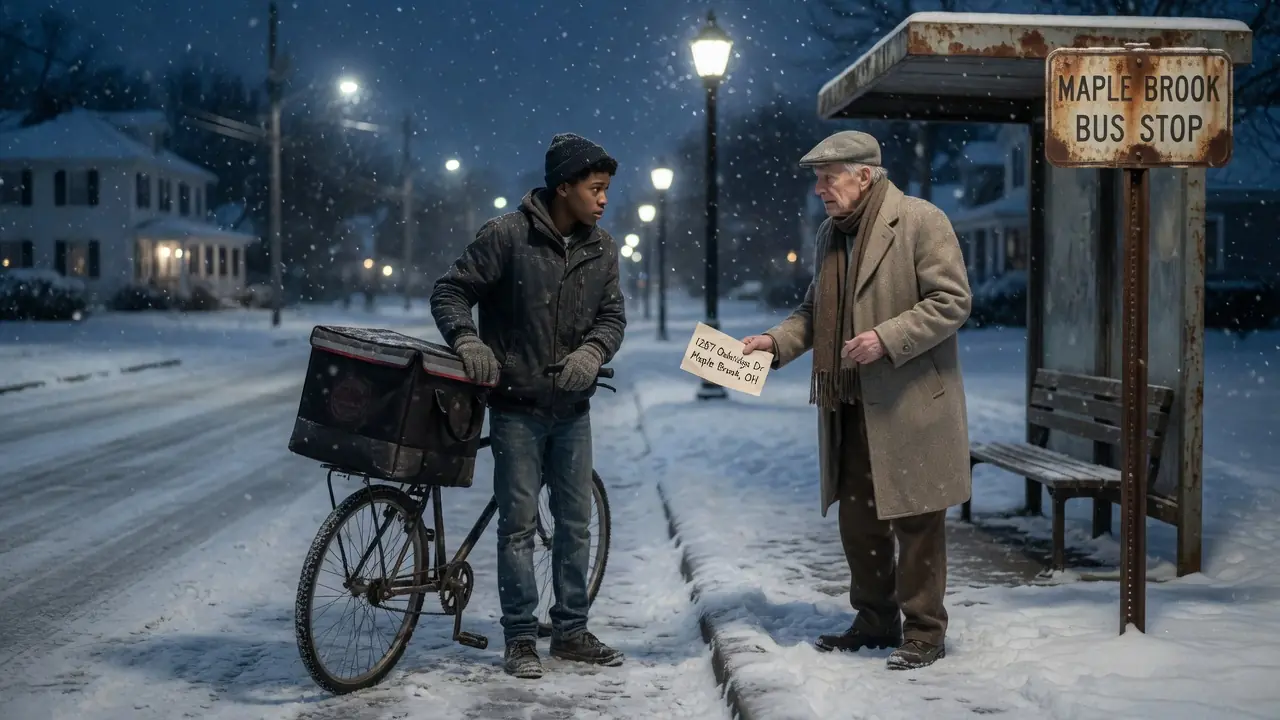
An old man stood by a rusted bus sign, his coat too thin, his scarf half undone, clutching a crumpled paper in shaking fingers. His skin was pale under the orange streetlight.
His eyes searched every passing car as if something might roll up at any second.
He murmured something Elijah could not catch.
Maybe a bus number.
Maybe a name.
Elijah slowed, one foot dragging against the ground, watching him from a few yards away.
No one else did.
People kept walking, heads down, collars up, too busy or too cold to care.
He bit his lip.
Don’t stop.
You can’t stop.
The clock on his phone flashed 7:41.
The delivery had to be done by 8:00. Ten minutes late, and he would lose not just his pay, but maybe the week’s rent.
He glanced again at the man.
His mouth moved soundlessly, the paper trembling in his hands. He looked lost, not waiting, but lost like a child who had wandered too far and forgotten the way back.
His mother’s voice flickered through his mind, soft and distant.
If you ever see someone alone like that, you stop, baby. Doesn’t matter who they are.
Elijah squeezed his eyes shut, pressing his tongue against the inside of his cheek.
“Not tonight,” he muttered. “Please, not tonight.”
He pushed down on the pedals, the bike jerking forward.
But after two turns of the wheel, his stomach twisted with guilt.
The image of the old man would not leave his head. Those empty eyes scanning the street. The way his shoulders hunched as if the world had forgotten he existed.
He cursed under his breath, turned the bike around, and coasted back toward the bus stop.
“Sir,” he called, cautious but gentle. “You okay out here?”
The man blinked, startled.
His gaze was cloudy and unfocused.
“Bus 23,” he whispered. “Willow End. I think I missed it.”
His voice cracked like dry wood.
Up close, Elijah saw how frail he was. His skin was thin as paper, and his fingernails were blue from the cold.
“You live near Willow End?” Elijah asked.
The man nodded slowly, unsure.
“That’s a long way,” Elijah said, eyes darting to his phone again.
7:46.
He could still make it if he left now.
But the man shivered, trying to rub warmth into his arms. Elijah looked at his shoes. Old leather, split at the toes, soaked through.
The guilt hit again, sharper this time.
“All right,” he sighed. “Come on. Let’s figure this out.”
The old man hesitated, confused.
“Figure what?”
“Getting you home,” Elijah said. “It’s too cold to wait here.”
The old man blinked at him, disbelief flickering like light behind fog.
“You don’t have to,” he murmured. “Someone will come.”
Elijah looked down the road.
The buses had stopped an hour ago.
Nobody was coming.
“Yeah, well, looks like I already did.”
He knelt and checked his bike’s back rack. It was not meant for passengers, but it had held weight before.
Boxes.
Groceries.
Sometimes his own despair.
He brushed snow off the rack and looked up.
“Can you sit here if I go slow?”
The old man frowned.
“I don’t want to be trouble.”
“Too late,” Elijah said with a faint grin. “Trouble’s kind of my thing.”
The old man smiled for the first time, a tired, small curl of his lips.
Elijah did not realize then how much that smile would stay with him.
But as the old man tried to climb on, his phone buzzed again.
Where are you?
Elijah ignored it.
His fingers trembled as he wrapped his scarf tighter around the old man’s neck, tucking the ends under his chin.
“Hold on,” he said.
The old man looked at him with glassy gratitude.
“You remind me of...” he started, but his voice trailed away into the cold.
Elijah did not ask who.
He pushed off the curb, wheels crunching against the snow, legs burning as he pedaled into the biting wind. The delivery bag thumped against his hip, heavy with the last order he would not complete that night.
Behind him, the man hummed something faint, a tune with no words.
Maybe a memory too faded to name.
Elijah clenched his jaw and kept pedaling.
Every push forward was a fight between reason and compassion.
You just ruined everything, his mind hissed.
Maybe not, his heart answered.
The road curved along the river, streetlights blinking in and out like dying stars. Each one he passed felt like a countdown.
He could not stop.
His phone buzzed again and again in his pocket, but he did not look. He did not need another threat to know what he had already lost.
The old man leaned closer, whispering through chattering teeth.
“It’s colder than it used to be.”
“Yeah,” Elijah said, breath white in the dark. “World’s meaner too.”
The old man gave a soft, wheezing laugh.
“Not all of it.”
Elijah looked over his shoulder, saw the ghost of a smile, and for a moment, the cold did not feel so cruel.
A car splashed past, horn blaring, sending a spray of icy slush over them both.
Elijah shook his head.
“People are wild,” he muttered.
“Always have been,” the man said, voice trembling but calm.
They passed the town’s edge, where the pavement ended and the old road began, cracked, narrow, and half buried under snow.
“How far did you say it was?” Elijah asked.
“Willow End,” he murmured, frowning. “I think near the hills.”
Elijah sighed.
“Great. Uphill.”
The man did not answer.
His head lowered as if sleep might take him right there.
Elijah bit his lip.
He could not let him freeze.
He pulled over under a flickering streetlight, opened his delivery bag, and pulled out the one thing he had left, a thin cheap blanket meant for groceries.
He wrapped it around the old man’s shoulders and tucked it close.
“You’re going to be fine, all right?” he said softly.
The old man nodded weakly, eyes half closed.
Elijah looked at him for a long second. His face, lined with age and confusion, reminded him too much of the man his mother used to visit at the nursing home, the one who always forgot her name but never forgot to smile.
“Hang on tight,” Elijah whispered. “We’re going.”
And he pedaled again, harder this time.
Somewhere between the sound of the chain and the scrape of his breath, something inside him shifted.
Quiet.
Small.
Undeniable.
For the first time that night, he was not just trying to survive.
He was trying to do right.
Behind him, the old man stirred, whispering the name Arthur.
Elijah did not hear it over the wind.
The river glittered beside them like a black mirror. Street by street, light by light, he rode through the frozen silence of Maplebrook, unaware that this single act, the choice to stop and care, was already rewriting both their lives.
The tires skidded across patches of black ice, but he kept his balance with the precision of someone who had no choice but to learn.
Behind him, the old man, Arthur, clung to the edges of the rack, his hands trembling but still holding on. His breath came in shallow bursts that turned white in the air and disappeared into the dark.
The town lights had vanished behind them, swallowed by the hill’s slow incline.
Every time the chain slipped, Elijah whispered a curse under his breath, but he never slowed.
He could not afford to stop now, not with the wind clawing through their clothes like it wanted to strip them down to bone.
Arthur spoke suddenly, his voice small and hesitant.
“I used to walk this road a long time ago. It didn’t feel so steep then.”
Elijah exhaled hard through his nose, forcing a half smile.
“Guess the hill got taller.”
“Or maybe I got smaller,” Arthur said with a faint laugh that broke into a cough.
Elijah glanced over his shoulder, concern flickering across his face.
“You holding up back there?”
“I’m all right, son,” he said. “I’ve had worse nights.”
“Yeah,” Elijah muttered, pushing harder on the pedals. “Can’t imagine too many worse than this.”
Arthur chuckled again, weakly this time, and Elijah could feel him shiver behind him.
The rhythm of the wheels, the whine of the chain, and the crunch of snow blended into a quiet music that filled the silence between them.
For a moment, Elijah forgot how cold he was.
“You remind me of my grandson,” Arthur said softly, his words almost lost to the wind. “He used to wear gloves like yours. Blue ones. Always losing them.”
Elijah blinked, glancing down at his own frayed gloves, once blue, now faded to gray.
“Guess I got that problem too,” he said. “What happened to him?”
The question hung between them.
Arthur did not answer right away. When he did, his voice cracked like an old door hinge.
“He passed a few winters back. I still talk to him sometimes.”
Elijah felt something tighten in his chest.
“Yeah,” he murmured. “I talk to my mom too. Guess it makes the silence less loud.”
The old man nodded, though Elijah could not see it.
For a while, they did not speak.
The world shrank to the road ahead, the snow around them, and the faint hum of their shared breath.
Then Arthur’s voice came again, softer than before.
“People used to stop for each other, you know. Now everyone’s in a hurry to get somewhere, and nobody remembers where they were going in the first place.”
“Tell me about it,” Elijah said. “Half the people I deliver to don’t even look up from their phones. I’m just another ghost on a bike.”
“You’re not a ghost tonight,” Arthur said, his tone suddenly clear and deliberate. “You stopped.”
The words hit harder than Elijah expected.
He swallowed, blinking back the sting in his eyes.
“Yeah, well, don’t thank me yet. Still got to get you home before we both freeze.”
They crested a hill, and the bike wobbled dangerously.
Arthur gasped, clutching tighter to the sides.
“You all right?” Elijah asked.
“Fine,” Arthur said, his voice shaky.
“You sure?”
“Yes,” he murmured. “You pedal like my daughter. Always stubborn.”
“Guess stubborn keeps people alive,” Elijah said with a small grin.
Arthur smiled too, but it faded quickly.
The wind picked up again, stronger now, pushing against them like a wall. Elijah’s legs ached. His lungs burned. The cold had turned his fingers numb, but he refused to slow down.
Almost there, he told himself.
Almost.
They passed through a stretch of trees where the branches bent under the weight of snow, creaking like old bones. The world felt suspended.
Time slowed.
Breath showed in the air.
The moon seemed like their only witness.
The glow from a distant farmhouse flickered briefly, then disappeared as the hill curved again.
Arthur whispered something Elijah could not make out.
Elijah leaned his head to the side.
“What’s that?”
“Willow End,” Arthur repeated, a faint smile in his voice. “Used to be full of gardens. You could smell the roses before you saw the houses. My wife loved that.”
“You got a wife waiting at home?”
“No,” Arthur said, and Elijah could hear the ghost of loneliness in his tone. “She’s gone too. Long time ago.”
Elijah nodded quietly.
He did not ask more.
The wind carried enough sorrow already.
They stopped once under the dim light of an old gas station sign, flickering half dead. The place was closed, but a vending machine hummed by the door.
Its neon glow was the only warmth for miles.
Elijah propped the bike against the wall, breathing hard. His thighs throbbed, and he could barely feel his toes.
“You thirsty?” he asked.
Arthur did not answer.
He just shivered, his teeth clattering.
Elijah rummaged through his pockets, counting coins. There was just enough for one drink.
He bought a small cup of hot chocolate from the vending machine and handed it to Arthur, steam curling in the cold air.
“Here. Careful, it’s hot.”
Arthur wrapped both hands around the cup, staring at it like it was the most precious thing in the world.
Then he smiled and pushed it gently toward Elijah.
“You take the first sip.”
“You need it more,” Elijah protested.
“And you need to keep pedaling,” Arthur said firmly, voice laced with quiet authority. “Humor an old man.”
Elijah gave in, took a small sip, and laughed at how it burned his tongue.
“See?” Arthur said, amused. “Still too young to be careful.”
“And you’re still too old to be freezing,” Elijah shot back.
They both laughed, a sound that echoed strange and beautiful against the empty road.
When they started again, the air felt different, lighter somehow, though the night had not grown any warmer.
Arthur hummed softly, a tune without words. It took Elijah a minute to realize it was a lullaby, the same one his mother used to hum when the lights went out during storms.
He did not ask how Arthur knew it.
Some things did not need explaining.
The climb grew steeper as they neared the ridge. Elijah’s breath came ragged now, every exhale a cloud of pain.
The wheels slipped more often, but he refused to stop.
He could hear his mother’s voice again in his head, steady and sure.
When you help someone, don’t count the cost. The good will find its way back.
“Hold on,” he whispered through gritted teeth. “We’re close.”
The old man said nothing.
His head rested lightly against Elijah’s back, his breath shallow but steady.
When they finally reached the crest, Elijah looked up and saw a faint outline of houses below, a neighborhood half buried in snow.
Old fences.
Lamplight glowing through fog.
“That it?” he asked, gasping for air.
“Oak Hill Drive,” Arthur said, his eyes brightening for the first time. “Just down there. White gate. Ivy on the fence.”
“You couldn’t have mentioned it was uphill?”
“Didn’t seem so bad last time,” Arthur said, smiling faintly.
Elijah laughed, short and breathless.
“You’re lucky I’m not charging by the pound.”
Arthur chuckled again, and for a fleeting second, Elijah forgot the ache in his muscles.
They rolled downhill, the bike rattling, snow spraying in thin arcs. The cold stung harder at that speed, but the relief was worth it.
At the bottom stood a white gate, its paint chipped, ivy climbing over the posts.
Elijah braked, his legs trembling as the tires skidded to a stop.
Arthur exhaled, staring at the gate like a man seeing a ghost.
“This is it,” he whispered. “Home.”
Elijah helped him off the bike, steadying his weight as he wobbled on weak legs.
The porch light flickered on, catching them in a halo of pale yellow.
He knocked on the door once.
Then twice.
A moment later, it opened.
An older man in a housecoat appeared, eyes widening as he saw Arthur.
“Mr. Leighton. Lord above, where have you been?”
“Went for a walk,” Arthur said softly. “Or a ride, I suppose.”
His voice trembled but carried a quiet humor that made the other man choke on a half laugh, half sob.
“We’ve been calling hospitals, sir. We thought...”
He stopped himself, blinking hard.
Elijah stepped back, unsure what to do.
“I just found him at the bus stop,” he said quickly. “Didn’t know where else to...”
The man cut him off, shaking his head.
“You did right. You did the right thing.”
He looked at Elijah with genuine gratitude.
“Please come in. Warm yourself. Have some food. You must be frozen.”
Elijah shook his head.
“No, I should get back. I’ve got work.”
He did not mention that he had probably already lost it.
Arthur turned toward him, his face soft in the light.
“You sure?”
“Yes,” Elijah said. “Just wanted to make sure you got home safe.”
He reached into his pocket, tore a piece of paper from an old receipt, and scribbled his number.
“In case you need help again,” he said, handing it to Arthur.
Arthur took it carefully, as if it might break in his hands.
“Thank you, Elijah,” he said, his voice trembling. “You’ve done more than you know.”
Elijah forced a small smile.
“Get some rest, okay?”
Arthur nodded.
The other man ushered him inside, still muttering in disbelief, and the door closed behind them.
Elijah stood there for a moment, watching the light glow through the window.
Then he turned back toward the road.
The cold bit harder now, cutting through his clothes, but he did not care. His fingers were numb, his stomach empty, his legs shaking.
But somewhere beneath all of that was a quiet warmth, a pulse of something fierce and good that refused to die.
As he pushed the bike back up the hill, he whispered to himself, “Worth it.”
By the time Elijah made it back to town, the sky had gone from black to dull gray.
The first thing he noticed when he turned the corner onto his street was the stillness.
No sound of music leaking through walls.
No muffled laughter from the tenants upstairs.
Not even the creak of the old sign above the door that always swung when the wind picked up.
It was too quiet.
His legs were heavy, his lungs burned from the ride, and all he wanted was his bed, a mattress thin as paper, but his.
He pedaled slower, coasting the last few feet, until his bike rolled to a stop in front of the boarding house.
Then he saw it.
His things sat in a plastic grocery bag by the door, half covered in snow, the strap of his old backpack sticking out from the top.
His heart dropped.
He climbed off the bike, blinking against the cold, trying to tell himself it was a mistake.
Maybe the landlord had fixed something.
Maybe someone had moved his stuff by accident.
But when he reached for his key, it did not fit.
He jiggled it, twisted it hard, the metal biting into his palm.
It would not turn.
He tried again.
Nothing.
That was when he saw the note.
It was taped crookedly to the door, written in thick black marker that bled through the paper.
Rent late. Lock changed.
The words hit him harder than the wind.
He just stood there, his hand frozen on the doorknob, staring at the letters until they blurred.
He knocked first softly, then harder.
“Mr. Barnes,” he called, his voice shaking. “It’s me, Elijah. Please, can we talk?”
No answer.
He pressed his ear to the door. He thought he heard movement inside, a chair scraping, a floorboard creaking, but no one came.
“Please,” he said again, louder this time. “I’ll get the money. I just need a little more time.”
The silence that followed was worse than a no.
He swallowed hard, backing up a step.
“Please,” he whispered once more, barely audible.
Nothing.
No mercy tonight.
He stared at his bag, the one that held everything he owned. Two pairs of jeans, his mother’s photo, and a phone charger that barely worked.
It had not seemed like much before.
Now it looked like all that was left of his life.
He crouched down, brushing snow off the plastic, his fingers stiff and red.
He wanted to scream, to kick the door until someone listened, but the fight drained out of him before it could start.
He had no strength left to argue with the world.
He slung the bag over his shoulder, his movements slow and mechanical. His chest hurt, not the kind of pain you feel in your body, but the kind that sits deep like shame.
The kind that tells you that you have lost something you cannot get back.
His bike leaned against the railing, the one his mother had saved for back when she thought the world would give her son a fair chance.
Elijah ran his hand along the cold metal frame, whispering under his breath, “Guess it’s just us again.”
His voice cracked on the last word.
He tried to think.
He could maybe stay at the diner, beg the owner to let him sleep in a booth until morning, but the diner had closed early all week.
The library was too far.
The bus station was too dangerous at night.
He rubbed his hands together, trying to feel something other than panic.
The wind stung his face, but he barely noticed.
He reached into his coat pocket and pulled out his phone. The battery was almost dead.
A red 3% glowed in the corner.
He hesitated, then opened the message app.
Nothing from anyone.
He scrolled to the top, staring at his last text from his manager.
Don’t screw this one up.
His stomach twisted.
He had missed the delivery. His manager was probably already furious.
Still, Elijah typed fast, fingers shaking.
I can explain. There was an emergency. Please don’t fire me. I’ll work extra shifts. I promise.
He hit send.
The little bubble appeared.
Delivered.
Then the phone vibrated almost immediately.
Incoming call: Manager.
His throat tightened as he answered.
“Hey, Elijah.”
His manager’s voice cut sharp through the static.
“What happened tonight?”
“I got delayed,” Elijah said quickly. “There was this old man at the bus stop. He was lost.”
“And you stopped for some random stranger?” the manager snapped. “You realize the customer called me three times asking where their package was?”
“I know. I’m sorry, but it was freezing, and he could have...”
“You think I care?” his voice rose. “You’re not paid to play hero. You’re paid to deliver.”
Elijah bit his lip hard.
“Please,” he said, his voice small now. “I need this job. I’ll make it up tomorrow.”
“No,” the manager said, flat and final. “You won’t. I can’t keep someone who doesn’t follow orders. I’ll have your last pay ready next week. Bring your uniform by then.”
“Wait. Don’t...”
But he had already hung up.
The silence on the other end was immediate and brutal.
Elijah stared at the cracked screen, his reflection faint and ghostly. His breath fogged over it until the screen went black.
He dropped the phone back into his pocket, his hands shaking uncontrollably now.
“Great,” he muttered. “Perfect.”
He laughed, but it came out wrong, brittle and hollow.
The kind of laugh that meant the opposite of what it sounded like.
The street was empty except for his voice bouncing weakly off the walls.
He sank down on the steps, his bag beside him, his elbows on his knees. The cold wood bit through his jeans, but he did not move.
The snow kept falling, soft and steady, landing on his hair and melting down his neck.
For a while, he just stared at the road, unfocused. His thoughts tangled, looping between what now and why me until they did not make sense anymore.
Somewhere down the street, a door opened and closed.
Light spilled briefly onto the snow, then disappeared.
He wondered if the person behind that door had any idea how lucky they were to walk into warmth without thinking about it, to not have to beg the world for a place to sleep.
His eyes stung, but he did not cry.
The tears would not come.
He had run out of those months ago.
He pressed his palms together, blowing into them for warmth.
“You did the right thing,” he told himself quietly, the words coming out shaky. “You did the right thing.”
But the world did not seem to care about right or wrong.
It cared about rent, rules, and clocks that did not stop ticking.
He lifted his head and looked up at the window of his old room. It was dark now.
Someone else would probably be in there by tomorrow.
Someone who could pay.
The thought cut deep.
He stood, pulling his coat tighter, the strap of his bag digging into his shoulder. The air hurt when he breathed.
He looked at his bike again, the old metal glinting faintly under the streetlight.
“Come on,” he whispered. “Let’s go.”
His voice barely carried over the wind, but it was enough.
He got back on the bike, the seat cold, the pedals stiff. He pushed off slowly, his breath forming clouds in the air as he rode through the empty street.
The snow hissed under the tires.
Behind him, the house faded into the dark.
He did not know where he was going.
Only that he could not stay.
The wind had only grown worse by the time Elijah reached the edge of town. His legs ached from hours of pedaling through snow.
His fingers were stiff and cracked around the handlebars.
He had nowhere to go.
No room.
No job.
No one to call.
The lights of Maplebrook’s main street flickered weakly ahead of him.
At the far corner, he saw it.
A small convenience store still open, its neon sign buzzing in the dark.
The windows were fogged. Inside, the light was dim and yellow under cheap fluorescent bulbs.
He coasted closer, the tires crunching against the frozen ground, and stopped just outside.
For a moment, he stared at the glowing sign, unsure if he had enough courage left to walk in.
He needed warmth.
Just for a few hours.
Enough to stop shaking.
That was all.
He pushed open the door.
The bell above it jingled softly.
A wave of stale air met him, half coffee, half floor cleaner.
Behind the counter stood two men.
The older one, in his late fifties, had gray hair and kind eyes. His name tag read Harold.
The other was younger, mid-thirties maybe, with a slick haircut and a permanent frown. His name tag said Evan.
Harold looked up first, his expression curious but not unkind.
Evan scanned Elijah from head to toe like he did not belong there.
“You lost?” Evan asked, his tone dry.
“No,” Elijah said quietly. “Just cold.”
Evan raised an eyebrow.
“We don’t let people hang around here. Store’s not a shelter.”
Harold shot him a warning glance.
“Relax, Evan. He’s a kid.”
Then to Elijah, he said, “You okay, son?”
Elijah nodded, hugging his bag close.
“I just need to rest a bit. I can help if you want. Stock shelves, clean, whatever.”
Evan scoffed.
“Yeah, sure. That’s what they all say before the cash drawer’s short.”
Harold frowned.
“Enough.”
Then, turning back to Elijah, he sighed.
“You said you’d help. Fine. You can organize the shelf by the drinks cooler. Just don’t block the aisles.”
“Yes, sir,” Elijah said, grateful enough that his voice trembled.
Evan muttered something under his breath, but Harold ignored it.
Elijah dropped his bag behind the counter where Harold pointed, rolled up his sleeves, and went to work.
The hours crawled by.
He stacked bottles, swept the floor, and refilled snack racks. The warmth inside the store made him dizzy, but it was better than the freezing street.
Evan kept glaring every time he walked past, his steps loud on purpose.
Harold, meanwhile, busied himself at the register, watching quietly.
Around midnight, the last customer left, and the parking lot outside went dark.
Harold turned the sign to Closed but did not lock the door yet.
“You can stay till morning,” he said softly. “We open again at 6:00, but you’ll have to be up before customers start coming in.”
“Thank you,” Elijah said, his throat thick. “I’ll do more work. Whatever you need.”
Harold smiled faintly.
“You’ve done enough. Get some rest.”
Elijah nodded, slipping to the corner near the back room, sitting on the floor beside the storage shelf. He wrapped his arms around his knees, exhaustion pressing down hard.
For the first time that night, he felt a little safe.
But not for long.
Evan came out from the office a few minutes later, holding his phone, his jaw tight.
“Harold,” he said. “We’re short twenty bucks from the drawer.”
Harold frowned.
“We’ve been busy. Maybe you miscounted.”
“No,” Evan said, his voice rising. “It was there earlier. I checked before he came in.”
Elijah looked up, startled.
“What? I didn’t...”
“Save it,” Evan snapped. “You’ve been walking around near the counter all night. Don’t tell me you didn’t see the drawer.”
“I didn’t touch anything,” Elijah said, standing. “I was just cleaning like you told me.”
“Don’t lie,” Evan said, taking a step closer. “You people always have an excuse.”
Harold’s tone hardened.
“Evan.”
But Evan was not listening.
“First, you wander in here looking for free heat. Now we’re missing cash. Give me a break. I should have known.”
Elijah’s stomach twisted.
“You can check me,” he said quickly. “I didn’t take anything.”
“Oh, I will,” Evan said, moving toward him.
Harold stepped between them.
“That’s enough. Nobody’s checking anybody. We’ll look at the camera.”
“Fine,” Evan said, jaw tight.
He stormed into the office.
Harold turned to Elijah.
“Don’t worry. It’ll clear this up.”
But Elijah was not so sure.
His pulse hammered in his ears as he watched Evan in the back room through the glass window, clicking through security footage.
After a few minutes, Evan came out smirking.
“Cameras went blank between 11:30 and 12:00,” he said. “Footage is gone. Must have been when he was working.”
“That’s not possible,” Harold said. “We just installed that system.”
“Guess we’ll never know,” Evan said, crossing his arms. “But I know what I saw.”
Elijah’s voice broke.
“I didn’t take your money.”
“Then where is it?”
“I don’t know.”
“You expect me to believe that?” Evan sneered. “You think you can walk in here, play helpless, and I’ll just let it slide?”
Harold cut in sharply.
“That’s enough, Evan.”
But Evan kept going.
“He’s a thief. Harold, you don’t see it because you’re too soft.”
The air felt thick.
The old heater buzzed in the corner, the only sound between them.
Elijah’s hands shook as he fumbled with his bag.
“You can look,” he said, his voice trembling. “I don’t have anything.”
“Forget it,” Evan said. “Just get out before I call the cops.”
Harold turned to him, furious.
“You’re out of line.”
“Am I? You want to cover for him? Go ahead. But don’t say I didn’t warn you.”
Evan pulled out his phone, thumb hovering over the screen.
“Don’t do that,” Harold said sharply. “I said don’t.”
Evan froze, glaring, but lowered his phone.
Elijah’s eyes filled with tears he refused to let fall.
“It’s okay,” he whispered. “I’ll leave.”
Harold stepped forward.
“No, you won’t. Not until I see the rest of that footage.”
He walked into the office, slamming the door behind him.
The silence that followed felt endless.
Evan leaned against the counter, watching Elijah with a cold smirk.
“People like you never learn,” he muttered. “Always think someone owes you something.”
Elijah said nothing.
His fists clenched at his sides, nails digging into his palms. He wanted to scream, but he stayed still.
A minute later, Harold came out holding a small remote in his hand.
“Funny thing, Evan,” he said calmly. “I forgot to tell you. We have a backup camera. Hidden one by the cooler.”
Evan’s face went pale.
“What?”
“You heard me.”
Harold pressed play.
The screen behind the counter flickered.
There was Evan standing at the register around midnight, opening the drawer, pulling out a bill, and slipping it into his jacket.
Then, a few minutes later, the footage showed him walking back to the office.
Harold stopped the video.
The silence hit like thunder.
Elijah stared, his heart pounding.
Evan’s mouth opened, but no sound came out.
“You want to explain that?” Harold asked, his voice flat.
Evan’s face twisted.
“I was checking the balance.”
“Save it,” Harold said. “Get your stuff. You’re done.”
“You’re firing me over him?” Evan shouted, pointing at Elijah. “Over some stray you found freezing on the street?”
“No,” Harold said calmly. “I’m firing you because you’re a liar.”
For a second, Evan looked like he might argue again.
But something in Harold’s expression made him stop.
He grabbed his coat from the hook, muttering curses under his breath as he stormed out.
The door slammed behind him, the bell clanging hard before the sound faded into the wind outside.
The store went quiet again.
Harold turned back to Elijah.
He stood frozen, his hands trembling, his eyes wide with shock.
“You okay?” Harold asked gently.
Elijah nodded, but his throat felt tight.
“I didn’t mean to cause trouble.”
“You didn’t,” Harold said. “He did.”
He rubbed a hand over his face, tired.
“I’m sorry you had to hear that. Some people only see what they want to see.”
Elijah swallowed hard.
“Thank you for believing me.”
“Didn’t take belief,” Harold said. “Just needed to look at the truth.”
He sighed.
“You can stay in the back room tonight. There’s an old cot near the stock shelves. It’s not much, but it’s warm.”
Elijah blinked, disbelief flickering across his face.
“Are you sure?”
“I wouldn’t offer if I wasn’t.”
He nodded slowly, a small, grateful smile forming despite his exhaustion.
“Thank you,” he whispered. “Really.”
“Get some rest,” Harold said. “We’ll figure something out in the morning.”
Elijah followed him to the back room.
The walls were lined with boxes of paper towels and canned goods, the air faintly smelling of cardboard and citrus.
There was a thin cot near the heater, exactly as Harold said.
Harold handed him an extra blanket from a shelf.
“You’ll be safe here,” he said. “Lock the door if it makes you feel better.”
“I will,” Elijah said softly.
Harold gave a small nod and left, the door clicking shut behind him.
The hum of the heater filled the room.
Elijah sat on the cot, the blanket pulled tight around his shoulders. For the first time in hours, he felt something close to relief.
His body ached.
His mind was raw.
But he was still here.
Still breathing.
He looked down at his hands, red, cracked, and trembling, and exhaled a long, shaky breath.
“Thank you,” he whispered.
He did not know if he meant Harold, the hidden camera, or something higher.
Lying back, he closed his eyes. The noise from the store faded, replaced by the steady sound of the wind outside.
He thought about Arthur, the old man he had helped, and wondered if he was asleep now, safe in his warm house.
The image made him smile faintly in the dark.
He did not know it yet, but that small act of kindness, both his and Harold’s, had just changed the direction of his life again.
And as the heater hummed and snow tapped softly against the window, Elijah Carter, for the first time in a long while, drifted into a deep, peaceful sleep.
The black car showed up just after sunrise.
It stopped quietly outside the convenience store while the streets were still half asleep and the air was sharp with cold.
Elijah was sweeping near the counter when he noticed it through the window.
The car was too clean, too polished for Maplebrook.
It did not belong here.
He frowned, broom still in his hand, watching as a tall man in a dark coat stepped out and looked around before walking toward the door.
Harold looked up from the register, curious.
“You expecting someone?” he asked.
“No,” Elijah said, shaking his head. “Never seen that car before.”
The bell above the door jingled as the man walked in.
He carried himself with quiet confidence, not like a customer, but like someone on a mission. His coat was buttoned perfectly. His hair was neat. His eyes were calm and focused.
He looked around once, then spotted Elijah.
“Good morning,” he said politely. “I’m looking for someone named Elijah Carter.”
Elijah blinked, surprised.
“That’s me.”
The man nodded slightly.
“My name is Charles. I work for Mr. Arthur Leighton. He asked me to find you.”
The sound of that name hit Elijah hard.
“Arthur,” he said slowly.
“Yes,” Charles replied. “Mr. Leighton remembers what happened last night. He wanted to thank you in person.”
Harold frowned, confused.
“Arthur Leighton? The one up on Oak Hill?”
“That’s right,” Charles said.
He reached into his coat and pulled out a folded piece of paper, worn and creased.
Elijah recognized it immediately.
The old store receipt he had torn in half the night before. His handwriting was still there, shaky and blue.
Elijah Carter, and a phone number.
His eyes widened.
“He still had that,” Elijah whispered.
Charles nodded.
“He kept it in his hand all night. When he woke up this morning, he handed it to me and said, ‘Find him.’”
“But how did you know I was here?” Elijah asked, still stunned.
“I called the number you wrote,” Charles explained. “But it didn’t go through. So I asked around town. In a small place like this, people talk. Someone at the delivery company said they’d seen you helping out here last night. Wasn’t hard to find you after that.”
Elijah stared at the paper, speechless.
“He really remembered me?”
“Every detail,” Charles said. “And he hasn’t stopped talking about you since.”
Harold leaned on the counter, impressed.
“You must have made quite an impression, kid.”
Elijah looked down, unsure what to say.
Charles gestured toward the door.
“If you’re ready, Mr. Leighton would like to see you. He insisted I bring you to him.”
Elijah hesitated, his voice quiet.
“Now?”
“He didn’t want to wait,” Charles said simply.
Harold gave Elijah a nod.
“Go on. You should see what this is about.”
“You sure?” Elijah asked softly.
“I’m sure. I’ll keep an eye on your things till you get back.”
Elijah took a deep breath, set the broom aside, and grabbed his coat.
The air outside was cold and sharp, the kind that bit your skin but woke you up. The black car waited at the curb, steam curling from the exhaust.
Charles opened the back door for him.
“Don’t worry,” he said. “You’re safe.”
Elijah hesitated for a second, then climbed in.
The seat was warm.
The car smelled faintly of pine and leather.
He had not sat in anything that clean in years.
Charles got in the front and started the engine.
As they drove, Maplebrook passed by slowly.
The old diner.
The cracked sidewalks.
The same streets Elijah had biked through every day.
But from inside the car, everything looked different.
Smaller somehow.
“Mr. Leighton said you helped him when he was lost,” Charles said after a few minutes. “He told me you wrapped your scarf around him, that you got him home when he couldn’t remember who he was.”
“He looked scared,” Elijah said quietly. “I couldn’t just leave him.”
“Most people did,” Charles said. “But you didn’t.”
The ride was quiet after that.
When they reached Oak Hill, the snow was thinner and the roads clearer. The car turned into a long driveway lined with bare trees.
At the top stood a white house.
Elijah remembered it from the night before.
“This is where I brought him,” he said softly.
“Yes,” Charles said, pulling to a stop. “He’s been waiting for you since morning.”
The front door opened before they even reached it.
Arthur Leighton stood there, cane in hand, smiling. He looked healthier now, his posture straighter, his eyes alert.
“There you are,” he said warmly. “Come in, son. Please.”
Elijah hesitated.
“You really didn’t have to send someone for me.”
Arthur chuckled.
“You didn’t have to save me either, but you did. Seems fair.”
Elijah smiled nervously and stepped inside.
The house was bright and warm, filled with the smell of coffee and wood polish. A fire burned quietly in the fireplace.
Arthur motioned for him to sit on the couch while he eased into a chair across from him.
“I remember everything now,” Arthur said. “You found me at that bus stop when no one else would. You got me home. You gave me your scarf. You even left me that paper with your name.”
Elijah looked at the folded receipt still in Arthur’s hand.
“I didn’t think you’d keep it.”
“It reminded me that people still care,” Arthur said softly. “That I’m not just an old man waiting to be forgotten.”
“I’m just glad you’re okay,” Elijah said. “You don’t owe me anything.”
“Oh, but I do,” Arthur said. “You gave me more than a ride. You gave me a reason to remember who I am. That doesn’t happen often at my age.”
Elijah smiled faintly.
“You sound a lot better than last night.”
“I am,” Arthur said. “You brought me back to myself. Now I want to return the kindness.”
“You don’t have to,” Elijah started, but Arthur shook his head.
“I want to. You said you lost your home and your job, didn’t you?”
Elijah hesitated, then nodded.
“It’s been rough,” he admitted. “I’ll be fine, though. I always figure it out.”
“You don’t have to figure it out alone,” Arthur said. “I have more rooms here than I can use and not enough people to fill them. You’re welcome to stay as long as you need.”
Elijah’s eyes widened.
“Here? I can’t do that. It doesn’t feel right.”
“It’s not charity,” Arthur said firmly. “It’s gratitude. You helped me when you didn’t have to. Now let me help you.”
Elijah stared at him, unsure what to say.
Arthur’s tone was not forceful. It was kind, steady, sincere.
“Just think about it,” Arthur said. “If you stay, we’ll find you some work. Maybe help you get back to school. I’ve been wanting to start a small fund to help young people like you, people who deserve a real chance. I could use your help with that.”
“Me?” Elijah asked. “Why me?”
“Because you understand what it means to struggle and still do the right thing,” Arthur said. “That’s what this world needs more of.”
Elijah sat quietly, his mind spinning.
A small part of him wanted to run. Things like this did not happen to people like him.
But another part, deeper down, wanted to believe it was real.
“Okay,” he said finally, his voice soft. “I’ll stay, just for a little while.”
Arthur smiled.
“Good. That’s all I ask.”
He looked at Charles.
“Show him to the guest room, would you? The one with the garden view.”
“Of course,” Charles said.
As Elijah stood, Arthur said gently, “And Elijah, thank you again. You didn’t just bring me home. You reminded me what kindness looks like.”
Elijah smiled, shy but genuine.
“You don’t have to thank me anymore.”
“Maybe not,” Arthur said. “But I will anyway.”
Elijah followed Charles upstairs, his steps quiet against the polished floor.
The house felt calm and peaceful, the air warm and still.
When they reached the room, Elijah stopped in the doorway.
The bed was soft.
The window was wide.
The garden below was covered in white.
“This is for me?” he asked.
Charles nodded.
“Mr. Leighton insisted.”
“It’s too much,” Elijah murmured.
“He doesn’t see it that way,” Charles said. “He says you gave him something he can’t repay.”
Elijah turned to the window again, the morning light bright on his face.
For the first time in months, he felt like he belonged somewhere, even if just for a moment.
The next morning, Elijah woke up to sunlight for the first time in weeks.
It streamed through the wide window, spilling across the white sheets and soft carpet.
For a moment, he did not move. His mind took a few seconds to catch up, trying to remember where he was.
Then he sat up slowly, blinking at the room.
The polished dresser.
The clean curtains.
The faint smell of fresh linen.
It felt strange being surrounded by quiet that was not cold or empty.
He got dressed quickly, brushing his hair back and folding the blanket even though no one had asked him to.
When he opened the door, the hallway outside was empty. He followed the sound of voices downstairs.
Arthur sat at the dining table with Charles, a cup of tea steaming beside him.
He looked up and smiled when he saw Elijah.
“Good morning,” he said warmly. “Sleep well?”
“Better than I have in a long time,” Elijah said honestly. “Thank you again for letting me stay.”
“No thanks needed,” Arthur said. “You helped me when no one else did. This is the least I can do.”
Elijah hesitated before sitting down, feeling out of place among the fine furniture and silverware.
Arthur noticed and gave him a reassuring look.
“Relax,” he said. “You’re not a burden here. You’re welcome.”
Elijah nodded quietly.
Charles poured him a cup of tea, then excused himself to answer a phone call.
The house fell into a comfortable silence.
“You said last night you wanted to talk about something,” Elijah said.
Arthur smiled.
“Yes, I did. I’ve been thinking about what happened to me and to you. It reminded me how easy it is for people to fall through the cracks. You lost your home because you did something kind. That should not happen to anyone.”
Elijah looked down, his fingers tightening around the cup.
“It’s just how things are sometimes.”
“It does not have to be,” Arthur said. “Not if people care enough to change it.”
He leaned back in his chair.
“I want to start something. A small foundation to help young people like you. Somewhere they can get back on their feet, finish school, find jobs. Real help, not charity.”
Elijah blinked, caught off guard.
“You mean like a program?”
“Exactly,” Arthur said. “I’ve been thinking about it for a while, but I never had the right person to help run it. Now I do.”
“Me?” Elijah asked, startled.
“Yes, you,” Arthur said. “You know what it means to struggle and still choose to help someone. That is what this needs. It needs heart.”
“I don’t know anything about running something like that,” Elijah said quickly. “I’ve never even gone to college.”
“You’ll learn,” Arthur said with a small smile. “And I’ll make sure you have the chance to. I’d like to help you go back to school if that is what you want.”
Elijah stared at him, unsure if he had heard correctly.
“You’d pay for that?”
“I’d invest in it,” Arthur corrected. “Because people like you are worth investing in.”
For a long moment, Elijah did not say anything.
His chest felt tight, but not in a bad way. He was not used to hearing words like that directed at him.
“I don’t want to take advantage of your kindness,” he said quietly.
“This is not about taking advantage,” Arthur said. “It is about accepting help when it is offered. You spent last night giving it. Let someone else take a turn.”
He paused.
“You don’t have to decide now. Stay a while. Think about it.”
Elijah nodded slowly.
“All right,” he said. “I’ll think about it.”
“Good,” Arthur said. “In the meantime, there’s plenty to do around here. Charles will show you the library later. There’s an office attached to it. It could use someone organized. Maybe you start there.”
Elijah smiled for the first time that morning.
“I can do that.”
“I know you can,” Arthur said.
After breakfast, Charles showed him around the house.
The place felt even bigger in daylight. Tall ceilings, long halls, shelves full of books that looked older than Elijah was.
There was a greenhouse out back, its glass roof dusted with snow. The air inside smelled like soil and lemon trees.
“Mr. Leighton comes here every morning,” Charles said. “Says it helps him think.”
Elijah touched one of the plants gently, the leaves warm from sunlight trapped in the glass.
“It’s beautiful,” he said.
“It’s quiet,” Charles replied. “That’s why he likes it.”
As the day went on, Elijah helped where he could, organizing the office, sorting mail, and tidying small things no one had touched in years.
Every so often, he caught himself pausing, wondering if he was dreaming.
It did not feel real yet, being somewhere safe and being needed.
Late in the afternoon, Arthur found him at the desk surrounded by old papers.
“How’s it going?” he asked.
“Good,” Elijah said, smiling faintly. “You weren’t kidding about the mess.”
“I’ve been meaning to get to it,” Arthur said. “I just needed the right person.”
Elijah looked up at him.
“You really trust me with all this?”
“You trusted me last night,” Arthur said simply.
That made Elijah smile again.
For the first time in a long while, he felt seen, not for what he lacked, but for what he could be.
That evening, they had dinner together in the small dining room, not the big formal one. Arthur insisted on keeping things simple.
They talked about Elijah’s mother, Arthur’s wife, the town, and the way people had changed over the years.
Arthur listened more than he spoke. And when he did speak, it was always thoughtful.
When Elijah told him about losing his job, Arthur nodded and said, “Sometimes life closes doors because it knows you’re meant to walk through another one.”
“That sounds like something people say when they have money,” Elijah said, half joking.
Arthur laughed softly.
“Maybe, but it is still true.”
After dinner, Charles brought in some papers for Arthur to sign, then excused himself again.
The house grew quiet.
Arthur looked at Elijah across the table.
“You’ve had a hard life, haven’t you?” he said gently.
“Yeah,” Elijah admitted. “But so have a lot of people.”
“True,” Arthur said. “But not everyone keeps their kindness through it. That is rare.”
Elijah did not know how to respond, so he just said, “Thank you.”
“Don’t thank me,” Arthur said. “Just promise me something.”
“What’s that?”
“Stay. At least until you find your footing. Give this a chance.”
Elijah looked down, thinking about it.
Part of him still wanted to run like he always did when things got too good. But something about Arthur’s tone made him stop.
Arthur was not offering charity.
He was offering trust.
“Okay,” Elijah said finally. “I’ll stay.”
Arthur smiled, relief softening his face.
“Good,” he said. “Then tomorrow we start talking about the foundation.”
“The what?”
“I’ve decided to call it the Maple Light Foundation,” Arthur said. “You inspired it. We’ll help young people who’ve lost their way, just like I lost mine that night.”
Elijah blinked, surprised.
“That’s really nice.”
“It’s necessary,” Arthur said. “And it will be our project together.”
“Together,” Elijah repeated, still not believing it.
“Yes,” Arthur said. “I’ll handle the money. You’ll handle the heart.”
Elijah laughed softly.
“I’m not sure what that means.”
“You will,” Arthur said with a grin. “You’ve already proven you know how to care about people. The rest you’ll learn.”
As the fire in the corner crackled, the warmth of the room wrapped around them.
For the first time since his mother died, Elijah felt like the ground under his feet was steady again.
When he went to bed that night, he lay awake for a while, staring at the ceiling.
The house was quiet, but it did not feel lonely.
Somewhere downstairs, he could hear Arthur’s voice faintly through the floor, talking to Charles about plans, ideas, and lists.
The sound made Elijah smile.
Maybe this was what hope sounded like.
Steady.
Simple.
Real.
And for the first time in a long time, Elijah let himself believe that his story was not over yet.
News about Elijah staying with Arthur spread faster than either of them expected.
It started as a small mention in a local newspaper, just a short piece about retired businessman Arthur Leighton being seen again in good health after weeks of illness, reportedly cared for by a young man who showed remarkable compassion.
But within days, that small story became something bigger.
A few local bloggers picked it up, turning it into a feel-good miracle about kindness and second chances.
Someone took a picture of Elijah walking beside Arthur in town, helping him with groceries. It looked innocent enough, Arthur smiling, Elijah laughing.
But online, people turned it into something else.
Comments started appearing, some kind, some cruel.
“He’s such a good kid,” one person wrote. “Wish more young people were like him.”
But below it, another said, “Good kid? Please. He’s playing him. You really think some boy off the street helps an old rich man out of the goodness of his heart?”
Elijah did not see the post at first.
He was too busy working with Arthur on the foundation.
The days were full of meetings, paperwork, letters, and planning sessions that ran late into the night. Arthur was patient and steady, teaching Elijah everything from budgeting to outreach programs.
For once, Elijah felt like his effort mattered.
But Charles noticed the noise online and decided to tell Arthur before Elijah saw it himself.
“It’s getting some attention,” Charles said carefully one morning, setting his tablet on the desk. “Mostly positive, but a few people are skeptical.”
Arthur looked at the screen, frowning.
“People will always talk,” he said simply.
“Yes, but some of these comments are spreading fast,” Charles said. “It might be wise to get ahead of it.”
“No,” Arthur said, shaking his head. “We’ll keep doing what we do. Truth does not need to shout.”
Unfortunately, the world did not see it that way.
A few days later, one of those skeptical voices became louder and personal.
Evan, the former store employee.
He had been scrolling through social media when he saw a headline.
Mysterious Teen Rescues Local Billionaire.
He froze when he saw Elijah’s face.
The same boy who had gotten him fired.
The same boy who, in his mind, had made him look like a fool in front of everyone.
His hands clenched around his phone.
“Unbelievable,” he muttered.
The article showed Elijah smiling beside Arthur, dressed neatly, standing in front of a white gate. The caption called him a young man with a heart of gold.
Evan felt his stomach twist with anger.
“Heart of gold,” he said under his breath. “Sure. More like gold digger.”
The jealousy turned into something uglier.
As the hours passed, he started posting comments under fake accounts, hinting that Elijah had used Arthur and played the sympathy card.
But that was not enough.
A few nights later, Evan made a video sitting in his car, face half lit by the dashboard glow. He spoke directly into his phone camera.
“You’ve all heard about that sweet story of the poor boy helping the rich old man,” he said, his voice dripping with sarcasm. “Yeah, I know him. Worked with him. He’s no angel. He’s a liar and a thief. Don’t let that fake smile fool you.”
He leaned closer.
“Ask yourself this. How does a homeless kid suddenly end up living in a billionaire’s house? You think that’s coincidence? Come on.”
He uploaded it to a local gossip page.
By the next morning, it had thousands of views.
The comments poured in.
Some people believed him right away. Others demanded proof. He did not have much, but he did not need it.
The rumor was enough.
By the time Elijah checked his phone that afternoon, he could feel something was wrong.
Dozens of notifications blinked on the screen.
His stomach sank as he started reading.
“He’s scamming him,” one comment said.
“How pathetic,” another wrote.
“Rich old guy gets played by a teenage sob story. Classic.”
His hands trembled as he scrolled.
“Arthur,” he called, his voice small.
Arthur looked up from his desk.
“What is it?”
“People are saying things about me. About us. Online.”
Arthur frowned and reached for his glasses.
Elijah handed him the phone. Arthur read in silence for a minute, then sighed and handed it back.
“It’s nonsense,” Arthur said calmly. “Don’t let it get to you.”
“But they’re saying I used you,” Elijah said, his voice shaking. “That I only helped you for money. They think I’m some kind of scammer.”
Arthur’s tone stayed even.
“And you know that’s not true.”
“That doesn’t matter,” Elijah said, tears welling up. “They believe it.”
“The internet believes everything for a day,” Arthur said gently. “Then it moves on.”
But this one did not.
Within twenty-four hours, the story was everywhere. News outlets picked it up, spinning headlines like Billionaire’s Young Companion Sparks Questions.
Some did not name him directly, but everyone knew.
The comments became crueler. Some said he was manipulating Arthur. Others hinted at things worse.
Elijah stopped checking his phone altogether. He could not stand seeing his name twisted by strangers.
Arthur tried to reassure him.
“People are restless,” he said one night. “They like to tear down what they don’t understand.”
“I shouldn’t have stayed,” Elijah said quietly. “This is my fault.”
“Nonsense,” Arthur said firmly. “You did what was right. I won’t let anyone change that.”
Charles was more cautious.
“We could release a statement,” he suggested. “Clarify that nothing inappropriate happened and that the foundation is legitimate.”
Arthur shook his head.
“I don’t owe anyone an explanation for kindness.”
But the pressure did not stop.
Reporters started showing up at the gates, calling through the intercom, asking for interviews.
Neighbors whispered. Elijah could feel their stares whenever he left the house.
It was not until a week later that something shifted.
A familiar face appeared online.
Harold, the store owner.
He had seen the videos and the accusations, and they made him furious.
One evening, he sat in his office, pulled up the old store camera footage, and uploaded it to his account.
“This is for anyone calling that boy a liar,” he said in the video. “I was there. I saw what happened. He got blamed for stealing money he did not touch. You want proof? Here it is.”
The clip showed Evan clearly taking cash from the register.
Harold spoke over it.
“He worked hard. He was respectful. He did not take a damn thing. That man lied then, and he’s lying now.”
The video went viral overnight.
People started connecting the dots. Old customers commented confirming the story.
“I remember that kid,” one wrote. “He used to deliver my groceries. Always polite, always on time.”
A few others posted photos and short clips of Elijah helping Arthur that night, one from across the street showing him holding the bike steady while Arthur climbed on.
The tide slowly began to turn.
The same people who had doubted him started apologizing, some quietly, some publicly.
“Maybe we judge too fast,” one post read.
Arthur showed him the comments one morning, smiling.
“See? Truth wins in the end.”
Elijah did not smile right away.
“It still hurts,” he said softly. “It shouldn’t have to get this far.”
“No,” Arthur agreed. “But now they know who you are.”
A week later, the local paper released a new article. This one told the story properly, from the night at the bus stop to the day the rumors broke.
The headline read: Kindness Under Fire: The Boy Who Reminded a Town What Humanity Looks Like.
It quoted Harold, Charles, and even Arthur.
“He did not save me for reward,” Arthur said in the article. “He did it because he cared. That is the truth.”
When Elijah read it, he felt his chest tighten again, but this time not from pain.
“You didn’t have to say that,” he told Arthur.
“Yes, I did,” Arthur said. “They needed to hear it.”
After that, things started to settle.
The reporters stopped coming.
The foundation’s donations increased.
People from nearby towns sent letters thanking Elijah for reminding them to look out for each other.
But not everyone disappeared quietly.
Evan posted one last angry message before deleting his accounts.
Believe what you want. You’ll see the truth one day.
He never showed his face again.
Elijah did not mention him.
He did not need to.
He had more important things to do.
Every morning, he met with Arthur in the study, going over plans for the Maple Light Foundation. They discussed outreach programs, scholarships, and volunteer networks.
He worked harder than ever, but this time the work meant something.
One evening, Arthur watched him from across the table as Elijah wrote notes.
“You know,” Arthur said, smiling faintly, “I think I was right about you.”
Elijah looked up.
“About what?”
“That you’d change this place. You already have.”
Elijah blushed slightly, shaking his head.
“I’m just trying to keep up.”
“Don’t sell yourself short,” Arthur said. “You turned a story full of hate into one about hope. That’s rare.”
Elijah smiled then, small but real.
“I guess sometimes you just have to ride a little farther than you planned,” he said quietly.
Arthur chuckled.
“That’s one way to put it.”
The room went quiet again, filled only by the soft ticking of the clock and the crackle of the fire.
Outside, the last of the snow was melting.
Inside, Elijah finally felt what he had been searching for since the night everything fell apart.
Peace.
For a few quiet weeks, things finally seemed to calm down.
The online noise faded. The reporters stopped calling, and Elijah’s name was no longer the center of every conversation.
He spent his days at the foundation’s office with Arthur, helping set up community programs and working on the first scholarship applications.
The Maple Light Foundation was becoming real.
Something solid.
Something good.
They had opened a small center downtown where kids could get tutoring or job training. Every afternoon, Elijah sat by the front desk, greeting people and making them feel welcome.
It was simple work, but it made him proud.
Arthur watched him with quiet satisfaction, knowing he had made the right choice.
Yet peace never lasted long.
One morning, Charles came in holding a folded newspaper. His face was tense.
“You should see this,” he said.
Arthur glanced at him immediately, sensing something was wrong.
“What is it now?”
Charles laid the paper on the table.
The front page had a headline that made Arthur’s stomach twist.
Ex-Employee Claims Foundation Is a Front for Exploitation.
Beneath it was a photo of Evan, the former store employee, standing outside a building with microphones around him. He looked smug, like someone who had just found a way to wound someone else.
The article quoted him directly.
“That boy is playing everyone,” he said. “He’s not helping that old man. He’s controlling him. I worked with him. He’s manipulative. He lies. I’m telling you, he’s got him fooled, and soon everyone else will be too.”
Arthur exhaled slowly, rubbing his temples.
“Of course, it’s him.”
Charles nodded grimly.
“He’s angry the first video didn’t destroy Elijah, so now he’s doubling down.”
“Will anyone believe him again after what happened last time?” Elijah asked quietly from the corner.
He had been listening the whole time.
“Some will,” Charles said. “People like drama more than truth.”
Arthur looked at Elijah.
“You’ve done nothing wrong. We’ll handle this the same way we did before, with patience.”
But this time, it was not just online noise.
Evan had given an interview to a local TV station, repeating his story with more detail, claiming he had documents proving Arthur’s foundation was funneling money for personal use.
It was all lies, but it was enough to stir suspicion again.
Anonymous emails started coming to the foundation’s inbox. Reporters asked for comment. Volunteers whispered behind Elijah’s back, unsure what to believe.
The damage was small but steady, like cracks forming in glass.
Elijah felt it every day.
People’s stares.
Their hesitation when he walked into a room.
One afternoon, a woman he had worked with on a community drive pulled him aside.
“I don’t believe those things they’re saying,” the woman said gently. “But you should know, some folks are talking.”
Elijah nodded.
“I figured they would.”
“Just keep your head up,” the woman said. “You can’t fight every rumor. You just keep being who you are.”
Elijah tried, but the weight of it all started pressing down again.
That night, he sat in the study long after Arthur had gone to bed, scrolling through the endless stream of comments and posts.
It was like watching a storm he could not stop.
Some people defended him.
Others attacked.
He wanted to scream, but he did not.
Instead, he turned off his phone and sat in the dark until the screen cooled in his hands.
The next morning, he went downstairs early.
Arthur was already at the table reading the paper, his glasses low on his nose.
He looked up when he saw Elijah.
“You didn’t sleep,” he said.
“I’m fine,” Elijah said softly.
“You’re not,” Arthur said. “But I know that look. You’re tired of being misunderstood.”
Elijah did not answer.
He just looked at him.
“When I was younger,” Arthur continued, “a rumor almost ruined my business. Took me months to prove my innocence. I learned something then. Truth takes time, but it never dies.”
“But what if people never listen?” Elijah asked.
“Then you live your truth anyway,” Arthur said. “Because your integrity does not depend on their belief.”
He reached across the table and took Elijah’s hand.
“You helped me remember who I was. Let me help you do the same.”
His words steadied Elijah more than he expected.
Still, he could not help feeling small against the force of public opinion.
A few days later, things shifted again.
But this time, in their favor.
Harold, the store owner, came by the foundation with a USB drive in his hand.
“Thought you might want this,” he said. “Found the old camera footage I saved before that punk deleted everything. Shows him taking the money and blaming Elijah.”
“We already cleared that up,” Elijah said.
“Maybe,” Harold said. “But a little reminder never hurts.”
They uploaded the footage online through the foundation’s page, along with a short message.
For anyone still doubting the truth, watch and decide for yourself.
Within hours, it spread.
The comments filled with support again. People apologized for ever believing Evan’s lies.
News outlets that had once run skeptical headlines now released follow-ups correcting the story. One even published an editorial titled, How We Failed a Young Man Who Only Showed Kindness.
Arthur read it out loud to Elijah at breakfast.
“You see? The same mouths that condemned you now praise you.”
“It doesn’t feel like a victory,” Elijah said. “It feels like a cycle that never ends.”
“That’s life,” Arthur said gently. “But you came out stronger.”
The next day, something unexpected happened.
A small news crew showed up at the foundation, not with accusations, but with gratitude. They wanted to run a segment on how the organization had grown despite public scrutiny.
The reporter, a young woman with kind eyes, interviewed Elijah in the garden behind the building.
“You’ve been through a lot in the last few months,” she said. “What keeps you going?”
Elijah thought for a moment.
“I guess knowing that what we do here matters. We help people find second chances. I can’t stop because people lied about me. That’s not who I am.”
“And what would you say to those who doubted you?”
“I’d say I forgive them,” Elijah said simply. “Because hate doesn’t need company. It needs silence.”
The reporter looked surprised but nodded, clearly moved.
When the segment aired that evening, it spread faster than any of the negative stories had.
The comments were full of praise and apology. People donated to the foundation. Former critics sent letters of support.
One said, “I judged too quickly. You made me want to be better.”
Arthur watched it all unfold with quiet pride.
“You didn’t just survive this,” he said. “You turned it into something that helps others.”
“I just told the truth,” Elijah said.
“Exactly,” Arthur said. “That’s what makes you different.”
A few days later, the governor’s office reached out, asking if Arthur and Elijah would attend a community leadership event. It was meant to highlight local organizations making a difference.
Elijah was nervous, but Arthur insisted he go.
“You’ve earned this,” he told him.
The event was held in the town hall, a grand old building with marble floors and long rows of seats.
Dozens of people came, including some who had once doubted Elijah.
When Arthur introduced him on stage, the applause was louder than he expected.
Elijah spoke briefly, thanking everyone who supported the foundation and reminding them that kindness was not weakness.
It was strength.
His voice trembled at first, but by the end, it was steady.
When he finished, the room stood in quiet respect.
Afterward, several people came up to shake his hand, including the woman from the grocery drive.
“Told you to keep your head up,” she whispered. “You did good, kid.”
Elijah smiled, feeling a lump in his throat.
Later that night, back at the house, he and Arthur sat by the fire.
“You proud of yourself yet?” Arthur asked.
Elijah laughed softly.
“A little.”
“Good,” Arthur said. “You should be.”
They sat in silence for a moment, the flames flickering low.
Then Elijah said, “Do you ever think it’ll all go away? The rumors. The memories of it.”
“No,” Arthur said honestly. “But that’s all right. The past doesn’t vanish. It just becomes quieter when you fill it with better things.”
Elijah nodded slowly, letting the warmth of the fire soak into his tired bones.
“Then I guess we just keep building,” he said.
“That’s the spirit,” Arthur replied. “Maple Light isn’t just about me or you anymore. It’s about everyone we’ve helped. You gave it that heart.”
The room fell quiet again.
But it was not heavy.
It was full.
The kind of silence that comes after surviving something hard and realizing you are still standing.
Outside, the snow was melting into small streams along the road, washing away the dirt and salt left behind.
Inside, Elijah finally understood that redemption was not something given.
It was something earned again and again through honesty, patience, and grace.
And as he looked across the room at Arthur, this man he had once found lost and confused at a bus stop, he realized that both of them had been rescued that night, each in their own way.
The years passed quietly, but they were full.
The Maple Light Foundation grew from one small office into three centers across the state. Elijah worked harder than anyone, often staying late to meet with students, organize supplies, or write proposals.
People respected him.
They listened when he spoke.
He had become the face of the foundation, not because he wanted the attention, but because his story gave it life.
Each time he spoke at an event or met a new volunteer, he carried the same calm, grounded energy, the kind that came from surviving something and choosing kindness anyway.
Arthur watched with quiet pride.
He did not speak at as many events anymore, his health slowing him down, but he was always there in spirit, reading reports, asking questions, and pushing Elijah to think bigger.
One evening, after a long day of meetings, Elijah found him sitting in the greenhouse. The light outside was dimming, the last of the sunset fading through the glass.
Arthur was in his chair, wrapped in a blanket, looking at the lemon tree he loved.
“You’re still working,” Elijah said softly, stepping inside.
“I’m just sitting,” Arthur said with a small smile. “The tree is doing all the work.”
Elijah pulled up a chair beside him.
“The board wants to name the scholarship after you,” he said. “They think it’ll inspire people.”
“They should name it after you,” Arthur replied. “You’re the one who made this place matter.”
“We made it matter,” Elijah said.
Arthur looked at him for a moment and nodded slowly.
“We did, didn’t we?”
The room was quiet except for the soft hum of the heater.
“You know,” Arthur said, “when I first started this foundation, I thought I was just giving money away. But you showed me it wasn’t about that. It was about giving people back their dignity.”
Elijah smiled gently.
“You gave that to me first.”
“You gave it to yourself,” Arthur said. “All I did was make sure the world saw it.”
His voice was softer now, weaker around the edges.
“Promise me something,” he said.
“Anything.”
“Promise me you’ll keep this going even after I’m gone.”
Elijah blinked.
“Don’t talk like that.”
“I’m old, not immortal,” Arthur said with a faint laugh. “It’s time. You’ll do fine without me.”
Elijah shook his head, tears already forming.
“I wouldn’t even be here if it weren’t for you.”
“And I wouldn’t have found my way home if it weren’t for you,” Arthur said. “Seems we’re even.”
Elijah reached out and held his hand.
It was colder than usual.
“You’ll be fine,” Elijah said quietly, more to himself than to Arthur. “You’ll be fine.”
“Maybe,” Arthur said, smiling. “But if I’m not, I’ll rest knowing you kept the light on.”
That night, after Elijah helped him back to his room, he stood outside Arthur’s door for a long time, listening to the faint sound of him humming an old tune.
It was the same one he used to hum when they worked late.
The same melody Elijah had first heard when Arthur was lost at that bus stop years ago.
Two weeks later, Arthur passed away in his sleep.
There were no dramatic moments.
No hospital scenes.
Just peace.
Charles found him in the morning still holding the folded blanket Elijah had given him for warmth.
The house fell silent in a way Elijah had never known.
The air felt heavy, like it was waiting for Arthur to walk in and tell one of his stories.
But he never did.
The funeral was small and quiet, filled with people whose lives he had touched. Businessmen, old friends, and families who had received scholarships from the foundation.
Elijah stood at the front beside Charles, his hands clasped tightly together, his heart aching in a way he could not describe.
When it was his turn to speak, he walked up to the podium, took a breath, and looked out at the faces before him.
“Arthur Leighton taught me what kindness really means,” he began. “He didn’t just believe in helping people. He believed in seeing them. He saw me when no one else did. He gave me a chance when I had nothing. And because of that, hundreds of others now have a chance too.”
His voice broke slightly, but he steadied it.
“He once told me that some choices weigh more than others, even when they don’t make sense on paper. That night at the bus stop, I made a choice to help someone I didn’t know. I didn’t know it would change my life or his, but it did.”
He paused.
“And now it’s our responsibility to keep that choice alive. To keep choosing kindness even when it costs us something.”
He looked down for a moment.
Then up again.
“He used to say that family isn’t always who you’re born to. It’s who you walk home with in the dark. I think that’s what we did for each other. And I hope we can keep walking for everyone else who’s still lost out there.”
When he finished, the room was silent for a moment before a soft wave of applause began.
Not loud or showy.
Just gentle and real.
After the service, Charles handed him a sealed envelope.
“He left this for you,” he said quietly.
Elijah’s hands trembled as he took it.
He waited until he was home before opening it.
Inside was a single handwritten letter and a small photograph of them standing together in front of the foundation on opening day.
The letter was written in Arthur’s shaky handwriting.
My dear Elijah,
If you’re reading this, I’ve already gone home.
Don’t be sad for long. You gave me back the best years of my life. You reminded me that goodness still exists even when the world forgets.
This foundation, this house, everything I built, it’s yours to guide now. Don’t think of it as a burden. Think of it as a light you carry forward.
I’ve left things in order, but more importantly, I’ve left you the freedom to make it grow in your way.
Keep it honest. Keep it kind.
You taught me that real wealth isn’t what we keep. It’s what we share.
You gave me peace, and I hope you’ll find yours too.
With love,
Arthur.
Elijah sat there for a long time, reading it again and again until the words blurred through his tears.
Then he folded it carefully and placed it back in the envelope.
The next morning, he walked to the greenhouse. The sun was just rising, spilling soft gold through the glass.
He stood beside the lemon tree, touched one of its leaves, and whispered, “I’ll keep the light on.”
From that day forward, Elijah took full leadership of the Maple Light Foundation.
He expanded the scholarship program, started mentorships, and opened safe housing for young people aging out of foster care.
Every decision he made carried a trace of Arthur’s lessons, but also his own touch.
Humble.
Steady.
Genuine.
Years later, at the foundation’s tenth anniversary, a reporter asked him how it all began.
Elijah smiled and said, “With a bus stop, a lost man, and a choice.”
The room laughed softly, but he meant every word.
After the event, he walked alone outside to the old white gate that had once felt like the edge of the world.
The same path where he had first brought Arthur home on that freezing night now led to a community center full of life.
Children laughed in the courtyard. Volunteers carried boxes of food. Somewhere, music played faintly through the open windows.
Elijah stood there for a moment, breathing it all in.
The sound.
The warmth.
The proof that kindness had not been wasted.
Charles, now gray at the temples, joined him quietly.
“He’d be proud,” Charles said.
“He already was,” Elijah replied.
They stood together, watching the evening settle in.
The streetlights flickered on one by one, and for a second, Elijah thought of that night again.
The cold wind.
The broken bus stop.
The man who had looked so lost.
He remembered Arthur’s voice, trembling but kind, asking for a way home.
And he remembered his own voice, steady and certain, saying, “Hold on tight. We’ll make it.”
Now, years later, Elijah understood that home was not a place at all.
It was the moment someone refused to leave you behind.
As the sky deepened into twilight, he whispered a quiet thank you to Arthur, to the town, and to the boy he once was, the boy who chose to stop.
The wind brushed past, gentle and cool, and he smiled.
The Maple Light Foundation shone behind him, its sign glowing softly against the night, a small but steady promise that compassion could outlast everything.
Elijah turned toward the door, ready to go back to work.
The world outside was still full of noise, struggle, and uncertainty.
But he knew now that one act of kindness could echo far longer than hate ever could.
And as he walked inside, he carried that truth with him, the same way Arthur had once carried faith in him, and the same way he would carry it forward for everyone still waiting to be seen.