At dawn, 603 motorcycles lined up outside a tiny restaurant in Memphis, Tennessee. The engines created a sound that made windows three blocks away tremble in their frames.
But to understand why 603 bikers rode through the night, you have to go back seventy-two hours to when a sixteen-year-old girl named Elizabeth Thompson made a choice that would change everything.
Seventy-two hours earlier, on a quiet Tuesday morning, Liz wiped the same table for the fifth time. Her dark hands moved in slow circles across the old wood, repeating a motion she had watched her mother and father do her entire life.
The breakfast rush had ended two hours ago.
Only six customers had come in all morning.
Last Tuesday, twenty-three people had waited for tables, but that was before the whisper started. Before neighbors began crossing the street to avoid the restaurant. Before people decided that a sixteen-year-old girl trying to save her family’s business was suddenly someone they could judge from a distance.
The little restaurant was called Liz’s Soul Kitchen, though everyone knew it had belonged to the Thompson family long before Liz was born. Her grandfather had helped build the counter. Her father had repaired the old brick wall with his own hands. Her mother, Denise Thompson, had run the place until three weeks earlier, when her heart condition put her in a hospital bed across town.
Now Liz was sixteen years old, wearing an apron too big for her shoulders, trying to keep a forty-three-year family legacy alive while pretending she was not terrified.
The bell above the door chimed.
Raymond Cartwright entered with his usual entourage of four suited associates.
He owned three car dealerships, two strip malls, and, in a cruel way, Liz’s survival. His corporate catering contract with the restaurant brought in four thousand dollars a month. Without it, the bank would have seized the place six months earlier.
“Little Miss Thompson,” Cartwright said, smoothing the front of his expensive suit. “The usual table.”
His voice carried the confidence of a man who knew exactly how important he was to everyone in the room.
Liz forced a polite smile.
“Yes, sir.”
As she led them to the corner booth with the cracked vinyl she could not afford to replace, the bell chimed again.
The man who entered made the air change.
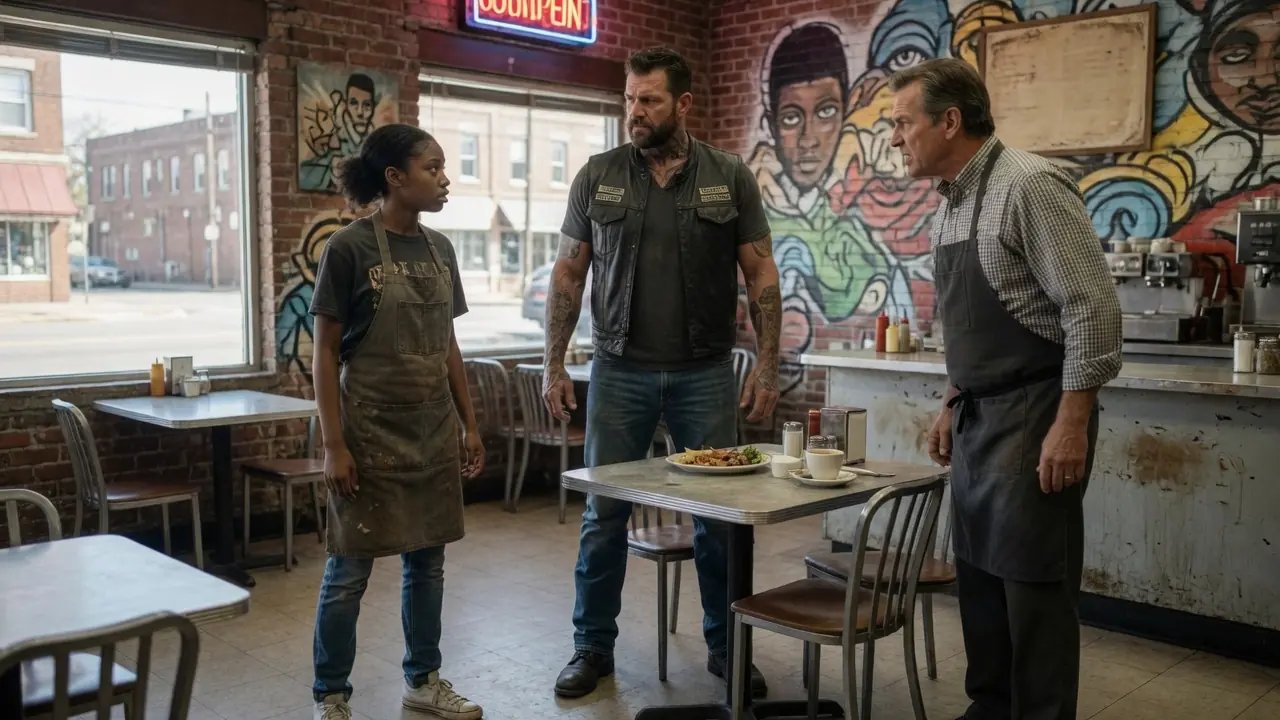
He was six foot three, more than two hundred pounds of muscle wrapped in black leather. A Steel Pilgrims patch covered his back, showing a medieval knight on a motorcycle. Tattoos crawled up his neck. Heavy boots thudded against the linoleum.
His beard was thick, his shoulders broad, and his eyes swept the restaurant before landing on Liz.
“Ma’am,” he said, his voice low and rough. “Table for one.”
Liz was used to people looking down on her because she was young. She was used to adults talking over her, through her, around her, as if being sixteen meant she could not understand fear, debt, hunger, or dignity.
But this man did not speak to her like a child.
He spoke to her like she belonged behind that counter.
“Of course, sir,” Liz said. “Anywhere you’d like.”
He chose the window table, moving with surprising grace for a man his size. As he settled in, the chair creaking under his weight, a sharp voice cut through the quiet.
“What is that doing in here?”
Cartwright’s voice could have cut glass.
Liz turned slowly.
“That’s a customer, Mr. Cartwright.”
“That is white trash on wheels.”
Cartwright stood, his six-foot-one frame seeming to fill the space.
“Do you know what those animals do? They terrorize neighborhoods. They deal drugs. They’re criminals in leather jackets pretending to be a motorcycle club.”
The biker, Jacob, though Liz did not know his name yet, sat motionless. His expression gave nothing away, but his knuckles had gone white where they gripped the edge of the table.
“Mr. Cartwright, please,” Liz began.
“You’re going to serve him?” Cartwright’s voice rose. “You’re going to let that white criminal sit here like he belongs in civilized company while respectable Black businessmen eat?”
Something cold crystallized in Liz’s chest.
She had heard that tone before.
Different words, same hatred.
When she was little, her father had once told her about a white store owner who had spoken to her grandfather that way. “Those people don’t belong here,” the man had said.
Her father had told her the story not to make her bitter, but to teach her something.
“Nobody gets to make another human being feel less than human in our place,” he had said. “Not in this restaurant. Not while a Thompson is standing.”
Liz was sixteen.
She was scared.
She had twelve thousand eight hundred dollars due to the bank.
Her classmates were planning dances and college visits while she was counting coffee filters and past-due notices.
But she was still a Thompson.
“He’s a customer,” Liz repeated, her voice steady despite her shaking hands. “Same as anyone else who walks through that door.”
Cartwright’s face darkened.
“You’re choosing him over me? Over my business?”
Most people fail when faced with exactly this kind of choice.
It is not the economy.
It is not competition.
It is the moment when doing what is right costs everything your family has built.
Most people choose survival.
Liz Thompson chose something else.
The restaurant held its breath. Even the ancient refrigerator seemed to stop humming. Liz thought about the foreclosure notice in her mother’s desk drawer, about the hospital bills climbing every day, about the forty-eight hours she had before the bank started taking the restaurant apart on paper.
She thought about her father’s voice.
Nobody gets to make another human being feel less than human in our place.
“Yes,” Liz said quietly. “I am choosing him, because this isn’t about business. It’s about being human.”
Cartwright’s laugh had no humor in it.
“You just destroyed yourself. Congratulations.”
He turned to his associates.
“We’re leaving, and we’re never coming back.”
“Mr. Cartwright, if you just…”
“My corporate account is canceled, effective immediately. The Johnson wedding reception scheduled here for Saturday, I’m moving it to Romano’s. And everyone I know, and little girl, I know everyone in this city, will hear about this.”
He leaned closer, his whisper somehow more threatening than shouting.
“They’ll hear how you betrayed your own people for white biker trash.”
The words hit like a fist to the stomach.
Her father had died two years earlier from a heart attack after working a double shift at the restaurant and unloading supplies alone because he could not afford extra help. Her mother had poured everything she had left into keeping the place open.
And now Liz might lose it all before she was even old enough to sign a legal contract without an adult beside her.
But her voice did not waver.
“My father taught me that character matters more than color,” she said. “He’d be proud of me.”
Cartwright’s lip curled.
“We’ll see how proud you are when the bank changes the locks.”
He swept out, his associates trailing behind him like obedient shadows. The door slammed hard enough to rattle the frame.
Silence crashed down like a physical weight.
Liz stood frozen, her mind doing calculations she did not want to finish.
Four thousand dollars monthly, gone.
The Johnson wedding, eighteen hundred dollars, gone.
Cartwright’s threat to poison her reputation, already beginning.
“Ma’am.”
She had almost forgotten the biker.
He stood now, wallet open, looking like he wanted to disappear into the floor.
“I’m real sorry,” he said. “I shouldn’t have come in. I’ll just go.”
“Sit down.”
The words came out sharper than Liz intended. She took a breath.
“Please. You haven’t done anything wrong.”
Jacob slowly lowered himself back into the chair.
“That man seemed important.”
“He was my mother’s biggest client,” Liz said. “Was being the key word.”
“How much did you just lose defending me?”
Liz shook her head.
“That’s not your concern.”
“Ma’am, with all respect, you just burned down half your business for a stranger. That makes it my concern. How much?”
The number felt too big for her sixteen-year-old mouth.
“About six thousand dollars just this month.”
Jacob whistled low. He pulled out his wallet and counted bills.
“I’ve got two hundred seventeen dollars. It’s not much, but…”
“Absolutely not.”
Liz stepped back like the money might bite her.
“I didn’t do that for money. I did it because it was right.”
“I know. But right doesn’t pay rent.”
The door burst open.
Clara Martinez stood there, Liz’s neighbor for fifteen years. The woman who brought tamales every Christmas Eve and used to braid Liz’s hair when she was small. Clara’s face was flushed, her eyes wide with panic.
“Liz. Oh God. Liz, what did you do?”
“Clara, what’s wrong?”
“Cartwright is calling everyone. He’s telling people you chose criminals over customers. That this place isn’t safe. That you’re…”
Clara’s voice dropped to barely a whisper.
“That you turned your back on your own community for white thugs.”
The words hung in the air like poison gas.
In the span of four minutes, Liz’s phone exploded.
Seven text messages.
All cancellations.
All using variations of the same phrase.
We can’t support someone who doesn’t support her community.
The eighth message made Liz’s knees nearly buckle.
Memphis United Bank.
Loan extension request denied. Full payment due within forty-eight hours or foreclosure proceedings begin immediately.
Forty-eight hours.
Twelve thousand eight hundred dollars.
Liz had seventeen hundred thirty-two dollars in the restaurant account, most of it already promised to suppliers.
“I need to go,” Clara whispered, backing toward the door. “My husband does business with Cartwright. If he finds out I was here…”
She fled before Liz could form words.
The restaurant fell silent except for the refrigerator’s hum.
Jacob stood awkwardly, his two hundred seventeen dollars still in his hand, looking as though he had caused a natural disaster.
“You should eat something,” Liz heard herself say.
Her voice sounded like it belonged to someone else.
Someone watching from far away.
“Menu’s on the table.”
“Ma’am, I can’t possibly.”
“Please.”
Liz met his eyes.
“Let me do this. It might be one of the last meals I serve in this place.”
Jacob slowly sat.
“Then I want your best. Whatever you recommend.”
Liz moved into the kitchen on autopilot.
Her mother’s recipe.
The one passed down four generations.
Fried chicken with collard greens, candied yams, and sweet potato pie. The same meal her grandfather had served on opening day forty-three years earlier. The same meal her father used to say could make a lonely person feel like somebody had been waiting for them to come home.
Her hands moved through familiar motions while her mind spun uselessly.
Twelve thousand eight hundred dollars.
Forty-eight hours.
Her mother’s hospital bills climbing every day.
When she placed the plate in front of Jacob, his eyes went wide.
“Ma’am,” he said softly, “this smells incredible.”
“Four generations,” Liz said, her voice cracking. “Four generations of my family.”
Jacob took a bite.
He closed his eyes.
For ten seconds, nothing existed except the food and the silence.
When he opened his eyes, they were wet.
“My grandmother made chicken like this,” he said quietly. “Before she passed. I haven’t tasted anything like it since.”
They sat there, the sixteen-year-old girl trying to save her mother’s restaurant and the white biker who had accidentally triggered its collapse, sharing a quiet moment while the neighborhood turned its back.
Jacob finished slowly, savoring each bite like it might be his last.
He stacked his dishes carefully, then left the two hundred seventeen dollars under his plate, weighted with a salt shaker.
At the door, one massive hand on the frame, he paused.
“That man was wrong about you,” he said. “You’re not a traitor. You’re the most loyal person I’ve met. Loyal to your principles. That’s harder than being loyal to people who only support you when it’s easy.”
Then he was gone, his motorcycle’s rumble fading into Memphis traffic.
Liz stood alone.
The two hundred seventeen dollars sat on the table.
She should have felt grateful.
Instead, she felt numb.
Two hundred seventeen against twelve thousand eight hundred.
Like emptying the ocean with a teaspoon.
Her phone buzzed.
Another cancellation.
The Wilson anniversary party.
Three hundred fifty dollars, gone.
She sank into a chair and buried her face in her hands.
She did not hear her phone buzz seventeen more times over the next hour. She did not see the neighborhood group explode with messages about that Thompson girl who chose white criminals over her own people.
Ninety miles away in Tupelo, Mississippi, Jacob pulled into a gravel lot behind a warehouse. His hands shook so hard he could barely kill the engine.
Two dozen motorcycles already lined the fence.
Inside, the Steel Pilgrims’ weekly meeting was starting. Fifty-three members from the Mississippi chapter filled the room. The air smelled like leather, motor oil, and cheap coffee. Men and women in their colors, the medieval knight patch, stood in clusters, trading stories.
Marcus “Hammer” Williams stood at the front.
He was sixty-two years old, with nineteen years stitched into his patch. His arms bore tattoos that told stories of a life lived hard and survived harder. A long scar ran from his left ear to his collarbone, a reminder of a night that should have ended him twenty-three years earlier.
“All right, settle down.”
Marcus’s voice cut through the noise.
The room fell silent instantly.
When Marcus spoke, people listened.
“First order of…”
The door banged open.
Jacob stood there, face pale, breathing like he had run a marathon.
“Jacob?” Marcus frowned. “You okay, brother?”
“I need to tell you something,” Jacob said. “I need the club’s help.”
The warehouse went dead silent.
In nineteen years, Marcus had never heard Jacob ask for help. The man once rode seventy miles with a broken collarbone rather than call for assistance.
“What happened?” Marcus asked.
Jacob walked to the center.
Fifty-three pairs of eyes followed him.
“I stopped for breakfast in Memphis. Little soul food place called Liz’s Soul Kitchen. The second I walked in, this Black businessman started in on me. Called me white trash. Criminal. Said I didn’t belong there.”
A few members bristled.
They had all heard it before.
“The girl running the place,” Jacob continued, his voice cracking, “she could have thrown me out. Should have, probably. This guy was her mother’s biggest client. Four thousand dollars monthly. But she didn’t.”
Marcus said quietly, “She didn’t.”
Jacob’s voice broke completely.
“She stood up to him. Told him I was a customer, same as anyone. He threatened her, said he’d destroy the business, called her a race traitor for defending me.”
The warehouse temperature seemed to drop ten degrees.
“A sixteen-year-old girl defended a grown man wearing our patch,” someone whispered.
“And lost everything,” Jacob confirmed. “I checked after I left. The restaurant has been in her family forty-three years. Her father died keeping it alive. Her mother’s in the hospital right now. Heart failure. Bills are piling up. The girl is trying to run the place by herself until her mom gets out.”
He pulled out his phone.
“I called the bank, pretended to be a potential buyer. They told me the Thompson account has forty-eight hours to pay twelve thousand eight hundred or they foreclose.”
“Jesus,” Ray “Knuckles” Johnson breathed.
At seventy-one, he was the oldest Pilgrim in the room.
“Here’s the thing that kills me,” Jacob said, his hands trembling. “After that businessman left, after her neighbor told her the whole community was turning against her, after she found out she was losing everything, you know what she did?”
The room waited.
“She cooked me the best meal I’ve had in fifteen years. Sat there and made sure I was okay, like I was the one who needed comfort.”
The story moved through the room without anyone needing to repeat it.
A girl who had every reason to protect herself.
A girl who had no money, no power, no adult standing beside her.
A girl who valued human dignity more than survival.
And now she had forty-eight hours before everything her family built disappeared.
“How much do they need total?” Ray asked.
“Twelve thousand eight hundred for the bank,” Jacob said. “Hospital bills are already over twelve thousand. Lost business this month, probably six thousand or more. Call it thirty-one thousand, give or take.”
Marcus stood motionless, his scarred face unreadable.
Then he said, “Show of hands. Who thinks we ride to Memphis and help this girl?”
Every hand went up.
All fifty-three.
“Ray,” Marcus ordered. “Call the other chapters. Tennessee, Arkansas, Louisiana, Alabama, Missouri. Tell them what happened. Tell them we ride at dawn. Anyone who wants to stand with us meets at the Mississippi state line at 0500 hours.”
Ray stepped outside, phone already to his ear.
Marcus turned back to Jacob.
“This businessman, Cartwright. You said he threatened her, destroyed her reputation, called her a traitor, poisoned the neighborhood against her.”
“Yes.”
“And the neighbors turned their backs?”
“Yes, sir.”
Marcus’s jaw tightened.
“So a sixteen-year-old girl stood alone against grown adults because she believed it was right.”
Jacob nodded.
Marcus walked to the center of the room.
“Brothers and sisters, you all know my story. Twenty-three years ago, I was found half-conscious in a Memphis alley. Three men had jumped me over territory that had nothing to do with me. Wrong place, wrong time.”
His hand unconsciously traced the scar on his neck.
“A man found me. Black man about fifty, wearing a work uniform. He could have kept walking. Most would have. But he didn’t. He put himself between me and those men, talked them down, got me to a hospital, waited three hours to make sure I would live, then disappeared before I could get his name.”
Marcus looked at Jacob.
“All I remember is his work shirt. Said Thompson Construction.”
Jacob’s face went white.
“What did you say?”
“Thompson. I’ve been looking for that family for twenty-three years. What’s the girl’s full name?”
“Elizabeth Thompson.”
The warehouse exploded.
Voices overlapped. People stood. The energy turned electric.
“Quiet.”
Marcus’s voice cracked like a whip.
Instant silence.
“That was her father,” Marcus said. “The man who saved my life twenty-three years ago was Elizabeth Thompson’s father. And now his daughter is about to lose everything because she did exactly what he would have done.”
Ray came back inside grinning like Christmas morning.
“Tennessee is in. One hundred twelve bikes. Arkansas, sixty-three. Louisiana, ninety-seven. Alabama, seventy-one. Missouri, forty-two. Plus our fifty-three.”
Marcus did the math.
“Four hundred thirty-eight.”
“Still counting,” Ray said. “Word’s spreading. Kentucky and Georgia want in. Florida is asking if they can make the trip. Ohio just called.”
“Tell them yes,” Marcus said. “Tell everyone yes.”
He turned to the room.
“Pack light. We leave at 0300. Meet at the state line at 0500. By dawn, we’re in Memphis.”
Wednesday afternoon, twenty-four hours until foreclosure, Liz stood in her mother’s hospital room, holding a hand that felt too light.
Tubes ran from Denise Thompson’s arms. Monitors beeped their rhythm. The woman who had carried the family restaurant for decades looked small beneath the white sheets.
“Baby girl,” her mother whispered. “You look tired.”
“I’m fine, Mama.”
“Don’t lie to your mama.”
A weak smile.
“What’s wrong?”
Liz could not tell her.
She could not say that in twenty-four hours they might lose the restaurant. She could not say the community had turned against them. She could not say everything her father had left behind was crumbling in her hands.
“Nothing, Mama. Just busy.”
Her mother’s eyes, still sharp despite the illness, studied her face.
“Your daddy used to get that same look when things were hard.”
Liz swallowed.
“He always said, ‘Do what’s right, even when it costs everything.’ You remember that?”
Liz’s throat closed.
“I remember.”
“Good,” her mother whispered. “Because looking at you, I can tell you did something that cost you. And I’m proud.”
“Mama, you don’t even know what happened.”
“I know my daughter,” Denise said. “I know you got your daddy’s heart. That’s all I need to know.”
Liz left the hospital as sunset painted Memphis orange and gold.
Her phone showed forty-three missed calls.
She did not check them.
She already knew what they would say.
More cancellations.
More accusations.
More people turning their backs.
At the restaurant, she sat in the dark going through old photos. Her grandfather on opening day, beaming behind the counter. Her father repainting the front sign. Her mother standing in the kitchen, young and strong, holding baby Liz on her hip.
Forty-three years of memories about to become foreclosure paperwork.
She must have fallen asleep at some point, her head resting on the photo albums.
Thursday morning, 4:57 a.m.
Liz jerked awake.
Something was wrong.
The building was shaking.
Dishes rattled in cabinets.
Windows vibrated in their frames.
She stumbled to her feet, disoriented.
Then she heard it.
Low and distant at first, like thunder rolling across open land.
But it did not fade.
It grew.
The rumble built into something physical, something that pressed against her chest and made her teeth ache. She moved to the window and pulled back the curtain.
The street was dark.
Empty.
But the sound kept coming.
Then lights appeared.
Headlights.
Not dozens.
Hundreds.
They came down the street like a mechanical river of chrome, steel, and thunder.
The motorcycles kept coming and coming. Liz watched through the window, hands pressed against the glass, as the street filled with an army of leather and metal.
They lined up in perfect formation, engines creating a symphony of controlled thunder.
One hundred.
Two hundred.
Three hundred.
She stopped counting.
Across the street, Raymond Cartwright stepped out of his Mercedes.
He had probably come to gloat, to watch the final hours before foreclosure.
His smug smile froze when he saw the motorcycles.
Then it melted completely as more kept arriving.
And more.
And more.
The lead rider dismounted. He was older, maybe sixty, silver threading through his beard. He removed his helmet and walked toward Liz’s door with surprising grace for a man his size.
Behind him, hundreds more began dismounting in synchronized waves.
He knocked three times.
Firm.
Respectful.
Liz opened the door on shaking legs.
“Elizabeth Thompson?”
His voice was gentle despite the thunder outside.
“Yes.”
“My name is Marcus Williams, president of the Steel Pilgrims Motorcycle Club.”
He gestured behind him.
“We have 603 riders here from eight states. We heard about what you did for our brother Jacob. How you stood up to that businessman. How you lost everything defending someone you didn’t know.”
Liz could not speak.
Could not process.
“We’re here to make things right,” Marcus continued. “But first, I need to tell you something.”
He paused.
“Twenty-three years ago, your father saved my life.”
The world tilted sideways.
“I was in an alley off Beale Street,” Marcus said. “I was hurt badly. Three men had left me there. Your father put himself between me and them. Got me to a hospital. Stayed until he knew I would live. I never got to thank him.”
Marcus’s voice cracked.
“I’ve been looking for the Thompson family for twenty-three years. When Jacob told me what happened, when he said the name Thompson…”
He pulled out a worn photograph.
“Is this him?”
Liz took it with trembling hands.
Her father, younger but unmistakably him, standing next to a younger Marcus outside a hospital.
“He never told me,” she whispered. “He never said a word.”
“Because he didn’t do it for recognition,” Marcus said. “He did it because it was right.”
Marcus met her eyes.
“Just like you did for Jacob. Your father gave me my life. Let us give you back yours.”
He pulled out an envelope.
“Inside is a certified check for thirty-eight thousand four hundred dollars. It covers the bank debt, your mother’s hospital bills, and three months of operating expenses. It is not a loan. It is family taking care of family.”
Liz’s knees weakened.
Marcus caught her elbow.
“We’re not done,” he said gently.
A younger biker jogged over.
“This is Tommy,” Marcus said. “He’s a contractor. He and fifteen of our members are going to renovate this place. New floors, new booths, fresh paint, new equipment, on our dime.”
“I can’t,” Liz whispered.
“You can,” Marcus said. “And you will.”
His voice was firm, but kind.
“Because as of right now, you and your mother are family. And family doesn’t let family fall.”
Liz tried to understand that 603 strangers had just ridden through the night to save her.
The next eight hours were controlled chaos.
Bikers swarmed the restaurant like a well-organized army. Some carried in supplies, wood, paint, and equipment. Others measured walls with professional precision. Three women, Steel Pilgrims members, organized the kitchen with military efficiency.
Someone brought breakfast for everyone.
Not from one restaurant, but from five different places, because nobody wanted Liz to cook on the day she was being saved.
At noon, Cartwright’s black Mercedes was still parked across the street. He had been standing there for six hours watching the transformation, his face cycling through confusion, fear, and growing horror.
Marcus walked across the street.
He did not hurry.
He did not need to.
Six hundred three pairs of eyes watched Cartwright realize exactly how badly he had miscalculated.
“Mr. Cartwright,” Marcus said, his voice carrying across the street, “I believe you owe Miss Thompson an apology.”
“I don’t owe that girl anything,” Cartwright said, though his voice shook. “She chose…”
“She chose to defend a member of my family from your bigotry,” Marcus interrupted. “She chose character over profit, dignity over dollars, and you punished her for it. You called her a traitor. You tried to destroy her mother’s business. You poisoned her community against her.”
Cartwright looked at the sea of leather surrounding him.
“You can’t threaten me. I’ll call the police.”
“Please do.”
Marcus pulled out his phone.
“While you’re at it, explain why you used your business connections to destroy a sixteen-year-old girl because she refused to discriminate against a white man. I’m sure Channel 5 News would love that story. They are already on their way.”
The color drained from Cartwright’s face.
Marcus continued.
“Here’s what’s going to happen. You’re going to walk across that street. You’re going to apologize to Elizabeth Thompson. You’re going to reinstate every contract you canceled. Then you’re going to tell every person you called that you lied about her.”
“I won’t.”
Six hundred three engines roared to life simultaneously.
The sound was physical, overwhelming, pressing against eardrums and shaking the ground. Every car alarm on the block triggered. Windows rattled. The Mercedes vibrated so hard its side mirrors shook.
Cartwright stumbled backward, hands over his ears, fear twisting his face.
Then the engines cut off.
Silence crashed down.
Marcus looked at him.
“You were saying?”
Five minutes later, Raymond Cartwright stood on the sidewalk in front of Liz’s Soul Kitchen, surrounded by cameras, neighbors, and hundreds of silent bikers.
His face was pale.
His voice shook.
“I was wrong,” he said. “I was hateful and cruel. I said terrible things. I did terrible things. I tried to destroy this restaurant because Elizabeth Thompson was better than me. Because she had the courage to stand up for what was right and I didn’t.”
Liz stood with Marcus at her side, feeling something break open inside her chest.
Not anger.
Not triumph.
Just exhaustion, relief, and the beginning of something that felt like peace.
“I forgive you,” she said quietly. “Not because you deserve it, but because my father taught me not to become the kind of person who lets hate decide who deserves kindness.”
By sunset, the restaurant was transformed.
New hardwood floors gleamed under fresh lighting. The cracked vinyl booths had been replaced with solid wood craftsmanship. The kitchen had new equipment. The walls were freshly painted. The old family photos were rehung with care.
A hand-carved wooden sign hung over the counter.
The letters were burned into oak.
Official Home of the Steel Pilgrims MC.
Marcus gathered everyone outside as the sun painted Memphis in amber and gold. Six hundred three bikers stood around Liz’s Soul Kitchen. Clara Martinez stood near the back, crying quietly. Dozens of neighborhood residents had returned once the truth spread.
“Today we paid a debt twenty-three years old,” Marcus announced, his voice carrying down the block. “Today we showed this city what family means. Not blood. Not color. Character. Loyalty. Standing up when it costs you everything.”
He turned to Liz.
“You are one of us now, forever. Your mother too. Anyone messes with this restaurant, they mess with all of us. You need anything, anything, you make one call and we ride.”
Liz looked at the faces surrounding her.
Black, white, Latino, Asian, young, old, scarred, tattooed, rough around every edge. Every single one had ridden through the night because a sixteen-year-old girl did the right thing.
“I don’t know what to say,” she whispered.
“Say you’ll make us that fried chicken recipe every Thursday night,” Ray Knuckles called out. “Because Brother Jacob won’t shut up about it.”
Laughter rolled through the crowd.
Liz laughed too, tears streaming, something in her chest finally releasing after seventy-two hours of terror.
Three months later, Liz’s Soul Kitchen was the most talked-about restaurant in Memphis.
Lines formed around the block every Thursday when the Steel Pilgrims gathered. Cartwright publicly apologized on Channel 5 News. The clip went viral, and he spent the months that followed sending business to the restaurant, desperate to repair even a small piece of what he had broken.
Denise Thompson recovered enough to come home.
When she walked into the renovated restaurant for the first time, she stopped just inside the door and cried so hard Liz had to hold her up.
Her hospital bills were marked paid in full.
The bank loan was gone.
The restaurant was safe.
But the real change was deeper than money.
Liz’s Soul Kitchen became a symbol. A place where color did not matter, where bikers and businesspeople sat side by side, where the only requirement for entry was treating every person with basic human dignity.
On Thursday evenings, Liz would stand behind her father’s counter and watch the packed restaurant, feeling 603 brothers and sisters at her back.
Marcus’s scar had come from her father’s mercy twenty-three years earlier.
Now that scar had brought mercy full circle, proving that kindness echoes across decades, that debts of honor do not expire, and that real family is built on choices, not appearances.
Every Thursday, when those engines rumbled outside the windows, shaking the ground and making the whole block vibrate with controlled power, Liz Thompson smiled.
She was still only sixteen.
Still learning.
Still scared sometimes.
But she was no longer standing alone.
Because she knew exactly what that sound meant.
Family was here.
And family never leaves.