Danny Jarvis heard the grinding before he reached the gates of Becker Equipment. The red Farmall H shuddered beneath him as if every turn of the wheels might be its last, sending a metallic death rattle across the dealership lot. At twenty-two, Danny was strikingly handsome, with thick dark-brown hair swept neatly back, sharp green-gray eyes, a clean-shaven jaw, and the athletic build of a man raised on hard labor. His faded tan overalls, red-and-green plaid shirt, and dusty boots made him look poor beside the rows of polished green tractors, but his steady gaze revealed a pride no price tag could measure.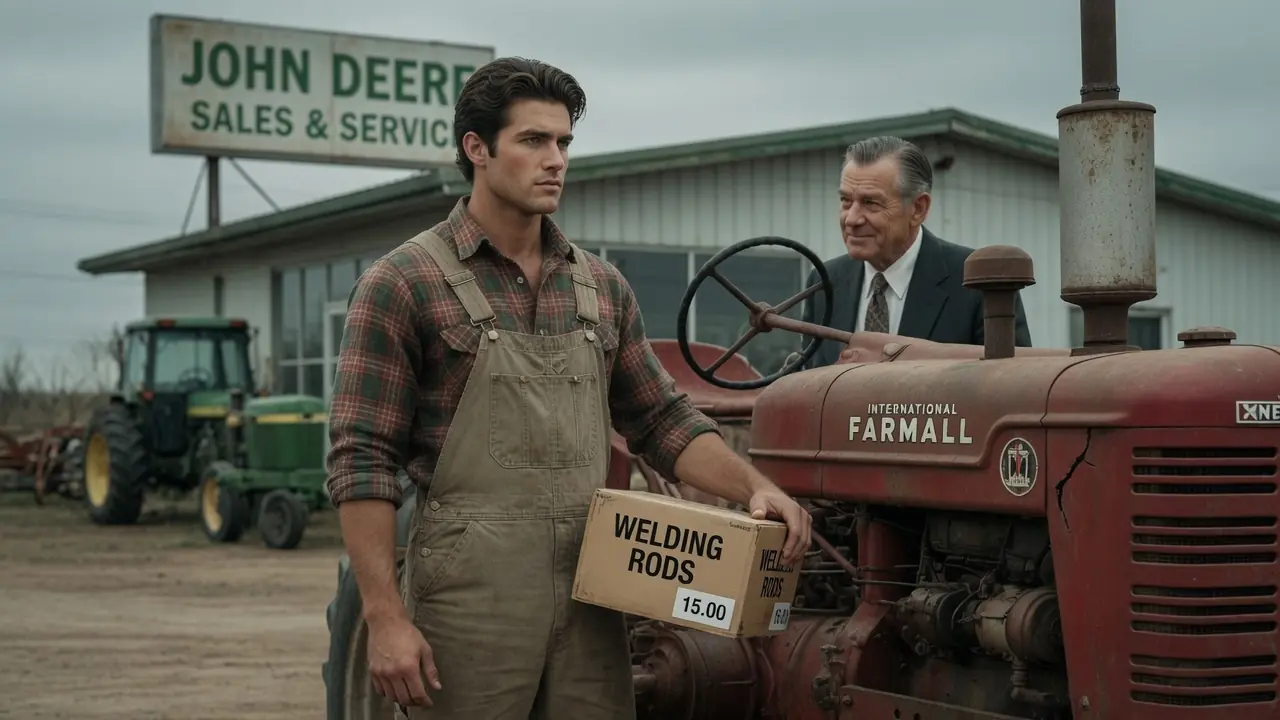
Carl Becker emerged from the main building wiping his hands on a white cloth. He was fifty-three, broad around the waist, silver at the temples, and dressed more like a businessman than a mechanic. For twenty-five years, he had sold farmers newer equipment by convincing them their old machines were already dying. One listen to Danny’s tractor made him shake his head as though he were examining a body at a funeral.
“That sound is coming from the crankshaft,” Carl said. “It’s cracked, maybe broken.”
Danny shut down the engine, and the sudden silence frightened him more than the noise had. The Farmall had belonged to his late father, Harold, and had worked the Jarvis farm since Danny was six. Without it, he could not prepare one hundred and sixty acres before spring planting. “How much to repair it?” he asked.
Carl calculated briefly. “New crankshaft, machining, labor, bearings—about eight hundred dollars.”
Danny had twenty-three dollars in his wallet and forty-one dollars hidden inside a coffee can at home. Eight hundred dollars was more than he could save in a year after seed, fuel, taxes, and payments on the farm. He looked toward the tractor, remembering his father’s hands on the steering wheel and the evenings they returned from the fields together. Carl saw only silence and assumed the young farmer had accepted defeat.
“I’ll give you two hundred dollars for the whole machine,” the dealer offered. “Scrap value.”
Danny turned slowly. “It’s worth ten times that when it runs.”
“But it doesn’t run properly, son. That’s the difference between value and sentiment.”
“It made it here.”
“It won’t make it through planting.”
Danny walked around the tractor and pressed his hand against the engine housing. He understood enough about machinery to know Carl was probably right about the crack. He had also spent four years learning welding from a former Navy shipbuilder named Mr. Patterson, a high-school instructor who believed metal could reveal its weaknesses to anyone patient enough to study it. Danny had repaired plows, gates, trailers, and broken housings, but never a crankshaft.
“What if I weld it?” he asked.
Carl stared at him before laughing.
The sound carried across the lot, drawing the attention of two mechanics and a salesman standing by the parts counter. Carl did not laugh because Danny’s question was amusing; he laughed because the young farmer’s confidence offended his experience. “A crankshaft spins under thousands of pounds of stress,” he said. “You can’t patch it like a fence.”
“I didn’t say patch.”
“You need precision equipment, controlled heat, exact alignment, and years of engine work.”
“I have welding experience.”
Carl laughed again. “That weld won’t survive one week in the field.”
Danny reached into his pocket and counted the bills he carried. “How much for the right welding rods?”
“Maybe fifteen dollars, but you’d be burning money.”
Danny looked directly into his eyes. “I only need fifteen dollars and the skill you’re mocking.”
Carl folded his arms. “Go ahead. Ruin the engine completely.”
Danny climbed back onto the Farmall.
The tractor started reluctantly, coughing smoke across the dealership’s clean parking lot. Carl followed him to the edge of the pavement and shook his head as Danny forced the machine onto the county road. “Come back when it breaks,” he called. “My two-hundred-dollar offer won’t last forever.”
Danny looked back once. “Come by Monday. Then remember this laugh when I own your shop.”
The mechanics smiled at the foolish threat.
Danny did not.
The journey home took nearly two hours. Every metallic knock made him imagine the crankshaft splitting apart and punching through the engine block. He kept the throttle low, avoided steep roads, and whispered encouragement to the tractor as though it were an injured animal. When the familiar red barn finally appeared beyond the cottonwood trees, relief nearly weakened his hands.
The Jarvis farm had belonged to his family for three generations. Oklahoma red dirt spread in every direction, divided by fences Danny repaired alone after Harold’s death. The farmhouse needed new shingles, the well pump leaked, and half the barn leaned slightly east after a spring storm. Yet the land was his responsibility, and responsibility had become the closest thing he had to a future.
Harold Jarvis had died three years earlier while repairing a broken irrigation line. One moment he was arguing with Danny about whether rain would arrive before Sunday, and the next he was lying motionless in the field. Danny buried his father on Wednesday and returned to work Thursday because the cattle still required water. His older brother, Thomas, remained in Texas, while their mother and younger sister depended on what the farm produced.
Danny drove the Farmall into the barn and removed the engine piece by piece.
He labeled every bolt, sketched the assembly in a notebook, and arranged components across a wooden bench. By midnight, grease covered his forearms and exhaustion burned behind his eyes. The crankshaft finally came free shortly before dawn. Beneath the work lamp, Danny found a thin crack cutting across one of the main bearing journals.
Carl had diagnosed it correctly.
A careless weld would fail.
Danny placed the crankshaft on the bench and studied it for two hours without touching his tools. He thought about heat traveling through iron, metal expanding, and welded joints shrinking as they cooled. Mr. Patterson once warned his students that strength came not from adding the most metal, but from controlling what happened around the repair. Danny needed to prevent distortion, preserve alignment, and rebuild the fractured area layer by layer.
After sunrise, he drove his old pickup into town.
Fifteen dollars purchased specialty nickel-alloy welding rods, a new grinding wheel, and a small box of precision files. The shopkeeper asked what he planned to repair. When Danny answered, the man looked at him with the same expression Carl had worn. News of the impossible repair began traveling before Danny returned home.
He spent Tuesday grinding the crack into a clean V-shaped channel.
Removing healthy metal felt wrong, but the weld required space to penetrate deeply. Danny cleaned the crankshaft repeatedly until no oil remained near the damaged area. Then he built a temporary heating chamber from firebrick and sheet metal. He warmed the entire component slowly, checking temperatures with borrowed gauges so one section would not expand faster than another.
The first welding pass took forty minutes.
Danny’s hand remained steady while molten metal filled the deepest point of the prepared channel. After each short section, he stopped and inspected for porosity or uneven fusion. He added another layer, then another, controlling the temperature between every pass. The repair continued until late Wednesday evening.
His mother brought soup into the barn and found him staring at the glowing metal.
“You should sleep,” she said.
“If I stop now, the temperature will fall too fast.”
“Can it work?”
Danny looked toward the disassembled tractor. “It has to.”
When welding ended, he wrapped the crankshaft beneath heavy insulating blankets. It cooled gradually through the night, protected from sudden temperature change that could create new fractures. Danny slept on a cot beside the workbench, waking every hour to check it. By Thursday morning, the metal had returned to room temperature.
The weld appeared solid.
Appearance was not enough.
Danny ground the raised surface carefully until it matched the original journal. He used micrometers borrowed from Mr. Patterson to measure roundness at several points. When one section remained slightly high, he filed it by hand rather than risk removing too much. For hours, he measured, polished, and measured again.
Mr. Patterson visited that afternoon.
The retired teacher had heard about Danny’s project from the hardware-store owner. He examined the weld without praising or criticizing it, then tested alignment with tools he brought from his garage. Finally, he stepped back and removed his glasses. “You understood the metal.”
“Will it hold?”
“No one can promise that.”
“Would you install it?”
Mr. Patterson smiled. “I would.”
Danny reassembled the engine through Thursday night and most of Friday. The work moved slowly because one misplaced bearing or improperly tightened bolt could destroy what he had repaired. Near sunset, he filled the tractor with oil and coolant. His mother, sister, and Mr. Patterson stood outside the barn while Danny climbed onto the seat.
He turned the key.
The starter groaned.
The Farmall coughed once, then the engine caught.
Danny listened for grinding but heard only the strong, familiar rhythm of four cylinders working together. He let the engine idle for twenty minutes, watching oil pressure and temperature. Then he increased the throttle gradually. The repaired crankshaft continued turning smoothly.
His sister began laughing.
His mother covered her mouth and cried.
Danny did not celebrate yet.
He drove the tractor around the farmyard, then attached a plow and entered the nearest field. The first row felt endless. He waited for the violent crack Carl had predicted, but the Farmall kept pulling. By nightfall, Danny had plowed twelve acres.
On Monday morning, Carl Becker’s truck appeared at the edge of the field.
The dealer climbed out and stood watching as the red Farmall moved steadily through the Oklahoma soil. Danny finished the row before stopping. Carl walked closer, listening to the engine with disbelief. “I heard you welded it,” he said.
“Yes, sir.”
“You actually welded the crankshaft.”
“Yes.”
Carl leaned toward the engine, hearing the smooth mechanical pulse that should not have existed. “How many hours has it run?”
“Twenty-seven.”
“It may last a month.”
“Then I’ll use the month.”
Carl looked at Danny differently. The amusement was gone, replaced by reluctant respect and a trace of irritation. “I’ve repaired tractors longer than you’ve been alive.”
“That doesn’t mean you know every repair I can make.”
“You’re stubborn.”
“My father said that was useful.”
Carl placed one hand on the tractor. “When it fails, bring it back. I’ll still offer scrap value.”
Danny restarted the engine. “When it doesn’t fail, I’ll bring you the repair bill.”
The crankshaft survived planting.
Then it survived harvest.
It continued through the following year without developing a new crack. Every season weakened Carl’s prediction and strengthened Danny’s reputation. Farmers began stopping beside the Jarvis fields simply to hear the tractor whose welded crankshaft was supposed to be impossible.
Soon they brought Danny their own broken equipment.
A neighbor arrived with a cracked transmission housing that a dealership wanted to replace for nine hundred dollars. Danny repaired it for sixty. Another farmer brought a damaged hydraulic cylinder, followed by a rancher with a snapped trailer axle. Danny never promised miracles, but he refused to declare anything useless before understanding how it had failed.
His barn gradually became a repair shop.
At first, customers paid in small amounts, eggs, meat, seed, or help during harvest. Danny accepted what families could manage because he understood desperation better than profit. He repaired machines at night and farmed during the day. His hands grew more skilled, his tools improved, and the rumors traveled beyond Caddo County.
People began calling him Junkyard Danny.
The nickname started as an insult from dealership mechanics who claimed he kept dead machines alive with improvised repairs. Danny painted the name above his barn entrance. Beneath it, he added another line: We fix what others throw away.
By 1975, he employed two mechanics.
One was a former classmate who lost his factory job. The other was a widowed father who needed hours compatible with raising three children. Danny paid them fairly even when doing so reduced his own income. He remembered how close twenty-three dollars once came to deciding whether his family survived.
Meanwhile, Carl Becker’s dealership prospered.
The 1970s brought rising crop prices, easy credit, and farmers eager to expand. Carl sold newer, larger tractors with air-conditioned cabs and stronger engines. He encouraged customers to trade paid-off machines for financed equipment, assuring them that land values and grain prices would continue climbing. For several years, his advice appeared brilliant.
Danny remained cautious.
He purchased used tools with cash and expanded his shop only when earnings justified it. When bankers offered large loans for a modern building, he declined. He remembered the sound of the cracked crankshaft and understood how quickly one failure could threaten everything.
Carl mocked his caution.
“You could build a real operation,” he told Danny during a county fair. “Instead, you’re still working from a barn.”
“The barn is paid for.”
“Debt lets a man grow.”
“It also lets another man own what he built.”
Carl smiled. “That sounds like fear.”
Danny looked toward the Farmall displayed beside his booth. “Sometimes fear remembers what pride forgets.”
The agricultural economy changed in the early 1980s.
Interest rates rose sharply, grain prices fell, and land values collapsed. Farmers who had borrowed heavily discovered their equipment was worth less than the loans attached to it. Banks repossessed tractors, families lost farms, and auction signs appeared along rural roads like grave markers.
Becker Equipment’s lot filled with returned machinery.
Carl had financed sales through agreements dependent on customer payments. When farmers defaulted, the dealership inherited equipment no one could afford. New tractors remained unsold while interest accumulated against Carl’s own business loans. His confident smile disappeared.
Danny’s repair shop became busier than ever.
Families could not purchase replacements, so they brought him whatever had broken. He repaired old combines, reconstructed worn gearboxes, and taught farmers how to maintain equipment rather than depend on costly dealer service. When clients could not pay immediately, he arranged installments without charging punishing interest.
The Farmall remained active.
Eighteen years after the original weld, it still pulled wagons and operated smaller implements. The engine had required rings, valves, and bearings, but the repaired crankshaft never cracked again. Danny kept the fifteen-dollar hardware-store receipt pinned above his workbench.
In the spring of 1986, Becker Equipment entered foreclosure.
The bank scheduled an auction for the dealership building, tools, inventory, and remaining tractors. Carl was seventy-one, exhausted, and facing the loss of the business that had defined his adult life. He watched strangers inspect his property with the same cold calculations he once applied to desperate farmers.
Danny attended the auction wearing clean tan overalls and a plaid shirt.
At forty, he remained handsome and powerfully built, though silver had begun touching his dark hair. He stood at the back of the crowd, remembering the day he arrived there with a dying tractor. The building looked smaller than it had when he was twenty-two.
Tools sold first.
Then tractors.
The dealership property opened at sixty thousand dollars. Two investors raised the price cautiously, hoping to convert the building into storage. Danny entered at seventy thousand.
People turned.
Most knew Junkyard Danny’s story, but few understood how carefully he had saved through eighteen years of repairs. He had paid his farm debts, supported his mother and sister, and placed the remaining profits into a modest business account. He had also secured financing from a local cooperative formed by farmers whose machines he had kept running.
The bidding reached eighty thousand.
One investor stopped.
The other offered eighty-one.
Danny raised his hand. “Eighty-two thousand.”
Silence followed.
The auctioneer counted twice before striking the hammer. “Sold to Daniel Jarvis.”
Danny walked forward to sign the papers.
Carl stood beside the old service counter, looking thinner and older than Danny remembered. The former dealer had heard every bid and knew exactly who now owned the property. When Danny approached, Carl forced a bitter smile.
“I suppose this feels good.”
“No, sir.”
“You finally own the shop.”
“I remember standing here with twenty-three dollars while you told me my tractor was dead.”
Carl looked down. “You came to remind me?”
“I came because the county still needs a repair shop.”
“You could tear down my sign and enjoy watching me leave.”
“I will remove the sign.”
Carl nodded painfully.
“But I don’t enjoy what happened to you,” Danny continued. “I know what it feels like to think one broken machine might end your life.”
Carl’s eyes glistened. “That weld—is it still holding?”
“Eighteen years.”
The old man laughed weakly. “I said one week.”
“You were right that it required precision.”
“I was wrong about you.”
“You never asked what I knew.”
Carl looked around the empty dealership. “Pride makes a man think experience belongs only to him.”
Danny extended his hand. “I need someone who understands parts, suppliers, and customers.”
Carl stared at the offered hand. “Are you offering me a job?”
“You can start Monday.”
“After everything I said?”
“You laughed at me. You didn’t steal from me.”
Carl slowly shook his hand.
Jarvis Repair opened two months later.
Danny removed the dealership’s corporate signs and placed the restored wooden sign from his barn above the entrance. Beneath the business name were the words: We Fix What Dealers Won’t. Farmers arrived before sunrise on opening day.
Carl answered telephones and tracked parts.
At first, embarrassment made him quiet. Then customers began asking for his knowledge, and Danny treated him with respect in front of everyone. Carl discovered that dignity could survive failure when someone offered honest work instead of humiliation.
The two men became unexpected partners.
Carl knew specifications, supply networks, and decades of equipment models. Danny understood metal, failure patterns, and the financial pressure carried by every farmer entering the shop. Together, they saved machines that would otherwise have become scrap.
Five years later, Carl retired.
Before leaving, he stood beside the old Farmall and touched the engine housing. “I built a business telling people new was better.”
“You sold what you understood.”
“I understood profit.”
Danny smiled. “Now you understand repair.”
Carl looked toward him. “That fifteen-dollar weld bought this building.”
“No. It taught me how to build something slowly.”
The Farmall continued working until 1998.
When it finally stopped, the crankshaft remained intact. Thirty years after Danny’s repair, other engine components had simply worn beyond practical restoration. He parked the tractor near the shop entrance and attached a small plaque.
They said the repair would last one week. It lasted thirty years.
Children climbed onto its seat while their parents told the story of Junkyard Danny. Young mechanics touched the welded crankshaft displayed beneath a clear panel and studied the evidence of patience, heat control, and skill. Danny never described the repair as luck.
He called it preparation meeting necessity.
By the time he retired, Jarvis Repair employed twenty-three people and served farmers across five counties. Danny transferred ownership gradually to his son and several longtime employees rather than selling to a national chain. He wanted the people who built the business to inherit its future.
At the retirement ceremony, Danny stood beside the Farmall.
His hair had turned white, but his green-gray eyes remained sharp. The fifteen-dollar receipt was framed on the wall behind him. Carl Becker, now walking with a cane, sat in the front row.
“I was once told I had two choices,” Danny said. “Pay money I didn’t have or surrender the machine my family needed.”
The crowd listened quietly.
“But there was a third choice. Learn enough to attempt what experienced men said could not be done.”
Danny rested one hand on the tractor.
“The lesson wasn’t that every broken thing can be saved. Some cannot. The lesson was that another man’s certainty should never replace your own willingness to understand the problem.”
He looked toward Carl.
“The man who laughed later worked beside me. I didn’t defeat him by buying his shop. We both defeated the pride that kept us from seeing what the other could teach.”
Carl wiped his eyes.
Danny smiled.
The young farmer had promised to own the dealership one day, and eighteen years later, he did. Yet his greatest victory was not the building, the business, or even the crankshaft that survived three decades.
It was the life created from refusing to accept that poverty made him powerless.
Carl saw a dead tractor.
Danny saw metal that had not yet been understood.
And the difference between those two visions became the foundation of everything he built.