The dust had barely settled on Main Street when Mason Lawson rode into Opal, Wyoming, with three dollars in his pocket and no intention of staying past sunrise.
It was late July of 1883, and the heat hung over the small mining town like a wool blanket no one had remembered to shake out. Mason’s paint mare, Juniper, picked her way carefully over the rutted street, her ears turning at every creak, shout, and wagon wheel.
Opal was barely a town, only twenty buildings or so, most of them leaning slightly as if tired of standing upright.
The largest building on the main street was a saloon called the Silver Nugget. Its painted sign had faded badly, but the name was still legible in the orange glow of the setting sun.
Mason had been riding for six days straight, working his way north from Colorado after a cattle drive that paid less than promised. At twenty-six, he had spent most of eight years drifting from job to job and town to town, never planting roots anywhere. His father had died when Mason was seventeen, leaving behind a struggling Texas ranch Mason sold within a year because he could not manage it alone. His mother had been gone since he was a boy.
Since then, the saddle had been his only real home.
He tied Juniper to the hitching post outside the Silver Nugget and stretched, feeling his spine crack in three places. A miner stumbled out through the saloon doors, already drunk despite the early hour. Mason stepped around him and entered.
The saloon smelled of whiskey, tobacco, sweat, and old wood. A silent piano sat in one corner. A handful of men occupied scattered tables, drinking or playing cards beneath the low murmur of tired conversation. Behind the bar stood a heavyset man with a grand mustache curled at both ends.
But it was the young woman moving between the tables with a tray balanced on one hand who caught Mason’s attention.
She could not have been more than twenty-two or twenty-three. Her hair was the color of honey, pinned into a practical bun, though several loose strands framed her face. She wore a simple blue dress with a white apron, both clean but clearly worn from years of use. Her eyes were green, bright enough to seem as if they held their own light.
She moved with efficient grace, delivering drinks and dodging wandering hands with the practiced ease of someone who had learned how to survive rough rooms without losing herself.
Mason found himself standing in the doorway longer than necessary.
She glanced up, caught him staring, and raised an eyebrow, more amused than offended.
Heat rushed to his face. He quickly moved to the bar.
“What can I get you?” the bartender asked.
“Whiskey and whatever food you have available,” Mason said, placing two of his precious dollars on the scarred wooden counter. “And I’m looking for a place to stable my horse for the night.”
“Whiskey I can do right now. Food will be ready in about twenty minutes. Dorothy makes a decent stew most evenings. As for the horse, Anderson runs the livery two buildings down. Tell him Frank sent you. He’ll give you a fair price.”
Frank poured a generous measure of whiskey and slid it across.
“Just passing through?”
“That’s the plan,” Mason said.
Frank studied him. “Any particular place you’re headed?”
“North. Maybe Montana. Heard there might be ranch work up there.”
“Long ride still ahead of you.”
Mason nodded and took a sip. The whiskey burned warmly down his throat.
The girl with honey-colored hair approached the bar with an empty tray.
Up close, Mason could see a small scar above her left eyebrow and a dusting of freckles across her nose. She smelled faintly of lavender soap.
“Table four wants another round, Frank,” she said. “And the Burke brothers are getting rowdy in the corner. You might want to keep an eye on them.”
Her voice was lower than Mason expected, warm and steady.
“I’ll handle it,” Frank said. Then he glanced at Mason. “This is my daughter, Grace. Grace, this fellow is just passing through. Going to have some supper.”
Grace turned those remarkable green eyes on Mason, and something shifted in his chest like a door opening in a room he had forgotten was there.
She held out her hand. Mason shook it, surprised by her firm grip.
“Welcome to Opal, mister.”
“Lawson,” he said. “Mason Lawson. Just Mason is fine.”
“Just Mason then.” A small smile touched the corner of her mouth. “I hope our humble establishment meets your standards. We may not be Denver, but we keep things relatively civilized most nights.”
“It seems just fine to me,” Mason said, and meant it.
She held his gaze a moment longer than strictly necessary, then turned to refill her tray.
Mason watched her go.
Frank cleared his throat, and Mason quickly returned to his whiskey, feeling like a schoolboy caught staring.
The stew, when it arrived, was indeed decent. Mason ate slowly, making it last while he observed the evening crowd. Grace moved through the room with tireless patience, somehow friendly without inviting disrespect. Mason noticed how she handled difficult customers, answering crude comments with wit and dignity, never giving away more of herself than she chose.
When she passed his table again, Mason spoke before he could stop himself.
“How long have you been working here?”
Grace paused, considering whether to answer.
“About four years. My father bought this place when I was eighteen. My mother had just died, and he wanted a fresh start somewhere new. I help him run it.”
“I’m sorry about your mother.”
“Thank you,” she said softly. “It gets easier with time, though I still miss her every day.”
She shifted the tray to her other hand.
“What about you? Any family?”
“Not anymore. It’s been just me for a while now.”
Something like understanding passed between them, the kind born of shared loss and no need for further explanation.
Grace nodded slowly.
“Well, I hope you enjoy your stay in Opal, however brief it may be.”
She moved on before he could respond.
Mason finished his meal, tended to Juniper at the livery, then returned to the saloon and rented a small room upstairs for two dollars. That left him with nothing, but exhaustion made the decision for him.
Room three was plain but clean, with a narrow bed, a washstand, a chair, and a window facing the back alley. Mason dropped his saddlebags, sat on the bed, and listened to the muffled sounds of the saloon below.
Tomorrow, he told himself, he would find work or move on.
That was how it always went.
He never stayed anywhere long enough to grow attached. It was easier that way. Safer. A man could not lose what he never had.
But as he drifted toward sleep, it was not Montana that filled his thoughts.
It was green eyes and honey-colored hair.
The next morning, sunlight streamed through the window, and the smell of coffee and bacon rose from below. For a moment, Mason forgot where he was.
Then he remembered.
Opal, Wyoming.
One night only.
Except he was broke now. He needed work before he could continue north.
The thought should have frustrated him, but instead, he felt a small spark of relief.
Downstairs, Frank was behind the bar, and Grace was setting plates before three miners. Mason sat near the window. A moment later, Grace brought him bacon, eggs, bread, and coffee.
“Sleep well?” she asked.
“Better than I have in weeks,” Mason admitted. “Thank you.”
“You’re welcome.”
She lingered by his table as if she wanted to say more.
“My father mentioned you were looking for work. There might be something, if you’re interested.”
Mason looked up quickly. “What kind of something?”
“Our handyman quit two weeks ago. Took off for the gold fields in Montana. We have a list of repairs that keeps getting longer. It would only be a few days’ work, maybe a week at most. We could pay you and provide room and board.”
“What kind of repairs?”
“The porch out front is loose in places. Several shutters need fixing. The storeroom door won’t close properly. The roof over the back entrance leaks when it rains. Nothing too complicated, but things that need someone who knows a hammer and saw.”
She smiled faintly.
“My father is good at many things, but carpentry is not one of them.”
Mason considered it.
A week in Opal would put him behind schedule, but what schedule did he really have? No one was waiting for him in Montana. No one was waiting anywhere.
And the thought of spending more time near Grace was more appealing than he wanted to admit.
“I can do all that,” he said. “I’d be glad to help.”
Grace’s smile transformed her entire face.
“Wonderful. I’ll tell my father. When can you start?”
“As soon as I finish breakfast.”
“Perfect.”
She turned to go, then looked back over her shoulder.
“I’m glad you stayed, Mason.”
He watched her walk away, his heart doing something complicated in his chest.
Just a few days, he told himself.
Just long enough to earn traveling money, fix a few things, and move on.
But even as he thought it, he knew he was lying.
The work was honest and satisfying. Mason repaired the front porch first, replacing loose boards and reinforcing the support posts. His hands remembered skills his father had taught him years ago. By noon, Grace brought him a sandwich and an apple and sat on the newly repaired steps while he ate.
“You do good work,” she said, running her hand over the smooth boards.
“My father taught me. He used to say a man should know how to build things as well as break them down.”
“Sounds like he was wise.”
“Stubborn as hell, but wise.”
Grace told him about her childhood in Kansas City, her mother who loved gardens and singing, and how Frank had sold his general store after losing his wife because everything there reminded him of her.
“I think he wanted to outrun his grief,” she said quietly. “I could have told him it doesn’t work that way, but he needed to try.”
“Did it help?”
“Maybe. He stays busy, and we’ve made a life here. It isn’t the life I imagined as a girl, but it’s ours.”
Over the next few days, Mason fell into a comfortable routine. He worked on repairs during the day, ate at the saloon, and spent evenings in the common room. He learned the way Grace tucked loose hair behind her ear when tired, how she bit her lip while calculating figures at night, how her laughter could soften even the roughest corner of the room.
Their conversations deepened.
She told him about her dream of opening a restaurant one day, a real one with tablecloths, proper china, and food people chose from a menu.
He told her about the Texas ranch, about selling it, about drifting for years without knowing what he was looking for.
One evening, they sat on the back porch as sunset turned the sky orange and pink.
“Do you miss the ranch?” Grace asked.
“Sometimes,” Mason admitted. “But mostly I miss the idea of it. I was seventeen, trying to fill my father’s boots and failing.”
“You were supposed to be a boy at seventeen.”
“Tell that to the bank that held the mortgage.”
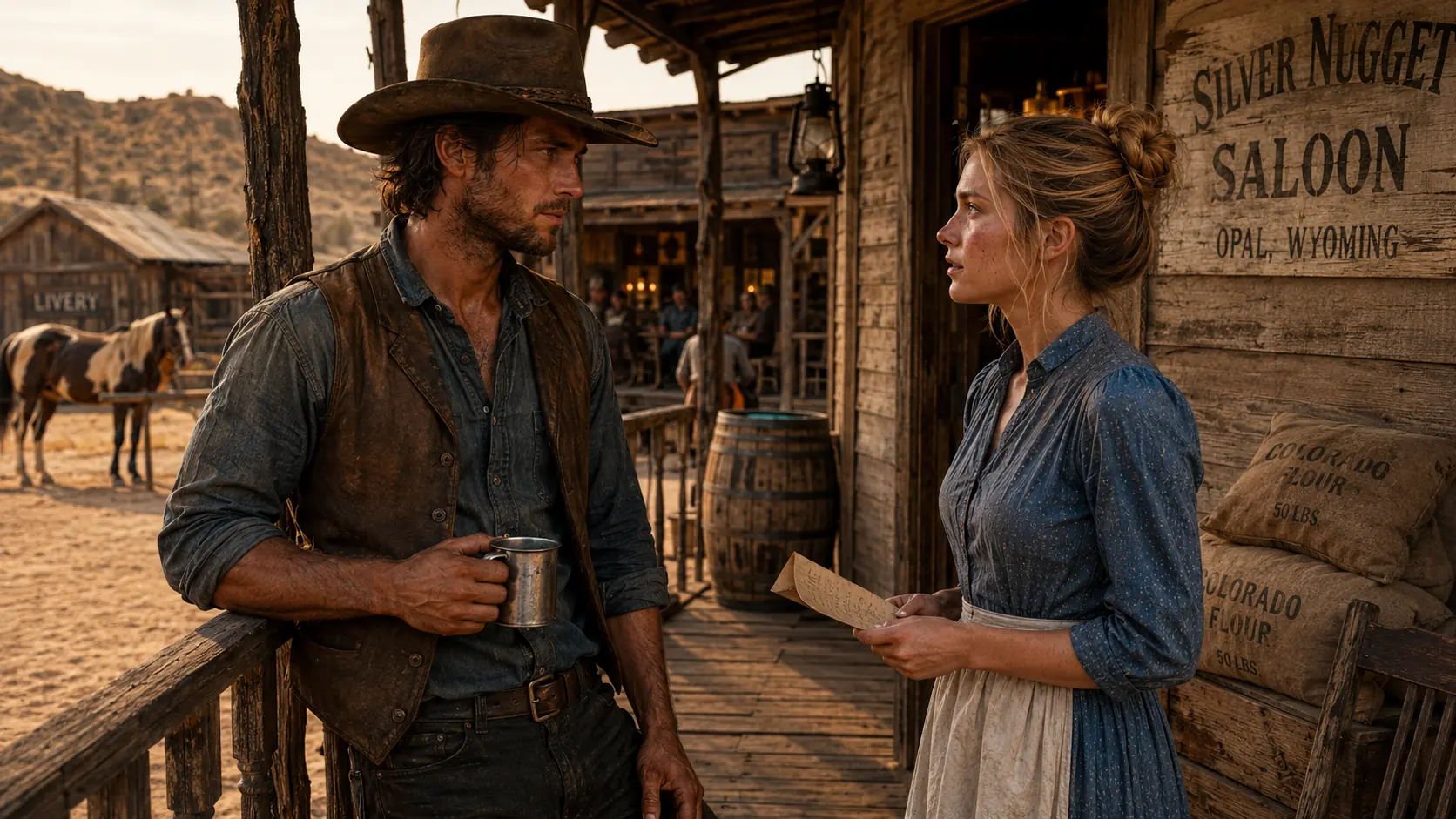
Grace looked at him with quiet understanding.
“What about you?” Mason asked. “Do you ever think about leaving Opal?”
“Every day for the first year, I hated it here. The dust, the small-mindedness, the way everyone knows everyone’s business. I missed the city. I missed the life I thought I’d have.” She paused. “But my father needs me. I couldn’t leave him alone.”
“That’s a heavy thing to carry.”
“Maybe,” she said. “But not everything worth doing is easy, Mason.”
The words settled inside him and stayed.
By the second week, Frank asked Mason to stay longer. There was always more to fix, and Mason was in no hurry to leave.
One afternoon, while repairing second-floor shutters, Grace brought him water. When he climbed down, she studied a list in her apron pocket.
“You’ve worked through most of the urgent repairs,” she said. “My father has been talking about building a proper storage shed out back, if you’d be interested in staying for that project.”
“How long would that take?”
“Two weeks. Maybe three.”
“That is a long time.”
“Yes,” Grace said, not meeting his eyes. “You probably want to get moving north before the weather turns.”
“Grace.”
She looked up.
“I’m not in a hurry to leave.”
Something flickered in her expression. Hope, maybe. Relief.
“The truth is,” Mason continued, “I’ve been looking for a reason to stay since about the second day I was here.”
“Why?”
He could have made a joke. He could have kept it safe.
Instead, he chose truth.
“Because of you. Because talking to you is the best part of my day. Because when I think about riding out of Opal, something in my chest feels wrong, like I’m leaving something important behind.”
Grace’s cheeks colored, but she did not look away.
“I like you, Grace. More than I’ve liked anyone in a very long time.”
“There are no other men,” she said softly. “There have been a few who asked, but I never felt anything for them. Then you rode into town looking exhausted and lost and determined not to need anyone.”
She stepped closer.
“And I thought, here is someone who understands what it means to keep going even when tired. Here is someone who has known loss and loneliness. Here is someone I want to know better.”
Mason’s breath caught.
“I like you too, Mason,” she said. “I tried not to, because you said you were only passing through. But I think it’s too late for that.”
He lifted his hand slowly, giving her time to step away.
She did not.
His palm cupped her cheek. She leaned into his touch, and something in him settled.
“What do we do now?” he asked.
“That depends,” Grace whispered. “Are you still planning to leave?”
Mason thought of Montana. Then he thought of Opal, the dusty little town that had nothing to recommend it except the woman standing in front of him.
“No,” he said. “I’m not leaving. Not unless you want me to.”
Grace smiled like sunrise.
“I definitely do not want you to.”
He kissed her softly, carefully, a question more than a statement.
She answered by rising on her toes and kissing him back.
That evening, Mason spoke to Frank. He asked permission to court Grace properly.
Frank studied him for a long time.
“My daughter deserves stability,” he said. “She deserves a man who stays when things get difficult. Can you be that man?”
“I can,” Mason said. “I know my past doesn’t prove it, but I’m asking for the chance to prove it now.”
Frank finally nodded.
“Grace is grown and can make her own choices. If she wants to be courted by you, I won’t stand in the way. But if you hurt her, you answer to me.”
Mason shook his hand.
“I understand.”
Weeks passed in a golden haze. Mason built the storage shed, helped Frank in the saloon, and took odd jobs around town. Opal slowly began to accept him as one of its own.
Six weeks after Mason first arrived, Grace told him again about the restaurant she dreamed of. She had saved nearly two hundred dollars over the years.
“A real restaurant,” she said. “With tablecloths and proper china. I know it may be foolish in a town this small.”
“It isn’t foolish,” Mason said firmly. “Dreams are what keep people going. And you would run an excellent restaurant.”
“Would you help me if I tried?”
“I would be honored,” Mason said. “Your vision and my labor. I’ll build what you need, fix what breaks, and stand beside you every step of the way.”
Grace’s eyes filled.
“I love you, Mason Lawson.”
The words stunned him.
Then they filled him with certainty.
“I love you too, Grace. I think I have since the first moment I saw you carrying that tray like you owned the world.”
That autumn, Mason found steady work at the Burke Ranch for thirty dollars a month. With a reliable income, he began thinking about a real future.
One evening, over dinner in the saloon, he spoke before he had planned to.
“I want to marry you, Grace. If you’ll have me.”
Grace stared at him, eyes wide.
“Are you proposing to me right now, covered in sawdust, in the middle of my father’s saloon, without a ring?”
“I suppose I am. Not very romantic, I know.”
“It’s perfect,” Grace whispered. “And yes, Mason. Yes, I’ll marry you.”
The saloon erupted in cheers when people realized what had happened. Frank tried to look stern, but failed.
“Congratulations,” he said. “Mason, take care of my girl. Grace, keep him in line. And someone get this man a ring before the whole town starts gossiping.”
The next day, Mason bought a simple gold band from an old rancher named Thomas Granger. That evening, he proposed again properly in the small garden behind the saloon where Grace grew herbs. She cried when he slipped the ring onto her finger.
They married in October in the small Methodist church, with nearly the whole town packed into the pews. Grace wore a simple white dress Mrs. Henderson helped sew, with wildflowers in her hair. Mason wore his best clothes, scrubbed clean and carefully pressed.
They spoke their vows clearly.
They exchanged rings.
When the minister pronounced them husband and wife, Mason kissed his bride, and the congregation burst into applause.
Their first years were full of work, adjustment, laughter, and small discoveries. Mason worked at the Burke Ranch. Grace helped at the saloon. They saved every spare penny.
In February, five months after their wedding, Grace told him she was expecting a baby.
Mason stared at her, overwhelmed.
“We’re going to be parents?”
Grace nodded, nervous. “I know it’s sooner than we planned.”
Mason pulled her into his arms.
“It’s wonderful. We’ll figure it out. That’s what we do. We face things together.”
Their son, Matthew Franklin Lawson, was born in August after twelve long hours of labor. When Mason held him for the first time, the baby weighed almost nothing, but the responsibility felt like everything.
“Hello, little one,” he whispered, tears on his face. “I’m your father. And I promise I’ll spend my life trying to be worthy of that.”
Years passed. Mason and Grace bought a small house on the edge of town. Mason repaired it with his own hands, and Grace made it a home. Later, their daughter Emily was born, fierce and loud from her first breath.
Grace never gave up her restaurant dream. She wrote recipes, studied what people liked, saved money, and waited for the right moment.
When the old mercantile building went up for sale in 1889, Mason and Grace bought it. Together, they turned the empty place into a restaurant.
They called it Grace’s Table.
Opening night was packed. Mason stood in the corner, holding baby Emily and watching Matt, while Grace moved through her restaurant with calm confidence. She greeted customers, checked orders, and made sure every plate left the kitchen with care.
Grace’s Table became beloved in Opal. Families celebrated there. Friends gathered there. Travelers stopped there. It was not just a business. It was proof that a dream, protected long enough, could become a life.
The years continued with the steady rhythm of seasons.
Matt grew into a bright boy with his mother’s green eyes and his father’s stubborn determination. Emily became a spirited girl who asked endless questions and climbed every tree she could reach.
Frank grew old and eventually moved in with Mason and Grace. When he passed away peacefully in the winter of 1893, the whole town mourned him. Grace grieved deeply, but she took comfort in knowing her father had seen her build a business, raise children, and live a happy life.
Mason and Grace grew older too. Their marriage deepened from young passion into something stronger and quieter, built from shared work, shared grief, shared joy, and thousands of ordinary days chosen again and again.
On their fifteenth wedding anniversary, Mason took Grace back to the garden behind what had once been her father’s saloon.
“You remember this place?” he asked. “You said yes to me here when you had every reason to say no. I was a drifter with no prospects.”
Grace touched his face.
“It was the easiest decision I ever made.”
“I’ve tried to be worthy of your trust every day.”
“You have,” she said. “You gave me a home, Mason. Not just a house. A real home. You believed in me, supported my dreams, and loved me exactly as I am.”
They kissed there in the overgrown garden, no longer young, but still full of the love that had begun with a tired cowboy and a girl serving tables in a saloon.
Years later, when Mason was an old man with more memories than days remaining, he would tell anyone who asked that the best decision he ever made was stopping for one night in a small town called Opal.
He had planned to leave at dawn.
Instead, he met Grace.
He stayed.
That single choice gave him everything: a wife he cherished, children who made him proud, a restaurant that carried her name, a community that embraced him, and a home that anchored his soul.
When Mason drew his final breath many years later, surrounded by children, grandchildren, and great-grandchildren, his last thought was of that first night.
Three dollars in his pocket.
Dust on his boots.
No plan beyond the next meal.
And green eyes that made him believe, for the first time in years, that maybe life still had something waiting for him.
The traveling cowboy had finally found what he had been searching for all along.
And in finding it, he discovered that sometimes the greatest adventure does not come from moving on.
Sometimes it begins with the courage to stop.
To stay.
To plant roots.
And to build a life worth calling home.