“Get away from my stand, you old beggar. Your own family threw you out, and I can see why.”
Forty people watched.
Forty phones came up.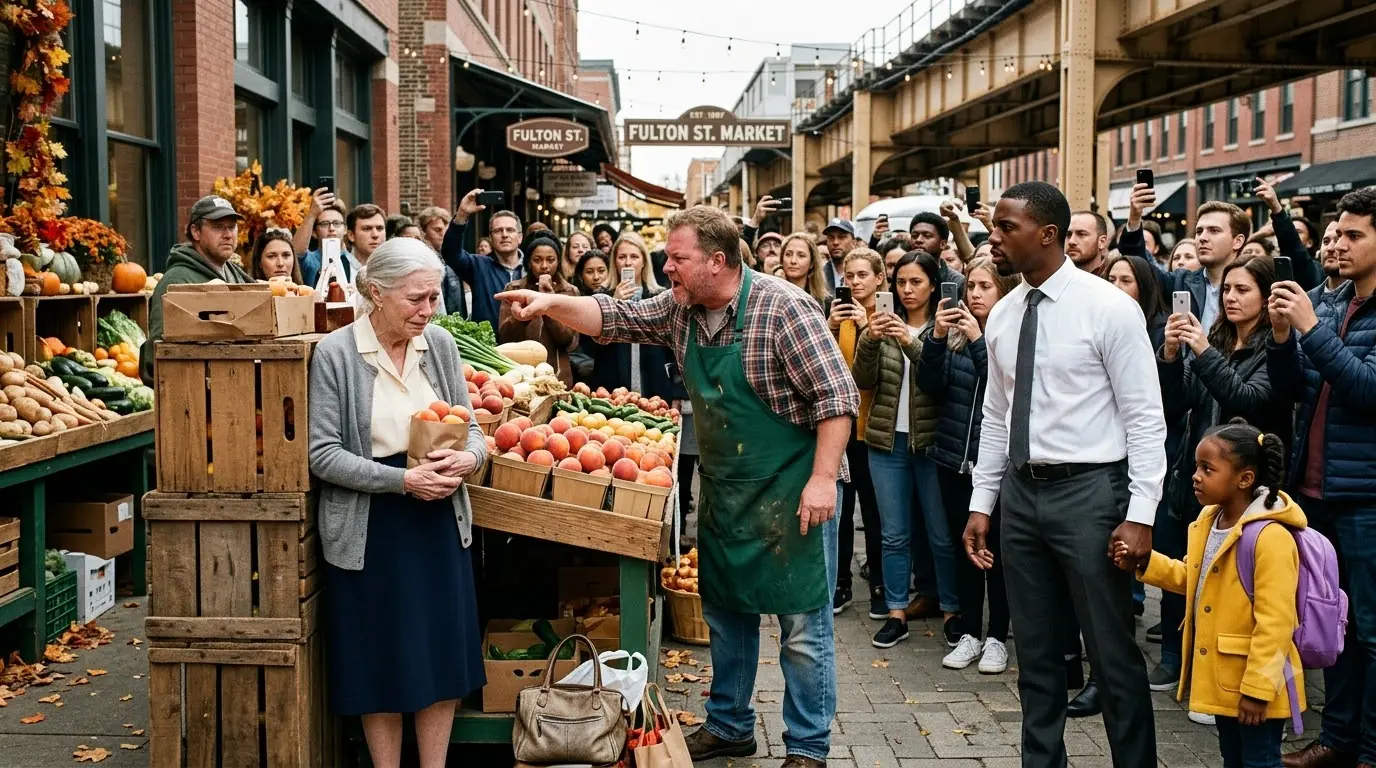
Nobody moved.
Then a voice cut through the market.
“That’s enough. You don’t talk to her like that.”
“Mind your business, man.”
“It became my business when you did it in front of forty people. She’s short a few dollars. She’s not a thief.”
“Young man, don’t. I can see what you have. Don’t spend it on me.”
“It’s already spent, ma’am.”
That money was his fare to the interview that would decide whether he kept his daughter.
He walked away with nothing.
Ten minutes later, three black cars stopped at the market.
Who was she?
Marcus Bell had learned to measure his life in shifts rather than years.
The warehouse on Delmar Avenue took him from five in the morning until one in the afternoon. The delivery routes took him from two until eight. Both paid cash at the end of the day, off the books, with no contract and no pay stub, which meant that as far as a courtroom was concerned, Marcus Bell did not earn a dollar.
What was left of the day belonged to a six-year-old named Naomi, who never once asked why he came home smelling like cardboard and diesel.
Two years ago, there had also been Diane.
Now there was a manila folder on the kitchen table with a case caption on the first page, The Estate of Naomi’s Mother, a hearing date, and a line in the middle stating that the court would need proof of stable income before it returned full custody of the child to her father.
The year Diane died, Marcus had gone under. He had lost the apartment, then the job, then eleven days he could not account for.
A woman named Ruth Doyle had signed the temporary guardianship papers in his place, and everyone had called it kindness.
Marcus had crawled back out.
The papers never quite went away.
Ruth called herself his mother. Marcus had never been able to disprove it because Marcus could not remember being anyone’s son.
Fifteen years ago, there had been an accident he was told about rather than recalled. A hospital bed. A young man waking up with no name, no history, and a headache that lasted a decade.
Ruth Doyle had walked into that ward, looked at him, and told the nurses he was hers.
The paperwork gave him her late husband’s name, Bell, because she said it was easier that way, and because a boy with no memory did not argue about a surname.
He had been paying for the privilege ever since, mostly to cover what her real son, Trey Doyle, lost at the tables on Hallstead Street.
He had one rule, and Naomi had learned it before she learned to tie her shoes.
You do not walk past.
Marcus could not say where the rule came from. It was one of the few things that had survived whatever the accident took.
And it had cost him money he did not have more times than he could count.
Which was why the eleven o’clock interview at BrightLine Freight mattered more than any job had ever mattered.
Dispatch supervisor.
Salary.
Benefits.
A letter on company paper he could hand to a judge.
Marcus had thirty-one dollars in his wallet, and eighteen of it was the round trip.
Across the city that same morning, Eleanor Carter told her driver she had a headache and wanted to lie down.
Then she waited until his car turned the corner and walked out her own back gate.
She was seventy-eight years old. She had buried a husband, raised a son, and outlived most of the people who used to argue with her. She had decided long ago that a woman should not need two men in dark suits standing behind her just to buy peaches.
Her son ran Carter Group.
Damian Carter’s name was on three towers Eleanor could see from her kitchen window, and on a foundation, and on a hospital wing he had built the year she nearly died.
She had nearly died fifteen years ago.
A rare blood type.
A hospital with none of it left.
And a boy who walked in off the street and gave what she needed.
He had given a first name and nothing else.
Elijah.
By the time the family came looking with their gratitude and their checkbooks, he was gone, and every road they followed after that ended at a wall.
Eleanor’s granddaughter had never let it go.
That morning, Zora Carter sat across from a table of board members while they explained gently that the company’s future heir was unmarried, and that investors preferred a story with an ending.
Her father waited until the room emptied.
“They want stability,” Damian said. “They want to know the name continues.”
“They want a wedding photograph,” Zora replied.
He did not disagree.
“You’ve turned down every reasonable match in this city for a boy whose last name we never learned.”
“He saved your mother’s life.”
“He did. And then he vanished. Fifteen years, Zora. Investigators, records, appeals on television. Every clue is a dead end.”
Zora gathered her folders and did not look up.
“I made a promise. I’ll marry Elijah, or I’ll marry no one.”
The board called it sentiment.
The city’s papers called Zora Carter cold, which was easier to print than the truth.
She had been sixteen years old, standing in a hospital hallway, when a boy barely older than she was gave a piece of himself to a woman he had never met and asked for nothing.
Nobody had ever done anything like that for her since.
Six blocks of fruit crates and folding tables, and on the far side, the bus that would take him to the rest of his life.
He heard the shouting before he saw it.
The vendor’s voice carried over three rows of stalls.
He was a big man named Royce who sold produce out of the corner stand, and he had a woman in a gray cardigan backed against his table with a bag of peaches in her hands.
“I lost my wallet,” she said. “My son will bring the money within the hour. I’m good for it.”
“Sure you are.”
Royce turned to his audience.
“Do I look like a fool? You people come here with your stories.”
“Please, I only need the peaches.”
“Get away from my stand, you old beggar. Your own family threw you out, and I can see why.”
Phones came up along the row.
Nobody moved.
Marcus looked at the clock on the bank sign across the street.
10:44.
Then he looked at the woman’s hands, which had begun to shake around the bag.
He understood that he was about to break something he could not afford to break.
He let go of Naomi’s hand and stepped in.
“That’s enough,” Marcus said. “You don’t talk to her like that.”
Royce looked him over.
“Mind your business, man.”
“It became my business when you did it in front of forty people.”
Marcus set his wallet on the table and counted out what the peaches cost.
“She’s not a thief. She’s short a few dollars. There’s a difference, and you know it.”
The vendor took the money because money was money.
“Take it and go.”
Marcus carried the bag to the curb for her.
“Thank you,” the woman said. “You didn’t have to do that.”
“Nobody else did. People stopped stopping.”
He looked down the street.
There was a car service two doors down that ran cheap flat fares to the north side.
And there were eighteen dollars left in his wallet.
Eighteen dollars was the bus there and the bus back.
He walked in, paid the fare to whatever address she gave, and put the change in her hand.
She tried to give it back.
“Young man, I can see what you have. Don’t spend it on me.”
“It’s already spent,” Marcus said, and closed her fingers around it.
“Eleanor Carter,” she said.
“Marcus Bell. That’s Naomi.”
Eleanor looked at the little girl, then at the father, and something moved in her face.
“If my granddaughter ever met a man like you, I’d die happy.”
“I’ll walk,” Marcus said, which was not an answer. “I’ve got an interview at eleven. If I move now, I might still make it.”
“Then give me your number so I know you made it.”
He gave it to her because it was faster than arguing.
Ten minutes after he was gone, three black cars stopped at the mouth of the market, and the row went silent in a different way.
The man who got out and knelt in front of Eleanor Carter had his name on three towers downtown.
Royce did not sell anything else that day.
Marcus left Naomi at the community center on the far side of the row.
Then he walked.
He reached BrightLine Freight at 11:40 with his shirt stuck to his back.
The woman at the desk was kind about it, which was worse.
The position had been filled at 11:15 by the second candidate.
She suggested he watch the website.
On the sidewalk, Marcus did the arithmetic he had been avoiding.
The hearing was in nine days.
He had no letter, no offer, and no other appointments.
Ruth Doyle was sitting in his kitchen when he got back, and she was not alone.
Trey had his feet on the radiator.
The third man wore a linen jacket and a watch that did not belong in that building, and he stood up when Marcus came in as if the apartment were his.
“Marcus,” Ruth said, “this is Harold Vaughn.”
“Get out.”
“Sit down and listen. Trey owes people forty thousand dollars. Mr. Vaughn has settled it.”
Marcus looked at the folder open on his own table.
“Settled it with what?”
“With what I had,” Ruth said, the way she said everything, as though she were the one being wronged. “I still hold the guardianship. I signed it over. Mr. Vaughn and his wife have a house upstate and schools and every single thing you can’t give that child.”
“You sold her.”
“I saved this family. You couldn’t even keep bus fare in your pocket today. I heard. The whole block heard.”
Vaughn smiled at him with terrible patience.
“Nobody is taking anything, Mr. Bell. The court will simply agree with the paperwork. It usually does.”
They left the folder behind.
Marcus stood in his own kitchen for a long time with his hands flat on the table, reading a sentence he could not argue with.
The man had no verifiable income.
No letter.
Nine days.
The phone rang at nine that night.
“Marcus, it’s Eleanor from the market. I want you to come and see me. Bring your daughter. I’m sending you the address now.”
“Ma’am, it’s late, and I’ve had…”
“Come anyway.”
The car Eleanor sent for him the next morning was longer than his kitchen.
It carried Marcus and Naomi north until the streets got quiet and the gates got tall. Then it turned in at a set of iron doors with a guardhouse beside them.
Kenmore Hill.
One house, three wings, and a garden you could lose an afternoon in.
“Good morning, Mr. Bell. Mrs. Carter is expecting you.”
They already knew his name.
Marcus sat very still and understood that the woman with the peaches lived here.
Eleanor met them at the door in the same gray cardigan.
“You didn’t tell me,” Marcus said.
“You didn’t ask,” she replied, and took Naomi’s hand. “It’s only a house. What matters is who’s inside it. My son built it for me. He lives downtown now. He finds this place too quiet. My granddaughter keeps the East Wing. And you may have heard of my son, Damian Carter.”
Damian came down the stairs like weather.
He had spent a night learning exactly who had been standing next to his mother in that market.
And he did not offer his hand.
“You gave her the last of your money,” Damian said. “Why?”
“Because she needed it.”
“Men who do things like that in front of cameras usually want something afterward.”
“I didn’t know there were cameras, and I don’t want anything from you.”
Eleanor cut across both of them.
“He lost a job over me, Damian. You will give him one.”
Her son looked at Marcus for a long moment.
“What can you actually do?”
“Logistics, routing, dispatch, freight scheduling. Eleven years of it.”
“Then be at the fortieth floor Monday. You’ll be assessed like anyone else.”
Eleanor took Marcus out to the garden afterward and asked him what was wrong.
And Marcus, who had not told anyone anything in two years, told her about the folder on his kitchen table.
Nine days.
No letter.
A woman who held papers she should never have held.
A man in a linen jacket who had already paid for them.
“A job in a week won’t move a judge,” Eleanor said. “A judge wants a household.”
“What are you saying?”
“I’m saying my granddaughter is being squeezed by her own board to produce a husband for the shareholders’ benefit, and you need a name on a form and a roof no one can question.”
“Marry Zora?”
Marcus laughed once, and it came out wrong.
“Ma’am, I met you yesterday.”
“And you gave me everything in your pocket.”
Eleanor folded her hands.
“I’m not asking either of you to fall in love. I’m asking two people who are being crushed to hold something up together for a while.”
Zora refused for eleven minutes.
“You know what I promised?” she told her grandmother. “I’m marrying Elijah.”
“Then marry Elijah when you find him,” Eleanor said. “Until then, the board takes your company apart one meeting at a time, and a little girl goes upstate with a stranger. Buy yourself the time. Buy him the household.”
Her granddaughter stood at the window with her arms crossed and thought about it the way she thought about acquisitions.
It was clean.
It cost nothing but a signature.
It ended the moment she wanted it to end.
They put it in front of Marcus that evening in a room with too much light.
Zora Carter did not sit down.
“Understand what this is,” she said. “My attorneys will crush your guardianship problem in a week. You and your daughter live in this house. You take nothing else from me. Not money, not a title, not a favor.”
“I wasn’t going to.”
“Three conditions.”
She held up her hand.
“First, no press. The board gets a copy of the certificate, and that’s where it stops. My lawyers seal the family court file, and we register in the next county so no reporter goes fishing. No photographs, no interviews, no story. I’ve been a headline since I was sixteen, and I’m not turning this into one.”
Marcus nodded.
“Second, it’s a contract, not a marriage. Your room is at the end of the hall. And third, when I find Elijah, this ends the same day, and you don’t argue.”
Damian objected in the hallway loudly and without shame.
“A man with nothing marries my daughter after two days. Do you hear yourselves?”
Nobody listened to him.
Marcus stood over the paper for a long while.
He thought about a linen jacket.
He thought about nine days.
He thought about the only rule he had, which had cost him everything it could cost by now.
He thought about a man who did not walk past, and about a little girl who was going to be put in a car by strangers if he was proud.
He signed.
The registry took nine minutes.
No flowers.
No guests.
No photographs.
Zora had been clear about photographs.
The clerk pronounced them married and asked if they had rings.
Eleanor produced two because she had come prepared for a yes.
“Congratulations.”
Marcus looked at the band on his hand and felt nothing he could name.
Across the counter, his wife of forty seconds was already reading a message about a man in Ohio who might have been Elijah.
It was, he told himself, a contract.
Nothing about it was supposed to hurt.
The East Wing had rooms Marcus never entered.
His was the last one on the left, exactly as promised, with a window over the garden and a door he closed quietly, because closing it loudly would have meant it mattered.
Zora’s attorneys took nine days and made it look like six minutes.
Ruth Doyle’s guardianship had been signed in a hospital corridor by a man who could not have understood what he was signing, and had been used since to move money that was never Naomi’s.
Harold Vaughn’s forty thousand dollars bought him a letter suggesting he consider his exposure.
The judge restored full custody to Marcus Bell on a Thursday morning and remarked for the record that the child’s household appeared stable.
Marcus thanked Zora in the parking garage.
She was already answering messages.
“Don’t. It was four hours of billable time. It cost me nothing.”
“It cost you something once,” Marcus said. “Somebody had to decide to spend it.”
She looked up at that briefly.
Then the elevator came.
He started on the fortieth floor the following Monday and told no one what his last name meant in that building.
It was not difficult.
Nobody looked at a new man in the routing group and thought of the Carters.
The family court file was sealed, and the certificate sat in a drawer in the next county.
He carried his own lunch, paid his own phone bill, and set up an automatic transfer of eight hundred dollars a month into Zora’s account for rent, which her assistant flagged as an error twice before Zora told her to leave it alone.
Three weeks in, the Northgate contract fell apart.
Carter Group had been promising a client seventy-two-hour delivery windows and hitting them a third of the time, and a room full of vice presidents had decided the answer was more trucks.
Marcus read the file overnight in the kitchen after Naomi went to bed.
On Tuesday, he asked for four minutes.
“The trucks aren’t the problem. You’re loading by contract value. The high-value freight goes out first, and the small orders sit in the yard for two days. So ninety percent of the complaints come from ten percent of the revenue. Load by distance. Same trucks, same drivers.”
A vice president explained why that was naive.
Marcus let him finish, then explained why it was not, using the yard’s own numbers, because he had spent eleven years in yards like that one.
By the end of the month, the seventy-two-hour rate had climbed past ninety percent.
And Damian Carter asked who had written the routing memo.
Zora had prepared herself for a certain kind of man.
She had watched them for years.
The ones who married up and then spent the rest of their lives asking.
She had cataloged exactly how it would go.
The requests.
The cards.
The introductions.
The slow discovery that he had opinions about her money.
Marcus never asked for anything.
It unsettled her more than any demand would have.
What undid her was smaller than that, and it happened at the kitchen table on a Wednesday.
Zora came in at nine at night, and a six-year-old looked up from a coloring book and said without ceremony, “Miss Zora, you missed dinner. Your plate’s in there. I told them to leave it.”
Nobody had ever kept a plate for Zora Carter.
Her father had built a hospital wing for her grandmother and had never once sat down at nine to ask how her day went.
She ate standing at the counter and did not trust her voice.
After that, she came home earlier.
She told herself it was the commute.
“Where’s your family?” she asked Marcus once in the garden, because it was the only question she had never asked.
“There isn’t one,” Marcus said. “It’s just us.”
It was the first lie he had told her.
And he told it because the truth was a woman who had sold his daughter and a man who was not his brother.
He told it because Zora Carter had signed her name next to his, and he would not hand her a reason to think her father had been right about him from the beginning.
Trey called on a Sunday.
“I need two hundred thousand.”
“Forty,” Marcus said. “It was forty.”
“It was then. I doubled up to get clear, and it went the other way. Come on, man. You’re living on Kenmore Hill. Ruth got a call from the county. Some clerk in the next county over confirming a certificate. You think we can’t read?”
The line went cold in Marcus’s hand.
“I’m done paying for you. I’ve been done for two years. I just didn’t say it out loud.”
“Then don’t blame me for what happens next,” Trey said, and hung up.
Marcus stood in the garden a long while with the phone against his leg.
Ruth had nothing left.
The papers were void.
Vaughn had been warned off.
There was nothing they could take.
Behind him, through the lit window, Zora was sitting at the kitchen table with a coloring book in front of her, being shown with great seriousness which crayon was correct.
For the first time since the market, Marcus let himself think the word home.
And it frightened him more than the phone call had.
Ruth called on a Thursday, and she was crying, which she had never done in fifteen years.
“I want to apologize,” she said. “Properly. Face to face. Marcus, I’ve had time to think about what I did, and I can’t carry it anymore.”
He knew better.
He went anyway because there was a piece of him that had spent half his life waiting for that exact sentence from that exact voice.
And it stood up before the rest of him could stop it.
The apartment on Hallstead was empty.
Trey was not there.
Ruth was not there.
What was there was a phone on the kitchen counter turned face up, ringing on speaker the moment he stepped through the door.
“Ruth’s at the community center right now,” Trey said. “She still has a copy of the old guardianship, and that front desk has never heard the word vacated. Vaughn’s driver is idling out front. Ruth told him the order got reversed on appeal. The man thinks he’s picking up his own daughter. By the time anybody untangles it, they’re upstate and you’re back in front of a judge with no lawyer.”
“Trey…”
“Or you send two hundred thousand, and I make one call.”
Marcus was already running.
He called Zora from the street and could not get the sentences in order.
She got them anyway.
What happened over the next fifty minutes did not involve Marcus at all, and he would think about that for a long time afterward.
Zora Carter did not shout.
She made four phone calls.
The first was to Patrice Hollis, who had drafted the custody order and who had, it turned out, filed certified copies with every relevant office in the county precisely because she had expected something like this.
The second was to the community center’s director, who pulled up the sealed order on her screen while Ruth Doyle was still standing at the front desk with a photocopy in her hand.
The third was to Harold Vaughn’s attorney, who understood within ninety seconds what his client’s driver was idling in front of, and who called that driver himself.
The fourth was to the sheriff’s civil office.
It ended in the community center parking lot without anybody raising their voice.
Ruth Doyle was still arguing with a laminated visitor’s badge on her chest when the deputies arrived.
“This is a misunderstanding about paperwork. I’m sixty-nine years old. I raised that man from a hospital bed.”
They wrote it all down.
She was released before dinner pending a hearing on attempted custodial interference and fraud.
Trey did not go home that night or any night after.
By Friday, his phone was dead and his apartment was empty.
Harold Vaughn discovered that his forty thousand dollars had purchased him criminal exposure instead of a daughter, and he stopped returning anyone’s calls.
Marcus reached the center twelve minutes after it was over.
He got out of the car and could not make his legs work properly.
Zora was standing in the lot in a suit she had not had time to change out of, with a six-year-old attached to her leg.
“She’s fine,” Zora said. “She never left the building. She’s annoyed. She wants a milkshake.”
Marcus put his hands over his face and stood there.
When he could speak, he told her all of it.
Ruth in the hospital ward fifteen years ago.
Trey.
The forty thousand.
The name on the paperwork that had never really been his.
The lie in the garden.
“I told you there wasn’t a family,” he said. “There is. It’s just not one you’d want your name near. Your father was right about me from the first day.”
Zora listened to the whole thing without moving.
“My father,” she said, “has been wrong about people since before you were born.”
Then she looked down at Naomi, and something in her face closed like a door.
“Nobody sells a person and calls it saving a family. And you’re not doing this alone anymore. That part’s finished.”
Marcus, standing in a parking lot with the afternoon going orange behind the fence, fell in love with his wife.
He knew it the way you know a bone is broken.
Not gradually.
All at once, with a kind of clarity that leaves no room to argue.
He did not say it.
He had signed a contract with three conditions, and two of them were still holding.
The third one broke that night.
The Carter Foundation’s autumn benefit had been on the calendar for eleven months.
Zora had asked him to come, and he had declined because of the press, and because Ruth Doyle had stood at a front desk eight hours earlier with his daughter’s name in her mouth, and Marcus was not leaving that house.
He watched it on the kitchen television at ten with the sound low.
Damian Carter stood at a podium in a room full of people who had spent fifteen years reading about the boy who saved Eleanor Carter’s life and vanished.
Damian did not do sentiment in public.
He did it that night.
“For fifteen years, my family has looked for a young man who gave my mother the blood that kept her alive and asked for nothing. This week, the laboratory confirmed a match. There is no question.”
The camera moved.
“Ladies and gentlemen, Andre Foster. The man we knew as Elijah.”
The room stood up.
And in the middle of it, on a screen in a kitchen he had begun to think of as his, Marcus watched Zora Carter’s face come apart with fifteen years of joy at once.
There is no correct way to congratulate your wife on finding the man she is going to leave you for.
Zora came home at two in the morning and found him still at the kitchen table.
She stood in the doorway with her heels in one hand.
“The result came in at four. Four hours before the doors opened. My father made the call to announce it. I didn’t even know until I was standing there.”
“I know.”
“Marcus, I…”
“You made a promise when you were sixteen,” he said. “You kept it for fifteen years. That’s not something a person should apologize for.”
He watched her look for something to say and not find it.
Then she went upstairs.
And that was the whole conversation.
The city took the story and would not let go of it.
The boy who came back.
Andre Foster on morning television with his hands folded, describing a woman who needed a type so rare the hospital spent two days hunting for it, and a seventeen-year-old who happened to be walking past with that exact type in his veins.
He told it well.
He told it every day for two weeks in slightly different words to slightly larger audiences, and the photographs of Zora Carter walking beside him ran under headlines about a promise finally coming due.
His blood work had been the first thing they checked that first afternoon before anyone got excited.
It matched.
It was rare, and it matched.
After that, nobody in the family asked another question, because the odds of a stranger walking in off the street with that type and that story were not odds a reasonable person argued with.
Damian Carter, who had not offered his hand to Marcus Bell at his own mother’s door, put his arm around Andre Foster in front of the cameras.
“This is what my family looks like now.”
Marcus watched it from the routing group on the fortieth floor, where he was still, as far as anyone knew, a competent hire with an unremarkable name.
Eleanor did not celebrate.
Marcus noticed it because nobody else did.
A woman who had waited fifteen years to thank the boy who saved her, sitting through dinner after dinner with her hands in her lap, saying very little.
“Grandma, you’ve barely spoken to him.”
“I’m an old woman,” Eleanor said. “Old women are slow.”
Marcus’s part in it was to be nowhere.
He came home at seven, made dinner, and answered the question that came at him across the table more nights than he could stand.
“Is Miss Zora coming home tonight?”
“She’s working, baby.”
“She’s not working. She’s on the TV.”
There was no answer to that.
So Marcus stopped giving one.
And Naomi stopped asking.
The second thing was worse than the first.
He understood what he was.
He had understood it since the moment the camera moved.
Zora Carter had not been holding a place for Marcus Bell.
She had been holding a place, and he had been standing in it because it was empty.
A fifteen-year vow does not lose to eleven months of a man who pays his own phone bill.
It was not cruelty.
It was arithmetic.
Marcus had always been good at arithmetic.
What he could not do was watch it.
He watched it anyway for nineteen days.
He watched her hold Andre Foster’s arm at the top of the stairs.
He watched her father, who had called Marcus a man with nothing, lift a glass to a man with less.
He watched the two of them on the terrace one night from the window at the end of the hall, his hall, the last room on the left, and he saw Zora laugh at something.
He thought, She is going to be happy. And I am the only obstacle to it. I am here because I signed a paper that says so.
The only conversation that came close to honesty happened in the garden on a Sunday.
“He doesn’t remember the hallway,” Zora said, looking at nothing. “I’ve asked him three times. He remembers the room, the nurse, my grandmother’s name. Not the hallway.”
“You were sixteen,” Marcus said. “Nobody remembers a hallway.”
“I do.”
She turned the glass in her hands.
“I remember every second of it.”
He could have said something then.
He had been putting the sentence together for nineteen days, and it was a good sentence, and it would have been the single most selfish thing he had ever done in his life.
“He’s been gone a long time,” Marcus said instead. “Give him room to be a stranger for a while.”
Zora looked at him with an expression he could not read.
Then her phone lit up on the table between them.
It was Andre.
And she took it.
Marcus went inside and stood in the kitchen with both hands on the counter.
The house was hers.
The name was hers.
The company was hers.
The promise was hers.
It had been made before he existed.
And every single thing he had in this life, he was holding on a temporary basis, at the pleasure of a contract with three conditions.
The third had already been triggered.
She simply had not said it out loud.
Marcus decided he would not make her.
He went to Eleanor first because she was the reason he was in that house at all.
She was in the garden, in the chair she always took, wearing the cardigan she had worn in the market.
Marcus sat down across from her and told her he was leaving.
“You’ll do no such thing.”
“Ma’am, the custody order is permanent. The papers are void. Ruth’s got a hearing of her own to worry about now. The contract had a condition. It’s been met.”
“Zora hasn’t invoked it.”
“She won’t. That’s the problem.”
Marcus looked at the hedge and made himself keep going.
“She’ll sit in that house for a year being decent to me. And every day she does it, it costs her something she doesn’t have to pay. She waited fifteen years for him. I’m not going to be the reason she waits sixteen.”
Eleanor was quiet in the way that made people confess things.
Marcus did not confess.
He did not have to.
“You love her,” she said.
“That’s mine. It’s not hers, and it’s not a claim on anybody. Loving somebody means knowing when to get out of the middle of their happiness.”
“He’s not what they think he is.”
“Everybody says that about the man who gets the girl.”
Eleanor reached into the pocket of her cardigan and produced a check she had clearly written before he sat down.
The number on it would have solved every problem Marcus had ever had.
He looked at it for a moment.
“No, ma’am.”
“Marcus.”
“I gave you the last of my money in a market, and it turned into a house I don’t own.”
He put the check back in her hand and closed her fingers over it.
“Let me leave the same way I came in. It’s the only thing in eleven months that’s still mine.”
Eleanor Carter, who had buried a husband and raised a man who built towers, sat in her garden and cried in front of someone for the first time in twenty years.
“You’re a fool,” she said. “Not you. Him. Every one of them.”
The annulment took less time than the wedding had.
Patrice Hollis drew the papers with the same efficiency she had used to break Ruth Doyle and told him twice on the record that he was entitled to a settlement.
Twice, he declined it.
He signed on a Tuesday morning at nine and was at his desk by ten.
He wrote Zora a note and left it on the kitchen counter under the salt because there was no version of that conversation he could survive out loud.
You kept your promise. Keep it all the way. The papers are with Patrice. You don’t owe me anything. You never did. That was the whole point of it. Thank you for the parking lot. I’ll be all right. M.
The apartment he found was one bedroom on the third floor of a building on Leadbetter Street.
The bedroom was Naomi’s.
Marcus took the couch.
He gave notice at Carter Group with two weeks’ service and a letter of reference he never used, because using it would have meant explaining.
He took a dispatch job at a freight company on the south side with nine trucks and a yard the size of a parking lot.
The office was one room.
The men there did not know his last name meant anything.
And it did not anymore.
The first night on Leadbetter Street, he sat on the couch after Naomi went down, listened to the radiator, and did the arithmetic of what he had.
He had his daughter.
He had a job.
He had no wife, no house, no family that had ever actually been his, and four hundred and twelve dollars in the bank.
Every legal thing that had ever protected Naomi had been Zora’s to give.
And the letter on Carter Group paper that the judge had liked so much now described a job he no longer held.
The order was permanent.
Orders could be revisited.
He thought about that for a long time.
“Dad, are we going back?”
“No, baby.”
“Is Miss Zora coming here?”
Marcus looked at the ceiling of a room he could barely afford and told the truth because he had run out of anything else.
“No. She’s not.”
Across the city, Zora Carter came home at eleven, found the East Wing quiet in a way it had not been in eleven months, and stood in the kitchen with a note in her hand and salt scattered across the counter, reading four sentences over and over until the words stopped meaning anything at all.
Down the corridor, in a chair by a dark window, an old woman was not asleep.
Eleanor Carter had spent an hour looking at a check nobody would take, and she had arrived somewhere around midnight at a question she should have asked five weeks earlier.
How does a man with no family and no memory grow up knowing that you do not walk past?
She reached for the phone and called the hospital that had saved her life.
Andre Foster spent money the way a man spends someone else’s.
In five weeks, there was a car, a watch, and an apartment overlooking the park that the foundation was quietly asked to guarantee.
He was late to everything except photographers.
Zora told herself she was being unfair.
A man raised with nothing walks into a room containing everything. Of course he grabs with both hands.
She had built a whole promise on the boy in that hallway, and she was not going to break it over a wristwatch.
Then, at dinner on a Tuesday, Andre sent back a plate.
“I said no onions,” he said to Delia, who had worked in that kitchen for nineteen years. “Is that difficult? Are you slow?”
“That’s enough,” Zora said. “Delia, thank you. Please go.”
Andre spread his hands after the door closed.
“Why are you defending her? She never listens.”
“She made a mistake. That doesn’t buy you the right to humiliate her.”
Zora set down her fork.
“The foundation review is Thursday. You’ve moved it five times.”
“I lost fifteen years of my life. Excuse me for not wanting to spend the rest of them in meetings.”
Across the table, Eleanor Carter said nothing at all.
She had said nothing for five weeks.
Zora asked him about the hallway one more time that night, and he described the room, the nurse, her grandmother’s name, everything that had been printed in the newspapers years ago.
She went to her father in the morning.
“I want the complete original file on that match. Every sample record, every signature, every laboratory entry.”
Damian Carter, who had put his arm around Andre Foster in front of the cameras, did not defend himself.
He picked up the phone.
The archive gave them the first crack in four hours.
The blood type was real.
Andre Foster genuinely carried it, and that single fact was the reason nobody had looked further.
But the donor sample from that night had been destroyed years ago in a routine purge, which meant a genetic comparison should have been impossible.
The report said otherwise.
It cited a retained archival specimen recovered by the laboratory director himself, a man named Aaron Pruitt, who had not been at his desk in nine days.
The rest took the investigators two more.
Pruitt and Andre Foster had met privately four times before the test was completed.
A transfer had cleared three days before the result was uploaded, and the recovered messages did not require interpretation.
Andre had asked for a positive match in plain words and had named his price.
Pruitt confessed in a lawyer’s office with his hands shaking.
“I was thirty thousand underwater. He came to me first months ago. He’d worked it out. A rare blood type and a fifteen-year-old newspaper story is most of a fortune. The only thing standing between him and the rest of it was a specimen that didn’t exist anymore.”
There had been no archival sample.
Pruitt had invented one and signed his name beneath it.
Damian did it himself in the hall in front of the staff, which was the only cruelty he permitted himself.
“You used my mother’s life. You used my daughter’s fifteen years.”
Andre tried three sentences.
None of them landed.
He walked out of the Carter house at eight in the evening with a watch he did not own and a car the foundation had already stopped paying for.
The door closed behind him.
Zora stood in the empty hall and understood too late what she had traded, and what she had let walk out of that same door five weeks earlier.
Eleanor had not waited for any of it.
She had gone to the hospital the morning after Marcus left because she was the woman whose life had been saved, and there were doors that opened for her without argument.
She asked for the original donor record from that night.
Not the report.
The record.
It took the archive eleven days to produce it.
When they did, it said the donor was seventeen years old, gave one name, refused payment, and never came back for his follow-up appointment.
Eleanor took that page to a second hospital eleven blocks away and asked a question that no one had ever thought to ask, because no one had ever had a reason to connect the two buildings.
Mercy General had a record from that same night.
At 11:40 in the evening, a little over an hour after a boy walked out of a blood bank, an unidentified male, seventeen years old, had been admitted after a collision on the street.
Head injury.
No wallet.
No name.
The same rare type written in the same careless hand.
Same night.
Same hour.
Same age.
Same blood.
He had woken up four days later remembering nothing, and a woman named Ruth Doyle had walked into that ward and told the nurses he was hers.
An old woman sat alone with two pieces of paper and did the arithmetic.
The boy who gave her his blood and asked for nothing had walked out of that hospital, been struck down eleven blocks away, and woken with no name.
Fifteen years later, he had stopped in a market when forty other people did not.
He had given her the last of what he had.
And he had never once mentioned it again.
Marcus Bell was Elijah.
He had stood beside Zora for eleven months.
They had all looked straight through him.
Then they had let him go.
Eleanor called her granddaughter at six in the morning.
Zora was in the car before the second sentence finished.
They were forty minutes from Leadbetter Street when Marcus Bell’s phone rang, and the voice on it was Ruth Doyle’s.
She was not crying.
“Two hundred thousand, and I’ll tell you your real name.”
Marcus stood in a one-room office at a nine-truck freight yard with a clipboard in his hand and did not say anything at all.
“I’ve got a hearing in three weeks and a lawyer I can’t pay. So here’s what I’m selling. Fifteen years ago, I walked into a ward and picked a boy who couldn’t contradict me. I did it because the police had already been in that room twice asking about him. They had a witness. They had a description of what he’d been doing an hour before that car hit him. I heard all of it standing in that hallway. And I never told you one word of it. Two hundred thousand, and I tell you who you were.”
“You don’t have two hundred thousand dollars’ worth of anything,” Marcus said. “You’ve got a hearing.”
“Then you’ll die not knowing.”
He had spent fifteen years reaching for a door that was not there.
He knew exactly what she was doing.
And he wanted it anyway.
That was the whole horror of it.
“No,” Marcus said.
It came out quieter than he expected.
“I don’t know who I was. I know who I am. I’m the man who raises that little girl. And nothing you say on a phone changes one hour of that. You had fifteen years to give me my name for free. You want money for it now because it’s the last thing you’ve got left to sell. I’m not buying myself back from you. Not today. Not ever. Go to your hearing, Ruth.”
He hung up.
He was still standing there when a car that did not belong in that yard came through the gate.
Zora Carter got out of it.
Behind her, moving carefully across the gravel, came an old woman in a gray cardigan.
Marcus came out into the lot with the clipboard still in his hand because he could not think what else to do with it.
Zora stopped in front of him and could not get a word out.
It was Eleanor who spoke.
“Marcus, I need you to tell me what you remember about the night of the accident.”
“Nothing. I’ve told you. I woke up four days later.”
“Not the accident. Before it. Not what you remember. What you dream about. You told me once in the garden that there’s a thing you’ve had since you were seventeen, and you never knew why.”
And Marcus, who had never repeated it to anyone but her, said it.
“A hallway. Green tile. There’s a girl sitting on the floor against the wall with her shoes off, crying, and nobody’s looking after her. That’s it. That’s all there is. I’ve had it since before I had a name.”
Eleanor Carter closed her eyes.
Zora made a sound Marcus had never heard from her and sat down on the bumper of her own car.
“They wouldn’t let me in the room. I was sixteen. I sat on the floor in the hallway for two hours. Every adult in that building walked past me. And a boy came out with a cotton ball taped to his arm and sat down next to me. He said, ‘She’s going to be fine, and somebody should have told you that an hour ago.’ Then he went to find a vending machine, and he never came back.”
She looked up at him.
“You never came back because you were on a table at Mercy General, eleven blocks away, and you woke up with no idea that you had saved anybody.”
Marcus stood in a freight yard on the south side and felt the floor of fifteen years go out from under him.
“You’re Elijah,” Zora said. “You’ve been Elijah the entire time. In my house. At my table. Standing next to me while I told you he didn’t remember the hallway.”
What Eleanor put in his hands was two pages.
A donor record with one name on it and no surname.
An admission form from a hospital eleven blocks away, an hour later, for a seventeen-year-old male with no wallet, no memory, and the same rare blood.
The formal work took two more weeks and was, by then, a formality.
His type.
The dates.
The witness statement from a blood bank technician who still remembered the kid who would not take the twenty-five-dollar voucher.
Patrice Hollis filed the petition to restore his identity.
And it was a family named Sinclair, three states away, who came to the office to meet him.
A mother and a father who had reported a seventeen-year-old missing in a city he had taken a bus to and never come home from, and who had spent fifteen years being told there was nothing more to find.
They did not ask him to remember them.
That was the part that undid him.
“You don’t have to know us,” his mother said. “We know you. That’s enough to start with.”
Then she looked past him at a six-year-old holding on to his leg.
“And who is this?”
Naomi, who had never had a grandmother in her life, found out in the space of one afternoon that she had two.
Damian Carter came to Leadbetter Street alone, which surprised everyone, including Damian.
He stood in a doorway on the third floor of a building he would never have entered otherwise, and he did not offer his hand because he had learned by then what that gesture was worth from him.
“I looked at your pockets instead of looking at you. My mother is alive because of a man I called a man with nothing. There’s no version of an apology that covers it. I’m going to make one anyway, if you’ll stand there while I do.”
Marcus stood there.
The Sinclairs did it properly in the end.
A room.
A night.
A hundred people who had prayed over a photograph for fifteen years and never expected to shake the hand of the man in it.
Marcus stood at the front of it in a suit he had not paid for and gave the shortest speech of the evening.
“They tell me I was born Elijah Sinclair. I believe them. I’m still learning how to answer to it. But I grew up as Marcus Bell. And Marcus Bell is a man who raises a little girl and comes home at seven and knows what everything costs. That’s who I know how to be. If you want the man from the hallway, he’s the same man. He just spent fifteen years learning it the hard way.”
Zora Carter was not supposed to speak.
She spoke.
“I made a promise when I was sixteen that I’d marry Elijah.”
The room went absolutely still because every person in it had read about that promise.
“I want to be honest about something, because I’ve let this city tell the story wrong for a long time. I didn’t fall in love with Elijah in that hallway. I was sixteen. I fell in love with a man who paid for a stranger’s groceries with money he needed for a job interview. Who put his last fare in my grandmother’s hand and then walked five miles. Who lived in my house for eleven months and never asked me for one thing. Who kept the truth from me to protect my name, and then walked out the door so I could be happy without him.”
She turned around.
“I don’t love you because you’re Elijah Sinclair. I love you because you’re Marcus. You stopped when nobody else did, and you didn’t know who she was. That’s the whole thing. That’s the only part that ever mattered.”
She had the ring in her hand.
She had, it turned out, been carrying it for five weeks.
“Marry me again. No contract. No conditions. No room at the end of the hall.”
There was no arithmetic left to do.
“Yes,” Marcus said.
And a six-year-old who had been told to sit still and had not sat still since the moment she was born came up the steps and took one of each of their hands.
That was how the photograph ran the next morning.
The only photograph Zora Carter ever willingly gave a newspaper in her life.
Eleanor watched it from a chair at the side of the room where the old ladies sit.
“Thank you for finding me, ma’am,” Marcus told her afterward.
“Oh, no,” Eleanor said. “You found me first, son. Twice. I just took fifteen years to notice.”
There is one part that stays.
Marcus Bell had thirty-one dollars in his pocket that morning.
He did not stop because he could afford to.
He stopped because there was a woman being humiliated in front of forty people, and forty people had decided it was not their business.
He lost.
He genuinely lost.
He missed the interview.
He nearly lost his daughter.
And for eleven months, that decision cost him more than it gave back.
If the story had ended there, it would still have been the right thing to do.
That is the part that matters.
He did not stop because it would pay.
He stopped because it was wrong, and he was standing there.
Most of the cruelty in this world is not done by the man shouting at the fruit stand.
It is done by the forty people holding up their phones.
Every one of us has been in that row at some point, busy, late, telling ourselves someone else will handle it.
So the question is not whether you would help if you knew she was a billionaire’s mother.
That is easy.
Anyone would.
The question is whether you would help when she is nobody.
When there is nothing in it for you.
When it is going to cost you the eleven o’clock interview.
When no motorcade is coming.
Because you never know who you are standing in front of.
But that was never the point.
The point is who you are while you are standing there.
Sometimes the whole thing is just somebody deciding not to walk past.