It was just another gray morning in the small town of Clearwater, Ohio, where life moved slowly and faces were familiar.
Rain tapped gently against the windows of Rosie’s Diner on Main Street. Outside, pickup trucks rolled past wet sidewalks, tires whispering over puddles.
The old hardware store across the road had just turned on its front sign.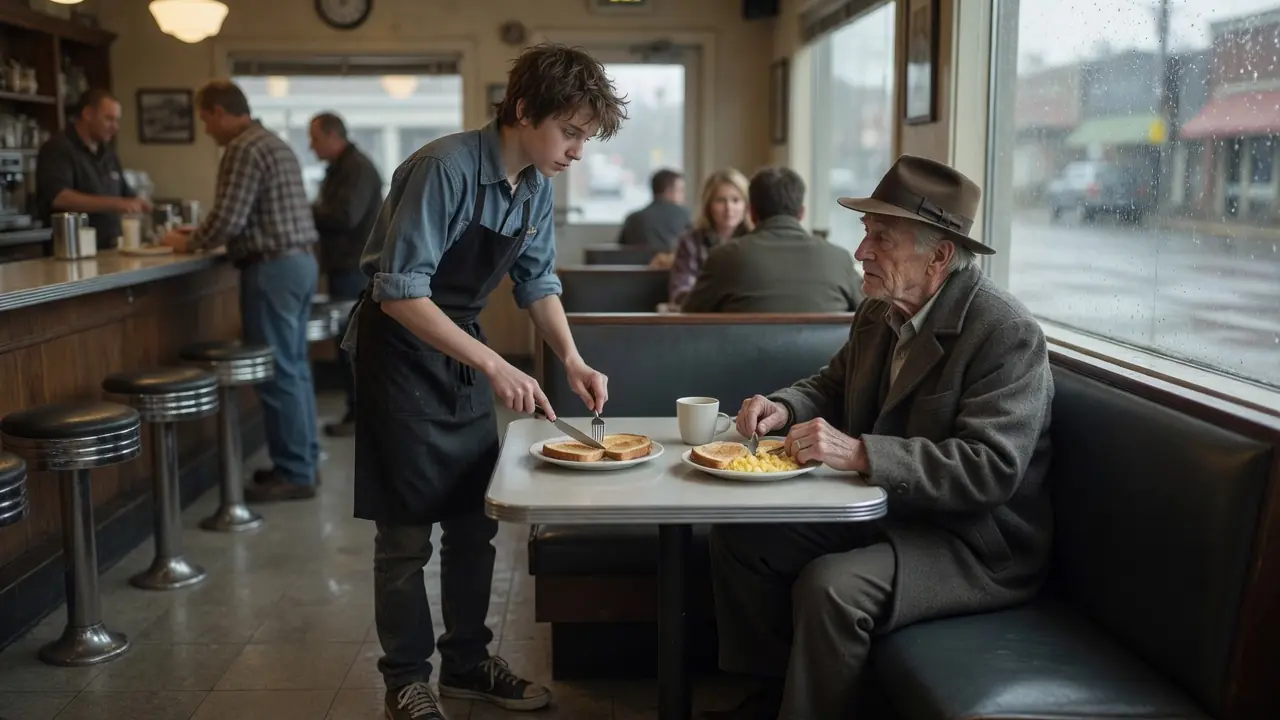
The post office flag hung heavy in the damp air. A few early customers hurried in with collars raised, shaking rain from their coats before settling into booths they had claimed years ago as if by law.
Inside the diner, the smell of fresh coffee, buttered toast, and bacon filled the air. The griddle hissed behind the counter. Forks clinked softly against plates. The old jukebox near the restroom played low country music that nobody had paid for, but nobody complained about either.
Rosie’s Diner was not fancy.
The floor tiles were worn. The vinyl booths had cracks repaired with tape. The coffee mugs did not match. The clock above the register always ran three minutes fast because Rosie claimed it helped people get to work on time.
But to most of Clearwater, Rosie’s was more than a diner.
It was where farmers came before sunrise.
Where teachers graded papers over coffee.
Where truck drivers stopped between routes.
Where widowers sat quietly in window booths because home felt too silent before noon.
And between the tables moved a young waiter named Ethan Carter.
Ethan was only sixteen years old.
He wore a slightly faded blue diner uniform, a white apron tied around his waist, and a pair of worn black sneakers that had already survived too many long shifts. His brown hair was always combed neatly before work, though by noon it usually fell over his forehead from rushing between tables. He had kind eyes, tired shoulders, and the careful manners of a boy who had been forced to grow up faster than he should have.
He was younger than most of the staff, but everyone knew he worked harder than almost anyone there.
His paycheck was small.
His heart was not.
“Table four needs coffee,” Rosie called from behind the counter. “And tell Mr. Bell if he complains about his toast again, he can come back here and make it himself.”
Ethan grabbed the coffee pot with one hand and a plate of eggs with the other.
“Yes, ma’am.”
Rosie Wilson, the owner, was sixty-three, sharp-tongued, soft-hearted, and allergic to laziness. She had hired Ethan six months earlier after seeing him count coins at the grocery store, trying to decide whether his mother’s medicine or dinner was more urgent.
She did not ask too many questions.
She just said, “You know how to carry plates?”
Ethan had said, “I can learn.”
Rosie looked him over and said, “That’s better than most people who think they already know everything.”
By the end of his first week, Ethan had learned the regulars’ orders, how to refill coffee without interrupting conversations, how to balance three plates on one arm, and how to smile even when someone left thirty-seven cents on a twenty-dollar bill.
Every morning at exactly 8:10, an elderly man named Arthur Harris walked through the diner’s glass door.
Most people called him Mr. Harris.
He always wore the same gray overcoat and brown hat, his face lined with years of stories no one else seemed to know. He moved slowly but carefully, using a polished wooden cane with a brass handle. He sat by the window, in the same booth every day, and ordered the same thing.
Black coffee.
Two slices of toast.
Scrambled eggs.
No pepper.
No jelly.
And never orange juice.
“Orange juice is cheerful in a way I don’t trust,” he once told Ethan.
Ethan had laughed, and Mr. Harris looked surprised, as if he had not expected anyone to hear the joke inside the sentence.
Unlike the other customers, Mr. Harris never said much.
His hands trembled slightly when he held his cup. Sometimes he stared out at the rain for minutes at a time, lost somewhere far away in his thoughts. Other mornings, he unfolded an old newspaper and read the same page for half an hour without turning it.
The other servers took his order, set down his plate, and moved on.
They were not cruel.
They were simply busy.
In a diner, quiet people could become part of the furniture if no one was careful.
But Ethan noticed him from his first week.
There was something lonely about Mr. Harris, something that tugged at Ethan in a way he could not explain. Maybe it was the empty seat across from him. Maybe it was the way he always looked at the door when it opened, as if still expecting someone who never came. Maybe it was the way he folded his napkin precisely after eating, then sat for several minutes before leaving, as if gathering strength for the rest of the day.
So Ethan lingered.
He asked how Mr. Harris’s morning was.
He made sure his toast was warm.
He learned that Mr. Harris liked his coffee fresh but not too hot.
Once, when the kitchen made too many slices of apple pie, Ethan slipped him one on the house.
Mr. Harris looked at the pie as if Ethan had placed a diamond on the table.
“I didn’t order this.”
“I know,” Ethan said. “The kitchen made extra.”
“Rosie does not make extra by accident.”
“No, sir.”
“Then this is theft.”
“It’s pie.”
Mr. Harris studied him for a long second.
Then the corner of his mouth moved.
“Pie theft.”
Ethan smiled.
“Yes, sir.”
Mr. Harris ate every bite.
It started as kindness, a simple act, but soon it became routine.
Every morning, Ethan greeted him with a smile and a fresh cup of coffee before he even asked.
“Morning, Mr. Harris.”
“Morning, Ethan.”
“Black coffee?”
“I admire your memory.”
“I admire your consistency.”
That made Mr. Harris smile.
Not widely.
But enough.
Over the weeks, Ethan learned small things about him.
Mr. Harris used to be a teacher. English literature, mostly. He taught for thirty-eight years at Clearwater High School, back when the building still had green chalkboards and students passed notes on paper instead of phones.
He had loved his wife, Eleanor, deeply.
She had died nine years earlier.
They had lived in a small white house just outside town, with blue shutters and a maple tree in the front yard. After Eleanor died, Mr. Harris stayed there alone among books, framed photographs, and memories too heavy to move.
He had two children once.
A daughter named Claire, who passed away young after years of illness.
A son named Robert, who had moved away decades earlier and never really came back. Mr. Harris did not speak about Robert often. When he did, his voice became polite in a way that hurt to hear.
“He chose distance,” Mr. Harris once said, stirring coffee he did not sweeten. “Some people do. It becomes easier the longer they practice.”
Ethan did not know what to say.
So he simply refilled his cup.
For Ethan, who was struggling to hold himself together, Mr. Harris’s quiet company became oddly comforting.
Because Ethan’s life was not easy either.
His mother, Dana Carter, had been sick for nearly two years. Some days were better than others, but even the better days came with pill bottles, appointments, medical bills, and exhaustion that lived in the walls of their small apartment. She had once worked full-time at the town library, shelving books, running children’s reading programs, and remembering every patron’s favorite author.
Now she could barely walk to the kitchen without needing to sit.
Ethan went to school during the day, worked shifts at Rosie’s after class and on weekends, and often did homework late at night beside his mother’s bed. He learned to cook simple meals, argue politely with insurance offices, wash uniforms in the sink when the laundromat cost too much, and pretend he was not scared when his mother asked whether they had enough for rent.
Some nights, he skipped his own dinner and told her he had eaten at work.
Sometimes that was true.
Sometimes it was not.
There were evenings when he sat on the floor of their apartment, staring at overdue notices spread around him like a losing card game, wondering how a sixteen-year-old boy was supposed to hold an entire life together.
But every morning, no matter how tired he was, he greeted Mr. Harris with warmth.
Helping him, even in small ways, reminded Ethan that kindness still mattered.
It reminded him that maybe life was not only struggle, bills, and fear.
One morning in late November, Mr. Harris arrived later than usual.
8:23.
Ethan noticed immediately.
He was wiping down table seven when the bell above the diner door jingled, and Mr. Harris stepped inside, leaning more heavily on his cane than usual. His coat was buttoned wrong, one button slipped into the wrong hole, making the whole front pull unevenly. His hat was damp from fog.
Ethan set down the rag and hurried over.
“Morning, Mr. Harris.”
Mr. Harris blinked at him.
For one strange second, he seemed not to recognize where he was.
Then his eyes focused.
“Ethan,” he said softly. “Yes. Good morning.”
“You okay?”
“I am old. That is rarely a medical emergency.”
Ethan smiled, but worry stayed in his chest.
He helped Mr. Harris to the window booth without making it obvious. That was something he had learned from caring for his mother. People did not always want help announced. Sometimes they just needed a chair pulled out at the right moment.
When Ethan returned with coffee, Mr. Harris was staring at the empty seat across from him.
“My wife used to sit there,” he said.
Ethan paused.
“Mrs. Harris?”
“Eleanor.” His fingers touched the rim of the cup. “She always ordered tea, then complained it was not coffee.”
Ethan sat across from him for just a second, though he knew he was not supposed to.
“What was she like?”
Mr. Harris looked at him with surprise.
Then something softened.
“She corrected my grammar during arguments.”
Ethan laughed.
Mr. Harris continued.
“She sang badly and proudly. She believed every child deserved at least one adult who noticed when they were trying. She planted tulips in colors that clashed horribly and called it joy.”
“She sounds wonderful.”
“She was.” His voice thinned. “She was my best sentence.”
Ethan did not fully understand what that meant, but he felt it.
Rosie called from the counter.
“Ethan, eggs are up.”
He stood quickly.
“Yes, ma’am.”
Before he left, Mr. Harris said, “Thank you for asking.”
Ethan looked back.
“Anytime.”
After that, their conversations grew longer in little pieces.
Not every day.
Some mornings, Mr. Harris was quiet. Some mornings, Ethan was too busy. But slowly, between coffee refills and plates of scrambled eggs, something like friendship formed.
Mr. Harris asked about Ethan’s school.
Ethan admitted he liked history but struggled with chemistry.
Mr. Harris began leaving small notes on napkins.
“Study first principles.”
“Read twice before answering.”
“The comma is a civilized pause.”
Sometimes he corrected grammar on diner menus with a pencil.
Rosie threatened to ban him.
He kept doing it.
Ethan started bringing homework to the diner on Saturday afternoons, and when the lunch rush ended, Mr. Harris would look over essays with a teacher’s eye.
“Your ideas are good,” he told Ethan once. “You rush the ending because you do not trust your own point.”
Ethan frowned.
“Is that an English comment or a life comment?”
Mr. Harris smiled.
“Yes.”
One cold winter morning, when snow had begun falling gently over Clearwater, Mr. Harris did not show up.
Ethan noticed right away.
At 8:10, he glanced at the door.
At 8:15, he looked again.
At 8:30, the booth by the window remained empty.
Something inside him tightened.
“Rosie,” he said, carrying a plate to the counter, “has Mr. Harris called?”
Rosie looked toward the empty booth.
“No.”
“He’s never late unless it rains hard.”
“It’s snowing.”
“He likes snow.”
Rosie’s face changed slightly.
“He’s old, Ethan. Sometimes old folks stay home.”
Ethan nodded, but worry stayed with him all morning.
The next day came.
Still no Mr. Harris.
Ethan asked Mrs. Calloway, who often saw him at the pharmacy.
She had not seen him.
He asked Mr. Bell, who drove past the road where Mr. Harris lived.
Nothing.
On the third morning, during his short break, Ethan stood near the back door with his phone in his hand. He had written down the number for Clearwater Community Hospital from the flyer pinned beside the register.
His thumb hovered over the call button.
Part of him felt foolish.
What if Mr. Harris had simply visited relatives?
What if he was resting?
What if the hospital could not tell him anything?
Then he thought of the empty booth.
He called.
After being transferred twice, he finally said, “I’m not family. I know that. But his name is Arthur Harris. He comes into Rosie’s Diner every morning. He hasn’t come in for three days, and I’m worried.”
The nurse on the other end softened.
“I can’t share much, honey, but yes, Mr. Harris is here. He was admitted after becoming unwell at home. He’s stable.”
Ethan closed his eyes.
“Can he have visitors?”
There was a pause.
“Family only right now.”
Ethan swallowed.
“Oh.”
Then the nurse asked, “What did you say your name was?”
“Ethan Carter.”
Another pause.
When she returned, her voice was gentler.
“He has your name written on a napkin in his coat pocket. It says, ‘If I miss breakfast, tell Ethan I did not choose the banana muffin.’”
Ethan laughed once, but it broke halfway.
The nurse said, “Come after your shift. I’ll see what I can do.”
That evening, after school and work, Ethan walked to the hospital with a blueberry muffin wrapped carefully in a napkin.
The hallways smelled like disinfectant, old coffee, and worry. Nurses moved quickly. Machines beeped behind curtains. Families sat in waiting areas wearing the same expression: hope mixed with fear.
When Ethan reached Mr. Harris’s room, he stopped at the doorway.
Mr. Harris looked smaller in the hospital bed.
His overcoat was gone, replaced by a pale blanket. His hat sat on the chair beside him. His face was tired, his skin thin under the fluorescent lights. But when he turned and saw Ethan, his eyes brightened.
“Well,” Mr. Harris said faintly. “The diner has made a house call.”
Ethan stepped inside.
“I brought you a muffin.”
“Blueberry?”
“Obviously.”
“Good boy.”
Ethan pulled the chair closer and sat awkwardly.
For a moment, neither of them spoke.
Then Mr. Harris looked toward the door.
“No one else came?” Ethan asked before he could stop himself.
Mr. Harris’s expression did not change, but his silence answered.
Ethan looked down at the muffin.
“I’m sorry.”
Mr. Harris sighed.
“Do not be. Some people are better at leaving than returning.”
Ethan did not know what to say to that.
So he did what he knew how to do.
He stayed.
Only for fifteen minutes that first night, because visiting hours were nearly over and his mother needed him. But he told Mr. Harris the diner was quieter without him, that Rosie had threatened to burn the banana muffins in protest, and that his booth was still empty.
Before Ethan left, Mr. Harris reached out.
His hand trembled.
Ethan took it.
“You remembered,” Mr. Harris whispered.
“Of course I remembered.”
For the next week, Ethan visited whenever he could.
Between school, shifts, homework, and helping his mother, he carved minutes from days that already had too few. Sometimes he brought coffee in a paper cup, though the nurses scolded him until he switched to decaf. Sometimes he brought a muffin. Sometimes he brought the newspaper. Sometimes he brought nothing but a few stories from the diner.
He told Mr. Harris about Mr. Bell complaining that his toast was too square.
About Rosie yelling at the new cook for putting parsley on hash browns.
About Mrs. Calloway leaving a thank-you card for him at the booth.
The nurses began to notice.
One of them, Nurse Angela, caught Ethan in the hallway one evening and said quietly, “That boy has a heart older than his age.”
Ethan heard it but pretended he did not.
He did not feel noble.
He felt tired.
He felt scared.
He felt like the world kept giving him people to worry about, and he had no idea how to save any of them.
A week later, Mr. Harris returned to the diner.
The bell above the door jingled at 8:16 on a Thursday morning, and Ethan nearly dropped a coffee pot.
Mr. Harris stood there in his gray overcoat and brown hat. His walk was slower. His hands weaker. But his eyes were softer now, brighter even.
Ethan hurried over.
“Mr. Harris.”
“Ethan.”
“You’re back.”
“So it appears.”
Ethan took his arm carefully.
“I saved your booth.”
“It is public seating.”
“Not to me.”
For once, Mr. Harris did not argue.
Ethan helped him to the window booth, hung his coat properly, and brought his breakfast with extra care.
Black coffee.
Two slices of toast.
Scrambled eggs.
No pepper.
No jelly.
And one blueberry muffin on the side.
Mr. Harris looked at it.
“I did not order this.”
“I know.”
“Pie theft has become muffin theft.”
“Holiday tradition.”
“It is February.”
“Early holiday.”
Mr. Harris smiled.
That morning, he did not say much.
But before he left, he stood beside the register and looked at Ethan for a long moment.
“You remind me of the son I wish I had known better,” he said quietly.
Ethan smiled, not realizing how much that sentence would mean later.
Days turned into weeks.
Things returned to their gentle routine.
Mr. Harris came in at 8:10, though sometimes 8:13. Ethan brought coffee. They talked about essays, old books, weather, and the strange crimes committed daily against scrambled eggs. Ethan’s mother had better days and worse ones. Bills kept coming. School continued. Rosie kept pretending not to notice when Ethan took leftover soup home in a container she had “accidentally” packed too full.
Then, one morning in April, something unusual happened.
It was just past 8:10, and Ethan was refilling sugar containers when the diner door opened.
But it was not Mr. Harris.
Instead, four men in black suits walked in, their presence so sharp it cut through the room’s calm. Behind them came two serious-looking lawyers holding folders, and the entire diner fell silent.
Forks paused halfway to mouths.
The griddle hissed in the sudden quiet.
Rosie stepped out from behind the counter, wiping her hands on a towel.
“Can I help you gentlemen?”
One of the lawyers looked around the diner, then turned toward Ethan.
“Are you Ethan Carter?”
Ethan froze with the sugar container in his hand.
His heart skipped.
“Yes,” he said slowly. “Is something wrong?”
The lawyer’s expression softened.
“We represent Mr. Arthur Harris.”
Ethan’s fingers tightened around the container.
Before he could respond, one of the men handed him a sealed envelope.
The lawyer continued, “Mr. Harris passed away last week. He spoke very highly of you. He wanted us to deliver this personally.”
Ethan’s breath caught in his chest.
The sound of dishes, the hum of chatter, the sizzling griddle, everything around him faded into silence.
He could barely hear himself whisper, “He passed away?”
The lawyer nodded, his tone gentle now.
“I’m sorry.”
Ethan gripped the edge of the counter.
“No. He was here last week.”
“Yes,” the lawyer said. “He passed peacefully at home three days later.”
Ethan looked toward the empty booth by the window.
The coffee mug he had placed there out of habit suddenly looked unbearable.
Rosie came around the counter and placed a hand on Ethan’s shoulder.
The lawyer waited respectfully.
Then he said, “Mr. Harris left something for you.”
Ethan stared at the envelope.
“For me?”
“Yes.”
“I don’t understand.”
“You will.”
His hands trembled as he opened it.
Inside was a handwritten letter and a folded legal document.
The handwriting was unmistakable.
Precise.
Slanted.
Teacherly.
Dear Ethan,
If you are reading this, then I have finally missed breakfast permanently. Do not let Rosie serve banana muffins in my memory. That would be an insult to both of us.
Ethan laughed once through the tears already forming.
Then he kept reading.
I have spent many years being old. That may sound obvious, but being old and being alive are not always treated as the same thing. People look past you. They speak around you. They assume your story has ended because your steps are slower.
You did not do that.
You saw me.
You remembered my coffee. You warmed my toast. You asked about Eleanor when others avoided the subject. You brought muffins to a hospital room when no one else came. You gave me mornings that felt less empty.
Do not tell yourself these were small things.
To a lonely man, small kindnesses are not small.
You once said you were only a waiter. I want you to know that in my last year, you were more than that. You were proof that goodness can still arrive wearing an apron and worn-out sneakers.
I know about your mother. Not because you complained, but because worry has a shape, and you carried it every day. I saw you working harder than any sixteen-year-old should. I saw you skipping meals. I saw you trying to be a man before the world had finished letting you be a boy.
I cannot fix everything. No one can.
But I can open one door.
Please accept what I have arranged, not as payment, but as gratitude.
Thank you for making an old teacher feel remembered.
Arthur Harris
Ethan could not read the last line aloud.
His vision blurred.
Rosie took the letter gently and finished reading silently, her own eyes shining.
The lawyer unfolded the legal document.
“Mr. Harris arranged for his house to be placed in a trust for you until you turn eighteen,” he explained.
Ethan blinked.
“What?”
“Because you are still a minor, you cannot directly receive the property outright at this time. So Mr. Harris created the Harris-Carter Trust. The home will be held for your benefit until you become an adult. Your mother may live there with you immediately if she chooses.”
Ethan stared at him.
The diner was silent.
The lawyer continued.
“He also left a sum of money to assist with your mother’s medical bills, housing costs, and your education. The funds will be managed by a trustee and used only for approved needs: healthcare, school, housing, transportation, and basic support.”
Ethan shook his head slowly.
“No. That can’t be right.”
“It is right.”
“I only brought him coffee.”
The lawyer looked toward the empty booth by the window.
“To him, it was never only coffee.”
A sound escaped Ethan’s throat.
Not quite a sob.
Not quite a word.
Rosie pulled him into a hug, and for once, he did not try to pretend he was fine.
The regular customers, who had quietly watched the exchange, sat in stunned silence.
Mr. Bell removed his cap.
Mrs. Calloway wiped her eyes with a napkin.
The old man who had sat in that corner booth for months, quietly sipping coffee, had left behind a legacy of gratitude for the one person who had cared enough to notice him.
That afternoon, after school, Ethan and his mother met the lawyers at Mr. Harris’s house.
The house sat just outside town at the end of a narrow road lined with maple trees. It was small, white, and neat, with blue shutters, a brick walkway, and a porch swing that moved slightly in the spring breeze. Tulips bloomed in wild, mismatched colors along the front path.
Dana Carter stood beside Ethan, one hand pressed to her chest.
She looked tired, as she often did, but there was something else in her face too.
A kind of stunned hope she seemed afraid to trust.
“This is too much,” she whispered.
Ethan looked at the porch.
“He said he wanted us to be safe.”
The lawyer unlocked the door.
Inside, the house smelled like old books, lemon polish, and time. Sunlight poured through lace curtains. Bookshelves lined the living room walls. Framed photographs sat on the mantel: Mr. Harris as a young teacher; Eleanor in a yellow dress; a little girl missing two front teeth; a teenage boy in a graduation gown; students crowded around a classroom desk; a black-and-white wedding photo.
Ethan moved slowly through the rooms.
The worn armchair by the window.
The desk covered in papers.
The kitchen table set for one.
The bedroom with a quilt folded carefully at the foot of the bed.
It was not a rich person’s house.
It was a loved house.
A house that had waited.
On the desk, Ethan found a framed picture he had never seen before.
It was of him and Mr. Harris at the diner, taken by another customer one morning when they were laughing over spilled coffee. Ethan remembered the day. He had overfilled the mug, and Mr. Harris had said, “Ambition is admirable, but coffee respects boundaries.”
Someone had captured them both smiling.
Mr. Harris had framed it.
Ethan picked it up carefully.
His mother stood beside him, one hand over her mouth, tears in her eyes.
“He must have loved you very much,” she whispered.
Ethan shook his head, crying silently.
“I didn’t do anything big.”
His mother placed a hand on his shoulder.
“Maybe to him, you did.”
The trust did not solve everything overnight.
Life rarely moves that cleanly.
There were papers to sign. Court approvals. Medical bills to verify. A trustee to meet. Ethan had to keep going to school, keep working reduced shifts, and keep helping his mother move carefully into a house that felt like both a gift and a responsibility.
Some people in town were happy for him.
Others whispered.
That was how towns worked.
A few said a sixteen-year-old boy should not receive a house for serving breakfast. Some suggested Mr. Harris had been confused. One distant nephew appeared suddenly, claiming Arthur Harris had “always intended” to leave the property to blood family.
The lawyers handled it.
Mr. Harris had prepared everything carefully.
He had medical evaluations proving he was competent when the documents were signed. He had written letters explaining his decisions. He had left specific statements about family members who had not visited, called, or assisted him for years.
In one letter, he wrote:
Blood without presence is only biology. Family is who shows up.
The nephew disappeared after that.
Ethan read that sentence many times.
Family is who shows up.
The first night Ethan and his mother slept in Mr. Harris’s house, neither of them slept much.
Dana took the downstairs bedroom because stairs were difficult for her. Ethan took the small room upstairs that had once belonged to Mr. Harris’s son, Robert. The room still had a built-in shelf, an old desk, and a window overlooking the maple tree.
Ethan lay awake under a quilt that smelled faintly of cedar.
For the first time in years, he did not hear traffic outside.
He did not hear the neighbor’s television through thin apartment walls.
He did not hear the hum of their old refrigerator struggling.
He heard wind in the tree.
The soft creak of the house settling.
His mother coughing once downstairs, then quieting again.
Safe, he thought.
The word felt unfamiliar.
In the morning, Ethan found a note taped inside the kitchen cabinet.
Arthur’s handwriting.
If you found this, you are making breakfast in my kitchen. Good. The coffee is in the tin. Do not trust the decaf unless advised by medical professionals or cowards.
Ethan laughed so hard his mother called from the bedroom to ask if he was all right.
“I’m okay,” he called back.
And for once, he meant it.
Over the next few months, Ethan changed in small ways.
He still worked at Rosie’s, but fewer shifts. Rosie insisted.
“You’re going to graduate,” she said, pointing a spatula at him. “I didn’t hire you so you could become a permanent exhausted ghost.”
“I need money.”
“You have support now.”
“I don’t want to be lazy.”
“Rest is not laziness. It’s maintenance. Ask any mechanic. Ask any nurse. Ask any toaster.”
“Toaster?”
“I panicked. The point stands.”
Ethan kept working mornings on weekends and two evenings after school. He still served coffee. He still refilled sugar containers. But now, when he passed Mr. Harris’s old booth, he paused.
Rosie never sat anyone there before 9:00.
Not officially.
She simply placed a small reserved sign on it each morning until 8:30.
When customers asked, she said, “Regular.”
And that was that.
Ethan brought fresh flowers from Mr. Harris’s garden once a week and placed them on the booth. Tulips in spring. Daisies in summer. Red leaves in a jar in autumn. During winter, he placed a folded newspaper there, even though no one read it.
He continued school.
With the pressure at home eased, his grades improved. His English teacher noticed first.
“You’re writing differently,” she said after class.
“Better?”
“More honestly.”
Ethan thought of Mr. Harris.
Your ideas are good. You rush the ending because you do not trust your own point.
He stopped rushing.
In his senior year, Ethan wrote an essay about old people in small towns and how easily they became invisible. He wrote about diners, hospitals, empty booths, and the power of remembering one person’s coffee order. The essay won a statewide scholarship.
When he received the letter, he drove straight to the cemetery.
Mr. Harris was buried beside Eleanor beneath a maple tree on a gentle hill. Ethan stood in front of the stone with the scholarship letter in his hand.
“I think you would correct the second paragraph,” he said.
The wind moved softly through the grass.
“But I won anyway.”
He folded the letter and smiled through tears.
Dana’s health improved slowly, not perfectly.
The trust paid for better treatment, transportation, and regular care. There were still difficult days. Still appointments. Still fear. But fear no longer owned every room.
Sometimes Dana sat on the porch swing in the evenings while Ethan watered Eleanor’s chaotic tulips.
“Mr. Harris planted these?” Ethan asked once.
Dana smiled.
“I think Eleanor did. No man with his grammar would choose colors this disorganized.”
Ethan laughed.
They kept the tulips exactly as they were.
Two years passed.
On Ethan’s eighteenth birthday, the trustee and lawyer met him at the same kitchen table where Mr. Harris had once eaten dinner alone.
The house formally became his.
Not as a burden.
As a legacy.
The lawyer slid the final document across the table.
“Mr. Carter, Mr. Harris left one additional letter for this day.”
Ethan took it slowly.
Dear Ethan,
If you are reading this, you are eighteen. I hope you have grown taller, wiser, and less inclined to overfill coffee cups.
This house is yours now, but I ask one thing.
Do not treat it as a trophy.
Treat it as a shelter.
Homes are not valuable because of what someone would pay for them. They are valuable because of who becomes safe inside them.
If someday you do not need this house, let it help someone who does.
And remember this: kindness is not small just because it is quiet.
With gratitude,
Arthur Harris
Ethan pressed the letter to his chest.
That sentence followed him into adulthood.
Kindness is not small just because it is quiet.
Years later, after Ethan graduated college with a degree in education, he returned to Clearwater.
People expected him to sell the house.
He did not.
Instead, he became an English teacher at Clearwater High School, in the same classroom where Arthur Harris had once taught. The first day Ethan walked into that room, he stood before the chalkboard and let the silence settle over him.
On the corner of his desk, he placed a framed photograph.
Him and Mr. Harris laughing over spilled coffee.
His students asked about it.
Ethan told them the truth.
“That man taught me that noticing people can change a life.”
“Was he your grandfather?” one student asked.
Ethan smiled.
“Not by blood.”
“What then?”
Ethan looked at the photo.
“By breakfast.”
The class laughed, but Ethan meant it.
He kept teaching.
He kept the house.
And every Saturday morning, he volunteered at Rosie’s Diner during the breakfast rush, not because he needed the money, but because Rosie said retirement was for people who had lost arguments with time, and she had not lost yet.
At 8:10 each Saturday, Ethan set a cup of black coffee at the window booth.
Not for a customer.
For memory.
Sometimes lonely people sat there after 8:30.
Older widows.
Travelers passing through.
Teenagers who looked hungry but ordered only water.
Men who stared out the window too long.
Ethan always noticed.
He would bring coffee.
Or toast.
Or pie if Rosie claimed there was extra.
Years later, the old Harris house became exactly what Arthur had asked it to be.
A shelter.
Not officially at first.
It began when one of Ethan’s students, a quiet boy named Lucas, needed somewhere safe to study after school because home was loud and unstable. Ethan let him use the kitchen table. Then another student came. Then a neighbor recovering from illness needed help with meals. Then Rosie sent over a young waitress who needed advice about college applications.
The house filled with life.
Books.
Homework.
Soup.
Conversations.
Tulips in impossible colors.
Eventually, Ethan turned part of the house into a small community study center named The Harris Room. Students came there for tutoring, meals, college applications, and quiet. Elderly neighbors came once a week for coffee and conversation. Nobody had to prove they were lonely. They only had to show up.
Above the doorway, Ethan hung a wooden sign with words from Mr. Harris’s letter.
Kindness Is Not Small Because It Is Quiet.
Every person who entered saw it.
One rainy morning, many years after the lawyers first walked into Rosie’s Diner, Ethan stood in the doorway of the Harris house watching students gather around the kitchen table. His mother sat in the living room, older now but smiling, helping a girl practice reading aloud. Rosie had brought cinnamon rolls. The tulips outside were blooming in colors that still made no sense together.
A boy at the table raised his hand.
“Mr. Carter?”
“Yes?”
“Why do you help everybody so much?”
Ethan looked at the framed picture on the mantel.
A sixteen-year-old waiter.
An old man with gentle eyes.
Coffee spilled between them.
Then he looked back at the boy.
“Because someone once taught me that being noticed can save a person.”
The boy nodded as if that made perfect sense.
And maybe it did.
Ethan walked to the kitchen and poured coffee into two mugs. One for himself. One he placed near the window, beside the old folded newspaper that had belonged to Mr. Harris.
Outside, rain tapped gently against the glass.
The sound reminded him of another gray morning in Clearwater, when life moved slowly, faces were familiar, and a lonely old teacher walked into a diner at 8:10.
Ethan had only been sixteen then.
A boy in a faded blue uniform.
A boy with worn sneakers, tired eyes, and bills waiting at home.
He thought he was only bringing coffee.
He thought he was only warming toast.
He thought he was only being polite to an old man everyone else had learned to overlook.
But kindness, he learned, has a way of traveling farther than we can see.
Sometimes it returns as a letter.
Sometimes as a home.
Sometimes as a future.
Sometimes as a room full of people who are safe because one lonely man was once made to feel remembered.
As the morning light softened through the rain, Ethan touched the photograph gently and whispered, “Thank you, Mr. Harris.”
Then he turned back toward the voices in the kitchen.
There was work to do.
Coffee to pour.
Students to help.
People to notice.
And every time he carried a warm mug to someone sitting alone, Ethan remembered the greatest lesson Arthur Harris ever taught him:
Love does not always arrive loudly.
Sometimes it comes in quietly, wearing an apron, carrying toast, and asking an old man how his morning is going.