The first thing Emily Carter noticed was not that the boy was crying.
It was that everyone else had stopped seeing him.
The Maple Street Diner was usually loud on Friday evenings. Plates clattered against old wooden tables. Coffee cups touched saucers with sharp little clicks. Families talked over one another because that was how families sounded when they were hungry, tired, and glad to be out of the house at the same time.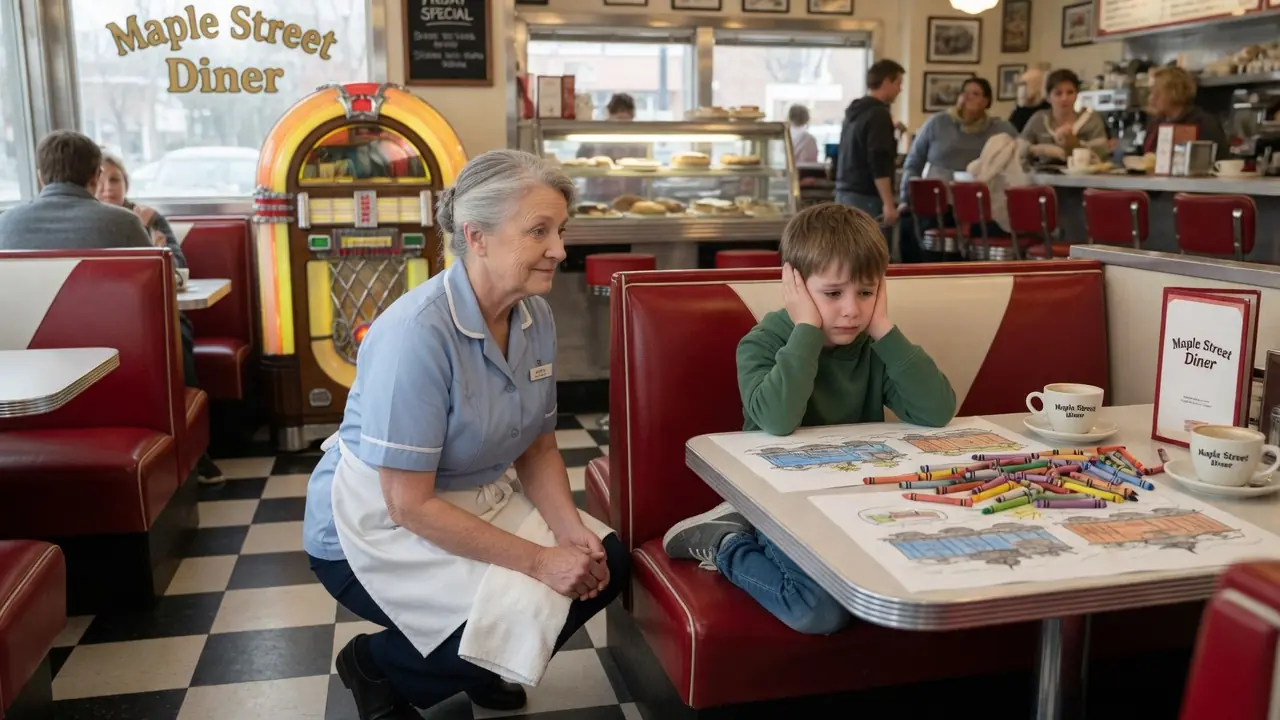
Children laughed near the window booths. A cook shouted order numbers through the pass-through. The old jukebox in the corner played songs that were always slightly too loud because nobody had bothered fixing the volume knob since 1998.
Emily had worked there for twelve years.
She knew noise.
She knew customers.
She knew the rhythm of dinner rush, the way impatience rose with hunger, the way kindness appeared in small tips and disappeared in complaints about cold fries. She knew how to carry six plates up one arm, refill coffee without interrupting a conversation, and smile at people who treated her like part of the furniture.
Most of all, she knew the difference between someone being difficult and someone being overwhelmed.
That was why she noticed the boy.
He sat alone at the end booth near the front window, half-hidden by the vinyl seat back and the reflection of the streetlights on the glass.
Maybe eight years old.
Maybe nine.
His hands were pressed tightly over his ears. His shoulders were pulled upward until they nearly touched his jaw. His eyes were squeezed shut, and his mouth opened and closed around breaths that came too fast.
A small paper cup of crayons had spilled across the table.
Red, blue, green, yellow, black, and purple rolled near his elbow, but he did not seem to notice.
His menu lay open in front of him, untouched. A kid’s placemat with a maze and a cartoon hamburger sat crooked under his arm. Someone had placed a glass of water beside him, but the ice had already begun to melt.
Around him, people whispered.
Not loudly.
That would have been too honest.
They whispered in the way people did when they wanted to pretend their judgment was concern.
“He’s been crying forever.”
“Where are his parents?”
“Why doesn’t his mother do something?”
“Maybe he’s spoiled.”
“Some people shouldn’t bring kids out if they can’t control them.”
Emily hated that sentence.
Control.
People used it when they did not understand.
They used it when a child’s pain inconvenienced them. They used it when they wanted the world to return to comfortable noise instead of uncomfortable truth. They used it when they thought a child should become quiet for the sake of strangers who had no interest in helping.
Emily was forty-four years old, with tired feet, strong hands, and a face that had learned to look gentle even when the world made her angry. Her brown hair was pinned in a loose knot at the back of her head, and her black Maple Street Diner apron was faded from years of washing.
She had seen enough children cry to know when tears were manipulation and when tears were the body’s last attempt to say, I cannot do this anymore.
This was not a tantrum.
This was a storm.
Emily glanced toward the counter.
Her manager, Ruth, was arguing with a delivery driver near the back door. Marco, the cook, was scraping something off the grill and muttering to himself. None of the other waitresses had reached the boy’s section yet because Friday nights at Maple Street moved like a machine, and machines were not built to notice one child falling apart in booth seven.
Emily grabbed a clean towel from behind the counter and walked over.
She did not rush.
Rushing made people feel chased.
She approached the booth slowly, from the side, not directly in front of him.
The boy’s breathing was fast.
Too fast.
His fingers pressed hard against his ears, and his face had gone blotchy from crying.
Emily crouched beside the booth, but she did not touch him.
She had learned that.
Never assume touch helps.
Sometimes touch was another loud sound.
“Hi,” Emily said softly.
No response.
“That’s okay.”
She sat on the floor a few feet away from the booth, careful to leave space between them.
A woman at the next table raised her eyebrows.
Emily ignored her.
The boy opened his eyes briefly.
Emily smiled.
Not too big.
Not the bright waitress smile she used for customers who wanted service with cheerfulness.
Just enough to show she was there and not angry.
“My name is Emily,” she said.
The boy looked away.
“That’s a good name,” she continued. “My grandmother had a cat named Emily.”
A tiny pause.
Then the boy looked back.
Emily nodded seriously.
“She was a very dramatic cat.”
The boy’s crying slowed slightly.
Not because the joke was funny.
Because Emily was not demanding anything from him.
She was not asking him to stop.
She was not asking him to behave.
She was not asking him to explain.
She was simply there.
The boy’s eyes moved toward the fallen crayons.
Emily noticed.
“Do you like drawing?”
A small nod.
“What do you draw?”
Another pause.
Then he whispered, so quietly she almost missed it.
“Trains.”
Emily looked at the crayons.
“Excellent choice.”
The boy looked at her.
“Trains are important.”
Emily nodded.
“Very important.”
“They have schedules.”
“They do.”
“They have tracks.”
“They definitely do.”
“And they know where they’re going.”
Something about that sentence made Emily’s chest tighten.
Because she understood.
Sometimes people just wanted the world to have tracks.
Sometimes a child wanted a path clearly marked, a destination named, a rhythm that could be trusted. Sometimes the world was too loud, too bright, too unpredictable, and all anyone could wish for was a train line on a map that said: here, then here, then here.
Emily sat on the floor beside booth seven and let the diner move around them.
She did not tell him to come out.
She did not tell him to use his words.
She did not ask him where his parents were right away, even though the question had already begun to worry her.
She reached slowly toward the closest crayon.
The boy stiffened.
Emily stopped.
“Can I move the blue one closer to you?”
He stared at the crayon.
Then gave the smallest nod.
Emily picked up the blue crayon with two fingers and placed it near the edge of the table, where he could reach it without stretching.
Then she moved the black one.
Then the green.
Each time, she asked first.
Each time, he watched carefully.
Each time, the world became a little more predictable.
“What kind of trains?” Emily asked.
The boy swallowed.
“Passenger trains.”
“Fast ones?”
“Some are fast.”
He hesitated.
“Some have sleeping cars.”
“That sounds useful.”
“You can go far away and still have a bed.”
Emily’s throat tightened again.
She had worked in diners long enough to know children said more than they meant to sometimes.
Especially when they were talking about something else.
The boy reached toward the placemat. His fingers hovered over the maze.
Emily slid the crayons closer, one by one, always slowly.
The boy picked up the black crayon and drew a line across the placemat.
Not random.
Track.
Then another.
Then a rectangle.
Then windows.
A train began to appear.
At the next booth, a man sighed loudly.
Emily turned her head and looked at him.
Not sharply.
Not rudely.
Just directly.
The man looked down at his menu.
The boy kept drawing.
The Maple Street Diner returned to its noise around them, but Emily noticed something had changed. The sound near booth seven had softened, not because the diner was quieter, but because she had created a small pocket of safety inside it.
She reached behind her and turned the jukebox volume down two notches.
Nobody complained.
The boy noticed.
His shoulders lowered.
“What’s your name?” Emily asked gently.
He did not answer at first.
That was all right.
Emily had time.
She was supposed to be taking orders from two new tables, refilling coffee at the counter, and checking whether table twelve still wanted extra ranch.
But some moments were more important than ranch.
The boy drew three train cars before he said, “Noah.”
Emily smiled.
“Noah. That’s a strong name.”
“It means rest.”
Emily blinked.
“Does it?”
“Yes.”
“That’s a good meaning.”
Noah looked down at the train.
“I’m not good at rest.”
Emily almost smiled, but something stopped her.
There was too much truth in the sentence.
“Some people need help finding it,” she said.
Noah colored the train windows blue.
For the first time, his breathing seemed almost normal.
The young couple seated nearby had been watching the whole time. The woman leaned toward Emily as she stood to get a glass of water.
“You’re good with him,” the woman whispered.
Emily shook her head.
“No.”
The woman looked surprised.
Emily smiled slightly.
“I’m just patient.”
There was a difference.
Patience did not mean magic.
It did not mean knowing the perfect thing to say.
It meant refusing to make someone else’s struggle about your own discomfort.
It meant waiting without resentment.
It meant believing there was a person inside the overwhelm, even when that person could not make themselves easy for you.
Emily brought Noah a fresh water cup with no ice because she had noticed he flinched whenever ice shifted in a glass.
“Water,” she said, placing it at the far edge of the table. “No ice.”
Noah looked at it.
Then at her.
“Thank you.”
“You’re welcome.”
She did not make the moment bigger than it was.
That mattered too.
Some children were praised until praise became pressure.
Noah sipped the water.
Emily used the quiet moment to look around the diner.
No adult seemed to be watching him.
No frantic mother.
No father at the counter.
No older sibling pretending not to be worried.
A small concern that had been sitting low in her stomach began to rise.
“Noah?”
He looked up from the drawing.
“Where is your dad?”
The question changed his face.
Not fear.
Confusion.
He looked toward the door.
“He was parking.”
Emily kept her expression calm.
“How long ago?”
Noah looked at the drawing.
“Before the train.”
Before the train.
Emily glanced at the clock above the pie case.
7:42 p.m.
She had first noticed him at around 7:00.
Forty minutes, maybe more.
“Was he coming inside with you?” she asked.
“Yes.”
“Did you walk in first?”
Noah’s fingers tightened around the crayon.
“The rain was loud. The car horn was loud. Dad said wait by the door, but the door opened and people were behind me. I moved.”
Emily nodded slowly.
“Then you found the booth.”
“It had a window.”
“Windows help?”
“Sometimes.”
“Okay.”
She stood slowly, making sure not to move too quickly.
“I’m going to check something at the counter. I’ll still be right there.”
Noah looked at her.
“You’re leaving?”
“Only to the counter. See?”
She pointed.
“Five steps. Maybe six because I’m tired.”
Noah looked at the counter.
Then back at her.
“Okay.”
Emily walked to Ruth, who had finally finished arguing with the delivery driver.
“Do you know anything about the boy in booth seven?”
Ruth looked over.
“The crying kid?”
Emily’s mouth tightened.
“The boy in booth seven.”
Ruth softened.
“No. I thought he was with the party near the window.”
“He isn’t.”
Ruth’s face changed.
Emily turned to Marco at the pass-through.
“Did you see a man come in with him?”
Marco frowned.
“Dark-haired kid? No. I saw him come through the door when that big group came in. Thought he belonged to them.”
Emily looked toward the door.
Rain slid down the glass in long lines.
A terrible thought entered her mind.
What if his father was outside somewhere?
What if he had fallen?
What if he had left?
No.
She pushed the last thought away.
Noah did not look abandoned.
He looked misplaced.
There was a difference, and Emily trusted differences.
She reached for the diner phone and called the non-emergency police line.
Before she could finish dialing, the phone rang in her hand.
Unknown number.
She answered quickly.
“Maple Street Diner, this is Emily.”
A man’s voice came through, breathless and shaking.
“Is this Maple Street Diner?”
“Yes.”
“Is there a boy there? His name is Noah? Noah Brooks. He’s eight. Brown hair, blue jacket, he may be crying, he may not answer right away. Please, is he there?”
Emily looked toward booth seven.
Noah was under the table now, but calm, drawing on the placemat with the crayons arranged in a perfect row.
“Yes,” she said. “He’s here. He’s safe.”
The voice changed immediately.
Relief.
Fear.
Exhaustion.
A sound came through the line that might have been a sob if the man had allowed it to become one.
“I’m his father.”
Emily closed her eyes for one second.
“Mr. Brooks, he is safe. He’s in a booth near the front window. He’s drawing trains.”
“Oh God,” the man whispered. “Oh God. I’ve been looking everywhere.”
“Where are you?”
“I’m outside. I’m coming in now.”
Ten seconds later, the diner door opened so hard the bell above it rang wildly.
A man rushed inside.
Early forties.
Dark jacket soaked at the shoulders.
Messy hair.
Panic written across his face.
His eyes scanned the diner with the terror of a parent who had spent the last hour imagining every possible version of loss.
“Noah!”
The boy looked up from under the table.
“Dad.”
The man crossed the diner and dropped beside the booth so fast one knee hit the tile. He did not seem to feel it.
“I’m sorry,” he said, his voice breaking. “I’m so sorry, buddy.”
Noah did not move away.
He just looked at him.
The father held out his hands, palms open.
“Can I hug you?”
Noah considered it.
Then nodded.
Daniel Brooks hugged his son carefully, not tightly, not suddenly, but with the kind of control that came from love practiced through learning. He pressed his face against Noah’s hair and closed his eyes.
For a moment, the diner disappeared around them.
Then Daniel looked at Emily.
“You’re the waitress?”
Emily nodded.
“I’m Emily.”
The man stood slowly.
“I’m Daniel Brooks.”
His eyes moved around the diner.
The crayons.
The drawing.
The lowered music.
The water cup without ice.
The quiet corner Emily had created without calling it one.
Then he looked back at her.
“What did you do?”
Emily frowned slightly.
“I sat with him.”
Daniel stared.
“That’s all?”
“That’s enough sometimes.”
For a moment, he looked like he might cry.
“I was parking the car,” he said quietly. “The rain was heavy. There was a delivery truck blocking the back lot. I told Noah to wait by the entrance while I pulled around. I thought he was right by the door.”
He swallowed.
“I looked away for maybe thirty seconds.”
Emily nodded.
“When I came back, he was gone.”
“He found the booth.”
“I checked the sidewalk. The bathrooms. The arcade next door. I thought…” He stopped. His face tightened. “I thought someone had taken him.”
Emily’s expression softened.
“No. He came inside.”
Daniel looked at Noah.
“He usually doesn’t talk to strangers.”
Emily smiled.
“He didn’t.”
That surprised him.
“He didn’t?”
“No.”
“What did he say?”
Emily looked at Noah.
The boy was drawing again, sitting on the booth seat now, his father close beside him.
“He told me trains know where they’re going.”
Daniel’s face changed.
Because that sentence meant something.
“He loves trains,” Daniel whispered.
“I noticed.”
“He says things like that when he’s overwhelmed.”
Emily looked at him.
“Why?”
Daniel swallowed.
“Because he likes things that make sense.”
The diner became quiet in that strange way public places sometimes do when people are pretending not to listen.
Daniel looked exhausted.
Not from today.
From years.
Years of explaining.
Years of protecting.
Years of watching people misunderstand his son.
“He’s autistic,” Daniel said softly.
Emily nodded.
“I figured.”
Daniel looked surprised.
“How?”
“You listened to him,” she said.
That answer seemed to hit him harder than expected.
Most people looked at Noah and saw a problem to solve.
Emily had looked at him and seen a person.
Daniel sat down in the booth. His hand rested on the table, close enough that Noah could touch him if he wanted, not so close that Noah had to.
“I should have been here,” Daniel said.
Emily shook her head.
“Don’t do that.”
“What?”
“Turn one scary moment into a reason to punish yourself.”
Daniel looked down.
“That’s easier said than done.”
“Most useful things are.”
Noah suddenly pushed his drawing across the table.
Emily looked.
A train.
Three cars.
A small person standing beside it.
She smiled.
“Is that you?”
Noah nodded.
“Is this your dad?”
Another nod.
“And this?”
He pointed to the third figure.
Emily looked at him.
“Who is that?”
Noah thought.
Then said, “Someone who waited.”
Emily looked at Daniel.
Neither of them spoke.
The words were too simple to answer.
Daniel tried to pay for Noah’s untouched dinner, the water, the crayons, and anything else Emily could possibly charge him for.
Emily refused.
“It’s just a drawing and a conversation.”
“It was more than that.”
“It was Friday.”
“It wasn’t.”
She smiled.
“Come back for dinner another day.”
Daniel looked surprised.
“That’s your price?”
“Yes.”
“What’s the catch?”
“You have to let me see the train drawings.”
Noah looked up immediately.
“I have more.”
Emily smiled.
“Then I guess I’ll have to see them.”
Before leaving, Daniel helped Noah put the crayons back into the paper cup. Noah did it by color order, then changed the order twice until it felt right.
Emily waited.
Daniel noticed.
He noticed that she did not rush him.
That she did not say, “Come on, buddy.”
That she did not look at the clock.
That she understood, somehow, that leaving also required tracks.
When Daniel and Noah finally walked out into the rain, Noah turned back once.
“Emily?”
“Yes?”
“Trains are not lost when they stop.”
Emily felt something deep in her chest shift.
“No,” she said gently. “They’re just waiting for the track to clear.”
Noah nodded.
Then he left with his father.
The next morning, Emily arrived at the diner at six.
The sky was pale and damp after the storm. The sidewalks still shone with rain, and the neon Maple Street Diner sign buzzed weakly above the front windows.
Emily unlocked the door and stepped inside, expecting another ordinary shift.
Coffee.
Orders.
Cleaning.
Ruth complaining about suppliers.
Marco burning the first toast of the day and blaming the toaster like he always did.
Instead, when she turned on the front lights, someone was already waiting outside.
Daniel.
Holding a folder.
Emily stopped.
“You’re early.”
“I know.”
“People usually wait until at least coffee before serious conversations.”
He smiled slightly.
“I brought coffee.”
He held up two cups.
She accepted one.
“Smart.”
She unlocked the door fully and let him in.
The diner was quiet in the early morning, almost holy in its stillness. No jukebox. No clattering plates. No impatient customers. Just the hum of refrigerators and the faint smell of yesterday’s coffee grounds.
Daniel stood near the counter and looked around.
Without the crowd, the diner seemed smaller.
Older.
Kinder.
Emily set her bag under the register.
“What happened?”
Daniel looked down at the folder.
“I wanted to thank you properly.”
“You already did.”
“No.”
He opened the folder.
Inside were photographs.
Noah drawing.
Noah smiling.
Noah building train models.
Noah asleep on a couch with a book about locomotives open on his chest.
And one picture from the diner.
Noah sitting in booth seven.
Calm.
Safe.
Emily touched the edge of the photo.
“Did you take this last night?”
Daniel nodded.
“After I came in. I don’t usually take photos when he’s overwhelmed. It feels wrong. But he looked so peaceful there, and I wanted to remember that it happened.”
Emily looked at the picture.
She had not known.
Daniel continued.
“That’s the first time in months he went somewhere new without leaving completely shut down.”
Emily’s eyes lifted.
“Really?”
“Yes.”
He closed the folder halfway, then opened it again, as if he needed the photos visible to say the rest.
“My son doesn’t need people to fix him.”
Emily nodded.
“He needs people to understand him.”
“Yes.”
A pause.
“And yesterday, you did.”
Emily looked away.
She did not know what to say to that.
Compliments made her uncomfortable when they touched something real.
Customers thanked her all the time for coffee refills, fast service, extra napkins, pies warmed properly, or letting them stay too long after closing. Those thanks were easy.
This was different.
This was a father telling her that for one hour, she had helped carry something he carried every day.
Daniel closed the folder.
“I also wanted to ask something.”
“What?”
“Would you come speak at a parent group?”
Emily laughed softly.
“Me?”
“Yes.”
“I’m a waitress.”
“No.”
Daniel shook his head.
“You’re someone who noticed my son.”
That was different.
Emily crossed her arms.
“Daniel, I don’t know anything about leading a parent group.”
“You don’t have to lead it.”
“I’m not an expert.”
“I don’t need an expert.”
“What do you need?”
He looked toward booth seven.
“I need people to know what it looks like when someone tries.”
Emily followed his gaze.
The booth was empty now, the table wiped clean, the crayons back in a cup near the register.
She thought of Noah under the table, hands over his ears, trying to survive a world too loud for him.
Then she thought of the people whispering.
Control your kid.
She looked back at Daniel.
“What would I say?”
“The truth.”
“That sounds dangerous.”
“It usually is.”
Emily almost smiled.
Daniel lowered his voice.
“There are parents in that group who are tired, Emily. Good parents. Loving parents. Parents who have been stared at, judged, corrected, and blamed in grocery stores, churches, schools, restaurants, airports, sidewalks. They need to hear that someone outside their world can learn to see their children differently.”
Emily was quiet.
Daniel added, “And maybe you need to hear that what you did mattered.”
That was unfairly effective.
Emily took a sip of coffee to give herself time.
Then she said, “I’ll come once.”
Daniel smiled.
“That’s all I’m asking.”
“One time. And I’m not giving a speech.”
“Understood.”
“I hate speeches.”
“Noted.”
“And if there are snacks, I’m sitting near them.”
Daniel laughed.
For the first time, Emily saw what he looked like when fear was not holding his face hostage.
Younger.
Softer.
Still tired, but not only tired.
“One time,” she repeated.
“One time,” he said.
It did not stay one time.
The parent group met in the basement of a community center beside the public library. The room had folding chairs, too-bright lights, a coffee pot that had seen better decades, and a bulletin board covered with flyers for occupational therapists, speech services, sensory-friendly movie screenings, and school advocacy workshops.
Emily arrived wearing her diner uniform because she had come straight from work.
She almost turned around at the door.
Then Noah saw her.
He was sitting at a side table with headphones around his neck, arranging wooden train cars in a line.
“Emily,” he said.
Not loudly.
But with recognition.
The room turned.
Emily felt twenty adult faces look at her.
Daniel stood.
“You came.”
“I said I would.”
Noah pointed to the empty chair beside his train line.
“You can sit there.”
So she did.
Daniel introduced her simply.
“This is Emily Carter. She works at Maple Street Diner. Last Friday, she helped Noah when he got overwhelmed and separated from me.”
A woman near the back, dark circles under her eyes, whispered, “That was you?”
Emily shifted in her chair.
“I mostly sat on the floor.”
A few people smiled.
That helped.
Daniel looked at her.
Emily took a breath.
“I don’t know all the right words,” she began. “So I’m going to say this badly and hope you understand what I mean.”
Nobody interrupted.
“I have worked in a diner for twelve years. I have seen tired kids, spoiled kids, sick kids, hungry kids, scared kids, and kids who just needed sleep. Last Friday, when I saw Noah, I knew he wasn’t trying to ruin anybody’s dinner.”
Daniel looked down.
Noah rolled one train car forward.
Emily continued.
“I think sometimes people see a child in distress and immediately make it about themselves. Their meal. Their evening. Their comfort. Their judgment. But what I saw was a boy whose world had gotten too loud and too unpredictable.”
The mother near the back wiped her face.
“I didn’t fix anything,” Emily said. “I didn’t know enough to fix anything. I just stopped trying to make him easier for me. I gave him time to become okay for himself.”
The room went very still.
Emily looked at the parents.
“I don’t know what it’s like to raise your children. I won’t pretend I do. But I know what it’s like to watch people treat someone like an inconvenience instead of a person. And I know that sometimes the kindest thing you can do is stop asking someone to hurry through being overwhelmed.”
For a few seconds, no one spoke.
Then the woman near the back began to cry.
Not loudly.
Just enough.
Another father put his hand over his face.
A grandmother nodded and whispered, “Yes.”
Emily looked at Daniel, suddenly alarmed.
He only smiled.
After the meeting, parents came up one by one.
Not to praise her exactly.
To tell her stories.
My daughter hides under tables too.
My son loves buses.
My grandson cannot handle hand dryers in public bathrooms.
My child has never made it through a full restaurant meal.
I wish someone had sat near us instead of staring.
Emily listened.
That was all.
But again, it seemed to be enough.
Months passed.
Emily began visiting the local support group regularly. She never pretended to be an expert. She did not give medical advice. She did not teach parents how to raise their children.
She simply told them what she had learned.
Listen first.
Assume less.
Lower the volume when you can.
Offer choices.
Give people time.
Do not turn someone else’s distress into a performance about your patience.
Daniel and Noah became regular customers at the diner.
Noah always sat in the same booth.
Booth seven.
The train booth.
Emily eventually placed a small wooden sign above it after asking Noah exactly what it should say.
NOAH’S TRACK
A QUIET PLACE TO THINK
Noah approved the wording after three revisions.
The diner customers accepted it.
At first, some complained.
Ruth shut that down quickly.
“If a lower jukebox and one reserved booth offend you,” she told a man in a fishing cap one evening, “there’s a burger place down the street that will be thrilled to disappoint you.”
The man did not complain again.
The diner changed slowly.
Not dramatically.
Not in a way that would make a newspaper article.
But in small ways that mattered.
Emily kept noise-reducing headphones behind the counter for anyone who needed them.
Ruth replaced the flickering light above booth seven.
Marco stopped ringing the order bell so sharply and began tapping the metal counter instead.
The servers learned not to crowd children who seemed overwhelmed.
Menus with pictures were laminated and kept near the register.
A small basket of fidget toys appeared beside the crayons.
Noah noticed every change.
He did not always comment.
But he noticed.
One Friday evening, nearly a year after the night Emily met him, the diner was full again. A toddler began screaming near the door, overwhelmed by the wait, the people, the smell of fried onions, and the cold air rushing in behind customers.
The mother looked near tears.
Before Emily could move, an older man at the counter reached over and turned the jukebox down.
A college student near the window quietly moved her chair to give the mother more room.
Ruth brought water.
Marco placed a plate of plain toast on the counter without being asked.
Noah, now nine, looked up from his drawing and said, “Booth seven is quiet if he needs tracks.”
The mother cried then.
Not because everything was fixed.
Because for once, the room did not turn against her.
Daniel sat across from Noah and looked at Emily.
She looked away quickly.
Praise still made her uncomfortable.
Years began to pass in the strange way they do when measured through familiar tables.
Noah grew taller.
His drawings became more detailed.
At ten, he drew subway systems from memory.
At twelve, he built a model train layout that covered half of Daniel’s garage.
At thirteen, he corrected a city transit map during a public open house and was proven right two weeks later.
At fifteen, he began volunteering during the diner’s quiet hours, organizing crayons, updating the sensory basket, and drawing maps for children who liked to know where the bathrooms, exits, and booths were.
Emily became family without anyone announcing it.
She attended Noah’s school presentation about rail networks.
Daniel came to fix her porch step after she nearly fell carrying groceries.
Noah mailed her hand-drawn birthday cards every year, each one featuring a train arriving at a station labeled Emily.
Emily and Daniel did not become a romance quickly.
Life was not that neat.
Daniel had lost his wife when Noah was four, after a sudden illness that turned their life into hospital rooms and casseroles. Emily had never married, not because she had rejected love, but because years of caring for her younger siblings after her parents died had made her life practical before it ever became romantic.
They were cautious people.
They were tired people.
They knew love was not a rescue boat.
It was maintenance.
Daily.
Unromantic.
Necessary.
It began with coffee after support group meetings.
Then dinners after Noah’s therapy appointments.
Then Daniel fixing things at Emily’s small house while Emily pretended she was not touched by how carefully he cleaned up afterward.
One evening, Noah was fifteen and busy reorganizing the diner’s crayon basket by color temperature when Daniel sat at the counter after closing.
Emily wiped down the coffee machine.
“You’re staring,” she said.
“I am.”
“That’s rude.”
“I know.”
She looked at him.
“What?”
Daniel smiled faintly.
“I was thinking about how I came into this diner years ago convinced I had failed my son.”
Emily’s expression softened.
“You hadn’t.”
“I know that now.”
“Good.”
“And I was thinking that after all these years, you still sit with people instead of standing over them.”
Emily stopped wiping the machine.
Daniel continued quietly.
“That is one of the reasons I love you.”
The diner seemed to hold its breath.
Emily looked at him.
“Daniel.”
“You don’t have to answer tonight.”
“That’s good, because I might say something foolish.”
“I like most of what you say.”
“You really shouldn’t.”
He smiled.
She looked toward Noah, who was pretending very hard not to listen.
“Noah,” she said.
“Yes?”
“Are you listening?”
“Yes.”
“At least you’re honest.”
Noah looked up.
“Dad has loved you for three years, four months, and approximately two weeks.”
Daniel closed his eyes.
Emily pressed a hand to her mouth.
Then she laughed.
It was not graceful.
It was not quiet.
It was real.
Daniel loved that sound.
Emily did answer eventually.
Not that night.
Three weeks later, on a rainy Thursday, she found Daniel outside the diner holding an umbrella over Noah while getting soaked himself.
She looked at him and thought, There are men who stand in the rain so someone else can stay dry.
Then she said, “I love you too.”
Daniel blinked.
Noah looked between them.
“Finally,” he said.
Emily laughed so hard she had to sit down.
Life did not become perfect.
Noah still had hard days.
Emily still worked too many hours.
Daniel still carried more guilt than he deserved.
But their lives became braided together, one patient strand at a time.
Then winter came hard.
The kind of winter that made old buildings reveal every weakness.
The Maple Street Diner had been open for more than fifty years. Its red sign had faded. Its booths were patched. Its floor tiles were worn down in the paths servers walked most often. Its roof leaked in two places, three when the wind came from the north.
The owner, Ruth’s older brother Harold, had moved to Florida years earlier and cared about the diner mostly as a line item. When repair costs rose and a developer offered to buy the building, he listened.
Emily was fifty-eight by then.
Ruth had retired.
Marco’s knees had gotten bad.
The young servers came and went.
Emily had become the manager, though she still wore an apron and still took tables because she did not know how to stand aside while other people worked.
The diner started struggling.
Not all at once.
That would have been easier.
It happened in pieces.
A rent increase.
A broken freezer.
A plumbing repair.
Higher supply costs.
A new cafe downtown taking younger customers.
Then Harold called from Florida and said words Emily had feared for months.
“I’m thinking of selling.”
Emily stood in the back office, staring at the framed health inspection certificate on the wall.
“Selling to who?”
“Developer group. They want the block.”
“What would happen to the diner?”
“They’d probably tear it down.”
“Harold.”
“Em, it’s business.”
She closed her eyes.
There it was.
The sentence people used when they wanted money to sound cleaner than loss.
“This place matters,” she said.
“I know it does. But mattering doesn’t fix the roof.”
After she hung up, Emily sat in the office for a long time.
Through the thin wall, she could hear the diner.
Coffee pouring.
Forks against plates.
Someone laughing at the counter.
A child asking for chocolate milk.
The sound of a life she had given thirty years of labor and love to.
She thought of leaving.
Maybe it was time.
Maybe places were allowed to end.
Maybe she had mistaken habit for purpose.
Then she looked at the framed drawing behind her desk.
Noah’s first train.
Three cars.
Three people.
Someone who waited.
Her eyes filled.
“No,” she whispered.
Not yet.
She tried to save it the ordinary way first.
She asked Harold for time.
She called the bank.
She spoke with contractors.
She reviewed numbers until they blurred.
She cut what could be cut and refused to cut what mattered.
Noah’s Track stayed.
The sensory basket stayed.
The free coffee for exhausted parents during support group nights stayed.
By February, the numbers made no sense.
Emily did not tell Daniel right away.
That was her mistake.
People who spend their lives helping others sometimes become very bad at being helped.
Daniel found out from Marco, who had never once successfully kept a secret longer than forty-eight hours.
The next morning, a black car stopped outside the diner.
Emily looked through the front window and froze.
Daniel stepped out.
Older now, with silver at his temples and the steady posture of a man who had learned how to carry worry without letting it rule him.
Behind him was Noah.
Twenty-one years old.
Tall.
Calm.
Confident in his own particular way.
Still carrying a small notebook, though now it was leather-bound and filled with transit designs, architectural sketches, and train drawings so precise they looked almost engineered.
Emily smiled despite herself.
“Noah.”
He smiled back.
“Emily.”
Daniel walked inside carrying a folder.
Emily immediately laughed, though her throat was tight.
“Still bringing folders?”
Daniel smiled.
“Still suspicious of them?”
“Always.”
He placed it on the counter.
“What is this?”
Daniel opened it.
Building ownership papers.
Renovation plans.
A preservation agreement.
A nonprofit partnership proposal.
Emily stared.
“What did you do?”
Daniel looked around the diner.
At the counter where he had once sat with shaking hands.
At booth seven.
At the small wooden sign above it.
At the framed train drawing behind the register.
“This place gave my son somewhere to breathe,” he said.
“Daniel…”
“You sat with him when the world was too loud.”
A pause.
“Now we’re making sure this place stays.”
Emily shook her head.
“I can’t accept this.”
Noah spoke quietly.
“You taught me something.”
She looked at him.
“What?”
“Everyone needs a place where they don’t have to explain themselves.”
Emily’s eyes filled.
Daniel continued.
“We’re buying the building. Renovating it. Keeping the diner open.”
“No.”
“Yes.”
“I helped your son.”
“No,” Daniel said gently. “You changed how people saw him.”
Silence.
Emily gripped the edge of the counter.
“Daniel, this is too much.”
Noah opened his notebook.
Inside was a drawing.
A train station.
A diner.
A woman standing outside the door.
People waiting inside.
Children drawing near the window.
Parents drinking coffee without being stared at.
The sign above the building read:
MAPLE STREET DINER
OPEN
Emily touched the page.
“Is this me?”
Noah nodded.
“What does the sign say?”
He smiled.
“It says open.”
The diner was restored.
But it never became fancy.
Emily refused.
“No black walls,” she said.
“No uncomfortable chairs.”
“No menus that need explanations.”
Daniel laughed.
The diner stayed warm.
Simple.
Safe.
The roof was repaired. The booths were reupholstered in the same red vinyl. The floors were replaced with tiles that looked like the old ones but did not crack under chair legs. The jukebox remained, but now the volume knob worked.
Noah designed the new layout himself, with input from families who had spent years gathering there.
Booth seven stayed where it was.
But beside it, a small side room was added.
Not hidden.
Not clinical.
Just quiet.
Soft lights.
A few drawing supplies.
Comfortable chairs.
A map of local train lines on the wall.
A sign on the door read:
THE TRACK ROOM
A Quiet Place To Reset
Noah designed the sign.
Emily cried when she saw it, though she denied this later.
Daniel helped create a nonprofit program connected to the diner, offering sensory-friendly dining hours, parent support nights, and job training for young adults who needed workplaces willing to teach differently.
Noah became part of that program.
Not as a symbol.
Not as a poster child.
As himself.
He helped design schedules, maps, quiet systems, visual menus, and station-style table numbers.
He also became very strict about crayon organization.
“Color order matters,” he told a new server one afternoon.
The server nodded solemnly.
Emily walked past and said, “He’s right.”
The diner reopened in spring.
The first day was not perfect.
The coffee machine jammed.
Marco, who came back part-time because retirement bored him, burned toast within fifteen minutes.
A child spilled orange juice near the entrance.
An older customer complained the pie slices were smaller, though they were not.
Emily loved every second.
Near closing, she stood behind the counter and watched the room.
A mother sat in booth seven with a little girl wearing headphones. A teenage boy drew buses at the art corner. Daniel talked quietly with a father near the register. Noah adjusted the Track Room sign by half an inch because it had been bothering him all day.
The diner hummed.
Not too loudly.
Just enough to feel alive.
Emily had spent most of her life believing kindness had to be immediate to matter.
A cup of water.
A lowered jukebox.
A patient seat on the floor.
A waitress choosing not to walk away.
But now she understood something larger.
Kindness could echo.
It could become policy.
Architecture.
Training.
A booth.
A room.
A place.
Years after she first sat beside a crying boy under a diner table, Emily finally understood that she had not simply comforted Noah.
Noah had changed her too.
He reminded her that kindness did not need to be perfect.
It just needed to arrive.
On rainy evenings, when the diner became loud and someone looked overwhelmed, Emily would lower the music, bring water, and sit nearby.
Not fixing.
Not forcing.
Just waiting.
Because sometimes the greatest thing you can give someone is not an answer.
It is a quiet place where they can find their own.
And every time Noah visited, he sat in the same booth.
The one where a waitress once saw a boy everyone else was trying to understand.
And simply chose to listen.
One evening, many years after that first Friday, Emily arrived at the diner before opening and found Noah already there.
He was standing near booth seven, looking at the framed drawing on the wall.
The original one.
Three train cars.
Three people.
Someone who waited.
Emily came up beside him.
“You’re early,” she said.
“So are you.”
“I work here.”
“I also work here now.”
She smiled.
“That’s true.”
Noah looked at the drawing.
“I remember parts of that night.”
Emily was quiet.
“What parts?”
“The floor was cold. The lights were too bright. The jukebox hurt. People were talking about me.”
Emily swallowed.
“I’m sorry.”
“You turned the music down.”
“I did.”
“You asked before touching the crayons.”
“I did.”
“You didn’t say calm down.”
Emily looked at him.
“No.”
He nodded.
“That was good.”
Her eyes stung.
From Noah, that was not a small compliment.
He opened his leather notebook and took out a new drawing.
He handed it to her.
Emily looked down.
It was a train station at night.
Lights glowing.
People waiting safely under the roof.
A train approaching in the distance.
And near the front, standing beside the track, was a woman in an apron holding a cup of water.
Above the station was a sign.
EMILY STATION
Where Waiting Is Welcome
Emily covered her mouth.
“Noah.”
He looked at the drawing, then at her.
“Trains stop at stations because stopping is part of getting somewhere.”
She nodded, tears slipping down her face.
“Yes,” she whispered. “It is.”
The front door opened then, and Daniel stepped in carrying coffee.
He saw Emily crying and looked at Noah.
“What did you do?”
“I gave her a drawing.”
Daniel sighed.
“That’ll do it.”
Emily laughed through tears.
The bell above the door rang again.
The first customers entered.
A mother with tired eyes.
A little boy holding a toy train.
Emily wiped her face, took a breath, and picked up two menus.
“Good morning,” she said warmly. “Sit anywhere you like.”
The little boy looked around, uncertain.
Noah stepped forward.
“There’s a quiet booth near the window,” he said. “It has tracks.”
The boy looked up at his mother.
His mother looked at Emily.
Emily smiled.
And just like that, the day began.
Plates would clatter.
Coffee would pour.
Children would laugh.
Someone would complain about toast.
Someone would need extra napkins.
Someone would be overwhelmed by noise.
Someone would need help finding the track.
And Emily Carter, who had once sat on the floor beside a crying boy because everyone else had stopped seeing him, would still be there.
Not as a hero.
Not as an expert.
Just as someone patient enough to wait.
And sometimes, that was the whole miracle.
Sometimes rescue did not arrive with sirens, money, or grand speeches.
Sometimes it arrived wearing a faded diner apron.
Sometimes it lowered the music.
Sometimes it moved a blue crayon closer and asks permission first.
Sometimes it sits nearby and says, without needing to say the words:
You are not a problem.
You are not too much.
You are not alone.
And for Noah Brooks, on one loud Friday night at Maple Street Diner, that had been enough to change everything.