On a bitter winter night in a quiet town, a young Black waitress stayed behind to clean, tired and hungry.
Just as she was about to leave, a soft knock echoed from the back door.
When she opened it, two orphaned children sat huddled in the snow, their small bodies trembling from the cold.
Without hesitation, she brought them inside, shared what little food she had, and offered them the gentlest smile.
What she did not know was that a cruel cook had seen it all.
By morning, she would be threatened, humiliated, and nearly pushed out of the only job keeping her alive.
But years later, those same children would return carrying a truth powerful enough to drown that cruel man in his own regret.
The snow had been falling all day.
Not gentle flakes, but thick, suffocating sheets that buried the sidewalks and silenced the streets of Halatin, a town so small it barely made the local weather reports.
The only sound that dared pierce the wind’s cry was the rusted bell above the diner door, clanging as it closed behind Amara Daniels.
Amara, twenty-five, exhaled a cloud of warm breath into the freezing night. She tugged her threadbare coat tighter across her chest, her scarf wrapped twice around her neck. Her smooth dark skin was flushed from hours of scrubbing dishes and balancing trays. Her fingers ached, but her steps were steady.
She walked the same road every night from the diner, past shuttered stores and flickering street lamps, boots crunching through snow that had turned to slush.
The cold bit at her bones, but she did not rush.
She never rushed anymore.
Not since she left college.
Back then, she had been Amara Daniels, sophomore in early childhood education, with lesson plans taped to her dorm wall and a scholarship pinned proudly to her mother’s fridge.
But when her mother’s heart began to fail, slowly at first, then all at once, Amara made her choice.
Books became bills.
Classrooms became kitchens.
Now she served eggs to men who did not look her in the eyes and cleaned tables for tips that barely covered insulin and rent.
The diner was a grim rectangle of neon and peeling paint called Margie’s Grill and Griddle, where Barlo Denton ran the kitchen like a forgotten war.
Barlo was tall and wide in the shoulders, with a jaw like stone and eyes that had not smiled since before the foreclosure. Once, people said, he owned three restaurants. Now he wore grease-stained aprons and told Amara not to look so hopeful.
“It makes customers uneasy,” he would mutter.
He never said her name.
He called her “you.”
Or worse, “girl.”
Amara turned the corner near the old schoolhouse when she heard it.
A sound.
Soft. Muffled. A whimper.
At first, she thought it was the wind again, weaving sorrow through the trees.
But then it came again, closer now, trembling and real.
Her eyes darted toward the curve in the road ahead.
Headlights blinked through the snow. Splintered glass caught the moonlight. A police barrier glowed orange under flashing sirens, casting strange shadows on the asphalt. A mangled sedan lay at the foot of a telephone pole, steam hissing from its hood like a dying thing.
Officers stood around it, talking low.
A body was covered in a white tarp near the ditch.
Two stretchers were loaded into ambulances.
No screaming. No crying.
Just silence.
Then Amara saw them.
Two children sat hunched in the snow behind the barrier.
No jackets.
No hats.
Just skin and fear and a thin layer of frost gathering in their hair.
The boy looked twelve, maybe younger, holding the girl, no more than eight, tight to his chest. Her face was red from crying, her eyes vacant, her hands bare.
No one noticed them.
Or maybe no one cared to.
One officer glanced in their direction, then turned back to his notepad.
A woman in a parka muttered, “Poor things,” and kept walking.
A man lit a cigarette.
Amara froze.
Her pulse beat loud in her ears.
She did not move for three seconds.
Then she stepped forward through the snow.
Past the line.
“Hey,” she whispered, kneeling before them. “You’re freezing.”
The boy flinched and pulled the girl tighter.
“Don’t touch her.”
“I won’t. I promise.” Amara’s voice softened. “My name is Amara. I work just down the street.”
The girl peeked at her through tangled curls.
“Where’s your mom?” Amara asked gently.
The boy did not answer.
Amara looked at the scene again. The tarp. The sedan. The silence.
Her breath caught in her throat.
“I’m so sorry,” she whispered, more to herself than to them.
Then she did what no one else had done.
She opened her arms.
“I’m not going to leave you,” she said. “Not tonight.”
The girl leaned in first, slowly, cautiously, like a wounded kitten testing a stranger’s palm.
Then the boy.
He did not cry. He just folded into her chest with a kind of silent fury, like he already knew the world did not owe him anything.
Amara held them both as snow fell harder, soaking through her coat and numbing her knees. She rocked them gently and whispered small, steady words.
“You’re okay now. I’ve got you. I’ve got you.”
Her hands trembled, but she did not pull away.
Behind her, a journalist from the Halatin Post paused and raised his camera.
The shutter clicked.
The flash glowed white against the falling night.
Later, the rescue workers took the children in. They asked for names. Amara did not know them yet.
She only knew that the girl had stopped shivering.
And the boy, Eli, she would learn later, looked at her one last time before being led away, like he was trying to memorize her face.
Amara stood alone at the edge of the scene, soaked through, too cold to move.
But her heart burned like a lantern.
The town would forget that night.
But the snow never did.
And neither did Amara.
It began three nights after the accident.
Amara was wiping down the counter long after the last customer had left and the buzz of the coffee machine had gone quiet. The diner smelled like old grease and burnt toast, familiar, if not exactly comforting.
Outside, the wind rattled the windows. The storm had passed, but it had left behind piles of snow crusted with ice.
Most of the town was asleep.
But Amara was not watching the clock.
She was watching the back door.
A soft knock came.
Once.
Then twice.
She did not jump.
She had been waiting.
Slipping off her apron, she moved toward the kitchen, passing the humming refrigerator and grabbing a napkin-wrapped bundle from a brown paper bag she had packed hours ago.
It was not much.
Half a grilled cheese sandwich, two boiled eggs, a handful of mashed potatoes, and the last corner of a blueberry muffin someone had not touched.
Not garbage.
Just unwanted.
She cracked the door open.
They were there.
Eli stood in front, his shoulders squared like he was bracing for rejection. His coat did not fit, probably scavenged from a charity bin. It hung heavy on his thin frame, the sleeves covering his fingers.
Nia clung to his side, eyes wide but hopeful.
Amara smiled.
“Hope you’re hungry.”
The bundle exchanged hands without a word.
Then the smallest thing happened.
Nia’s face lit up.
Not wide. Not dramatic.
Just a flicker, like the glow of a candle catching.
Amara watched them hurry off into the dark, back to wherever they were hiding.
She did not ask.
She did not want to know.
Because if she knew, she would never sleep.
The next night, they came again.
And the next.
No words were needed.
She just handed off the food. A nod here, a whisper of thanks there, and always the way they tore into the bread like it might vanish if they did not eat fast enough.
But on the sixth night, Eli lingered.
He did not look at her directly when he spoke.
“Can I work?”
Amara blinked.
“What?”
“I can clean. Or take trash out. You shouldn’t have to feed us for nothing.”
The way he said it, so firm and adult, struck her.
He was not begging. He was bargaining with whatever pride a twelve-year-old could still hold on to after watching his mother die in the snow.
“I appreciate that,” she said quietly. “But you’re too young. If they see you here, it could get me fired.”
His mouth set in a hard line.
“But I can help.”
“I know,” she said, kneeling a little. “You already are.”
His lips parted like he wanted to argue.
But he stopped himself.
He just nodded, clutching the warm paper bag to his chest.
Nia stood behind him, tracing shapes in the frost on the door. Her small finger drew a heart, then a star, then something that might have been a house or might have been nothing at all.
“Where are you staying?” Amara asked gently.
Eli’s shoulders tensed.
“Different places.”
“The shelter?”
“Sometimes. When there’s room. When they don’t ask too many questions.”
Amara’s chest tightened.
“And when there’s no room?”
He shrugged, like sleeping in the cold was just another fact of life.
Like it did not matter.
But the way Nia pressed closer to him said otherwise.
“There’s an old shed behind the mechanic shop,” he said. His voice was carefully neutral. “Mr. Peterson doesn’t use it anymore. He doesn’t lock it either. We go there when we need to.”
Amara closed her eyes for a moment.
A shed in February.
Two children sleeping on concrete floors while the town slept in warm beds.
“I wish I could do more,” she said.
“This is more,” Eli replied.
He lifted the bag slightly.
“This is everything.”
The way he said it, with such quiet certainty, made Amara’s throat tighten.
To him, a half sandwich and some cold eggs were not charity.
They were survival.
They were the difference between making it through the night and not making it at all.
“You come back tomorrow,” she said. “And the next night. And the next. You hear me?”
“We will.”
For the first time, the ghost of a smile touched his lips.
“We promise.”
Then, just like that, they disappeared into the dark.
Amara stood in the alley for a long time after they left. The cold seeped through her uniform. Her breath came out in white clouds, but she did not go inside.
She thought about calling someone.
Social services.
The police.
Someone who could actually help.
But she had seen how the system worked that night at the accident. Officers walking past them. Social workers who saw paperwork instead of people. Foster homes that were just buildings with beds, no warmth, no safety.
Maybe this, these stolen moments in an alley, these scraps of food, this small rebellion against a world that did not care, was the only help that mattered right now.
It should have ended there.
A secret kindness.
A fleeting exchange.
But secrets in Halatin did not stay quiet for long.
And kindness, Amara was learning, always came with a price.
Barlo saw them.
She had not meant for it to happen. He must have stayed late for inventory, or counting quarters, or whatever kept him in that building when everyone else had sense enough to go home.
She had barely cracked the door, just a sliver of light spilling into the dark alley, when his voice thundered from behind the kitchen doorway.
“So this is what you do with our leftovers.”
The words hit like a physical blow.
Amara stiffened.
Slowly, she turned, hiding the bag behind her back. Her heart hammered so hard she could feel it in her fingertips.
“It’s food no one ate,” she said. Her voice came out steadier than she felt. “It would have gone in the trash anyway.”
“Would have.”
Barlo’s boots echoed as he stepped closer. Each step was deliberate, measured, heavy. His thick fingers pointed at her like weapons.
“You don’t get to decide what goes in the trash. I decide. This is my kitchen, my food, my rules.”
“They’re children, Barlo.”
The words came out before she could stop them.
His eyes narrowed.
“Not my children. Not your children. Not anybody’s problem but their own.”
“They’re twelve and eight years old. Their mother just died.”
“And that’s sad.”
He stepped even closer, and Amara could smell the cigarette smoke on his clothes, the coffee on his breath.
“Real sad. But this is a business, not a charity. You want to play savior? Use your own damn kitchen. Buy your own food. Feed them on your own time.”
Behind her, through the crack in the door, Amara heard Eli’s sharp intake of breath. She could sense him pulling Nia back into the shadows, trying to make her invisible, trying to protect her the way he had been doing since the night their world ended.
Amara took a small step to the side, blocking Barlo’s view of the door completely.
“I’ll stop,” she said.
The lie tasted bitter in her mouth.
“Damn right you’ll stop.”
Barlo leaned in close.
“You want to keep this job? You stop handing out freebies like your mother Teresa. You stop looking at me like I’m the bad guy for running a business. You stop acting like you’re better than everyone else in this town just because you went to college for five minutes before dropping out.”
The cruelty of it, the casual way he threw her broken dreams in her face, should have hurt more.
But Amara had learned to carry that particular wound so long it had become part of her.
“Next time I catch you,” Barlo continued, his voice dropping low and dangerous, “you’re out. No warning. No two weeks’ notice. Just gone. You understand me, girl?”
The word hung in the air between them.
Girl.
Not her name.
Never her name.
Just “girl,” like she was less than human, less than worthy of basic respect.
She did not answer.
He barked louder now.
“Do you understand?”
She nodded once, slowly, hating herself for it and hating him more.
Barlo stared at her for another long moment, making sure his point had landed, making sure she knew who had power there.
Then he turned and stomped back inside, letting the door slam behind him with a bang that echoed through the alley like a gunshot.
Amara stood frozen, her hands still trembling.
She waited until his footsteps faded, until she heard the walk-in cooler door slam, until she was sure he was not coming back.
Only then did she turn to the door.
Eli and Nia were pressed against the wall, barely visible in the shadows. Nia’s eyes were wide with fear. Eli’s jaw was clenched so tight she could see the muscle working.
“I’m sorry,” Eli said. His voice cracked. “We shouldn’t have come. We’re going to get you fired. We’re going to ruin everything for you.”
“No.”
Amara knelt down, not caring that the alley was wet and dirty.
“You listen to me. This is not your fault. None of this is your fault.”
“But he said—”
“I don’t care what he said.”
She reached out and took Eli’s hand.
It was so cold.
Too cold.
“You’re not ruining anything. You’re not a burden. You’re just two kids trying to survive something no kid should have to survive.”
“Then why can’t we help?” Eli’s voice rose, desperate now. “Why can’t we do something to make it fair?”
“Because fair doesn’t exist,” Amara said quietly. “Not here. Not for people like us. But that doesn’t mean we stop trying. That doesn’t mean we stop caring.”
She pressed the bag into his hands.
“Go,” she said. “Go now before he comes back. And tomorrow night, don’t come to the door. I’ll leave something for you by the dumpster in a bag marked waste. You understand?”
Eli nodded, but his eyes were bright with unshed tears.
“We’re going to be smarter about this,” Amara continued. “We’re going to be careful. But we’re not going to stop. Okay?”
“Okay,” Eli whispered.
Nia reached out and touched Amara’s hand again, that same gentle touch, like checking to make sure she was real.
Then they were gone, melting into the darkness like ghosts.
That night, Amara did not sleep.
Not because she was afraid of losing her job, though she was.
Not because she was worried about money, though she should have been.
She did not sleep because she kept hearing Eli’s voice.
Why can’t we do something to make it fair?
And she did not have a good answer.
Her mother noticed, of course.
Even through the creaky door of their shared apartment, even while knitting by the weak yellow glow of the hallway lamp, even though her hands shook more these days and her breath came harder.
Mama always noticed.
Amara found her sitting in the old rocking chair by the window, yellow yarn in her lap slowly becoming a blanket, or trying to. Progress was slow now.
Everything was slow now.
“I don’t want you worrying,” Amara said as she helped her into bed, adjusting the pillows under her back and smoothing the worn quilt. “It’s nothing.”
“You only lie when it’s something,” her mother said.
Her voice was thin, threadbare as the blanket she had been knitting, but calm.
Always calm.
“So tell me.”
Amara sat on the edge of the bed, and it all came spilling out.
The accident.
The children in the snow.
The food she had been sneaking them.
Barlo’s rage, his threats, the impossible choice between keeping her job and keeping her conscience.
Her mother listened without interrupting. Her eyes closed, but Amara knew she was taking in every word.
When Amara finished, the silence stretched between them long enough that she wondered if her mother had fallen asleep.
Then finally, her mother reached across the narrow bed and took her daughter’s hand.
Her grip was weak, but her touch was warm.
“You remember what I used to tell my students?” she whispered.
Amara smiled faintly, tears already gathering at the corners of her eyes.
“You told them a lot of things, Mama.”
“I told them this.”
Her mother opened her eyes. In the dim light, they still held that spark, that fire no illness could quite extinguish.
“When you help someone at the moment they need it most, you change the rest of their life. Even if they don’t know it yet. Even if you don’t know it yet.”
She paused to catch her breath.
Amara wanted to tell her to rest, to save her strength.
But she knew her mother needed to say this.
Needed Amara to hear it.
“It’s not about the food, baby,” her mother continued. “It never is. It’s about being seen. Those children were invisible that night at the accident, weren’t they? Everyone walking past them like they were ghosts.”
“Yes,” Amara whispered.
“And you saw them. You knelt down in the snow, and you saw them.”
Her mother squeezed Amara’s hand with what little strength she had.
“That’s what changes a life. Not the sandwich. Not the soup. Being seen. Being told by someone’s actions that you matter. That your life has value. That somebody in this cold world cares whether you wake up tomorrow morning.”
Tears spilled down Amara’s cheeks. She did not try to stop them.
“But Mama,” she said, her voice breaking, “if I lose this job, your medications, the rent… I can’t.”
“We need you to be who you are,” her mother interrupted gently. Her voice was fierce despite its weakness. “The woman I raised. The woman who stops in the snow for strangers. The woman who sees people everyone else walks past.”
She smiled.
And even though she was dying, it was beautiful.
“That’s who you are, Amara. Don’t let them take that from you. Don’t let them make you small.”
“What if small is all I can afford to be?” Amara asked.
The question came out raw, honest, scared.
“Then you’ll be small and bright,” her mother said. “One small flame can light up a whole dark room. You remember that? That’s what I always told my students.”
She coughed, a wet rattling sound.
“You don’t have to save the whole world, baby. Just light your corner of it. Just be warm where you stand.”
Amara laid her head on her mother’s chest carefully, trying not to hurt her. She could hear her mother’s heartbeat, irregular and struggling, but still fighting.
“I’m scared, Mama,” she whispered into the darkness.
“I know, baby. But do it anyway. Be scared and kind at the same time. That’s called courage.”
They stayed like that until her mother’s breathing evened into sleep.
Even then, Amara did not move.
She counted her mother’s heartbeats like prayers, each one a small mercy.
The next night, Amara did not take leftovers.
She paid for the food.
Whatever she could afford, usually something small, sometimes just a sandwich split between two paper bags. She packed it quietly during her break when the kitchen was busy and no one was watching, then labeled it “waste” in large black marker, letters that would make Barlo’s eyes skip right over it.
It was not much.
A peanut butter and jelly sandwich.
An apple.
A bag of chips from the vending machine.
Some nights, it was just crackers and cheese.
But it was warm.
It was consistent.
It was a promise kept.
Every night, she left the bag by the dumpster.
And every night, when she came back twenty minutes later, it was gone.
She never saw them take it.
That was the agreement they had come to without words.
Safer for everyone if they kept their distance. Stayed invisible. Did not give Barlo any reason to look too closely at what happened in that alley after dark.
But sometimes Amara found small signs they had been there.
A rock placed on the step in the shape of a heart.
A stick figure drawn in frost on the dumpster.
Two tall ones holding hands with a smaller one.
Little messages that said, We’re still here. We’re still okay. Thank you.
Those small signs kept Amara going through the long shifts.
Through Barlo’s constant criticism.
Through the ache in her feet and the exhaustion that settled into her bones.
She would think about those stick figures and remember why small acts of rebellion mattered.
Three weeks passed like this.
March crept in, cold and wet.
Amara’s tips suffered because she was too tired to smile convincingly. Her walks home got longer because she avoided the bus to save three dollars a day.
Those three dollars bought a sandwich.
That sandwich kept two children alive.
One more night.
The math was simple.
Brutal, but simple.
Then one evening in early March, everything shifted.
Amara was locking up her locker at the end of her shift. It was just after eleven, and she was so tired she could barely see straight. She had worked a double because another server had called in sick.
Sixteen hours on her feet.
Her back ached. Her hands were raw from washing dishes. The dishwasher had broken down, and they had done it all by hand.
She was reaching for her threadbare coat when she heard a sound behind her.
A soft clearing of a throat.
Hesitant. Careful.
She turned.
And there, in the hallway where they had never been before, stood Nia and Eli.
They looked different than the last time she had seen them up close.
Their clothes were still worn, but they had been washed recently. Their faces were less hollow, still thin, but not starving.
And there was something else in the way they stood.
Less hunched.
Less ready to run.
Less invisible.
Nia was holding something wrapped in newspaper. Her small hands clutched it tight, like it was the most precious thing in the world.
“Miss Amara,” Eli said softly.
Amara’s heart leaped into her throat.
“What are you doing here? You shouldn’t be here. If Barlo—”
“He’s gone,” Eli said quickly. “We watched. We waited. His truck left ten minutes ago.”
Still, Amara glanced down the hallway and listened for the sound of heavy boots, the slam of the walk-in door.
But there was nothing.
Just the hum of refrigerators and the distant sound of the dishwasher finally running again.
“Nia wanted to give you something,” Eli said. His voice carried a mixture of pride and nervousness. “We both did. But she’s the one who made it.”
Nia stepped forward, one hesitant step, then another, until she was standing right in front of Amara, looking up with those wide eyes that had seen too much for eight years old.
When she spoke, her voice was barely above a whisper.
“We wanted to give you something warm. Like you gave us.”
She held out the newspaper-wrapped package.
Her hands were shaking slightly.
Amara took it with trembling fingers.
The newspaper was last week’s edition, wrapped carefully and tied with a piece of string that looked like it had been saved from somewhere else. Reused because new string was a luxury they could not afford.
“You didn’t have to,” Amara started.
“Yes, we did,” Eli interrupted. His voice was firm. “You give us food every night. You spend your own money. We see you, Miss Amara. We see you getting thinner. We see you walking home in the rain instead of taking the bus. We know what it costs you.”
Amara’s throat tightened.
She had not thought they noticed.
She had not wanted them to notice.
“Open it,” Nia whispered. “Please.”
Amara unwrapped the newspaper slowly, gently, like it was the most delicate thing she had ever touched.
Inside was a hand-knitted scarf in blue yarn.
The yarn was slightly rough, the kind that came from cheap acrylic blends. The stitches were uneven, some tight, some loose, some dropped and picked back up again with determination showing in every loop. There were little knots where Nia had obviously made mistakes and kept going anyway.
The edges were crooked.
The color was an odd shade between navy and turquoise, the result of mixing whatever yarn they could find.
It was lumpy in places, misshapen in others.
The tassels at each end were different lengths.
It was not perfect.
But to Amara, it was the most beautiful thing she had ever seen.
“I made it,” Nia whispered, her eyes fixed on her worn sneakers. “I found the yarn behind the church in the donation box. And there’s a lady at the shelter, Mrs. Chen. She knows how to knit. She showed me. She let me use her needles.”
Nia’s voice grew even quieter.
“It took me three weeks. I worked on it every night after Eli fell asleep. It’s not very good. The stitches are all wrong, and it’s kind of lumpy, and the color is weird. But I wanted you to have something warm because you gave us warm.”
Amara felt tears spilling down her cheeks before she realized she was crying.
Her hands shook as she held the scarf.
She could see the hours in it.
The patience of small fingers learning something new.
The determination of a child who wanted to give back the only way she knew how.
“It’s perfect,” Amara whispered.
Her voice cracked on the word.
“It’s absolutely perfect.”
She wrapped the scarf around her neck right there, despite the mild evening air, despite the fact that it scratched a little against her skin, despite its lumps and crooked edges.
The yarn smelled faintly of mothballs and dust from the donation box.
One end hung noticeably longer than the other.
And she loved it more than anything she had ever owned.
Nia looked up then.
For the first time since they met, she smiled.
A real smile.
The kind of smile that transforms a face and makes you remember that beneath all the trauma and fear and survival, there is still a child.
Still hope.
Still the possibility of joy.
“You really like it?” Nia asked.
“I love it.”
Amara pulled both children into a hug right there in the dingy hallway behind a greasy diner.
She did not care if Barlo came back.
She did not care if another server walked by.
She did not care about anything except this moment.
“I’ll treasure it forever,” she whispered. “I mean that. Forever.”
Eli’s arms came around her waist.
His voice was muffled against her shoulder.
“You really spend your own money on us?”
“Every night,” Amara admitted.
“That’s why you look so tired.”
“I’m not tired,” Amara lied.
“You’re getting thinner,” Eli said. “We can see it. Your uniform is looser than it was three weeks ago.”
Amara pulled back and looked at his serious face, his too-old eyes.
“That’s not your worry,” she said gently.
“Yes, it is,” Eli replied. His jaw was stubborn. “You’re keeping us alive. We should at least know what it costs you.”
“It doesn’t cost me anything I can’t afford to lose,” Amara said.
The lie came easier this time, but Eli saw through it.
Twelve years old, and he had already learned to read people, to see past the comforting lies adults told.
“Thank you,” he said finally.
The words were weighted with everything he could not say.
“For everything. For all of it.”
Amara tightened her arms around them both.
“You don’t need to thank me.”
“Yes, we do,” Eli said.
He pulled back and looked up at her with eyes that had seen his mother die, eyes that had watched the world turn cold and cruel.
“You’re the only person who sees us. The only person who treats us like we matter.”
“You do matter,” Amara said fiercely.
She touched Eli’s face, then Nia’s, making sure they were really looking at her.
“You matter so much. Don’t ever forget that.”
Nia reached up and touched the scarf around Amara’s neck.
“You’ll really keep it forever?”
“I promise. On every cold day for the rest of my life, I’ll wear this scarf, and I’ll remember the night a beautiful, brave, incredibly talented little girl gave me something she made with her own hands.”
Nia’s smile grew wider, brighter, and for a moment in that hallway, everything felt possible.
From that night on, the scarf never left Amara’s neck on cold days.
It became part of her.
A reminder of why she kept going when everything else told her to stop.
A reminder that kindness, no matter how small, could be returned in ways that changed everything.
More than that, it was proof.
Proof that she was not just surviving.
She was living.
She was making a difference.
She was being seen, just as she had helped two children be seen.
It was a Sunday morning in early spring when the world, just for a moment, tilted out of place.
The sky was unusually clear, washed in pale gold and softened by a breeze that hinted at the end of winter. The kind of morning that made a person believe, just for a moment, that maybe things could get better.
The bell above the diner door had not rung yet. It was too early for the breakfast crowd, too quiet for the regulars who usually shuffled in around seven demanding coffee and eggs.
Amara was setting up tables, humming to herself as she refilled sugar jars and straightened chairs. The same routine she did every morning. The same small rituals that made her feel useful, needed, like she had a place in the world, even if it was just this small corner of it.
She was tired, but it was the quiet kind of tired that made her feel purposeful rather than defeated.
Her feet ached from yesterday’s double shift. Her hands were rough from constant work. But she had slept well for the first time in weeks, and the morning light coming through the diner windows felt like a gentle promise.
The scarf Nia had given her still hung around her neck.
She had worn it that morning, even though the air was mild.
The yarn had faded in the six weeks since she received it. The edges were fraying where the stitches had not been quite tight enough, but she refused to leave it at home.
It was her talisman.
Her reminder.
Her small piece of proof that kindness mattered.
She was wiping down the counter when the knock came.
Not at the back door.
Not the soft, coated tap she had come to expect during those cold nights.
This was different.
Bold.
Rhythmic.
Confident.
A knock at the front window.
Amara looked up, her hand still holding the dish rag, water dripping onto the counter.
And for one beautiful, impossible moment, she could not speak.
Could not move.
Could not breathe.
There they stood, framed by the morning sun like characters stepping out of a dream and into reality.
Eli wore a collared shirt that actually fit him. Not too big. Not scavenged from a donation bin. Clean jeans with a belt. Real shoes, not worn sneakers with holes, but actual leather shoes that had been polished.
His hair was cut neatly. His face was clean. There were no dark circles under his eyes.
Nia wore a yellow dress under a gray coat, a real coat with a working zipper and no rips. Her braids were tied with soft pink ribbons. Her cheeks were bright as apples.
She had gained weight. Not much, but enough that her face had lost that hollow, haunted look.
Enough that she looked like a child again instead of a small ghost.
They looked new.
Not just in clothes and washed faces, but in a deeper, radiant way, like they had finally had a full night’s sleep in a bed that was truly theirs.
Like they had woken up somewhere warm and safe and been told they could stay.
Like they had found their way out of the cold and into the light.
Amara’s hands started shaking.
The dish rag fell from her fingers, landing with a soft splash in the bucket of cleaning solution.
She walked to the door slowly.
Each step felt strange, unsteady, like she was moving through water or a dream.
She unlocked it with trembling fingers and pushed it open.
“You two,” she whispered. “What…”
“We came to say goodbye,” Eli said.
The words hit her like a punch to the chest.
Her heart dropped and soared at the same time.
Dropped because they were leaving.
Soared because goodbye meant they had somewhere to go.
“Goodbye?” she asked.
The word came out small, uncertain.
Nia nodded, her eyes shining with something that looked like joy and sadness mixed together.
“Our aunt. Mama’s sister. Her name is Marie. She found us.”
Amara’s hand flew to her mouth.
“She found you?”
“She saw the picture,” Eli said. His voice was stronger than she remembered. More confident. Less afraid. “The one from the newspaper. From the night of the accident.”
Amara’s breath caught.
That photo.
The one the reporter had taken the night everything changed.
The night she knelt in the snow and held two strangers like they were hers.
The moment captured on film that she had almost forgotten.
Dismissed as unimportant.
But someone else had not forgotten.
Someone else had seen it and recognized two small faces and understood what it meant.
“She’s been searching for us since that night,” Nia continued. “She lives in Toronto. She and Mama were really close, but they hadn’t talked in years. Some kind of fight. Aunt Marie didn’t even know about the accident until she saw that picture in the paper.”
“She called the newspaper,” Eli said. “They wouldn’t give her your name or information about us because of privacy laws. But they told her which police station responded to the accident. Which county we’d be in.”
“She’s been calling every day,” Nia added, “checking every record, looking through foster system databases. It took her two months just to find out where we’d been placed initially.”
“And then we kept running away from the foster homes,” Eli said. “So it was like chasing ghosts. But she never stopped.”
His eyes were bright, not with tears, but with something bigger.
Pride.
Relief.
Hope.
“She never gave up. Just like Mama always said she wouldn’t. Mama used to tell us Aunt Marie was the stubbornest person in the world. Once she decided something, nothing could change her mind.”
“She came to the shelter last week,” Nia said. “Mrs. Chen, the lady who taught me to knit, had been keeping track of us, making sure we came back. When Aunt Marie finally tracked us down through the system, Mrs. Chen called her directly.”
Amara felt tears gathering in her eyes.
“Where is she now?” she asked, her voice thick.
Eli nodded toward a Honda Accord parked at the curb.
Ontario plates.
A woman sat in the driver’s seat, watching them. Even from a distance, Amara could see the resemblance. She had Nia’s face shape. Eli’s eyes. The same bone structure. The same way of holding her head.
Their mother’s sister.
Sarah’s blood.
“She’s been doing all the legal paperwork,” Eli explained. “Custody forms, court hearings, background checks. It took a week to get everything approved, but it’s done now.”
“We’re leaving today,” Nia said. “Going to Toronto. She has a house there. A real house with real rooms for us. Our own beds. Our own space.”
“She showed us pictures,” Eli added. “It’s not big or fancy, but it’s warm. It’s safe. And it’s ours.”
Safe.
That word again.
The one that mattered more than anything.
Amara pressed her fingers to her lips.
She was trying so hard not to cry, trying to be strong for them, but her chest felt like it was breaking open.
This was good news.
This was what she had prayed for during those long nights when she wondered if she was doing enough.
This was the ending she hoped for, but never quite believed would come.
But it still hurt.
God, it hurt.
“I’m so proud of you,” she managed to say. The words came out broken, punctuated by tiny sobs she could not quite swallow. “So very, very proud. Your mom would be proud, too.”
“We know,” Eli said softly.
Nia stepped forward suddenly.
She reached into her coat, that beautiful new coat that fit her perfectly, and pulled out something wrapped in wax paper.
It was flat, rectangular, slightly bent at the corners from being carried carefully in an inside pocket.
“We wanted to give you something,” Nia whispered. “Before we go.”
She unwrapped it slowly, revealing the paper beneath.
A drawing.
Handmade in colored pencils, rough around the edges, but full of soul and raw emotion no technical skill could fake.
The scene was simple but devastating in its power.
A figure stood in the middle of a storm. Dark skin rendered in browns and deep umbers, kind eyes, arms stretched wide like wings, like shelter, like protection. Behind her, two small figures curled close beneath the safety of those arms.
Snow fell around them in swirls of white and pale blue, but none of it touched the children.
They were safe in the circle of her embrace.
The sky in the picture glowed, not with light exactly, but with something warm and protective, like the storm itself had paused, like even the wind had decided to be gentle in that one small space.
Above the woman’s head, in careful, painstaking letters that must have taken Nia hours to get right, were two words.
Our Angel.
Amara’s vision blurred.
Her hands shook as Nia placed the drawing in them.
“You were our angel that night,” Nia whispered, her own voice breaking. “The night Mama died. The night the whole world felt like it was ending. You knelt down in the snow, and you held us. You promised you wouldn’t leave, and you kept that promise.”
“Every night,” Eli added, his voice thick with emotion. “Every single night for weeks, you kept that promise. You fed us. You saw us. You made us feel like we mattered when everyone else treated us like we were invisible.”
Amara could not hold back anymore.
Her chest broke open, and she knelt right there on the sidewalk, pulling both children into her arms.
They were warm.
Solid.
Breathing.
Safe.
Real.
She did not cry from sadness this time.
Not exactly.
These were not tears of loss.
They were something deeper, older.
The kind of tears that come when a person realizes that maybe goodness does not get swallowed by the world after all.
Maybe small acts of kindness do not disappear into the void.
Maybe they grow into something bigger than anyone imagined.
She held them tight, memorizing the weight of them, the warmth, the aliveness.
Then she leaned back, still kneeling, and looked into their faces.
“You listen to me,” she said. Her voice was fierce despite the tears. “You’re going to have a beautiful life, both of you. You’re going to grow up strong and kind and brave. You’re going to remember your mama. You’re going to honor her by being the best versions of yourselves you can be.”
She touched Eli’s face, then Nia’s.
“And don’t forget who you are. Don’t forget what you survived. Don’t forget that you have people who love you.”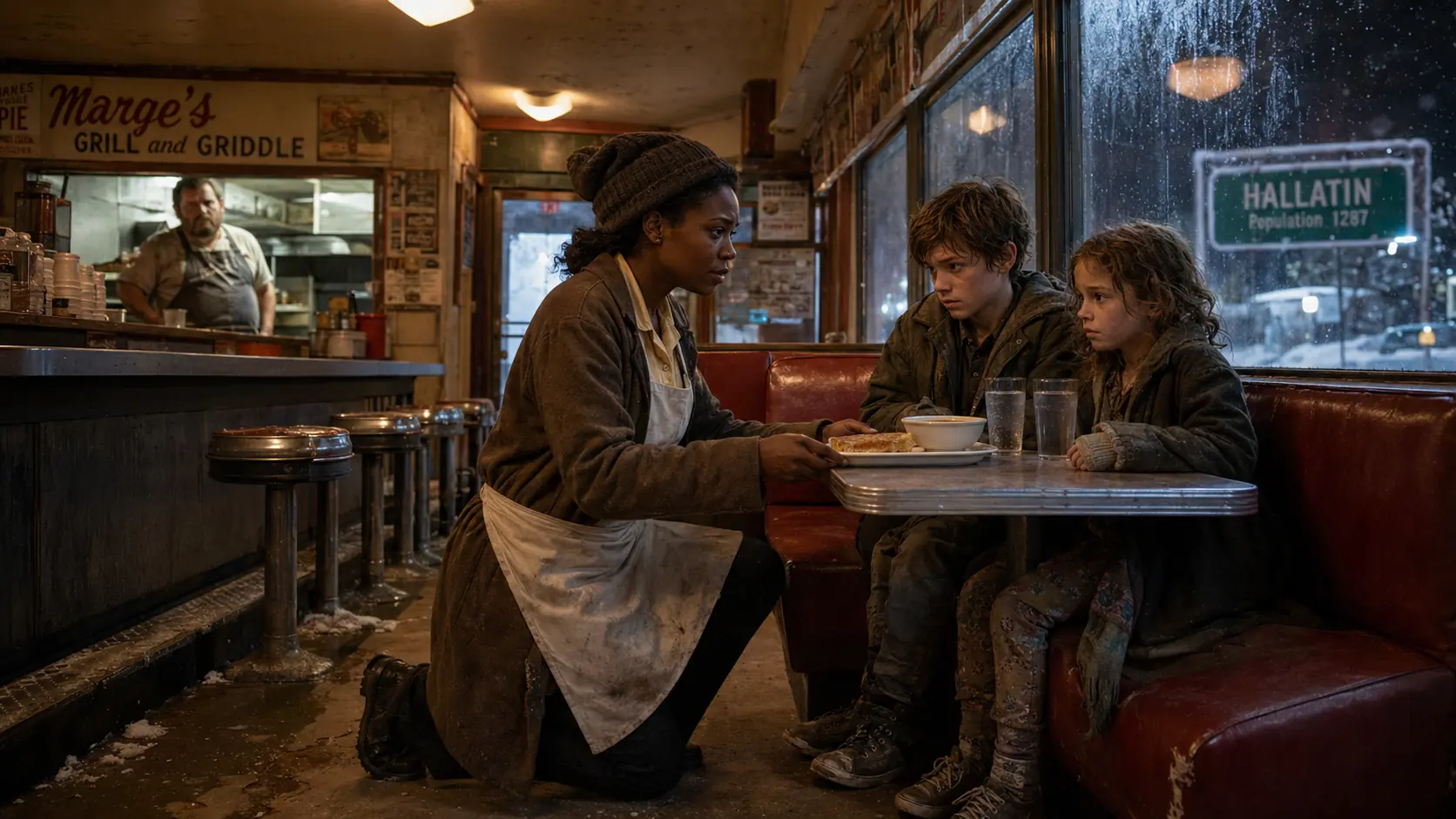
“We won’t,” Eli promised.
His voice was barely above a breath.
“We’ll write to you. I swear we’ll call if Aunt Marie lets us. We’ll never forget you, Miss Amara. Never.”
Amara smiled through the blur.
“You better write. You better call. Because I’ll be waiting.”
They hugged once more, long and tight, holding on as if maybe, if they held tightly enough, the goodbye would not hurt so much.
But eventually they had to let go.
Amara watched as they walked hand in hand down the sidewalk. Eli’s stride was more confident now. Nia skipped a little. They were not hunched or scared or looking over their shoulders.
They looked like children again.
Aunt Marie got out of the car. As they approached, she opened the back door for them.
Before getting in, both children turned back one last time.
Nia waved, her hand moving in big arcs.
Eli raised his hand in a small salute, a gesture that said thank you and goodbye and I’ll remember you all at once.
Then they climbed into the car.
The doors closed.
The engine started.
Slowly, the car pulled away from the curb.
Amara stood on the sidewalk, the drawing clutched to her chest, and watched until the car turned the corner and disappeared.
Even then, she did not move.
She stood there for a long time, the morning sun warming her face, the spring breeze gentle against her skin, the blue scarf around her neck despite the mild temperature.
People walked past her. A few gave curious looks, but no one stopped. No one asked if she was okay.
She was alone on the sidewalk, holding a child’s drawing, wearing a lumpy blue scarf, crying like her heart was breaking.
But her heart was not breaking.
Not exactly.
It was full.
So full it was overflowing.
She had made a difference against all odds.
Despite having almost nothing to give, she had helped two children survive the darkest season of their lives.
And now they were safe.
They had family.
They had a future.
It was enough.
More than enough.
It was everything.
Fifteen years passed.
Seasons changed. People came and went. The diner eventually closed down, sold to a chain that served powdered eggs and watery coffee.
Amara moved on, but not easily.
Not without scars.
Six months after Eli and Nia left, Margie’s Grill shut its doors for good. Barlo blamed the economy, but everyone knew the truth. His harsh management and penny-pinching had finally driven away the last loyal customers.
Amara found herself unemployed in a town with few opportunities and no college degree to fall back on.
She took whatever work she could find.
She cleaned houses during the day, watching wealthy families live lives she could barely imagine. She stocked shelves at the twenty-four-hour grocery store on the night shift, her body moving on autopilot while her mind drifted. She walked dogs for elderly neighbors. She collected bottles and cans for recycling deposits. She learned to stretch a dollar further than physics should allow.
Through it all, she wore the blue scarf and kept the drawing tucked safely in her bag, wrapped in plastic to protect it.
Three years after the diner closed, her mother died.
It happened on a Tuesday morning, spring light coming through the single window of their apartment. Her mother’s breathing slowed and then stopped.
Her last words were, “You made me proud, baby. You loved when it cost you everything. That’s the only kind of love that matters.”
Amara buried her mother with what little savings she had left and found herself truly alone.
Some nights, she would pull out the drawing and the scarf and cry until there were no tears left.
She wondered if kindness truly mattered in a world that seemed designed to punish it.
But she kept going because giving up would mean that night in the snow meant nothing.
Four years after her mother’s death, Amara finally found steady work at a place called Riverside Diner.
It was larger than Margie’s Grill, busier, with better tips.
Or at least, the tips should have been better.
She should have been grateful.
But she was not.
The head manager was a woman named Gloria, middle-aged and sharp-featured, with eyes that always seemed to be calculating who to cut down next. Her assistant manager, Derek, was younger, but just as cruel in his careless way.
From Amara’s first day, she felt it in the air.
The toxicity hung like grease smoke.
Gloria saw her as a threat.
Amara was younger, worked harder, and customers liked her genuine warmth.
So Gloria did what insecure people do.
She made Amara’s life hell.
The worst shifts.
The largest sections.
Impossible standards.
Public humiliation in staff meetings.
Tasks that were not in her job description.
Cleaning bathrooms. Mopping floors. Scrubbing behind refrigerators.
Derek joined in with casual cruelty. He gave her orders to the wrong tables. He told the kitchen her tickets were low priority. He spread rumors that she was stealing tips.
And he mocked her scarf.
“What’s with the ugly rag?” he would say, flicking it with his fingers. “Goodwill reject?”
Amara never responded.
She had learned that responding only made it worse.
Other servers avoided her, afraid to be associated with the target.
Amara understood.
They were just trying to survive, too.
So she endured alone.
Two years passed.
Then five.
Then ten.
Amara was forty years old, but she looked older. Stress had carved lines into her face. Her hands were rough from constant work. Her feet had permanent calluses.
But she still wore the blue scarf.
She still kept the drawing in her locker.
She still helped people when she could.
There was a homeless man who came to the back door on Tuesday nights. Amara saved her own lunch and gave it to him.
A young single mother came in sometimes with her two children. Amara often “forgot” to charge for their drinks and sides.
An elderly veteran sometimes came up short on his bill. Amara covered the difference from her own tips.
One day, Gloria caught her handing her lunch to the homeless man.
“Stealing food for trash again?” Gloria’s voice was sharp with triumph. “Some people never learn.”
She wrote Amara up and threatened termination if it happened again.
So Amara started bringing food from home. Cheap sandwiches made from day-old bread. Soup in a thermos. She gave away her own meals and went hungry.
It was easier than she expected.
Hunger was just another kind of pain, and she had gotten good at living with pain.
Then came the day that broke something inside her.
It was a slow Tuesday evening. A customer, an elderly man who came in every week, complimented Amara to Gloria.
“That young woman is wonderful,” he said, gesturing toward Amara. “So patient and kind. You’re lucky to have her.”
Amara saw Gloria’s face go hard.
Gloria smiled at the customer, sugary sweet, and thanked him for the feedback.
Ten minutes after he left, Gloria “accidentally” dropped an entire tray of dirty dishes onto Amara.
Food splattered across her uniform.
Broken plates clattered to the floor.
Dirty water soaked into her clothes and hair.
And her scarf, her precious blue scarf, got covered in grease and food waste.
“Clumsy girl,” Gloria said loudly.
Everyone in the restaurant could hear.
“Look what you made me do. Clean it up. Maybe if you weren’t so slow, these things wouldn’t happen.”
Amara stood there dripping with filth while customers shifted uncomfortably in their seats.
No one said anything.
No one defended her.
She got down on her hands and knees and cleaned it up.
Every broken plate.
Every puddle of dirty water.
Gloria stood over her, watching.
That night, Amara sat in her tiny apartment and carefully washed the blue scarf in her bathroom sink. She cried as she worked, quiet tears falling into the soapy water.
But the worst moment came years later, on a random evening Amara would remember forever.
Derek snatched the scarf right off her neck while she was carrying a tray of drinks.
He did it so fast she barely had time to react.
“Let’s see what this ugly thing looks like in the trash where it belongs,” he said, dangling it over the trash can and laughing.
Amara set down the tray carefully.
Her hands were shaking.
“Give it back.”
Her voice was quiet.
Steady.
“Why?” Derek grinned. “It’s garbage. I’m just putting it where garbage goes.”
“Please.”
The word came out broken, desperate.
“It’s all I have left.”
Something in her voice made Derek pause for just a second.
For a moment, it seemed like he might actually feel shame.
Then Gloria appeared.
“What’s going on here?”
“Just having some fun with the homeless lady’s scarf,” Derek said.
Gloria held out her hand.
“Give it here.”
Derek handed her the scarf.
Gloria examined it with theatrical disgust, holding it between two fingers like it was contaminated.
“This is what you wear to work?” she said. “This ratty, filthy thing? It’s unprofessional. Unhygienic.”
She dropped it on the floor.
Then she stepped on it deliberately, grinding it under her heel.
“Pick it up after your shift,” Gloria said. “If you’re lucky, I won’t write you up for violating dress code.”
Amara worked the rest of her shift watching customers and staff walk over her scarf.
Each footprint felt like it landed on her chest.
But still, she endured.
Because she needed the job.
Because she had nowhere else to go.
Ten years.
Amara worked at Riverside Diner for ten brutal years.
Then, one closing shift, Gloria cornered her in the kitchen. Derek stood in the doorway, blocking her exit.
“You know why you’re still here?” Gloria’s voice was low and mean. She stepped closer, backing Amara against the stainless steel counter. “Because you’re too pathetic to leave. You’ve got nothing. No education. No family. No future. This is all you’ll ever be. A washed-up waitress cleaning toilets until you’re too old to stand.”
Derek laughed from the doorway.
“At least she’s consistent. Consistently useless.”
Amara stood there holding a mop, wearing a dirty apron, her threadbare blue scarf around her neck.
And something inside her finally broke.
Not her spirit.
Her fear.
She looked at Gloria.
Really looked at her.
And for the first time, she saw clearly.
This woman was not powerful.
She was small.
Small and scared and trying to make herself feel bigger by making everyone else smaller.
“You’re wrong,” Amara said quietly.
Gloria’s eyes widened with shock.
In ten years, Amara had never talked back.
“What did you say?”
“You’re wrong about who I am.”
Amara’s voice was steady. She straightened, standing to her full height.
“You think I’m nothing. But I’m the one who helps people when no one’s watching. I’m the one who gives when I have nothing left to give. I’m the one who sees people everyone else looks past.”
“You’re delusional,” Gloria spat.
“Maybe.”
Amara untied her apron.
“But I’m done being small to make you feel big.”
That night, Amara went home and looked at Nia’s drawing on her wall.
The angel in the snowstorm with her arms spread wide.
She thought about her mother’s words.
One small flame can light up a whole dark room.
She counted the money she had saved over ten years.
It was not much.
But it was something.
And something was enough to start.
The next morning, Amara wrote a simple resignation letter.
I quit. Effective immediately.
She walked into Riverside Diner before her shift and placed it on Gloria’s desk.
Gloria stormed out.
“You can’t quit. You’re scheduled.”
Amara took off her apron and folded it neatly.
“I just did.”
Derek appeared from the kitchen.
“You’ll be back. You always come back to where you belong.”
Amara looked at him.
Really looked at him.
Then she said the truest thing she had said in ten years.
“I’m going where I belong. And it’s not here.”
She walked out the door.
The morning air was cold and fresh.
The blue scarf was around her neck.
And for the first time in a decade, Amara Daniels felt like herself again.
The restaurant space was tiny, just fifteen hundred square feet on the corner of Grant and Fifth in a neighborhood that had seen better days but was showing signs of life again.
The rent was seven hundred dollars a month.
Amara had enough saved for the first month, last month, and security deposit.
That left her with three thousand dollars to turn an empty shell into a working restaurant.
It should have been impossible.
The floors were warped.
The walls were dingy, marked with holes.
The kitchen equipment was ancient: a grill from the 1980s, a refrigerator that wheezed, an oven with a door that would not close right.
But when Amara signed that lease, her hands shaking as she wrote her name, she felt something she had not felt in a long time.
Purpose.
She named it Little Flame after her mother’s favorite saying.
One small flame can light up a whole dark room.
For six months, Amara worked harder than she had ever worked.
She watched repair videos at the public library: how to replace floorboards, how to patch drywall, how to fix a refrigerator compressor. Then she went to the restaurant space and tried to follow along.
She made mistakes.
A lot of them.
She patched a wall wrong and had to start over.
She bought the wrong kind of paint and had to strip it off.
But slowly, painfully, the space came together.
She found a used commercial dishwasher at an estate sale for three hundred dollars. She spent a weekend repairing an industrial mixer that a closed bakery was selling for parts. She bought mismatched plates and cups from thrift stores.
Five dollars here.
Ten dollars there.
The tables and chairs came from a church that was renovating. They just wanted them gone.
She slept on a cot in the back storage room because she could not afford both apartment rent and restaurant rent. She showered at the YMCA. She lived on rice and beans because every other dollar went into building this place.
Some days, she sat on the floor of the half-finished restaurant, too exhausted to move, and wondered if she was crazy.
Then she would look at the drawing tacked to the wall, the angel in the snowstorm, and she would get back up.
The menu was simple.
Things she knew how to make.
Grilled cheese, three kinds.
Tomato soup.
Simple salads.
Breakfast sandwiches.
Pancakes.
Nothing fancy.
Nothing that required skills she did not have.
But everything made with care.
And she had one rule written on a small chalkboard by the back door.
If you’re hungry, knock. Always.
Little Flame opened on a rainy Tuesday in October, twenty years after the night Amara had knelt in the snow to comfort two grieving children.
The first day, three people came in.
Two were older men from the neighborhood who had seen her working on the place. The third was a young mother with a baby who looked like she just needed somewhere warm to sit for a while.
Amara served them herself.
Cooked their food herself.
Cleaned their tables herself.
When they paid, she thanked them like they had given her the world.
Because they had.
They had given her a beginning.
The second day, five people came.
The third day, eight.
Word started to spread slowly through the neighborhood.
There was a new place on the corner, run by a woman who smiled like she meant it and made grilled cheese that reminded people of being children.
After a month, Amara hired her first employee.
His name was Marcus, nineteen years old, working three jobs to help his mother pay rent. She could not pay him much, minimum wage and whatever tips came his way, but he showed up every day, and he worked hard, and he was kind to customers.
Six months later, she hired Rosa, a woman in her fifties who had been laid off from the textile factory. Rosa had thirty years of food service experience and a smile that made customers feel like they had come home.
They were small.
They were scrappy.
But they were family.
The blue scarf hung on a hook in the kitchen, too fragile now to wear every day. Nia’s drawing of the angel in the snow was framed properly and hung above the cash register.
People asked about it sometimes.
“That’s beautiful. Who’s the artist?”
Amara would smile.
“Someone I helped a long time ago. Someone who taught me what kindness looks like.”
She never told the whole story.
It was too precious.
Five years passed.
Slowly.
Painfully.
Beautifully.
Little Flame grew.
Money was still tight. There were months when Amara was not sure they would make rent. Months when she did not pay herself so she could pay Marcus and Rosa.
But they survived.
More than survived.
They mattered.
A local food blogger discovered them and wrote a piece titled, Heart in Every Meal: Little Flame Serves More Than Food.
Amara was forty-three years old, still alone. The lines on her face were deeper now. Her hands were more scarred.
But when she looked around Little Flame, she felt something close to peace.
She thought about Eli and Nia.
Sometimes she wondered what they looked like now.
Eli would be twenty-seven.
Nia would be twenty-three.
Were they happy?
Did they ever think about her?
She hoped so.
But it was okay if they did not.
Then the rumors started.
It began with whispers, the kind that trickled through town like a cold draft under a locked door.
A cough here.
A cramp there.
Someone’s aunt said her stomach had not settled since lunch.
A teenager posted a video saying she felt sick after eating a bowl of lentil stew.
By nightfall, rumors had become headlines.
Food Poisoning at Little Flame.
Outbreak at Halatin Diner.
Restaurant Under Fire.
Amara did not see the first wave coming.
The day had started like any other. Sunlight through the windowpanes. Tables full. Regulars chatting warmly.
Then the front door slammed open.
A crowd.
Not just a few people.
Dozens.
Angry, loud, confused faces.
Neighbors.
Former customers.
Strangers with phones filming her every move.
The accusations came fast.
“I ate here yesterday and I’ve been throwing up since dawn.”
“You fed my nephew raw chicken.”
“You’re poisoning people to save money.”
Amara stood behind the counter, heart pounding so loud it filled her ears.
She opened her mouth to speak, but the noise swallowed her.
Cameras flashed.
Someone threw a napkin holder.
Then she saw him.
Barlo.
Standing at the front of the mob like a conductor with no music.
Same heavy frame, though now weighed down with bitterness and resentment. His beard was unkempt, his eyes glassy with victory.
“I warned y’all,” he shouted, arms outstretched like a preacher at a funeral. “Told you this place was a front. Told you she’d cut corners to make a buck. You just didn’t want to listen.”
The crowd roared.
Amara’s knees weakened.
Barlo turned toward the police officers now pushing through the crowd.
“She should be arrested,” he declared, voice low and venomous. “This ain’t just a food violation. It’s endangerment. Maybe attempted manslaughter. Kids got sick. Families got sick.”
“That’s not true,” Amara said, barely above a whisper.
“You calling everyone here a liar?” Barlo snapped. “You poisoning people and smiling while doing it. You think just because you hand out free bread with soup, you’re a saint?”
Amara looked to the officers.
They did not meet her gaze.
One of them took out handcuffs.
Her chest tightened.
Her hands began to shake.
Marcus came running from the back.
“What’s going on?”
But the officer raised a hand to him.
“Sir, please stay back.”
“I didn’t do this,” Amara whispered, half to herself. “I’ve never hurt anyone.”
But no one heard her.
Or worse, they did not care.
The shouting reached a fever pitch.
Then, out of nowhere, came the sound of tires crunching gravel.
A sleek black car pulled to the curb, polished to a mirror sheen, windows tinted, engine humming like a held breath.
Everything stopped.
The crowd parted like water as a tall man stepped out from the passenger side.
Young. Sharp suit tailored to perfection. He walked with the quiet confidence of someone who had nothing to prove and everything to protect.
Behind him came a woman in a charcoal coat, familiar in ways Amara could not place, and a technician in jeans carrying a small black case.
The man did not say a word at first.
He took in the crowd, the building, the chaos.
Then his gaze landed on Amara.
And he smiled.
Not with smugness.
Not with malice.
But with memory.
Amara’s breath caught in her throat.
Something stirred in her chest, a warmth buried under layers of fear and disbelief.
She did not know yet why he was there, who he was, or what he intended.
But something in her bones told her she had seen that smile before.
Once, long ago, through a veil of snow and silence.
The man stepped closer, past the police, past the doubters, past the lies still hanging thick in the air.
His voice came steady and smooth, but it carried weight, the kind that silenced people mid-breath.
“I’d like to see the kitchen,” he said.
The officer hesitated.
“Who are you exactly, sir?”
The man reached into his coat, pulled out a card, and showed it to the officer, then to the crowd.
People leaned in, curious and confused.
Eli Marin.
CEO, Hearthstone Culinary Group.
Gasps moved through the crowd like wind rustling brittle leaves.
Hearthstone.
An empire.
Five-star restaurants across three continents. Television appearances. Philanthropy awards. A name no one heard in Halatin unless it was on TV.
But Eli.
The boy from the snow.
Amara felt her knees tremble.
Still, she could not speak.
Nia stepped forward then, taller now, elegant, her fingers ink-stained, her coat stitched with a sunflower pattern.
She did not speak either.
She simply took Amara’s hand, squeezed it tight, and nodded.
That same nod she used to give from behind Eli’s arm when the world felt too cold to face.
“We never forgot you,” Nia whispered.
Eli turned to the technician.
“Sam, run the analysis.”
Sam crouched near the side alley entrance, opening his case and pulling out a small device connected to a monitor.
“The main water intake runs behind this wall,” he said, fingers flying across a touchpad. “Kitchen pipe is accessible through the external duct.”
Amara’s stomach turned.
Barlo knew that area well. He had spent a few months on the old building’s maintenance crew after Margie’s Grill closed, learning every pipe and valve by heart.
“There’s no camera back there,” Barlo said loudly from the crowd, his voice shrill and defensive. “They’ll find nothing. This is just grandstanding.”
Eli’s eyes did not move from the screen.
“There’s always a witness,” he said.
Then Sam lifted his head.
“Found it.”
The monitor showed a timestamped sequence.
Low-resolution.
Grainy.
But clear enough.
A man in a thick coat crouched behind the diner. He reached into his pocket. A small plastic bag appeared. A gloved hand unscrewed the service valve and poured something into the kitchen’s waterline.
The face was obscured until he turned slightly.
Then the old security light caught his profile.
The silence after the footage ended was thick.
Dense with shock, shame, and the cold realization that a storm had just changed direction.
On the screen, frozen mid-frame, was Barlo.
Not a shadowy figure.
Not a vague outline.
Barlo.
Clear as day.
His thick frame hunched beside the diner’s outer wall, gloves tight around a plastic bag, his breath misting in the cold air as he twisted open a service pipe behind Little Flame.
The scar above his left brow was unmistakable, a mark Amara had seen nearly every day she worked under him as he barked orders and lashed out at anyone who reminded him of his own failure.
Now that scar told a different story.
The crowd, once so loud and eager to condemn, folded in on itself.
Someone in the back muttered, “Jesus.”
Another man took a slow step backward.
A woman pulled her child closer, as if realizing too late the true danger had not come from the woman behind the counter, but from the man who had stood beside them all along.
Barlo did not move at first.
He blinked.
Opened his mouth.
No words came.
When he finally found his voice, it was thin and stretched with desperation.
“That could be anyone,” he said, half laughing, half pleading. “Come on. Grainy footage. You can’t arrest someone over that.”
Eli did not even turn to him.
“Check the timestamp. Cross-reference it with the delivery logs. The water contamination began precisely forty minutes after this moment. No one else had access to that intake pipe.”
Barlo’s face flushed, then paled.
He turned to the police officer closest to him.
“You know me, Rick. You know me. I ran kitchens in this town for thirty years. This woman is manipulating you all. She’s got tricks. Sympathy. Some kind of story. But she’s not clean. She’s been lying. She’s always been playing the part.”
The officer, a man in his forties with heavy eyes and a badge that looked too polished for such an old town, shook his head.
“I know who you are, Barlo. That’s exactly why this makes sense.”
Another officer stepped forward.
“Barlo Denton, you are under arrest for tampering with food infrastructure, criminal endangerment, and conspiracy to cause public harm. Turn around and place your hands behind your back.”
Barlo’s hands hovered in the air, shaking.
“No. No, this is ridiculous.”
But he did not resist when the cuffs closed around his wrists.
The click was soft but final.
He was marched through the crowd, eyes wide, lips tight.
He looked toward the people who had once accepted his coffee, nodded at him on sidewalks, feared him and respected him in equal measure.
Now they averted their eyes.
One woman hissed through clenched teeth.
“You poisoned my niece.”
Someone else spat near his shoes.
He was no longer powerful.
He was a man undone.
As he passed Amara, he dared to meet her eyes for a moment.
The hate was gone.
So was the arrogance.
In their place was disbelief.
Pure, bone-deep disbelief that the woman he had stepped on, dismissed, mocked, and tried to destroy had survived him.
But Amara did not look away.
She did not need to say a word.
The world had finally seen.
As the squad car carrying Barlo rolled away down the street, Amara stood in the soft hush that followed.
The evidence had spoken.
The storm had passed, but the emotional weight had not left her chest.
She turned toward the man who had made it all happen.
Eli’s suit was clean-cut, his face older, defined now not by years lost, but by purpose earned.
But something in him was unchanged.
Something in the eyes.
In the stillness of his posture.
He was not a boy anymore.
But Amara knew those eyes.
She had once watched them fill with snow and sorrow as he clutched his sister in the dark.
Now they looked at her the way a man might look at a lighthouse after crossing an endless sea.
“Eli,” she whispered.
Just the name.
And in that one word, everything returned.
The snow.
The hunger.
The quiet knock at the door.
The scarf.
The fire she had tried to keep lit when the world around them had turned to frost.
He stepped forward.
“It’s been a long time.”
She nodded, her voice catching in her throat.
“Fifteen years.”
Nia appeared beside him, taller now, regal in posture, dressed in muted tones save for a splash of blue, a painted scarf draped over one shoulder.
Her hands were stained faintly with charcoal and color, nails trimmed short.
Amara gasped softly as she realized those were the hands of an artist.
The little girl with cold fingers and hungry eyes now created beauty for the world.
“You both look…”
Amara could not finish.
Nia smiled gently.
“We became what you believed we could be.”
Then she reached into a long canvas case slung over her shoulder. Carefully, reverently, she pulled out a framed painting wrapped in soft cloth.
She peeled back the covering.
It was Amara.
Amara in the snow, kneeling, arms open, the folds of her coat painted in deep earth tones, her scarf catching light like stained glass. Behind her, two small children were wrapped in her warmth.
Snow whirled around them, but none touched them.
The storm had no power where she knelt.
The painting glowed.
Tears spilled down Amara’s cheeks.
She touched the frame with trembling fingers.
“You painted this?”
Nia nodded.
“It took me years to finish. I had to wait until I was strong enough to face that night again.”
Amara’s voice was barely audible.
“Why bring it here?”
“Because this is where the story began,” Eli said quietly. “And where it should be honored.”
She looked from one to the other.
“You saved me today.”
Eli shook his head.
“You saved us first. We only returned what you gave freely.”
They embraced, the three of them, in the quiet awe that comes from knowing something profound has come full circle.
She held them as she once had.
And for a moment, despite the years, despite the noise, they were once again three souls in the snow, clinging to one another for warmth.
Weeks later, the painting hung in the heart of Little Flame above the mantle, framed in mahogany and lit by soft amber sconces.
Visitors stared at it, moved not just by its artistry, but by the spirit it carried.
Survival.
Memory.
One woman’s quiet refusal to stop caring.
Below it, on a brass plaque etched in calm script, were the words:
Kindness needs no proof. It lives forever in those rescued from the dark.
And every evening before closing time, Amara stood beneath it, her hand brushing the frame, her heart steady, her eyes lifted not in sorrow, but in gratitude.
She had not been forgotten.
She had been remembered.
And through her, the town remembered something of itself.
That kindness is not weakness.
That being poor does not mean being powerless.
That one small flame, protected long enough, can grow bright enough to expose every lie hiding in the dark.