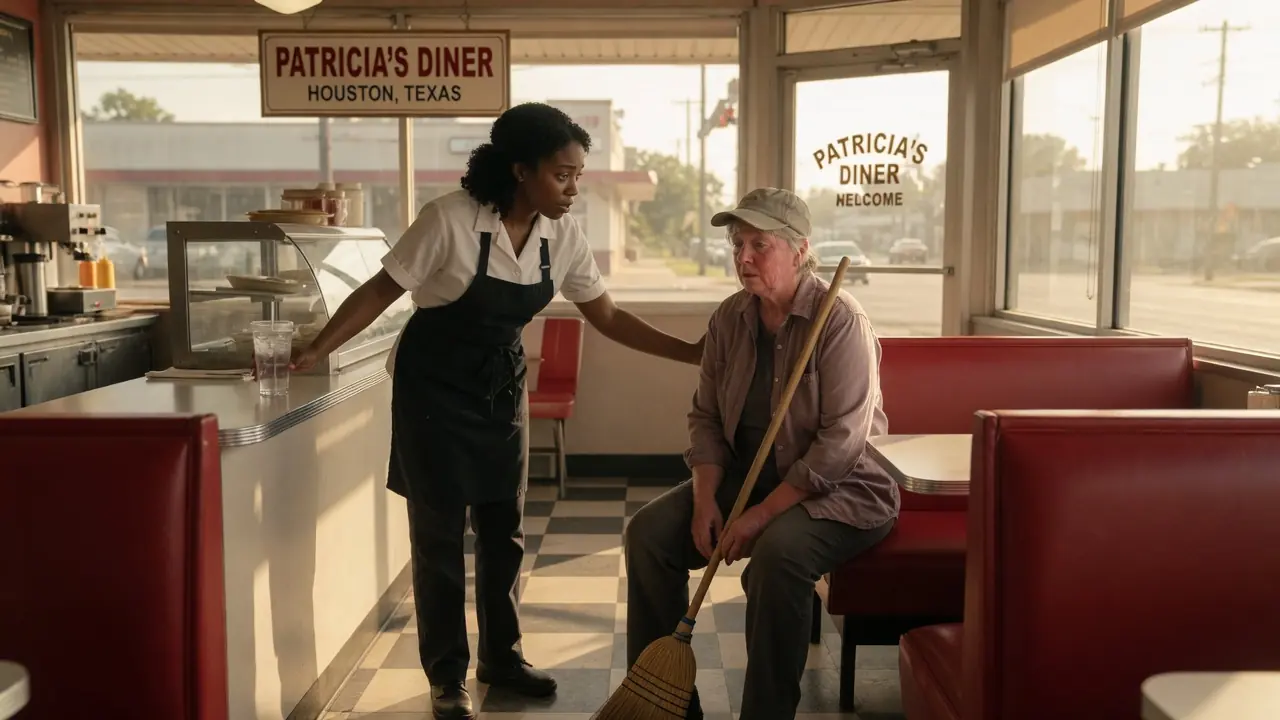
One scorching morning in Houston, a young diner waitress was busy serving customers when she suddenly noticed an old woman sweeping the sidewalk outside, her face flushed from the unbearable heat.
Without hesitation, she pulled a couple of crumpled bills from her pocket, bought a large cup of ice water, and stepped out into the blazing sun.
She walked straight to the woman and placed the cup in her trembling hands, a small act of kindness from a young woman who had almost nothing.
But what she did not know was that the old woman was a powerful CEO.
And the way she chose to repay that kindness would bring the waitress to tears.
The Houston heat was already brutal at six-thirty in the morning, the kind of oppressive humidity that made breathing feel like work. Maya Thompson had been on her feet at Patricia’s Diner for half an hour, and the breakfast rush was just beginning to hit.
Maya was twenty-eight years old, though the stress of her life made her look older on the mornings when she had not slept enough. She had been working at Patricia’s Diner for three years, ever since her mother died and left her responsible for her younger sister, Diana. Before the diner, she had cobbled together whatever work she could find: retail shifts, warehouse packing, cleaning jobs, grocery store cashier work, anything that paid just enough to keep the lights on.
Nothing had benefits.
Nothing paid well.
Nothing felt like it could lead anywhere.
The diner was more of the same, but at least Patricia was decent. She paid on time, did not harass her staff, and occasionally let them take home leftover food. In Maya’s world, that counted as a good job.
“Coffee, eggs over easy, pancakes with no butter, hash browns extra crispy.”
The orders blurred together, different faces but the same needs. Everyone was desperate for caffeine before facing another scorching Texas summer day.
“Maya, two coffees, black, table six,” Patricia called from behind the counter.
“Got it,” Maya replied, her hands moving on autopilot.
Three years she had been doing this, and her body knew the rhythm even when her mind wandered.
Through the large front windows of the diner, something caught her eye.
An older white woman, probably in her sixties, was sweeping the sidewalk outside. Maya had noticed her the day before for the first time, moving slowly in the oppressive heat, her worn clothes already soaked with sweat.
What struck Maya now was how much worse the woman looked today.
The heat was getting to her.
She could see the old woman leaning heavily on her broom, her face flushed red, her movements slow and labored. She looked like she might collapse.
A flicker of worry cut through Maya’s focus.
She had seen people push themselves past their limits before, people who did not have the luxury to rest. Something about the way the woman swayed on her feet reminded Maya of her mother after a long double shift, too proud to sit down even when her legs trembled.
Maya glanced at the clock.
Her break was not for another hour, but this could not wait.
“Patricia, I need five minutes,” she called out.
Patricia looked up, saw Maya staring out the window, and followed her gaze. Her expression softened.
“Go. Make it quick.”
Maya grabbed a large cup and filled it with ice water, adding extra ice and two lemon wedges. She hesitated for just a second.
The drink would come out of her own pocket, and money was already tighter than ever.
But she paid for it anyway.
Some things, she figured, were worth more than a couple of dollars.
She did not think about it again.
She just moved.
The wall of heat hit her the moment she stepped outside, but she barely noticed. The woman was leaning on her broom now, clearly struggling.
“Excuse me, ma’am,” Maya said gently, approaching her.
The woman looked up, startled.
Her blue eyes were tired but kind, her weathered face showing surprise that anyone had noticed her. Most people walked right past, treating her like part of the scenery.
“I thought you might need this,” Maya said, extending the cup of water. “It’s dangerous out here today. Has to be ninety-five already, and it’s not even seven.”
The woman stared at her, then at the water, then back at her. Something flickered in her expression, an emotion Maya could not quite read.
She took it slowly, her hands rough and calloused.
“Thank you, sweetheart,” she said, her voice raspy. “You didn’t have to do this. This is very kind of you.”
Maya shrugged, offering a small smile.
“Just seemed like the right thing to do. Can’t have you getting heatstroke out here. Please find some shade soon, okay?”
The woman nodded and took a long drink.
The relief on her face was immediate.
“This really hits the spot.”
She lowered the cup and looked at Maya more carefully.
“What’s your name, dear?”
“Maya. Maya Thompson.”
“Rebecca,” she replied, extending her free hand. “Rebecca Whitmore. It’s nice to meet someone who still sees people, Maya. That’s rare these days.”
“Nice to meet you, too, Ms. Whitmore.”
Maya heard Patricia calling her name from inside.
“I’ve got to get back to work, but you take care of yourself, okay?”
“Thank you, Maya,” Rebecca said.
There was something in her eyes, something that suggested she was filing this moment away, remembering it.
She took another sip and smiled, the lines around her eyes softening.
“You’ve got a good heart,” she murmured.
Maya chuckled awkwardly.
“My mom would have said the same.”
“Then she raised you right,” the woman replied simply.
Maya nodded and hurried back inside, retying her apron as she returned to the chaos of the breakfast rush.
But as she wiped the counter and poured drinks for customers, her mind kept drifting back to the woman outside. The tremor in her hands. The exhaustion in her eyes. The quiet dignity in the way she had sipped that cold lemon water like it was a gift.
Something about her reminded Maya of her mother.
Sarah Thompson had worked as a housekeeper her entire adult life, cleaning other people’s homes while their own apartment fell apart around them. She had worked herself to death, literally. At fifty-four, her body had simply given out, exhausted from decades of physical labor and stress.
Before she died, she made Maya promise to take care of Diana, to make sure her baby sister got the education Sarah never had, the opportunities that had never come their way.
“Diana’s smart, Maya,” her mother had whispered from her hospital bed, her voice weak. “Smarter than both of us. Get her through school. Promise me.”
“I promise, Mama,” Maya had said, holding her hand. “I’ll take care of her. I swear.”
She had kept that promise.
But it was hard.
Diana was twenty-three now, working on her degree at Houston Community College while working part-time at a grocery store. Between them, they barely made enough to cover rent on their cramped apartment, utilities, food, and tuition.
There was never anything left over.
No savings.
No cushion.
No room for error.
Maya worked fifty to sixty hours a week at the diner whenever she could get the shifts. She woke at four-forty-five to catch the early bus downtown, worked until three or four in the afternoon, then came home to collapse. Sometimes she picked up evening shifts at a warehouse, labeling boxes until midnight, then doing it all again the next day.
She was exhausted all the time.
Her body ached constantly.
Her feet hurt. Her back hurt. Her hands were rough from hot plates, wet towels, and cleaning chemicals.
She was twenty-eight, but some days she felt fifty.
But Diana was in school. Diana was getting her degree. Diana was building toward something better.
That was what mattered.
That was what kept Maya going through the endless days of serving coffee to people who rarely bothered to learn her name, people who looked through her like she was invisible.
The invisibility was the worst part.
Not the low pay.
Not the hard work.
Not even the exhaustion.
It was the way people treated service workers like they were not fully human, like they were furniture that happened to bring food.
Most customers never made eye contact. They barked orders without saying please or thank you. They complained about everything. They left terrible tips, or no tips at all. They were rude to her face because they could be, because what was Maya going to do about it?
She needed the job.
So she smiled and said, “Yes, ma’am,” and “Right away, sir,” and swallowed her pride every single day.
She carried the weight of being invisible, dismissed, and treated as less than.
That was why she noticed Rebecca sweeping the sidewalk.
Maya knew what it felt like to be invisible.
She knew what it meant to work hard at something people considered beneath notice.
Her mother had taught her that.
“We might not have much, baby,” Sarah used to say, “but we always have kindness. That costs nothing, and it’s worth everything. You treat people right, Maya, especially people who can’t do anything for you. That’s when kindness means the most.”
So when Maya saw Rebecca struggling in the heat, she did not calculate what she might gain. She did not think about the two dollars. She just saw another human being who needed help, and she helped.
Simple as that.
Except it was not simple at all.
Because Rebecca Whitmore was not what she appeared to be.
And that cup of water was about to open doors Maya did not even know existed.
The rest of Maya’s shift passed in the usual blur. The lunch rush hit around eleven-thirty, and for the next two hours, Maya barely had time to breathe.
Orders.
Payments.
Complaints.
More orders.
Her feet ached. Her back screamed. Sweat soaked through her uniform despite the struggling air conditioning.
Around two, things finally slowed down. Maya leaned against the counter, catching her breath, when Patricia approached her.
“That was a nice thing you did this morning,” Patricia said. “With that lady outside.”
Maya shrugged.
“Just water. No big deal.”
“It’s a big deal to her, I bet,” Patricia said. “Most people wouldn’t have noticed. Wouldn’t have cared if they did. You’ve got a good heart, Maya. Your mama raised you right.”
Maya felt her throat tighten at the mention of her mother.
Three years gone, and it still hurt like yesterday.
“She did her best.”
“She did better than best,” Patricia said firmly. “You turned out good despite everything. That’s not an accident.”
At three, Maya’s shift finally ended. She clocked out, grabbed her worn backpack from her locker, and stepped back out into the brutal afternoon heat.
The bus home would not come for another ten minutes, so she stood in the shade of the diner’s awning, trying not to melt into the sidewalk.
Rebecca was still there.
Still working.
She had moved down the block, but she was still sweeping, still methodical despite the heat.
Maya watched her for a moment, concerned.
How long was she planning to stay out here?
As if sensing her gaze, Rebecca looked up and waved.
Maya waved back.
Something told her she would see Rebecca again tomorrow.
Something told her this was not over.
She had no idea how right she was.
The apartment Maya and Diana shared was on the third floor of a run-down building in their old neighborhood. The elevator had not worked in two years, so Maya climbed the stairs, each step a reminder of how tired she was.
Inside, Diana was at their small kitchen table, textbooks spread everywhere, laptop open, face buried in notes. She looked up when Maya walked in.
“Hey,” Diana said, pushing her glasses up her nose.
She had their mother’s eyes: warm, perceptive, impossible to lie to.
“How was work?”
“Not bad,” Maya said lightly, forcing a grin as she hung her keys by the door. “Set a new record for how fast I can refill coffee. Pretty sure I impressed the coffee machine.”
Diana smiled, but her eyes lingered on her sister. Maya’s shirt was damp from the heat. Her smile was a little too practiced.
“You sure you’re okay?” Diana asked softly.
“I’m great,” Maya said, heading straight for the fridge. “Got a night off, which means I’m officially living the dream. Leftovers, bad TV, maybe even sleep before midnight. Don’t be jealous.”
“Jealous isn’t the word I’d use,” Diana murmured, watching her take a long drink of water.
Maya changed the subject before Diana could press further.
“How’s studying? You still terrorizing your professors?”
“Midterms next week,” Diana sighed. “I’m trying not to panic.”
“You’ll be fine,” Maya said, pointing at her with mock authority. “You’ve got this. You always do.”
Diana smiled faintly, but her brow furrowed.
“Maya, we’re short on rent. About one-fifty. I’m picking up extra shifts, but—”
“Hey, hey,” Maya cut in, flashing her easy grin again. “Relax. I’ll take care of it. Maybe Patricia’s got a few doubles for me. No big deal.”
“Maya.”
“Nope,” she said, shaking her head. “We’ve been through worse. You focus on your books. That’s your full-time job. Let me worry about the boring stuff.”
“Maybe I should work more hours,” Diana said quietly. “It’s not fair that you—”
“Diana,” Maya interrupted gently, her tone soft but final. “You’re not dropping anything. You’re going to graduate. That’s the deal. You study for both of us, all right?”
Diana blinked hard, then nodded.
“Okay.”
Maya smiled and tapped her notebook.
“Good. Now remind me again what a sociologist actually does, because I still think you made that word up.”
Diana laughed, and for a brief moment, the heaviness in the room lifted.
Later, when Diana had gone to bed, Maya sat alone at the kitchen table. The light from her sister’s laptop still glowed faintly, casting long shadows across the cluttered books.
She stared at the open pages, the neat notes, the ambition in every line of Diana’s handwriting, and felt something tighten in her chest.
Her mother had always said Diana would go farther than either of them.
“She’s got the brains. You’ve got the grit,” Sarah Thompson had told Maya once. “Between the two of you, you’ll make it.”
Maya smiled faintly at the memory, then glanced toward the window.
Somewhere out there, the woman she had helped that morning was probably asleep, the cup of lemon water long forgotten.
But Rebecca’s words still echoed in Maya’s mind.
“It’s nice to meet someone who still sees people.”
Maya did not understand what Rebecca meant.
Not yet.
But by tomorrow, she would.
The next morning arrived with the same relentless heat. Maya’s alarm went off at four-forty-five, and she dragged herself out of bed feeling like she had barely slept.
Her body ached from yesterday, and today would bring more of the same.
But Diana needed her.
Their rent needed paying.
And sitting around feeling sorry for herself would not change anything.
She went through her morning routine quietly, not wanting to wake her sister.
Coffee.
Quick breakfast.
Uniform.
She left a note by the coffee maker.
Have a good day. Love you. Study hard.
The bus ride downtown was already hot and crowded, full of other early morning workers heading to their own exhausting jobs. Maya stared out the window, watching Houston wake up, and wondered if this was all her life would ever be.
Work.
Exhaustion.
Struggle.
Repeat.
When she arrived at the diner, Patricia was already there, preparing for the morning rush.
“Morning, Maya,” she greeted her. “That lady from yesterday, the one sweeping, she was here earlier asking about you. Asked what time you started your shift.”
Maya felt a small flutter of curiosity in her chest.
“She was here already?”
“About half an hour ago,” Patricia said. “She’s down the block now. Seems like a nice woman. You made an impression.”
The morning rush hit hard and fast.
Maya barely had time to think, much less look out the window, but around ten-thirty, during a brief lull, she glanced outside and saw Rebecca.
She was sweeping near the corner, moving even slower than yesterday, if that was possible. The heat was already oppressive, promising another day over a hundred degrees.
Maya did not hesitate.
She filled another cup with ice water, extra ice, lemon wedges, and headed outside.
“Miss Rebecca,” she called out.
Rebecca turned, and her tired face broke into a genuine smile.
“Maya. Good morning to you.”
“Morning,” Maya said, extending the water. “Thought you could use this again. It’s even hotter today than yesterday. Weather says it might hit one-oh-three.”
Rebecca took the cup, and Maya noticed her hands were shaking slightly.
She was pushing herself too hard in this heat.
“You’re doing this again, Maya,” Rebecca said. “You’re too kind, really.”
“It’s just water,” Maya said, feeling a little embarrassed by her gratitude. “No big deal.”
“It is a big deal,” Rebecca said firmly, taking a long drink.
She closed her eyes, savoring the cold water.
“Most people walk right past me every single day, like I’m invisible. Like I’m not even here. But you see me. You see me as a person. That matters more than you could possibly know.”
Maya shifted uncomfortably.
She was not good with compliments or praise.
“You remind me of my mama,” she admitted quietly. “She worked hard her whole life, cleaning other people’s houses. Nobody ever really noticed her either. She was just the help, invisible. I just think about how I wish someone would have done something nice for her once in a while. Shown her she mattered, you know?”
Rebecca’s expression softened with understanding and something deeper.
Sadness, maybe.
Or recognition.
“You lost her, didn’t you? I can hear it in your voice.”
Maya nodded, her throat suddenly tight.
“Three years ago. Worked herself to death, basically. She was only fifty-four.”
“I’m so sorry, Maya,” Rebecca said gently.
Her sympathy felt genuine, not performative.
“That’s far too young. But she clearly raised a remarkable daughter. You honor her memory every time you show kindness to someone the world has forgotten. I hope you know that.”
Maya felt tears threatening and blinked them back.
She could not cry at work.
“Just trying to do right by her. That’s all.”
“You’re doing more than that,” Rebecca said. “You’re being the kind of person this world desperately needs more of.”
Before Maya could respond, she heard Patricia calling her name. The lunch rush was starting.
“I’ve got to get back,” Maya said reluctantly. “But please, Miss Rebecca, take breaks today. Find shade. This heat is dangerous.”
“I will,” Rebecca promised. “And Maya?”
“Yeah?”
“Thank you. Truly.”
Maya hurried back inside, but her mind lingered on their conversation. There was something about Rebecca, something genuine and kind, that made her want to keep talking to her.
In a world where most people treated her like she was nothing, Rebecca treated her like she mattered.
The lunch rush was brutal. Two and a half hours of nonstop orders, demanding customers, and Maya’s feet screaming in protest. But she pushed through like she always did, because what other choice was there?
Finally, at three, her shift ended.
Maya clocked out, exhausted and ready to go home. As she gathered her things from her locker, Patricia approached her with a small, neatly folded piece of paper.
“That lady, Rebecca, gave me this for you,” Patricia said, handing it over. “Said to make sure you got it. Said it was important.”
Maya took the paper, her heart suddenly beating faster.
The paper was nice.
Expensive stationery.
Not what she would expect someone sweeping streets to have.
She unfolded it carefully.
The handwriting was elegant and educated.
Maya,
Please meet me tomorrow during your lunch break. I have something important to discuss with you, something that could change your life and your sister’s life.
I know this sounds mysterious, but I promise you, it is worth your time.
Please trust me.
Rebecca Whitmore.
Maya read it twice.
Then a third time.
Change your life and your sister’s life.
How did Rebecca even know about Diana?
And what could a street sweeper possibly have to discuss that would change anything?
“Everything okay?” Patricia asked, noticing her expression.
“I don’t know,” Maya said honestly, folding the note. “She wants to meet tomorrow. Says she has something important to tell me.”
Patricia studied her face.
“You should meet her, Maya. I’ve got a feeling about this. Sometimes unexpected things turn out to be exactly what we need.”
Maya nodded slowly, slipping the note into her pocket.
“Yeah. I’ll meet her.”
On the bus ride home, Maya could not stop thinking about the note. She pulled it out and reread it several times. The expensive paper, the elegant handwriting, the strange promise about changing her life.
None of it made sense.
When she got home, Diana was in the kitchen making dinner: ramen noodles with an egg. Nothing fancy, but it was what they could afford.
“Hey,” Diana greeted her. “How was work?”
“Weird,” Maya said.
She pulled out the note and handed it to her sister.
Diana read it, her eyebrows climbing toward her hairline.
“Who is Rebecca Whitmore, and how does she know about me?”
“This woman who sweeps outside the diner,” Maya explained, dropping into a chair. “I’ve been giving her water the past couple days because of the heat. Now she wants to meet with me about something that could change our lives. I don’t know what to make of it.”
Diana set the note down, concern clear on her face.
“Maya, this sounds strange. What does she mean, change our lives? How does she know I exist? This could be some kind of scam or something. You need to be careful.”
“I know,” Maya said. “But Diana, what if it’s legitimate? What if this could actually help us? We’re drowning here. Rent’s due in four days, and we’re still short. Maybe this is that something coming through I keep praying for.”
Diana bit her lip, worry written all over her face.
“Or maybe it’s too good to be true. Those things usually are, especially for people like us. Life doesn’t just hand you opportunities out of nowhere, Maya. You know that.”
“I do know that,” Maya agreed. “But I also know I gave her water because it was the right thing to do, not because I wanted anything from her. And she’s been nothing but kind to me. Maybe I should at least hear what she has to say.”
Diana sighed, running a hand through her hair in that familiar gesture of stress.
“Okay. But promise me you’ll be careful. If anything feels wrong, if she asks you for money or tries to get you involved in something shady, you walk away immediately. Promise me.”
“I promise,” Maya said, reaching over to squeeze her sister’s hand. “I’m not going to do anything stupid. But I have to at least find out what this is about.”
That night, Maya lay in bed staring at Rebecca’s note by the light of her phone.
The paper was definitely expensive.
High quality.
The kind of thing someone with money would use, not someone sweeping sidewalks for a living.
Something did not add up, but Maya could not figure out what.
She thought about the way Rebecca had looked at her, really looked at her, seeing her as a person instead of just a waitress. She thought about her gratitude for simple water, her words about Maya honoring her mother’s memory.
She did not feel like a scammer.
She felt genuine.
But Diana was right to be cautious. Life had taught them both that opportunities rarely came without strings attached, especially for people from their neighborhood.
Still, what if this was different?
What if, just once, something good could happen?
Maya folded the note carefully and set it on her nightstand.
Tomorrow, she would find out what Rebecca wanted to tell her.
Whatever this mysterious meeting was about, she would face it with open eyes and a cautious heart.
But deep down, in a place she barely dared to acknowledge, Maya felt a tiny spark of hope igniting.
Maybe, just maybe, something was about to change.
Maya barely slept.
Every time she started to drift off, her mind jerked her awake with another scenario about what Rebecca might want. By the time her alarm went off at four-forty-five, she felt like she had not slept at all.
She went through her morning routine on autopilot, her thoughts consumed by the upcoming meeting.
Diana was already awake, sitting at the kitchen table with her coffee.
“Couldn’t sleep either?” Maya asked.
“I’m worried about you,” Diana admitted. “About this whole thing. It just feels too strange, too convenient.”
“I know,” Maya said, pouring her own coffee. “But I have to find out what this is about. I’ll be careful, I promise.”
“Call me right after,” Diana insisted. “As soon as the meeting is over. I don’t care if you’re at work. Just call me so I know you’re okay.”
“I will,” Maya promised, kissing the top of her sister’s head. “Don’t worry so much. I’m smarter than I look.”
The bus ride to work felt longer than usual. Maya’s leg bounced nervously, her fingers drumming against her thigh. She kept checking her pocket to make sure the note was still there, as if it might somehow disappear and prove this whole thing was just her imagination.
When she arrived at the diner, Patricia gave her an encouraging smile.
“Big day,” she said simply.
“Yeah,” Maya replied, tying on her apron with trembling fingers.
The morning passed in its usual chaotic rhythm, but Maya could not focus. She messed up two orders, forgot to refill coffee cups, and generally performed like it was her first day on the job.
Patricia covered for her, sending her understanding looks.
Around eleven, Maya glanced out the window and froze.
Rebecca was there.
But she looked completely different.
Gone were the worn work clothes and tired posture. Instead, she wore an elegant cream-colored linen blouse and tailored navy slacks. Her gray hair was styled professionally, swept back in a sophisticated way. She wore understated gold jewelry, a watch that looked expensive even from a distance, and she carried a leather handbag that probably cost more than Maya made in a month.
She looked like she belonged in the business district, not sweeping sidewalks.
She caught Maya’s eye through the window and gestured to the bench outside, the one in the shade of the diner’s awning.
Maya’s heart pounded.
What was going on?
“Go ahead,” Patricia said, appearing at her elbow. “Take as long as you need.”
Maya untied her apron with shaking hands and walked outside.
The heat hit her immediately, but she barely noticed. Her entire focus was on Rebecca, who stood as she approached, her expression warm but serious.
“Maya, thank you for meeting me,” Rebecca said. “Please, sit down. We need to talk. And I know what I’m about to tell you is going to sound incredible, possibly unbelievable. But I need you to hear me out completely before you react. Can you do that for me?”
Maya sat down slowly, her mind racing.
“Okay.”
Rebecca took a seat beside her, folding her hands in her lap. She took a breath as if steadying herself.
“My full name is Rebecca Catherine Whitmore. I’m not a street sweeper, Maya. I’m a venture capitalist and real estate investor. I’ve been in business for over thirty years, building commercial properties, investing in startups, managing a portfolio. I’ve been quite successful over the years. My company is worth several million dollars.”
Maya stared at her, unable to process what she was saying.
The words did not make sense.
They could not be real.
“But you’re out here sweeping streets. I’ve seen you for the past two days.”
“I know how it looks,” Rebecca said gently. “Let me explain.”
Maya stared at her in silence.
“Maya, I do this sometimes. Once or twice a year. I take a week or two and step away from my regular life. I dress down, do simple work like sweeping sidewalks, and I observe. I watch how people treat each other when they think nobody important is watching. It tells me everything I need to know about character. About who people truly are when there’s nothing to gain from kindness.”
Maya felt her stomach drop, a cold feeling washing over her despite the heat.
“You were testing people,” she said slowly. “Testing me.”
“Yes,” Rebecca admitted.
Maya saw genuine apology in her eyes.
“But it’s more than just a test. Please understand. I’ve seen so much in my decades in business. I’ve watched people step over those they consider beneath them without a second thought. I’ve seen kindness become transactional, only given when something can be gained in return. I’ve watched wealth corrupt good people and poverty harden kind hearts. I wanted to see if there were still people out there who gave kindness freely. People who saw others as human beings worthy of dignity, regardless of their station in life.”
Maya shook her head, still trying to catch up, feeling like the ground beneath her was shifting.
“I just gave you water. That’s all. I don’t understand what this has to do with anything.”
“That’s everything,” Rebecca said firmly, her voice passionate now. “Maya, you didn’t have to do that. You’re struggling financially. I could see that. Every dollar matters to you and your sister. But you spent your money on a stranger, someone you thought couldn’t do anything for you in return. You did it because it was right. Because you saw me as a human being who needed help. And you did it twice, without hesitation, without expecting anything back. Do you know how rare that is?”
She leaned forward slightly.
“I’ve been coming to this neighborhood for five days now. I’ve been on these streets for hours each day. Do you know how many people have offered me even a kind word?”
Maya did not answer.
“Eight,” Rebecca said. “Do you know how many offered me something to drink or eat?”
She paused.
“You. Just you. That tells me everything I need to know about your character.”
Maya felt overwhelmed, emotions swirling inside her.
Confusion.
Anger at being tested.
Hope she did not dare acknowledge.
“Why?” she asked quietly. “Why does it matter?”
Rebecca reached into her handbag and pulled out a business card, handing it to Maya.
It was elegant cardstock with embossed lettering.
Rebecca Catherine Whitmore
CEO, Whitmore Ventures LLC.
An address in the business district downtown.
A phone number.
“I want to offer you a job, Maya,” Rebecca said simply. “A real opportunity to use your talents, your compassion, your work ethic, your ability to see people for who they really are. I need people like you in my organization. People who genuinely care about others, not just profit margins and bottom lines. People with integrity.”
Maya stared at the card, her hand shaking so badly she could barely hold it.
This could not be real.
Things like this did not happen to people like her.
“But I don’t know anything about business,” she said. “I’m just a waitress at a diner. I barely finished high school because I had to start working full-time. I don’t have any experience with ventures or real estate or any of that. I wouldn’t even know where to start.”
“You have the most important qualification,” Rebecca said, her voice gentle but firm. “You have character. You have empathy. You have a good heart and a strong work ethic. You treat people with dignity and respect regardless of who they are. Everything else can be taught, Maya. I can teach you about business, real estate, finance. But those core qualities are innate. Either you have them or you don’t. And you have them in abundance.”
Maya looked up at her, tears blurring her vision.
“Why me? There have to be thousands of people more qualified than me. People with degrees and experience and connections. Why would you choose someone like me?”
Rebecca’s expression softened with compassion.
“Because I’ve been watching how you work, Maya. Not just these past few days on the street. For the past week, I’ve been coming to this diner, sitting in different spots, observing. I’ve seen how you treat every single customer with respect, even when they’re rude to you, even when they don’t tip, even when they complain, even when they treat you like you’re invisible. I’ve seen you stay late to help your coworkers without being asked. I’ve seen the way you carry yourself with dignity despite obviously struggling.”
She paused, her voice becoming softer.
“And I made some discreet inquiries. I know you take care of your younger sister. I know you sacrificed your own education and opportunities so she could have hers. That takes a kind of strength and selflessness that is incredibly rare. You’re exactly the kind of person I want in my organization.”
Maya could not speak.
Her throat was too tight, emotions threatening to overwhelm her completely.
This could not be real.
But Rebecca’s eyes were sincere. Her words were genuine. She believed what she was saying.
“I don’t know what to say,” Maya finally whispered.
“You don’t have to decide right now,” Rebecca said kindly. “But I’d like you to come to my office today if possible. Meet my team. See what we do. Get a feel for whether this might be right for you. I’ll be completely transparent about everything. The position, the salary, the expectations, all of it. Then you can make an informed decision.”
She smiled gently.
“What do you say? Can you spare a few hours this afternoon?”
Maya’s mind was spinning. This felt surreal, like something out of a movie or a dream.
“I have to finish my shift. Patricia needs me.”
“I’ll take care of that,” Rebecca said, standing gracefully. “Let me talk to Patricia. I think she’ll understand.”
Before Maya could respond, Rebecca was walking into the diner.
Through the window, Maya watched her approach Patricia. Whatever she said, Patricia’s eyes went wide. She glanced at Maya through the window with an expression of shock and something that looked like excitement.
Then she was nodding enthusiastically, smiling, gesturing for Rebecca to continue.
Jennifer and the other staff members were staring, whispering to each other. Several customers noticed the commotion. Everyone seemed to recognize Rebecca, seemed to understand that something significant was happening.
Everyone except Maya had known who she really was.
Rebecca came back out, looking satisfied.
“All set. Patricia says you should absolutely go, that you deserve something good for once. Her exact words.”
Maya stood on shaky legs. Her entire world was tilting, nothing making sense anymore. But beneath the confusion and fear, there was something else growing.
Hope.
Real, tangible hope for the first time in years.
“Okay,” she said, her voice barely audible. “Let’s go.”
Rebecca smiled, warm and genuine.
“Excellent. My car is just down the street.”
The car was exactly what Maya should have expected now that she knew the truth: a sleek black luxury sedan, probably worth more than Maya would make in ten years at the diner. The leather interior was cool from the air conditioning, softer and more comfortable than any furniture Maya had ever sat on.
As Rebecca drove them downtown, weaving through Houston traffic with practiced ease, she talked about her company, about the work they did, about the opportunities that could be available to Maya.
But Maya could barely focus on her words.
Her mind was too busy spinning, trying to process the impossibility of what was happening.
They passed from her neighborhood into the business district, and the transition was stark and immediate.
Gleaming skyscrapers replaced run-down buildings.
Well-dressed professionals replaced struggling families.
Luxury cars replaced old buses.
This was a different world, one Maya had only ever seen from bus windows, never imagined she might actually enter.
When Rebecca pulled into an underground parking garage beneath a tall glass building, Maya felt her breath catch.
The building was stunning, all modern architecture and gleaming windows reflecting the bright Texas sky.
Rebecca had her own reserved spot near the elevator, her name on a sign.
“This is us,” Rebecca said, leading Maya to the elevator. “We have the top three floors.”
The elevator was smooth and silent as it carried them up. Maya watched the numbers climb with increasing anxiety.
Twenty-two.
Twenty-three.
Twenty-four.
The doors opened directly into a sleek reception area with floor-to-ceiling windows offering a breathtaking view of downtown Houston. The space was modern and elegant, all clean lines, expensive furniture, and carefully chosen art pieces.
“Welcome to Whitmore Ventures,” Rebecca said, and there was obvious pride in her voice.
A young professional woman at the reception desk looked up and smiled warmly.
“Good afternoon, Ms. Whitmore.”
“Good afternoon, Jennifer,” Rebecca replied. “This is Maya Thompson. She’s considering joining our team.”
Jennifer’s smile widened.
“Welcome, Ms. Thompson. It’s nice to meet you.”
Maya managed a nod, too overwhelmed to speak.
Everything was so polished, so professional. She felt completely out of place in her diner uniform, worn shoes, and calloused hands.
Rebecca guided her through glass doors with the company name etched elegantly on them into the main office space.
People worked at sleek modern desks. Phones rang quietly. Computers hummed. There was an energy and purpose to everything that felt both exciting and terrifying.
“Let me give you a tour,” Rebecca said.
She introduced Maya to various people as they walked. Everyone was dressed professionally in business attire. Everyone looked educated and confident. Everyone seemed to belong in this world of success and opportunity.
They all had degrees, probably advanced degrees. They came from good families with connections and resources.
Maya shook hands and tried to smile, but inside she felt like a fraud.
What was she doing here?
She was a woman from the Third Ward who served coffee for a living.
She did not belong in this world.
Each person they met looked her up and down, taking in her uniform, her appearance, her obvious discomfort. Some looked at her with curiosity. Others with barely concealed skepticism. A few with what might have been pity or confusion.
Maya could see the questions in their eyes.
Why her?
What made her so special?
What could a diner waitress possibly contribute here?
Finally, Rebecca led her to a large corner office with floor-to-ceiling windows offering an incredible view of the city. She closed the door behind them and gestured for Maya to sit in one of the comfortable leather chairs facing her desk.
Maya sank into the chair, feeling small in the expansive office.
This was Rebecca’s domain, where she made decisions that affected millions of dollars, where she wielded real power and influence.
Rebecca sat in her executive chair, her expression warm and understanding.
“I know this is overwhelming, Maya. Believe me, I understand. This is a completely different world from what you know. But I need you to understand something important.”
She leaned forward on her desk.
“You’re here because I see potential in you that is rare and precious. You care about people in a way that has become increasingly rare in the business world, especially at higher levels. You want to make things better, even when it’s hard, even when there’s no reward. That’s exactly what I need. That’s what this company needs to get back to its roots.”
Maya looked down at her hands, rough from years of hard work.
“But I don’t know how to do any of this,” she said. “I don’t know how to be whatever you’re offering me to be. I don’t even understand half of what people out there probably do every day. I’d be starting from nothing, and everyone here would know it. They’d all be wondering why I’m here, what gives me the right to be in this space.”
“That’s okay,” Rebecca said patiently. “You’re not supposed to know everything right away. That’s why we have training, mentorship, support systems. I believe in you, Maya. I wouldn’t have brought you here if I didn’t.”
She paused.
“But the real question is, do you believe in yourself? Do you believe you deserve this opportunity?”
Maya felt tears threatening again.
She thought about her mother, about all the years Sarah had worked herself to the bone for so little recognition, dying young and exhausted. She thought about Diana, sitting at their kitchen table every night, studying hard and dreaming of a better future while worrying about how they would pay for it.
She thought about the bills piling up, the constant stress, the feeling of being trapped in a cycle she could not break, no matter how hard she worked.
And she thought about the possibility that maybe, just maybe, this could be real.
That maybe she could actually do this.
That maybe she could give Diana the life she deserved, the life their mother had wanted for both of them.
“I want to try,” she said finally, her voice shaking but determined. “I’m scared. I’m terrified, actually. But I want to try. For me and for my sister. We need this. We need something to change because what we’re doing now isn’t sustainable. I can’t keep working myself to death just to stay poor. So yes, I want to try. I have to try.”
Rebecca’s face broke into a warm, genuine smile.
She stood and extended her hand across the desk.
“That’s all I needed to hear, Maya. That willingness to try. That courage to step into the unknown despite your fear. Welcome to Whitmore Ventures. Let’s take this one step at a time, together.”
Maya stood on trembling legs and took her hand. Rebecca’s grip was firm and confident.
“Thank you,” Maya said, her voice thick with emotion. “Thank you for seeing me. For giving me this chance. I won’t let you down. I promise you that.”
“I know you won’t,” Rebecca said with confidence. “Welcome aboard, Maya Thompson. I think you’re going to surprise a lot of people, probably including yourself.”
As they left her office and Rebecca walked her back through the workspace, explaining that her assistant Elizabeth would reach out about start dates and paperwork, Maya felt the weight of her decision settling in.
She had no idea what lay ahead.
No idea if she could actually do this.
No idea if she was making the biggest mistake of her life or the best decision she had ever made.
But for the first time in years, maybe since her mother died, Maya felt something she had almost forgotten existed.
Hope.
Real, tangible, powerful hope that her life could actually be different.
That she could be more than just a struggling waitress watching life pass her by.
That maybe, just maybe, kindness could actually be rewarded instead of exploited.
On the drive back to the diner to get her things, Maya pulled out her phone and called Diana.
“Well?” Diana answered immediately, her voice tight with anxiety. “What happened? Are you okay?”
“Diana,” Maya said, her voice shaking with emotion. “You’re not going to believe this. Rebecca Whitmore is a millionaire venture capitalist. She was testing people, seeing who would show kindness when there was nothing to gain. And she offered me a job. A real job with a real salary. She says I can start in two weeks.”
There was silence on the other end of the line.
Then Diana’s voice came back, shaky with emotion.
“Are you serious? Maya, are you serious right now?”
“This is real. I’m serious,” Maya said, her own voice breaking. “This is real, Diana. This is actually happening. We’re going to be okay. You can focus on school. We can pay rent. We can breathe. For the first time in three years, we can actually breathe.”
Diana started crying, and Maya felt her own tears finally spill over.
They cried together over the phone, releasing years of stress and fear and struggle, letting themselves believe that maybe, just maybe, something good could actually happen to people like them.
When Maya finally composed herself enough to speak again, she said, “I need to go back in and officially quit. I’ll be home soon. We’ll talk about everything then.”
“Okay,” Diana said, her voice still thick with tears. “Maya?”
“Yeah?”
“I’m so proud of you. So, so proud.”
Maya felt her chest tighten.
“Love you, sis.”
“Love you, too.”
Maya walked back into the diner to find Patricia and the entire staff waiting. They had clearly heard some version of what happened, and Patricia looked like she might cry.
“I need to give my two weeks’ notice,” Maya said.
Patricia waved her hand dismissively.
“Nonsense. You’ve worked here for three years without a single day off. You’ve covered every shift I ever asked you to. You’ve been the most reliable waitress I’ve ever had. Consider those two weeks waived with full recommendation. You go build your new life, Maya. You’ve earned it.”
The other staff members crowded around, hugging her, congratulating her, expressing genuine happiness for her good fortune. Jennifer was openly crying. Even some of the regular customers who had overheard were smiling and wishing her well.
As Maya left the diner for the last time as an employee, carrying her few personal belongings from her locker, she paused at the door and looked back.
Three years of her life had been spent in this place.
Serving coffee.
Taking orders.
Being invisible to most of the world.
But not anymore.
She stepped out into the Houston heat, and for the first time in years, it did not feel oppressive.
It felt like possibility.
The next two weeks passed in a blur of preparation and barely contained excitement mixed with terror.
Maya gave her official notice at the diner, though Patricia had already made it clear she was free to leave immediately. The staff threw her a small party on her last day, and several regular customers stopped by to wish her well.
Elizabeth, Rebecca’s assistant, called Maya three times during those two weeks, walking her through paperwork with patience and professionalism. She never once made Maya feel foolish for her questions, explaining everything clearly.
“The starting salary is sixty-five thousand dollars per year,” Elizabeth said matter-of-factly during their first call.
Maya had to ask her to repeat it.
Sixty-five thousand dollars.
More than three times what she made at the diner.
For one person doing one job with normal hours.
“Is that… is that okay?” Maya asked hesitantly, still not quite believing it was real.
Elizabeth laughed kindly.
“Maya, that’s the starting salary for a junior associate in our industry. It’s completely standard. You’ll also have full benefits: health, dental, and vision insurance, paid time off, and you’ll be eligible for performance bonuses. Ms. Whitmore has very high hopes for you.”
That night, Maya and Diana sat at their kitchen table, actually calculating a budget where the numbers worked.
Not just barely worked.
Actually worked.
With money left over.
“We could save money,” Diana said, her voice full of wonder. “Actually save. Build an emergency fund. Maybe even move to a better apartment eventually.”
“Let’s not get ahead of ourselves,” Maya cautioned, but she was smiling. “Let me make sure I don’t get fired in the first month.”
“You won’t,” Diana said firmly. “Rebecca wouldn’t have hired you if she didn’t believe in you completely. You’re going to be amazing at this, Maya. I know it.”
Maya wanted to believe her desperately, but as her start date approached, the anxiety grew stronger than the excitement.
What if she could not do this?
What if she had been fooling herself?
What if Rebecca realized she had made a terrible mistake?
On July fourteenth, her last night as a diner waitress, Maya barely slept. She lay in bed staring at the ceiling, her mind racing with fears and possibilities in equal measure.
July fifteenth arrived hot and humid, a typical Houston summer day.
Maya dressed carefully in new clothes she and Diana had scraped together money to buy: a proper blouse, decent slacks, actual dress shoes that did not have holes.
Looking in the mirror, she barely recognized herself.
“You look good,” Diana said, straightening her collar with sisterly precision. “Professional. Like you belong there.”
“I feel like I’m playing dress-up,” Maya admitted, her voice shaky.
“Fake it till you make it,” Diana advised. “That’s what everyone says, right? Besides, you’re not faking anything important. You’re a good person with a strong work ethic. That’s real. The business knowledge will come.”
The bus ride downtown felt different this time, charged with possibility and terror.
Maya was not heading to serve coffee.
She was heading to build a career.
To learn.
To grow.
To become something more.
Her hands would not stop shaking.
When she arrived at the building, Rebecca was waiting in the lobby with Elizabeth. She smiled warmly when she saw her.
“Maya. Right on time. Punctuality is important in this business, so that’s an excellent start.”
She looked her over approvingly.
“You look very professional. Ready for day one?”
“As ready as I’ll ever be,” Maya said, hoping her voice sounded more confident than she felt.
“Perfect. Come on, then. Let me show you to your workspace.”
She led Maya through security, which now had her photo ID ready and waiting. They took the elevator to the twenty-third floor, and Maya tried not to let her nervousness show as her stomach did flips the entire ride up.
Rebecca guided her to a cubicle near a window with a view of the city. It was not huge, but it had everything she needed: a desk, a computer, a phone, filing cabinets, and a nameplate that read:
Maya Thompson
Junior Associate
Maya stared at the nameplate, her throat suddenly tight with emotion.
Her name, professionally printed on a real desk in a real company.
She belonged here.
The nameplate said so.
“This is yours,” Rebecca said warmly. “Your space. Your place in this company.”
She continued, “Now, I’m going to pair you with Sarah Mitchell, one of our senior associates. She’ll be your mentor, show you the ropes, and help you get oriented. Don’t worry about knowing everything right away, Maya. Just focus on learning, asking questions, and being yourself. That authenticity is what got you here in the first place.”
A white woman in her early forties approached with a friendly smile. She had warm brown eyes and an easy, approachable manner that immediately put Maya slightly more at ease.
“You must be Maya,” she said, extending her hand. “I’m Sarah Mitchell. Rebecca’s told me so much about you. I’m really excited to work with you. Ready for your first day?”
“As ready as I’ll ever be,” Maya repeated, shaking her hand.
Her grip was firm and confident without being aggressive.
Sarah laughed warmly.
“Perfect attitude. Come on. Let’s start with the basics. Coffee first, because that’s essential. Then we’ll dive into the actual work.”
The first day was overwhelming in ways Maya had not fully anticipated.
Not because people were unkind. Everyone was professional and welcoming.
But the sheer volume of information was staggering, like trying to drink from a fire hose.
Sarah was patient and thorough, walking Maya through their computer system step by step, explaining the various types of projects they worked on, introducing her to team members throughout the day.
Whitmore Ventures handled commercial real estate development and venture capital investments in startups, particularly those focused on community development and social impact.
Terms like cap rate, internal rate of return, due diligence, market analysis, equity stake, and exit strategy flew at her constantly.
Maya took notes furiously, her hand cramping from writing so much. She nodded and asked clarifying questions, but inside she felt like she was drowning in unfamiliar concepts.
At lunch, Sarah took her to the building’s cafeteria, a nice space with various food options, nothing like the diner.
“How are you holding up?” she asked as they sat down with their meals.
“Overwhelmed,” Maya admitted honestly. “This is so different from anything I’ve ever done. There’s so much I don’t know.”
Sarah nodded sympathetically.
“That’s completely normal and expected. Can I be straight with you about something?”
“Please,” Maya said, bracing herself.
“Rebecca doesn’t usually hire people without extensive business backgrounds,” Sarah said carefully. “When she told us she was bringing in someone from outside the industry, someone without a degree, there was definitely skepticism among some people. Some questioned whether it was wise, whether it was fair to you to put you in this situation.”
Maya felt her stomach sink.
“I know I don’t have the credentials everyone else has.”
“Let me finish,” Sarah said gently.
Maya nodded.
“Here’s what I told people. If Rebecca Whitmore sees something in you, there’s a reason. She’s been doing this successfully for thirty years. She doesn’t make hiring mistakes. And in just a few hours I’ve spent with you this morning, I can already see what she saw. You ask thoughtful questions. You’re not afraid to admit when you don’t understand something, which is actually rare. You’re humble, but engaged. You’re taking notes on everything. Those qualities matter more than you might think.”
She leaned forward slightly.
“But I’m going to be honest with you about something else. You’re going to have to work harder than everyone else here to prove yourself. Some people are going to doubt you until you show them otherwise. It’s not fair, but it’s reality. The question is, are you prepared for that?”
Maya thought about her entire life, about growing up poor, about being treated as invisible, about working multiple jobs just to stay afloat.
“I’ve been working twice as hard my whole life just to get half as far,” she said quietly. “I’m used to having to prove myself. At least here, I’m getting paid fairly while I do it. And I’m learning skills that can actually lead somewhere.”
Sarah smiled, and there was genuine respect in her expression.
“Good answer. You know what? I think you’re going to do just fine here, Maya. I can feel it. You’ve got something that can’t be taught.”
The afternoon was spent in meetings.
Maya mostly observed, taking notes frantically and trying to follow discussions about properties, investments, and market trends. She felt lost more often than not, but she paid careful attention to everything, absorbing what she could, making notes about terms to look up later.
By the end of the day, Maya was mentally exhausted in a way she had never experienced from physical work. Her body felt fine, but her brain felt completely fried, overwhelmed with new information, new concepts, new ways of thinking.
Rebecca stopped by her cubicle as she was getting ready to leave, her expression warm.
“How was day one?”
“Overwhelming,” Maya said honestly. “But good, I think. There’s so much to learn. So much.”
“That’s completely normal,” Rebecca assured her. “Give yourself time, Maya. You’re not supposed to understand everything on day one. That would be impossible. Sarah told me you asked good questions and stayed engaged even when things got technical. That’s exactly what I want to see. Curiosity and engagement matter more than immediate comprehension.”
“Thank you for this opportunity,” Maya said.
The words felt inadequate for the magnitude of what Rebecca had given her.
“I’m going to work so hard. I promise you won’t regret taking a chance on me.”
“I already know I won’t,” Rebecca said warmly. “See you tomorrow. And Maya?”
“Yes?”
“You’re doing fine. Better than fine, actually.”
On the bus ride home, Maya felt that strange mixture of exhaustion and exhilaration. She had survived her first day. She had not made any major mistakes.
Maybe, just maybe, she could actually do this.
When she got home, Diana was waiting eagerly at the door.
“Tell me everything.”
Maya collapsed on their worn couch and recounted the entire day. The office, the people, Sarah, the meetings, how much she did not know, how overwhelming it all felt.
“But you made it through,” Diana pointed out. “You showed up. You tried. You didn’t give up or run away. That’s huge, Maya. That’s everything.”
“Day one down,” Maya said, managing a tired smile. “Only about a million more to go.”
“One day at a time,” Diana said, sitting beside her and taking her hand. “That’s all any of us can do. One day at a time.”
The following week settled into a pattern that was both challenging and rewarding.
Maya would wake up early, though mercifully not at four-forty-five anymore, dress in her professional clothes that still felt slightly foreign, and take the bus downtown.
Each day brought new challenges, new things to learn, new moments where she felt completely out of her depth.
But slowly, incrementally, things started to make sense.
The jargon became familiar.
The processes started to feel natural.
The overwhelming flood of information began to organize itself into understandable patterns and systems.
Sarah was patient and thorough, never making Maya feel foolish for her questions. She taught her not just about the work itself, but about office culture: how to write professional emails, how to present herself in meetings, when to speak up, when to listen, when to absorb.
“You’re picking this up faster than I expected,” Sarah told her after her third week. “You have good instincts, Maya. Learn to trust them.”
Maya spent her evenings at home with Diana, studying business terms, reading articles about real estate and venture capital, watching videos about business concepts, trying to catch up on years of knowledge she had never had access to.
She was exhausted constantly, but it was a different kind of exhaustion than the diner.
This felt like building something.
Like moving toward something meaningful instead of just treading water.
“You’re working yourself too hard,” Diana said one night around eleven-thirty, finding Maya still awake, reading on her laptop at the kitchen table.
“I have to,” Maya replied, rubbing her tired eyes. “Everyone else here has degrees, years of experience, networks, and connections. I’m starting from zero. If I don’t work three times as hard, I’ll never catch up. I can’t let Rebecca down. I can’t let you down.”
“But you’re not zero, Maya,” Diana insisted, sitting down next to her. “Rebecca didn’t hire you because of what you knew. She hired you because of who you are. Don’t forget that. Your character, your perspective, your values, those are your strengths. You can’t study those in a book.”
Maya wanted to believe her, but every day she felt the weight of her inexperience. She saw the occasional skeptical look from colleagues, heard the unspoken questions about whether she really belonged there, felt like she had to prove herself over and over again.
Most people were kind and professional, but Maya could sense the doubt underneath in some of them.
Could this woman from the diner really cut it in the business world?
Was Rebecca making a mistake?
Was this charity or a genuine business decision?
She was determined to prove she could not just survive, but thrive.
By the end of her first month, Maya received her first paycheck.
When she saw the amount after taxes, she actually had to sit down.
It was more money than she had ever seen at once in her entire life, more than she had made in three months at the diner.
That evening, she and Diana went to the bank together. They paid their rent in full, with enough left over that they were not immediately worried about next month. They bought groceries, real groceries, not just ramen and whatever was cheapest. They even splurged on a small celebration dinner at a casual restaurant.
“We did it,” Diana said, tears in her eyes as they ate. “We’re actually going to be okay.”
“We are,” Maya agreed, her own voice thick with emotion. “For the first time in three years, we’re actually going to be okay.”
That night, lying in bed, Maya thought about how much had changed in just one month.
From serving coffee and worrying about eviction to working in a professional office with a real salary and benefits.
It still felt surreal sometimes, like a dream she might wake up from, but it was real.
The paycheck was real.
The work was real.
The opportunity was real.
And Maya was determined to make the most of it.
As Maya entered her second month at Whitmore Ventures, she was starting to feel slightly less overwhelmed, though there was still so much she did not know. The daily routine was becoming familiar. The jargon was becoming clearer. She was beginning to understand how the different pieces of the business fit together.
Rebecca checked in with her regularly, always encouraging.
“You’re doing well, Maya. Better than you probably think. Sarah is very impressed with your progress.”
In late August, as Maya approached the end of her second month, Rebecca called her into her office.
She went with the usual flutter of nervous anticipation, though these meetings were becoming less terrifying and more a part of her routine.
“Maya, sit down,” Rebecca said warmly. “I want to talk to you about something exciting.”
Maya sat, trying to calm her racing heart.
“You’ve been here almost two months now,” Rebecca continued. “Sarah tells me you’re doing excellent work. You’re learning quickly, asking smart questions, contributing thoughtfully to discussions. Your work ethic is exemplary. I’m impressed with your progress.”
“Thank you,” Maya said. “I’m trying my best to absorb everything I can.”
“I know you are,” Rebecca said. “Which is why I think you’re ready for something more substantial. I want to give you a project to manage. Something real. Something that matters.”
Maya felt her stomach flip with anxiety and excitement.
“Manage a whole project?”
“Yes,” Rebecca said, her eyes warm with confidence in her. “It’s a community center renovation in Third Ward, actually, not far from where you grew up. The building needs updates. The facilities need modernizing. It’s not a huge project by our standards, but it’s important to the community it serves. I want you to manage the logistics, work with contractors, coordinate with city officials, and make sure everything stays on budget and schedule.”
Maya felt a rush of conflicting emotions.
Excitement.
Terror.
And something deeper, a sense of coming full circle.
“That’s my neighborhood,” she said quietly. “I know that community center. My mom used to take me and Diana there when we were kids. We used their after-school programs.”
Rebecca smiled knowingly.
“I know. That’s exactly why I’m giving this to you, Maya. You understand what this project means beyond just the numbers on a spreadsheet. You know what these spaces represent to the families who use them. I want someone working on this who actually cares about the outcome beyond the profit margin, someone who understands the real-world impact.”
Maya took the thick project folder from Rebecca’s desk with trembling hands.
“I won’t let you down. I promise.”
“I know you won’t,” Rebecca said confidently. “Sarah will be available to support you and review your work, but this is your project, Maya. Your decisions, your responsibility, your chance to show what you can do. I believe in you.”
That night, Maya spread the project files across the kitchen table while Diana studied nearby for her own classes.
Budget spreadsheets.
Contractor bids.
Renovation plans.
Timeline proposals.
City permit requirements.
It was overwhelming at first, dozens of documents, hundreds of details to track and coordinate. But as Maya read through everything carefully, multiple times, patterns started to emerge. She began to see how all the pieces fit together, how the budget connected to the timeline, how the contractor bids related to the scope of work, how it all formed a coherent whole.
“You’re getting that focused look again,” Diana observed, glancing up from her textbook.
“What look?” Maya asked, not taking her eyes off her notes.
“The focused look. The I’m figuring this out and I’m going to make this work look. I like seeing that look. It’s confidence.”
Maya paused, considering.
“This is my neighborhood, Diana. This is the community center where Mama used to take us every day after school. Remember the art classes? The homework help? The summer programs?”
Diana’s eyes softened with memory.
“I remember. You used to help Mama set up for the activities. You were always helping.”
“If I can make this work, if I can help renovate this place properly, it’ll mean something real. It’ll actually help people, kids who are growing up like we did. That matters. That really matters.”
“Then you’ll do it right,” Diana said with complete confidence. “Because you care. That’s your superpower, Maya. You actually give a damn about people.”
Over the following weeks of September, Maya threw herself into the project with everything she had.
She met with contractors, many of whom were initially skeptical of someone so new and obviously inexperienced managing a significant construction project. But Maya’s genuine care for the community, her meticulous attention to detail, and her willingness to listen and learn gradually won them over.
One contractor, a middle-aged Hispanic man named Carlos Martinez, was particularly helpful.
“You actually care about this neighborhood,” Carlos observed during one of their meetings. “Most project managers from downtown firms just want to check boxes and stay on budget. But you, you’re asking about the people who use this place. That’s different. That’s good.”
Maya visited the community center multiple times, talking to the staff, the program directors, the families who actually used the space daily. She asked them what they needed, what would make the biggest difference in their lives.
She incorporated their feedback into the renovation plans in ways the original proposal had not even considered.
The computer lab needed updated equipment so kids could do homework and learn digital skills.
The playground needed safety improvements and equipment that worked.
The bathrooms needed to be fully accessible for people with disabilities.
The heating and cooling system was failing and needed complete replacement.
The roof was leaking.
The kitchen where they prepared meals for programs needed modernization to meet current health codes.
Maya documented everything, adjusted the budget carefully, found efficiencies in some areas to fund improvements in others. She learned to negotiate with contractors, read construction specifications, understand building codes and permit requirements.
Sarah supervised her work, reviewing her progress reports and budget analyses, offering guidance and asking probing questions that made Maya think more deeply. But she was increasingly stepping back and letting Maya make decisions independently.
“You’re doing really well with this,” she told her in early October, after reviewing her latest comprehensive report. “Your approach is different from what we typically see from new associates. More community-focused, more human-centered. You’re not just looking at this as a project to complete on time and on budget. You’re thinking about the actual impact on real people’s lives. Rebecca is going to love this approach.”
Maya worked late many nights, coming home exhausted but energized in a way the diner had never made her feel.
This work mattered.
This work had meaning beyond just a paycheck.
In mid-October, two and a half months into her tenure at Whitmore Ventures and about six weeks into managing the community center project, Maya had to present her complete proposal to Rebecca and the senior leadership team.
Her hands were shaking as she walked into the conference room, carrying her carefully prepared materials and laptop.
The senior team consisted of Rebecca plus four other executives, all successful business people with decades of experience each. They looked at Maya with expressions ranging from curious to supportive to cautiously skeptical.
Maya took a deep breath, set up her presentation on the screen, and began.
She walked them through the project methodically, explaining each phase of the renovation, the budget allocations by category, the timeline with built-in buffers for inevitable delays, and the risk mitigation strategies.
But more importantly, she talked about the impact, the why behind every decision.
“This community center serves over three hundred families every single month,” Maya explained, her voice growing stronger as she spoke about something she truly cared about. “It provides after-school programs that keep kids safe and help them with homework. It offers job training programs that help adults build careers and support their families. It has senior activities that provide community for isolated elderly residents. It’s a hub for this neighborhood, a place where people can access resources and support.”
She clicked to the next slide, showing the planned improvements.
“Every dollar we’re spending here will ripple out into people’s lives in tangible ways. The new computer lab will help kids develop digital skills they need for school and future jobs. The updated kitchen will allow them to serve more nutritious meals to families facing food insecurity. The accessible bathrooms mean elderly residents and people with disabilities can use this facility with dignity. The new HVAC system means programs can run year-round comfortably, not shut down when it’s too hot or too cold.”
Maya looked around the room, making eye contact with each person.
“This isn’t just a building renovation. This is an investment in a community that has been overlooked and underserved for too long. This is about treating people with dignity and giving them the resources they need to thrive. That’s what this project is really about. That’s why it matters.”
When she finished, there was a moment of silence that made Maya’s stomach clench with anxiety.
Had she said something wrong?
Had she focused too much on the emotional impact instead of the business case?
Had she failed to justify the costs properly?
Then Rebecca smiled, and it was genuine and full of pride.
“This is exactly what I was hoping for, Maya. You didn’t just look at the numbers, though your budget work is solid and thorough. You looked at the people. At what this project actually means beyond our balance sheet. You made the business case while keeping the human impact front and center. This is the kind of thinking we need more of in this company. Well done. Really well done.”
James, one of the senior executives Maya knew had been skeptical of her hiring from the beginning, spoke up.
“I have to admit, I had my doubts about giving such a significant project to someone so new to the industry. But this is really solid work, Maya. Your community engagement approach, your attention to both financial and impact metrics, your realistic timeline with appropriate contingencies. This is professional-level work. You should be genuinely proud of this.”
Another executive, a woman named Patricia, nodded in agreement.
“I’m particularly impressed by how you incorporated direct input from the actual users of the facility. That level of stakeholder engagement is something our more experienced project managers sometimes forget to do. You’re bringing a fresh perspective that’s valuable.”
Maya felt a wave of relief and pride wash over her so intense it was almost overwhelming.
She had done it.
She had proven, at least to herself and apparently to them, that she belonged here.
That she could handle real responsibility.
That she could deliver professional results.
After the meeting ended, Rebecca pulled her aside in the hallway.
“Maya, I want you to see this project through to completion from start to finish. You’ll have full autonomy on day-to-day decisions, with Sarah available for support and guidance whenever you need it. This is your project now. Own it, manage it, make it successful.”
“Thank you, Rebecca,” Maya said, her voice thick with emotion that she tried to control. “Thank you for believing in me enough to give me this opportunity, for trusting me with something this important.”
“You’re earning that trust every day,” Rebecca replied warmly, placing a hand on her shoulder. “Keep doing exactly what you’re doing, Maya.”
That evening, Maya took Diana out to dinner at a modest but nice restaurant, a step up from fast food but nothing too extravagant. They were learning to balance their improved financial situation with the ingrained caution of people who had been poor their whole lives.
“I presented my project today,” Maya told her over their meals. “The community center renovation. The senior executives approved it. I get to manage the whole thing from start to finish.”
Diana’s face lit up with joy and pride.
“Maya, that’s incredible. That’s huge.”
“I know,” Maya said, still processing it herself. “Three months ago, I was serving coffee and worried about making rent. Now I’m managing a real construction project that’s going to help hundreds of families. It’s surreal. Sometimes I still can’t believe this is actually my life.”
“It’s what you deserve,” Diana said firmly, reaching across the table to squeeze her hand. “You’ve worked hard your whole life. You’ve always been capable of this. You just needed someone to give you the chance to show it.”
They talked about their futures, about possibilities that had seemed impossible just months ago.
Diana was doing well in school, her grades excellent now that she was not constantly stressed about money. She was talking seriously about transferring to a four-year university next year to finish her bachelor’s degree.
“We’re actually making it,” Diana said, wonder still clear in her voice. “We’re actually climbing out of that hole we were stuck in.”
“We are,” Maya agreed. “Together, like we always said we would.”
As they finished their meal, Maya felt a profound sense of gratitude mixed with determination.
Rebecca had opened a door for her, yes.
But Maya was the one walking through it.
Doing the work.
Proving herself.
Earning her place.
And this was just the beginning.
October brought slightly cooler weather to Houston, cooler being relative in Texas. Maya was now deeply immersed in managing the community center renovation, which had entered construction in late September.
It was her first major project, and every challenge became a lesson.
Permit delays.
Supply issues.
Budget revisions.
She built strong relationships on site, especially with Carlos Martinez, the head contractor, who became both collaborator and mentor.
“You’re a natural at this,” Carlos told her one afternoon. “You listen, you solve problems, and you care about quality. That’s more important than any fancy degree.”
By mid-October, Rebecca began inviting Maya to sit in on venture capital pitch meetings.
“I want you to learn how we evaluate opportunities,” she said. “Listen for authenticity. Who’s real and who’s rehearsed. You have good instincts about people. Let’s refine them.”
Maya found these sessions fascinating. Most presenters were young entrepreneurs from privileged backgrounds with polished decks and lofty projections. Some were sincere, but others seemed motivated only by prestige and profit.
In one November meeting, a startup pitched an affordable meal delivery app for working families.
Their meals cost twelve dollars each.
When the question-and-answer period opened, Maya raised her hand.
“Who exactly is your target customer?” she asked.
“Working families who don’t have time to cook,” the founder replied smoothly.
Maya nodded.
“For a family of four, that’s nearly fifty dollars a meal plus delivery fees. That’s not affordable for most working families. You’re really targeting middle-class professionals who want to feel like they’re helping lower-income households.”
The room fell silent.
The presenter fumbled for a response.
Rebecca’s eyes glowed with pride.
Sarah was clearly impressed.
Afterward, Rebecca told her, “That was excellent. You saw through the surface. You bring a real-world perspective this room often lacks.”
James from the investment team added, “You probably just saved us from a bad deal.”
By late November, five months into her role, Maya had become confident. The community center project was ahead of schedule, and colleagues treated her with genuine respect.
Then disaster struck.
Whitmore Ventures’ largest development of the year, a multimillion-dollar mixed-use complex, was thrown into chaos when the lead contractor declared bankruptcy overnight. The entire project was suddenly at risk.
Rebecca called an emergency meeting.
“We have two weeks to replace the contractor or risk losing investors,” she said firmly. “Maya, you’ve built solid relationships through the community center project. Leverage them. Find us options fast.”
“I’m on it,” Maya said, already thinking through contacts.
The next ten days tested her more than anything before.
She barely slept, fueled by coffee and urgency. She spent sixteen-hour days contacting contractors, comparing bids, verifying credentials, and negotiating.
Diana grew worried.
“Maya, you’re running yourself into the ground,” she warned.
“I know,” she said, exhausted. “But Rebecca believed in me when no one else did. I have to give this everything I’ve got.”
By day eight, Maya found the solution.
Martinez Construction.
Carlos’s company had the experience, workforce, and reliability to take over.
“I can do this,” Carlos said, “but I need commitment within twenty-four hours.”
Maya prepared the proposal that night and brought it to Rebecca, who was still in her office long after sunset.
“This is solid work,” Rebecca said after reviewing it. “Carlos has a great reputation and fair pricing. If this holds, it could save the project. Be ready to present to the board tomorrow morning.”
Saturday morning, Maya stood before eight board members, experienced executives who had seen everything. Despite exhaustion, she presented clearly, explaining the crisis, the plan, and every contingency.
A board member named Margaret studied her.
“You know this contractor personally?”
“Yes, ma’am,” Maya said. “We worked together on the community center. He stayed under budget and ahead of schedule. I trust him completely.”
“And you’re staking your professional reputation on this recommendation?”
“Yes, ma’am. I wouldn’t bring it forward if I wasn’t certain.”
Margaret nodded.
“That’s confidence and integrity. I respect that.”
The board voted unanimously to approve the deal.
Martinez Construction was hired.
The project was saved.
Afterward, Rebecca pulled Maya aside.
“What you did was extraordinary,” she said. “You worked yourself nearly to exhaustion, but you delivered. That kind of dedication doesn’t go unnoticed.”
She paused.
“But you can’t sustain this pace forever. Part of leadership is knowing when to rest, when to ask for help. You don’t need to prove yourself anymore. You already have.”
Maya nodded slowly.
“You’re right. I was so focused on not letting anyone down that I forgot to take care of myself.”
Rebecca smiled gently.
“That’s the last lesson of this project: sustainability. You’ve earned your place here, Maya. Don’t forget that.”
With Martinez Construction on board, the project resumed smoothly. Carlos’s team delivered exceptional work, and Maya, now delegating more, learned the power of trust.
By early December, her sixth month at Whitmore Ventures, Rebecca invited her to lunch.
“I wanted to check in,” she said. “How are you doing, really?”
Maya smiled.
“Better than I’ve ever been. Six months ago, I was working at a diner, barely surviving. Now I’m managing million-dollar projects. It’s surreal.”
Rebecca leaned forward.
“You’ve earned this. But I also want to talk about your future.”
She hesitated, then continued.
“I’m sixty-eight. I’m not retiring yet, but I’m thinking about succession. Who will lead this company in ten years? Maya, I see you as part of that future. You have everything leadership requires: integrity, empathy, creativity, and courage. You care about people, not just profit.”
Maya was stunned.
“Me? I’ve only been here six months.”
Rebecca chuckled.
“I’m not naming you CEO tomorrow. But I want to invest in your long-term growth. The company will sponsor your bachelor’s degree part-time at the University of Houston. You’ll study while you work. It’ll take a few years, but it’ll give you the credentials to match your talent.”
Tears welled in Maya’s eyes.
“You’d really do that?”
“It’s an investment in our future,” Rebecca said simply. “You’ve earned this. Think about it and talk to Diana.”
That night, Maya shared the news with her sister over dinner.
Diana beamed.
“Maya, this is incredible. You have to say yes. You’ve spent your whole life helping me and everyone else. It’s time you build your own future, too.”
“It feels unreal,” Maya admitted. “Like I’ll wake up back at the diner.”
“It’s real,” Diana insisted. “You earned every bit of it. You just needed someone to see you.”
By mid-December, Maya had officially enrolled in online classes starting in January. The community center project was nearly complete, slightly ahead of schedule and under budget. Rebecca scheduled the reopening for just before Christmas and made sure Maya would stand beside her at the ceremony.
On a bright December morning, families crowded into the new facility.
Children laughed in the computer lab. Elders admired the accessible rooms. The smell of fresh paint mixed with community pride.
An older woman, the center’s director, approached Maya with tears in her eyes.
“Are you Maya Thompson? Ms. Whitmore said you led this.”
“Yes, ma’am,” Maya said softly.
“Thank you,” she said, her voice trembling. “This center serves hundreds of families. You’ve made life better for people who needed it most.”
Maya’s eyes glistened.
“My mama used to bring me and my sister here when we were kids. I’m just grateful I could give something back.”
As Rebecca drove her back to the office, she asked, “How does it feel?”
Maya smiled, watching the city blur past.
“Like everything came full circle. Six months ago, I gave you a cup of water because it was the right thing to do. Now I’m helping change lives. It’s overwhelming in the best way.”
Rebecca nodded.
“You’ve come far, Maya. But this is just the beginning. You have so much more to offer. You’re going to make a lasting impact.”
Driving through Houston, past the neighborhoods where she had once struggled to make rent, Maya reflected on the past half year.
She had gone from invisible to indispensable.
Not because of luck, but because someone had truly seen her and trusted her enough to rise.
Rebecca had opened the door.
Maya had walked through it, working tirelessly, proving herself at every turn.
She had earned her place, not just at Whitmore Ventures, but in a world that had once overlooked her.
And as they pulled into the parking garage, Maya felt something she had never known before.
Belonging.
Purpose.
A sense that her life was no longer about survival, but contribution.
She looked toward the skyline and thought of her mother’s words.
“Kindness costs nothing, and it is worth everything.”
Six months ago, a simple act, a cup of water for a stranger, had changed everything.
Now Maya was determined to do the same for others, to keep paying it forward, one chance, one person, one life at a time.
She had found her purpose.
And she was just getting started.
January brought cold fronts to Houston, a rare relief from the heavy summer air. Maya had started her online classes at the University of Houston while continuing her full-time job at Whitmore Ventures.
Balancing both was tough, but she was learning to pace herself, proof that she had earned the right to take care of her own well-being.
Diana was thriving, too. She had been accepted to transfer to the University of Houston that fall to finish her degree in social work.
For the first time in their lives, the constant financial pressure was gone.
They had moved into a small but clean apartment in a safer neighborhood. Nothing fancy, but it had working appliances, good light, and peace.
Maya would never forget the day they moved in.
Diana had stood in her own bedroom and whispered through tears, “We made it.”
But Maya knew her journey was not just about comfort.
It was about using the chance Rebecca had given her to open doors for others, the way Rebecca had opened one for her.
In February, she approached Rebecca with a proposal she had spent weeks developing.
“I want to create a program,” she told her, spreading papers across Rebecca’s desk. “Something for people with potential but without opportunities. People like me a year ago. Hard-working, overlooked, but capable if someone just believed in them.”
Rebecca listened carefully as Maya described partnering with local organizations to find candidates of strong character. They would receive six months of training and mentorship, then real job placements at Whitmore Ventures and partner companies.
“We’d be looking for people who have been written off,” Maya said passionately. “We give them structure, support, and a chance to prove themselves. If they make it, they’ll have a career. If not, they’ll still walk away with experience and confidence they never had before.”
Rebecca smiled, deeply moved.
“I love it. It’s exactly what I’ve always wanted to do but didn’t know how. Let’s make it happen.”
She called in Sarah, who had mentored Maya from the start.
After hearing the plan, Sarah said warmly, “This could change lives. And I think it should be called the Thompson Initiative, in honor of Maya and her mother.”
Maya felt her throat tighten.
“You’d name it after me? After her?”
Rebecca nodded.
“It’s your vision, and it honors everything your mother stood for.”
Over the next two months, Maya worked closely with HR, Rebecca, and Sarah to build the program: funding, partnerships, curriculum, everything. They planned to start with ten candidates and expand if successful.
By April, the Thompson Initiative officially launched at a small ceremony. Diana attended, proud and teary-eyed as her sister spoke.
“This program represents what business should truly be about,” Maya said. “Not just profit, but purpose. Not just success for a few, but opportunity for the many. Everyone deserves a chance to show what they’re capable of.”
Applications poured in, over one hundred fifty in the first two weeks.
Maya personally reviewed every one, searching for that spark Rebecca had once seen in her: character, resilience, and heart.
One stood out.
Christina Rodriguez, twenty-four, working three part-time jobs to raise her two younger siblings after losing her parents. No degree, little money, but glowing references and a heartfelt essay about wanting a real chance.
Maya called her in for an interview.
Christina arrived nervous but composed, wearing her best clothes, clean, pressed, and worn. She reminded Maya of herself months earlier, hopeful but afraid to hope too much.
“Tell me why you want this,” Maya asked gently.
Christina clasped her hands.
“Because I’m tired of just surviving. I know I can do more, be more, if someone just lets me try. I just need someone to see me.”
Maya smiled.
“Christina, you’re our first candidate for the Thompson Initiative. Welcome to Whitmore Ventures.”
Her eyes widened.
“Really?”
“This is real,” Maya said. “Someone once did the same for me. Now it’s my turn.”
Christina broke down in grateful tears, and Maya let her.
She knew exactly what that release felt like.
Weeks later, Christina was thriving, curious, hard-working, and eager to learn. She soaked up every lesson, brought empathy and insight from her own struggles, and impressed everyone she worked with.
Sarah told Maya one afternoon, “You were right about her. She’s got that same spark you had when you started. Humility, drive, heart. She’s going to do great things.”
By June, Maya had been at Whitmore Ventures for a year.
She managed major projects, mentored new hires, and had begun taking advanced business courses online. Her work ethic and perspective had earned her real respect.
Rebecca organized a company-wide celebration for her one-year anniversary.
Maya felt awkward being the focus of attention, but proud, too.
“One year ago,” Rebecca began, addressing the staff, “I hired Maya Thompson. Some of you were skeptical, wondering if I had made a mistake bringing in someone with no formal background.”
She smiled at Maya.
“But Maya has not only proven she belongs here. She has become one of our most valuable people. Her compassion, creativity, and integrity remind us why we do what we do. Her projects have improved real lives, and her creation, the Thompson Initiative, is already changing many more.”
Rebecca’s voice softened.
“Maya, your mother would be so proud.”
The applause that followed was long and heartfelt. Even those who had once doubted her smiled now. Christina, standing near the back, was beaming through tears.
Later, in Rebecca’s office, she showed Maya a report on her computer.
“This is your impact, Maya.”
Charts and numbers filled the screen.
Families served at the community center.
Affordable housing units built.
New jobs created through investments she had helped approve.
“These aren’t just statistics,” Rebecca said. “They’re lives you’ve touched. You’ve proved what happens when someone with good values gets a real chance.”
Maya was speechless.
“I never realized it all added up to this.”
“You should,” Rebecca said gently. “This is just the beginning. Imagine what you’ll accomplish over decades.”
That evening, Maya met Diana for dinner at their favorite restaurant, the same place where they had celebrated her first big success a year before.
“One year ago, everything changed,” Diana said, raising her glass. “You gave someone water, and it opened a door you didn’t even know existed. I’m so proud of you.”
“We did this together,” Maya said. “And I’ve been thinking. After you graduate, I want you to work with me at Whitmore Ventures. Maybe with the initiative. We could build this side by side.”
Diana’s eyes filled with tears.
“Really? You’d want me there?”
“Of course. You’ve lived this journey, too. You understand what it means.”
They clinked glasses, smiling through emotion.
As they ate, Maya reflected on how far she had come.
From invisible diner waitress to respected leader.
All because of one moment of kindness.
Rebecca had seen potential in her when no one else had. But Maya had done the work, step by step, day by day.
Now she was doing for others what Rebecca had done for her.
Christina was only the beginning.
Maya wanted hundreds more to get the same chance to prove that talent and heart mattered more than connections or degrees.
That night, back in their apartment, Maya stood by the window, watching the Houston skyline glitter against the night.
Somewhere out there, someone was still struggling like she once had.
Tired.
Unseen.
Desperate for a chance.
She made a silent promise to her mother, to Rebecca, to Christina, to everyone who would come after.
She would keep working.
Keep learning.
Keep seeing people, really seeing them, the way Rebecca had seen her.
Because sometimes one person believing in you is all it takes to change everything.
Maya had walked through that open door.
Now she would spend her life holding it open for others.
The sun would rise over Houston again tomorrow.
The heat would return.
But it did not feel oppressive anymore.
To Maya Thompson, it felt like home.
It felt like possibility.
It felt like the beginning of something far bigger than she could imagine.
One cup of water at a time.
One act of kindness at a time.
One life at a time.
She would help change the world, just like Rebecca had changed hers.