At a high-end restaurant, a hard-working waitress moved quietly from shift to shift, doing everything she could to support her little sister.
But when she paused to comfort a young boy having a sensory meltdown, her manager fired her right then and there.
With her only income gone, her world began to fall apart until the phone rang.
On the other end was the boy’s father.
She had no idea that one act of kindness would open the door to a future she had never even dreamed of.
The alarm clock blared at 5:02 a.m., its harsh tone slicing through the dim quiet of the small apartment.
Nia Carter groaned softly, swiping at the snooze button before swinging her legs off the mattress. The floor was cold, and so was the silence. No parents to greet her, no comforting sounds of breakfast being made, just the hum of a struggling refrigerator and the creak of floorboards that knew her footsteps too well.
In the next room, her younger sister, Aaliyah, slept peacefully, her breath even, textbooks scattered beside her.
Nia stood for a long moment watching her.
Sixteen, bright, determined, a girl who could still dream because Nia had chosen to carry the weight of survival.
Seven years ago, their parents had died in a late-night car accident, leaving two girls to fend for themselves in a world that didn’t soften for the broken.
Nia, just 17 then, had walked away from a full scholarship to a prestigious hospitality school and into the fluorescent haze of back rooms, kitchens, and customer service counters.
She traded textbooks for trays, exams for exhaustion.
What choice did she have?
Her sister needed food. Rent needed paying. And grief didn’t excuse unpaid bills.
That morning, like every morning, she dressed in the faded uniform of Lavish Fork, a sleek, high-end restaurant nestled in the heart of downtown Los Angeles. The shirt was a size too big, the fabric thinned from hundreds of washes, but she pressed it anyway, smoothing out wrinkles that felt metaphorical.
Her hair was neatly pinned, her makeup light but flawless.
Presentation mattered more in places where skin color often spoke before your resume did.
The bus ride downtown was quiet, filled with the tired faces of invisible people, janitors, caregivers, kitchen staff, workers who made the city run before the city even opened its eyes.
She slipped into the back entrance of Lavish Fork, past the frosted glass and velvet ropes that never had her name on them.
Her manager, Gregory Hensley, was already pacing near the host stand. He was a man with a clipboard, a sharp jawline, and eyes that rarely met hers unless something had gone wrong.
“You’re late,” he said flatly, though she wasn’t.
“You’ve got section B. Make sure you smile. It helps compensate.”
The pause before “compensate” was deliberate, almost theatrical.
Nia met his gaze briefly, then nodded, swallowing the retort that burned in her throat.
He never spoke to the white servers like that. Not to Clare with her chipped nails and constant texting, or to Evan, who showed up reeking of weed last Friday and still got offered Saturday night shifts.
The restaurant was already humming.
Polished floors, white linens, air scented with truffle oil and entitlement.
Nia floated from table to table, balancing trays and tempers, her voice a soft melody of, “Of course, ma’am,” and “Right away, sir.”
She was efficient, intuitive, warm.
But she was also unseen.
Some customers refused to make eye contact. One man, a regular, always called her “girl,” no matter how many times she introduced herself.
“Hey, girl. More lemon in my water next time,” he barked that morning.
Her smile didn’t falter, but her fingers trembled slightly as she refilled the glass.
There were small graces. A middle-aged couple who tipped well and asked about her sister. A solo diner who always left a kind note on the receipt.
But they were flickers of light in a place that asked her to be excellent while treating her as dispensable.
The ache in her lower back was sharp, a reminder of long shifts and short sleep.
But it wasn’t the physical tiredness that gnawed at her most.
It was the constant necessity to prove she belonged in a place that never truly wanted her there. Not as herself. Not as a young woman with dreams long deferred.
Still, when the bell chimed, signaling a new guest, she tucked a strand of hair behind her ear, straightened her posture, and stepped back into the golden-lit dining room.
Because that was what Nia Carter did.
She showed up, no matter how heavy the silence.
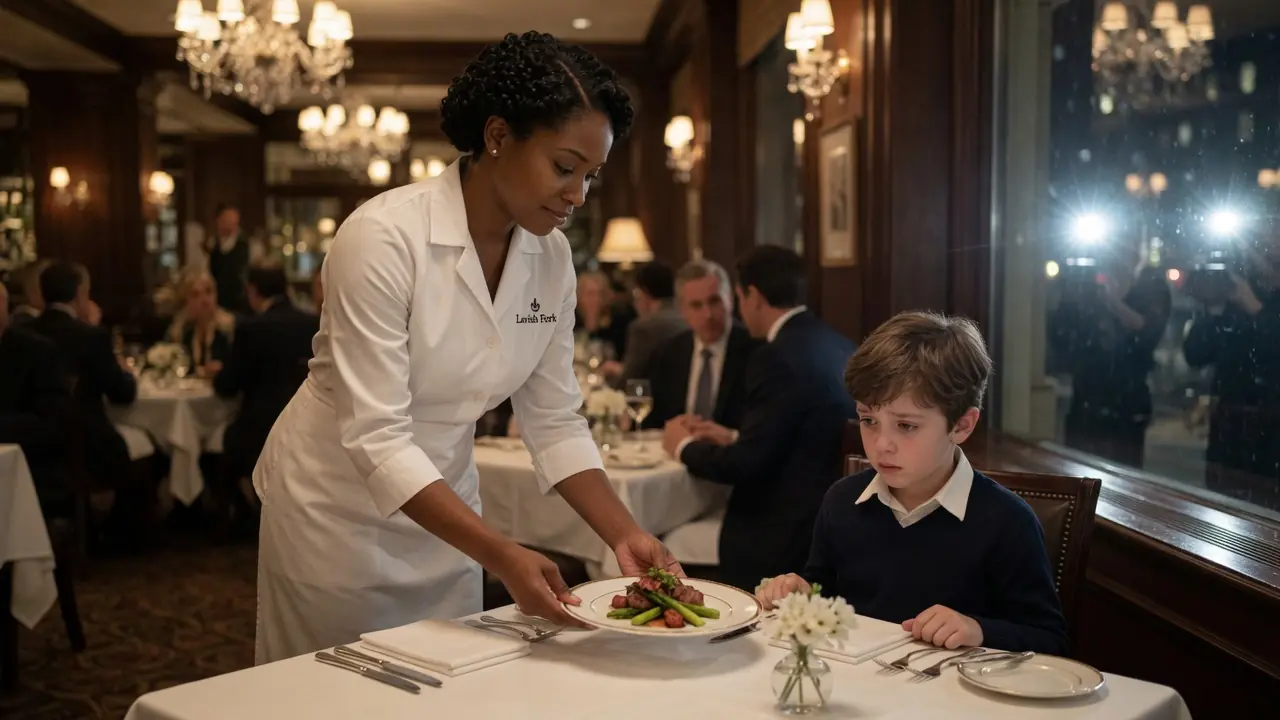
By early afternoon, the golden light pouring through the tall glass windows of Lavish Fork had turned harsh and scattered. The sun was high, bouncing off car roofs and storefronts outside, but it was the storm of camera flashes that truly shattered the room’s calm.
A film actor, famous, impossibly handsome, and endlessly trailed by paparazzi, had just stepped inside, and with him came chaos.
Outside, photographers clustered like vultures, snapping through the restaurant’s pristine glass facade. Bright flashes flickered across tables, catching in wine glasses, glinting off silverware, and slicing through the air like a strobe in a nightclub.
Guests murmured in hushed awe.
Some complained about the distraction.
Others took out phones, eager to join the spectacle.
But at one corner table near the window, something else was unfolding.
The boy couldn’t have been more than eight. He sat stiffly, hands gripping the linen tablecloth, eyes wide and glassy.
His name was Asher, though Nia wouldn’t learn that until later.
His shoulders twitched at each camera flash, his breaths growing shallow. He rocked slightly, a silent rhythm of rising panic.
His father, Preston Langford, had been with him just minutes before, but had stepped away for a phone call, leaving his son temporarily alone amid the thunder of lenses and murmurs.
Nia had been delivering a tray of artisanal sliders to a party of executives when she caught sight of the boy.
Something in the way his fingers clawed at his collar, in the stifled whimpers escaping his lips, made her freeze.
She had seen this before.
Her cousin’s son, diagnosed with sensory processing disorder, reacted the same way when overwhelmed.
This wasn’t a tantrum.
It was a full-body storm.
It started with small rocking, but in seconds his panic escalated. His fists pressed against the sides of his head, quick and sharp. Then he began gripping at his sleeves and arms in distress. His breathing was erratic, wild.
This wasn’t just discomfort.
It was danger.
Asher let out a strangled cry, curling into himself. His hands lashed out first at the air, then toward himself. His fingernails dragged against his forearms with desperate force, leaving angry red marks. One hand struck against his temple again and again.
The room didn’t notice.
Too focused on celebrity and wine.
But Nia did.
Instinct over protocol, she moved.
She placed her tray gently on the nearest table, ignoring the indignant look from a man in a suit expecting his aioli, and rushed to the boy’s side.
The boy was spiraling fast.
If no one stopped him, he might seriously hurt himself.
She had seen this before. This wasn’t the moment to hesitate.
“Hey, sweetheart,” she whispered, kneeling. “You’re okay. You’re safe.”
Her voice was low, calm, a balm against the onslaught of noise and flashing light.
She grabbed a linen napkin, folding it carefully over his eyes, blocking out the chaos. Her other hand reached for his, steadying it gently as he trembled.
“Breathe with me,” she said softly. “In and out, just like waves.”
For a moment, the restaurant faded.
The plates, the stares, the rules.
It was just Nia and a frightened boy who needed protecting.
Then came the voice.
“Miss Carter,” snapped Gregory Hensley, storming over with his mouth tight and cheeks flushed. “What exactly do you think you’re doing?”
His eyes flicked to the untouched table she had abandoned.
“Is this how you prioritize your responsibilities? Dropping trays to play nanny?”
Nia stood but didn’t back away.
“The child was hurting himself. He was overwhelmed. I couldn’t wait for someone else to notice.”
“Then let his parent handle it,” Gregory shot back. “You don’t get paid to play hero. You get paid to serve.”
A beat passed.
Somewhere behind them, someone dropped a fork.
Asher whimpered again, and Nia crouched beside him once more, shielding him from the confrontation.
Her voice didn’t rise, but it carried.
“If that were your child, would you have wanted someone to walk away?”
She looked down at the boy again, his hands trembling, his chest heaving. Her body shifted slightly to shield him, as if her presence alone could stop the world from tearing through him.
Gregory’s eyes narrowed.
“Don’t get smart with me. This is not a charity. It’s a business. And this,” he gestured toward her and the child with a disgusted scoff, “is a liability.”
A few heads turned now, whispers curling in the air.
One man near the bar, a tall gentleman in a crisp blazer, stood halfway, his brows furrowed.
“She did the right thing,” he said clearly, voice calm but steady.
Gregory didn’t even look his way.
“Thank you for your input, sir, but we run things by policy here.”
Then he turned back to Nia.
“Consider this your last shift.”
At that moment, Preston Langford returned, phone still in hand, eyes going immediately to his son, now curled against Nia’s chest.
He rushed forward, dropping to one knee.
“Asher,” he breathed.
Then he looked up at Nia.
Their eyes met briefly, his full of surprise and a kind of aching gratitude.
“Thank you,” he whispered, reaching for a business card from his coat. “Can I call you later?”
She nodded mutely, too shaken to speak.
He turned to his son, arms wrapping him close.
Gregory, now visibly uncomfortable, attempted to reclaim authority.
“Sir, I apologize for the scene. Our staff—”
Preston cut him off with a single glance, stood with Asher in his arms, and walked out the door without another word.
Nia stood there, her hands trembling.
Her heart thundered beneath her pressed shirt, not from fear, but from rage and disbelief.
She had done the right thing.
She knew it.
But still, she had been punished for stepping outside the lines drawn for people like her.
Rules over people.
Order over compassion.
She looked at the window, at the distorted reflections cast by flashes, and thought how quickly a person could become invisible if the world decided they weren’t the right kind of visible.
The bus ride home felt longer than usual, though the route hadn’t changed.
Nia sat near the window, the city outside blurred by grime-streaked glass and the heat of her thoughts pressing inward.
Her name tag was still clipped to her shirt, though her employment had already been erased.
The plastic square with “Nia — Section B” stared back at her from her lap like a cruel joke.
She unclipped it slowly, fingers trembling, and shoved it into her bag.
Around her, no one asked why she looked like she’d just been gutted.
Everyone on that late-night bus had their own quiet unravelings.
When she stepped through the door of their apartment, the smell of instant ramen hit her first, then the soft hum of Aaliyah’s voice singing along to something on her phone in the other room.
The sound was sweet and normal.
Painfully normal.
Nia stood in the doorway, shoes still on, shoulders heavy.
She didn’t want to ruin her sister’s night.
Not yet.
So she called out light and practiced.
“Everything okay in there?”
Aaliyah shouted back, “Studying, but I made you a bowl. It’s on the counter.”
The kitchen light buzzed faintly above her as she stood over the small chipped bowl of noodles.
She sat down, but the food stayed untouched.
Her fingers gripped the edge of the table, the weight of the afternoon pressed against her like wet cement.
The humiliation of being yelled at like a child in front of strangers.
The way Gregory’s voice cut through the room with sharp precision.
The indifference in his tone, like she was nothing more than a misbehaving utensil to be discarded.
The sting didn’t come from the loss of the job.
She had lost jobs before.
It was how easily a life could be dismissed. How quickly compassion became a liability when offered by the wrong kind of person.
Her mind replayed Asher’s trembling form, the way he flinched under the flashes, his thin hands clutching at his arms.
She had done what no one else did, what needed to be done, and for that she was punished.
Her chest ached, and before she could stop it, a sob broke through her throat. She muffled it with both hands, shoulders shaking silently in the dim kitchen.
The kind of cry that came not from weakness, but from the sheer effort of holding the world upright with hands that had never been given gloves.
She should have been angry.
And she was.
Furious, even.
But beneath the fire was something colder, a doubt that crept in, whispering in the voice of every boss who had ever called her “too much,” every customer who had looked through her.
Maybe it wasn’t your place.
Maybe compassion isn’t yours to offer.
Maybe rules weren’t made to include you.
She hated how those thoughts found room in her mind.
Later, long after Aaliyah had fallen asleep, Nia sat curled on the couch, laptop open, job boards blinking back at her.
The screen reflected her hollow eyes.
She typed slowly, then deleted, then typed again.
Part-time server.
Entry-level front desk.
Hotel night shift.
The listings felt like bruises waiting to form.
Her phone buzzed, the screen lighting up with an unknown number.
She ignored it.
Then it buzzed again.
She picked it up this time, heart already bracing for bad news or another rejection.
But the voice on the other end wasn’t a stranger.
“Hi, it’s Preston Langford from the restaurant. I’m sorry to call this late, but would you be willing to meet me tomorrow morning? I owe you a proper conversation and possibly a new beginning.”
Nia stared at the wall, stunned, the phone still pressed to her ear.
Something in his voice wasn’t just gratitude.
It was resolve.
Her breath caught.
In that moment, something shifted.
The world hadn’t forgotten her.
Not entirely.
And maybe, just maybe, she hadn’t made the wrong choice after all.
The next morning, Los Angeles was dressed in haze.
Sunlight filtered through a thin veil of coastal fog as Nia stood outside the mirrored entrance of Langford Holdings.
Her palms were slick despite the breeze, and the cheap flats she wore felt impossibly thin against the pristine marble beneath her.
She almost hadn’t come.
After hanging up the night before, she’d stared at the ceiling for hours, caught between fear and something dangerously close to hope.
Now, standing there with a rumbling stomach and questions she was too afraid to shape into words, Nia reminded herself that this was just a meeting.
Nothing more.
She wasn’t the kind of girl billionaires rescued.
Inside, the elevator chimed softly, delivering her to the 27th floor, where a receptionist greeted her with a polite smile, genuine even, and led her through a hallway lined with soft carpet and tall glass walls.
When Preston Langford appeared, it wasn’t with the aura of money or power she expected.
He looked tired, sleeves rolled up, no tie, a father who had spent the night watching over a child instead of stock markets.
He extended a hand, firm but warm.
“Thank you for coming. I wasn’t sure you would.”
“I almost didn’t,” Nia said honestly.
He nodded as if he understood completely.
“I won’t waste your time. I didn’t sleep much last night. Part guilt, part thinking. Watching you with Asher, I realized something that should have been obvious a long time ago. Not just about him, but about how people like you, people who actually give a damn, get treated.”
Nia didn’t know what to say.
Her instincts told her to stay silent, guarded.
She’d been through enough charm that curdled fast.
Preston continued, walking toward the window, speaking more to the cityscape than to her now.
“My son doesn’t connect with people easily, and yet he found safety in you, a stranger. That matters. Not just to me as a father, but to me as someone who’s built an empire on the backs of workers I rarely see.”
He turned then, eyes sharp with clarity.
“I own a restaurant group. Seventy-eight locations. We do well financially, but our culture needs a reset. And after yesterday, I realized I don’t need more people who can balance wine glasses on their fingertips. I need people with heart, with backbone.”
Nia blinked, unsure where this was going, her heart thudding in her chest like it was trying to escape.
“I’d like to offer you a position,” he said. “Not as a server. As a leadership trainee, paid, with a full scholarship to finish your degree in hospitality management. You’ll work closely with our senior team, help design how we hire, how we train, how we treat people. I want you to help us become what we should have been.”
The words felt impossible.
Nia gripped the armrest of the chair, afraid she might float right out of it.
“Why me?”
“Because rules shouldn’t punish people for doing the right thing,” Preston said simply. “And because my son asked this morning if the nice lady would come back.”
Her eyes burned, but she forced herself to speak steadily.
“You know, I don’t look like the people you usually put in leadership.”
He didn’t flinch.
“Exactly. That’s the point.”
For the first time in days, the weight in her chest lifted just a little.
Not gone, but loosened.
This wasn’t a rescue.
It was recognition.
And that, perhaps, was even more powerful.
She left the building an hour later with a contract in hand and something far rarer tucked behind her ribs: the sense that her story had paused, not ended.
The door that had slammed shut at Lavish Fork had only ever led here, to a room with tall glass windows and a chance she’d carved herself, one act of compassion at a time.
It had only been three weeks, but to Nia, it felt like stepping into another life.
The corporate offices of Langford Dining Concepts were nothing like the kitchens and break rooms she was used to.
No greasy tile floors.
No managers barking orders with clipped, performative smiles.
Here, people greeted her by name. Her ideas were not only heard, they were asked for.
She wore a badge that didn’t say “server,” but “leadership associate.”
At first, the title felt borrowed, too big for someone who still double-checked that her shoes weren’t scuffed. But with each meeting, each training session, each late-night class funded entirely by the company’s scholarship initiative, that badge began to fit.
Preston had kept his promise.
He paired her with Marisol Vega, the director of training and development, a sharp Puerto Rican woman who didn’t sugarcoat a single thing.
“You’ve got a hell of a voice,” she told Nia after their second session. “Now use it like it’s yours.”
Most days were a blur of note-taking and policy drafts, of observing kitchen teams and hosting small sessions where Nia would ask staff questions no one had asked them before.
What makes you feel invisible here?
What would respect look like to you in your role?
The answers were raw, sometimes painful, and always revealing.
She took it all in, building a framework of reform, not from theories, but from the ground-level truth she understood too well.
There were moments she doubted herself.
Deep, bone-level doubt, the kind that whispered that this seat at the table came with an expiration date.
But each time she felt it creeping in, something small pulled her back.
A thank-you email from a line cook.
A nod from a shift lead who had once brushed her off.
A quiet “I see you” from Marisol during a tense meeting when Nia had to push back on outdated protocol.
Still, nothing could have prepared her for the afternoon Preston walked into the office holding a manila folder and a smile that didn’t quite hide his excitement.
“Got a few minutes?” he asked.
They sat in the open-concept lounge overlooking the city skyline.
He handed her the folder.
“We’re opening a new concept restaurant downtown. Clean food, inclusive culture, community-built. And I want you to help launch it. Co-lead training, write the cultural ethos, help build the staff from the ground up.”
Nia stared at the folder, at her name typed beneath the title: Opening Leadership Team.
She couldn’t speak.
Preston leaned forward, voice softer now.
“This isn’t charity. You earned this. From the floor of Lavish Fork to here. You did that.”
She finally looked up, voice low but steady.
“I spent so long thinking the best I could do was survive other people’s expectations. I didn’t think I’d ever be allowed to build my own.”
Preston nodded, not as a man giving her permission, but as someone grateful to be part of the change.
“That’s the point, Nia. We don’t need to just change policy. We need to change what people expect of someone like you.”
That night, she sat on the worn couch back at the apartment, the contract beside her, textbooks open, Aaliyah humming in the kitchen.
The lamp buzzed faintly, same as always, but the space around her felt different. Wider, like she could finally breathe in it.
For the first time in a long time, her future wasn’t a narrow hallway lined with locked doors.
It was a room she was building herself.
And in that room, people like her didn’t have to ask for a seat.
They made their own table.
The story might have stayed quiet, just one woman’s private redemption in a city that forgot too quickly.
But fate had a different plan.
It began with a post written not by Preston or Nia, but by a woman who had been sitting three tables away at Lavish Fork the day Nia was fired.
Her words were simple but pointed.
I watched a waitress get scolded in public for comforting a child in distress. I watched a manager choose optics over compassion, and I watched everyone else look away. But not her.
The post included a blurred photo taken through a wine glass of Nia kneeling beside Asher, her hand on his back, shielding him from the world.
The post exploded overnight, shared thousands of times.
It became a kind of digital reckoning.
Hashtags bloomed.
Compassion is not unprofessional.
We serve with dignity.
Former employees of Lavish Fork commented anonymously, confirming a pattern of discrimination, of harshness cloaked in high standards.
Customers posted one-star reviews, not about the food, but the culture.
Within a week, Lavish Fork released a vague statement defending its policies while claiming to re-evaluate practices.
But it was too late.
The internet had moved on from outrage to action.
Nia, meanwhile, hadn’t seen the post until Marisol waved her over one morning, laptop open, eyes wide.
“Girl, you’ve gone viral. Not just kind of. Full-on, world-watching viral.”
Nia stared at the screen, stunned as comments scrolled past faster than she could read.
Some were angry.
Some poetic.
Some tearful.
But all of them spoke to the same truth.
That kindness, especially when offered by someone the world doesn’t expect it from, is revolution.
Preston’s team responded swiftly, resharing the post under the Langford Dining banner.
But they didn’t stop there.
They filmed a short video, part training, part tribute.
It opened with Nia’s voice, steady and calm.
“Service isn’t just about what’s on the plate. It’s about how people feel when they’re seen.”
The video was shown at every Langford restaurant, embedded into their onboarding program, and played during a hospitality conference that fall where Nia was invited to speak.
She stepped onto the stage with her badge still clipped to her blazer, the crowd larger than any dining room she’d ever worked.
She spoke of empathy, of dignity, of what it meant to hold space for someone else when the world was too loud.
She didn’t raise her voice.
She didn’t need to.
The impact was immediate.
Industry blogs picked up the speech.
Other restaurant groups began reviewing their conduct policies.
A national culinary magazine listed her as one of the 25 people redefining hospitality.
But none of that compared to the moment a handwritten letter arrived at her office.
It was from a young girl in Ohio working nights at a diner, dreaming of something more.
The letter read:
I didn’t think someone like me could ever change anything until I saw you.
Nia sat holding that letter long after her co-workers had left for the day, the words echoing in her bones.
Change hadn’t just happened to her.
It had passed through her, out into the world like ripples she never meant to make but could no longer stop.
She thought of the girl who had once believed survival was the best she could hope for.
And then she thought of this girl in Ohio, looking up, reaching out, daring to believe in more.
Maybe that was the quiet revolution.
Not in viral posts or headlines, but in the hearts that shifted even slightly because one woman refused to walk past a child in pain.
Because one woman stayed human in a world that asked her not to be.
The grand opening of Haven, the new Langford concept restaurant, was a quiet kind of electric.
No red carpet.
No celebrity chef holding court.
Just warm lights, reclaimed wood, and a staff that looked more like the city it served than any fine dining space in memory.
Nia stood near the host stand in a deep green blazer, her name embossed in gold on a badge that read: Culture and Experience Director.
It still felt surreal to see her title there in metal and weight.
But what mattered more was what she saw around her.
Line cooks laughing with servers.
Hosts checking in on dishwashers.
A team that wasn’t just trained, but trusted.
Preston walked up beside her, nodding toward the packed dining room.
“You did that,” he said quietly.
Nia shook her head with a small smile.
“We did. But yeah, I led it.”
They both laughed, but there was something deeper in her tone.
Confidence, rooted and earned.
Asher was there, too, curled in a booth with noise-canceling headphones, coloring peacefully while a staff member he had bonded with brought over a bowl of fries shaped like stars.
Nia watched him for a moment, remembering the boy curled on the floor weeks ago.
Her heart ached, but not in pain.
In pride.
She stepped into the kitchen, where the newest team members were finishing up the final push.
A young woman with braids like hers turned from the prep station and grinned.
“Chef says my sauce might make the cut for the permanent menu.”
“It better,” Nia said, then added gently, “and your voice does, too.”
Later that night, when the final table had cleared and the lights were low, Nia walked the perimeter of the restaurant alone.
She stopped near the window, where outside the same city kept rushing by, where the same rules still held too many people back.
But in here, in this space, something different pulsed.
It wasn’t just a restaurant.
It was proof that a girl like her, a waitress with a worn name tag and a full heart, could be more than what the world expected.
Could build something lasting.
Could rewrite the rulebook with the same hands that once carried trays no one saw.
As she turned to leave, her phone buzzed.
Another message.
Another story.
Another stranger saying, “You reminded me I mattered.”
Nia slipped the phone into her pocket and looked around one last time.
It wasn’t perfect.
And neither was she.
But in this place, imperfection was allowed to grow into purpose.
And kindness, the kind that had once cost her everything, now formed the foundation of what she stood on.
She smiled to herself, steady and quiet.
This table, this place, wasn’t given to her.
She built it piece by piece, heart by heart.
And now, finally, she had a seat she didn’t have to ask permission for.
She had become the story she once needed to hear.