Rain struck the windows of the roadside diner so hard that the neon OPEN sign trembled in its frame. The Beautiful Waitress stood behind the counter, wiping the same clean coffee cup for the third time while she watched the empty highway disappear beneath sheets of water. It was almost midnight, and every customer had left except an elderly trucker sleeping in the far booth. She was preparing to lock the door when a motorcycle slid sideways beneath the streetlight outside.
The rider fought the machine upright before the engine died. He remained bent over the handlebars for several seconds, breathing heavily while rain poured from his long dark hair and black leather vest. Then he looked behind him toward the highway, abandoned the motorcycle, and crossed the flooded parking lot with a painful limp. The diner door flew open, carrying cold wind and water across the tile.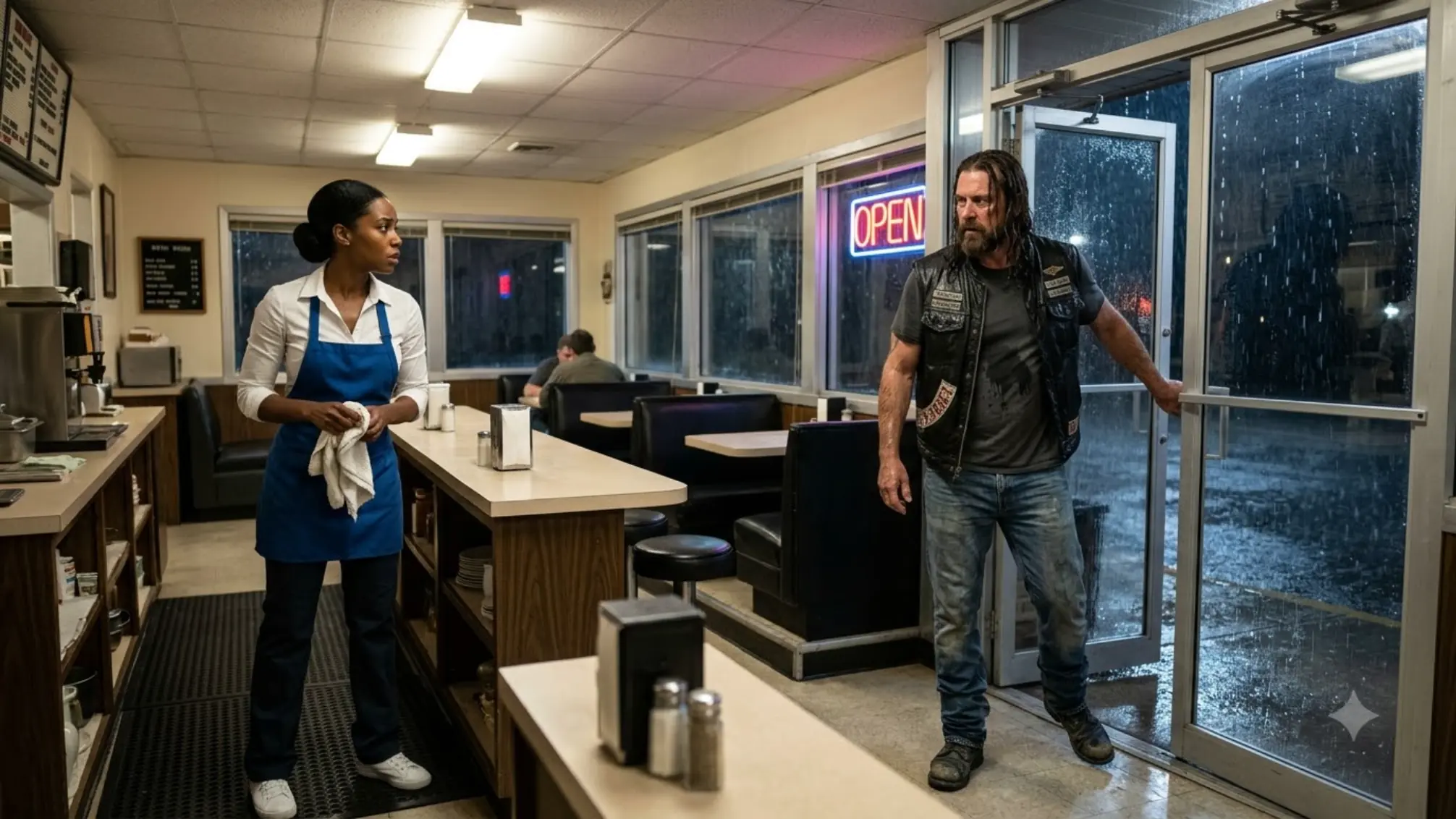
The Hell’s Angel Biker stood in the entrance with blood darkening one sleeve and fear hidden behind a hard expression. He was tall, broad, and intimidating enough to make most people reach for a phone, but the Beautiful Waitress noticed that he kept one empty hand raised where she could see it. His eyes moved immediately to the rear exit, the kitchen hallway, and the sleeping trucker. He was not searching for someone to hurt; he was searching for somewhere to survive.
He did not argue. The biker moved behind the counter, nearly falling when his injured leg struck a stool, and followed her through the swinging kitchen door. The Beautiful Waitress led him past the freezer and into a narrow storage room containing dry goods, cleaning supplies, and an old employee locker. She pulled aside a rolling shelf and revealed a maintenance space barely large enough for one man.
The biker stared at the opening. “Why do you have that?”
“My former manager used it to hide liquor from inspectors.”
The Beautiful Waitress handed him a clean kitchen towel and pointed toward the blood on his arm. Before he entered, he removed a small black memory card from inside his vest and pressed it into her palm. His fingers were cold, and his voice lost every trace of command.
Hell’s Angel Biker (urgently, closing her fingers around the card): “If they find me, get this to a state investigator—not local police.”
Beautiful Waitress (uneasily, staring at the card): “What is on it?”
Hell’s Angel Biker (grimly, stepping into hiding): “Enough to bury half the sheriff’s department.”
The first patrol car arrived thirty-eight seconds later. Its tires cut through the water and stopped sideways across the diner entrance, blocking the motorcycle from view of the highway. A second cruiser followed without sirens, then a black county SUV with no visible markings. The Beautiful Waitress rolled the shelf back into position and returned to the counter just as three officers entered.
The County Sergeant came first. He was a heavy white American man in his late forties with rain dripping from his hat and one hand resting near his belt. Two younger officers spread out behind him, checking booths and looking beneath tables without asking permission. The elderly trucker woke, saw the uniforms, and wisely remained silent.
County Sergeant (coldly, placing both hands on the counter): “A violent fugitive came through here.”
Beautiful Waitress (calmly, setting down the coffee cup): “Nobody came through that door except you.”
County Sergeant (threateningly, leaning closer): “His motorcycle is sitting outside.”
Beautiful Waitress (firmly, glancing toward the storm): “People abandon motorcycles when they crash. That doesn’t mean they walk into my diner.”
The County Sergeant studied her face. She had worked enough late shifts to recognize the difference between an officer asking questions and a man testing whether intimidation would succeed. His gaze moved across the kitchen entrance, the register, and the security monitor near the ceiling. He noticed one camera was active.
“Turn over the footage.”
“You need the manager.”
“I am speaking to the manager.”
The Beautiful Waitress hesitated. The diner’s owner lived forty miles away and trusted her with closing responsibilities, but he had never formally changed her title. The sergeant interpreted the hesitation as weakness and smiled. He walked around the end of the counter without invitation.
The Beautiful Waitress stepped into his path. “Customers are not allowed back here.”
“I am not a customer.”
“You are also not carrying a warrant.”
One younger officer looked uncomfortable. The other moved toward the kitchen door until the sergeant stopped him with a slight shake of the head. The Beautiful Waitress realized they were not conducting a lawful search because they did not want an official record showing where they had searched.
The sergeant reached up and unplugged the security monitor. The screen went black, but the recording system remained active inside a locked office cabinet. He did not know the difference. His confidence grew as though he had erased everything simply by removing the image from view.
County Sergeant (smirking, lowering his voice): “You are protecting the wrong man.”
Beautiful Waitress (coldly, folding her arms): “I told you no one came inside.”
County Sergeant (stepping close enough for her to smell coffee on his breath): “When we find him, your diner becomes part of his crime.”
Beautiful Waitress (holding his stare): “Then you better find evidence before you start writing lies.”
The elderly trucker shifted in his booth. The sergeant turned and asked whether he had seen anyone enter. The trucker looked toward the rain-soaked window and said he had been asleep. It was not completely true; he had seen the biker cross the parking lot, but he had also watched three officers enter like men hunting prey rather than protecting the public.
After ten minutes, the officers left. The County Sergeant remained outside beside the abandoned motorcycle, making a phone call beneath the diner awning. The Beautiful Waitress pretended to clean while studying his reflection in the window. She saw him strike the motorcycle’s fuel tank with his fist, then speak angrily into the phone before driving away.
She waited twenty minutes before moving the shelf. The Hell’s Angel Biker emerged pale and sweating, one hand pressed against his injured arm. He had heard every word through the thin wall. He looked at her differently now—not as a frightened civilian who had taken a reckless chance, but as someone who had stood between him and men carrying badges.
Beautiful Waitress (quietly, reaching for the first-aid box): “Sit down before you fall.”
Hell’s Angel Biker (gratefully, lowering himself onto a crate): “You didn’t even know my name.”
Beautiful Waitress (carefully cutting his torn sleeve): “Your name wouldn’t tell me whether those men were lying.”
Hell’s Angel Biker (watching her clean the wound): “Most people believe the badge first.”
Beautiful Waitress (softly, meeting his eyes): “Most people haven’t watched a badge unplug a camera without a warrant.”
His name was Bull, though he admitted it was a road name rather than the one printed on his license. He belonged to a motorcycle club whose public reputation made easy headlines whenever police needed someone frightening to blame. Bull explained that the club organized charity rides, emergency road assistance, and veterans’ support, but certain members also knew people in rough places. That made them useful witnesses when corrupt men became careless.
Three nights earlier, Bull had followed a distressed young woman from a highway gas station after she slipped a note beneath his coffee cup. The note said local officers were forcing women arrested for minor offenses to transport cash and illegal packages through county checkpoints. Those who refused were threatened with prison, violence, or losing custody of their children. The woman claimed the operation was led by the County Sergeant and protected by Sheriff Colton Reed.
Bull did not believe every detail immediately. He began watching.
That evening, he recorded the County Sergeant meeting two men behind an abandoned feed warehouse. The video showed deputies unloading sealed bags from a patrol SUV and transferring them into a private truck. It also captured Sheriff Reed discussing payment amounts, fake evidence reports, and the name of a woman who had disappeared after threatening to speak.
Bull’s presence was discovered when one deputy saw the reflection of his motorcycle in a warehouse window. He escaped through back roads, but a cruiser forced him into a ditch before he reached the highway. Someone fired at him as he ran, grazing his arm.
The Beautiful Waitress stopped bandaging him. “They fired at an unarmed man?”
“They expected everyone to believe the motorcycle gang started it.”
“Why not send the video immediately?”
“I tried. The county signal tower was blocking mobile data near the warehouse.”
Bull pointed toward the black memory card she had hidden inside her apron. The camera recording existed only there. If the sergeant recovered it, every victim connected to the investigation would lose their best chance of being believed.
The Beautiful Waitress finished the bandage and made a decision. She locked the front door, woke the trucker, and asked whether he could drive Bull somewhere safe without using the highway. The trucker looked at the vest, the blood, and the silent camera monitor. Then he looked at the waitress who had served him coffee for six years without ever asking him for a favor.
“I know every farm road between here and Springfield,” he said.
Bull refused to leave until he knew the memory card would be protected. The Beautiful Waitress placed it inside an empty sugar packet, sealed it with kitchen tape, and slipped it beneath the removable heel of her work shoe. Bull almost smiled.
“They will search your pockets.”
“They are welcome to.”
The trucker pulled his eighteen-wheeler beside the rear loading door. Bull hid behind stacks of empty produce crates inside the trailer while the Beautiful Waitress reopened the diner and waited. Ten minutes later, the truck rolled away through the rain.
She did not sleep that night.
At 7:15 the next morning, two county detectives returned with a warrant. This time the document authorized a search for weapons, illegal substances, stolen property, and evidence connected to an “armed biker assault.” The description was broad enough to search nearly everything.
The Beautiful Waitress called the diner owner. He arrived furious about the police attention and frightened about losing the business. Instead of defending her, he demanded to know whether she had helped the biker.
Diner Owner (nervously, pulling her aside): “Tell them whatever they want. I cannot lose this place.”
Beautiful Waitress (hurt but controlled, lowering her voice): “They are searching because they think fear makes everyone obedient.”
Diner Owner (angrily, pointing toward the officers): “You’re a waitress, not an investigator.”
Beautiful Waitress (firmly, removing her apron): “Today I’m the only person in this building who saw how they behaved.”
The officers searched the kitchen, freezer, office, storage room, garbage containers, and employee lockers. They found no biker, weapon, stolen property, or memory card. The County Sergeant arrived halfway through the search and stared at the Beautiful Waitress as though he could force the truth from her by refusing to blink.
He asked where Bull had gone.
She repeated that she never saw him.
He showed her a blurred photograph captured by a distant traffic camera. It revealed the biker walking toward the diner but did not show him entering. She acknowledged that the man might have crossed the parking lot and continued behind the building.
The County Sergeant hated answers he could not disprove.
Before leaving, he placed a folded violation notice on the counter. The county health department had suddenly received anonymous complaints about pests, contaminated food, and illegal storage areas inside the diner. An inspection was scheduled for the following morning.
The Beautiful Waitress understood the message.
Help them, or lose the diner.
At noon, the elderly trucker called from a prepaid phone. Bull was safe in a workshop owned by another biker seventy miles away. The memory card, however, still belonged with her because no one had searched her shoe.
Bull asked her to contact State Investigator Lena Cross. She used the public telephone inside a grocery store rather than her mobile phone. The investigator listened carefully, gave her a secure meeting location, and told her not to confront anyone.
The Beautiful Waitress delivered the card at 3:40 that afternoon. State technicians verified the video and began identifying the officers, vehicles, and license plates. Investigator Cross warned that arrests could not occur immediately because they needed warrants, backup, and protection for witnesses.
“Return to the diner,” she said. “Act normal.”
“What happens when they return?”
“We will be watching.”
That promise did not comfort her as much as the investigator intended.
By evening, rumors had spread through town. Social media posts claimed the Beautiful Waitress had helped an armed criminal escape. Anonymous comments accused the diner of serving as a biker hideout. Someone painted TRAITOR across the rear wall.
The diner owner fired her by telephone.
He said he was sorry.
She told him sorrow without courage was only another excuse.
The Beautiful Waitress returned after closing to collect her belongings. She stood alone behind the counter, touching the coffee machine, the order wheel, and the worn spot where her shoes had rested during thousands of shifts. She had spent eight years inside those walls, caring for customers who knew her name but apparently not her character.
Headlights appeared outside.
One black motorcycle rolled into the parking lot.
Then another.
Within seconds, the road began vibrating beneath the thunder of engines. Motorcycles arrived from both directions in disciplined lines, filling the diner lot, the closed gas station next door, and the field beyond the highway.
The Beautiful Waitress stepped toward the window.
Twenty bikes became fifty.
Fifty became one hundred.
The line continued until the highway lights stretched beyond what she could count.
By sunrise, nearly five hundred bikers surrounded the diner.
They did not carry weapons or shout threats. They parked in organized rows, removed their helmets, and stood peacefully beneath club banners from several states. Some wore the same Hell’s Angel patch as Bull, while others represented independent clubs, veterans’ groups, and motorcycle charities.
Bull entered the diner last.
His arm was bandaged, and exhaustion lined his face, but he was standing without fear. Behind him walked State Investigator Cross, two federal agents, and a state-police commander.
The Beautiful Waitress stared through the windows at the enormous crowd.
Beautiful Waitress (overwhelmed, looking toward the bikes): “Why are they all here?”
Hell’s Angel Biker (warmly, standing beside her): “Because one waitress protected one of us when everyone else looked away.”
Beautiful Waitress (emotionally, fighting tears): “I only hid you for a few minutes.”
Hell’s Angel Biker (gently, placing a hand over his heart): “Those minutes kept the truth alive.”
The five hundred bikers had not come to fight.
They had come to become witnesses.
Every phone was recording. News crews arrived after being notified by motorcycle organizations and civil-rights attorneys. State officers controlled the road, preventing the county department from entering without authorization.
At 8:12, Sheriff Reed arrived with six deputies.
He stopped when he saw the motorcycles.
The County Sergeant stepped from the second cruiser, looked toward Bull, and reached for his radio. Federal agents moved forward before he completed the call.
Investigator Cross presented arrest warrants for conspiracy, evidence tampering, trafficking, obstruction, and attempted murder. Sheriff Reed began shouting that the state had been manipulated by criminals.
Bull said nothing.
The video said enough.
The County Sergeant looked toward the Beautiful Waitress. Hatred replaced authority in his face.
County Sergeant (furious, struggling as agents restrain him): “You threw your life away for a biker.”
Beautiful Waitress (coldly, standing behind the counter): “No. I stopped you from throwing away everyone else’s.”
Investigators searched the sheriff’s office, warehouse, patrol vehicles, and several private properties. They found falsified arrest reports, hidden cash, seized narcotics never entered into evidence, and records documenting payments from a regional trafficking organization.
The missing woman Bull mentioned was found alive in another state. She had escaped after officers threatened her family and agreed to testify once she learned the operation had been exposed.
Eight deputies were charged.
Two cooperated and revealed how the County Sergeant selected vulnerable people to use as couriers. Sheriff Reed had protected the scheme by assigning complaints to loyal investigators and discrediting witnesses as addicts, criminals, or unstable women.
Bull’s video became the evidence that connected every separate allegation.
The diner footage mattered too. It showed the County Sergeant entering without lawful authority, unplugging the security monitor, threatening the Beautiful Waitress, and directing officers to search only after learning Bull had escaped.
The diner owner watched the footage on television.
He called the Beautiful Waitress and offered her job back.
She declined.
Twenty-four hours after she hid Bull, the motorcycle clubs raised enough money to purchase the struggling diner from its frightened owner. They did not ask the Beautiful Waitress to become an employee.
They asked her to become the owner.
She initially refused because she had no experience running a business. Bull reminded her that she had already kept the place alive through late shifts, broken equipment, staff shortages, and an armed corruption investigation.
“You know the work,” he said. “Now the name on the door catches up.”
The diner reopened three months later under new ownership. A small brass plaque appeared beside the entrance:
NO ONE WHO ASKS FOR SAFETY WILL BE TURNED AWAY.
The Beautiful Waitress hired the elderly trucker’s daughter as manager and gave the former owner’s frightened employees the option to return. She also reserved one booth for travelers who needed food but could not pay.
Bull visited every Thursday evening.
He always sat near the kitchen door, ordered chili and cornbread, and left a tip larger than the meal. He never spoke publicly about the night he entered wounded because the story did not belong only to him.
It belonged to the woman who recognized fear behind a frightening vest.
One year after the arrests, the bikers returned for a charity ride supporting victims of official corruption. They did not bring five hundred motorcycles this time.
They brought more than seven hundred.
The Beautiful Waitress stood beneath the diner sign as the engines quieted. Bull approached with a framed photograph showing the original five hundred bikes filling the storm-dark parking lot.
“You saved my life,” he said.
She shook her head.
“I opened a storage room.”
Bull looked toward the diner crowded with families, veterans, travelers, and bikers sharing tables without fear.
“You opened more than that.”
The night Bull arrived, the Beautiful Waitress believed she was choosing whether to hide one stranger for a few minutes. She could not see the women being forced into crimes, the money hidden behind badges, or the officers who had built power from everyone else’s silence.
She saw only a wounded man asking for time.
She gave it to him.
Twenty-four hours later, five hundred bikers surrounded her diner—not to demand revenge, but to ensure the woman who protected one of them would never stand alone when the truth arrived.