On a stormy winter night in Maine, a woman quietly cleaned up the diner after the last customer left.
Just as she reached to turn down the lights, the door suddenly blew open.
An old man staggered in, his face pale from the cold, his coat soaked with snow, his hands shaking so badly he could barely hold himself upright.
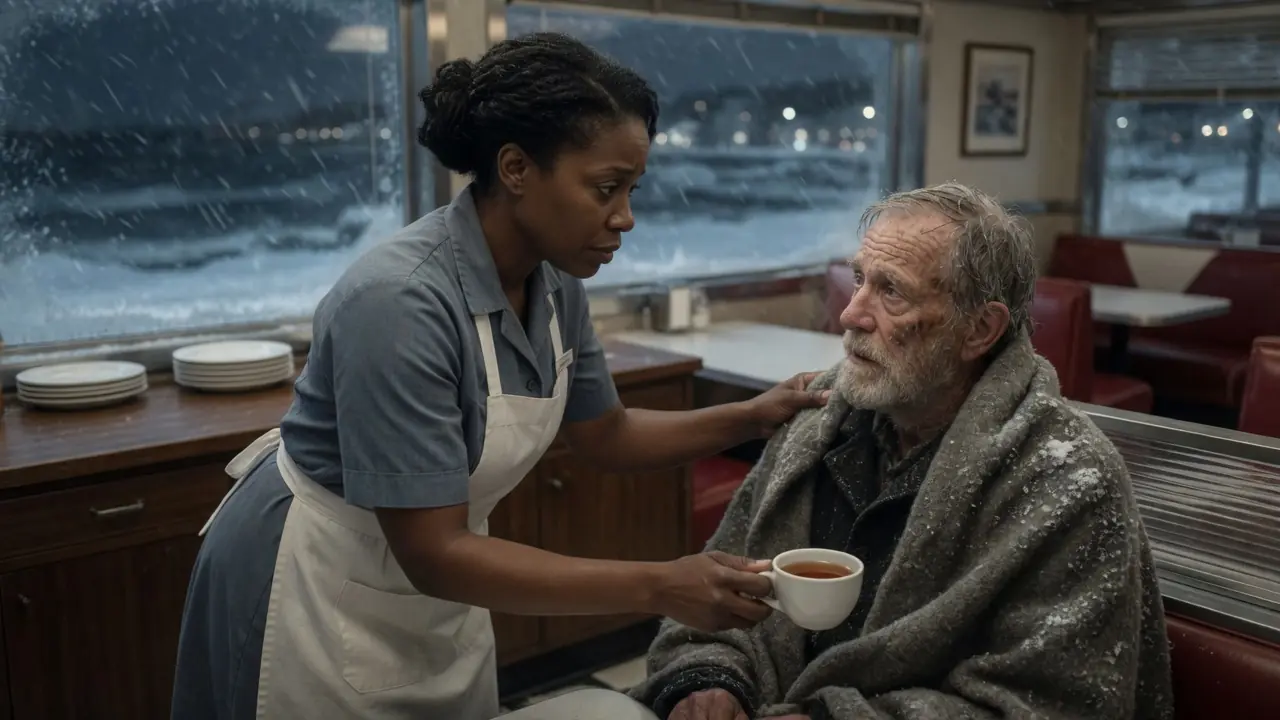
Startled, she rushed over, wrapped a blanket around his shoulders, and made him a cup of hot tea to warm his trembling hands.
What she did not expect was that the stranger she had helped was not just any old man.
He was the father of a wealthy billionaire.
And by morning, that one act of kindness would pull her out of hiding, uncover a buried truth, and change her life forever.
The storm had been beating against Harbor Light Diner since late afternoon.
But by the time the dinner crowd thinned and the neon sign outside flickered into its reddish glow, the wind had taken on a deeper, heavier voice.
It pressed against the glass, rattled the old window frames, and pushed snow across the parking lot in wild white sheets.
Lydia Crane stood behind the counter, wiping the same circular patch she had already cleaned twice.
The rag was warm from her hand. The smell of lemon disinfectant rose faintly through the sharper scents of coffee, fried onions, and old grease that clung to the air no matter how many times she cleaned.
She could feel the cold pushing in from the walls.
It always did on nights like this.
Old buildings had their own ways of complaining.
Mr. Winters, wrapped in his faded green wool coat, pulled his scarf tighter around his neck. His breath made a little cloud each time he sighed. He was the last customer in the place, sitting at his usual booth near the window, though he kept glancing nervously at the whiteout outside as if expecting the storm to reach inside and carry him away.
“You should close up, Lydia,” he said as she headed toward him with his check. “This isn’t a regular storm. Radio said it’ll get worse before morning. No one else is coming out in this mess.”
Lydia offered a small smile, the kind she used when she did not want to argue but also did not want to agree.
“You know I like to stay open a little longer when the weather gets bad.”
Mr. Winters tapped the edge of the check with a shaky finger before pushing a few bills onto the table.
“Yeah, and you know I’m going to keep telling you that you’re too kind for your own good.”
She laughed softly.
“Maybe. But kindness doesn’t cost much.”
He snorted.
“Spoken like a woman who hasn’t been on this earth long enough.”
“I’m thirty-nine.”
“Exactly,” he said, sliding out of the booth with a grunt. “Still young.”
She helped him with his coat sleeves, brushing a bit of lint from his shoulder.
He patted her hand absentmindedly, the way older men sometimes did when they felt fond and did not know how else to show it.
“You take care, Lydia,” he said, voice crackling with age. “And please lock the door behind me.”
“I’ll be fine, Mr. Winters,” she said gently. “Drive safe.”
He stepped outside.
A blast of snow and wind rushed in behind him, swirling around her ankles before she forced the door shut. For a moment, she watched his taillights vanish into a curtain of white.
Then silence fell.
Only the refrigerator humming.
The old heater breathing in slow, weary bursts.
The small television in the corner muttering about road closures and emergency advisories.
Lydia flipped the open sign a little to the right.
Not closed.
Not exactly open either.
Just slightly off-kilter, the way she always left it during storms.
She knew it was silly. The whole town knew Harbor Light stayed open late in bad weather because people got stranded or needed warmth or simply did not want to go home and sit alone.
Her mother used to say, “If you keep a light on, someone will eventually come in from the dark.”
Lydia did not have much left of her mother except that memory.
That, and this diner.
This little stubborn, imperfect place that she had clung to after her life fell apart.
She returned to the counter and counted the drawer.
Forty-seven dollars and change.
Not good.
Not disastrous.
Just another evening in the slow season.
She tucked the money into the register and sat on the stool, rolling her shoulders to loosen the knots that always built up near closing time.
The storm pressed against the windows again.
The neon sign flickered.
The lights buzzed overhead.
The place felt strangely expectant, like a theater stage waiting for someone to walk in and start the play.
“Just one more hour,” she told herself. “One more, in case someone needs a warm seat tonight.”
When she reached over to turn down the television volume, she caught her reflection on the darkened screen.
Tired eyes.
Hair escaping from her bun.
Apron creased.
Not the woman she used to be.
Not the woman in crisp suits and expensive heels, the one who used to walk through glass towers in New York with a tablet in one hand and a coffee in the other, the one who understood spreadsheets and risk exposure and regulatory filings better than most men who outranked her.
That woman felt like an echo now.
Soft.
Barely there.
She touched the photo tucked into the edge of her wallet, her younger self smiling at a corporate event, champagne in hand, confidence shining from her face.
Then she slid it back out of sight.
The wind howled low and long, like a warning.
Then the diner door slammed open with such force that the bell above it clanged wildly against the glass.
A rush of snow swirled inside.
The temperature dropped instantly.
And an old man, thin, shivering, and covered in white, stumbled over the threshold.
Lydia’s heart lurched.
He looked as if he had been carved out of the storm itself.
His coat was far too thin for Maine in winter, a light wool fabric that hung heavy with melting snow. His hair and beard were frosted. His cheeks were pale. His lips trembled. He blinked the snow from his lashes and tried to steady himself against the doorframe.
“Sorry,” he whispered. “I saw the light.”
Then he swayed.
Lydia darted around the counter and caught his elbows just as his knees began to buckle.
“I’ve got you,” she said firmly. “Come in, sir. Come in.”
His breath was shallow, and his hands felt like ice through her fingers.
She guided him toward the booth closest to the heater. The leather seat squeaked beneath his weight as he sank into it.
Without a word, she reached for the emergency blanket she kept behind the counter, a thin silver thing that crinkled as she wrapped it around his shoulders.
She raised the heater a notch.
The small orange glow brightened, humming louder.
“Thank you,” he whispered, voice thin. “I wasn’t sure I’d make it anywhere.”
“You made it,” she said, kneeling beside him to look at his face. “You’re safe now. What happened? Where were you coming from?”
He tried to rub warmth into his fingers, but they did not seem to obey him.
“Cab dropped me off. Wrong place, I think. I couldn’t see anything. Everything was white.”
She nodded slowly.
The storm was cruel tonight. Even people who lived in Fair Haven could lose their bearings in weather like this.
“Let me get you something hot to drink,” she said. “Tea, coffee, something warm.”
He nodded.
“Tea, please.”
As she prepared it, she watched him through the rising steam of the kettle. He sat hunched, shoulders trembling, the emergency blanket shining softly under the diner’s yellow lights.
The sight made her chest tighten with worry.
When she brought him the cup, he wrapped both hands around it and closed his eyes almost as if praying over the warmth.
“You’re very kind,” he murmured. “Most places would have been closed.”
She gave him a small smile.
“Some nights, you just keep the light on.”
He let out a weak laugh.
“Your mother must have said that, too.”
Her breath caught slightly.
“Yes,” she said. “She did.”
Silence settled in again.
Not uncomfortable this time.
Just quiet, soft, like snow falling.
After a few minutes, some color returned to the man’s face. His trembling slowed. He pushed wet strands of hair back from his forehead.
“Can I ask your name?” he said.
“Lydia Crane.”
He nodded.
“Lydia. That’s a lovely name.”
He held out one cold, frail hand.
“I’m Arthur. Arthur Holloway.”
His handshake was gentle, but something about the name tugged faintly at her memory.
Not from her personal life.
Somewhere else.
A headline.
A press release.
A financial news segment.
She could not quite place it, but right now it did not matter who he was.
He was a man who had almost frozen in a storm.
That was enough.
“Arthur,” she said softly. “Do you know where you were trying to go? Maybe I can help you call someone.”
The address was written in neat, careful handwriting.
Crestview Residence
Apt. 1201
Marine Lake View
Fair Haven
Lydia lifted her eyebrows slightly.
Crestview was one of the most expensive apartment buildings in the region, a modern glass-and-steel structure overlooking the lake. Executives, surgeons, investors, and high-profile people lived there.
She had seen photos.
She had passed it a few times on her way to the grocery store.
It always looked like a place where even the air cost money.
She looked at Arthur’s worn shoes, his thin coat, the frayed cuffs on his sleeves.
It did not match.
“Are you visiting someone there?” she asked carefully.
“My son,” Arthur said.
His voice warmed with pride and sadness intertwined.
“I haven’t seen him in two years.”
A soft ache bloomed in her chest.
“That’s a long time.”
He nodded.
She brought out a paper map she kept for customers. With him watching, she circled where Crestview Residence was located. It was several blocks in the opposite direction from where he had come.
The fact that he had wandered this far in the blizzard felt like a miracle.
“I should have called before I came,” he said, shaking his head. “I just wanted to surprise him. Show up like we used to.”
Lydia smiled gently.
“Surprises can be good sometimes.”
“Yes,” he said. “But I think I misjudged this one.”
He pressed his hands against the warm surface of the mug as though trying to thaw decades of distance.
When he finished his tea, she brought him a small bowl of soup. Nothing fancy, just chicken broth with noodles, but he accepted it as if she had offered him gold.
After a few bites, a tired smile appeared on his face.
“This is wonderful,” he said, voice easing. “Thank you.”
She watched him eat.
He took slow, grateful spoonfuls, pausing often to warm his fingers again.
As the minutes passed, his eyelids began to droop.
“You’re exhausted,” she said softly.
He nodded.
“Walked too long.”
“There’s a small room in the back,” she said. “It’s just a storage room with a cot, but it’s warm. You can rest there until the storm calms.”
He blinked at her, surprised.
“You’d let me do that?”
“Of course,” she said. “I’m not going to send you back out there.”
Emotion flickered across his face.
Something like gratitude mixed with humility.
“You remind me of someone,” he said. “My wife. She always believed the world needed more people who did the right thing even when no one was watching.”
Lydia swallowed gently, feeling that old familiar sting in her throat, the one that came whenever someone unintentionally brushed against the tender places of her own past.
She led Arthur to the back room.
The hallway creaked under their steps. The storage room was small, piled with boxes and old menus, but warm. The cot along the wall had a thin mattress, but she added two extra blankets.
“Thank you, Lydia,” he said, voice rasping with sleep.
“Rest,” she replied. “You can call your son again later.”
He nodded weakly and pulled his phone from his pocket.
She lingered by the door as he made the call, mostly because she did not want him to fall asleep without finishing the message.
The phone rang once.
Twice.
Three times.
Then a voicemail beeped.
“Adrian,” Arthur said softly. “It’s Dad. I’m in Fair Haven. I hope I’m close to the right place. I’ll try again later. I’d like to see you, son.”
He hung up.
His eyes glistened under the dim backlight of the phone.
“Sometimes,” he whispered, “the hardest doors to open are the ones that used to be easy.”
Lydia felt something tug painfully inside her.
She did not have children, but she knew what it was like to reach out and have no one reach back.
“You should sleep,” she said gently. “I’ll be right in the next room.”
He settled onto the cot as she pulled the door halfway shut.
She paused one last time to check that he was warm enough and breathing comfortably.
He already seemed more peaceful.
She returned to the front of the diner, turned down the heater a notch, and wiped her damp hands on her apron.
But the moment she stepped behind the counter again, she froze.
Arthur Holloway.
The name finally clicked.
Holloway Innovations.
Her breath caught.
Adrian Holloway, billionaire founder and CEO, rising star in technology, known for his efficiency, brutal standards, and cold-eyed business decisions. She had seen his face in financial news segments. She had read articles about his ambitious expansions last year. She had even watched a clip of him speaking to the board of a major investment group.
The resemblance was there.
The sharpness in the jawline.
The set of the mouth, softened now by age and sadness.
Her pulse quickened.
She took a deep breath, grounding herself.
It should not matter who Arthur was.
It should not matter whose father he was.
Arthur was a man who had nearly frozen in the storm.
He had needed help.
She had helped.
That was all.
Still, she felt something shift inside her.
Something like gears turning in the dark.
She could not explain it, but she knew this night was going to change something.
Maybe many things.
The storm outside howled stronger, hitting the diner like a restless sea.
She poured herself a cup of coffee and sat in the booth across from the windows. The neon sign sent little red pulses across the floor. She watched the snow pile higher and higher outside.
As the minutes ticked on, exhaustion pulled gently at her eyes, but she stayed awake, watching, listening, making sure the light stayed on for someone out there still fighting the storm.
For Arthur sleeping in the back room.
For whatever was coming next.
The storm did not rest.
Hours seemed to fold into one another, marked only by the changing shapes of the snow on the windows and the way the neon sign outside brightened and dimmed behind the shifting curtain of white.
Lydia nursed her coffee until it went lukewarm, then switched to hot tea, more for something to hold than anything else.
From the back room, she heard the faint sound of Arthur’s snoring now and then, soft and uneven, like a tired engine finally settling down.
Every so often, she stood in the doorway to check on him. He lay on his side, one hand tucked under his cheek, the emergency blanket crinkled over his shoulders, breathing slow and steady.
Each time she saw him asleep and safe, some small knot inside her loosened.
The town outside felt abandoned.
No headlights swept by.
The usual distant hum of traffic was gone, replaced by the dull roar of wind. Somewhere far off, a plow growled, then faded again.
She checked her phone.
No new messages.
A weather alert warned of whiteout conditions through the night.
Another part of her mind, the part that used to live inside schedules and risk assessments, noted the rising danger of staying open.
But the part of her that had led Arthur to the cot simply would not let her lock the door.
She turned off the television to save power and let the quiet fill in.
The fluorescent lights buzzed overhead.
The heater rattled a little, then steadied.
Minutes stretched.
She had just started wiping out the coffee pots, listening to the slow scrape of the sponge against glass, when a different sound cut through the wind.
A low rumble that grew louder.
She straightened, heart picking up.
The rumble became a growl, then a crunching, heavy noise.
Headlights swung across the front windows, bright and harsh, cutting through the snowstorm like two white knives.
The light slid across the empty booths, across the counter, across her face.
A large dark shape eased into the parking lot.
Even through the snow, she could see the outline.
A SUV.
Big.
Expensive.
Its engine humming low.
Lydia wiped her wet hands on her apron and moved toward the front, stopping just short of the door.
The SUV’s engine shut off.
For a moment, everything went quiet except for the wind.
The driver’s door opened.
A man stepped out, shoulders squared against the storm. His coat collar was up. The wind whipped at his clothes and tried to steal his hat, but he moved quickly with the kind of purpose that did not falter under bad weather.
He reached the diner door, grabbed the handle, and tugged.
The bell above the door chimed as he stepped inside.
A swirl of snow followed him, then died as the door closed behind him.
For a heartbeat, he just stood there catching his breath.
Lydia took him in with one long glance, the way she had learned to do years ago.
The dark wool coat that looked expensive but practical.
The polished shoes now dusted with snow.
The soft leather gloves in one hand.
His hair was a little damp from the storm, but neatly cut. His face was sharper than Arthur’s, edges not yet softened by age. His blue eyes, an echo of Arthur’s, were alert and cool.
He did not look around with the shy curiosity of a stranger.
He scanned the room like a man used to walking into spaces and assuming they would bend to his purpose.
His gaze found her.
It lingered, evaluating, measuring.
“Good evening,” Lydia said, keeping her voice even. “You picked quite a night to go out driving.”
He pulled in a long breath, then let it out slowly, as if steadying himself.
“I received a voicemail,” he said.
His voice was lower than Arthur’s, smoother, carrying a faint trace of the city.
“From my father. He said he was in Fair Haven. He sounded disoriented. Is he here?”
The words hung in the warm air like a dropped plate, ready to shatter.
Lydia let herself exhale.
Of course.
The son.
The one whose name carried weight in business articles and investor calls.
She had known this moment would come the second Arthur had said Adrian Holloway and closed his eyes.
“Yes,” she said quietly. “He’s here. He’s resting in the back. He walked a long way in the storm. He was in bad shape when he got here.”
The man’s shoulders seemed to relax by a hair, but his jaw tightened.
“Is he all right now?”
“He’s warm. He’s fed. He’s sleeping.”
She let a hint of firmness into her tone.
“And he needs to stay that way for a while.”
Adrian glanced toward the back hallway as if he could see through the walls.
Then he turned back to her.
“I’d like to see him.”
There was no arrogance in the words, but there was quiet expectation, as if he were stating something obvious and inevitable.
Lydia hesitated.
She pictured Arthur’s lined face, his bone-deep exhaustion, the way he had almost collapsed on her floor, the raspy whisper when he said he was not sure he would make it anywhere.
She also pictured a son driving through a blizzard late at night because of a worried voicemail, the raw edge in his voice when he asked if Arthur was all right.
She drew in a breath.
“I’m not going to wake him,” she said. “He barely made it here. His body needs rest. You can see him when he wakes up on his own.”
Those cool blue eyes focused on her more sharply.
“You don’t understand,” he said. “He’s my father. I need to know—”
“You do know,” she said gently but firmly. “I just told you he’s warm, safe, and sleeping. You’re welcome to sit down, have a coffee, and wait for him. But I’m not waking him up so you can ask questions he won’t be able to answer properly until he’s rested.”
The air between them seemed to shift.
He straightened, coat settling around him.
“I’m responsible for him,” he said, not loud but edged. “He’s elderly. He’s not well. I flew in from New York and drove through a whiteout to get here. I appreciate what you’ve done for him, but you don’t get to decide.”
“I get to decide not to drag an exhausted old man out of bed because his son doesn’t like waiting,” Lydia replied. “That’s all I’m deciding.”
For a second, they just stared at each other.
Lydia felt her heart thudding a little harder than usual, but she kept her breathing steady.
She had been in rooms with men who controlled millions of dollars. She had sat at conference tables while they shouted and tried to bully her into changing numbers on a spreadsheet.
She had survived that.
She could handle one worried son in a storm.
His eyes searched her face.
A muscle jumped near his temple.
He looked like a man who rarely heard the word no and did not quite know what to do with it.
Something in his expression shifted.
Not quite softening.
But cooling.
Settling.
“What did you say your name was?” he asked.
“I didn’t,” she said. “But it’s Lydia.”
“Lydia Crane.”
He gave a small nod.
“I’m Adrian Holloway.”
“I know,” she answered before she could think better of it.
His eyebrows lifted slightly.
“You know me?”
“I read the news,” she said, shrugging one shoulder. “I used to work in finance. Your face pops up on screens sometimes.”
For the first time, something like discomfort flickered across his features.
His gaze slipped away from her for a moment, scanning the diner instead.
The old booths.
The worn tile.
The coffee-stained counter.
He seemed out of place here, like an expensive briefcase left at a bus stop.
“I see,” he said.
The heater clicked louder, filling the silence that followed.
“Look,” Lydia went on, softening her tone a little. “You’re worried. I understand. Why don’t you sit down? I’ll make you something hot. You’re not doing your father any favors if you’re half frozen yourself when he wakes up.”
He hesitated.
Then he let out a breath that sounded more like defeat than agreement.
“Fine,” he said quietly. “I’ll wait.”
He shrugged off his coat, revealing a dark suit underneath, simple, tailored, clearly not bought off the rack. He laid the coat carefully over the back of a chair, then stepped to the counter and chose a stool.
His movements were controlled, like he was always aware someone might be watching.
Lydia poured fresh coffee into a heavy white mug and set it in front of him.
“Cream? Sugar?”
“ is fine.”
He wrapped one hand around the mug, absorbing the heat, but he did not drink right away.
He seemed somewhere else for a moment, listening to a storm inside his own head.
Lydia busied herself behind the counter, giving him a little space. She refilled the napkin holder, straightened a jar of sugar packets that did not really need straightening.
After a while, he said, “So, he just walked in here?”
She looked up.
His eyes were on the coffee, not on her.
“The door blew open, and he all but fell through it,” she said. “He was soaked to the bone and shaking so hard I thought he might break. His coat isn’t warm enough for this weather.”
Adrian closed his eyes briefly.
His hand tightened around the mug.
“He’s not supposed to be traveling alone,” he said, voice low. “He knows that. He has a tendency to think he’s still forty.”
Lydia thought of Arthur’s stubborn smile, the pride in his voice when he said he wanted to surprise his son.
“He just wanted to see you,” she said gently.
Adrian’s jaw clenched.
He took a sip of coffee, perhaps more harshly than he meant to.
“I told him I would come visit him in the spring,” he said. “When things calmed down.”
He gave a faint, humorless laugh.
“Apparently, work has been calming down for two years.”
There was an ache in the way he said it, as if he were quoting his own excuses back to himself.
Lydia leaned on the counter with one hand, watching him.
Snow hissed softly against the windows.
The neon sign outside buzzed and flickered.
“I think he got tired of waiting,” she said quietly. “So he came to you.”
Adrian did not answer.
His eyes stayed fixed on the rising little curls of steam.
In the back of the diner, a pipe banged once, twice, as the heater shifted into a higher gear.
The sound made them both glance up.
“That heater sounds like it’s about to die,” Adrian said.
A faint humorless smile touched his lips.
“He’s been dying for years,” Lydia answered. “He’s too stubborn to stop.”
He huffed almost a laugh.
Some of the tension left his shoulders.
“So this is your place?” he asked after a moment. “You own it?”
“Manage it,” she said. “The building belongs to a family in town. I keep the lights on, the coffee flowing, and the grill from exploding. In exchange, I get to call it mine from open to close.”
He looked around again more carefully.
“You keep it open in storms like this. For what? Three customers all night?”
“Tonight it was one,” she said. “And your father.”
He frowned slightly.
“That can’t be good for business.”
“It isn’t,” she agreed. “But it’s good for people.”
His gaze returned to hers, sharp.
“You always choose people over business?”
She held his stare.
“I try to. I did not always work for people who agreed with that.”
Their eyes locked for a beat.
There was a question in his, but he let it go for now.
The wind howled outside, as if irritated by their quiet conversation.
A sudden flash lit up the windows.
A bright blue-white blink that turned everything momentarily stark.
Lydia felt the hair on her arms rise.
A second later, the lights in the diner flickered once.
Twice.
Then everything went dark.
The heater cut off.
The hum of the refrigerator died.
The neon sign outside vanished.
The only sound was the wind and the sudden surprising silence of a world without electricity.
For a moment, Lydia saw nothing.
Just pitch .
“Great,” she muttered under her breath.
From the stool, Adrian said, “Is this normal?”
“More than you’d think,” she said, forcing a calmness she almost felt. “Welcome to Fair Haven in a blizzard.”
She reached under the counter, hands moving by memory, and found the flashlight.
A click.
A soft yellow beam cut through the dark, bouncing off chrome and glass and the curve of Adrian’s jaw.
His eyes seemed different in the half-light.
Less composed.
More human.
“I’ve got candles in the back,” she said. “Stay put. No sudden moves. Last thing I need is a CEO breaking his neck in my diner during a power outage.”
The corner of his mouth twitched.
“I’ll do my best.”
She headed down the hallway, flashlight beam jittering over the walls. As she passed the storage room, she paused, listening.
Arthur was still snoring softly, oblivious.
She exhaled in relief and continued to a small closet near the kitchen. The candle box sat on the top shelf, tall glass ones from the hardware store, short stumpy ones in little tins, a hodgepodge collected over the years.
She gathered several in her arms.
As she turned back toward the dining area, she nearly ran into Adrian, who had followed her halfway down the hall.
“I thought I told you not to move,” she said, startled.
“I’m not very good at sitting still,” he replied. “Let me help.”
She hesitated, then nodded toward the dining room.
“Take a few. Put one on each table. Matches are in the box.”
He took three candles, their glass sides clinking softly, and followed her out.
They moved through the dark diner like two people crossing a moonlit stage, the flashlight beam and the first candle flame slowly pushing back the shadows.
One by one, small circles of light bloomed.
The booths, the napkin dispensers, the salt and pepper shakers, all took on a warm, gentle glow.
The storm outside turned the windows into dim ghostly frames.
But inside, the shadows softened.
“Not bad,” Adrian said quietly as he lit another wick. “I have to admit, this is more atmospheric than a boardroom.”
“Depends on the boardroom,” Lydia replied.
He watched the flame steady itself.
“I don’t think I’ve been in a room lit by candles since... I don’t know when. Everything in my world has backlighting and screen glare.”
She smiled.
“Well, enjoy the throwback. No Wi-Fi, no power, no conference calls. Just you, me, and an old heater who might never forgive us for the strain.”
He chuckled softly.
When they had finished setting up the candles, the diner looked almost like a different place. The harsh fluorescent lights were gone. In their place, gentle pools of yellow and orange made the booths look inviting, almost cozy.
The counter gleamed faintly.
The chrome edges of the stools glinted.
Lydia felt some of her own tension ease.
Candlelight made everything slower, quieter. It left less room for sharp angles and hard truths and more space for pauses.
Adrian returned to his stool.
She went behind the counter and relit a burner on the gas stove. The blue flame came alive with a little whoosh.
“Power’s out, but gas still works,” she said. “You hungry?”
“I am,” he admitted, sounding almost surprised. “I don’t think I’ve eaten since early afternoon.”
“Some night to skip dinner,” she said. “I can do eggs, toast, something simple. Or I can try to recreate whatever they serve at your corporate events.”
“That’s usually small things on sticks and plates I’m not allowed to actually finish,” he said dryly. “Eggs and toast sounds like heaven.”
She cracked eggs into a pan, the sizzle filling the quiet with a comforting sound. The smell of butter spread through the air, blending with coffee and the faint trace of lemon cleaner.
She moved easily, sliding toast onto the grill, flipping eggs, her body sinking into the familiar pattern.
Adrian watched her work in the soft light.
He looked less like the man from the business news and more like any tired son who had just driven through a storm.
“You really used to work in finance?” he asked after a moment.
“Yes,” she said, eyes on the eggs. “A long time ago.”
“Where?”
“New York,” she said. “Mostly Midtown. Lots of glass, lots of screens, very serious coffee machines.”
He smiled faintly.
“What made you trade all that for a small-town diner?”
She slid the eggs onto a plate, followed by golden toast.
“Short answer?” she said. “I wanted to sleep at night without grinding my teeth.”
She set the plate in front of him.
“Long answer is complicated.”
He looked at the food for a moment before picking up his fork.
“Most real answers are,” he said.
He took a bite, and his eyes closed briefly.
“Good?” she asked.
“It’s very good,” he said. “I didn’t realize how hungry I was.”
They ate in companionable silence for a few minutes, he with his eggs, she with a piece of toast she had made for herself at the stove.
The candle flames flickered gently with each draft of wind that slipped through the old windows. The storm outside began to sound more distant, as if the worst of its anger had passed.
From the back room, a small sound carried through the hallway.
A cough.
A shifting mattress.
Adrian set down his fork.
Every muscle suddenly alert.
“That’s him,” he said.
“Yes,” Lydia said quietly. “Let me check on him.”
He was already sliding off the stool.
“Please,” she said, putting a hand lightly on his arm. “If he wakes up and sees you, it’ll be enough of a shock without you looming over him in a dark hallway.”
His gaze dropped to her hand, then lifted to her face.
For a second, she saw something raw and young in his eyes.
Something that did not match the polished CEO exterior.
“I’m not trying to loom,” he said, voice softer now. “I just... I need to see him. I haven’t—”
He broke off, jaw tightening.
She took her hand back, nodding.
“All right. Come with me. Just let me talk first.”
They walked down the hallway together, their steps slow, the candle in Lydia’s hand casting bobbing shadows on the walls.
She pushed open the storage room door gently.
Arthur was awake, propped up on one elbow, squinting at the light.
“Lydia,” he said, voice rough with sleep. “Did the storm take the lights?”
“Yes,” she said. “Power’s out, but we’ve got candles. How are you feeling?”
“Like someone put snow in my bones and then took it out again,” he said with a small smile.
His gaze shifted past her.
Then froze.
“Adrian,” he whispered.
Adrian stood in the doorway, suddenly looking much taller in the low room, a dark shape against the softer light.
“Hey, Dad,” he said quietly.
For a moment, nobody moved.
Then Arthur swung his legs slowly over the side of the cot. The emergency blanket slipped from his shoulders to his lap. His feet touched the floor, unsteady but determined.
“I didn’t mean to make you drive in this,” Arthur said, his voice trembling slightly. “I got the address mixed up. I should have called first.”
Adrian stepped into the room past Lydia.
He was close enough now that she could see his throat move as he swallowed.
“It’s okay,” he said. “You’re okay. That’s what matters.”
He reached out, then seemed to hesitate, his hand hovering halfway between them.
Arthur bridged the distance, taking his son’s hand in both of his.
Their fingers curled together.
A small, simple contact that carried years of unspoken words.
Lydia stood back, the candle steady in her hand.
“I was worried,” Adrian said, looking at his father’s face as if trying to memorize it. “Your message sounded confused. You know you’re not supposed to wander around in a blizzard.”
Arthur smiled weakly.
“Your mother would have given me an earful.”
“Mom would have taken my ear off, too,” Adrian said.
A soft laugh escaped him, and he looked surprised to hear it.
“I just wanted to see you,” Arthur went on. “You sounded tired on the phone last time. I thought maybe if I came, we could just sit for a bit, drink coffee, talk about something other than those... what do you call them?”
“Quarterly reports,” Adrian supplied.
“Yes, those terrible things.” Arthur gave him a fond look. “But I made a mess of it, didn’t I?”
Adrian shook his head.
“No. You got here. That’s what counts.”
Arthur’s gaze shifted to Lydia, then, as if he were remembering she was there.
“This young woman saved me,” he said. “She took me in when I looked like a snowman someone forgot to build properly.”
Lydia smiled.
“You weren’t that bad.”
“You were,” Adrian said quietly, eyes still on his father. “And she did save you.”
There was something humbled in his tone that made Lydia’s chest tighten.
Arthur squeezed his son’s hand.
“She’s a good one, this Lydia. Keep her on a retainer or something.”
“Dad,” Adrian said, half amused, half exasperated.
Lydia chuckled.
“He’s not my boss, Mr. Holloway. I work for Harbor Light.”
Arthur gave her a knowing look.
“Nobody works only for a diner, dear. You’ve got more in you. I can tell.”
A quiet beat followed.
The room was small and warm, the air thick with the smell of old cardboard, cotton blankets, and the faint lemon cleaner that seemed to cling to everything. The candlelight made their faces look softer, younger and older at the same time.
“Do you feel up to standing?” Adrian asked. “We could move you out to the front. It’s more comfortable out there.”
Arthur made a little show of trying to stand, then wobbled.
“Easy,” Lydia said, stepping closer on instinct.
Between the two of them, they guided Arthur down the hallway and into the diner, one of Adrian’s arms braced around his father’s back, Lydia holding Arthur’s other elbow.
Their steps were slow, careful, Arthur’s slippers whispering on the tile.
They settled him into the booth nearest the heater.
The candles on the table flickered gently, painting golden lines across his tired face.
“Look at this,” Arthur said, glancing around. “Candlelight dinner with my son and my favorite rescuer. Not bad for an old man’s night out.”
“You scared me half to death,” Adrian said, sitting across from him. “I didn’t know where you were. I checked half the town before I saw your message again and thought to look for a place that might stay open.”
“Harbor Light,” Arthur said, nodding toward Lydia. “Nice name.”
“It was here before me,” she said. “I just try to live up to it.”
She brought Arthur a cup of tea and a plate with a slice of toast, butter melting into its surface, then quietly stepped back to give them space.
She busied herself wiping an already clean section of counter, but her eyes kept drifting back to the booth.
Father and son sat together in the soft light, a little awkward, as if they were trying on new clothes that did not quite fit yet.
“How have you been, Dad?” Adrian asked after a pause. “Really?”
Arthur sighed, his shoulders dropping.
“Oh, you know. Doctor visits. Gardening when the weather lets me. I joined a book club. They talk more than they read, but I like the cookies.”
“And you don’t tell me about any of this,” Adrian said. “Your primary update last time was about your neighbor’s cat.”
“It’s a very fat cat,” Arthur said. “It takes up space in the world. I like that about it.”
Adrian shook his head, smiling despite himself.
“And you?” Arthur asked. “Still living in your office?”
The smile faded.
“Things have been busy,” Adrian said. “We’ve been working on some big deals, partnerships, acquisitions, the usual.”
Lydia could hear the distance in the word usual, like it stood for a whole life he never really had time to examine.
“You sound like a press release,” Arthur said gently. “Are you sleeping?”
“I sleep when I can.”
“Are you eating?”
Adrian glanced at his empty plate, then at Lydia.
“I am now.”
Arthur followed his look, then turned to Lydia with gratitude written plainly in his eyes.
“Thank you,” he said, “for feeding my boy, too.”
“You raised a very polite one,” Lydia replied. “He even complimented the eggs.”
Arthur chuckled.
“See? Miracles happen.”
For a while, they talked about small things.
The neighborhood where Arthur lived.
The bakery down the street that had started selling gluten-free bread Arthur thought tasted like chewed cardboard.
A mutual acquaintance from Adrian’s childhood who now sold real estate and sent Arthur postcards.
The conversation wove around the big gap between them, but never quite crossed into the heart of it.
Lydia knew that dance.
She had done it with her own father at times, skirting the sharp questions neither of them wanted to voice.
She refilled their cups when they ran low, moving quietly between counter and kitchen, the candlelight turning her into a moving shadow in the corners of their reunion.
It was Arthur who finally broke the circle.
“Why did it take us two years?” he asked suddenly, his voice soft but clear. “Between visits, I mean.”
Adrian’s hand froze around his mug.
He did not look up right away.
“Dad—”
“I’m not blaming,” Arthur said, holding up a hand. “I’m asking.”
Adrian lifted his eyes to his father’s face.
For the first time, Lydia saw how tired they were.
Not just from the drive.
From everything.
“When Mom died,” Adrian said, each word slow, “I didn’t know what to do with myself. I didn’t know what to do with you. You were both home. And then there was no home. Just a house and work.”
Arthur listened, his expression softening.
“So I buried myself in the company,” Adrian went on. “I told myself I was building something that would last, something that would make all her sacrifices worth it, something that would make you proud.”
“I am proud,” Arthur said quietly.
“But I never came home,” Adrian said, as if he had not heard. “I told myself I couldn’t. There was always a crisis, always a meeting, always another quarter. And then one day I realized it had been a year. We argued on the phone that time. You said I sounded like I worked for a machine, not a company. I said you didn’t understand. We both hung up angry.”
He stared down into his coffee, shoulders hunched, the careful suit and polished shoes suddenly less important.
“After that, it was easier to send flowers on your birthday than to show up and risk another fight,” he said. “And then two years. Just like that.”
Arthur’s eyes shone.
“I didn’t mean to push you away,” he said softly. “I was worried you were disappearing into something that didn’t care if you came back out.”
“I know,” Adrian said.
Lydia felt her throat tighten.
Candlelight flickered across their faces, turning the lines on Arthur’s skin into gentle shadows and catching the small shine in the corners of his eyes.
Outside, the wind had quieted into a low, steady hum, like the storm had decided to lean against the diner and listen in.
“I’ve missed you,” Arthur said.
He said it simply.
Without drama.
Adrian’s fingers curled tighter around the mug.
His jaw worked.
“I know,” he repeated.
A silence fell that felt heavier than the ones before.
It was not empty.
It was crowded with all the things they had not said.
All the years that sat between them like another person at the table.
Lydia busied herself at the grill, flipping an empty pan, wiping a clean surface, giving them privacy.
But her own chest ached.
Some old memory of not being able to fix what was broken hummed in her bones.
Arthur cleared his throat softly.
“Do you even want me here, son?” he asked.
The words landed like a stone dropped into a still pond.
Lydia’s hand stilled on the counter.
She looked up.
Adrian’s head snapped up too, eyes wide.
“What?”
“It’s a fair question,” Arthur said gently. “You have your life, your company. I showed up in your town in the middle of your night, half frozen in a diner. I don’t want to be a burden. I don’t want to force myself into a place I’m not wanted.”
His voice did not accuse.
It simply laid the truth on the table.
Adrian stared at him, stunned.
His mouth opened, then closed again.
For once, it seemed he had no practiced speech ready.
Do you want me here?
Lydia felt those words echo inside her.
She had never heard them from her own parents, but she knew the question well. She had asked it of jobs, of friendships, of whole cities.
Adrian’s shoulders rose and fell with a slow, shaky breath.
His eyes shone now, too, unexpectedly bright in the dim.
“It’s not about wanting or not wanting,” he said at last, his voice rough. “It’s about not knowing how to do this. Not knowing how to be anything but what I’ve been. CEO. Problem solver. Crisis manager. I can negotiate contracts and restructure departments, but I don’t know how to sit in a room with you and just be your son again without feeling like I’m failing at something.”
Arthur’s face softened even more.
“You can sit,” he said. “You can drink coffee with me. That’s where you start.”
Adrian let out a breath that was almost a laugh and almost a sob.
He rubbed his fingers against his forehead, pressing as if something behind his eyes hurt.
“I’m scared,” he admitted in a small voice, as if confessing a secret. “I’m scared if I let go of what I am at work, there’ll be nothing left. Just someone who can’t fix what he broke.”
Lydia watched him, feeling the room tighten around his words.
Arthur reached across the table, his old hand resting over his son’s.
The action was slow, but sure.
“You’re my boy,” Arthur said. “You were my boy before you ever had a title. You’ll be my boy after they forget your name in those articles. That’s what’s left.”
For a moment, neither of them spoke.
The candle flame on their table swayed slightly, then steadied again.
Lydia felt moisture gather in her own eyes and quickly turned away, pretending to check the coffee pots.
Her chest felt heavy and strangely light at the same time, like something inside her was cracking open just enough to let air in where there had not been any for a long time.
This is what kindness looks like, she thought.
Not grand speeches.
Just an old man putting his hand on his son’s and saying, You’re still mine.
The storm outside had lost much of its fury. The howling had turned into a steady wind, and now and then there was a hush, as if the sky itself was tired.
In the gentle glow of the candles, time seemed to slow.
After a while, Arthur leaned back, his eyelids drooping again.
“I think,” he said, “I’ve had as much deep conversation as an old heart can take for one night.”
“You need more rest,” Adrian said immediately. “We’ll find you a better bed as soon as the roads clear. You’re not staying on that cot.”
“I’ve slept in worse places,” Arthur replied. “But I won’t say no to better.”
He looked at Lydia.
“You’ll be here in the morning?”
“I live ten minutes away,” she said. “If the snow lets me walk. If not, I might be in that booth over there sleeping on the job.”
Arthur smiled.
“You’re a blessing, Lydia Crane.”
Her throat tightened again.
“I’m just doing what I can.”
“That’s what blessings are,” he said.
With Adrian’s help, he got to his feet, moving slowly back toward the storage room. Adrian hovered close, protective. Lydia followed with a candle.
At the doorway, Arthur paused and turned.
“You, too, son,” he said. “You’re doing what you can. That’s all I’ve ever asked.”
Adrian swallowed.
“I’ll do better,” he said.
Arthur’s eyes warmed.
“We’ll see,” he said.
But there was affection in the words.
Then he stepped inside, and Lydia pulled the blanket over him once more.
When they returned to the front of the diner, the room felt different.
Not just because one more heart was resting safely in the back, but because something between Lydia and Adrian had shifted, too.
They stood near the counter, both looking toward the window where the storm had finally begun to thin. The faint outline of the streetlight was visible again, snow piled high around its base.
“Thank you,” Adrian said quietly. “For everything you did for him before I came. For what you’re still doing.”
“You’re welcome,” she said. “I’m glad he found his way here.”
He nodded, hands resting on the back of a stool.
“I meant what I said earlier,” she added. “He was in bad shape when he came in. I didn’t refuse to wake him to be difficult. He needed sleep.”
He gave a small, rueful smile.
“I know. I’m not used to people telling me no when I’m afraid. They usually back down.”
“I’m not people,” she said lightly. “I’m a diner manager. Entirely different species.”
He laughed softly, and the sound surprised them both.
For a moment, the only sounds were the soft crackle of candle wicks and the distant drip of melting snow somewhere along the roof.
“So you left finance,” he said, eyes drifting to the coffee cups stacked near the machine. “Because you wanted to sleep at night.”
“That was the short answer.”
“Someday you might give me the long one.”
“Someday,” she said. “Maybe when the coffee is fresh and the lights are on.”
He nodded.
“I’d like that.”
He looked once more toward the hallway, then picked up his coat from the stool and draped it over his arm instead of putting it on.
“I’m going to stay here,” he said. “In case he wakes up again and panics. Is that all right?”
She nodded.
“Of course. The booth is yours. I’ll bring you another cup of coffee if the power ever decides to come back.”
“And if it doesn’t?”
She glanced around at the candlelit room, the soft shadows, the quiet.
“Then we’ll be fine,” she said. “We’ve got light. We’ve got heat. We’ve got toast. That’s more than some people have tonight.”
He studied her for a moment, as if memorizing the way she looked in this warm circle of light.
“You really do choose people over business.”
“We’ll see,” she replied. “Depends on the people.”
His smile deepened just a little.
He slid into the booth where his father had sat, his coat folded neatly beside him.
Lydia poured another cup of coffee from the still-warm pot, brought it over, and set it down quietly next to his folded hands.
As she turned away, she heard him murmur, almost to himself, “Thank you, Lydia.”
She did not answer.
Sometimes, she had learned, the kindest thing you could do was let gratitude settle into the air without needing to catch it.
The diner, wrapped in candlelight and the fading storm’s quiet, felt like a ship anchored in a sea of snow.
Inside, three lives had bumped against one another and begun to change course, slightly, almost imperceptibly.
Lydia moved through the familiar space, refilling salt shakers, straightening menus, checking the door.
Outside, the wind began to calm.
Inside, something new had started to stir.
And as the night edged slowly toward morning, with Arthur asleep in the back and Adrian keeping watch in the booth, Harbor Light Diner lived up to its name.
The light stayed on.
Dawn did not arrive cleanly over Fair Haven.
It seeped into the sky in uneven patches, as if the storm had forgotten to pull back its curtain all the way. The streetlights outside Harbor Light Diner still glowed faintly, their orange halos blurred by the snow piled high around their bases.
The wind had calmed, but the world remained muffled, as if holding its breath.
Inside the diner, the candle flames had grown shorter, their glass jars warm to the touch. The air carried a mixture of cooling wax, cold drafts from the old windows, and the faint buttery smell of the last batch of toast.
Lydia’s eyes burned with tiredness, but she did not feel ready to rest.
She had spent most of the night checking on Arthur, checking on Adrian, checking on the storm. She brewed a small pot of coffee over the gas flame as the dark turned gradually into a windy, pale-gray morning.
Adrian had dozed off sometime near dawn, his head resting against the side of the booth, one arm draped over his coat for warmth. The candle on his table cast a soft glow on the side of his face, highlighting the tired lines there.
He looked younger in sleep.
Less guarded.
Almost vulnerable.
Lydia wiped down the counter quietly, glancing toward him now and then.
She was not sure why she kept looking.
Habit, maybe.
Concern.
Or because seeing him seated there, not as a CEO but as a son who had sat vigil through the night, stirred something in her she was not prepared to name.
A soft thump came from the back room.
A moment later, Arthur appeared in the hallway, leaning one hand against the wall for balance.
Lydia moved toward him immediately.
“Careful, Mr. Holloway. You should have called me. I would have helped you walk.”
Arthur waved a hand.
“I’ve managed longer hallways than this before. Besides, I smelled coffee. Hard to sleep when your nose knows there’s coffee somewhere.”
She smiled and offered an arm for extra balance.
“Come sit at a table. I’ll get you a fresh cup.”
As they entered the dining area, Adrian stirred, blinking awake.
“Dad.”
His voice was thick with sleep and worry.
Arthur grinned.
“Still here. Still in one piece.”
Adrian stood, smoothing the lines in his suit jacket even though he had slept in it. He moved to his father’s side instinctively, hand ready near Arthur’s elbow, but not quite touching.
“You should be in bed,” Adrian said quietly.
“And you should sleep in something other than a booth,” Arthur countered. “Looks like you got about five minutes of rest.”
Adrian exhaled somewhere between a laugh and a sigh.
“That sounds about right.”
Together, they guided Arthur into the booth nearest the heater.
Lydia poured coffee, brought toast, and busied herself with small tasks nearby, giving them space but staying close in case Arthur needed anything.
Arthur warmed his hands around the mug.
“You know,” he said conversationally, “I used to wake you up for school by making coffee this early. Not for you. Your mother wouldn’t have allowed that. But for myself. The smell always got you out of bed.”
Adrian blinked, trying to pull the memory from the fog of years.
“I barely remember that.”
“I do,” Arthur said. “You’d come into the kitchen with your hair sticking up everywhere. And your mother would say, ‘Look at this wild thing. You’ll need an extra gallon of milk today.’”
Adrian smiled faintly.
“I do remember the milk.”
“And the cereal you drowned in it,” Arthur added.
Lydia turned slightly, pretending to focus on stacking plates, but she could not help smiling too.
The warmth of their conversation filled the room, pushing back the cold drafts.
A few minutes passed in quiet comfort.
Then the back door banged hard.
The sound cut through the diner like a sharp knife.
Coffee cups rattled.
Lydia jerked around, startled, and Adrian’s posture snapped upright.
Arthur jumped a little in his seat.
“What on earth?” Arthur muttered.
Before anyone could answer, the back door creaked again.
Snow-laced wind slid in along with the shape of a tall man sweeping flakes from his shoulders.
Lydia’s breath caught.
She recognized him instantly, though she had not seen him in years.
Victor Langford.
Taller than she remembered.
Sharper, too.
His hair was neatly combed. His coat was expensive. His shoes were wet but polished. His presence felt like a blade slicing through the soft, fragile safety of the morning.
He stepped farther in, shaking snow from his collar with an impatient flick.
“Adrian,” he said loudly, without even noticing Arthur or Lydia yet. “There you are. I’ve been trying to reach you all night. Your lines were dead. I figured you’d be at Crestview, but no, you’re nowhere to be found in the entire building. Your assistant said you came to Fair Haven, which made no sense.”
Then he noticed the table.
The candles.
The two Holloways.
And Lydia.
His speech faltered.
“What is this?” he asked, eyes narrowing.
Adrian stood slowly.
“What are you doing here, Victor?”
Victor spread his hands with dramatic exasperation.
“I came to find you. Vexton’s numbers don’t add up again. I need you. The auditors need you. We have a situation brewing, and you vanished during a storm.”
His gaze snapped back to Lydia and stopped.
His pupils pinned small.
His shoulders stiffened.
“Lydia Crane,” he said in a low voice.
Lydia felt a cold, familiar dread rise from the pit of her stomach.
Like the time she had walked into her old office and seen her access revoked.
Like the moment she realized her reputation was collapsing beneath her feet.
She forced herself to meet his gaze.
“Hello, Victor.”
Adrian looked back and forth between them, trying to piece together something that was clearly not coincidence.
“You two know each other?” he asked quietly.
Victor did not answer.
Lydia’s fingers curled against the counter, trying to keep her hands steady.
Victor turned back to Adrian.
“We need to talk privately.”
“No,” Adrian said. “Not until you tell me what’s going on.”
Victor placed a hand on Adrian’s arm.
“Not here, Adrian. Not in a...” He threw a withering glance around the diner. “This place.”
Lydia felt heat rise in her face, but she kept her posture still.
Arthur, however, lifted his chin sharply.
“Watch your tone,” he said. “This diner kept me alive last night.”
Victor blinked, apparently only now registering Arthur’s presence.
“Mr. Holloway, I didn’t realize—”
“You didn’t ask,” Arthur replied evenly. “Sit down, young man. You look like you’re about to lecture everyone in a two-mile radius.”
Victor swallowed.
“Sir, I—”
“Sit,” Arthur repeated.
Victor sat.
The three men were now crowded around the booth. Arthur seated, Adrian beside him, and Victor across the table. The candle in the center cast flickering light on their faces.
Lydia remained standing behind the counter, feeling the air thicken.
She could tell this moment was a hinge.
Something that would alter everything.
Victor leaned back in the booth, crossing his legs, trying to recapture his usual confidence.
“Adrian,” he said carefully, “I don’t know what she told you, but Lydia and I have history.”
Adrian’s eyes sharpened.
“What kind of history?”
“Professional,” Victor said. “And unpleasant. She used to work for Langford & Company, and she caused a lot of problems.”
Lydia’s jaw tightened, but she did not speak.
Not yet.
Victor gestured dismissively.
“She has a history of instability. She accused people of things she didn’t understand. She interfered where she shouldn’t have, and she nearly cost us a huge deal. I’m surprised to see her here. Actually, no. I’m concerned.”
Lydia stared at the stainless steel coffee machine, watching her own faint reflection tremble with the candlelight.
She wanted to speak, but her voice was caught somewhere deep, tangled with memories.
Victor leaned in.
“Adrian, whatever she has told you, it is most likely wrong or twisted. She has a way of seeing patterns that aren’t there. And the timing of her presence here, right when the Vexton numbers are going haywire, is too convenient.”
Silence.
Adrian looked toward Lydia, waiting for her to respond.
She lifted her eyes.
She stepped away from the counter, wiping her palms against her apron slowly, like washing off something sticky and persistent.
She walked over to the booth, but stayed standing, keeping distance.
“Victor is lying,” she said calmly.
Victor scoffed.
“Of course she’d say that.”
Arthur’s gaze swung sharply to Victor.
“Let her speak.”
The old authority in his voice stilled even Victor.
Lydia inhaled.
She forced her breathing to slow.
In.
Out.
“When I worked for Langford & Company,” she began, “I discovered that Vexton Technologies was falsifying their fourth-quarter revenue. They were booking sales that hadn’t happened yet, counting inventory they didn’t have, and hiding debt.”
Adrian blinked.
“Vexton. That’s exactly what we’re investigating right now.”
“Yes,” Lydia said quietly. “I imagine it is.”
Victor leaned forward.
“She’s twisting things. She always twists things.”
Lydia looked at him, her expression almost gentle.
“I’m only telling the truth. Something you should try once.”
Arthur let out a low whistle.
Victor stiffened.
“This woman,” he said, ignoring Arthur now, “brought false accusations to management. She made everyone’s life miserable. She wouldn’t let it go.”
“I wouldn’t alter the numbers,” Lydia corrected softly. “That’s what you asked me to do, Victor.”
Victor’s face flushed.
“That is absolutely—”
“Then why,” Lydia asked, her voice still steady, “did you log into my account the night after I reported the fraud? Why did the files show edits under my credentials when I was in a meeting with you at the exact same time?”
Adrian’s head snapped toward Victor.
Victor’s face paled.
“That’s a coincidence.”
“No,” Lydia said quietly. “It isn’t.”
“She gave her password to someone,” Victor snapped. “Or her system was hacked. Or—”
“Be careful,” Lydia said quietly. “I have the access logs.”
Silence, heavy as snowfall.
Victor blinked, and a slick sheen of sweat appeared at his temples.
“She’s bluffing.”
“I’m not,” Lydia replied. “Before I was fired, I backed up everything. Original Vexton reports, audit trails, emails, all of it.”
Adrian stared at her.
“You saved the evidence?”
“Yes.”
“Where is it?”
“In a safety deposit box in Boston.”
Victor burst out laughing, sharp and brittle.
“Oh, please. What a coincidence. Evidence suddenly appearing out of nowhere.”
“It isn’t sudden,” she said.
Her hands trembled slightly at her sides.
She folded them together to still them.
“It has been there for two years. Waiting. Like I’ve been waiting.”
Her voice wavered just a little, and she stopped, pressing her lips together until she had control again.
She exhaled.
“When the SEC investigation began,” she continued, “someone altered the data again under my login. They made it look like I had tampered with the numbers. I was told I could resign quietly or face charges. I was told I’d never work in finance again. I was told I should be grateful the company didn’t sue me.”
Her voice thinned.
“And then I was threatened. Not directly. Not loudly. But enough that I knew I had to leave. So I packed what I could. I came here. I took the first job that let me be safe, quiet, invisible.”
Adrian’s eyes were fixed on her, stunned and steady.
Victor shifted uncomfortably.
“She’s exaggerating.”
“No,” Lydia said softly. “I’m not.”
Victor tried a different angle.
“Adrian, with everything happening at Holloway Innovations, are you really going to take her word over mine? Over ours? You have a company to run. A deal to protect.”
Adrian’s jaw clenched.
“If what she’s saying is true, the deal is built on fraud.”
Victor looked at him sharply.
“And if it’s not, you’re destroying your own career for a woman who—”
“Enough,” Adrian said sharply. “This isn’t about her or you. It’s about the truth.”
Arthur leaned forward slightly, watching his son with quiet pride.
Victor’s eyes darkened.
“Adrian, we stand to lose millions. Tens of millions. The entire future of the company could be at risk.”
Adrian straightened.
His voice dropped, low and controlled.
“And what do we risk by hiding fraud, Victor? What do we risk by becoming the kind of company people whisper about? The kind that buries people for telling the truth?”
Victor swallowed.
“You’re scared. That’s all this is. You’re tired. You’ve been sitting in a diner all night with your emotions pulled out of you.”
Arthur’s nostrils flared.
“Mind how you talk to him.”
“You think I’m scared?” Adrian said slowly.
Victor hesitated.
“Yes. I think you’re letting sentiment cloud your judgment. And I think this woman walked into your life at the perfect moment to manipulate that.”
Arthur’s hand slammed onto the table, startling everyone.
“Watch your mouth.”
Victor stared at the older man, momentarily shocked into silence.
Arthur leaned forward, eyes steady and sharp.
“I might be old, Mr. Langford, but I’m not blind. Lydia saved my life. She has spoken nothing but honesty here. Painful honesty. Meanwhile, you’ve done nothing but deflect and accuse.”
Victor opened his mouth, but no sound came out.
Arthur continued, voice gentler now, but firm.
“My son has built a company with his own sweat. Don’t you dare tell him integrity is weakness.”
The silence afterward was absolute.
Victor’s jaw tightened.
His eyes darted to Adrian, pleading, desperate, grasping at control.
“Adrian,” he said, “I’m warning you. If you pursue this, if you expose Vexton, they’ll drag us down with them. They’ll drag Holloway Innovations down. The board will hold you responsible. You’ll be finished. And for what? For someone who already took another company apart with accusations?”
Lydia inhaled sharply but said nothing.
Victor pressed on.
“Think carefully before you throw away everything you built.”
Adrian stared at him for a long, slow moment.
Then he said very quietly, “You should leave, Victor.”
Victor blinked.
“What?”
“You should leave,” Adrian repeated. “Now.”
Victor’s face twisted.
“You’re making a mistake.”
“No,” Adrian said. “I’m correcting one.”
Victor stood abruptly, the bench squeaking.
“When you lose everything,” he hissed, “remember this moment.”
Adrian met his glare evenly.
“I will.”
Victor snatched his coat from the booth and stormed toward the back door. He yanked it open, letting in a gust of cold air that extinguished two nearby candles.
Snowflakes whirled around him as he stepped out into the morning, slamming the door behind him so hard the windows rattled.
Silence.
Long.
Aching.
Adrian sat back down slowly as if his legs had given way under him. His hands rested on the table, palms open, fingers trembling ever so slightly.
Arthur reached across and gently took one of his hands.
Lydia felt tears burning at the edges of her eyes.
She turned away for a moment, steadying herself.
When she faced them again, Adrian was staring at nothing, breath shallow.
“Are you all right?” Lydia asked softly.
He looked up.
“I don’t know.”
Arthur rubbed his son’s knuckles with his thumb.
“You did the right thing.”
Adrian let out a hollow laugh.
“We’ll see.”
Lydia stepped forward, pulling out the opposite seat across from him.
She sat down slowly, as if approaching a wounded animal.
“You were brave,” she said gently. “Not many people choose integrity when it costs them something.”
Adrian swallowed hard.
“I’m scared,” he said.
His voice was barely above a whisper.
“Victor was right about one thing. I stand to lose a lot.”
“Then you’re doing something worth doing,” Arthur murmured.
Adrian closed his eyes.
Lydia reached forward and rested a hand lightly near his on the table.
Not touching.
But close enough to feel the warmth.
“I can get the evidence,” she said quietly. “It’s safe, untouched. But I won’t blame you if you don’t want to pursue this. You don’t owe me anything.”
Adrian opened his eyes, gaze locking on hers.
“I owe you honesty,” he said. “And the truth is, I can’t go back to pretending I don’t see what’s in front of me.”
A quietness settled around them again.
Arthur leaned back, relief softening his features.
“Good boy,” he said, almost to himself.
Adrian glanced at his father, then at Lydia.
“I’m in,” he said.
Lydia’s breath caught.
“We’ll bring the truth forward,” Adrian continued. “No covering up. No backroom deals. No quiet settlements. If Vexton committed fraud, and if Victor was helping them, we’ll expose it.”
Lydia nodded slowly.
“All right.”
A small trembling smile tugged at the corner of Arthur’s mouth.
Outside, the sky finally began to brighten.
Soft blue threading through the edges of gray clouds.
The worst of the storm had passed.
Inside the diner, something new had begun.
A partnership formed not by business interests, but by courage.
A fragile trust drawn from truth.
A sense of direction carved from the wreckage of old fears.
Arthur reached out and took both their hands, Adrian’s in one, Lydia’s in the other.
“You two,” he said softly, “have something the world needs more of.”
Their hands formed a small circle around his.
Warm.
Human.
Brave.
Lydia felt the moment settle deep inside her, like the first clear breath after years of holding everything in.
Adrian squeezed his father’s hand gently.
“I’ll need you both,” he said.
“Then you have us,” Arthur replied.
Lydia nodded.
And in that quiet booth, lit only by the few remaining candles, the truth became a promise.
A promise that would change everything.
The storm left quietly without apology.
By late morning, the sky had turned a pale pearly blue, and sunlight slid across the snow in soft sheets of brightness. The plows had carved rough, narrow passageways along the streets of Fair Haven. The town woke slowly, as if unsure it was allowed to return to ordinary life after a long, restless night.
Inside Harbor Light Diner, the last of the candles had burned down to nubs. The place smelled faintly of extinguished wicks, fresh coffee, and melting snow from everyone’s boots.
Lydia moved through the quiet space with a kind of reverence, as though walking through the aftermath of something sacred.
Arthur was still asleep in the storage room, his breathing steady.
Adrian sat in the same booth he had occupied through the night, one hand wrapped around a mug of coffee he had barely touched. His eyes were tired, but there was something new in them.
Something resolved, even if the shape of that resolve still frightened him.
Lydia refilled his mug gently, not asking anything yet.
“Thanks,” he murmured.
She nodded, brushing away a stray curl that had fallen into her eyes.
“You need food,” she said softly. “Do you want breakfast?”
He shook his head.
“Not yet.”
She sat across from him, letting the quiet settle.
The morning light filled the diner differently than candlelight.
It was clearer.
Less forgiving.
It made the fingerprints on the salt shakers visible, the scratches on the counter more pronounced, the exhaustion on both their faces unmistakable.
Adrian stared at the grayish world outside the window, elbows resting on the table.
“They’ll hate me,” he said finally.
“Who?”
“The board. The investors. The partners. Everyone who needed this Vexton deal to go through.”
His hand tightened around the coffee mug.
“I’m about to upend a major acquisition.”
Lydia studied him.
“Do you regret it?”
He hesitated only for a fraction of a second.
“No.”
That no seemed to settle a little deeper than the first one he had spoken hours earlier. It sounded like someone choosing the road ahead, even if he could not see where it led.
“Then that’s the right path,” she said gently.
He blinked at her.
“You say that so confidently.”
“Because I’ve already lived the other path,” she murmured. “Where you pretend you didn’t see the wrong, where you nod along because you’re afraid, where you let yourself become small to keep other people comfortable.”
He lowered his gaze, absorbing that.
A long silence passed before Lydia spoke again.
“When you’ve seen what dishonesty does to people,” she said quietly, “you learn the cost of keeping quiet.”
His throat bobbed slightly.
He took a slow breath and let it out.
“I don’t want to run my company like that,” he said. “Not anymore.”
“That’s enough,” she said. “That’s more than enough.”
Another silence settled, softer this time.
Then a door creaked and Arthur emerged from the back room, his hair sticking in odd angles, his blanket draped over one shoulder like a makeshift shawl.
“Morning,” he said, voice stiff but cheerful. “Didn’t expect to wake up to sunshine.”
Lydia smiled.
“Sunshine and coffee. Sit down. I’ll get you a plate.”
Arthur smiled back at her, warm and genuine, and slid into the booth beside his son. Adrian shifted to make room, his posture relaxing a little with that familiar presence beside him.
Lydia cracked eggs on the grill, the sizzle filling the diner with a comforting sound. She made toast, warmed butter, poured orange juice, moving with the grace of habit.
As she worked, she listened to the murmur of father and son talking softly.
Their voices did not carry far, but the tone was peaceful.
The kind of conversation made possible only by truth finally spoken.
When she placed the plates in front of them, Arthur clasped her wrist gently.
“Thank you, Lydia,” he said. “For taking care of both of us.”
“Always,” she replied quietly.
They ate slowly, letting the morning settle around them.
For the first time since the storm began, the diner felt like itself again.
Warm.
Familiar.
A haven where time could stretch without pressure.
After breakfast, while Lydia cleared plates, Adrian checked his phone.
It buzzed endlessly with notifications.
Emails.
Missed calls.
Text messages.
His face tightened each time another alert appeared.
“You don’t have to face that alone,” Lydia said quietly as she passed him with a stack of dishes.
He looked up, startled.
“I’m not used to having help.”
“You’ll get used to it,” she replied softly.
Arthur smiled proudly at that.
The snowplows cleared enough of the roads by early afternoon to allow limited travel. Adrian insisted on driving them to Boston. The evidence Lydia had stored was too important to delay.
Lydia protested at first.
“You should go alone,” she said. “This is your company, your decision. I don’t want to cause more trouble.”
Adrian shook his head firmly.
“I’m not leaving you here, and I’m not going after evidence that affects your life without you.”
Arthur added, “And I’m not letting my boy drive off in a storm again without me.”
Lydia almost laughed.
“All three of us in one car.”
“Family road trip,” Arthur said with a wink.
A warmth settled in Lydia’s chest at that word.
Family.
It was not literal.
But it felt true.
Adrian brushed snow off the SUV and started the engine.
Lydia locked up Harbor Light, flipping the sign to CLOSED for the first time in weeks.
When she stepped back and looked at the quiet building, it seemed to watch her like an old friend.
“I’ll be back soon,” she whispered, as if reassuring it.
The three of them set off slowly, the tires crunching over snow.
Sunlight glinted off drifts piled like dunes along the road. Fair Haven faded behind them, replaced by long stretches of white fields and scattered farmhouses.
Inside the SUV, the heater hummed, filling the cabin with warm air.
Arthur dozed in the back seat, his head resting against the window.
Lydia sat in the passenger seat, watching the landscape pass.
Adrian kept his eyes on the road, but his voice was quiet when he asked, “Are you scared?”
“About Boston?”
“About everything.”
She folded her hands in her lap.
“I’m nervous,” she admitted. “But not scared. What’s in that box isn’t just evidence. It’s the truth. And the truth has waited long enough.”
He nodded slowly.
They drove in comfortable silence until the Boston skyline appeared in the distance. Tall glass towers caught the late winter light, streaks of sun glinting off windows in cold flashes.
Lydia felt something tighten in her chest.
She had not been here since everything fell apart.
The tall buildings, the clean lines, the sense of power.
They all tugged at memory and fear.
“You okay?” Adrian asked quietly.
She nodded, though her hands were trembling.
He reached over without thinking and rested his hand lightly on her forearm.
“You’re not alone.”
She breathed out slowly.
Then nodded.
“Let’s finish this.”
The bank lobby was warm, the air smelling faintly of carpet cleaner and printer ink.
Lydia approached the desk with cautious steps. Her ID trembled slightly in her hand as she gave it to the teller.
Moments later, she was ushered into a private room lined with quiet gray walls and a small tray table. She retrieved the safety deposit box, a long metal container that felt cold and strangely heavy.
Adrian and Arthur waited at a respectful distance, letting her be the one to open it.
She lifted the lid.
Inside were neat stacks of documents, printed emails, financial reports, handwritten notes, and a small flash drive wrapped in paper.
Everything she had saved.
Everything she had feared to lose.
Her breath caught, but she did not cry.
She just looked at the contents for a long moment, then whispered, “It’s all here.”
Adrian stepped closer.
“May I?”
She nodded.
He opened a few documents, scanning quickly but carefully. His face tightened as he recognized the significance of what he was reading.
“This is damning,” he said. “This isn’t just a mistake. This is deliberate fraud.”
Lydia nodded, her voice small.
“I know.”
“And they blamed you.”
She closed her eyes.
“Yes.”
Arthur squeezed her hand gently.
“Not anymore.”
Adrian placed the papers back carefully, as though handling something precious.
“We’ll bring this straight to counsel,” he said. “And regulators. And the board. No hiding. No excuses.”
She nodded.
Arthur smiled.
“That’s my boy.”
For the first time in a long time, Lydia felt the weight inside her chest lighten.
The return trip to Fair Haven was calmer. The sky cleared into a soft blue streaked with white. The roads were mostly plowed, and the world felt gentler now that truth had found its footing.
Arthur hummed softly in the back seat, occasionally asking for snacks or commenting on the scenery like a cheerful tour guide.
Lydia watched the sunlight catch in Adrian’s hair. Saw the tension in his jaw loosen inch by inch.
He still had a mountain ahead of him.
Potential legal battles.
Angry investors.
Shaken trust.
But something in his posture had changed.
He no longer looked like a man bracing for impact.
He looked like a man choosing where to plant his feet.
Back in Fair Haven, the diner’s windows glowed warmly as the sun dipped low. Lydia unlocked the door and flicked on the lights. The place came alive at once.
Something inside her settled.
This diner had been her refuge, her hiding place, her second chance.
But now, stepping inside, she felt something different.
This place was not where she hid anymore.
It was where she began.
Arthur insisted on helping tidy the booth cushions, though he kept mixing them up. Lydia laughed, gently correcting him. Adrian organized the paperwork they had brought back, lining it on the counter in order.
As evening deepened, a few locals peeked in through the windows, surprised to see Harbor Light open after a storm.
Lydia flipped the sign to OPEN with a small, proud smile.
Customers trickled in.
Familiar ones.
People in thick coats, cold cheeks, rosy noses.
They filled the diner with the comforting noise of ordinary life.
Forks against plates.
Quiet conversation.
Laughter.
Arthur sat at the counter, greeting everyone like a host.
Adrian sat with a laptop open, sending careful emails to his board. Messages about transparency, ethics, cooperation, and a full investigation.
He typed slowly.
Deliberately.
No spin.
No shortcuts.
Lydia watched him from the kitchen pass-through, admiration mingling with something softer, something she was not ready to name.
For the first time, he looked like a man who might sleep well tonight.
The next few weeks unfolded in surprising ways.
Lydia traveled to Boston again, this time with lawyers and regulators. She testified. She handed over the documents. She sat in rooms that once terrified her, and for the first time, she did not shrink.
People believed her.
Her name was cleared.
Her old colleagues sent messages, some apologetic, some ashamed, some quietly grateful.
But she did not return to Wall Street.
She did not want that life back.
Instead, she founded a small nonprofit group dedicated to supporting whistleblowers and teaching financial ethics. Workshops. Community meetings. Online resources. Quiet guidance for people who had seen wrongdoing and did not know where to turn.
People from all over New England came to Harbor Light Diner for advice.
Adrian funded the organization’s first office but insisted it be separate from Holloway Innovations.
“Your work stands on its own,” he said. “It shouldn’t be tied to me.”
She appreciated that more than he knew.
And Harbor Light, her Harbor Light, became something more than a diner.
It became a community refuge.
A place where people came not just for eggs and coffee, but to tell the truth.
Adrian’s board called emergency sessions. There were heated debates, fear of fallout, anger at Vexton, anger at Victor.
But there was also respect.
Respect for the ethics he showed.
Respect for the evidence.
Respect for the fact that he brought truth forward instead of burying it.
Holloway Innovations weathered the storm, battered but intact. New safeguards were introduced. A culture of transparency began to take shape.
Adrian spent more time in Fair Haven.
He visited Arthur often.
Sometimes he worked from a corner booth at Harbor Light, his laptop open beside a plate of Lydia’s toast. Sometimes he simply sat there, breathing in the quiet.
The man who once lived in boardrooms became someone who could sit with a cup of coffee and watch snowfall without thinking of lost productivity.
He became more human.
More whole.
Arthur returned to his home, but he visited Fair Haven every week. He helped Lydia wipe down tables, fold menus, fix the loose hinge on the storage room door. He became a fixture of Harbor Light, part handyman, part sage, part proud father figure.
He called Lydia his second daughter and Adrian his second chance.
He watched them both find their footing, staying close enough to guide but far enough to let them walk their own paths.
Every time he sat at the counter, he looked content.
Sometimes, when the afternoon sun hit his face just right, he seemed decades younger.
One crisp evening in early spring, when the air still held a hint of winter, Lydia closed the diner later than usual. Customers had lingered, enjoying coffee and conversation. The town felt gentle, as if exhaling after everything.
Adrian and Arthur stayed behind to help her clean.
They moved around each other easily.
Arthur stacking chairs.
Adrian wiping tables.
Lydia counting the till.
The radio played soft oldies in the background.
At last, they finished.
Lydia turned off the lights above the counter, leaving only the soft lamp light near the windows.
Arthur paused near the wall and said, “I almost forgot.”
He reached into his coat pocket and pulled out a small frame.
“What’s that?” Lydia asked.
Arthur smiled.
“Something we took a while back. I printed it.”
He hung the frame carefully on a small nail between two old photos of Fair Haven.
Lydia stepped closer.
In the picture, taken by a local regular weeks ago, the three of them stood in front of Harbor Light.
Arthur in the middle, smiling broadly.
Lydia on one side with her apron tied crookedly.
Adrian on the other, looking surprisingly relaxed.
She felt her throat tighten as she looked at the image.
“It makes this place feel even more like home,” Arthur said.
Adrian slipped his hands into his pockets, glancing at the photo with a small, honest smile.
Lydia looked at the two of them, this father and son who had wandered into her life through a storm, and felt something warm settle deep in her chest.
Something like belonging.
Something like peace.
She turned off the last light and stepped outside with them, locking the door behind her.
The night was quiet.
A few snowflakes drifted lazily from the sky, soft and slow.
Arthur walked ahead with careful steps.
Adrian lingered beside her.
“Thank you,” he said softly. “For everything you’ve done for my father. For me. For the truth.”
She looked up at him, her breath fogging slightly in the cold.
“You don’t have to thank me,” she said.
“I do,” he whispered.
They stood there a moment longer, watching Arthur wave impatiently at them to hurry up.
Lydia smiled.
Adrian smiled back.
And as they walked together toward Arthur, the snow falling like a soft blessing around them, Lydia felt a certainty she had not known in years.
Storms bring people to your door.
What comes after—the kindness, the courage, the truth—that is what keeps them close.
Harbor Light Diner glowed behind them, warm and bright, its sign flickering gently like a heartbeat.
The light stayed on.