“You buried your last good field under six hundred useless sticks and sixty filthy sheep. You’ve finally killed your father’s farm.”
Tom Reynolds shoved the overdue loan notice against David Miller’s chest while workers unloaded young chestnut trees behind them. The saplings were thin enough to bend in the Missouri wind, and the sixty sheep crowded inside the trailer looked more nervous than valuable. Beneath David’s boots, the exhausted soil was hard, pale, and split by narrow cracks.
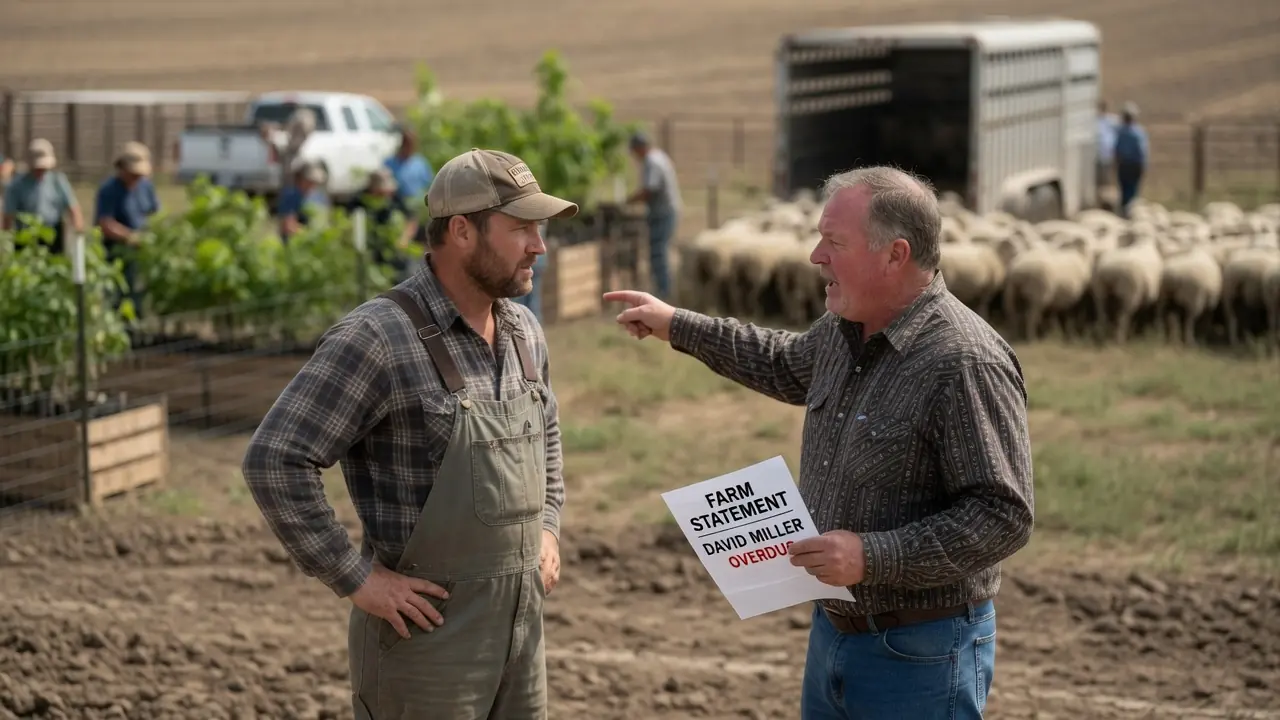
“The farm was dying because men like you kept ripping everything out of it,” David replied.
Tom laughed loudly enough for the workers to hear. At fifty-five, he owned more than two thousand acres, three new combines, and the largest grain-storage complex in the county. He wore a spotless western shirt and polished boots whenever he visited smaller farms, as though cleanliness itself proved superior management.
“When the bank takes this dirt,” Tom said, “I’ll buy it for pennies and tear every tree back out.”
David stepped closer, his broad shoulders filling the faded olive overalls he had worn since sunrise. His blue-gray eyes remained calm beneath the tan farm cap his father gave him twenty-eight years earlier. “Come back at harvest,” he said. “Your dead cornfield will be begging mine for shade.”
Tom drove away smiling.
David waited until the truck disappeared before looking down at the bank notice. The Miller farm owed more than he had admitted to his wife, Sarah, and the interest payment due in December would consume nearly all their remaining savings. Planting chestnuts was not a confident victory over traditional agriculture.
It was the last idea standing between his family and losing the land.
The Millers had farmed those northern Missouri acres for three generations. David’s grandfather raised cattle, cut hay, and planted corn in small fields separated by pasture and trees. His father removed most of the fences during the agricultural expansion of the 1980s, replacing the mixed farm with larger corn and soybean fields.
For years, the change appeared successful.
Bigger machinery covered more acres. Commercial fertilizer pushed yields higher, and government crop programs reduced some of the risk. David grew up believing a productive field should be clean, uniform, and free of anything that did not enter a grain truck.
By the time he inherited the farm at forty-four, that belief had begun collapsing.
Rain no longer soaked easily into the main southern field. Water ran across the surface after storms, carving shallow channels and carrying dark soil toward the county road. During summer, the ground hardened until David struggled to push a shovel into it.
Corn yields declined while fertilizer costs climbed.
David changed seed companies, increased nitrogen, adjusted planting dates, and purchased equipment he could barely afford. Each solution produced temporary improvement, but the field continued demanding more money while returning less grain. Some autumns, his profits disappeared before the combine finished its final row.
The worst year came after six weeks without meaningful summer rain.
David walked into the field one August afternoon and found the corn leaves tightly curled. Dust rose around his boots, and the ground felt almost lifeless beneath the hard surface. Sarah brought him water and stood beside him without offering the false comfort he would have rejected.
“How bad?” she asked.
“Worse than last year.”
“Can we cover the winter payment?”
David stared across the damaged corn. “Not without borrowing again.”
Sarah looked toward the farmhouse where their two children waited. Their son, Caleb, was twelve, and their daughter, Emma, was nine. Both loved the farm, but neither knew how close their parents had come to selling part of it.
“And if next year is the same?” Sarah asked.
David had no answer.
That night, bills covered one side of the kitchen table while yield records covered the other. David calculated the value of selling thirty-five acres, then calculated how much smaller the operation would become after losing its best field. Every number felt like a different form of surrender.
A month later, he attended a soil-health workshop in Columbia.
David nearly left during the first hour. The speakers discussed microbial activity, perennial roots, rotational grazing, and biological systems in language that sounded expensive and uncertain. He expected another consultant to recommend equipment, chemicals, or technology that required new debt.
Then a photograph appeared on the screen.
It showed sheep grazing beneath rows of mature trees while green grass covered the soil from fence to fence. The presenter called the system silvopasture—a managed combination of trees, livestock, and pasture occupying the same land. The trees provided a long-term crop, the grass protected the soil, and the animals converted vegetation into income while returning nutrients.
David raised his hand. “What kind of trees?”
“Depends on the region and market,” the presenter answered. “Timber, fruit, or nuts.”
The next image showed a chestnut orchard.
Chestnuts could produce for decades. Their deep roots remained in the ground year-round, holding soil and moving organic material into deeper layers. Unlike annual corn, the trees would not require the field to be opened, planted, fertilized, and harvested with heavy machines every season.
The nuts also had an established market.
American retailers imported large quantities because domestic production remained limited. Restaurants, bakeries, specialty stores, and families bought fresh chestnuts each autumn. The trees would take several years to produce heavily, but sheep could generate income between the rows while the orchard matured.
David wrote one word in his notebook.
Chestnuts.
For three months, he studied.
He read about disease-resistant hybrids, spacing, pollination, pruning, irrigation, harvest equipment, grazing pressure, and protective tree guards. He learned that sheep could control grass and weeds while fertilizing the field naturally. He also learned that an unsupervised flock could strip bark, break branches, and destroy hundreds of young trees in a single afternoon.
Every answer created another risk.
Sarah found him at the kitchen table one night surrounded by orchard diagrams.
“You’re considering it seriously,” she said.
“I keep trying to prove it won’t work.”
“And?”
“I haven’t succeeded.”
She looked through the projected costs. The trees, fencing, irrigation, pasture seed, and initial flock required nearly everything they had left. Even under optimistic estimates, the orchard would not produce meaningful chestnut income for several years.
“This could save the farm,” David said.
“It could also finish it.”
“I know.”
Sarah sat across from him. “What happens if we plant corn again?”
David did not answer immediately. “We borrow more, spend more, and pray the soil gives us enough to repeat it.”
She closed the folder. “Then at least the trees are a different risk.”
The following spring, David ordered six hundred chestnut saplings.
The delivery truck attracted attention immediately. Neighbors slowed along the road, and several stopped to ask why a farmer with overdue payments was planting trees where corn should have been. Tom Reynolds arrived before the workers finished unloading.
Tom had offered to buy the southern field twice.
He described the purchase as neighborly assistance, but David understood the opportunity Tom saw. Acquiring the weakened farm would connect his own property to the highway and create one uninterrupted block of valuable cropland. Tom did not want David to recover.
He wanted him desperate enough to sell cheaply.
After their confrontation, David planted the trees in long rows across thirty-five acres. Between them, he seeded orchard grass, clover, and other pasture plants selected for deep roots and livestock forage. Thin tree guards stood across the field like hundreds of pale markers over buried hopes.
From the road, the farm looked absurd.
The trees barely reached David’s knees. Wide empty spaces separated the rows, and there were no mature branches, shade, or chestnuts. Neighbors joked that he had created the slowest forest in Missouri.
Tom called it a retirement project for someone who could no longer compete.
Then summer arrived without enough rain.
The irrigation system kept most saplings alive, but leaves browned along the edges and growth slowed. David walked every row with a notebook, marking each stressed tree and adjusting water lines. By September, eighty-seven saplings had died.
Every dead tree felt like a receipt proving Tom right.
David ordered replacements anyway.
The next spring, he brought sixty sheep onto the farm. The flock provided something the young orchard could not: immediate production. Lambs could be sold annually, and the animals would reduce mowing by grazing vegetation between the trees.
For several weeks, the plan worked beautifully.
The sheep moved through green paddocks, eating grass and weeds while leaving manure behind. David divided the orchard using temporary electric fencing and rotated the flock before they grazed any section too closely. The ground remained covered, and fuel use dropped because he no longer mowed thirty-five acres repeatedly.
Then someone failed to secure a gate.
The sheep entered a section containing the smallest trees. By the time David noticed, guards had been pushed over, bark stripped, and young branches broken. More than forty saplings were badly damaged.
He stood in the center of the destruction with both fists clenched.
Sarah approached slowly. “Can they recover?”
“Some.”
“And the others?”
“I’ll replace them.”
That night, David barely slept.
The following morning, he rebuilt the grazing system. He added stronger tree guards, additional fence lines, and a rule that no paddock could be opened until two people checked every gate. The mistake cost money they did not have, but it also forced him to create a safer system before the trees grew larger.
During the third spring, five inches of rain fell in less than two days.
Water rushed across the orchard and carved a channel through one section where the ground cover remained thin. Soil collected near the road in a dark pile. David followed the erosion path and noticed that the damage ended wherever thick clover and grass covered the surface.
The living roots slowed the water.
He overseeded every exposed area, stopped mowing the pasture short, and adjusted the grazing rotation so sheep left more vegetation behind. Instead of treating the grass as something to remove, he began treating it as armor protecting the soil.
The field gradually changed.
Rainwater disappeared into the ground instead of racing across it. During dry weeks, the pasture remained green longer than surrounding cropland. When David pushed a shovel into the orchard, the soil no longer broke into pale, dusty chunks.
It held together in dark clumps.
One afternoon, Caleb found an earthworm near a chestnut tree and carried it to his father.
“Look.”
David smiled. Earthworms had once been common on the farm, but years of exposed soil and heavy chemical use had made them rare in the southern field. “Put him back.”
“Why?”
“Because he’s working for us.”
By the fourth year, most chestnut trees were taller than David.
Their branches spread wide enough to cast narrow sections of shade. Sheep began resting beneath them during hot afternoons instead of crowding around water tanks. Grass beneath the young canopies stayed greener because the soil was no longer exposed to direct sun all day.
The orchard had not paid for itself.
But it had stopped looking foolish.
Tom Reynolds visited after seeing the taller trees from the road.
“You’ve spent four years waiting,” he said. “How many nuts have you sold?”
“None.”
Tom laughed. “That’s what I thought.”
David looked across the sheep grazing beneath the trees. “The lambs pay bills.”
“Not enough bills.”
“More than corn did on this field during the last dry year.”
Tom pushed his boot into the soft soil. “You put something down here?”
“Roots.”
“That’s not an answer.”
“It’s the only answer that worked.”
Tom left unconvinced.
That September, David found three chestnuts beneath one of the oldest trees.
Two were small, and one showed insect damage. The third was glossy brown, firm, and almost perfectly shaped. David carried it into the farmhouse and placed it beside Sarah’s coffee.
She touched it carefully. “Is that ours?”
He nodded.
“After all this time?”
“After all this time.”
The first meaningful harvest fit inside several plastic crates.
David brought the nuts to a weekend market, expecting customers to ignore them. Instead, families stopped because many had never seen locally grown chestnuts. Older shoppers remembered roasting them during childhood, while younger customers asked how to prepare them.
A restaurant owner purchased several bags.
“These are all you have?” she asked.
“Nearly.”
“Call me next season.”
The income was modest, but the sale proved the orchard could produce something people wanted.
Each following year brought more nuts.
David learned that chestnuts required fast collection after falling, careful cleaning, cold storage, and reliable sorting. He converted an old machine shed into a simple packing area and purchased used equipment whenever harvest volume justified it. Sarah designed labels reading Miller Family Chestnuts — Grown With Sheep, Grass, and Patience.
Restaurants in Kansas City and St. Louis began ordering.
A specialty grocery store offered shelf space. Families visited during harvest to purchase bags directly, and some remained for hours watching sheep move between the trees. David’s children helped collect nuts and explain how the orchard worked.
The sheep operation grew too.
The pasture supported a larger flock as soil and forage improved. Trees provided shade in summer and reduced wind exposure during colder months. The animals grazed vegetation that would otherwise require fuel and machinery to manage.
David still bought supplemental feed during difficult periods.
He still replaced trees, repaired fences, and worried about late freezes. Silvopasture had not removed risk; it had spread the risk across several products and biological systems. A poor chestnut year did not erase sheep income, and high feed costs did not eliminate the long-term value of the trees.
By the seventh year, the farm no longer resembled the dying cornfield Tom wanted to buy.
Long rows of mature chestnuts covered the land. Clover and grass formed a thick floor beneath them, while birds nested in the branches and beneficial insects appeared throughout the pasture. After heavy storms, no dark streams of topsoil reached the road.
The land remained where it belonged.
A soil specialist compared samples from the orchard with soil from a neighboring cornfield. The orchard contained more organic material near the surface, stronger root structure, and significantly better water infiltration. The improvement did not come from one product or miracle treatment.
It came from continuous cover, living roots, managed grazing, falling leaves, manure, and time.
Tom arrived during harvest that autumn.
Workers filled buckets beneath trees heavy with chestnuts, while sheep grazed in a recently cleared section. Bags waited outside the packing shed for delivery to restaurants and grocery stores.
Tom stopped near the place where he once called the saplings useless sticks.
“How much are the trees producing now?” he asked.
“More every season.”
“And the sheep?”
“They paid expenses while the orchard grew.”
Tom looked toward the rows. “So you make money from both on the same ground.”
“That was always the plan.”
He pushed his boot into the soil again. This time, the ground sank slightly beneath his weight.
Tom glanced toward his own property across the road. His corn had struggled through another dry summer, and fertilizer costs had reached the highest level he had ever paid. Bare patches remained where runoff removed topsoil after spring storms.
“What did you use to repair this field?” he asked.
David pointed toward the orchard. “Trees, grass, sheep, and seven years of not demanding instant results.”
Tom’s face tightened. “You still owe the bank.”
“Not anymore.”
David handed him a folded statement.
The chestnut contracts, livestock sales, and direct farm revenue had paid off the overdue debt six months earlier. The bank notice Tom once shoved against his chest had been marked PAID IN FULL.
Tom read it twice.
“You could expand,” he said. “Sell me the orchard and use the money to plant more acres somewhere cheaper.”
David smiled. “You still think value means removing what’s already working.”
“I’m offering more than this land was worth when you started.”
“That was before I taught it how to live again.”
Tom lowered the statement.
For the first time, the wealthy neighbor had nothing sharp to say.
That year, Miller Family Chestnuts sold to restaurants, bakeries, grocery stores, and customers in several states. The farm hired seasonal workers during harvest and hosted educational tours for producers interested in combining trees and livestock.
David always showed visitors photographs from the first season.
The tiny saplings, dead trees, broken guards, bare soil, damaged fences, and empty spaces surprised them. Most people saw the mature orchard and assumed the system had unfolded exactly as designed.
“It didn’t,” David told them. “I kept correcting it.”
He explained that the farm survived not because of one brilliant decision, but because hundreds of smaller decisions followed. He changed grazing periods, replaced trees, strengthened fences, altered pasture mixes, improved storage, and learned which markets valued local chestnuts.
Failure became information.
The orchard became stronger because David remained long enough to listen.
One October afternoon, a group of local farmers walked through the oldest section of trees. Among them was Bill Henderson, an older producer who once told David he was wasting good farmland. Bill watched workers collect chestnuts while sheep grazed behind temporary fencing.
“I drove past for years waiting for you to quit,” Bill admitted.
“So did I sometimes.”
“We spent our lives removing trees from fields.”
David nodded.
“Now half the county wants to know how to put them back.”
“Not every field needs trees,” David said. “But every farmer should ask whether the land is getting stronger or just being forced to perform.”
Bill looked down at the grass.
He had no argument.
That evening, David stood at the highest point of the orchard with Caleb, now a teenager. Sunlight moved through thousands of chestnut leaves, and the flock traveled slowly toward a fresh paddock.
“Do you think Grandpa would have liked this?” Caleb asked.
David considered his father’s belief that good farming meant producing as much as possible from every acre. His father would have questioned the waiting, the trees, and the sight of sheep beneath what used to be corn.
“He would have asked a lot of questions.”
“Would he think it was strange?”
“At first.”
“And afterward?”
David looked across the farm. “He would understand that we didn’t stop producing. We stopped producing in only one way.”
The farm was never perfect.
Late frost damaged flowers during one spring. A chestnut disease required the removal of several trees, and changing markets occasionally lowered prices. Fences still broke, sheep still escaped, and weather remained beyond anyone’s control.
But the family no longer depended on one crop and one harvest.
The trees produced nuts. The grass fed sheep. The sheep managed vegetation and returned nutrients. The roots held soil, and the canopy protected moisture.
Each part supported another.
Years earlier, Tom Reynolds believed David had destroyed the farm by refusing to squeeze one more corn crop from exhausted ground. He saw thin saplings and dirty sheep where profitable rows should have been.
David saw a system that needed time.
Today, visitors often ask what saved the Miller farm. They expect him to name chestnut varieties, fencing systems, or grazing schedules.
David gives them a simpler answer.
“We stopped asking how much more we could take.”
Then he looks toward the trees, where sheep rest beneath the leaves and workers stack bags of chestnuts beside the packing shed.
“We started asking what the land needed so it could keep giving.”
The southern field had never truly been dead.
It was exhausted.
For decades, it had been opened, planted, fertilized, harvested, and left exposed. When yields declined, everyone recommended pushing harder, spending more, and demanding another crop.
David chose patience instead.
He planted six hundred trees. He brought sixty sheep. He covered the soil and allowed roots, animals, water, and time to work together.
The neighbors mocked him.
Tom threatened to buy the failed farm for pennies.
But when harvest finally came, the chestnuts filled trucks, the sheep paid bills, and the soil beneath David’s boots was darker, softer, and more valuable than the polished farmer across the road had ever imagined.
The farm had not died.
It had been waiting for someone brave enough to stop treating it like a machine.