The marble lobby of Oakwood Heights had been designed to make ordinary people feel as though they should lower their voices. White orchids rose from brass planters beside floor-to-ceiling windows, polished stone reflected every chandelier above, and the reception desk curved across the center of the room like the front counter of a private bank. Residents crossed the space carrying designer bags, dry-cleaning, coffee, and the certainty that anything unpleasant could be handled by someone wearing a name tag. Marcus Hayes entered through the revolving doors at 8:17 on a Tuesday morning looking like the only man in the building who had actually worked before sunrise.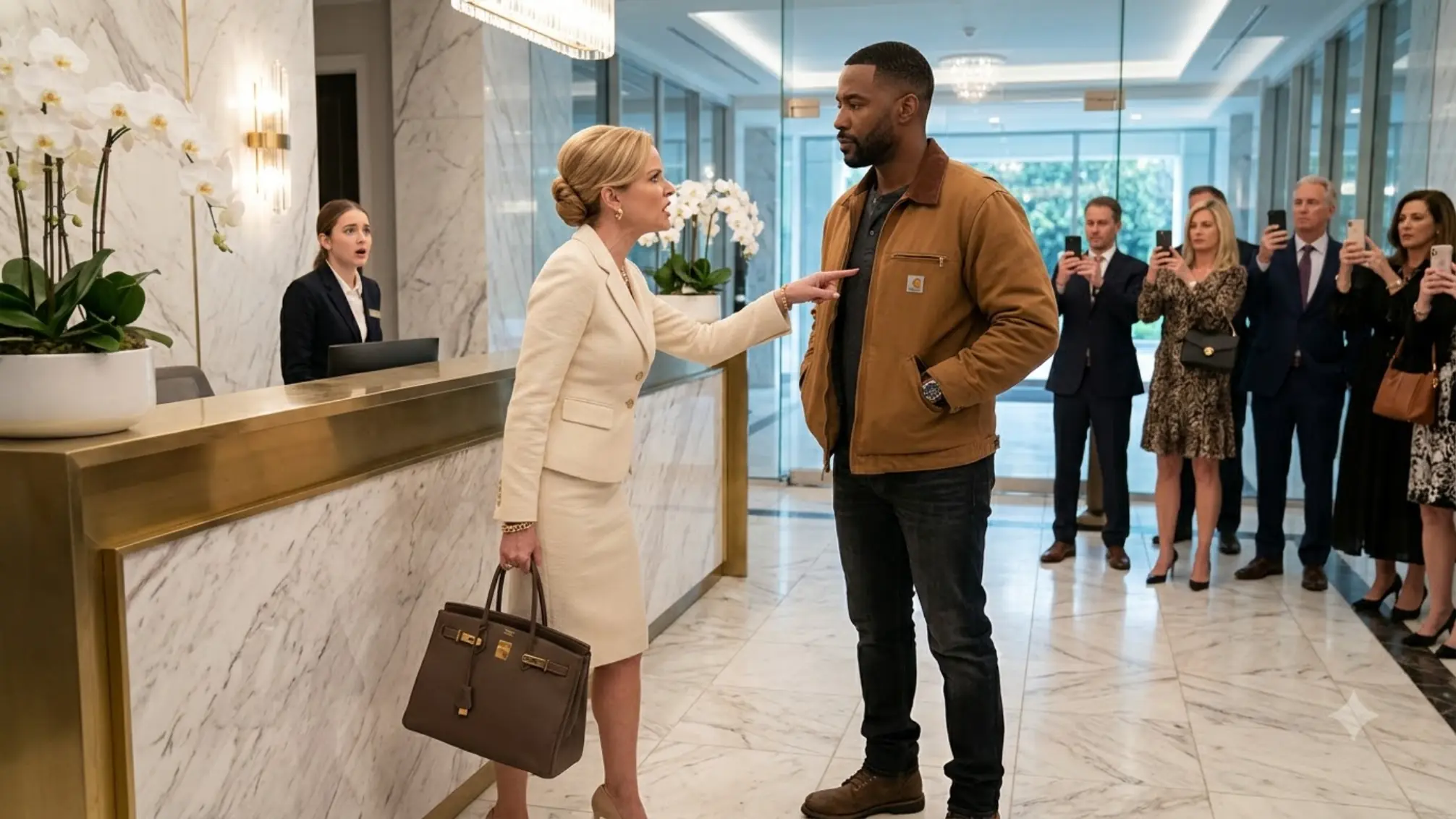
He wore a faded brown Carhartt jacket over a charcoal work shirt, dark jeans, and heavy Red Wing boots marked with dried dirt along the soles. At forty-two, Marcus was tall and solidly built, with deep-brown skin, short black hair, a close-cropped beard, and the quiet eyes of someone who had learned long ago that speaking less often made people reveal more. He carried no briefcase, no assistant, and no executive badge clipped to his chest. The only thing about him that looked remotely expensive was an old mechanical watch that had belonged to his grandfather.
Marcus had been up since five. He had packed lunch for his nine-year-old daughter, Maya, driven her to school, inspected a drainage repair at another property, and stopped at a gas station for coffee before heading downtown. Oakwood Heights was supposed to take twenty minutes. He only needed to sign the final management transition documents, review the resident compliance report, and return home in time to make dinner.
The building meant more to him than anyone in the lobby understood. Marcus controlled seventy-two percent of Oakwood Residential Holdings, the company that owned Oakwood Heights and four other luxury developments across Virginia. He had not inherited the portfolio from a wealthy family. He had built his first contracting company with two borrowed trucks, bought distressed apartment buildings one at a time, and spent fifteen years turning repair work into property ownership.
His wife, Lena, had been there for almost every step.
She had died from cancer two years earlier.
That changed Marcus more than money ever had.
He no longer attended every corporate dinner. He stopped buying suits he hated wearing. He spent more afternoons at job sites because the smell of sawdust and drywall reminded him of the years before hospitals and treatments became the center of his family’s life. Most importantly, he guarded his evenings because Maya had already lost one parent and Marcus refused to let business take the other one away by inches.
That morning, he stood beside the reception desk waiting for assistant property manager Sammy Cole to finish printing a document.
Sammy was twenty-three, eager, nervous, and had joined Oakwood Heights only six weeks earlier.
“I’m sorry, Mr. Hayes,” Sammy said. “The printer upstairs keeps disconnecting.”
Marcus shrugged.
“I’ve survived worse.”
Sammy smiled.
Then someone behind Marcus said, “Excuse me.”
He did not turn.
The tone suggested the speaker expected movement from somebody nearby, and Marcus assumed she meant the concierge.
“I said excuse me.”
Still nothing.
Then came the sharper version.
“Hey. You. Delivery man.”
Marcus turned slowly.
The woman standing three feet away looked as though she had been prepared by a committee responsible for making wealth visible.
Victoria Van Der Kamp, fifty-one, wore an immaculate cream skirt suit, nude heels, gold earrings, and a structured brown handbag large enough to carry every complaint she had ever made. Her blonde hair had been swept into an elegant bun, and her makeup was perfect enough that the anger in her face looked almost professionally applied.
Marcus recognized the name.
He had never met her.
That was about to change.
Victoria looked from his boots to his jacket.
“Are you deaf?”
Marcus remained calm.
“No.”
“Then don’t just stand around. Just do your job.”
The receptionist stopped typing.
Marcus looked at Victoria for a second.
“What job is that?”
Her mouth tightened.
“The one people like you are hired to do.”
Marcus glanced briefly toward Sammy.
The young manager looked horrified.
“Mrs. Van Der Kamp,” Sammy began, “he’s actually—”
Victoria slapped her palm onto the reception counter.
The orchid stems beside Sammy trembled.
“Do not interrupt me while I am speaking.”
Sammy stopped.
Marcus could have ended it then.
One sentence.
One introduction.
He could have watched her expression collapse.
But something made him wait.
It was not revenge.
It was curiosity.
Marcus had purchased controlling interest in Oakwood Heights fourteen months earlier. Since then, the management reports had looked unusually clean for a building containing nearly two hundred high-income households. Complaints were low. Employee turnover was described as manageable. Resident relations were supposedly excellent.
Yet three concierge employees had resigned in six months.
Two maintenance workers had requested transfers.
And one housekeeping contractor had quietly terminated its agreement.
Marcus had asked why.
The responses were vague.
Difficult resident interactions.
Scheduling issues.
Personality conflicts.
Nothing specific.
Now Victoria stood in front of him demonstrating exactly how a building could appear peaceful while employees quietly disappeared.
She pointed toward the revolving doors.
“I pay almost eight thousand dollars a month to live here.”
Marcus said nothing.
“I expect service.”
Still nothing.
“And I certainly do not expect people standing around the lobby looking lost.”
“I’m not lost.”
Victoria laughed.
It was sharp and performative.
Several residents near the elevators turned.
Marcus continued.
“I’m waiting for paperwork.”
“Paperwork?”
Her smile widened.
“For landscaping?”
Marcus looked toward the marble floor.
“No grass in here.”
A man near the mailroom coughed to cover a laugh.
Victoria’s face hardened.
She stepped closer.
“Do you think you’re funny?”
“No.”
“You people always have an attitude when someone asks you to do what you’re being paid for.”
Marcus’s eyes sharpened slightly.
Sammy tried again.
“Mrs. Van Der Kamp, please.”
She spun toward him.
“You stay out of this.”
“I’m trying to explain—”
“I said stay out of it.”
Her voice echoed across the lobby.
By then, phones were appearing.
A woman standing beside the elevator held hers near her chest, recording openly.
Another resident leaned against a brass column.
Marcus noticed something else.
None of them looked surprised.
That mattered.
Victoria turned back to him.
“Now move.”
Marcus remained where he was.
Her expression became almost triumphant.
“You’re refusing?”
“I still don’t know what you think I’m refusing to do.”
“You know exactly what I mean.”
“No.”
He looked directly at her.
“I’d like you to explain it.”
For the first time, Victoria seemed uncertain.
Not because she regretted anything.
Because calm questions required words she preferred leaving implied.
She pointed toward the desk.
“Carry something. Deliver something. Clean something. Whatever maintenance has you here for.”
“I’m not maintenance.”
“Security, then?”
“No.”
“Contractor?”
Marcus looked at his jacket.
“Sometimes.”
Victoria gave a dismissive laugh.
“There. So I was right.”
“No.”
The answer irritated her.
“You people always think technicalities matter.”
Marcus slipped one hand deeper into his jacket pocket.
His thumb touched his grandfather’s watch.
That old habit had begun when he was twenty.
His grandfather, Isaiah Hayes, had worked thirty-eight years as a carpenter and had endured more disrespect than Marcus could imagine. Whenever Marcus came home angry about customers speaking down to him during the early contracting years, Isaiah always told him the same thing.
Never let cruel people choose the version of you the world gets to see.
Lena loved that sentence.
She had repeated it during Marcus’s worst business disputes.
Now Marcus heard both voices.
Grandfather.
Wife.
Stay calm.
Victoria stepped directly into his space.
Her perfume was strong enough to cover the smell of his coffee.
She jabbed one manicured finger against the center of his jacket.
“Listen carefully.”
Marcus looked down at her hand.
“You do not belong here.”
The lobby became quieter.
Victoria noticed the attention and appeared energized by it.
“If you do not leave immediately, I will call security.”
Marcus met her eyes.
“Okay.”
The simplicity confused her.
“I’ll call the police.”
“Okay.”
She leaned closer.
“And who exactly do you think they’re going to believe?”
That changed the air in the room.
Sammy’s face went pale.
A resident near the elevator lowered her phone slightly.
Marcus stared at Victoria.
“What does that mean?”
“You know what it means.”
“No.”
Again, he forced her to own the implication.
“Explain it.”
Victoria’s lips tightened.
Then she said the word.
“Thug.”
Silence.
Complete.
The elevator chimed.
Nobody moved.
Marcus felt anger rise through his chest.
Not wild anger.
The heavier kind.
The kind built from humiliation experienced too many times across too many years.
He remembered being twenty-four and standing inside a wealthy client’s kitchen while the homeowner asked whether anything was missing after Marcus’s crew finished working.
He remembered being thirty and walking toward his own truck when a security guard assumed he was stealing tools from a construction site he owned.
He remembered Lena holding his hand afterward.
Don’t give them the version they already wrote for you.
Marcus inhaled once.
The anger settled.
Victoria smiled slightly, believing silence meant she had finally found his weakness.
Marcus reached inside his jacket.
Several people tensed.
Victoria stepped backward.
He removed a slim black phone.
Unlocked it.
Selected one contact.
The call connected after two rings.
“Yes, Mr. Hayes?”
Marcus never looked away from Victoria.
“I’m in the main lobby.”
Her smile disappeared.
“Pull the resident compliance file for Victoria Van Der Kamp, unit 47B.”
Victoria blinked.
“What?”
Marcus continued.
“Send full history to legal. Assess every outstanding violation, complaint, payment dispute, staff incident, and guest-access report.”
A pause.
“Yes. Preserve lobby footage from today too.”
Victoria stared.
Marcus’s voice remained quiet.
“Begin formal enforcement review immediately.”
He ended the call.
“What are you talking about?” she whispered.
Marcus held the phone toward her.
“Take it.”
She did not.
“Who are you?”
Sammy finally spoke.
His voice shook.
“Mrs. Van Der Kamp, this is Marcus Hayes.”
Victoria looked toward him.
Sammy swallowed.
“He owns Oakwood Residential Holdings.”
Nothing happened for two full seconds.
Then recognition reached her.
Marcus watched it travel across her face.
She looked toward the gold Oakwood emblem behind reception.
Then toward him.
“No.”
Sammy said nothing.
Victoria shook her head.
“You’re lying.”
Marcus nodded toward Sammy’s tablet.
“Show her.”
Sammy turned the screen.
A corporate profile appeared.
Marcus Hayes.
Managing principal.
Majority owner.
Victoria stared at the photograph.
Then at Marcus.
The lobby remained perfectly silent.
Her finger slowly lowered from his jacket.
“You should have said something.”
Marcus almost laughed.
“Why?”
“What?”
“If you knew I owned the building, would you have spoken differently?”
Victoria glanced toward the people recording.
“This is being taken completely out of context.”
“You supplied the context.”
“I thought you were an employee.”
Marcus nodded.
“I know.”
That answer destroyed every defense she was trying to assemble.
Victoria tried another.
“I was frustrated.”
“At who?”
“Management.”
“You called me a thug.”
“I did not mean it racially.”
Marcus’s expression remained unreadable.
“I didn’t say you did.”
She stopped.
Around them, several residents exchanged looks.
Marcus continued.
“You assumed I worked here.”
“Yes.”
“Then threatened to have me removed.”
“I believed you were refusing instructions.”
“You weren't my supervisor.”
Victoria’s mouth opened.
Nothing came.
Marcus looked toward Sammy.
“How often does this happen?”
Sammy froze.
Victoria turned sharply.
“Do not answer that.”
Marcus looked at her.
“You are not his employer.”
Then back to Sammy.
“How often?”
The young manager hesitated.
“Mr. Hayes…”
“It’s okay.”
Sammy swallowed.
“Pretty often.”
Victoria’s face changed.
“Samuel.”
Marcus held up one hand.
“Let him finish.”
Sammy stared at the tablet.
“She yells at staff.”
“How many reports?”
“I don’t know exactly.”
“Approximately.”
“Maybe fifteen?”
Victoria laughed nervously.
“That is absurd.”
Sammy continued.
“Some weren't formally entered.”
Marcus’s attention sharpened.
“Why?”
Sammy looked toward the property manager’s office.
“Because Mr. Vance told us not to escalate everything.”
Marcus knew the name.
Edward Vance, general manager of Oakwood Heights.
Highly rated.
Excellent retention numbers.
Few resident complaints.
Suddenly Marcus understood why.
Problems were not being solved.
They were being hidden.
Victoria crossed her arms.
“This is ridiculous. Edward knows me.”
Marcus nodded.
“I’m beginning to understand that.”
Within twenty minutes, Edward Vance arrived.
He hurried across the lobby wearing a navy suit and the expression of a man trying to determine how much damage had occurred before he walked into it.
“Marcus.”
Marcus turned.
Edward glanced toward Victoria.
Then the residents.
Then the phones.
“What happened?”
Victoria immediately stepped toward him.
“Thank God. Edward, this man is threatening eviction over a misunderstanding.”
Edward looked toward Marcus.
“What misunderstanding?”
Marcus answered.
“She called me a thug after threatening security and police because she assumed I worked here.”
Edward closed his eyes briefly.
Tiny movement.
Marcus noticed.
“You knew.”
Edward opened them.
“Knew what?”
“That she treated staff this way.”
“No.”
Sammy looked down.
Marcus saw that too.
“Samuel?”
Edward turned sharply.
“Sammy, be careful.”
Marcus’s expression hardened.
“No.”
He stepped between them slightly.
“You be careful.”
Edward stopped.
Marcus looked at Sammy.
“You cannot be disciplined for answering me honestly.”
The young man inhaled.
“Staff complained.”
Edward’s jaw tightened.
“How many times?”
“I don't know.”
“You told us Mrs. Van Der Kamp was an important resident.”
Victoria folded her arms.
Edward interrupted.
“I said we needed to handle resident conflicts professionally.”
Sammy finally looked up.
“You told housekeeping not to file another incident because she might threaten to move.”
Silence.
Marcus turned toward Edward.
“Did you?”
Edward hesitated.
“High-value resident retention requires judgment.”
Marcus nodded slowly.
There it was again.
Money changing the rules.
Victoria saw an opening.
“Exactly. I have lived here six years. Do you know how much I’ve paid this building?”
Marcus looked toward her.
“That doesn’t buy employees.”
“I never said it did.”
“You behaved like it did.”
She became angry again.
“You cannot evict me because you are embarrassed.”
Marcus’s voice remained level.
“I’m not evicting you.”
Victoria blinked.
“You just called legal.”
“I ordered a review.”
“So this was theater?”
“No.”
Marcus stepped closer.
“Unlike what happened here, the next part will use evidence.”
That stopped her.
Marcus continued.
“Your lease has procedures. Virginia has laws. Oakwood has enforcement requirements.”
Victoria stared.
“Legal will review everything.”
“And if they find nothing?”
“You stay.”
She seemed surprised.
Marcus nodded.
“I’m not going to abuse power because you did.”
That sentence spread through the lobby differently than any threat could have.
Several residents lowered their phones.
Edward looked uncomfortable.
Marcus turned toward him.
“You’re suspended pending management review.”
Edward’s eyes widened.
“Marcus.”
“Your access remains active only for turnover procedures. Human Resources will contact you.”
“You cannot possibly conclude anything from one employee’s statement.”
“I haven’t.”
Marcus pointed toward the cameras.
“I’m preserving records.”
Then toward Sammy.
“And preventing the person accused of suppressing complaints from supervising the witnesses.”
Edward said nothing.
That was procedure.
And procedure was harder to argue with than anger.
The legal review lasted nineteen days.
Marcus did not control it directly.
He assigned outside counsel because he knew Victoria would claim retaliation if his own anger became part of the process.
The findings surprised even him.
Victoria had accumulated twenty-seven documented incidents over four years.
She had screamed at valets.
Called one housekeeper “illiterate.”
Threatened a concierge’s job because a restaurant reservation could not be moved.
Ordered a maintenance technician out of an elevator because she did not want “workmen riding with residents.”
Three employees had specifically requested never to be assigned to her floor.
One contractor refused future work inside her unit entirely.
More seriously, Victoria had violated guest-access requirements repeatedly by allowing extended occupants into her unit without registration.
She had ignored three fines.
And she owed more than fourteen thousand dollars in unpaid assessments after disputing charges she had previously approved.
Edward Vance had personally waived late penalties twice without required authorization.
He had also removed seven staff complaints from the building’s monthly corporate reports.
Marcus read the findings at his kitchen table after Maya went to bed.
He expected satisfaction.
Instead he felt tired.
Lena would have understood.
Winning against ugly behavior never felt as good as movies promised.
It mostly revealed how long people had been hurting quietly.
Legal counsel recommended formal termination of Victoria’s tenancy under the building’s lease-enforcement provisions, subject to notice and hearing requirements.
Marcus approved the process.
Not the outcome.
The process.
Victoria received formal notice.
Her attorney responded within forty-eight hours.
Then came accusations.
Retaliation.
Discrimination based on economic status.
Abuse of ownership authority.
Public humiliation.
Marcus expected all of it.
Oakwood provided records.
Not emotion.
Every incident.
Every warning.
Every unpaid assessment.
Every suppressed report.
Every signature.
The resident review hearing occurred privately.
Victoria arrived with two attorneys.
Marcus did not attend.
That surprised her.
She had expected another confrontation.
Instead, the independent compliance panel reviewed evidence without him in the room.
Sammy testified.
So did two former employees.
Edward provided a statement through counsel.
The lobby footage played.
Victoria watched herself point into Marcus’s chest.
Watched herself threaten police.
Then heard the word.
Thug.
Her face tightened.
One panel member asked, “Would you have spoken that way if you had known Mr. Hayes owned the building?”
Victoria remained silent.
The attorney beside her whispered something.
Finally she answered.
“No.”
The panel member nodded.
“That appears to be the central problem.”
Her tenancy was terminated sixty days later based not on the single lobby incident, but on the cumulative pattern of conduct, unpaid obligations, repeated lease violations, and interference with building staff.
Victoria appealed.
The decision stood.
She moved from Oakwood Heights quietly.
No security escort.
No spectacle.
No crowd.
Marcus specifically prohibited anyone from turning the move into punishment.
That mattered to him.
He did not want humiliation to become company culture simply because this time he controlled who received it.
Edward Vance lost his management position after the investigation confirmed he had suppressed legitimate employee complaints to protect retention statistics.
Sammy received an unexpected meeting invitation afterward.
Marcus found him inside the conference room staring nervously at a coffee cup.
“You think I’m firing you?”
Sammy looked embarrassed.
“A little.”
Marcus sat across from him.
“Why?”
“I froze that morning.”
“You tried to intervene.”
“Not enough.”
Marcus nodded.
“That’s true.”
Sammy looked up.
Marcus continued.
“So learn from it.”
He slid a folder across the table.
Inside was a promotion.
Assistant Resident Relations Manager.
Sammy stared.
“What?”
Marcus smiled faintly.
“You’re not being promoted because you were brave.”
Sammy looked confused.
“You’re being promoted because when someone finally gave you room to tell the truth, you did.”
Marcus created several policy changes across Oakwood Residential afterward.
Residents could no longer direct building employees outside normal service procedures.
All staff complaints would be visible at corporate level rather than filtered solely through property managers.
Anonymous reporting became available.
Repeat conduct involving harassment could trigger independent review.
Resident revenue could never be cited as justification for suppressing staff incidents.
The policy document contained one sentence Marcus insisted remain exactly as written:
Service does not mean servitude.
Six months later, Oakwood Heights still looked the same.
Same marble.
Same orchids.
Same polished elevators.
But employees moved differently.
A maintenance worker no longer stepped aside automatically when residents entered the hallway.
Concierge employees were trained to enforce boundaries politely.
Residents complained initially.
Then they adjusted.
Most people did.
The truly wealthy ones, Marcus discovered, rarely had a problem.
It was people terrified of losing status who needed everyone below them to feel it.
One Friday afternoon, Marcus brought Maya to Oakwood Heights after school.
She was nine, small for her age, with Lena’s eyes and Marcus’s habit of asking questions nobody expected.
They stopped beside the reception desk.
Sammy greeted her.
“So you’re Maya.”
She looked suspicious.
“How do you know me?”
“Your dad talks about you.”
She looked toward Marcus.
“How much?”
“Too much.”
Marcus smiled.
They walked toward the elevators.
Maya noticed a photograph in the management office.
Her father standing beside the Oakwood logo.
“You own this?”
Marcus looked down.
“Part of it.”
“How much?”
“Enough.”
She frowned.
“That sounds like something adults say when they don’t want kids asking another question.”
Marcus laughed.
She looked around the marble lobby.
“Is this where that lady yelled at you?”
Marcus stopped.
He had never told her the full story.
Apparently adults were not the only people who talked.
“Who told you?”
“Grandma.”
Of course.
Marcus sighed.
Maya looked toward the spot near reception.
“Were you scared?”
The question surprised him.
“No.”
“Were you mad?”
“Yes.”
“How mad?”
“A lot.”
“Why didn’t you yell?”
Marcus thought about his grandfather.
Then Lena.
He crouched so he was eye level with his daughter.
“Because being angry and letting anger decide what you do are different things.”
Maya considered this.
“She was mean.”
“Yes.”
“And you could kick her out.”
“Eventually, the building ended her lease.”
“That’s the same thing.”
“No.”
Marcus shook his head.
“I could have tried punishing her immediately because she embarrassed me.”
“But you didn’t.”
“No.”
“Why?”
“Because power doesn’t make you right.”
Maya’s eyebrows tightened.
“Then what does?”
“Evidence helps.”
She smiled.
“That sounds boring.”
“It usually is.”
Maya looked toward the ceiling.
“So boring is good?”
“Sometimes boring keeps people fair.”
She nodded solemnly as though recording the idea for later.
Then pointed toward the café.
“Can ownership get me hot chocolate?”
Marcus laughed.
“That power I’m willing to abuse.”
A year after the confrontation, Marcus attended the Oakwood staff holiday dinner.
He hated speeches.
Everyone knew it.
Sammy still handed him a microphone.
Marcus looked toward nearly sixty employees gathered inside the dining hall.
Concierge workers.
Maintenance crews.
Housekeeping staff.
Managers.
Security.
People who kept a luxury building functioning while residents often knew only their first names.
Marcus cleared his throat.
“I’ll make this short.”
Everyone laughed because owners always said that before talking twenty minutes.
Marcus continued.
“A year ago, something happened in our lobby that embarrassed this company.”
The room quieted.
“Not because somebody insulted me.”
He looked around.
“Because employees already knew the behavior was normal.”
Several faces changed.
Marcus continued.
“That’s what embarrassed me.”
He paused.
“A company doesn’t become good because the owner gets treated well.”
Sammy watched from the side.
“It becomes good when the person with the least power can tell the truth about the person with the most.”
Silence.
Then applause began.
Marcus raised one hand.
“I said short.”
Laughter returned.
He stepped away from the microphone.
Later that night, he walked alone through the lobby.
The orchids had been replaced with white lilies for winter.
Rain streaked the tall glass windows.
Marcus stopped exactly where Victoria had confronted him.
For years, he had believed success meant reaching a place where people could no longer look down on him.
He understood now how impossible that goal was.
There would always be someone who judged clothing.
Race.
Work.
Money.
Address.
Accent.
Education.
Success could not control their assumptions.
Character controlled what happened next.
Marcus touched his grandfather’s watch.
The old man had been right.
Cruel people would always try to choose the version of you the world saw.
Angry.
Dangerous.
Inferior.
Uneducated.
Weak.
Marcus had spent years believing the answer was proving them wrong through achievement.
Buildings.
Contracts.
Ownership.
Money.
But standing beneath the lights of Oakwood Heights, he finally understood something simpler.
He did not need Victoria Van Der Kamp to discover he was powerful.
He had needed only to refuse becoming the man she expected him to become.
The building belonged to him legally.
That was paperwork.
His restraint belonged to him completely.
That was character.
And in the end, Victoria had not lost her apartment because she insulted the wrong man.
She lost it because once the right people finally examined the records, they discovered how many people she had treated badly when she believed none of them could answer back.
Marcus walked toward the exit.
Outside, his old work truck waited among Mercedes, Range Rovers, and chauffeured sedans.
The valet hurried toward him.
“Mr. Hayes, I can bring it around.”
Marcus smiled.
“I've got legs.”
He crossed the driveway himself.
Before climbing into the truck, his phone buzzed.
A message from Maya.
DON’T FORGET ICE CREAM.
Marcus laughed.
He typed:
Already got it.
Then he drove home.
Not to a board meeting.
Not to another confrontation.
To his daughter.
To dinner.
To the ordinary life all the marble, contracts, and ownership documents were supposed to protect in the first place.
Behind him, Oakwood Heights continued glowing above downtown Virginia.
Same expensive building.
Different rules.
And inside its management office sat one new policy that summarized everything Marcus Hayes wanted the property to remember long after nobody cared about the viral lobby video anymore.
No resident’s wealth, title, rent level, influence, or relationship with management places them above the dignity of the people who work here.
That was the paperwork that mattered.