Rain struck the empty highway hard enough to blur the lights of passing cars into pale streaks. The Single Dad remained on one knee beside the white luxury sedan, holding the damaged brake line between his yellow work gloves while the Woman stared down at him. A minute earlier, she had treated him like a roadside thief who had noticed an expensive car and invented an excuse to approach it. Now the clean cut in the line gleamed beneath his flashlight, too precise to have come from road debris.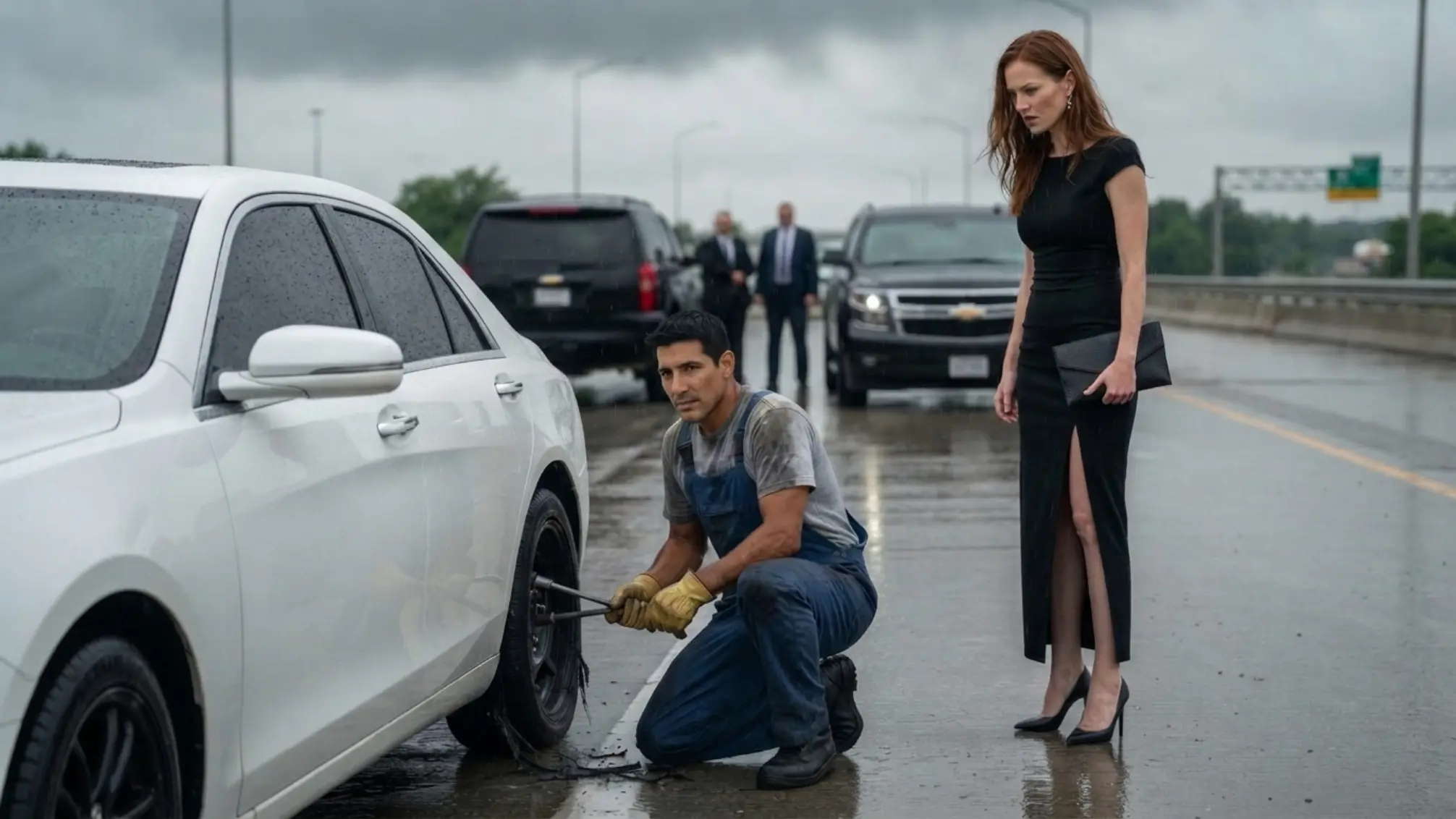
The Single Dad had been driving home after repairing a delivery van when he saw the Woman standing beside the disabled sedan. He had promised his nine-year-old Daughter he would return before dinner, but the storm had grown stronger and the nearest service station was more than ten miles away. He stopped because leaving anyone alone on that section of highway felt wrong. He had not known the stranded driver controlled one of the largest automotive technology companies in the state.
The Woman had spent most of her adult life learning to distrust strangers. Wealth attracted opportunists, authority attracted enemies, and her position as chief executive meant every conversation contained something unspoken. When the Single Dad pulled over in an aging pickup and approached in grease-stained overalls, she immediately assumed he wanted money. His quiet refusal to react to her insult irritated her more than an argument would have.
He removed the shredded tire, checked the rim, and noticed scoring along the inner sidewall. The pattern was too even, as though someone had weakened the rubber with a specialized blade before inserting a narrow metal spike near the tread. A normal blowout produced irregular damage. This tire had been prepared to fail after reaching highway speed.
Then he inspected the brake assembly and found the second modification. Someone had sliced almost completely through the hydraulic line but left enough material intact to delay the leak. The tire would fail first, forcing the driver to brake on the next curve. That pressure would rupture the line, leaving the sedan without reliable stopping power precisely when control mattered most.
The Single Dad rose slowly and looked toward the road behind them. “How long was this car unattended tonight?”
The Woman’s expression tightened. “Ten minutes at a private fuel station.”
“Anyone know your route?”
“My security team.”
Before he could ask another question, two black SUVs appeared through the rain. They slowed sharply and stopped behind the sedan, forming a protective barrier across the shoulder. Four suited men emerged, led by the Head of Security, whose eyes moved immediately from the Woman to the wrench in the Single Dad’s hand. Within seconds, the mechanic who had stopped to help was treated as the greatest threat on the road.
“Move away from her vehicle,” the Head of Security ordered.
The Single Dad placed the wrench on the wet pavement. “Inspect the front brake line before anyone drives this car.”
“I gave you an order.”
“And I gave you the reason she’s still alive.”
The Head of Security stepped closer, visibly offended that a roadside mechanic had answered without fear. The Woman could have ended the confrontation, but embarrassment kept her silent for a moment. She had accused the Single Dad of planning to rob her, and now he was claiming someone had prepared her car for a fatal crash. Admitting he might be right meant admitting she had misjudged the only person who had helped her.
One of the guards crouched near the wheel with a flashlight. He followed the Single Dad’s instructions, cleaned rainwater from the brake line, and found the narrow cut. His posture changed immediately. He called the Head of Security closer and pointed toward the weakened section without saying anything.
The Head of Security examined the damage twice. “Could this have happened on the road?”
“No,” the Single Dad answered. “The protective coating was removed first. Whoever made that cut knew how much material to leave so the pressure would finish the job later.”
The Woman folded her arms against the rain. “How can you know that?”
“Because I spent twelve years investigating vehicle failures that companies wanted classified as accidents.”
The Single Dad had once worked as an independent automotive safety specialist. Manufacturers hired him when crashes involved unexplained steering loss, brake failure, electrical shutdowns, or components that performed perfectly in laboratories but failed on public roads. He had reconstructed fatal accidents, identified hidden defects, and testified against corporations that tried to bury evidence. He eventually left after his wife died and his Daughter began waking every night terrified that her remaining parent would disappear too.
He now repaired ordinary cars in a modest garage outside the city. The work paid less, but he controlled his schedule and collected his Daughter from school every afternoon. He had believed that part of his life was over. Yet kneeling beside the luxury sedan, he felt the old pattern-recognition returning before he could stop it.
The Head of Security ordered a complete inspection of every vehicle in the convoy. Guards checked tires, brake lines, electrical panels, and wheel wells beneath portable lights. The other SUVs appeared untouched, but the Woman’s sedan contained another irregularity. A small transmitter had been attached behind the rear bumper.
The Single Dad examined it without removing it. “This isn’t a tracker.”
The Head of Security frowned. “Then what is it?”
“A confirmation device. It sends a signal when the car reaches a certain speed or when the brakes lose pressure.”
The Woman looked toward the dark highway. “Someone wanted to know whether the crash happened.”
The transmitter contained no obvious manufacturer markings, but its position revealed careful planning. It had been hidden where a normal security sweep would miss it, yet close enough to monitor wheel vibration and hydraulic pressure. The attacker had not merely damaged the vehicle. Someone intended to watch the assassination unfold through data.
The Woman finally gave the Single Dad her full attention. Her contempt had disappeared, replaced by calculation. “I have an emergency board meeting in the city tonight.”
“What happens if you miss it?”
“A sale moves forward without me.”
The company she led had developed a safety-control system capable of detecting mechanical failures before they caused crashes. A private investment group wanted to acquire the company, close its local manufacturing facility, and move production overseas. The Woman opposed the sale because it would eliminate hundreds of jobs and give the buyers ownership of technology funded partly through public grants. If she failed to reach the board meeting, a proxy agreement could allow the transaction to pass without her vote.
The Single Dad looked again at the damaged sedan. “Then the crash was not the only objective.”
The Head of Security understood. “Removing her permanently guarantees the sale. Delaying her might be enough to pass it tonight.”
The Woman’s face hardened. “Only six people knew my exact route.”
The Single Dad asked whether the vehicle had recently been serviced. The Head of Security checked the maintenance records on his tablet and found that the sedan had undergone a routine inspection three days earlier. The contractor had been selected by the company’s Chief Operations Director, the same executive publicly supporting the acquisition.
The Woman rejected the implication immediately. “He has worked beside me for nine years.”
“That doesn’t make him innocent,” the Single Dad said.
“It also doesn’t make him guilty.”
“No. The evidence will decide that.”
His answer unsettled her because it contained neither accusation nor fear. He was not trying to impress her or exploit her vulnerability. He was simply following the evidence, even when it moved toward someone powerful.
The Head of Security called for a flatbed truck, but the Single Dad stopped him. Moving the sedan without stabilizing the damaged line could destroy the physical evidence or cause a sudden pressure failure. He opened his worn tool bag and produced a temporary hydraulic clamp, a pressure gauge, and clean evidence sleeves. The Woman watched him photograph every component before touching it.
“You carry evidence bags in your truck?” she asked.
“I learned that finding the truth means nothing if someone can claim you contaminated it.”
He sealed the weakened tire, metal spike, and photographs in separate bags. Then he installed the clamp over the damaged brake line, preserving the cut while preventing further leakage. The work took less than five minutes. When the pressure gauge stabilized, even the Head of Security stopped questioning his ability.
A guard inspecting the transmitter discovered that it had received a signal only moments earlier. Someone nearby had tried to confirm whether the vehicle was moving again. The Head of Security ordered his men to scan the road and tree line, but the Single Dad looked toward a distant service lane instead. A white cargo van sat beneath an overpass with its lights off.
The van began moving as soon as one guard pointed toward it. It accelerated onto the highway and disappeared before the convoy could block the road. The Head of Security wanted to pursue, but the Single Dad warned him that separating the team could be exactly what the attackers expected. Protecting the Woman mattered more than catching a vehicle that was probably registered under a false identity.
The Woman called the company’s legal counsel from inside one of the secure SUVs. She instructed them to delay the board vote and preserve every email, service record, security log, and financial transfer connected to her sedan. The counsel warned that the Chief Operations Director was already inside the meeting room demanding that the sale proceed. He claimed she had deliberately disappeared because she knew the board would reject her objections.
“Tell them my vehicle was sabotaged,” the Woman said.
The Single Dad shook his head.
She covered the phone. “Why?”
“Because whoever planned this may not know exactly what we found. Don’t give them time to erase the wrong evidence.”
The Woman changed her instructions. She said only that a serious mechanical problem had delayed her and that no vote could occur until an independent safety review was completed. The Chief Operations Director objected, but the company’s legal counsel froze the meeting under emergency governance rules. For the first time that night, the attacker’s timetable began collapsing.
The Head of Security proposed taking the Woman directly to headquarters in another SUV. The Single Dad agreed, but only after inspecting the replacement vehicle himself. Beneath its hood, he found nothing dangerous. However, he noticed that the navigation system had received a route update from the company’s internal network less than twenty minutes earlier.
The new route led away from the main highway and through an industrial district with several unfinished roads. The Head of Security said his team had not requested the change. Someone with administrative access had attempted to redirect the convoy after the first trap failed.
The Woman stared at the navigation screen. “Only our executive transportation office can push updates like this.”
“And who controls that office?” the Single Dad asked.
“The Chief Operations Director.”
The evidence remained circumstantial, but the pattern was narrowing. The damaged sedan, monitoring transmitter, maintenance contractor, board vote, and unauthorized route update all passed through systems controlled by one executive. The Woman looked suddenly older as she realized the threat might come from someone she had defended for years.
The Single Dad should have left then. His Daughter had called twice, and the neighbor watching her had sent a message asking when he would return. He stepped away from the convoy and called home, expecting anger. Instead, his Daughter asked whether the stranded Woman was safe.
“Not yet,” he admitted.
“Then don’t leave her alone,” the Daughter said. “But come home after.”
The simple request struck harder than any command. The Single Dad had built his life around being present for his child, yet he also wanted her to grow up knowing that responsibility sometimes required staying when walking away would be easier. He promised to call again within an hour.
The Woman overheard enough to understand. “You have a daughter waiting.”
“Yes.”
“And you’re still helping me.”
“I’m helping you because someone tried to turn a murder into a mechanical failure. But I am not forgetting her while I do it.”
That distinction changed something between them. The Woman was accustomed to executives sacrificing families for ambition and then describing the absence as leadership. The Single Dad refused both extremes. He would not abandon a person in danger, but he would not let powerful strangers consume the life he had promised his Daughter.
The convoy departed using a route selected manually from a printed road map. The Single Dad rode beside the Head of Security while the Woman sat behind them. Before reaching the city, he noticed a uniform reflective pattern across the pavement near a curve.
“Slow down,” he said.
The Head of Security saw only rain at first. Then the headlights revealed a thin layer of hydraulic fluid spread across both lanes. At normal speed, the convoy could have lost traction and collided with the guardrail. The Single Dad guided each vehicle through at a crawl, forbidding sudden steering or braking.
The second trap confirmed that the attackers had anticipated the Woman surviving the damaged sedan. This was not the work of a desperate individual acting impulsively. It required route access, timing information, technical knowledge, and multiple people stationed across several locations. The Head of Security finally admitted that the company’s internal protection system had been compromised.
At headquarters, the board members were still gathered when the Woman entered the building with rain on her coat and the Single Dad carrying sealed evidence. The Chief Operations Director rose from his chair and demanded an explanation for the disruption. His confidence weakened when he saw the damaged brake line inside a transparent evidence bag.
He laughed dismissively. “You brought a mechanic into a board meeting?”
The Woman placed the transmitter on the table. “I brought the man who noticed what our security contractors missed.”
The Chief Operations Director looked at the Single Dad’s overalls and worn boots. “And we are supposed to trust him?”
The Single Dad did not react to the insult. He connected the transmitter to an isolated diagnostic device and displayed its command history on the room’s main screen. The final confirmation request had been sent from an account registered to the executive transportation office.
The Chief Operations Director claimed the account had been hacked. The Single Dad agreed that it was possible, then displayed the route update sent to the replacement SUV. That instruction originated from a workstation inside the headquarters building. Security footage showed the Chief Operations Director’s assistant entering the transportation office after normal hours.
The assistant was brought into a separate conference room and questioned by legal counsel. Within twenty minutes, she admitted receiving instructions to update the route but claimed she believed it was a legitimate security change. She produced the message from her supervisor.
The instruction came directly from the Chief Operations Director.
He still refused responsibility. He accused the Woman of manufacturing a crisis to block a lawful company sale. He argued that no one could prove he knew about the mechanical sabotage. Then the Single Dad asked for access to the sedan’s maintenance invoice.
The contractor had billed the company for inspecting the exact tire and brake assembly that later failed. The digital invoice included a technician identification number. That technician did not exist in the contractor’s employment database, but the payment account connected to the number belonged to a shell company.
Legal counsel traced the shell company to the Chief Operations Director’s brother-in-law. Over the previous six months, it had received more than two million dollars from the investment group seeking to buy the company. Payments increased whenever internal safety reports lowered the company’s valuation.
The assassination attempt was only the final stage of a larger plan. The Chief Operations Director had been secretly sabotaging test vehicles and manipulating failure reports to make the company appear unstable. Lower valuation made the acquisition cheaper. Once the sale closed, he would receive a senior position, stock options, and a private payout.
The Woman stood across the table from the man she had trusted for nearly a decade. “You were willing to destroy the company.”
“I was saving what could still be sold,” he replied.
“You were willing to kill me.”
His silence answered more clearly than denial.
Police entered the boardroom shortly afterward. The Chief Operations Director was arrested on suspicion of attempted murder, corporate fraud, evidence tampering, and conspiracy. Investigators later found the white cargo van in a private warehouse owned by the maintenance contractor. Inside were cutting tools, hydraulic fluid containers, duplicate transmitters, disposable phones, and printed copies of the Woman’s travel schedule.
The investment group immediately denied knowledge of violence, but financial records told a different story. Executives had approved payments described as “contingency execution services” and “route-risk management.” Regulators froze the acquisition, seized communication records, and opened a wider investigation into manipulated safety data.
By sunrise, the Woman’s company was no longer preparing to be sold. It was preparing to survive the scandal.
The Single Dad packed his tools and prepared to leave before reporters arrived. The Woman followed him into the nearly empty lobby and offered him a position leading the company’s independent vehicle-integrity division. The salary was more than he had earned in several years combined.
He declined.
“You have not even heard the full offer,” she said.
“I heard enough to know you’re offering it the morning after I helped save your life.”
“You think this is sympathy?”
“I think gratitude can make people confuse rescue with qualification.”
The Woman studied him for a long moment. Then she asked what would make the opportunity fair.
“Give me a damaged system your engineers cannot explain,” he said. “Pay me for an independent assessment. If my work is better than the other candidates’, then we talk about a job.”
Three weeks later, the Woman brought him a control unit connected to a series of unexplained braking errors. The Single Dad worked from his garage while his Daughter completed homework at a small desk beside him. He discovered a manufacturing flaw that caused the unit to misread temperature changes, along with deliberate code alterations introduced during the sabotage scheme.
His report separated criminal manipulation from genuine design failure. He refused to let the company blame every problem on the arrested executive. Concealing the real defect would only repeat the corruption they claimed to oppose.
The Woman read the report twice. “You found the flaw our engineering team missed.”
“They were looking for someone to blame. I was looking for what could fail.”
She offered him the position again.
This time, he accepted under strict conditions. He would work flexible hours, remain available for his Daughter’s school schedule, and report directly to an independent safety committee rather than corporate management. Any serious defect would be disclosed immediately, regardless of its effect on profits.
The Woman agreed to every condition.
Under the Single Dad’s leadership, the company created a protected reporting system for mechanics, technicians, drivers, and factory workers. Employees could raise safety concerns without risking retaliation. The company also began hiring experienced tradespeople without college degrees, recognizing that practical knowledge often exposed failures that executive reports overlooked.
The Woman kept the manufacturing facility open and canceled the sale permanently. Instead of eliminating hundreds of jobs, the company expanded its diagnostic program and trained local mechanics to install safety-monitoring systems. The Single Dad’s garage became one of the first independent testing centers.
He never told his Daughter that he had saved an important executive. When she asked why a black SUV sometimes arrived outside their modest home, he said the Woman had become a customer with complicated car problems.
One evening, the Woman visited the garage without security. She found the Single Dad teaching his Daughter how to identify uneven tire wear. The girl listened carefully, holding a flashlight while her father explained that small marks often revealed larger problems.
The Woman smiled. “That sounds familiar.”
The Daughter looked up. “Was your car the one Dad fixed in the storm?”
“Yes.”
“Did you pay him?”
The Woman glanced at the Single Dad. “Not nearly enough at first.”
The Single Dad shook his head, but the Woman continued. She told the Daughter that her father had noticed danger everyone else missed and stayed even when returning home would have been easier. She did not describe the assassination plot or the armed security response. She simply said his attention saved many people from making a terrible mistake.
The Daughter considered this seriously. “He does that a lot.”
“Does what?”
“Pretends helping people is just another repair.”
The Woman laughed softly, and the Single Dad returned to the tire to hide his smile.
Months later, the damaged brake line and transmitter were placed inside the company’s training center. Beneath them was a plaque chosen by the workers rather than the executives:
THE FIRST FAILURE WAS MECHANICAL.
THE SECOND WAS JUDGMENT.
BOTH WERE FOUND BY SOMEONE WILLING TO LOOK CLOSER.
The Woman often remembered the contempt in her own voice on the highway. She had seen worn overalls, an old pickup, and calloused hands, then decided she understood the man kneeling beside her car. The attackers made the same mistake. They planned for security teams, executive schedules, corporate systems, and predictable routes.
They never planned for a Single Dad who stopped because leaving a stranger alone in the rain felt wrong.
The flat tire had been designed to end the Woman’s life and hand control of her company to people who believed every human decision could be predicted through money, pressure, or fear. Instead, it exposed their entire conspiracy.
The Single Dad did not defeat them because he was the richest person on the highway or the most powerful person in the boardroom.
He defeated them because he noticed what everyone else had learned to ignore.