October came with teeth that morning.
The wind crawled low across the Dakota prairie and cut through my worn wool shawl, through the patched sleeves of my dress, through the hollow place inside me where warmth had lived.
It came from the north in long, bitter breaths, rolling over the grass and pressing against the walls of my homestead as if the season itself had decided to test whether I was still standing.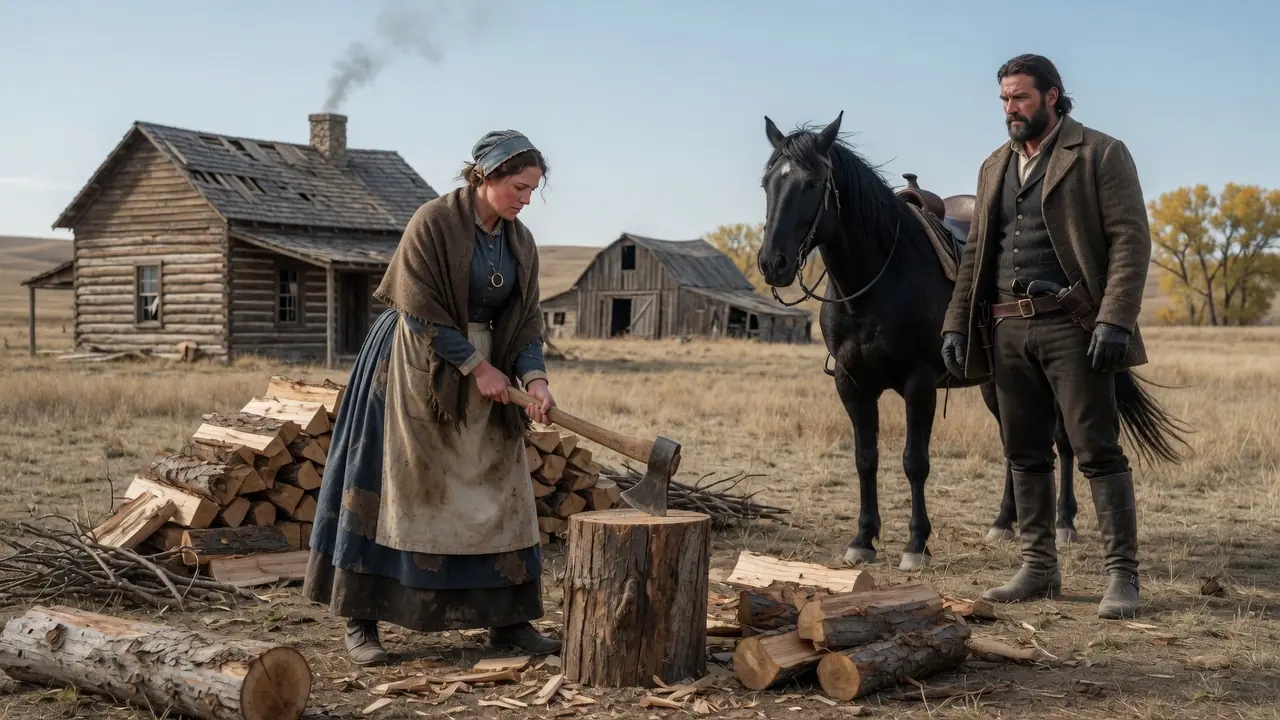
The sky was the color of old tin.
The grass beyond the house bent flat beneath the cold, whispering against the dirt like dry bones. A line of blackbirds crossed the gray horizon, then vanished toward the cottonwood rise behind the barn, where my husband lay buried beneath a weathered board I had carved with my own hands.
Every year, the prairie gave a woman reminders.
Spring reminded her what could grow.
Summer reminded her what could burn.
Autumn reminded her what she had failed to prepare.
Winter reminded her whether she had been honest with herself.
That morning, as I stood beside the chopping block with my hands wrapped around the axe handle, I knew winter was coming faster than I wanted to admit.
The roof still leaked.
The barn door still hung crooked.
Half my chickens had vanished to foxes because I had not managed to mend the coop wire before the first hard frost.
The pump had begun coughing rust again. The pantry shelves looked too bare for October. The haystack was smaller than it should have been, and my woodpile would not carry me past January unless I became very careful, very lucky, or very cold.
Every sound on that land had learned how to accuse me.
The rusty drip in the corner of the roof said I was failing.
The broken hinge said I was failing.
The empty nests said I was failing too.
So I lifted the axe again.
Crack.
Another stubborn piece of oak split open beneath my hands, and Thomas’s gold wedding ring tapped against my chest on its chain. It struck my breastbone with every swing, soft as a heartbeat, cruel as memory.
I wore it beneath my dress every day because I could not bear to leave him in a drawer, and because sometimes, when the prairie wind was loud enough, I could almost pretend the ring was his hand resting near my heart.
Thomas Marsh had died bringing firewood down from Eagle’s Pass two years before.
They found him three days later, frozen to the reins, his face turned toward home, while our old mare, Mercy, had somehow made it back without him. The men who brought his body said little. Men on the prairie were not built for speaking of tragedy beyond what was necessary. They took off their hats, lowered their eyes, and told me he had likely lost the trail in the whiteout.
Likely.
That word had eaten at me for two years.
Thomas did not lose trails.
He knew the folds of that land better than the lines in his own palm. He could read a sky from a doorway, smell snow before clouds gathered, and find his way home in moonless dark by the shape of the wind against his cheek. If he had not come home, there had been a reason.
But nobody had given me one.
So I buried him behind the cottonwood rise, marked the grave with a board I carved myself, and learned how to keep breathing inside a house that had once held laughter.
The first winter after his death nearly took me too.
Not from cold alone, though there was plenty of that. Cold was honest. Cold told you exactly what it meant to do and gave you no false courtesy. It crept under doors, found cracks in the chinking, settled inside bones, and waited for weakness.
No, it was the silence that came closest.
The bed too wide.
The table too large for one plate.
The barn too empty without Thomas humming to the horses.
The mornings when I woke and forgot for half a second, then remembered all at once and felt the grief drop through me like a stone through pond ice.
The house had been built for two people who still believed tomorrow would be kinder.
After Thomas died, every room seemed built too large.
At first, neighbors helped.
Mrs. Harlow brought stew in a blue pot and stood in my doorway with red eyes, as if grief had come for her too and she did not know where to set it down.
Old Mr. Briggs mended the pump handle and pretended not to notice when I cried behind the chicken coop.
The church women came with quilts, pies, beans, and advice, most of it wrapped in pity.
“Come stay with us awhile.”
“You should not be alone out here.”
“A woman was not made to shoulder land by herself.”
“Thomas would not want you working yourself to the bone.”
That last one always made me turn away.
People loved telling widows what dead husbands would have wanted, as if death gave every neighbor a vote in a marriage.
Thomas would have wanted me warm.
He would have wanted me fed.
He would have wanted me safe.
But he also would have known that asking me to leave the land we had broken our backs for would have been like asking me to bury him twice.
This land was not much to look at if you had soft eyes.
A little house with a roof that sloped unevenly because Thomas had built half of it in a storm season and cursed every nail.
A barn that leaned slightly east.
A patch of beans, potatoes, and onions behind the kitchen.
A pasture barely green enough in summer.
A chicken coop, a woodpile, a well, a shed, two cottonwoods, and a grave.
But Thomas and I had made it ours by labor.
We had come to Dakota with one wagon, two trunks, three chickens, Mercy the mare, and a stubbornness large enough to be mistaken for hope. We had slept the first week beneath canvas, our hands blistered and our bodies sore, laughing at the absurdity of calling dirt and wind a future.
Then we built.
Thomas cut.
I carried.
Thomas hammered.
I held boards steady.
He dug fence posts.
I packed soil around them.
We fought over the stove placement, the pantry shelves, and whether the bedroom window should face east.
He won the stove.
I won the window.
Every morning, when the first light came through that east window, Thomas would mumble, “You and your sunrise.”
And I would say, “You married me knowing I had sense.”
He would laugh and pull me close, smelling of woodsmoke and hay.
Those memories were sharper than hunger some days.
Neighbors helped at first, but pity thins faster than broth.
By spring, people had their own fields, their own children, their own troubles. By summer, I was simply Widow Marsh, the woman trying to hold land alone on a prairie that had never been kind to anyone, least of all a woman with no sons and no husband.
Men began offering help that came with hooks.
Silas Rook, who owned the south pasture beyond mine, came by twice with talk of “fair offers” and “practical decisions.” He had small eyes, a dry smile, and the habit of looking at my land as if he were measuring where to lay fence once I finally admitted defeat.
“You are wearing yourself down, Clara,” he told me once, leaning one elbow on my gate without invitation. “No shame in selling before winter teaches you the lesson harder.”
I stood with a basket of eggs against my hip.
“I have never enjoyed a man who calls his greed a lesson.”
His smile thinned.
Banker Pritchard from town reminded me more than once that a homestead needed upkeep, taxes, seed, and strength.
He said the word strength in a way that meant man.
Even Reverend Cole suggested, with a softness that made it worse, that remarriage was not a betrayal if it kept a roof over my head.
I smiled.
I thanked them.
I kept my axe sharp.
That morning, the woodpile was too small for the season ahead.
I knew it.
The prairie knew it.
Thomas would have known it before I admitted it.
I struck another piece of oak.
Crack.
The sound split the cold air.
Then the hoofbeats came.
At first, I thought it was a neighbor passing along the hard-packed road, someone with no business stopping. But the rider turned straight toward my land from the north, coming over the low rise like he had ridden out of a story told around winter fires.
He sat a massive black stallion as if the prairie itself had agreed to carry him.
I knew him before he reached the yard.
Everybody knew Ephraim Cutter.
The town had wrapped that man in stories until he sounded less like flesh and more like weather. They said he could lift a full-grown steer out of mud, walk fifty miles through a blizzard with medicine for a dying child, and speak to horses as if they had been waiting their whole lives to understand him.
They said he had once faced down three drunk cattlemen outside the livery without throwing a single punch, because the way he looked at them made fighting seem foolish.
They said his ranch north of town stretched farther than a man could ride in half a day.
They said he had buried two brothers, broken wild horses no one else could touch, and once rode through a flooded creek with a boy tied to his back because the child needed a doctor.
Some stories were likely lies.
Some were likely smaller than truth.
Fathers had pushed daughters into his path on Main Street.
Pretty girls had smiled at him from the church steps.
Widows had lowered their eyes when he passed, and married women had raised theirs.
Ephraim Cutter had looked past every one of them.
And now he was looking at me.
Not at my patched apron.
Not at the mud on my hem.
Not at the stains on my roof, the crooked barn door, or the axe still gripped in my hands.
At me.
He drew the stallion to a halt near the chopping block. The animal’s breath steamed in the cold, and the muscles beneath its black coat shifted like water. Ephraim dismounted without hurry, though a man his size should have shaken the earth.
His boots touched the dirt softly, and the stallion tossed its head once, then went still the moment Ephraim’s hand brushed its neck.
“Mrs. Marsh,” he said.
I did not answer at first.
The way he spoke my married name made Thomas’s ring lift and fall against my skin.
Ephraim stepped closer, close enough for the pale sun to disappear behind his shoulder, leaving me standing in his shadow. He was broader than I remembered from town, with dark hair worn longer than fashion allowed, a beard trimmed close, and eyes the color of storm clouds before they broke.
His coat was heavy brown wool, travel-stained at the hem, and one leather glove was tucked into his belt as though he had forgotten to put it back on.
“Winter’s coming hard,” he said.
“It always does.”
His eyes moved over the split oak, the thin smoke curling from my chimney, the roof I had not been able to mend, and the barn door I had tied shut with rope. Then his gaze dropped to the gold ring hanging against my chest.
Something unreadable passed through his face.
“A woman alone can’t keep this place through snow.”
My fingers tightened around the axe handle.
“That so?”
He did not smile.
He did not soften.
He only looked at me with the terrible calm of a man who had already made a decision.
“By winter,” he said, each word plain as a nail driven into a coffin, “you’ll carry my son.”
For one breath, even the chickens went quiet.
I should have screamed.
I should have cursed.
I should have run for the house and barred the door that barely hung straight.
Instead, I set the axe down slowly, carefully, making sure he understood I was choosing not to swing it.
Then I touched Thomas’s ring.
“Say that again,” I whispered, “and decide first whether you came here as a man or as a storm.”
His face changed.
Not much.
But enough.
It was the kind of change a woman notices only after surviving two winters by reading the sky.
Regret moved through his eyes before pride could stop it.
“I spoke wrong,” he said.
“You spoke plain enough.”
“No.” His jaw tightened. “I spoke like a fool.”
“That may be the first wise thing you have said on my land.”
A sound came from behind him then.
Not from the stallion.
From the small covered wagon I had not noticed below the rise, half-hidden behind the tall grass and a stand of pale willow.
A woman sat on the wagon bench, wrapped in a brown shawl, holding a bundle against her chest.
The bundle moved.
A thin cry carried across the yard.
A baby.
My hand fell from Thomas’s ring.
Ephraim turned toward the wagon, and all the hardness in his face cracked open for half a second.
“My son,” he said, quieter now. “Not as you thought.”
The woman on the wagon carefully descended, holding the child. She was older, with gray hair pinned beneath her bonnet and the brisk manner of someone who had spent a lifetime doing what needed doing before anyone could argue.
She came across the yard and stopped beside Ephraim.
“This is Mrs. Pike,” Ephraim said. “She has been keeping him while I ride.”
Mrs. Pike looked me over, not unkindly.
“Baby’s chilled,” she said. “Needs a fire and milk warmed proper. That man needs manners, but the child needs warmth first.”
The baby cried again.
Something inside my chest tightened.
I had no children.
Thomas and I had wanted them.
We had spoken of names while planting beans, argued playfully over whether a son should learn horses before letters, and whether a daughter would have my temper or his patience. There had been one small hope that ended before it became a cradle, and after that, grief had folded itself into other grief until I no longer spoke of it.
Now a child cried in my yard.
And whatever anger I had toward Ephraim Cutter, it did not belong on an infant.
“Bring him inside,” I said.
Ephraim looked at me.
I lifted one finger.
“You stay outside until I invite you. Mrs. Pike and the child may come in.”
A corner of Mrs. Pike’s mouth twitched.
“That sounds fair.”
Ephraim accepted the insult without complaint.
That surprised me more than the baby.
Inside, my house was not pretty, but it was warm enough near the stove. The roof leaked in two corners, the table had one uneven leg, and the curtains were made from a flour sack I had washed until the printing faded.
Mrs. Pike stepped in, glanced around, and immediately chose the chair nearest the heat.
I took the baby from her arms.
He was small.
Too small to be riding prairie roads in October.
His cheeks were red from cold, his dark hair soft as down beneath his cap, and his fist opened and closed near his mouth. When I held him, his crying weakened into a restless whimper. He smelled of milk, wool, and woodsmoke.
“What is his name?” I asked.
Mrs. Pike’s face softened.
“Thomas.”
My breath stopped.
The room tilted.
The baby shifted against me, his tiny cheek brushing the wool of my dress.
I looked toward the door where Ephraim stood outside, broad shoulders framed by the cold morning light.
Mrs. Pike saw my face.
“Aye,” she said quietly. “After your husband.”
I nearly gave the child back.
Not because I hated him.
Because the name hurt too much.
Instead, I held him closer, because he was cold and had done nothing but be born into other people’s sorrow.
“Why?” I asked.
Ephraim answered from the doorway, though he did not cross the threshold.
“Because Thomas Marsh saved my life.”
The stove popped.
Outside, the stallion stamped once.
I looked at Ephraim, waiting.
His face had gone pale beneath the weathering.
“Two years ago,” he said, “at Eagle’s Pass.”
My hand tightened around the baby.
Mrs. Pike lowered herself into the chair and said nothing.
Ephraim removed his hat.
“I was hauling timber from the north ridge. Storm came faster than it ought to have. My wagon wheel broke near the pass, and the team panicked. One horse went down. I was thrown and pinned under the axle.”
I could hear my own heartbeat.
“Thomas found me,” Ephraim continued. “He could have ridden past. Any sensible man would have. But he stopped.”
My throat closed.
“He cut the harness loose,” Ephraim said. “Got the weight off me somehow. I don’t remember all of it. I remember him cursing at the wheel, telling me not to sleep. I remember him giving me his coat.”
I shook my head once.
“No.”
Ephraim’s eyes lowered.
“He put me on your mare.”
“Mercy came home alone.”
“She came home because he sent her.” His voice roughened. “He tied me across her saddle first. She carried me to the Harlow place before turning back toward you. I was half out of my mind with cold. They kept me inside for days.”
My vision blurred.
No one had told me.
No one.
“They said he lost the trail,” I whispered.
Ephraim flinched.
“He did not.”
The baby made a soft sound against my chest.
I could barely feel my arms.
“Why did you not come?” I asked. “Why did you not tell me?”
His silence said more than words.
Then he spoke anyway.
“Shame.”
The word was low.
Ugly.
Honest.
“I lived because he died,” Ephraim said. “Every breath I took after that felt stolen. By the time I could ride, he was buried. I came as far as the cottonwood rise three times and turned back each time like a coward.”
I stared at him.
He did not look away.
“My wife, Miriam, was carrying our child then. She made me promise that if it was a boy, he would bear Thomas’s name. She said a life saved ought to become a life remembered.”
Mrs. Pike wiped at one eye.
“She was a fine woman, Miriam.”
Ephraim nodded once.
“She died bringing him into the world.”
His gaze moved to the baby in my arms.
“Now the boy has no mother. I have a ranch I can run, men I can command, horses I can break, storms I can survive, but I do not know how to be soft enough for him. I have tried. God knows I have tried.”
His voice broke slightly on the last word.
The sound unsettled me.
Men like Ephraim Cutter were not supposed to sound lost.
Mrs. Pike spoke gently.
“He feeds the boy. Changes him. Walks all night when the crying comes. But a baby knows grief in a house. That ranch is full of it.”
Ephraim kept his eyes on me.
“I came because winter is coming. Because your roof leaks. Because your woodpile is too low. Because Thomas saved my life, and I left his widow to weather two winters alone.”
My anger returned, but this time it had tears in it.
“So you rode here and claimed I would carry your son.”
He closed his eyes briefly.
“Yes.”
“Like I was a field you could plant because you felt guilty.”
His face twisted.
“No.”
“That is how it sounded.”
“I know.”
The baby stirred, and I rocked him without meaning to.
Ephraim saw it.
So did I.
That made me angrier.
“What do you want from me?” I asked.
He took a slow breath.
“I want to repay Thomas Marsh.”
“You cannot.”
“No,” he said. “I cannot.”
That answer took some of the force from me.
“I want to keep this roof above you through winter,” he continued. “I want to mend your barn and fill your woodpile. I want to bring in hay, grain, salt pork, and whatever else you will accept without throwing at my head.”
I almost smiled.
Almost.
“And the boy?” I asked.
Ephraim looked at baby Thomas.
“I want him to know the woman whose husband gave him his father.”
The room went quiet.
A log shifted in the stove.
I looked down at the child.
His eyes were half-open now, dark and unfocused, searching the world without knowing what it had already taken from him.
“I will not be bought by debt,” I said.
“I am not asking to buy you.”
“You spoke like a man claiming land.”
“I know.”
“You do not get to decide what I carry.”
“No,” he said. “I do not.”
For the first time since he arrived, the giant man bowed his head.
“I should have come as a man,” he said. “Not a storm.”
The words returned mine to me, softened by shame.
Mrs. Pike rose with effort.
“Well,” she said, “while you two stand around sharpening grief into knives, the baby still needs milk.”
That broke the moment.
I turned toward the stove.
“There is goat milk from yesterday.”
“That’ll do,” Mrs. Pike said. “Warm it slow.”
For the next hour, my house filled with the strange rhythm of other lives.
Mrs. Pike warmed milk, scolded Ephraim from the doorway, and checked the baby’s blanket with the authority of a general. I sat near the stove and fed little Thomas while Ephraim remained outside, splitting the rest of the oak I had left beside the block.
He did not ask permission.
He did not come inside.
He only worked.
I watched him through the wavy glass window.
Each swing of the axe was powerful but controlled, splitting wood cleanly enough that even Thomas would have approved. The ring at my chest lay still now because I was no longer swinging. The baby’s small weight rested against my arm, and every breath he took seemed to press memory and future together in a way I did not yet understand.
When the wood was split, Ephraim carried it to the porch and stacked it neat.
Then he fixed the barn door.
Then he climbed the roof.
I stepped outside with the baby in my arms and glared up at him.
“You fall off my roof, I am not dragging you anywhere.”
He looked down at me from the shingles.
“I believe you.”
“You always mend strangers’ houses without being asked?”
“No.”
“Only widows whose husbands died saving you?”
His hammer paused.
“Yes.”
The honesty took the fight from the question.
I went back inside.
By sundown, the barn door closed properly for the first time in seven months. The worst roof leak had been patched. The woodpile had doubled. Mrs. Pike had made coffee strong enough to raise the dead and declared my flour fit for biscuits if “handled with more hope.”
Ephraim stood in the yard as the sky bruised purple over the prairie.
“I will come back tomorrow,” he said.
“I did not invite you.”
“No.”
“And yet?”
“The chimney needs cleaning.”
I folded my arms.
“You noticed that too?”
“Yes.”
“I suppose you noticed the north fence is loose.”
“I did.”
“And the pump freezes.”
“Yes.”
“And the chicken coop needs wire.”
He looked toward the sad little coop.
“I was trying not to stare.”
I hated that he made me want to laugh.
So I did not.
“You may come tomorrow,” I said. “You may work. You may bring the baby if Mrs. Pike comes too. You may not speak of claims, sons, winter, or what a woman alone can or cannot do.”
His eyes met mine.
“Yes, Mrs. Marsh.”
“And you may call me Clara.”
Something moved through his face.
Gratitude, maybe.
Or pain.
“Yes, Clara.”
That night, after they left, I sat at my table with Thomas’s ring in my palm and wept until the candle burned low.
Not only because Thomas had died.
I had known that.
But because now I knew how.
He had not lost the trail. He had not been careless. He had not chosen wood over sense. He had found a man trapped in a storm and given him the only chance to live.
My Thomas had turned his face toward home because he had been trying to return to me.
And for two years, I had been angry at him for leaving.
The next morning, Ephraim returned with Mrs. Pike, baby Thomas, a wagon of lumber, two sacks of flour, a smoked ham, three coils of wire, and a face that suggested he expected me to object to all of it.
I did.
Loudly.
“You cannot unload half a mercantile onto my porch and call it repayment.”
“It is not half.”
“I have eyes.”
“It is perhaps one quarter.”
Mrs. Pike climbed down from the wagon with the baby wrapped against her chest.
“You two may count flour after he’s fed.”
She set the child in my arms with no ceremony at all.
That became the pattern of our days.
Ephraim arrived at sunrise and worked until the light weakened. Mrs. Pike sat in my kitchen, knitting, dozing, correcting my biscuit dough, and telling me stories of people I had known only by their church faces.
Baby Thomas learned the shape of my house, the sound of my voice, and the comfort of being rocked beside the stove while prairie wind worried the walls.
I told myself I was only helping.
Only for the child.
Only because winter was hard.
But lies told for comfort are still lies.
At first, I measured everything Ephraim did against my suspicion.
If he stacked wood, I looked for pride.
If he mended a fence, I looked for ownership.
If he brought supplies, I looked for strings tied around the sacks.
But the man was maddeningly plain in his labor.
He worked. He asked where I wanted things placed. If I said no to something, he set it back on the wagon. If I said yes, he nodded once and did the thing without making gratitude feel like rent.
He had men at his ranch who could have come.
He did not send them.
“I owe the debt,” he said when I asked why.
“Your men have arms.”
“They did not live because of Thomas.”
That answer silenced me.
By November, the homestead looked less like surrender.
The roof held. The barn door swung straight. The chicken coop had new wire, and no fox had stolen a hen in three weeks. Ephraim fixed the pump, strengthened the north fence, and rebuilt the sagging porch step without once asking to sit at my table unless invited.
At first, I did not invite him.
Then one afternoon, rain came cold and hard, and I found him standing beneath the eave eating bread from his coat pocket because he would not come in without permission.
“Ephraim Cutter,” I called from the doorway, “if you eat supper in my yard like a stray dog, I will consider it an insult to my cooking.”
He looked almost startled.
Then he came inside.
He removed his hat at the threshold and washed his hands before sitting. The table seemed too small with him at it. Baby Thomas slept in a cradle Ephraim had brought and I had pretended not to admire.
We ate stew and biscuits.
For several minutes, no one spoke.
Then Ephraim said, “Thomas told me about you.”
My spoon stilled.
“At Eagle’s Pass?”
He nodded.
“He was trying to keep me awake. Or himself. Maybe both. He said his Clara could mend a shirt tighter than a banker’s fist and shoot straighter than most men in town.”
I swallowed.
“He exaggerated.”
“About the shooting?”
“About the shirts.”
Ephraim’s mouth twitched.
“He said you hated being told what to do.”
“That part was true.”
“He said if he died before you, you would likely argue with God about the timing.”
I looked down at my bowl.
“Did he say anything else?”
Ephraim’s face became solemn.
“He said he had never known home until you opened a door and said, ‘Wipe your boots if you plan to marry me.’”
A laugh broke from me before I could stop it.
Then it became a sob.
I pressed my napkin to my mouth and turned away, humiliated by the suddenness of it.
Ephraim did not move toward me.
He did not touch my shoulder or speak comforting words he had not earned.
He simply sat quietly until I could breathe again.
That was when I began to understand him.
Ephraim Cutter was not gentle by nature. Gentleness had to travel through him like water through stone. But he was trying, and there was a kind of humility in watching a strong man learn softness because a baby needed it and a widow demanded it.
The town noticed, of course.
Towns always do.
By the second week of November, Mrs. Harlow asked me after church whether Mr. Cutter was “helping with repairs or settling claims.” Her eyes flicked to Thomas’s ring around my neck when she said it.
I told her Mr. Cutter was paying a debt owed to my husband, and that if gossip needed more detail, it could come split wood and earn the right to ask.
She did not ask again.
Silas Rook did.
He rode up one afternoon while Ephraim was away hauling feed and found me hanging laundry with baby Thomas asleep in a basket near the porch.
Silas was narrow-eyed and thin-lipped, a man who smiled like he had purchased the expression secondhand. He sat on his horse at the edge of my yard and looked from the baby to the repaired barn.
“Widow Marsh,” he called. “You’re keeping interesting company.”
“I keep useful company,” I replied.
His gaze dropped to the baby.
“That Cutter’s boy?”
“Yes.”
“Folks are talking.”
“Folks get cold mouths this time of year. Talking warms them.”
Silas did not like that.
His horse shifted beneath him.
“You know, a woman’s reputation is fragile out here.”
I pinned a sheet to the line and looked at him.
“Mine has survived two winters and several visits from you. It will manage.”
His smile disappeared.
“Banker Pritchard says you’re behind on the seed note.”
“My husband paid that note.”
“Can you prove it?”
My fingers paused on the clothespin.
Silas saw.
His smile returned.
“Paper matters, Mrs. Marsh. A dead man’s word doesn’t keep land.”
The baby stirred in the basket.
I stepped between Silas and the porch.
“Get off my land.”
“For now,” he said.
Then he turned his horse and rode away.
That evening, I told Ephraim.
His face hardened in a way that reminded me why men stepped aside for him in town.
“Pritchard,” he said.
“You know something.”
“Yes.”
He stood and went to his saddlebag near the door.
From inside, he drew a small tin tobacco box, dented and dark with age. He held it for a moment before placing it on the table between us.
“Thomas gave me this at Eagle’s Pass,” he said.
My heart began to pound.
“He said if I lived and he did not, I was to get it to you.”
The room went still.
“You kept it?” I whispered.
Shame moved across Ephraim’s face.
“Yes.”
I stared at him.
For a moment, I hated him.
Not because of what was inside.
Because he had carried a piece of Thomas for two years while I had been starving for any last word.
“Open it,” he said.
“My hands won’t.”
He opened it for me.
Inside was a folded paper, stiff from cold and time, a small pencil stub, and a lock of my own hair tied with thread. I had given that lock to Thomas before he rode west one spring, laughing at myself for being sentimental.
He had kept it.
I touched the hair first.
Then the paper.
The handwriting was Thomas’s.
Clara,
If this reaches you, I have done something foolish or brave, and you will likely call it both. Pritchard’s note is paid. Receipt inside. Do not let any man tell you otherwise. If I do not come home, know I turned toward you with everything I had left.
I have loved you better than I have ever done anything.
T.
I could not see after that.
Ephraim stood and moved away, giving me the room like a gift.
When my tears cleared enough, I found the receipt beneath the letter.
Paid in full.
Signed by Pritchard himself, though he had never mentioned it after Thomas died.
The next morning, I went to town.
Not Ephraim.
Me.
He offered to ride with me.
I told him he could wait outside the bank and look frightening if it comforted him, but the words would be mine.
Banker Pritchard sat behind his polished desk, thin spectacles low on his nose, fingers folded over a waistcoat stretched by too many comfortable meals. Silas Rook stood near the window, pretending his presence there was accidental.
“Mrs. Marsh,” Pritchard said. “A surprise.”
“Not a pleasant one for you.”
His smile faltered.
I placed the receipt on his desk.
He looked at it.
Then at me.
Then at Silas.
“You told Mr. Rook my land could be vulnerable because of an unpaid note,” I said.
Pritchard cleared his throat.
“There may have been confusion in the records.”
“No.”
I unfolded Thomas’s letter and placed it beside the receipt.
“There was no confusion. There was opportunity. You saw a widow alone and thought paper could be buried easier than a husband.”
Silas stepped forward.
“Now, Mrs. Marsh—”
The door behind me opened.
Ephraim Cutter filled the frame.
He did not enter fully.
He did not need to.
“Let her speak,” he said.
Silas’s mouth closed.
Pritchard’s face had gone pale.
I leaned over the desk.
“You will correct the records today. You will write a letter confirming the Marsh homestead is free of that note. You will give me three copies. And if one more man rides onto my land speaking as if my grief is a weakness to be purchased, I will bring this paper to every farmer, widow, preacher, and judge between here and Bismarck.”
Pritchard looked at Ephraim.
Ephraim said nothing.
I smiled without warmth.
“Do not look at him. He did not bury the receipt. You did.”
By noon, I walked out with three signed copies.
By sundown, half the town knew.
Not because I told them.
Because Pritchard’s clerk had a sister, his sister had a husband, and her husband had a mouth larger than good sense.
For the first time since Thomas died, people stopped looking at me with pity.
They looked with caution.
It suited me better.
Winter came hard, as Ephraim had promised.
Snow fell early and stayed. The prairie disappeared beneath white, and the wind dragged cold across the land with a sound like distant mourning. But my roof held. My barn door held. My woodpile stood taller than my shoulder. There was flour in the bin, beans in the jar, salt pork in the pantry, and hay enough to keep the animals alive.
Ephraim came less often once the worst snow began, but when roads allowed, he came with baby Thomas wrapped against his chest beneath his coat.
By then, the child knew me.
His face brightened at my voice.
He reached for Thomas’s ring when I held him, tiny fingers closing around the gold band like memory had found a new hand.
Ephraim saw it once and went very still.
“You can ask,” I said.
He looked at me.
“What?”
“What you are thinking.”
He swallowed.
“Does it hurt when he touches it?”
“Yes.”
“Should I stop him?”
“No.”
The answer surprised us both.
I looked down at the baby.
“Some hurts prove love lived. I do not want to stop all of them.”
Ephraim sat across from me at the table, snow melting from his boots near the door.
“I do not want to replace him,” he said.
I looked up.
He did not look away.
“I know.”
“I would not know how.”
That almost made me smile.
“No,” I said. “You would not.”
He nodded, accepting the truth without offense.
“I came here wrong,” he said.
“You did.”
“I thought debt gave me a right.”
“It did not.”
“I know that now.”
The baby gurgled, saving him from whatever came next.
But what came next arrived anyway, three nights later, wrapped in wind.
A blizzard struck just after dusk.
Not a gentle snow.
A prairie whiteout, the kind that erased fences, roads, distances, and sense. The house groaned beneath it. Snow packed against the door. The chimney complained. Mercy shifted uneasily in the barn, and the chickens went silent in their coop.
Ephraim had come that afternoon with baby Thomas and Mrs. Pike, planning to leave before dark.
The storm arrived first.
“You’re staying,” I said.
Ephraim looked toward the window.
“I can make the north road if I leave now.”
“No, you cannot.”
“I have ridden worse.”
“And Thomas knew Eagle’s Pass.”
The words struck both of us.
His face changed.
I had not meant to throw Thomas between us like a wall, but perhaps I had.
Mrs. Pike, already wrapping the baby more tightly, snapped, “If either of you fools opens that door except to check the animals, I will beat you with my cane.”
“You do not have a cane,” Ephraim said.
“I will borrow Clara’s axe handle.”
That settled it.
We stayed.
For hours, the storm battered the house. Ephraim brought in extra wood from the porch while I held the door against the wind. Mrs. Pike kept the baby near the stove and muttered prayers that sounded half like orders. The roof did not leak. The door did not give. The chimney drew well.
All the things Ephraim had mended held.
That knowledge moved through me slowly.
A house could be saved before the storm.
A heart, perhaps, took longer.
Near midnight, a crash came from the barn.
Mercy screamed.
I was moving before I thought.
Ephraim caught his coat.
“I’ll go.”
“No,” I said. “She’s my mare.”
“Clara—”
“She came home without Thomas. If she is in trouble, I go.”
He looked at me.
The wind screamed outside.
For one moment, I expected him to argue.
Instead, he pulled on his gloves and said, “Then we go together.”
Together.
Not ahead.
Not instead.
Together.
We tied rope from the porch rail to the barn because visibility vanished six feet from the door. The cold struck so hard it stole thought. Snow slammed into my face, needles of ice against skin, but Ephraim’s hand held the rope behind mine, steady, not dragging, not pushing.
We reached the barn half-blind.
Inside, one of the old beams had shifted and dropped part of the loft rail. Mercy was trapped near the stall door, frightened but standing. A board had pinned the latch awkwardly, and every time she moved, the broken rail scraped loud enough to panic her further.
I spoke first.
“Easy, girl. Easy.”
Mercy’s eyes rolled white.
Ephraim stood back.
He could have forced the board aside. He was strong enough. But he let me speak to her because she knew my voice, because she had carried my dying husband’s last hope home, because some debts belonged to no man’s muscle.
I moved slowly.
Mercy trembled.
I touched her neck.
“There now,” I whispered. “You came home once. Come home again.”
Ephraim lifted the broken rail when I nodded.
I freed the latch.
Mercy stepped clear.
Only then did my knees begin to shake.
Ephraim saw, but he did not mention it.
Back inside the house, Mrs. Pike looked us over like a judge.
“You’re both fools,” she said.
“We saved the mare,” I answered.
“Fools often have reasons.”
She handed me coffee.
My hands shook so hard the cup rattled.
Ephraim reached as if to steady it, then stopped halfway, asking without words.
I let him.
His large hand covered mine around the cup, steady and warm.
The moment lasted longer than it should have.
Neither of us spoke.
Baby Thomas began crying then, offended by being ignored in his own story.
Mrs. Pike thrust him toward Ephraim.
“Here. Learn softness.”
Ephraim took the baby carefully.
The sight of him, that giant man holding a child named for my dead husband while snow tried to tear the house apart, broke something open in me that grief had kept locked.
Not love.
Not yet.
But the possibility of it.
Morning came pale and exhausted.
The world outside was buried. Fence posts wore white caps. The barn roof sagged but held. The chimney smoked steadily into a sky washed clean after violence.
Ephraim stood at the window with baby Thomas asleep against his shoulder.
I stood beside him.
For a long time, we watched the prairie breathe.
Then he said, “I will ask you something now.”
My heart tightened.
He turned toward me.
“No claim. No storm. A question.”
I nodded once.
He looked down at the baby, then back at me.
“I have land enough. Cattle enough. Men enough. None of it teaches a child tenderness. None of it gives a home the kind of courage yours has.”
I did not speak.
“I care for you,” he said, and the words seemed to cost him more than labor ever had. “Not because Thomas saved me. Not because I owe him. Not because winter is hard.”
His voice lowered.
“I care for you because you stand in front of storms and make them introduce themselves.”
A laugh escaped me, broken and wet.
He continued.
“I would marry you if you wished it. I would raise my son with you if you wished it. I would move here, or you could come north, or we could build between lands. I would never ask you to stop loving Thomas.”
My hand went to the ring at my chest.
Ephraim’s eyes followed it.
“I would not be second to him,” he said.
My face tightened.
Then he added, “I would be after him. There is a difference.”
Tears stung my eyes.
That difference was everything.
“I do not know if I am ready,” I whispered.
He nodded.
“Then I will wait.”
“For how long?”
His mouth softened.
“Winter is long.”
I looked at him.
“And if spring comes and I still say no?”
“Then I will still bring Thomas to visit if you allow it. I will still honor the debt. I will still mend what I can, if you ask.”
“If I ask,” I repeated.
“Yes.”
I looked at baby Thomas.
He slept with one fist tucked beneath his cheek.
For the first time, the name did not feel like a wound only.
It felt like a bridge.
Spring did not come quickly.
Dakota never gives up winter without a fight.
But it came.
Snow withdrew from the fields. Mud took its place. Green showed first in the low places where meltwater gathered, then across the prairie in thin brave threads. The chickens grew noisy again. Mercy foaled a chestnut colt with a white star on his forehead. The repaired roof shone silver in morning light.
Ephraim came often through thaw.
Sometimes to work.
Sometimes with supplies.
Sometimes with no excuse except baby Thomas reaching for me from his arms.
I learned the child’s moods.
His hungry cry.
His sleepy sigh.
The way he calmed when I sang the hymn Thomas used to hum badly while shaving.
Ephraim learned my silences.
When to leave them.
When to sit beside them.
When to break them with coffee.
By May, Mrs. Pike declared that if we did not marry soon, she would move into the barn just to avoid the “thick-headed yearning” in my kitchen.
By June, Ephraim asked again.
We were standing behind the house near Thomas’s grave.
He had come with me because the cottonwood needed trimming, but mostly because I had asked. The wooden marker had weathered, and I had carved the letters deeper that morning.
Thomas Marsh.
Beloved Husband.
A Man Who Turned Toward Home.
Ephraim stood with his hat in both hands.
“I should have told you sooner,” he said.
“Yes.”
“I cannot undo that.”
“No.”
“I can spend the rest of my life not turning away from the truth again.”
I looked at him.
The prairie wind moved softly through the cottonwood leaves.
Thomas’s ring rested against my chest.
Little Thomas sat in a blanket nearby, slapping a wooden spoon against a tin cup with great purpose.
I thought grief would protest.
It did not.
Grief had not vanished. It never would. But it had made room, not because it was weak, but because love does not remain the same shape forever.
“Yes,” I said.
Ephraim went completely still.
“Yes?” he repeated.
“Yes, I will marry you.”
His eyes shone.
I lifted a finger.
“But if you ever ride onto my land again declaring what I will carry, I will put you in the ground beside the potatoes.”
Baby Thomas laughed at nothing, which made the warning less powerful than I intended.
Ephraim smiled.
It was the first full smile I had ever seen from him.
“Yes, Clara.”
We married in July beneath the cottonwood rise.
Not in town.
Not under the eyes of people who had spent two years measuring my sorrow and calling it weakness.
Reverend Cole came out to the homestead, along with Mrs. Pike, Mrs. Harlow, old Mr. Briggs, and a handful of neighbors who had learned to bring food before opinions. Baby Thomas slept through half the vows and cried through the other half. Mercy stood near the fence as if she had come to witness the matter personally.
I wore my blue dress, mended at the waist.
Thomas’s ring stayed on the chain around my neck.
Ephraim placed a new ring on my hand, plain gold, warm from his palm.
When the vows ended, I lifted baby Thomas into my arms.
He grabbed at the ring on my necklace.
People laughed softly.
Ephraim looked at us both with a tenderness that made the whole prairie seem to pause.
Two years earlier, my husband had died bringing firewood home.
I had thought that was the end of warmth.
Then a giant stranger rode onto my Dakota land with a claim that made the whole prairie go still. He spoke wrong, proud, clumsy, and burdened by a debt he did not know how to carry. I answered him with Thomas’s ring against my heart and an axe close enough to remind him that widows are not empty houses waiting to be occupied.
By winter, I did carry his son.
Not because Ephraim claimed me.
Not because grief had been erased.
Not because survival demanded surrender.
I carried him because I chose to.
I carried little Thomas through snow and spring, through crying nights and biscuit mornings, through a house repaired by hands learning humility and a heart repaired by time refusing to stay cruel.
And when I stood on that prairie with one ring on my hand and one ring near my heart, I understood at last that love can die, and still leave behind enough light for another life to find its way home.
Years later, when little Thomas was old enough to ask why he had two fathers in the stories people told him, Ephraim took him to the cottonwood rise.
I watched from the porch as the boy stood between two graves.
One grave held the man who had given him his name.
The other, many decades later, would hold the man who had raised him.
But that day, Ephraim knelt in the grass and told the boy the truth.
He told him of Eagle’s Pass.
Of Mercy carrying a half-frozen man toward help.
Of Thomas Marsh turning back toward home with no coat, no mare, and nothing but love and stubbornness to guide him.
He told the boy that some men live because another man chooses not to ride past.
Little Thomas listened with his hands folded in front of him.
Then he asked, “Did my first father know me?”
Ephraim looked back toward the porch.
I went to them.
My knees were not young anymore, but they carried me over that grass.
I knelt beside the boy and touched his cheek.
“No,” I said. “But he knew love. And love knew where to send you.”
The boy thought about that.
Then he placed one small hand on Thomas Marsh’s grave marker and said, very solemnly, “Thank you.”
The prairie wind moved over us.
It lifted the grass, brushed the cottonwood leaves, and passed over the repaired roof of the house that had once been too quiet to bear.
I felt Thomas’s ring against my chest.
I felt Ephraim’s hand at my back.
I felt the boy between us, alive because one man had stopped in a storm and another man had finally learned how to come home with the truth.
And I knew then that no love is ever truly lost if it teaches the living how to shelter one another.
The prairie takes much.
It takes warmth, crops, roofs, horses, husbands, certainty, and sometimes the easy shape of a woman’s future.
But sometimes, after the long cold, it gives something back.
A child’s hand in yours.
A man who learns to ask instead of claim.
A roof that holds.
A grave that no longer feels like the end of the road.
A new ring beside an old one.
And a home where the dead are remembered, the living are forgiven, and love, though changed by storm, still finds a way to burn.