The slap landed before the wedding music had completely faded. Its sharp crack sliced through the ballroom, louder than the bells outside and more shocking than the collective gasp of two hundred guests. Sixty-two-year-old Evelyn Waverly stumbled sideways until one hand struck the gift table, making crystal champagne glasses tremble against one another. When she looked up, her new son-in-law was standing over her with a satisfied smile.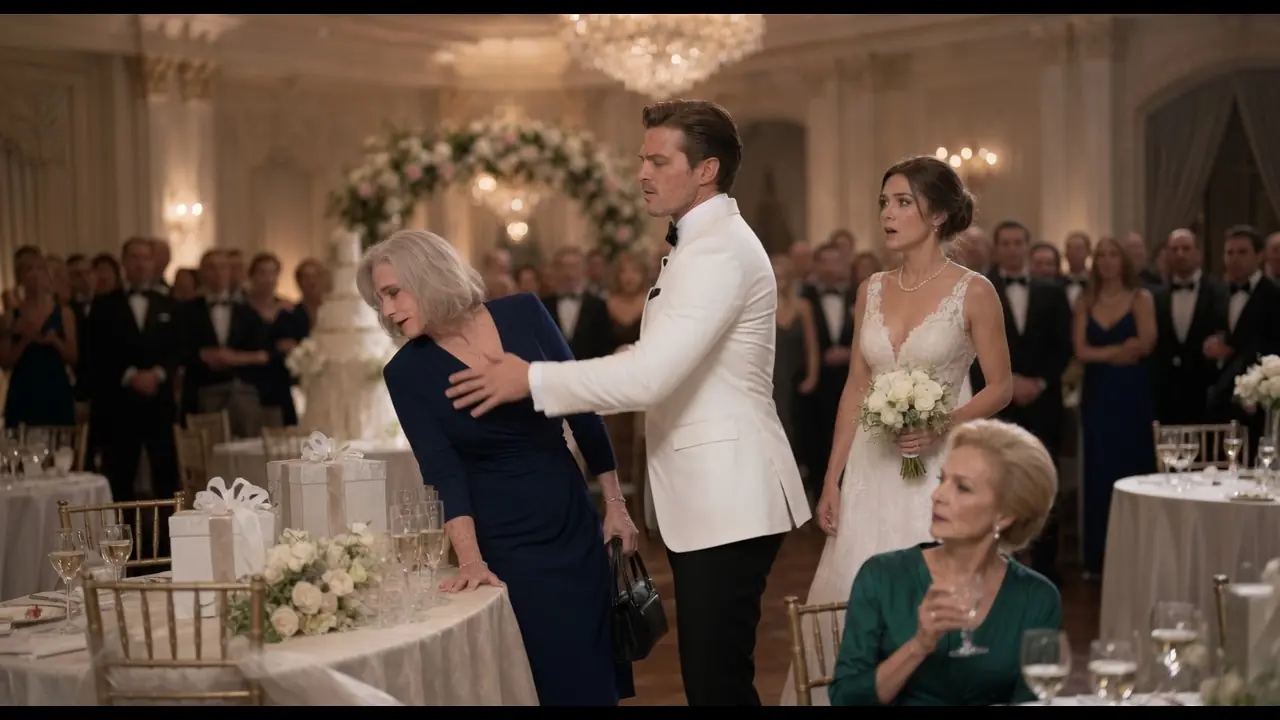
Brent Harlan looked immaculate in his white tuxedo jacket, black trousers, and polished shoes. Nothing in his expression suggested regret, fear, or even awareness that he had assaulted an elderly widow in front of his bride. He simply extended his hand as though Evelyn were a servant who had failed to obey an order. “Give me the farm keys. Now.”
Evelyn’s cheek burned, and she tasted blood at the corner of her mouth. Yet the deepest pain did not come from Brent’s hand. It came from Clara, her only daughter, standing several feet away in a lace wedding gown and pearl necklace. Clara’s fingers trembled around her bouquet, but she did not move toward her mother.
“Mom,” Clara whispered. “Please. Just give them to him.”
Those words hurt more than the slap.
Waverly Farm had belonged to Evelyn’s family for four generations. Its forty acres stretched across the rolling Nebraska countryside, filled with apple orchards, pasture, weathered barns, and the white farmhouse her late husband Daniel had repaired with his own hands. It was where Clara had taken her first steps, learned to ride a pony, and spent summer evenings catching fireflies beneath the apple trees.
It was also where Evelyn had buried Daniel.
For years, Brent had mocked the farm as dead land. He complained about the aging barns, dismissed the orchard income, and joked that Evelyn was wasting her life protecting mud and old trees. Then the county quietly announced plans for a highway extension and commercial interchange less than two miles away. Almost overnight, the property Brent had ridiculed became worth several million dollars.
His mother, Vivian Harlan, watched from the front table with irritation rather than horror. She wore a dark green designer gown and held a crystal wineglass between perfectly manicured fingers. “Really, Evelyn,” she said, “this spectacle is unnecessary. You are alone now, and everyone knows you cannot manage a property that large forever.”
Several groomsmen exchanged amused looks.
“Let the men handle the business,” Vivian added.
Evelyn slowly straightened. Her navy dress was modest beside the expensive gowns surrounding her, and soil remained beneath one fingernail despite the manicure Clara had arranged that morning. To Brent’s family, those details confirmed that she was merely a grieving farm widow who baked pies for church events and avoided confrontation. They believed kindness and weakness were the same thing.
They were wrong.
Three months earlier, Evelyn had discovered a development proposal inside her mailbox. The document offered to sell Waverly Farm to a holding company for a fraction of its projected commercial value. It carried her name, her property details, and a signature that looked almost exactly like hers.
Almost.
Evelyn had never signed it.
She had not confronted Brent immediately. Instead, she contacted Arthur Cole, a retired state investigator who had once helped Daniel expose an agricultural equipment scam. Arthur quietly traced the holding company through layers of legal registrations until he found the real beneficiary.
Brent Harlan owned it.
Additional records revealed that Brent had arranged loans using the proposed sale as collateral. He had also contacted a physician about declaring Evelyn mentally incompetent and researched methods for transferring property through an emergency guardianship. The forged signature was not a mistake or premature draft.
It was part of a plan.
Brent stepped closer, his polished shoes stopping inches from Evelyn’s. “You promised Clara a substantial wedding gift.”
“I promised my daughter a home,” Evelyn replied, carefully steadying her voice.
His smile tightened. “Love does not pay corporate property taxes.”
Evelyn touched the blood at her lip and looked directly into his eyes. “No, but greed leaves fingerprints.”
For the first time, Brent’s confidence flickered.
Vivian leaned forward. “What is that supposed to mean?”
The ballroom seemed to shrink around them. Guests stared from beneath the chandeliers while the photographer slowly lowered his camera. He had captured the slap, Brent’s demand, and Evelyn’s injured face before realizing his wedding photographs might now be evidence.
Clara reached for her mother’s arm.
“Mom, please don’t ruin this day.”
Evelyn stared at the daughter she had taught never to surrender to intimidation. Clara’s face was pale beneath her makeup, and fear lived behind her eyes. Evelyn wondered when love had become obedience and when Brent had convinced her daughter that silence was the price of keeping peace.
“You made a mistake, Brent,” Evelyn said quietly.
He laughed and looked around, inviting his friends to enjoy her humiliation. “No, Evelyn. You did.”
Evelyn said nothing more. She walked past the towering wedding cake, floral arch, and rows of guests who suddenly found the floor fascinating. Outside, the October wind struck her swollen cheek, but it felt cleaner than the air inside that ballroom.
She opened her handbag and removed her phone.
At the far end of the driveway, beyond the rows of luxury vehicles, a dark county sedan waited beneath the trees. Two sheriff’s cruisers remained hidden farther down the road. Evelyn found Arthur’s number and pressed call.
He answered after one ring.
“It’s time,” she said.
Inside the ballroom, Brent attempted to restart the celebration. He lifted a champagne glass and announced that the family had experienced a minor emotional misunderstanding. The orchestra remained silent, and no one raised a drink.
Clara stood near the wedding cake, still clutching her bouquet.
“Why did you hit her?” she whispered.
Brent kept smiling for the guests. “Because she was humiliating you.”
“She did not say anything.”
“She refused to cooperate. That is the same thing.”
Clara stared at him as though she were finally hearing the logic beneath years of manipulation. Brent had always explained his anger as protection, his control as responsibility, and his insults as honesty. Every wound became someone else’s fault.
Vivian approached and adjusted Clara’s veil. “Your mother is emotional because she knows you no longer need her. Do not let one unpleasant moment ruin the future Brent is building for you.”
“What future?”
“The farm will be sold, and you will finally have enough capital to live properly.”
Clara pulled away. “Mom never agreed to sell.”
“She will.”
The ballroom doors opened before Vivian could say more.
Arthur Cole entered wearing a charcoal suit beneath a dark overcoat. He was followed by Sheriff Elena Ruiz, two deputies, and a woman carrying a locked evidence case. Guests turned in their chairs as the officials walked directly toward Brent.
His expression hardened.
“This is a private event,” he said.
Sheriff Ruiz stopped several feet away. “Mr. Harlan, we have a warrant to search your hotel suite, vehicle, electronic devices, and business records.”
A murmur moved through the ballroom.
Brent glanced toward the exit. One deputy quietly shifted position to block it.
“What is this about?”
Arthur placed a clear evidence sleeve on the nearest table. Inside was a copy of the forged development agreement bearing Evelyn’s false signature. “Criminal forgery, attempted property theft, conspiracy, fraud, and suspected witness intimidation.”
Vivian rose. “That is absurd. My son is a respected developer.”
Arthur looked toward her. “Your name appears on several communications discussing how to pressure Mrs. Waverly into signing after the forged sale was discovered.”
The wineglass slipped from Vivian’s fingers and struck the carpet without breaking.
Brent’s face reddened. “Evelyn gave me permission to prepare documents.”
“No, I did not.”
Everyone turned toward the entrance.
Evelyn had returned with a folded handkerchief pressed against her lip. Her posture remained straight despite the bruise forming along her cheek. When Clara saw the injury clearly, tears filled her eyes.
Brent pointed toward Evelyn. “She is confused. She has been forgetting things for months.”
Sheriff Ruiz removed another document from her folder. “That claim appears repeatedly in emails between you, your mother, and Dr. Samuel Price.”
Clara looked sharply at her husband. “Who is Dr. Price?”
“A physician Brent contacted to support a petition declaring your mother mentally incompetent,” Arthur explained. “He offered the doctor seventy-five thousand dollars after the farm transfer.”
Brent moved toward Clara, but she stepped away.
“That is not what happened,” he said. “I was protecting you. Your mother would have destroyed your inheritance by refusing to develop the land.”
“It was never yours,” Evelyn replied.
“It should belong to Clara.”
“And therefore to you?”
Brent’s voice rose. “I married into this family. I have rights.”
“You have exactly the rights granted by law,” Sheriff Ruiz said. “None of them include forging a widow’s signature or striking her at your wedding.”
The photographer raised one trembling hand. “I captured the assault.”
Several guests immediately lifted their phones.
Brent looked around and realized the room had transformed. Moments earlier, the crowd had been his audience. Now every witness represented another piece of evidence.
He turned toward Clara. “Tell them your mother promised us the farm.”
Clara’s lips parted, but no words came.
Brent gripped her wrist. “Tell them.”
Evelyn saw her daughter flinch.
That movement explained everything.
She crossed the room and placed herself between them. “Take your hand off her.”
Brent laughed once in disbelief. “You think you can order me around after setting this up?”
“I think you have mistaken patience for surrender.”
Sheriff Ruiz ordered Brent to release Clara.
He did not.
The deputy moved first, pulling Brent’s hand away and turning him toward the table. Brent resisted just enough to knock over two champagne glasses before the second deputy secured his arms behind his back.
“You are ruining my life!” he shouted at Evelyn.
“No,” she replied. “I am refusing to let you ruin ours.”
The handcuffs closed around his wrists.
Vivian protested loudly, demanding attorneys and threatening lawsuits against the county. Arthur calmly informed her that investigators had obtained records from the holding company, bank, and title office. The evidence connected her to the attempted transfer and to payments made through a consulting business she controlled.
Her anger collapsed into silence.
Clara watched her new husband being escorted across the ballroom only an hour after exchanging vows. Her bouquet slipped from her hands and landed among scattered white petals. She looked toward Evelyn, but shame prevented her from meeting her mother’s eyes.
“Mom,” she whispered.
Evelyn did not embrace her immediately.
Some wounds required truth before comfort.
Sheriff Ruiz asked Evelyn to accompany a deputy to document the assault. The photographer transferred his images, while several guests provided videos capturing Brent’s demand for the keys and his threat to have Evelyn declared incompetent. What Brent intended as public humiliation became the clearest possible record of his motive.
The wedding ended without music, dancing, or cake.
By midnight, investigators had searched Brent’s hotel suite. They found copies of Evelyn’s property records, a forged notary stamp, financial projections for the highway development, and a list of companies prepared to purchase parcels after the sale. His laptop contained messages bragging that the wedding would finally give him enough leverage to force Evelyn’s cooperation.
One message to Vivian read, Clara will make her sign. If not, we use the competency petition.
Another said, The old woman is too sentimental to fight once the daughter chooses me.
Clara read those words two days later inside Arthur’s office.
She became physically ill.
Evelyn sat across from her without speaking while her daughter scrolled through messages revealing years of calculated manipulation. Brent had targeted Clara shortly after learning about the highway proposal through a county planning consultant. Their romance, rapid engagement, and insistence on an extravagant wedding had all been timed around the property deal.
“Did he ever love me?” Clara asked.
Evelyn’s heart broke for her, but she refused to offer an easy lie. “I do not know what he felt. I know what he chose.”
Clara covered her face. “I asked you to give him the keys.”
“Yes.”
“I stood there after he hit you.”
“Yes.”
“Why aren’t you screaming at me?”
“Because you are already hearing everything I would say.”
Clara began to sob.
For months, Brent had isolated her from friends and criticized every decision she made without him. He monitored her accounts, chose her clothes for public events, and convinced her that Evelyn’s concern was jealousy. Each time Clara resisted, he threatened to cancel the wedding or expose private messages he had persuaded her to send.
She had mistaken fear of losing him for proof of love.
“I was so afraid he would leave,” Clara admitted.
Evelyn reached across the table. “A person who loves you should not make abandonment the weapon that controls you.”
Clara finally took her mother’s hand.
The marriage was annulled before the criminal trial began. Brent remained in custody after prosecutors proved he had attempted to move money offshore and contact a witness through a friend. Vivian was charged separately and eventually agreed to cooperate in exchange for a reduced sentence.
The investigation uncovered more than one attempted fraud.
Brent had used similar methods against elderly property owners near proposed development routes. He approached families through romantic relationships, business partnerships, and investment offers. Once he gained access, he created forged options to purchase their land below market value.
Three previous victims came forward after seeing news coverage from the wedding.
One was an eighty-year-old farmer who lost twelve acres through documents he never remembered signing. Another was a widower pressured into selling after Brent arranged false code violations against his barns. The third was a woman whose adult son had been paid to convince her that the land carried dangerous debt.
Evelyn’s case helped expose the entire operation.
At trial, Brent’s attorney attempted to portray the slap as an emotional mistake unrelated to the property scheme. Prosecutors played the photographer’s video. The jury watched Brent strike Evelyn and immediately demand the farm keys.
Then they heard him threaten to have her declared mentally incompetent.
Evelyn testified for nearly four hours. She described the farm’s history, the forged proposal, and her decision to investigate quietly rather than confront Brent without proof. When the defense attorney suggested she had manipulated the wedding to create maximum embarrassment, Evelyn remained calm.
“I did not choose the moment,” she said. “Mr. Harlan chose it when he struck me.”
“You could have surrendered the keys and handled the dispute privately.”
“He assaulted me publicly because he believed shame would make me obedient.”
“Did you intend to give the farm to your daughter?”
“I intended to give Clara a place where she would always be safe.”
The attorney glanced toward Brent. “And now?”
Evelyn looked at Clara sitting in the front row.
“That intention has not changed.”
Brent was convicted of forgery, attempted theft, fraud, conspiracy, assault, and witness intimidation. The judge sentenced him to many years in prison and ordered restitution to the previous victims. Vivian received a shorter sentence after cooperating, but her social circle and carefully protected reputation disappeared almost overnight.
The highway extension eventually moved forward.
Developers offered Evelyn enormous sums for Waverly Farm, but she refused to sell the entire property. Instead, she sold eight acres near the highway at full market value and placed the remaining land into a conservation trust.
The sale gave her more money than she would ever need.
She used part of it to restore the barns, modernize the orchard, and establish a retreat for women escaping abusive relationships. Several cottages were built along the far pasture, offering temporary housing, legal support, employment counseling, and privacy.
Clara became the program’s first full-time director.
Her recovery was not immediate. She attended therapy, rebuilt friendships, and learned to make decisions without waiting for someone else’s approval. Some days, she could discuss Brent with clear understanding; on others, she blamed herself for every warning she had ignored.
Evelyn never allowed guilt to become another prison.
“You made choices while afraid,” she told her daughter. “Now make different choices while free.”
Their relationship healed slowly.
Clara returned to the farmhouse but did not move into her childhood bedroom immediately. She rented a small cottage on the property, paid her own expenses, and joined Evelyn for dinner only when both wanted company. Trust grew through ordinary acts rather than dramatic apologies.
One autumn evening, nearly two years after the wedding, mother and daughter stood beneath the apple trees while families gathered for the retreat’s annual harvest dinner.
Children ran between tables. Women who once arrived frightened and isolated now worked in the bakery, orchard, office, and counseling center. The restored barn glowed with strings of lights, and music drifted across the pasture.
Clara touched Evelyn’s hand.
“I still dream about that slap.”
“So do I.”
“In the dream, I move. I step between you before he touches you.”
Evelyn looked toward her daughter. “Perhaps the dream is not asking you to change the past. Perhaps it is showing you who you are becoming.”
Clara’s eyes filled.
“I should have protected you.”
“And I should have understood sooner how frightened you were.”
“You did understand.”
“Not enough.”
They stood in silence beneath the trees Daniel had planted decades earlier.
Clara eventually rested her head against her mother’s shoulder. Evelyn placed one arm around her, holding the daughter who had once failed her and then found the courage to face that failure honestly.
At the edge of the orchard stood a new wooden sign:
Waverly Haven — No One Surrenders Their Home to Fear.
Visitors often asked Evelyn why she had not sold the farm after its value increased. She would smile and explain that land could be worth more than whatever a developer offered.
Waverly Farm held her family’s history.
It held Daniel’s grave, Clara’s childhood, four generations of work, and the moment greed revealed itself beneath a white tuxedo. Most importantly, it had become a place where frightened people learned that safety did not require silence.
Evelyn kept the original farm keys in a small shadow box inside the retreat office.
Beside them was the photograph taken seconds after Brent’s slap. It showed Evelyn stumbling, Clara frozen in horror, and guests watching from beneath the chandelier.
The image was painful.
It was also honest.
Underneath the photograph, Evelyn placed a single sentence:
He demanded the keys because he believed fear had already given him the farm.
But fear had given him nothing.
Brent lost his freedom, his fortune, and the future he attempted to steal. Clara lost a marriage built on manipulation but reclaimed her voice, her family, and her purpose.
Evelyn kept the farm.
She kept the keys.
And when someone arrived at Waverly Haven believing abuse had taken away every choice, Evelyn would place those keys in the woman’s hand and lead her toward one of the cottages.
“This door belongs to you while you rebuild,” she would say.
Because that was the lesson Brent never understood.
A home was not merely land, money, walls, or legal ownership.
A true home was the place where no one had to surrender dignity to remain inside.