In the winter of 1887, Montana Territory looked less like a place meant for living and more like a test sent down from heaven.
The wind swept across the open plains with a voice of its own, dragging snow over fence lines, rattling shutters, and driving even the proudest men indoors before sunset.
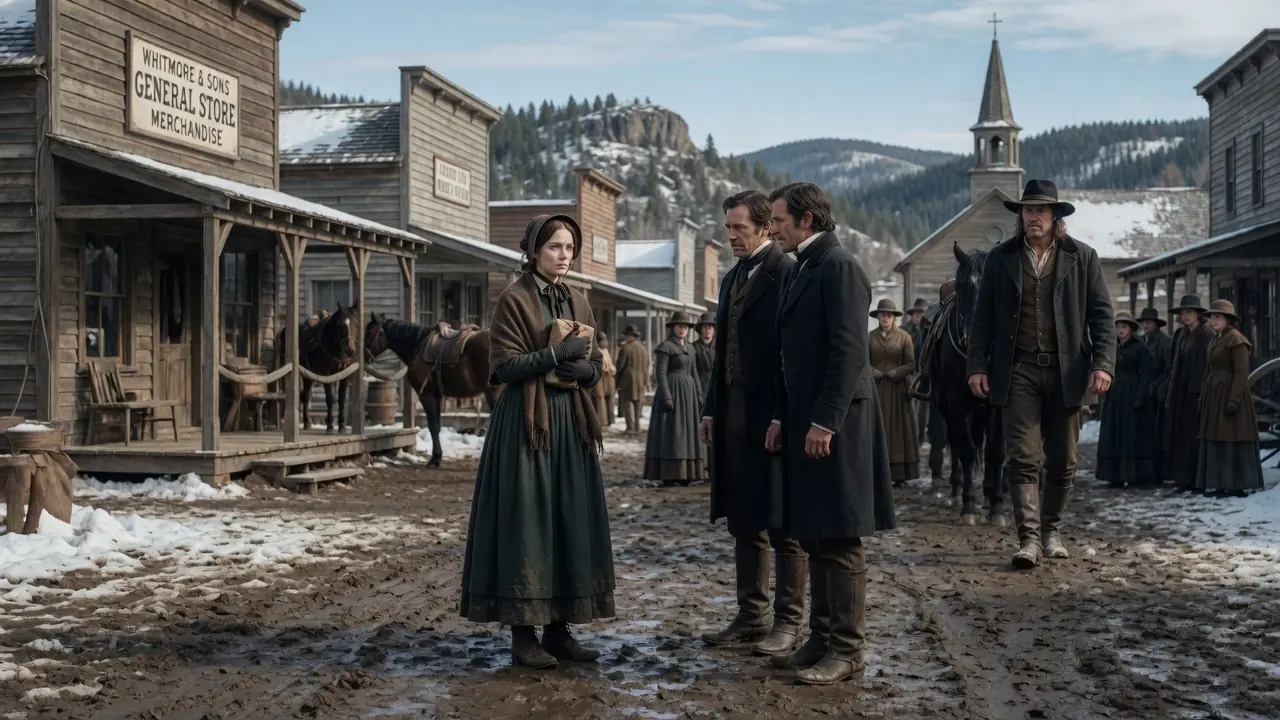
The small frontier town of Mercy Ridge sat at the edge of that hard country, no more than a row of wooden buildings, a church with a crooked bell tower, a general store, a blacksmith shop, and a hotel that smelled of coal smoke and damp wool.
Most people hurried when the weather turned. They lowered their heads, pulled collars tight, and moved quickly from one door to the next.
Ethan Cole did not hurry.
He rode through the storm on a black horse named Samson, sitting tall in the saddle as if the cold had no claim on him. At thirty-four, Ethan was already known across the territory. Some knew him as the owner of the largest ranch north of Mercy Ridge. Others knew him as the man who could lift a fence post alone, calm a wild horse with one hand, and work from sunrise to moonrise without complaint.
But most people simply called him the Giant.
He stood six feet nine inches tall, with shoulders broad enough to fill a doorway and hands large enough to make an ordinary coffee cup look like a child’s toy. Long dark hair brushed the collar of his heavy ranch coat, and his deep-set eyes rarely gave away what he felt. He did not laugh loudly. He did not waste words. He did not enter a room without people noticing.
Children stared at him.
Women lowered their eyes.
Men pretended not to be intimidated, then stepped out of his way.
Ethan had grown used to it. A man could grow used to almost anything if life forced him to.
He owned thousands of acres outside town, a spread of rolling grassland, cold creeks, rocky hills, and grazing cattle. His barns were full. His horses were admired. His name meant something from Mercy Ridge to Fort Benton.
By every visible measure, Ethan Cole had built a successful life.
But a successful ranch did not answer a man when he came home at night.
It did not sit across from him at supper.
It did not warm the empty side of a bed or fill a house with morning conversation.
For years, Ethan had hoped he might marry. Not because he needed help managing the ranch, and not because people expected a man of his standing to take a wife. He had wanted something quieter than that. A companion. A woman who might sit beside him at the end of a hard day and understand that silence did not always mean coldness.
He had never asked for beauty or wealth.
He had only hoped to be seen without fear.
But women in Mercy Ridge looked at him as if he were a storm cloud moving toward them. Some were polite, some nervous, and some openly frightened. More than once, he had watched a young woman smile at him from a distance, then stiffen when he came near enough for her to understand his size.
After a while, Ethan stopped trying.
Loneliness became another chore, like chopping wood or mending wire.
He did not like it.
He simply carried it.
That evening, Ethan rode into town to collect supplies and settle an account with the blacksmith. The sun had already slipped low behind the hills, and blue dusk gathered between the buildings. Snow came down in sharp, slanting lines. Lamps glowed behind frosted windows. Families moved inside. Horses stamped under awnings.
Then the stagecoach arrived.
It came in late, wheels grinding through snow, horses breathing hard, the driver cursing the weather as he pulled to a stop before the hotel.
Passengers spilled out quickly. A merchant with a red nose hurried toward the general store. A mother wrapped a scarf around a sleepy child. Two men ran toward the hotel, arguing about rooms before they even reached the door.
Only one passenger remained beside the coach.
A woman.
She stood with one gloved hand wrapped around the handle of a worn suitcase. Snowflakes clung to her chestnut hair and melted against her pale cheeks. Her traveling dress was plain, dark, and carefully mended. She looked around the town with the uncertain expression of someone who had traveled far on hope and arrived to find the world colder than expected.
Ethan watched from across the street.
He did not know her name then.
Dawn Whitmore.
Twenty-six years old.
Widowed for six months.
Homeless for three weeks.
Exhausted beyond words.
Dawn had once lived in a modest white house near a river in eastern Kansas. It had belonged to her husband, Thomas, a gentle man with soft hands and patient eyes. Their marriage had not been long, but it had been kind. They had planted beans in spring, read together by lamplight, and spoken often of going west one day to begin again where no one knew their troubles.
Then fever came.
Thomas was strong on Monday, burning by Wednesday, and gone before Sunday church bells rang.
While Dawn was still trying to understand how a husband could become a memory so quickly, Thomas’s brothers arrived with papers, claims, and cold expressions. Samuel and Richard Whitmore had never cared much for Thomas while he lived, but they cared deeply for anything he left behind.
They said the house had never been legally transferred.
They said Thomas had owed debts.
They said Dawn had no right to stay.
In the end, she left with one suitcase, a few coins, and the terrible knowledge that people could take everything from a woman and still call it lawful.
Now she stood in Mercy Ridge with no family, no home, and snow gathering on her shoulders.
She entered the hotel first.
Ethan saw her through the window speaking to Mr. Cawley, the hotel keeper. Cawley shook his head. Dawn said something else, probably offering less than the price of a room. Cawley shook his head again and pointed toward the door.
She left.
Next, she tried the general store.
Mrs. Hollis listened for half a minute, then lifted both palms with practiced sympathy and stepped back inside.
Dawn asked a woman near the church.
The woman glanced at Dawn’s suitcase, then at the darkening sky, then hurried away with an apology too quiet to be useful.
One man laughed.
Another told her Mercy Ridge had enough troubles of its own.
By the time Dawn reached the center of town again, her face had gone still in the way faces do when tears are too dangerous to let fall.
Ethan dismounted.
His boots hit the snow with a heavy sound.
Dawn did not notice him until his shadow fell across the road beside her. She turned, then looked up.
And up.
For one breath, fear moved across her face.
Ethan saw it. He always saw it.
He almost stepped back.
Instead, he lowered his voice.
“What happened?”
Dawn swallowed. Her hand tightened around the suitcase.
“I arrived on the stage. I was told there might be work here.”
“What kind of work?”
“Bookkeeping. Sewing. Cooking. Anything decent.”
“You have a place to stay?”
Her silence answered.
A wagon rolled past them, wheels crunching through snow. Somewhere behind them, a door shut quickly against the wind.
Dawn lifted her chin.
“I can pay when I find work.”
“That wasn’t my question.”
Her eyes searched his face, expecting mockery, suspicion, or some bargain hidden behind kindness.
“My husband died,” she said finally. “His family took the house. I came west because there was nothing left behind me.”
Ethan said nothing for a moment.
The wind pushed snow between them.
Then he reached down and picked up her suitcase.
Dawn stepped back.
“What are you doing?”
“I have an empty cabin on my ranch.”
She blinked.
“What?”
“It’s old, but the roof holds. The stove works. You can stay there.”
“How much?”
“Nothing.”
“There must be a condition.”
“There isn’t.”
Dawn looked at him as if kindness itself had become suspicious.
“Why would you do that?”
Ethan glanced toward the hotel window, where Mr. Cawley had pulled the curtain aside just enough to watch.
“Because it’s cold,” he said. “And because you asked for help in a town full of people who heard you and kept walking.”
Dawn’s expression changed.
Not trust yet.
But something close to it.
“You don’t even know me.”
“No,” Ethan said. “But I know what it looks like when a person has nowhere to go.”
He led Samson closer and secured her suitcase behind the saddle. Dawn hesitated only a moment before accepting his help onto the horse. Ethan walked beside them rather than riding, one hand on the reins, his large figure cutting through the storm.
People watched from windows.
Mercy Ridge had always been quick to stare and slow to act.
The ride to Ethan’s ranch took nearly an hour. Dawn said little. Ethan did not press her. The land opened around them, wide and white beneath the dark sky. Eventually, lantern light appeared in the distance, then the shape of a large ranch house, barns, fences, and smaller outbuildings.
The cabin sat at the edge of the main property near a line of cottonwoods.
It was simple, with one room, a narrow bed, a small stove, a table, two chairs, and a shelf where someone had left old tin plates stacked neatly. But it was clean. A quilt lay folded at the foot of the bed. Firewood had been stacked beside the door.
Ethan entered first, lit the stove, checked the flue, and made sure the window latch held.
Dawn stood in the doorway, still holding herself as if expecting the floor to vanish beneath her.
“It’s not much,” Ethan said.
“It’s warm.”
“That matters here.”
She turned toward him.
“Mr. Cole.”
“Ethan.”
“Ethan,” she said softly. “Thank you.”
He nodded once.
“There’s bread and beans in the cupboard. I’ll send someone with coffee in the morning.”
“You don’t have to.”
“I know.”
He moved toward the door.
Dawn spoke again.
“Why do people in town look at you like that?”
Ethan paused with one hand on the latch.
“Like what?”
“Like they’re afraid of you.”
He looked over his shoulder. In the stove light, his face was half-shadowed and tired.
“People are often afraid of what they don’t understand.”
Then he stepped outside and closed the door behind him.
From the cabin window, Dawn watched him walk back into the snow. His enormous shape faded slowly into the storm until the night swallowed him.
She pressed one hand against the glass.
For the first time since Thomas died, she felt safe enough to cry.
Winter loosened its grip slowly.
The snow softened at the edges. Streams began to move under the ice. Brown earth showed through white fields, and by March, the first stubborn green grass appeared along the fence line.
Dawn did not remain idle.
On her second morning at the ranch, she walked to the main house and asked Ethan for work. He had looked at her from the porch, coffee cup in hand.
“You should rest.”
“I’ve rested enough.”
“You traveled through a storm.”
“And I survived it. Now I need to earn my keep.”
Ethan had studied her for a moment.
Then he gave her a stack of receipts, account books, and ranch supply records that had been neglected through winter.
By supper, Dawn had sorted them by month.
By the next evening, she had found three errors that saved Ethan more than forty dollars.
His foreman, Mr. Abel Price, was the first to become openly impressed. He brought her more records. Then invoices. Then payroll notes. Before long, ranch hands were leaving torn shirts and busted coat seams near her cabin door, always with sheepish apologies and sometimes with small gifts of eggs or apples.
Dawn sewed, balanced books, helped with meals, and found herself standing a little straighter each day.
Work restored something grief had stolen.
Purpose.
Ethan watched from a distance.
He saw the way she greeted every hand by name. Saw how she never treated rough men as foolish simply because they lacked schooling. Saw how she listened before speaking, and how the entire rhythm of the ranch seemed to grow steadier around her.
One morning, a rider came hard into the yard leading an injured mare.
The horse limped badly, trembling from pain and fear. Several hands gathered near the barn.
“She’s done,” one man muttered.
“Leg’s ruined,” said another. “Best to end it quick.”
Dawn stood near the porch, a bundle of accounts in her arms.
Ethan crossed the yard.
He placed one large hand on the mare’s neck.
“Easy,” he murmured.
The horse shuddered, then quieted.
Dawn watched in surprise. The same hands that could split logs and lift heavy beams moved with careful gentleness over the animal’s leg. Ethan cleaned the wound himself. He wrapped it slowly. He spoke in a low voice the entire time, not caring who heard him.
“She has a chance,” he said.
“Boss,” Abel warned, “that leg won’t heal right.”
“Then we’ll help it heal crooked.”
The men exchanged glances, but no one argued.
For weeks, Ethan visited that mare each morning and evening. He changed the wraps, checked her feed, and stood beside her until she stopped trembling when others approached.
By late spring, she was walking again.
Dawn never forgot the sight.
Most people saw Ethan’s strength first.
She was beginning to see his mercy.
After that, she noticed it everywhere.
When one of the younger ranch hands tore his coat and could not afford another, a new one appeared beside his bunk with no explanation.
When an orphan boy in town fell ill, medicine was paid for anonymously.
When a widow’s chimney collapsed after a storm, Ethan sent two men to repair it, claiming the work was for practice.
One evening, Dawn saw him loading flour, beans, coffee, and cured meat into a wagon after dark. Curious, she watched from a distance. He drove toward the valley road and stopped at three small houses where families had suffered through hard seasons. He left the food on porches, knocked once, and rode away before anyone answered.
The next day, she asked him about it while they stood near the barn.
“Do they know it’s you?”
Ethan tightened a saddle strap.
“No.”
“Why not?”
“Because hunger doesn’t need an audience.”
Dawn looked at him for a long moment.
“You hide your kindness.”
He glanced at her.
“Kindness isn’t smaller because no one claps for it.”
She had no answer to that.
The ranch became brighter as spring deepened into summer. Or perhaps Dawn only learned to see it.
The mornings smelled of hay and coffee. The evenings glowed with purple light over the hills. Sometimes after supper, she and Ethan sat on the porch of the main house, not quite together and not quite apart, watching the sky turn from gold to indigo.
At first, they spoke of practical things.
Supply orders.
Cattle counts.
Fence lines.
Then, little by little, other words came.
Ethan told her his parents had died when he was young. An uncle had raised him badly, then lost the small family ranch through drink and debt. Ethan had bought back the land acre by acre, working until his body became the tool by which he built a life.
“What about family?” Dawn asked one evening.
Ethan sat with his elbows on his knees, looking toward the far pasture.
“Never happened.”
“You never wanted one?”
He was quiet long enough that Dawn thought he might not answer.
Then he said, “I wanted one.”
The sadness in those three words made her chest ache.
Another evening, she told him about Thomas.
“He was kind,” she said. “Not bold. Not strong in the way people notice. But steady. I think I loved him most because he never made me feel small.”
Ethan listened without jealousy, without discomfort.
“That’s a good kind of man,” he said.
“Yes,” Dawn whispered. “He was.”
The way Ethan honored that love instead of competing with it stayed with her.
By midsummer, both of them were fighting feelings they had not invited.
Ethan had fallen in love first, though he refused to name it.
He loved Dawn’s courage, the way she carried grief without letting it harden her. He loved how she could quiet a room with patience rather than force. He loved her laugh, rare at first, then more frequent as the ranch became home to her. He loved seeing lamplight in her cabin window at night, knowing she was safe there because he had made it so.
But Ethan had spent too many years seeing himself through fearful eyes.
Too large.
Too rough.
Too stern.
Too strange.
Dawn was graceful and intelligent. Surely one day a better man would come along, a man who did not make children stare or women flinch. Ethan told himself friendship was enough because wanting more felt like reaching for something he had no right to hold.
Dawn had her own battle.
At first, she had been grateful. Then curious. Then admiring.
Now she was in danger.
She loved the man beneath the legend. The man who rescued calves in storms, paid doctors quietly, repaired broken gates before anyone asked, and spoke to frightened animals more tenderly than many men spoke to their wives.
She loved his silence because it was honest.
She loved his strength because it was controlled.
Most of all, she loved that he had never once used her vulnerability to make himself powerful.
The giant everyone feared had given her back her dignity.
That was a difficult thing not to love.
Then Samuel and Richard Whitmore came to Mercy Ridge.
Dawn saw them outside the general store on a hot afternoon in July.
The sight stole the warmth from her skin.
Samuel was the older one, narrow-eyed and well-dressed, with a smile that never reached anything human. Richard stood beside him, broader and less clever, but just as cruel when cruelty served him.
They had taken her home.
They had left her with nothing.
And now they were here.
Samuel’s eyes found her across the street.
His smile widened.
“Well,” he said later, cornering her near the mercantile steps. “There you are.”
Dawn kept her voice steady.
“What do you want?”
“What belongs to us.”
“You already took everything.”
Richard laughed.
“Not everything.”
The next week became poison.
Samuel and Richard spread rumors through town. They claimed Dawn had stolen papers from her late husband’s estate. Claimed she owed money. Claimed she had run west to escape debts. Claimed Ethan Cole had been fooled by a pretty widow with a practiced sob story.
The lies were ugly, but worse than the lies was the silence around them.
People knew enough to doubt the brothers. Some had heard other stories. Some remembered how Dawn had arrived with nothing and worked honestly for every meal. But doubt was not courage.
When she walked into town, whispers followed.
When she entered the general store, conversation stopped.
When she passed the hotel, Mr. Cawley looked away.
The old fear returned. Not all at once, but slowly, like cold seeping under a door.
One evening, Dawn sat on the porch of her cabin watching the sun disappear behind the mountains. Tears blurred the horizon before she could stop them.
Footsteps approached.
She wiped her face quickly.
Ethan stepped into the lantern light carrying a small sack of coffee.
“You’re worried,” he said.
Dawn tried to smile.
“I’m fine.”
“You don’t have to pretend with me.”
That almost broke her.
For a long moment, she stared at the darkening pasture. Then the truth poured out. The brothers. The threats. The lies. The memory of losing her home. The fear that she was about to lose this one, too.
Ethan listened without interrupting.
When she finished, he sat beside her on the porch steps.
The wood groaned softly beneath his weight.
“You’re not alone anymore, Dawn.”
She looked at him.
Those simple words reached places in her that speeches never could.
“People said that before,” she whispered. “Then when trouble came, they disappeared.”
“I’m not people.”
No boast.
No drama.
Only fact.
Three days later, those words were tested.
It was market day in Mercy Ridge. Wagons crowded the street. Merchants called from storefronts. Children ran between buildings. Dawn had come for flour, lamp oil, and thread, hoping to finish quickly and return to the ranch.
Samuel and Richard stepped into her path near the town center.
The street quieted almost instantly.
Samuel smiled.
“We need to talk.”
Dawn’s hands tightened around her basket.
“No, we don’t.”
Richard moved closer.
“You don’t decide that.”
People gathered at a careful distance. No one wanted to miss trouble, though no one wanted to enter it either.
Samuel raised his voice so the crowd could hear.
“We gave you a chance to cooperate.”
“I owe you nothing.”
“That’s not what the sheriff will hear.”
Dawn’s anger rose hotter than her fear.
“You have no proof because there is no truth in what you’re saying.”
Samuel’s eyes hardened.
“Truth is whatever people can be made to believe.”
The crowd shifted uneasily.
Dawn looked around.
Faces turned away.
Again.
Again, she was standing alone while others watched.
Samuel took another step.
“Leave town willingly,” he said, his voice sharp enough to cut through the street, “or we’ll make sure you’re forced out.”
The threat hung in the air.
Then a deep voice spoke from behind the crowd.
“That’s enough.”
Every head turned.
Ethan Cole stood at the far end of the street.
Dust covered his boots from the ride. His coat was open at the front, and his long dark hair moved slightly in the wind. He did not shout. He did not reach for a weapon. He simply began walking forward.
The crowd parted.
Not because he pushed through.
Because no one wished to be in his way.
Samuel’s confidence weakened before Ethan had crossed half the distance.
Richard swallowed.
Ethan stopped beside Dawn, then stepped in front of her.
Completely.
The difference in size was almost startling. Samuel and Richard suddenly looked smaller, not only in body, but in spirit.
Ethan’s gaze never left them.
“You’ve said enough.”
Samuel forced a laugh.
“This isn’t your business.”
“The moment you threatened her,” Ethan said, “it became my business.”
The street went still.
Samuel’s face flushed.
“You don’t know what you’re getting involved in.”
Ethan took one step forward.
Only one.
Both brothers stepped back.
Then Ethan spoke words the town would repeat for years.
“As long as I draw breath, no one will lay a hand on her.”
Silence.
Deep.
Complete.
Dawn felt tears gather in her eyes, but she did not look away.
She believed him.
That was what undid her.
Not the size of him. Not the force of his voice. Not the way the Whitmore brothers shrank before him.
It was the certainty.
Ethan did not protect her because it benefited him. He did not stand there because someone praised him for it. He stood there because he had decided she mattered, and once Ethan Cole decided something mattered, the whole territory could not easily move him.
Samuel looked around for support.
He found none.
For the first time, the crowd was not watching Dawn with doubt. They were watching Ethan with respect and the Whitmore brothers with open suspicion.
Richard tugged Samuel’s sleeve.
“Let’s go.”
Samuel’s jaw worked, but no words came.
The brothers backed away.
Their threat had entered the street like thunder and left like smoke.
When they disappeared, the town slowly began breathing again.
Ethan turned to Dawn.
“Are you all right?”
She nodded, though she was not sure she was.
“I am now.”
He studied her face, then gave a small nod.
To anyone else, that might have looked like the end of it.
To Dawn, it was the beginning.
By Sunday, she had made up her mind.
The church near town filled quickly that morning. Families arrived in wagons. Ranch hands removed their hats at the door. Children whispered until their mothers pinched their sleeves. Light poured through plain glass windows and fell in bright bars across the floorboards.
Ethan attended as he always did, sitting near the back, shoulders slightly hunched as if trying to make himself smaller. It never worked.
Dawn sat several rows ahead, hands folded in her lap, barely hearing the sermon.
Her heart beat steadily.
Not from fear.
From decision.
After the service, people gathered outside in the town square. The air was clean after a night of rain, and sunlight shone over the church steps. Women spoke near the wagons. Men discussed cattle prices. Children chased one another around the pump.
Ethan stood near the steps speaking with Abel Price.
Then Dawn walked toward him.
One by one, people noticed.
Conversation slowed.
Then stopped.
Ethan saw her coming and stiffened slightly, as if preparing for bad news.
Dawn stopped before him.
For a moment, the whole square seemed to lean closer.
“Ethan Cole,” she said.
His eyes searched hers.
“Yes, ma’am?”
A faint smile touched her mouth.
“You gave me a home when I had none.”
The square fell silent.
“You gave me dignity when others turned away.”
Ethan’s face changed.
Not much.
But enough.
“You gave me kindness when I needed it most,” Dawn continued.
Her voice trembled, but did not break.
“And when those men tried to frighten me out of the life I was building, you stood in front of me when no one else would.”
Someone in the crowd drew a soft breath.
Ethan looked as if he had forgotten how to move.
Dawn took a step closer.
“I have spent months trying to understand why a man everyone feared was the only one who made me feel safe.”
Her eyes shone with tears.
“Then I understood. They feared your size because they never bothered to see your heart.”
Ethan swallowed.
Dawn held out her hand.
“I see it.”
The words seemed to strike him harder than any blow.
“I see you,” she said. “And somewhere along the way, you became the most important person in my life.”
No one spoke.
Even the horses tied near the rail stood quiet.
Dawn’s voice softened.
“If you are willing, Ethan Cole, marry me.”
The silence became absolute.
Ethan stared at her, certain he had misunderstood.
The woman he loved, the woman he thought could never love him, had asked for his name, his home, his future, in front of the whole town.
For a moment, all the years of loneliness rose inside him at once.
Every frightened glance.
Every whispered name.
Every supper eaten alone.
Every dream he had buried because he believed no woman would ever look at him and see anything but the Giant.
His eyes filled with tears.
He tried to blink them away.
Failed.
Dawn waited.
Patient.
Certain.
Finally, Ethan found his voice.
It was rough and low, barely above a whisper, yet everyone heard it.
“I have waited my whole life to hear those words.”
Dawn laughed through her tears.
Then Ethan stepped forward and took her hand with such care that several women in the crowd began crying openly.
He did not crush her against him. Did not sweep her up to prove strength. He simply bowed his head until his forehead touched hers.
The church bell began ringing.
Nobody admitted later who pulled the rope first.
The square erupted.
Applause burst through the town. Children jumped. Abel Price shouted loud enough to startle two horses. Mrs. Hollis wiped her eyes with her apron. Even Mr. Cawley, who had once turned Dawn away from his hotel, removed his hat and looked ashamed.
Samuel and Richard Whitmore left Mercy Ridge before sundown.
No one stopped them.
No one asked them to stay.
Three months later, Ethan and Dawn married in that same church.
She wore a cream dress sewn by her own hands. Ethan wore a dark suit that had taken the tailor two fittings and several muttered prayers to finish. When Dawn walked down the aisle, Ethan stood so still that Abel later claimed the man looked carved from oak.
But his eyes were not still.
They followed her like she was sunrise after a long winter.
After the vows, the ranch became a different place.
Not all at once.
Joy rarely storms a home. It settles in.
Dawn’s cabin became a guest house for travelers who needed safety. The main house filled with curtains, books, laughter, and the smell of bread. The injured mare Dawn had once watched Ethan save gave birth to a strong foal in spring. Ethan pretended not to care when Dawn named it Mercy, but he visited the stall twice the first night to make sure both were well.
The people of Mercy Ridge began seeing Ethan differently.
Not smaller.
Never smaller.
But clearer.
They saw him delivering supplies to widows. Saw him paying the doctor quietly. Saw him kneel to speak gently to frightened children. Saw him walk beside Dawn, not in front of her unless danger required it, but beside her as if partnership mattered more than pride.
Years later, when children asked why the largest rancher in Montana Territory always looked softest when standing beside his wife, the old-timers told them the story.
They told of a winter night when a widow arrived with no place to sleep.
They told of a giant who offered shelter without asking for anything in return.
They told of greedy men who came to take what was not theirs.
They told of the day Ethan Cole stood in the street and promised that no one would touch the woman under his protection.
And they told of a Sunday morning when Dawn Whitmore stood before the whole town and did what no one else had done.
She looked at the Giant.
And saw the man.
True love does not always arrive wrapped in charm or easy smiles.
Sometimes it comes wearing a heavy ranch coat, with snow on its shoulders and silence in its hands.
Sometimes it looks too large, too stern, too different for people who only understand what is familiar.
But the heart knows what the eyes often miss.
Dawn had been turned away by an entire town.
Ethan had been misunderstood by one.
Together, they became each other’s answer.
In a land where people judged the Giant by his size, one woman chose to judge him by his heart.
And that changed everything.