Eleanor Graves was carrying two steaming plates through the Blackstone Ranch cookhouse when Cole Mercer caught the edge of one with his hand.
Not her wrist.
Not her fingers.
Only the plate.
That distinction mattered more to Eleanor than he could possibly know.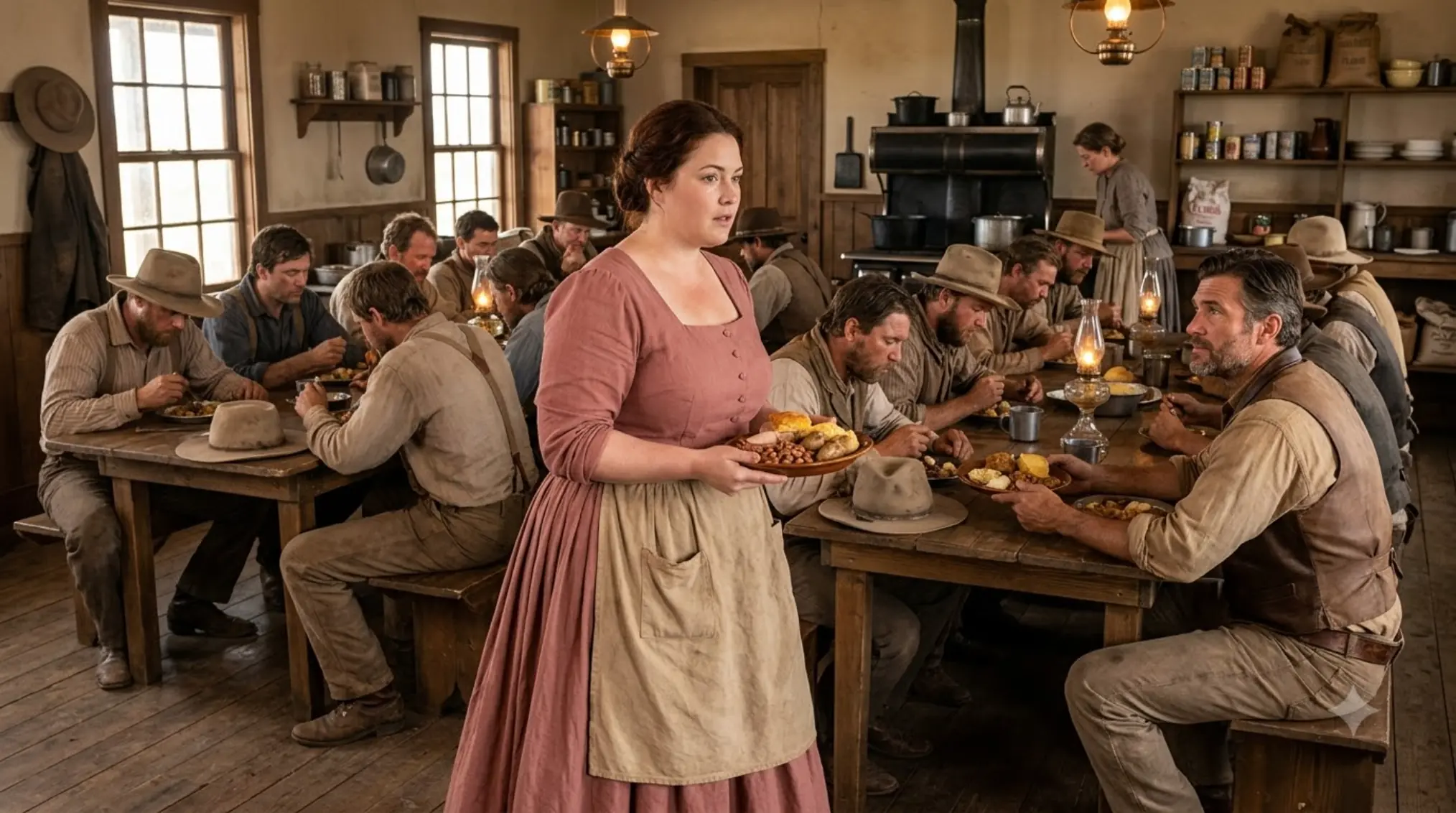
Sixteen ranch hands filled the long wooden room, shoulders bent from twelve hours beneath the Kansas sun, boots dusty, hats hanging from pegs beside the door. Plates were piled with ham-bone beans, potatoes, cornbread, and the last apple cobbler Eleanor had managed from a crate of dried fruit she found buried beneath forgotten flour sacks.
A month earlier, the men had eaten cold beans directly from tins.
Tonight, they were arguing over who deserved the final biscuit.
Eleanor turned toward Cole.
He sat near the far end of the table wearing a faded tan shirt with sleeves pushed over his forearms, dark vest, and the exhausted expression of a man who had forgotten what it felt like not to carry an entire ranch inside his head.
“Something wrong with supper?” she asked.
Cole looked down at the plate.
“No.”
“Then you’ll have to release it.”
His mouth almost smiled.
That almost-smile had become familiar to her.
Cole Mercer seemed to treat expressions the way a careful businessman treated cash.
Never spend more than necessary.
He released the plate.
But before Eleanor could turn away, he said, “You know I’m not coming in early every evening just for supper anymore.”
Eleanor paused.
Several men nearby suddenly became intensely interested in their food.
She raised an eyebrow.
“Then I hope my accounting hasn't frightened the great rancher into needing company.”
Cole held her gaze.
“No.”
His voice softened.
“You walked through my gate with nothing, and somehow made everything I had feel worth coming home to.”
The room became quieter.
Not silent.
But quieter.
Eleanor felt heat rise into her cheeks.
She rested one hand beside his plate.
“Then maybe stop calling this only your ranch.”
Cole’s eyes changed.
“Because I’m starting to feel like I belong here too.”
For one suspended moment, neither moved.
Then Cody, the nineteen-year-old ranch hand who possessed neither patience nor good judgment, whispered loudly from the other table:
“Lord, finally.”
Henry Bush kicked his boot beneath the bench.
Cody nearly dropped his fork.
Laughter broke the tension.
Eleanor shook her head and walked back toward the kitchen.
But her hands trembled slightly when she reached the counter.
And across the room, Cole Mercer watched her go.
Four months earlier, Eleanor had arrived with less than nothing.
That was how she thought of it.
People who possessed nothing still had the advantage of beginning at zero.
Eleanor had begun below zero.
Her late husband Thomas Graves had left debts.
Not one debt.
Dozens.
Gambling markers.
Business obligations.
Private loans.
Two sets of ledgers.
Three months after his burial, men began appearing at her door in Independence, Missouri.
Some were polite.
Some were not.
All wanted money.
By July, the house was gone.
Furniture sold.
Horses sold.
Cookware sold.
The small garden she had tended for nine years belonged to someone else.
She kept one dress suitable for work, another for church, a wool coat, her mother’s Bible, and a battered leather case.
Her brother-in-law James gave her one useful thing before she left.
A name.
Cole Mercer.
Blackstone Ranch.
Outside Caldwell, Kansas.
“They always need a cook,” James had said. “Mercer is difficult.”
“Cruel?”
“No.”
“Dishonest?”
“No.”
“Then difficult I can manage.”
James looked at her for a long moment.
“He’s fair.”
Fair.
That was enough.
Eleanor stopped expecting kindness long ago.
Fairness felt luxurious.
The wagon dropped her beside Blackstone’s rough timber gate beneath heat strong enough to bleach the sky.
Four ranch hands stared when she entered.
One laughed.
Another asked whether she was lost.
Eleanor kept walking.
Cole Mercer sat behind a desk covered in papers when she knocked on the main-house office.
“If you're selling something,” he said without looking up, “I’m not buying.”
“I’m selling nothing.”
That made him look up.
Eleanor stood in front of him covered in road dust.
“I'm looking for work.”
“What kind?”
“Cook.”
Cole stared.
“You?”
Eleanor’s expression hardened.
“Unless you've got another Eleanor Graves behind me.”
His eyes flickered.
“Thomas Graves’s widow?”
“Unfortunately.”
Something passed over his face.
Perhaps recognition.
Perhaps sympathy.
She hated sympathy.
He asked about experience.
Eleanor told him.
Boarding houses.
Church fellowship meals.
Farm crews.
Family gatherings large enough to resemble minor disasters.
Cole finally said:
“Sixteen men.”
“I can count.”
“Forty cents a day.”
“I can count that too.”
This time he nearly smiled.
“You stay out of ranch business that doesn't concern the kitchen.”
“Agreed.”
“When can you start?”
Eleanor looked toward the cookhouse.
“Now.”
Her first discovery was that nobody had been running the kitchen.
They had merely been surviving it.
Food existed everywhere and nowhere.
Three sacks of cornmeal.
No onions.
Four boxes of canned tomatoes.
A barrel of beans.
Dried apples forgotten beneath spoiled flour.
Meat stored badly.
Receipts stuffed into drawers.
No inventory.
No ordering schedule.
No rotation.
Nothing that told anyone what Blackstone actually consumed.
Eleanor stood in the storeroom with both hands on her hips.
“This ranch isn't poor,” she whispered.
“It’s disorganized.”
She understood disorganization.
Thomas had made an art of it.
His gambling debts had not destroyed their marriage in one dramatic night.
They destroyed it through small omissions.
Forgotten payments.
Missing explanations.
Numbers that did not match.
Promises without records.
Eleanor had learned something from those years.
Chaos was expensive.
So she imposed order.
She labeled shelves.
Burned spoiled goods.
Counted everything.
Created a kitchen ledger.
Then she cooked.
The first meal changed the bunkhouse faster than any speech could have.
Beans simmered with ham bone, thyme, and pepper.
Cornbread came hot from iron skillets.
Dried apples became cobbler.
When the men entered, they looked suspicious.
Henry Bush, the gray-mustached foreman, sniffed the air.
“Pass it down before Cody eats the table.”
They ate.
Conversation returned.
Shoulders relaxed.
A man who had barely spoken in days asked for seconds.
Cole arrived late.
He ate two bowls.
Then another piece of cornbread.
He never complimented Eleanor that evening.
But he sat over his coffee five minutes longer than necessary.
She noticed.
Eleanor noticed everything.
Three days later she found the first real problem.
Receipts.
Three months of them.
The Caldwell supplier had overcharged Blackstone repeatedly.
Incorrect weights.
Inflated prices.
Duplicate entries.
Eleanor spent two hours checking every line.
Then carried the papers to Cole.
He looked annoyed when she entered his office.
That expression disappeared after he read the first page.
“How much?”
“Nearly sixty dollars.”
Cole looked up sharply.
“In three months?”
“Yes.”
“Who approved these?”
“Apparently whoever was cooking.”
He rubbed the back of his neck.
Eleanor had already learned this gesture meant something had gone worse than expected.
She waited.
Finally he asked, “What would you do?”
It was the first time he asked for her opinion.
Not about food.
About business.
“Renegotiate.”
“With the same supplier?”
“If he knows you're checking the arithmetic, yes.”
“You'd trust him?”
“No.”
“Then why keep him?”
“Because replacing a supplier costs time and transport. Trust is irrelevant when verification exists.”
Cole stared at her.
“Thomas taught you accounts?”
Eleanor’s expression changed.
“No.”
She collected the receipts.
“Thomas taught me why accounts need watching.”
Cole did not ask again.
That mattered too.
By the end of Eleanor’s second week, waste had dropped.
By the end of the third, supply costs had fallen.
By the end of the first month, even Dyer—an older ranch hand seemingly offended by happiness—stopped complaining about supper.
Cody started appearing before meals.
“Need water?”
“Yes.”
“Wood?”
“Yes.”
“Anything else?”
“Stop stealing biscuits.”
“I don't steal them.”
“You currently have one in your pocket.”
Cody looked down.
“That could be anybody’s biscuit.”
Eleanor laughed.
She had not expected laughter at Blackstone.
She had expected wages.
A bed.
Food.
Survival.
The ranch began offering more without asking permission.
Henry read newspapers at her kitchen table each morning.
Cody talked about Tennessee.
Men started repairing chairs instead of throwing them away because the cookhouse had become somewhere worth caring for.
And Cole began arriving early.
At first he simply poured coffee.
Then he lingered.
One evening Eleanor was scrubbing a pot when he returned after everyone had eaten.
“You went to Caldwell alone.”
She looked over.
“Yes.”
“You should've asked for a wagon.”
“I managed.”
“I know you managed.”
Something in his voice made her pause.
“I’m saying you shouldn't always have to.”
Eleanor stared at him.
No man had ever framed help that way.
Thomas used help as evidence of debt.
Martha, her mother, had treated dependence like weakness.
Cole offered assistance without implying incapacity.
Eleanor returned to the pot.
“I’ll ask next time.”
He nodded.
Then, at the door:
“The cobbler was good.”
“It’s the same recipe.”
“I know.”
Cole looked back.
“I wanted to say it.”
He left.
Eleanor stood alone in the kitchen longer than she intended.
Summer worsened.
The grass turned pale.
The ranch’s financial strain became harder to hide.
Eleanor heard fragments over meals.
South fence failing.
Two ranch hands gone.
Cattle buyer delaying.
October payment approaching.
Then one evening she overheard Cole and Henry outside the herb garden.
“If Rollins doesn't buy, October breaks us,” Cole said.
Henry answered, “He’ll buy.”
“He’s asked for three delays.”
Silence.
“What are you going to do?”
Cole’s answer came quietly.
“I don't know.”
Eleanor remained crouched beside the sage until they walked away.
She knew that sentence.
Thomas had said it hundreds of times.
I don't know.
Usually after the moment when knowing would have mattered.
Eleanor spent two days deciding whether to interfere.
Then she asked Cole for the ranch ledgers.
“No.”
She expected that.
“The kitchen saved almost a third after I organized it.”
“This isn't the kitchen.”
“Numbers don't know which building they're standing in.”
Cole frowned.
“You're asking to see private accounts.”
“Yes.”
“You remember what I told you when you arrived?”
“Stay out of ranch business.”
“And?”
“I did.”
Eleanor leaned forward.
“Until ranch business started threatening my kitchen, my wages, my room, and sixteen men’s employment.”
Cole stared at her.
She continued.
“You hired me because you needed someone capable.”
“I hired a cook.”
“Then you got lucky.”
Silence.
Cole almost smiled.
He hated that she could see it.
“Three days,” he said.
“What?”
“I’ll think about it.”
Three days later the ledger appeared on her kitchen table.
No explanation.
Eleanor poured two coffees.
Cole sat.
They worked until sunset.
The problem was not bankruptcy.
It was neglect.
Old contracts.
Poor purchasing.
Payment scheduling.
A cattle sale delayed too long.
One service agreement charging Blackstone for work no longer performed.
“This ranch isn't dying,” Eleanor said.
Cole rubbed his eyes.
“Feels like it.”
“It’s bleeding.”
He looked at her.
“That supposed to make me feel better?”
“Yes.”
“How?”
“Bleeding can be stopped.”
For the first time, Cole laughed openly.
The October payment was renegotiated.
The cattle sold.
The unused contract was canceled.
Blackstone survived.
Then trouble arrived wearing a fine coat.
Victor Hale appeared in Caldwell asking questions about Eleanor.
Henry told her first.
“Man from Missouri.”
Eleanor’s stomach tightened.
“What name?”
“Victor Hale.”
The past arrived instantly.
Victor had financed some of Thomas’s gambling.
Not through banks.
Not through contracts.
Through handshakes and quiet arrangements designed precisely so courts could not examine them.
Thomas owed him money when he died.
The official estate settlement contained no enforceable claim from Victor.
Victor did not care.
Eleanor told Cole that evening.
“He’ll come here.”
Cole’s face became still.
“Let him.”
“I don't want trouble because of me.”
“Whatever he brings isn't because of you.”
His voice was calm.
“It’s because of him.”
Eleanor looked at him.
The sentence stayed.
Victor arrived Thursday.
He smiled when Eleanor stepped outside.
“Hard woman to find.”
“I wasn't hiding.”
He looked around Blackstone.
“You've done better than expected.”
“What do you want?”
“Thomas owed me four hundred twenty dollars.”
“Thomas is dead.”
“Debts aren't.”
“Legal ones went through probate.”
Victor smiled.
“Our arrangement wasn't legal.”
“Then it wasn't my obligation.”
His smile cooled.
“You're working as a cook.”
“Yes.”
“Not exactly respectable after Independence.”
Eleanor folded her arms.
“I’m earning honest money. You should try it.”
Victor’s eyes sharpened.
He stepped closer.
“You think Mercer will keep you when he understands what followed you here?”
Eleanor felt fear.
Real fear.
Not for herself.
For Blackstone.
Victor saw it.
That was his mistake.
He pressed.
“I've spent five days in Caldwell. People talk. Ranch is barely recovering. Mercer can't afford scandal.”
Eleanor heard boots behind the barn.
Cole.
He had heard enough.
But he stayed where he was.
He let Eleanor answer.
“I don't owe you three hundred dollars.”
Victor smiled.
“I’m prepared to accept—”
“I don't owe you three dollars.”
His expression changed.
“Leave.”
Victor mounted his horse.
Before riding away, he said:
“You've gotten harder.”
Eleanor met his eyes.
“No.”
“I’ve gotten tired of confusing fear with obligation.”
Victor rode away.
Only then did Cole approach.
“He's bluffing,” Cole said.
“Partly.”
“Then we find the part that isn't.”
Eleanor looked at him.
“We?”
Cole’s expression did not change.
“Yes.”
One word.
But Eleanor felt something inside her shift.
Saturday market in Caldwell brought half the county into town.
Victor stood outside the saloon.
Exactly where Eleanor expected.
She arrived holding the probate documents.
Cole and Henry remained several steps behind.
Victor smiled.
“You brought protection.”
Eleanor stopped in the middle of the street.
“No.”
She lifted the papers.
“I brought records.”
People began watching.
Victor’s smile weakened.
Eleanor spoke clearly.
“These documents list every lawful creditor against Thomas Graves’s estate.”
She opened them.
“Your name isn't here.”
“Our dealings were private.”
“Then produce evidence.”
Victor said nothing.
“A note.”
Nothing.
“A signed agreement.”
Nothing.
“A witness.”
His jaw tightened.
Eleanor looked toward the townspeople.
“This man has spent a week telling people I hid my husband’s assets.”
She turned back to Victor.
“Show them.”
Victor’s face hardened.
“You think making a spectacle—”
“You made the spectacle.”
Eleanor held the document higher.
“I’m simply providing the arithmetic.”
A few men laughed.
Victor looked furious now.
“You were always smarter than Thomas gave you credit for.”
Eleanor’s voice softened.
“Thomas was wrong about many things.”
She lowered the papers.
“So are you.”
Victor left Caldwell the following morning.
No dramatic arrest.
No gunfight.
No threats fulfilled.
He simply discovered that intimidation failed when his target stopped accepting his version of reality.
Eleanor returned to Blackstone.
That evening, Cole found her finishing accounts.
“I wanted to say something.”
“That sounds dangerous.”
He ignored the joke.
“I watched you today.”
Eleanor’s pencil stopped.
“You stood in that street terrified.”
She looked up sharply.
“You knew?”
“I know what courage looks like.”
Cole sat across from her.
“It doesn't look fearless.”
He held her eyes.
“It looks frightened and standing anyway.”
Eleanor felt tears threaten.
She hated crying.
Especially when someone deserved to see it.
Cole continued.
“I’m glad you came through my gate.”
Eleanor swallowed.
“So am I.”
He left before either said too much.
That, she realized, was beginning to become their specialty.
Winter arrived.
The ranch stabilized.
Eleanor began teaching Cody how to maintain inventory.
Then Prescott.
Then Alderman.
Soon Saturday mornings became unofficial lessons.
Accounts.
Supplies.
Contracts.
Basic arithmetic.
Planning.
Cole watched without interfering.
One Sunday he found Eleanor checking the rosemary behind the cookhouse.
“Can we talk?”
She stood.
“You look worried.”
“I am.”
“About the ranch?”
“No.”
That worried her more.
Cole removed his hat.
“My wife died five years ago.”
Eleanor waited.
“Clara.”
“I know her name.”
“I spent years deciding this ranch was enough.”
He looked toward the winter fields.
“It needed to be.”
“And now?”
Cole turned.
“Now I think I misunderstood enough.”
Eleanor’s chest tightened.
“Cole.”
“I know you're not Clara.”
“Good.”
“And I don't want Clara.”
She studied him.
“I’m difficult.”
“I noticed.”
“I’ll continue interfering with your accounting.”
“I’m counting on it.”
“I don't need saving.”
“I know.”
Eleanor’s voice softened.
“Then what do you need?”
Cole reached into his coat.
A simple silver ring rested in his palm.
Small turquoise stone.
“My grandmother’s.”
Eleanor stared.
“How long have you carried that?”
“Since Caldwell.”
She looked at him.
“Why?”
“Because that was the day I realized I wasn't afraid you’d leave.”
A pause.
“I was afraid you'd decide you didn't need to stay.”
Eleanor looked away.
Her eyes burned.
Cole continued.
“I don't want gratitude.”
She nodded.
“I don't want you marrying me because I gave you work.”
Another nod.
“I want you because when something breaks, you fix it without pretending it wasn't broken.”
Eleanor almost laughed.
“That is possibly the least romantic proposal ever delivered.”
“I haven't proposed yet.”
“That was the rehearsal?”
“Apparently.”
She smiled.
“Then try again.”
Cole straightened.
“Eleanor Graves.”
“Yes?”
“Marry me.”
She waited.
Cole swallowed.
“Build the rest of this with me.”
The winter wind moved through the dry Kansas grass.
Eleanor thought of Thomas.
The debts.
The lost house.
The wagon.
The Blackstone gate.
The first kitchen.
Cole drinking coffee silently at the window.
Victor in Caldwell.
Cody stealing biscuits.
Henry standing in the doorway.
The ranch she had helped save.
The life she had rebuilt without realizing it.
Finally:
“Yes.”
Cole exhaled.
“Yes?”
“Yes, Cole.”
He placed the ring on her finger.
It fit.
Barely.
Eleanor laughed.
“You guessed.”
“I hoped.”
“That is not good accounting.”
“No.”
Cole finally smiled fully.
“But sometimes you risk something.”
They married in March.
Sixteen ranch hands scrubbed themselves into varying degrees of respectability.
Henry stood beside Cole.
Cody cried before the ceremony even started.
Dyer nodded once, which everyone agreed represented wild celebration.
Eleanor cooked half the wedding meal herself because nobody could stop her.
They ate outside beneath lanterns.
The food was imperfect.
The wind knocked over one pitcher.
A horse escaped.
Someone burned bread.
It was, Eleanor decided, perfect.
Later, when the others were laughing around the long tables, Cole rested his hand over hers.
“You happy?”
Eleanor considered.
Not because she doubted.
Because she had learned not to use important words carelessly.
“Yes.”
Cole squeezed her fingers.
“So am I.”
Marriage did not remove Eleanor from the accounts.
That was the first thing she noticed.
Cole still brought ledgers.
Still asked her opinion.
Still argued.
Still occasionally made decisions she considered ridiculous.
And when she told him so, he listened.
Blackstone grew.
Eleanor’s Saturday lessons expanded beyond ranch hands.
Neighboring families began arriving.
Then women.
Widows.
Farm wives.
Young daughters.
People who had never been taught how to read contracts because nobody expected them to need the skill.
Eleanor taught everyone.
Years later, a newspaper called her little Saturday group a frontier management school.
Eleanor laughed.
“It’s a kitchen table.”
But people came.
Some rode forty miles.
Blackstone survived droughts.
Bad cattle prices.
Winter losses.
Cole and Eleanor lost friends.
Henry died quietly one February night.
Cody eventually became foreman.
His children grew up on the ranch.
Eleanor’s students taught other families.
The knowledge spread.
Not because Eleanor built an institution.
Because she refused to keep useful things locked inside one person’s head.
Cole understood.
That was what he loved most about her.
One evening, eleven years after Eleanor first walked through the Blackstone gate, they stood together on the porch watching a young woman named Clara Voss ride away after spending two years learning accounts and ranch management from Eleanor.
“She’ll do well,” Cole said.
“Yes.”
Eleanor watched until the road emptied.
Cole looked toward the ranch.
The expanded barn.
Repaired fences.
Cookhouse smoke rising.
Men returning from pasture.
The herb garden that should have died five winters earlier but refused.
“What are you thinking?”
Eleanor took her time.
“If everything stopped tomorrow, this would still have mattered.”
Cole nodded.
“What we've built?”
“Yes.”
He smiled.
“When you walked through that gate, I thought you were going to be trouble.”
“You were right.”
“Best trouble I ever had.”
She looked at him.
His hair had gone mostly silver.
His shoulders remained broad.
His face more weathered.
But the eyes were unchanged.
Steady.
Listening.
Present.
Eleanor rested her head briefly against his shoulder.
“I’m glad I walked through that gate.”
Cole put an arm around her.
“So am I.”
They stood there as the Kansas sun lowered across Blackstone Ranch.
Years earlier, Eleanor had believed she came west because she had nowhere else to go.
She understood now that was only partly true.
She had arrived with one battered case.
No money worth mentioning.
A husband’s ruined name.
A letter of recommendation.
And a spine Thomas Graves had spent twelve years trying to convince her she did not possess.
Cole Mercer had not created her strength.
Blackstone had not rescued her.
They had done something more important.
They had given her a place where strength no longer needed to be spent merely surviving.
She could finally use it to build.
A kitchen.
A ranch.
A marriage.
A community.
A life.
And in the end, that was why the men at Blackstone remembered the summer Eleanor Graves arrived.
Not because the widow was an extraordinary cook.
Though she was.
Not because she saved money.
Though she did.
Not even because she eventually married Cole Mercer.
They remembered because before Eleanor came, Blackstone was a ranch where exhausted men happened to work.
After Eleanor came, it became somewhere people returned to at the end of the day.
A home.
And Cole had understood it before anyone else.
That evening in the cookhouse, when Eleanor placed his supper before him and he stopped the plate beneath his fingers, he had tried awkwardly to explain something he did not yet know how to say.
He had thought she was saving his ranch.
He was wrong.
She was teaching all of them how to build one worth saving.