“Please, I can’t handle it.”
The woman’s voice barely carried through the rain outside the Turning Point Café. She sat sideways in the open doorway of a dark sedan, one hand gripping the seat while the other fought with the folded wheelchair beside her. A loose wheel had slipped from her fingers and rolled beneath the car, leaving her stranded beneath the parking-lot lights.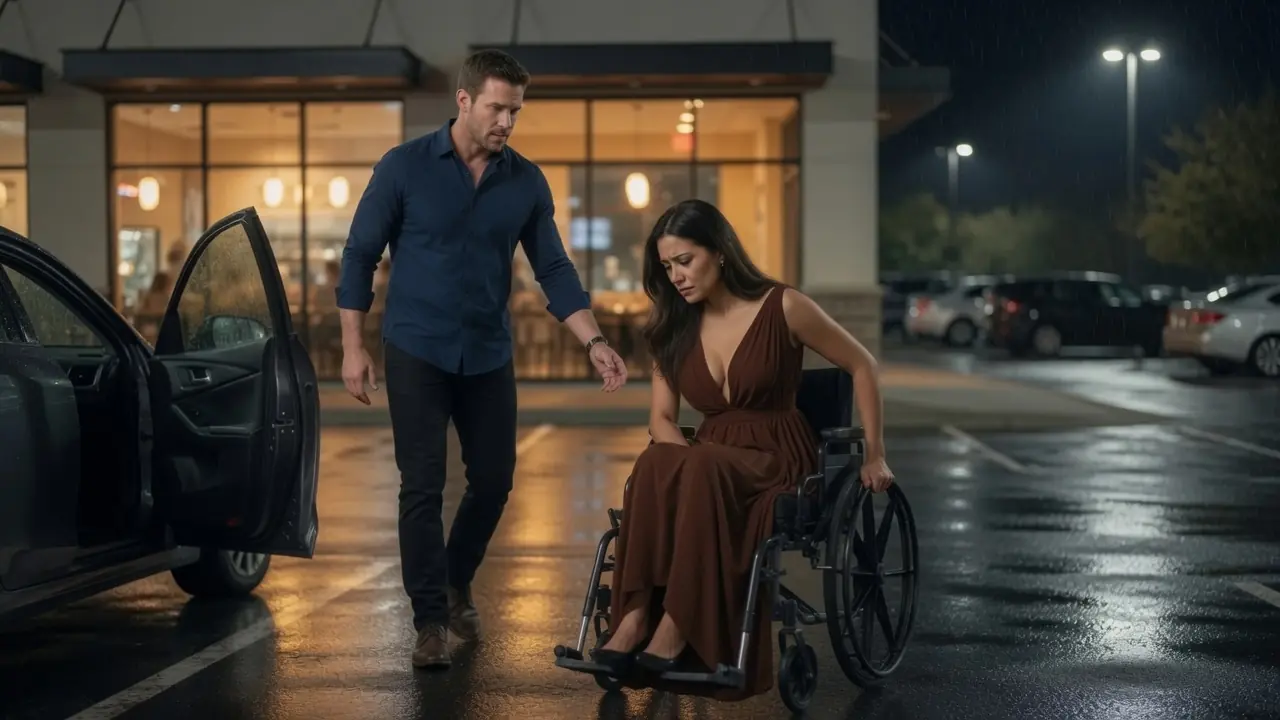
Jackson Reed had been sitting inside his truck three spaces away, trying to invent an excuse to cancel his first date in three years. His sister Vanessa had arranged it and threatened to expose every humiliating childhood secret she possessed if he failed to enter the café. Jackson had almost accepted the consequences when he saw the woman struggling alone.
He climbed out before fear could stop him.
Rain soaked the shoulders of his navy shirt as he approached with both hands visible. The woman looked to be in her mid-thirties, with long dark hair, tearful brown eyes, and a burgundy dress that had clearly been chosen for an evening more hopeful than this one.
“May I help?” Jackson asked.
“I said I can handle it.”
Her voice carried more embarrassment than anger.
The detached wheel remained beneath the sedan.
Jackson crouched several feet away. “I’m not trying to take over. Tell me what you need.”
She looked at him, surprised by the question.
Most people, Jackson knew, either stared helplessly or grabbed a wheelchair without asking. His late wife, Sarah, had lived with multiple sclerosis during the final years of their marriage. She had taught him that assistance should never erase the person receiving it.
“The release pin jammed,” the woman whispered. “I kept pulling, and then the wheel came loose.”
Jackson reached beneath the sedan and retrieved it.
“You’ve done this before,” she said as he examined the axle.
“My wife used a chair.”
The woman’s defensive expression softened slightly.
“Used?”
“She died three years ago.”
“I’m sorry.”
Jackson nodded, focused on the wheel. “The pin isn’t broken. It’s twisted.”
He took a small multitool from his truck and straightened the metal carefully. The wheel clicked back into place, but the chair still refused to lock fully. Jackson checked the frame and found a bent bracket near the brake.
The woman watched his hands.
“My fiancé used to fix it,” she said. “Then he left.”
Jackson did not ask why.
She answered anyway.
“Two months after the accident, he said he couldn’t build a future around someone who needed help getting out of a car.”
Jackson’s jaw tightened.
“Then he misunderstood what a future is.”
She blinked.
“I used to dance,” she continued. “Not at weddings or in little studios. Professionally. Touring companies, national stages, all of it. Now I spend twenty minutes fighting a chair in a parking lot while some man I’ve never met waits inside to decide whether I’m too complicated.”
Jackson tightened the repaired bracket.
“Your date knows about the chair?”
“My sister told him.”
“And he still came.”
“He might not stay.”
Jackson looked up at her.
“Then look at me. I see the woman fighting not to break, and she’s the reason I’m staying here until this chair works.”
Her lower lip trembled.
“You don’t understand,” she said. “My fiancé promised forever, then disappeared when forever became difficult. I can’t survive being abandoned again.”
Jackson held out his hand gently.
“I’m not him. And before I even knew your name, something in me had already chosen not to walk away.”
For several seconds, she simply stared at him.
Then she placed her hand in his.
Her name was Elena Martinez.
Jackson stabilized the wheelchair while she transferred from the car seat. He did not rush her or hold more of her weight than she requested. When she settled into the chair, she wiped her cheeks and tried to repair the makeup the rain had ruined.
“Thank you,” Elena said. “My date is probably wondering whether I changed my mind.”
Jackson glanced toward the café.
“Mine probably thinks the same thing.”
Elena managed a small laugh.
He pushed the wheelchair over a rough section of pavement only after she asked. At the entrance, he held the door and watched her move independently toward the hostess stand.
Jackson stepped aside to check his phone.
Three messages from Vanessa waited.
She’s already there.
Table seven.
Her name is Elena. Do not ruin this.
Jackson slowly lifted his head.
Elena had stopped beside table seven.
She was looking directly at him.
“You’re Jackson?” she asked.
He slipped the phone into his pocket. “You’re my date?”
The surprise on her face lasted only a moment before humiliation replaced it.
“So now you know.”
“I knew your name thirty seconds ago.”
“You know what I mean.”
Jackson approached the table. “I helped because you needed help.”
“You helped because you’re kind to strangers. That doesn’t mean you want to have dinner with one in a wheelchair.”
He sat across from her.
“I almost canceled before I saw you.”
Elena’s expression closed.
“Thank you for your honesty.”
“It had nothing to do with you. I haven’t been on a date since Sarah died.”
The anger in Elena’s face weakened.
Jackson continued before fear silenced him.
“I spent twenty minutes outside trying to convince myself that staying home would protect me from betraying her memory. Then I saw you fighting that chair, and for the first time tonight, I stopped thinking about myself.”
Elena looked down at her hands.
“You can still leave,” he said. “But don’t leave because you think I’m planning to.”
The café owner brought menus and two glasses of water. Jackson noticed Elena studying the logo embroidered on his shirt.
Reed & Cole Architecture.
Her eyes sharpened.
“You work there?”
“I’m a partner.”
Elena’s entire posture changed.
“Jackson Reed?”
“Yes.”
“The Jackson Reed who designed the Horizon Performing Arts Center?”
His uneasiness returned. “I led the original design.”
Elena rolled backward from the table.
“Of course you did.”
“What happened?”
She laughed bitterly. “You truly don’t know who I am.”
“I know you were a dancer.”
“I’m also the accessibility consultant filing a federal complaint against your firm tomorrow.”
Jackson stared at her.
The Horizon Performing Arts Center had been the largest project of his career. The city commissioned it as a modern home for dance, theater, and community programs. Jackson’s original proposal included wheelchair-accessible stages, wide backstage routes, adjustable dressing rooms, and ramps built directly into the architecture.
His business partner, Grant Cole, managed construction after Sarah’s health declined.
The completed building looked beautiful in photographs.
Jackson had attended only one inspection because Sarah entered the hospital during the final phase. Grant assured him every accessibility feature had been constructed exactly as approved.
“What is your complaint?” Jackson asked.
Elena’s eyes filled with anger.
“The main entrance has a ramp, so everyone congratulates themselves. But once I’m inside, I can’t reach the stage without using a service elevator behind the kitchen. The backstage corridor is too narrow to turn my chair. The accessible dressing room became storage, and the emergency exit has a six-inch step.”
“That is impossible.”
“I was trapped during a fire drill last month.”
Jackson’s face changed.
Elena leaned toward him. “I was invited to choreograph the opening performance. Instead, three staff members carried me down a service staircase while donors watched. The video was shared thousands of times.”
Jackson had seen the video.
Grant told him the problem resulted from unauthorized equipment blocking a compliant route. He claimed the city had already corrected it.
“You designed that building,” Elena said. “You created a place celebrating movement while ensuring people like me would enter through the back.”
“No.”
“You signed your name.”
“I designed integrated ramps connecting every public level.”
“Then where are they?”
Jackson took out his phone and opened a cloud folder containing the original drawings. He found the stage plan and placed the screen between them.
Elena studied it.
A wide sloping route curved naturally from the audience floor to the stage. Another ramp connected the stage to accessible dressing rooms. An exterior egress path had no step.
“That is not the building they constructed,” she said.
Jackson swiped to the project metadata.
The file had been approved eighteen months before construction began.
“Grant managed the revisions,” he whispered.
Elena’s eyes remained cold. “Is this where you blame your partner and expect me to withdraw my complaint?”
“No. I want you to file it.”
That answer surprised her.
Jackson closed the menu.
“If the building does not match my approved plans, someone changed the project after my signature. Your complaint may be the only way to force the city to open the records.”
“You expect me to trust you because you fixed one wheel?”
“No. I expect you to verify everything yourself.”
Elena studied him for a long moment.
Their first date became an unofficial investigation.
They ordered coffee but forgot dinner. Jackson showed her original drawings, design notes, and emails demanding that accessibility features remain part of the structure. Elena described every barrier she encountered inside the finished building.
The differences were not accidental.
The integrated ramps had been replaced by cheaper removable equipment that never arrived. The accessible backstage elevator had been downgraded. Dressing-room dimensions had been reduced to create a private lounge for donors.
Nearly six hundred thousand dollars assigned to accessibility had disappeared from the final construction.
Jackson called Grant before they left the café.
His partner answered cheerfully.
“Did Vanessa’s blind date survive?”
“Why doesn’t Horizon match my plans?”
Silence followed.
Grant recovered quickly. “We made standard adjustments during construction.”
“You removed the stage ramps.”
“The client needed more seating.”
“You told me every accessibility requirement remained intact.”
“It passed inspection.”
“Elena Martinez was trapped during a fire drill.”
Grant’s voice cooled. “You’re with her?”
“Yes.”
“She is looking for publicity. Do not encourage this.”
Elena heard every word.
Jackson placed the call on speaker.
Grant continued. “The complaint could cost us the municipal contract. Be careful whose side you choose.”
Jackson looked at Elena.
“The side that can leave the building during a fire.”
He ended the call.
Elena’s anger did not disappear, but something in her expression shifted.
“You didn’t know,” she said.
“I should have.”
“You were caring for your wife.”
“I still signed the project.”
They agreed to meet the following morning at Horizon.
Jackson brought his nine-year-old daughter, Mia, because Vanessa was unavailable. Mia had inherited Sarah’s dark hair and Jackson’s serious blue eyes. She remained close to her father when Elena arrived but stared openly at the wheelchair.
Elena noticed.
“You can ask,” she said.
Mia looked embarrassed. “Does it hurt?”
“My legs don’t hurt. My back sometimes does.”
“Can you move them?”
“A little, but not enough to walk.”
Mia nodded thoughtfully. “My mom used a wheelchair near the end.”
Elena looked at Jackson.
He had not mentioned that detail during dinner.
Sarah had been a music teacher before MS slowly weakened her body. Jackson had redesigned their home around her changing needs, refusing to let accessibility look like a temporary medical addition. Those designs later inspired the original Horizon plans.
The building was not merely another project.
It carried pieces of his wife.
They entered through the public ramp and began documenting every difference. Jackson measured corridors while Elena photographed slopes, door widths, and turning spaces. Mia followed with a clipboard, recording numbers in careful handwriting.
At the stage, Elena demonstrated the route performers using wheelchairs were expected to take.
She moved through a side door, passed stacked kitchen supplies, entered a freight elevator, and traveled along a narrow corridor smelling of cleaning chemicals. At the final corner, her chair could not turn without striking the wall.
“This is where I got stuck,” she said.
Jackson stared at the marks left by wheelchair frames along the paint.
His original design had provided direct access from the audience area. No performer should have been hidden behind kitchens and loading zones.
Mia touched his hand.
“Did you make this?”
“No, sweetheart.”
“But your name is on the sign outside.”
The innocent observation hurt more than Grant’s threat.
Jackson crouched beside her.
“That means I’m responsible for helping fix it.”
They spent six hours inside Horizon.
Elena found missing tactile signs, inaccessible control panels, and restroom mirrors positioned too high. Jackson discovered structural cavities where the original ramps should have been. Someone had altered the plans late enough that the foundation already contained space for them.
The ramps had not been removed to gain more seating.
They had been billed but never built.
Jackson searched the city’s digital archive that evening. The final revision carried his electronic signature, but the approval had been submitted while he was at the hospital with Sarah.
Grant possessed administrative access to Jackson’s account.
The next morning, Grant entered Jackson’s office and closed the door.
“You are creating a problem that can still be contained,” he said.
Jackson placed copies of the conflicting plans on his desk.
“You forged my approval.”
“I used your authorization to keep the project moving.”
“You billed the city for ramps you removed.”
“The money covered overruns.”
“Through a subcontractor owned by your brother-in-law?”
Grant’s jaw tightened.
Jackson had found the company only hours earlier.
Cole Adaptive Solutions received $612,000 despite never delivering equipment. Its registered address belonged to Grant’s wife’s brother.
Grant sat across from him.
“You were unavailable for nearly a year. I kept this firm alive while you sat beside a hospital bed.”
Jackson’s hands curled into fists.
“Do not use Sarah to justify theft.”
“I protected your company, your income, and your daughter’s future.”
“You endangered people and put my name on it.”
Grant lowered his voice. “If you expose this, the firm collapses. Every employee loses a job. Your daughter loses the business you planned to leave her.”
Jackson thought about Mia standing beside the inaccessible stage, asking whether he had created it.
“A company built on trapping people inside buildings is not something I want to leave her.”
Grant stood.
“You’ll regret choosing that woman over everything we built.”
“This isn’t about choosing Elena.”
Grant smiled without warmth. “It will be when people learn you began sleeping with the consultant suing your firm.”
Jackson felt the trap immediately.
Grant intended to portray Elena’s complaint as leverage inside a personal relationship. Even an innocent date could be used to discredit her investigation.
Jackson called Elena and told her they needed to stop seeing each other socially until the case ended.
She went silent.
“That sounds convenient,” she said.
“I’m trying to protect your credibility.”
“Or your company?”
“Both.”
“I knew this would happen.”
“Elena—”
“You saw me in that parking lot and made me believe you were different.”
“I am not walking away.”
“It feels exactly like walking away.”
She ended the call.
For the next month, they communicated only through attorneys and investigators.
Elena filed the federal accessibility complaint. Jackson provided original drawings, metadata, emails, and financial records. The city suspended Horizon’s grand opening and began an independent review.
Grant fought back publicly.
He claimed Jackson had approved every revision and was blaming his partner to protect a romantic relationship with Elena. Photographs from the café parking lot appeared online, showing Jackson helping her into the wheelchair.
Elena was accused of manufacturing a scandal with a man inside the firm.
Jackson was accused of exploiting a disabled woman to destroy his partner.
Mia saw the news at school.
“Why are people saying Miss Elena lied?” she asked.
“Because lies are often louder before the truth catches up.”
“Are you still her friend?”
Jackson hesitated.
“I hope so.”
Mia folded her arms with the same expression Sarah once used when Jackson disappointed her.
“You should tell her.”
The decisive evidence came from an unexpected source.
A young project accountant named Priya Shah contacted Elena’s attorney. Grant had instructed her to move accessibility funds into Cole Adaptive Solutions and label the payments as completed installations. She saved copies because the invoices contained serial numbers belonging to equipment never manufactured.
Priya agreed to testify during the city hearing.
Grant attempted to cancel the hearing by offering Elena a settlement. He promised money, renovations, and a consulting contract if she withdrew her complaint and signed a confidentiality agreement.
Elena refused.
The hearing took place inside Horizon’s main auditorium.
City officials, reporters, disability advocates, employees, and donors filled the seats. Grant arrived with attorneys and a prepared statement accusing Elena of exploiting personal sympathy.
Jackson sat several rows away from her.
They had not spoken privately in weeks.
Elena moved to the presentation area and described being forced through a kitchen to reach the stage. She explained that accessibility was not a decorative ramp near the front door. It was the freedom to enter, work, perform, and escape without depending on strangers to carry her.
Grant’s attorney displayed the parking-lot photograph.
“Is it true that Mr. Reed assisted you before your first meeting?”
“Yes.”
“And did a romantic relationship develop?”
“No relationship existed while this complaint was investigated.”
“But there was emotional involvement.”
Elena looked toward Jackson.
“There was honesty,” she said. “That made it unusual.”
Jackson presented the original plans next.
Grant insisted they were preliminary concepts abandoned for structural reasons. Then Priya testified. She displayed invoices, bank transfers, and emails ordering her to conceal the missing equipment.
The final evidence appeared on the auditorium screen.
A security recording from the construction office showed Grant using Jackson’s computer credentials while Jackson was at the hospital. The footage had been archived automatically and forgotten.
Grant watched himself submit the forged revision.
The room went silent.
The city terminated Reed & Cole’s contract and referred the financial records to prosecutors. Grant was removed from the firm that afternoon. Horizon remained closed until every accessibility failure could be corrected.
Outside the auditorium, reporters surrounded Elena.
Jackson stayed back.
When the crowd finally dispersed, she found him near the stage.
“You were right to create distance,” she said.
“It still hurt you.”
“Yes.”
“I’m sorry.”
Elena looked toward the service corridor where she had once been trapped.
“My former fiancé left because my life became inconvenient. When you stepped away, even for the right reason, I heard his voice again.”
Jackson moved closer but did not touch her.
“I can’t promise I’ll never make you afraid. I can promise I’ll never treat your fear like an inconvenience.”
Her eyes filled with tears.
“And what happens now?”
“Professionally, I rebuild this place under your direction.”
“And personally?”
Jackson smiled faintly. “Personally, I ask whether you’ll let me take you on the dinner we never finished.”
Elena laughed through her tears.
“One condition.”
“Name it.”
“No talking about ramps during dessert.”
The renovations took eight months.
Elena became Horizon’s lead accessibility consultant. She redesigned backstage routes, dressing rooms, rehearsal studios, emergency exits, and seating areas. Jackson rebuilt the integrated ramps Sarah had inspired.
They argued often.
Elena demanded changes Jackson believed were structurally impossible. Jackson found ways to make them possible. Their professional respect became friendship, and friendship slowly became love.
Mia accelerated the process.
She had stopped playing music after Sarah died, afraid that enjoying her mother’s songs meant forgetting her. Elena began visiting on Saturday afternoons and teaching her movement exercises designed for performers of different physical abilities.
One afternoon, Elena played Sarah’s favorite song.
Mia stood perfectly still.
“I can’t dance to this,” she whispered.
“Why?”
“Mom used to.”
Elena moved her wheelchair beside her.
“Then we’re not taking it from her. We’re dancing with her memory.”
She lifted both arms, allowing the music to guide her shoulders and hands. Mia copied the movement hesitantly. Soon she was turning across the living room while Jackson watched from the doorway with tears running down his face.
Elena saw him.
This time, neither looked away.
A year after the rainy night at the café, Horizon reopened with an adaptive dance performance choreographed by Elena. The stage could be reached from every level without a service elevator, narrow corridor, or hidden entrance.
Performers using wheelchairs, prosthetics, walkers, and no mobility devices moved together beneath the lights.
Mia joined them during the final piece.
Jackson sat in the front row holding Sarah’s old concert program. He no longer felt that loving Elena betrayed the woman he had lost. Sarah had taught him to build spaces where people could remain fully present in their own lives.
Elena had taught him to do the same with his heart.
After the performance, Jackson found her alone on the stage.
“You did it,” he said.
“We did.”
He knelt beside her chair.
Elena raised an eyebrow. “Are you checking the ramp?”
“No.”
Jackson took a ring from his pocket.
Her hand flew to her mouth.
“The night we met, you thought I would see the chair and leave,” he said. “But I saw you before I knew your name, and every day since then has given me another reason to stay.”
Elena began crying.
Jackson took her hand.
“You gave my daughter her music back. You gave me the courage to build something honest after everything collapsed. Elena Martinez, will you marry me?”
Mia ran onto the stage before Elena could answer.
“Please say yes,” she shouted. “Dad practiced that speech for three weeks.”
Elena laughed, pulled Mia close, and looked at Jackson.
“Yes.”
Their wedding took place at Horizon the following spring.
There were no hidden entrances, separate routes, or spaces designed as afterthoughts. Elena moved down the aisle beside Mia while musicians played Sarah’s favorite song.
Jackson met them at the stage ramp he had designed years earlier and finally built correctly.
During his vows, he looked at Elena and remembered the woman crying beside a broken wheelchair in the rain.
“You asked me not to leave,” he said. “The truth is, helping you that night saved me from walking away from my own life.”
Elena squeezed his hands.
“You never made me feel brave because I survived,” she replied. “You made me feel loved because you saw who I still was.”
The performing-arts center eventually created a permanent adaptive dance program under Elena’s direction. Mia became one of its youngest volunteers, teaching children that movement did not require one kind of body.
Jackson renamed his firm Reed Inclusive Design.
Every new employee began training by traveling through one of their buildings using a wheelchair, walker, low-vision glasses, or other mobility simulations under the guidance of disabled consultants. Jackson refused to let accessibility remain a line buried inside architectural documents.
Grant was convicted of fraud and forgery.
The stolen funds were recovered and used to support free arts programs for disabled performers. Priya became Jackson’s financial director, with authority no partner could override alone.
Years later, Elena and Jackson returned to the Turning Point Café on the anniversary of their first date.
Rain tapped softly against the windows.
Their original table stood empty beside the glass.
Elena smiled at him. “You almost canceled.”
“You almost told me to go away.”
“I did tell you.”
“I chose not to listen.”
She reached across the table and took his hand.
Outside, a young woman struggled to unfold a walker beside her car. Before Jackson could rise, another stranger approached carefully and asked what kind of help she wanted.
Elena watched the exchange.
“That’s how it should begin,” she said.
“With a broken wheel?”
“With someone asking instead of assuming.”
Jackson looked at the woman who had once believed everyone would see her chair before seeing her.
He had not repaired Elena’s life in that parking lot. She had never needed to be repaired.
He had only stopped, listened, and stayed long enough to learn who she was.
The chair had brought him across the rain.
Her courage had carried them everywhere after that.