At 9:06 on a bright Tuesday morning, Diana Mitchell stepped from a black Mercedes G-Class onto Rodeo Drive and adjusted the brim of her hat.
She did not look toward the driver because there was no driver.
Diana had driven herself.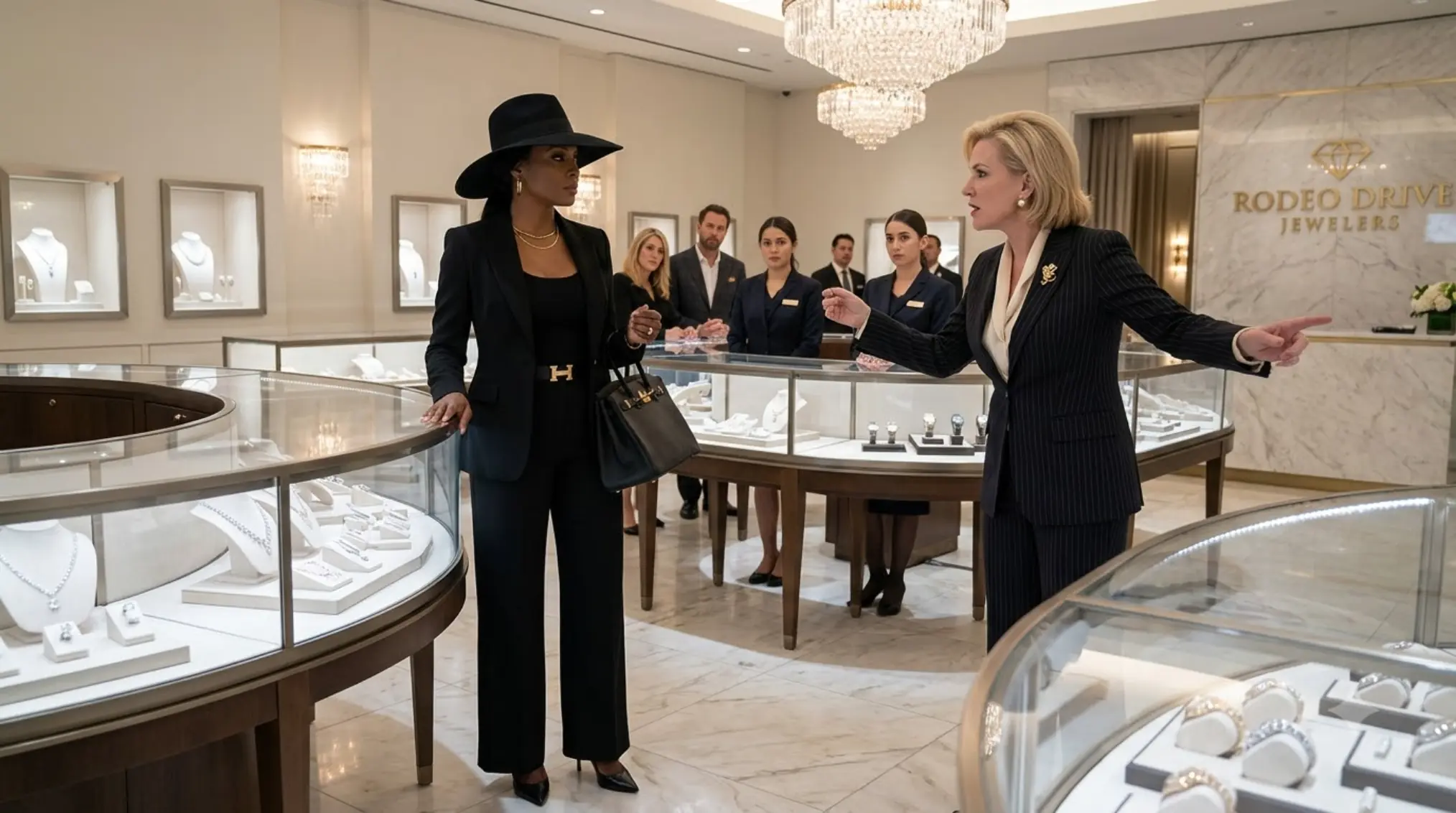
That alone would have surprised many employees inside Maison Aurelia, the luxury jewelry group whose Beverly Hills flagship occupied three polished floors of limestone, glass, brass, and carefully controlled silence.
Most of those employees had never met her.
That was exactly why Diana had come alone.
She was forty-two years old, strikingly beautiful, with deep-brown skin, dark expressive eyes, refined features, and long black hair hidden beneath a wide-brim black felt hat.
Her clothes were expensive without advertising their price.
A fitted black tailored blazer.
Black top.
High-waisted wide-leg black trousers.
A polished gold H-style belt buckle.
Pointed black heels.
Delicate gold jewelry.
A structured black handbag with understated gold hardware.
No diamonds worth six figures.
No visible corporate identification.
No assistant.
No security entourage.
Nothing announcing that the woman crossing the sidewalk controlled a jewelry company valued at more than $2.6 billion.
Diana preferred it that way.
Maison Aurelia had started with one store in Atlanta twenty-three years earlier.
Her mother, Lorraine Mitchell, had been a bench jeweler who repaired wedding rings in the back room of a neighborhood pawnshop.
Her father, Samuel Mitchell, understood gemstones but hated sales.
Neither had money.
What they had was precision.
Lorraine could rebuild a damaged prong setting so cleanly that customers sometimes cried when they saw their rings again.
Samuel could identify poor stone matching from across a counter.
Diana grew up around magnifying loupes, velvet trays, appraisal lamps, tiny pliers, and conversations about why trust mattered more than sparkle.
By sixteen, she could explain the difference between carat weight and visual spread.
By twenty-three, she had an MBA.
By twenty-seven, she had borrowed against everything her family owned to open a second store.
By thirty-two, Maison Aurelia had expanded to New York, Miami, Dallas, and Los Angeles.
By forty, Diana controlled thirty-one boutiques, private salons in three countries, and one of the most respected custom-jewelry workshops in America.
Yet the Beverly Hills flagship worried her.
Revenue was excellent.
Customer satisfaction scores were not.
That contradiction had brought her to California.
Three months earlier, Diana had received an email from a Black television producer named Angela Morris.
Angela had visited the Rodeo Drive location to purchase an anniversary necklace.
She had already selected a $42,000 piece online.
Inside the store, however, she waited eighteen minutes before anyone approached her.
A white couple who entered six minutes later received champagne immediately.
Angela eventually asked to see the necklace.
A sales associate told her certain pieces required “prequalification.”
Angela asked what that meant.
Nobody could explain.
She left.
Two days later, she purchased a $57,000 necklace from a competitor.
Diana read the complaint personally.
Then another appeared.
A Latino entrepreneur named Carlos Vega said he was followed around the store by security after arriving in jeans and work boots.
A young Asian software founder wrote that staff repeatedly directed him toward entry-level watches despite his asking specifically about a limited-production tourbillon.
Then came a complaint from an elderly Black woman named Marjorie Ellis.
That one stayed with Diana.
Marjorie had entered carrying an old diamond brooch.
She wanted the stone reset for her granddaughter’s wedding.
A sales associate allegedly told her the flagship “was probably more expensive than what she needed.”
Marjorie never even received an appraisal.
Diana requested internal reports.
Everything appeared clean.
Too clean.
The Beverly Hills store showed almost no formal service complaints.
Yet customer-care headquarters had received eleven outside complaints in fourteen months.
Diana called regional director Thomas Bellamy.
“Why aren’t these in the branch records?”
Thomas went silent.
“I don’t know.”
“Find out.”
He did.
The answer involved Patricia Whitman.
Patricia had managed Beverly Hills for nearly seven years.
Sales had increased every year.
Average transaction value was among the highest in the company.
High-profile clients liked her.
Celebrities knew her.
Luxury concierges requested her personally.
She was organized, polished, aggressive, and fiercely protective of what she called the “Aurelia experience.”
When a customer complained directly to the branch, Patricia often handled the matter herself.
Many complaints never traveled farther.
Diana asked Thomas:
“Is she hiding them?”
“I can’t prove that.”
“Then don’t tell me she is.”
Thomas understood.
Diana believed evidence should arrive before conclusions.
She ordered an anonymous service audit.
Mystery shoppers entered the flagship over six weeks.
Different races.
Different ages.
Different clothing.
Different scripts.
Same approximate financial profiles.
The results bothered Diana.
Customers who appeared traditionally wealthy were offered private consultations faster.
Those dressed casually received more questions.
Black shoppers were asked about budgets earlier in the conversation.
Several were shown lower-priced inventory despite requesting specific high-end pieces.
Still, the sample was limited.
Enough for concern.
Not enough for a conclusion.
Diana decided to see the store herself.
Not undercover.
She hated that word.
She would use her own name.
Her own identity.
The only thing she would withhold was status she should never need to display simply to receive professional treatment.
Thomas scheduled her for 9:15 with the private collections director.
Patricia was not told who Diana was.
Only that a Diana Mitchell had an executive appointment.
That was supposed to be enough.
At 9:06, Diana opened the glass door.
A soft chime sounded.
The boutique smelled faintly of white tea and cedar.
Diamonds glittered inside curved display cases under meticulously positioned lights.
A wall of watches occupied the right side.
Private consultation rooms stood farther back behind frosted-glass doors.
Three sales associates were already working.
A white couple examined bracelets.
An older man spoke with a watch specialist.
A young woman in a cream jacket stood near reception.
She smiled.
“Good morning. Welcome to Maison Aurelia.”
“Good morning.”
Diana removed her sunglasses.
“I’m Diana Mitchell. I have a nine-fifteen appointment with Elena Ruiz.”
The receptionist’s smile remained.
“Certainly.”
She turned toward a tablet.
Before she could touch it, a voice came from behind her.
“Who?”
The receptionist turned.
Patricia Whitman approached from the private-salon corridor.
Fifty-six.
White.
Carefully styled blonde hair.
Pearl earrings.
Dark pinstripe designer suit.
Cream silk blouse.
Black heels.
Gold floral brooch near her left lapel.
She moved with the confidence of someone accustomed to rooms becoming orderly when she entered.
The receptionist said:
“Ms. Mitchell has an appointment with Elena.”
Patricia’s eyes moved toward Diana.
Hat.
Black suit.
Handbag.
Face.
Then back to the receptionist.
“Elena is preparing for the Hartwell viewing.”
Diana knew about the Hartwell viewing.
The Hartwell family was buying approximately $1.1 million in diamonds for a wedding.
Their appointment was at eleven.
Diana said:
“My appointment is at nine-fifteen.”
Patricia looked at her.
“What are you hoping to see?”
“The Lucerne Collection.”
Something changed in Patricia’s expression.
Small.
But Diana noticed.
The Lucerne Collection contained seven unreleased pieces designed around rare Colombian emeralds and colorless diamonds.
The least expensive piece was $185,000.
The largest necklace had an internal valuation above $2 million.
Patricia smiled.
“That collection isn’t currently available for general viewing.”
“I know.”
“Then perhaps there’s been some misunderstanding.”
“There hasn’t.”
Patricia folded her hands.
“Who scheduled your appointment?”
“Thomas Bellamy’s office.”
That should have stopped everything.
Instead Patricia gave a soft laugh.
Not rude enough to complain about.
Almost.
“Mr. Bellamy doesn’t normally schedule customer appointments personally.”
Diana looked at her.
“I didn’t say he did.”
Patricia’s smile weakened.
“May I ask whether you already have an Aurelia client profile?”
“Yes.”
“Under Diana Mitchell?”
“Yes.”
The receptionist moved toward the tablet.
Patricia raised one finger.
“Hold.”
The young woman stopped.
Diana noticed.
Patricia turned back.
“The Lucerne pieces require advance qualification.”
“What does that mean?”
“We protect both our inventory and our clients.”
“That didn’t answer the question.”
Patricia’s eyes sharpened.
“We need to establish that a viewing is appropriate.”
“Appropriate based on what?”
“Purchase history.”
“You haven’t checked mine.”
“Referral status.”
“You haven’t checked that either.”
Patricia’s lips tightened.
“Ms. Mitchell.”
Diana waited.
“This is Rodeo Drive.”
The sentence hung there.
Diana almost smiled.
“I noticed.”
Patricia continued.
“Our private collections are not displayed simply because someone walks in and asks.”
“I didn’t walk in and ask.”
Diana placed one hand gently on the curved glass counter.
“I arrived for a scheduled appointment.”
Patricia glanced toward Diana’s handbag.
Then the hat.
Then the trousers.
Diana saw every movement.
“Would you mind removing the hat?”
Diana’s eyebrows lifted.
“Why?”
“It’s a security preference.”
“Is that written policy?”
Patricia hesitated.
“We maintain discretion.”
“That isn’t what I asked.”
The white couple near the bracelet case had started listening.
Patricia noticed.
Her voice lowered.
“I’m trying to help you avoid an uncomfortable situation.”
Diana looked directly at her.
“What uncomfortable situation?”
Patricia leaned slightly closer.
“Being shown merchandise significantly outside your intended range.”
There it was.
Clearer now.
Diana remained calm.
“What do you believe my intended range is?”
Patricia smiled thinly.
“That’s why we establish client profiles first.”
“You stopped your employee from checking mine.”
Patricia looked toward the receptionist.
The young woman immediately lowered her eyes.
Diana continued.
“So again: what do you believe my intended range is?”
Patricia did not answer.
Diana waited.
Several seconds passed.
Then Patricia said:
“Perhaps I can show you our main-floor collection.”
“No.”
Patricia blinked.
“I came to see Lucerne.”
“I already explained—”
“No.”
Diana’s tone sharpened for the first time.
“You explained nothing.”
Patricia’s posture changed.
Diana continued.
“You made assumptions.”
“You refused to verify my appointment.”
“You stopped your employee from checking my profile.”
“And now you’re trying to redirect me toward cheaper merchandise without asking what I intend to purchase.”
Patricia’s cheeks colored slightly.
“I will not be spoken to like this in my store.”
Diana stared.
There it was.
My store.
Not the company’s.
Not the shareholders’.
Not the customers’.
Patricia’s.
Diana said:
“Your store?”
Patricia misunderstood the question.
“Yes.”
“I’m responsible for this flagship.”
“And that gives you authority to decide who looks wealthy enough to enter the private salon?”
Patricia’s expression hardened.
“I did not say that.”
“What did you say?”
“I said we serve serious clients.”
Diana tilted her head.
“And I don’t look serious?”
A salesperson at the watch counter froze.
Patricia realized she had moved too far.
Instead of retreating, she escalated.
“I don’t care who you think you are.”
The words were louder now.
Every nearby customer heard them.
“You need to leave my store right now, or I will call security to have you removed.”
Silence.
Diana looked at Patricia for several seconds.
No anger visible.
Only attention.
Then she slowly removed her sunglasses.
Folded them.
Placed them beside her handbag on the counter.
“You denied me before checking my appointment, my account, or even my name.”
Patricia pointed toward the entrance.
“Leave.”
Diana picked up her phone.