The rain had been falling over Portland, Maine, since late afternoon, turning the narrow streets shiny and black beneath the streetlights.
By the time Evelyn Moore finished wiping the last table at Harbor Light Diner, the city looked almost empty, as if everyone with a warm place to go had already disappeared behind locked doors.
Evelyn was seventy-two years old, thin but sturdy, with deep brown skin, tired eyes, and silver hair tucked beneath a faded blue wool hat.
She had worked at Harbor Light Diner for more than thirty years, first as a waitress, then as the woman who came in during the evening to help clean tables, refill napkin holders, and close the place down when the younger staff were too tired to notice small things.
Her knees hurt from standing too long.
Her fingers were stiff from age and years of carrying plates, scrubbing counters, and counting coins at kitchen tables.
Her faded brown coat smelled faintly of coffee, fried potatoes, and dish soap.
She had counted the small money Mr. Kaplan gave her before leaving.
Twenty-seven dollars and forty cents.
It was not much, but it was enough to buy groceries, maybe pay a little toward the electric bill, and keep her small apartment running for another few days.
Evelyn pulled her coat tighter around herself and stepped out into the rain.
The diner sign buzzed behind her in red neon, reflecting across the puddles near the curb.
The sidewalk was cold beneath her worn black shoes, and the wind blew hard enough to push rain sideways under the awnings.
She should have waited for the bus.
Her legs were not as strong as they used to be, and the damp weather always made her joints ache.
But the next bus would not come for twenty minutes, and her apartment was only six blocks away.
Evelyn had walked in worse weather before.
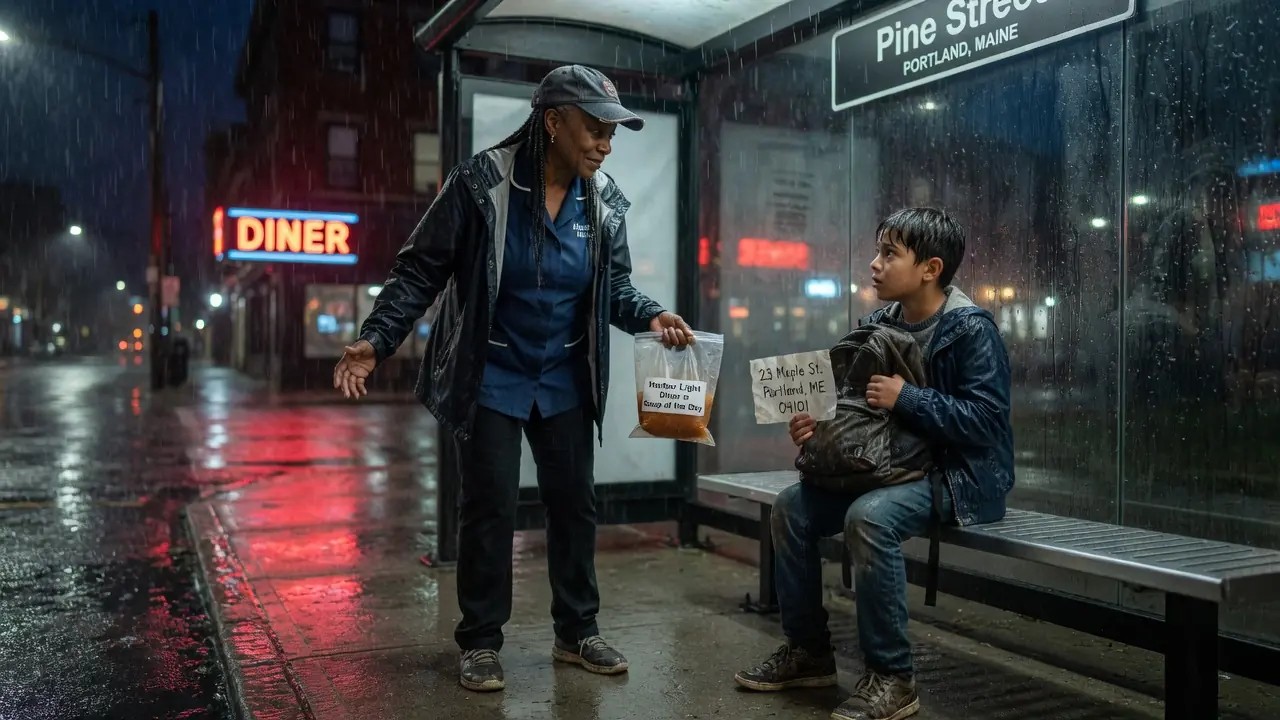
She was halfway down Pine Street when she saw the boy.
At first, he looked like a shadow beneath the bus stop shelter.
A small figure sat on the metal bench, knees pulled tightly to his chest, backpack pressed against his stomach.
The shelter’s thin roof barely protected him from the rain, and water dripped from one corner in a steady stream beside his shoes.
Evelyn slowed.
The boy was not dressed for the storm.
He wore a soaked navy jacket over a thin gray sweater.
His jeans were wet to the knees, and his sneakers were caked with mud.
His dark hair was plastered against his forehead, and his small hands clutched a crumpled sheet of paper so tightly the edges had begun to tear.
He kept looking down the street.
Then at the paper.
Then back down the street again.
Evelyn knew that look.
It was not the look of a child simply waiting for a bus.
It was the look of someone waiting for help he was no longer sure would come.
She stepped closer, careful not to move too fast.
“Hey there,” she said gently. “Are you okay?”
The boy’s head jerked up.
His eyes were wide and dark, full of fear he tried to hide too quickly.
“I’m fine,” he said.
Evelyn looked at the rain dripping from his sleeves.
“You don’t look fine, sweetheart.”
He hugged the backpack tighter.
“I’m waiting.”
“For someone?”
He nodded.
“My mom.”
Evelyn glanced up and down the street.
No one was coming.
No car slowed.
No adult stood nearby.
The bus stop was empty except for the boy and the storm.
“What’s your name?” she asked.
He hesitated.
“Alex.”
“Alex what?”
“Alex Rivera.”
Evelyn nodded softly.
“I’m Evelyn Moore.”
He looked away, uncomfortable.
“I’m not supposed to talk to strangers.”
“That is a good rule,” Evelyn said. “A very good one.”
He looked back at her, confused.
“Then why are you talking to me?”
“Because sometimes a safe adult helps you find the adult you already know.”
Alex said nothing.
A gust of wind blew rain across the shelter, and he shivered so hard his shoulders jumped.
Evelyn’s heart tightened.
“How long have you been here, Alex?”
He looked down at the crumpled paper in his hands.
“I don’t know.”
“Was it still light outside?”
He nodded.
Evelyn looked at the sky.
It had been dark for over an hour.
“Did your mom tell you to wait here?”
He swallowed.
“She told me to take the bus after school and wait at the stop near our building. But I think I got off at the wrong stop.”
Evelyn leaned slightly closer, but still gave him space.
“Do you know your address?”
Alex looked at the wet paper.
“I wrote it down. But it got wet.”
He held it out slowly.
Evelyn took the paper with care.
The ink had blurred badly, but she could make out a few words: Maple, Unit, 3B, and a phone number that had smeared at the last two digits.
“Do you have a phone?” she asked.
He shook his head.
“My mom’s phone is broken. She said she was going to get it fixed when she got paid.”
Evelyn looked at the street again.
Rain poured harder, rattling against the bus stop roof.
The boy’s lips were trembling now, and he was trying to hide it by pressing them together.
“Alex,” Evelyn said gently, “you can’t stay out here in this weather all night.”
“My mom will come.”
“I believe she is looking for you. But she may not know this is where you are.”
His eyes filled immediately, though he blinked fast to keep the tears back.
“She told me not to get lost.”
Evelyn’s voice softened.
“Getting lost is an accident. It is not something bad you did.”
He looked down at his shoes.
“I missed the right stop,” he whispered. “I thought I knew it. Then the bus turned, and I got scared, so I got off. I tried walking back, but everything looked different.”
Evelyn felt an ache deep in her chest.
She had been a child like that once.
Not lost at a bus stop, but afraid to ask for help because every adult around her seemed too busy, too tired, or too angry to hear her.
She had also been a mother once.
Her son, David, had died years ago in a car accident when he was only thirty-one.
He had left behind no children, no wife, and no one for Evelyn to care for except herself.
Since then, she had learned how quiet life could become when nobody needed you at the end of the day.
She looked at Alex again.
“Do you want to come somewhere dry for a little while?”
Alex stiffened.
“I can’t go inside a stranger’s house.”
“You’re right to be careful.”
He blinked at her.
Evelyn continued, “My apartment is a few blocks away. You can stand in the hallway while I call the police non-emergency number and try to reach your mom. You do not have to go anywhere you feel unsafe. But I don’t want you sitting here in wet clothes until you get sick.”
Alex looked toward the dark street.
His fear was fighting the cold.
Evelyn did not reach for him.
She did not touch his arm.
She only stood beneath the shelter and waited.
Another bus passed on the opposite side of the street, spraying water along the curb.
Alex flinched.
Then he whispered, “Just until we call?”
“Just until we call.”
He stood slowly.
He was smaller than Evelyn had first realized.
His backpack seemed too large for his body, and his wet shoes made soft squeaking sounds on the sidewalk as he followed her.
Evelyn walked slowly so he could keep distance if he wanted.
He stayed two steps behind, clutching his backpack and the ruined paper.
Her apartment was on the second floor of a faded brick building above a closed laundromat.
The stairwell smelled faintly of detergent, old wood, and rain-soaked coats.
Evelyn climbed slowly, one hand on the railing, feeling the familiar ache in her knees.
Alex noticed.
“Do you need help?”
Evelyn glanced back at him and smiled.
“Not yet, sweetheart. But thank you for asking.”
She unlocked her door and switched on the light.
The apartment was small but clean.
A couch sat against one wall with a knitted blanket folded over the back.
A little kitchen table stood near the window.
There were two mugs in the sink, a stack of library books on the counter, and a pot of chicken soup cooling on the stove.
Framed photographs lined a narrow shelf near the wall.
One showed Evelyn as a young woman in a waitress uniform, smiling beside a little boy with missing front teeth.
Another showed that boy grown into a tall young man in a graduation gown.
Alex stopped at the doorway.
“I’m dripping on your floor.”
Evelyn gave him a small smile.
“Floors dry.”
“My shoes are muddy.”
“I own a mop.”
He looked uncertain.
Evelyn stepped aside and pointed to the little entry rug.
“You can stay right there while I get towels.”
She brought him a towel, a pair of thick socks, and a gray sweatshirt that had once belonged to David.
It was much too big for Alex, but it was dry.
Evelyn held the sweatshirt for a moment longer than necessary.
She had not taken it out in years.
For a second, her fingers remembered folding it when David was still alive.
Then she handed it to Alex.
“The bathroom is right there,” she said. “You can change out of the wet jacket and sweater. You can keep the door unlocked if that feels safer.”
Alex looked at the clothes.
“I don’t have money.”
Evelyn paused.
“For the sweatshirt?”
“For anything.”
Her face softened.
“I didn’t ask for money.”
He looked down, ashamed.
“I can pay you back when my mom comes.”
“You can get warm first.”
He went into the bathroom and changed.
When he came out, the sweatshirt hung over his hands, and his wet hair curled against his forehead.
For one painful second, Evelyn saw David at that age.
A boy in clothes too big for him, trying not to look scared.
She turned away quickly so Alex would not see the tears in her eyes.
Evelyn set his jacket and sweater near the radiator, then handed him a blanket from the couch.
“Sit at the table,” she said. “I’m going to call for help.”
He sat carefully, still holding his backpack on his lap.
Evelyn called the police non-emergency line first.
She explained everything clearly: her name, address, where she found Alex, his name, the bus stop location, the blurred address, and that he was safe in her apartment.
The dispatcher took the information and said officers would check missing child reports and send someone if needed.
Alex listened to every word, tense and silent.
Evelyn hung up, then looked at him.
“You are not in trouble.”
He did not seem convinced.
“What if my mom is?” he asked.
“Why would she be?”
“Because I got lost.”
Evelyn pulled out a chair and sat across from him.
“Alex, your mom told you where to go. You tried to follow directions. Something went wrong. That does not mean she did something bad, and it does not mean you did something bad.”
His mouth trembled.
“She works a lot,” he whispered.
“What does she do?”
“She works in the hospital cafeteria. Sometimes she cleans rooms at night too. She gets tired. But she always comes.”
Evelyn nodded.
“I believe you.”
Alex looked up quickly.
“You do?”
“Yes.”
That seemed to matter more than she expected.
Evelyn warmed the soup and placed a bowl in front of him with two slices of bread.
“I’m not hungry,” Alex said automatically.
His stomach answered with a loud growl.
Evelyn raised her eyebrows.
“The soup heard otherwise.”
For the first time, Alex almost smiled.
He picked up the spoon and took a small bite.
Then another.
Then he ate quickly, his shoulders slowly lowering as warmth moved through him.
Evelyn turned away and washed a few dishes to give him privacy.
Children often hated being watched when hunger won over pride.
When he finished, she asked if he wanted more.
He hesitated.
“There’s enough?”
“There’s always enough for a second bowl.”
He nodded.
She gave him more.
After dinner, Evelyn tried the phone number from the paper several times, changing the last two digits where the ink had smeared.
Most were wrong numbers.
One went nowhere.
One rang until voicemail, but the voice was not Alex’s mother.
Alex grew quieter each time a call failed.
Evelyn then called two nearby elementary schools and left messages with after-hours lines.
She called the hospital main desk and asked whether a Maria Rivera worked in the cafeteria or cleaning department.
The operator transferred her three times before telling her there were several staff members with the last name Rivera, but no one could confirm without more information.
Evelyn looked at Alex.
“What is your mom’s full name?”
“Maria Elena Rivera.”
That helped.
Another transfer.
Another hold.
Finally, someone in the hospital cafeteria office said Maria Rivera had worked the day shift but left around five-thirty.
She had mentioned needing to pick up her son.
Evelyn’s chest tightened.
If Maria had left work at five-thirty and still had not found Alex, she must have been terrified.
The office did not have a working phone number they could give out.
Evelyn left her name and number in case Maria called back.
By then, it was almost ten at night.
Alex sat on the couch with the blanket around his shoulders, fighting sleep.
Evelyn sat in the chair across from him.
“You can sleep,” she said.
He shook his head.
“My mom might come.”
“If she comes, I’ll wake you.”
“What if I sleep and she thinks I forgot her?”
Evelyn’s throat tightened.
“A mother does not think that because her child fell asleep after being scared and cold.”
He stared at the floor.
“I don’t want her to cry.”
“I know.”
“She cries when she thinks I’m asleep.”
Evelyn looked at the rain streaking the window.
“She must be carrying a lot.”
Alex nodded.
“She says we’re starting over.”
“Starting over can be hard.”
“It feels like losing,” he whispered.
Evelyn let those words settle.
Then she said, “Sometimes starting over feels like losing because you haven’t reached the new part yet.”
Alex looked at her.
“Does it get better?”
Evelyn wanted to say yes immediately.
She wanted to promise the way adults often did when they were afraid of a child’s sadness.
Instead, she answered honestly.
“It can. Especially when people help each other through the hard part.”
He curled deeper into the blanket.
A little later, Evelyn set up the couch for him with clean sheets and an extra pillow.
She left the hallway light on and placed a glass of water on the coffee table.
“You can keep your backpack beside you,” she said.
He looked surprised that she understood.
“Thank you.”
Evelyn slept lightly in her bedroom with the door open.
She woke twice during the night.
Once, she found Alex sitting up, staring toward the window.
“You okay?” she asked softly.
“I thought I heard the bus.”
“It’s just the rain.”
He lay back down.
The second time she woke, he was asleep, one hand gripping the strap of his backpack.
Evelyn stood in the doorway for a moment, watching him breathe.
The apartment did not feel so empty with a child sleeping in the next room.
That made her heart ache in a way she had not expected.
In the morning, the rain had softened but not stopped.
Gray light filled the apartment.
Cars hissed along the wet street below.
Evelyn made oatmeal, scrambled eggs, and toast.
It was more than she usually cooked for herself, but she told Alex she had “accidentally made too much.”
He looked at the table.
“You don’t accidentally make eggs.”
“You do if you are very talented.”
That earned a real smile.
After breakfast, Evelyn called the non-emergency line again.
No confirmed missing child report had matched yet, but the dispatcher said an officer could come by to take more information.
Evelyn also called the school district office, giving Alex’s name and the possible address on the paper.
After several minutes, a woman confirmed that an Alex Rivera attended East Harbor Elementary.
The woman’s tone changed when Evelyn explained the situation.
“We had a message this morning,” she said. “A mother called before the office opened. She was looking for her son. She said he never made it home yesterday.”
Evelyn closed her eyes with relief.
“Can you contact her?”
“We can call the number we have on file.”
“Please do. Tell her Alex is safe with me. I already contacted the police non-emergency line. Give her my number.”
Alex stood near the kitchen, barely breathing.
Evelyn hung up.
“They found your school record,” she said gently. “They’re calling your mom.”
His eyes filled.
“She’s coming?”
“I think so.”
Fifteen minutes later, Evelyn’s phone rang.
She answered immediately.
A woman’s voice came through, shaking so hard Evelyn could barely understand her.
“Is my son there? Is Alex there?”
“Yes,” Evelyn said. “He’s safe. He is right here.”
A sob broke through the phone.
“Oh God. Oh God, thank you.”
Evelyn held the phone out.
“Alex.”
He took it with both hands.
“Mom?”
The sound that came from him was small and broken.
“I’m sorry. I got off wrong. I tried to find home. I’m sorry.”
Evelyn turned away to give him privacy, but she heard enough to know Maria was crying too.
“No, baby. No. You’re safe. That’s all I care about. I’m coming.”
When Alex handed the phone back, Evelyn gave Maria the address and explained that she had already contacted the non-emergency line.
Maria said she was taking the next bus and would arrive as soon as possible.
Twenty minutes later, there was a knock at the apartment door.
Alex ran to it but stopped before opening, remembering safety.
Evelyn smiled and opened it.
Maria Rivera stood in the hallway, soaked from the rain, her dark hair pulled into a messy bun, her face pale with exhaustion and fear.
She wore a hospital cafeteria uniform beneath a worn black coat.
Her eyes were red, and her hands trembled around the strap of her purse.
The moment she saw Alex, she dropped to her knees.
“Alex.”
He threw himself into her arms.
“I’m sorry, Mom.”
“No. No, no, baby.”
Maria held him so tightly he could barely move.
“I’m sorry. I should have been there. I should have found you.”
“I got off wrong.”
“I know. I know.”
“I tried to read the paper, but it got wet.”
“You did your best.”
Evelyn stood back, tears stinging her own eyes.
There was something sacred about a mother finding her child after a night of terror.
After a long moment, Maria looked up at Evelyn.
“Mrs. Moore?”
“Evelyn.”
Maria stood slowly, still holding Alex’s hand.
“I don’t know how to thank you.”
“You don’t have to.”
“Yes,” Maria said, her voice breaking. “I do. You took him in. You fed him. You kept him safe. I was looking all night. I went to the wrong bus stop first, then the police station, then the old apartment, then the school. I thought…”
She could not finish.
Evelyn touched her arm gently.
“He was safe.”
Maria covered her mouth.
“I’m not a bad mother,” she whispered.
Evelyn felt the weight of that sentence.
It was not spoken to defend herself from Evelyn.
It was spoken against every fear inside her.
“I didn’t think you were,” Evelyn said.
Maria looked at her, startled.
Evelyn repeated it softly.
“I didn’t think you were.”
Maria began crying again.
They sat at the kitchen table while Alex leaned against his mother’s side, refusing to let go of her sleeve.
Evelyn made tea.
Maria explained what had happened.
They had moved to a new apartment only two weeks earlier after losing their old place when rent rose.
Alex had not yet learned the new bus route.
Maria usually picked him up, but her supervisor had asked her to stay late because another worker called out sick.
She had written the address and route on paper, thinking it would be enough.
But the rain blurred the paper.
The bus route confused him.
And the city became unfamiliar.
“I should have said no to the extra shift,” Maria said.
Evelyn shook her head.
“You were trying to keep a roof over his head.”
Maria looked down at her tea.
“Sometimes it feels like every choice is wrong.”
Evelyn knew that feeling too.
She had grown up watching her own mother choose between rent, medicine, groceries, and pride.
She knew that poor families were often judged most harshly during the exact moments when they were working hardest to survive.
“Do you have support nearby?” Evelyn asked.
Maria shook her head.
“My sister lives in Florida. My mother passed two years ago. Alex’s father is not involved.”
Evelyn nodded slowly.
Before Maria left, Evelyn wrote down her phone number clearly on a dry index card and placed it inside a small plastic sandwich bag to protect it from rain.
“Keep this in your backpack,” she told Alex.
Alex took it carefully.
Maria tried to protest.
“Evelyn, you’ve already done enough.”
“No,” Evelyn said. “This is just a phone number.”
But it became more than that.
In the weeks that followed, Evelyn checked in.
At first, only once.
Then again.
Maria called one evening to say the school bus schedule had changed and she was nervous about Alex waiting alone.
Evelyn offered to meet him at the diner for an hour after school until Maria’s shift ended.
Maria said no.
Then, after a long silence, said yes.
That was how Alex began spending Tuesday afternoons at Harbor Light Diner.
He sat in the back booth with homework and hot chocolate while Evelyn worked.
The owner, Mr. Kaplan, grumbled at first about children taking up space, but one look at Alex quietly doing math problems between the salt shakers softened him.
By the third week, Mr. Kaplan was saving day-old muffins for him.
By the fifth, the other waitresses knew him by name.
“Hey, professor,” one cook called whenever Alex walked in.
Alex always smiled at that.
Evelyn helped him with reading assignments during slow hours.
Maria came after work, tired but relieved, and sometimes stayed for soup if Evelyn had convinced Mr. Kaplan to let them use leftovers.
Slowly, the panic of that rainy night became something else.
A connection.
A safety net.
A small chosen family formed between an old woman, a tired mother, and a boy who had once been lost at the wrong bus stop.
Maria and Evelyn became friends in the careful way tired women become friends: by sharing practical things first.
Bus schedules.
Coupons.
Job leads.
A winter coat Alex had outgrown that Evelyn knew another child could use.
A phone charger.
A ride.
A meal.
Then, slowly, they shared harder truths.
Maria spoke about fear.
Evelyn spoke about loneliness.
Maria spoke about guilt.
Evelyn spoke about losing her son and learning to live in a quiet apartment where no one called her Mom anymore.
One evening, months after the storm, Maria said, “You could have kept walking.”
Evelyn looked toward the booth where Alex was drawing a map of bus routes in his notebook.
“I know.”
“Why didn’t you?”
Evelyn was quiet for a moment.
“Because when I was little, I waited outside a grocery store once for almost two hours. My mother was late because her car broke down. People walked past me the whole time. Nobody asked if I was okay.”
Maria’s eyes softened.
Evelyn continued, “I remember thinking adults only noticed children who belonged to them.”
Maria looked at Alex.
“And you wanted him to feel noticed.”
“I wanted him to feel like he belonged to someone, even before we found you.”
Maria reached across the table and squeezed her hand.
Years passed.
Alex grew taller.
His voice changed.
The frightened boy under the bus shelter slowly became a thoughtful, observant teenager with a strong memory for maps, routes, and people who looked unsure.
He never forgot the bus stop.
Instead of avoiding buses, he became fascinated by them.
He studied schedules.
He noticed which stops were poorly lit.
He noticed which shelters leaked.
He noticed where children waited alone, where elderly people struggled to climb aboard, where route signs were confusing, and where neighborhoods seemed cut off from the rest of the city.
At fourteen, he created a school project called Safe Stops, mapping bus shelters near schools and recommending better signs, lighting, and emergency contact boards.
Evelyn attended the presentation with Maria.
She wore her best church coat and sat in the back row with her hands folded over her purse.
Alex stood nervously in front of the class, holding a poster board filled with maps and colored lines.
“A bus stop can be safe or unsafe depending on more than traffic,” he said. “It depends on whether people can understand where they are, whether they have shelter, whether they can call for help, and whether someone would notice if they were alone too long.”
Evelyn cried quietly in the back.
Maria held her hand.
At sixteen, Alex began volunteering with a youth transit program.
At eighteen, he received a scholarship to study urban planning and public policy.
Before he left for college, he visited Evelyn at the diner.
The same diner.
The same back booth.
The same rain tapping against the window, though softer this time.
He placed a small framed drawing on the table.
It was a picture of a bus stop in the rain, with an elderly woman holding an umbrella and a boy sitting beneath the shelter.
At the bottom, he had written:
For Evelyn, who stopped walking.
Evelyn stared at it, tears rising too fast for her to hide.
“You remembered all that?”
Alex smiled softly.
“I remember everything.”
She touched the frame.
“I was just trying to keep you dry.”
“No,” he said. “You made me believe the world still had safe people in it.”
Evelyn covered her mouth.
Alex hugged her.
Not like a little boy clinging in fear.
Like a young man saying thank you for the life that had continued after one difficult night.
College took him away from Portland for a while.
He studied transportation planning, community safety, and emergency response systems.
He called Maria every Sunday and Evelyn almost as often.
Evelyn stayed at the diner for years, then finally cut her hours when her knees grew worse.
She never became rich.
Her apartment stayed small.
Her hands grew more wrinkled.
But the back booth remained open for kids who needed somewhere to wait.
Mr. Kaplan eventually stopped pretending he minded.
He even placed a small sign near the register:
Students Waiting For Family May Sit Here. Ask Staff For Help.
Evelyn laughed when she saw it.
“You getting soft?”
Mr. Kaplan frowned.
“Absolutely not. It’s customer service.”
But he kept muffins ready.
Alex returned to Portland after graduate school.
By then, he was twenty-eight, tall, calm, and serious in the best way.
He worked for a nonprofit that helped cities redesign public transit spaces with safety in mind, especially for children, seniors, working parents, and people without reliable phones.
His first major project in Portland focused on bus stops near schools, hospitals, diners, shelters, and low-income apartment buildings.
He knew exactly where he wanted to begin.
Pine and Third.
The old bus stop was still there.
The roof still leaked in one corner.
The bench was still cold metal.
The route sign was still confusing.
Evelyn stood beside Alex one autumn afternoon as city workers measured the sidewalk.
She leaned on a cane now, her silver hair tucked beneath the same faded blue wool hat.
“You’re really changing it?” she asked.
Alex nodded.
“Not just this one. But this one first.”
Maria stood on his other side, older now, steadier, with tears in her eyes.
“What will it look like?” she asked.
Alex opened a folder and showed them the design.
The new shelter would have a wider roof, better lighting, clear route maps, a protected notice board, an emergency call button, and a small sign listing nearby safe waiting places, including the diner.
There would be a bench that stayed dry.
There would be a message etched into the side panel.
Evelyn leaned closer.
The words read:
Someone Safe May Be Closer Than You Think.
She looked at him.
“Alex.”
He smiled.
“That night, I didn’t need a hero. I needed one person to ask if I was okay. This stop should remind people to ask.”
The shelter was finished in late spring.
The city held a small dedication ceremony, though Evelyn begged Alex not to make a fuss.
He made a fuss anyway.
Maria came in a blue dress.
Mr. Kaplan brought muffins from the diner.
Several waitresses came.
Teachers from Alex’s old school came.
Neighbors gathered beneath a clear sky that seemed almost too gentle for a story born in rain.
Alex stood in front of the new bus shelter and spoke.
“When I was ten years old, I got off at the wrong stop during a storm. My address had blurred on a piece of wet paper. My mother was searching for me, but I didn’t know how to get home. I sat right here, cold and terrified, trying not to cry.”
Evelyn lowered her head.
“Evelyn Moore had just finished a long evening at the diner. She was tired. She was old enough to have every reason to keep walking. Instead, she stopped. She asked if I was okay. She gave me food, warmth, a safe couch, and the help I needed to find my mother the next day.”
Maria wiped her eyes.
Alex continued.
“That one decision shaped my life. It taught me that safety is not only about buildings, lights, signs, or systems. It is about people willing to notice one another. This shelter is dedicated to every child waiting alone, every working parent trying to make it home, and every ordinary person who chooses not to walk past.”
Then he turned toward Evelyn.
“And it is dedicated to the woman who stopped walking.”
Evelyn cried openly.
She did not care who saw.
The new shelter became known around the neighborhood as Evelyn’s Stop, though that was not its official name at first.
Children waited there after school.
Elderly people sat there while buses ran late.
Parents used the emergency call button twice in the first year.
The clear signs helped people avoid wrong transfers.
The diner became an official safe waiting partner in the community network Alex helped create.
Eventually, the city added a small plaque.
EVELYN MOORE SAFE STOP
In honor of the kindness that brought a lost child home.
Evelyn said it was too much.
Maria said it was not enough.
Years later, on another rainy evening, Evelyn walked past the bus stop after leaving the diner.
She was much older now, moving slowly with her cane, with deep lines around her eyes and silver hair showing beneath her hat.
Her feet still hurt after long walks.
She still carried leftover soup when Mr. Kaplan insisted there was too much.
Under the shelter sat a little girl with a backpack, staring at a phone with a dead screen.
Evelyn stopped.
The rain tapped softly against the wide roof.
The bench beneath the girl was dry.
The lights glowed clearly.
Evelyn stepped closer.
“Hey there,” she said gently. “Are you okay?”
The girl looked up, frightened.
“I’m waiting for my aunt.”
Evelyn nodded.
“Would you like help calling her?”
The girl hesitated.
“I’m not supposed to talk to strangers.”
Evelyn smiled softly, remembering a boy in a soaked navy jacket.
“That is a very good rule,” she said. “So we’ll do this carefully.”
Across the street, Alex stood near the diner entrance, visiting town for the anniversary of the Safe Stop project.
He heard Evelyn’s voice and turned.
For a moment, he saw himself at ten years old.
Cold.
Lost.
Waiting.
Then he saw Evelyn, still stopping.
Still noticing.
Still choosing kindness at the exact moment someone needed it.
The girl took the phone Evelyn offered and called her aunt.
Within minutes, everything was all right.
Evelyn did not call it a miracle.
She called it what people should do.
But Alex knew better.
He knew that what people should do and what people actually do are not always the same.
Long ago, Evelyn Moore had walked home from a diner shift with sore knees, little money, and every reason to keep her head down in the rain.
Instead, she stopped at a bus shelter.
She helped one lost boy get warm.
She helped him find his mother.
She helped him believe that the world was not only full of danger, confusion, and closed doors.
That one night became a memory.
The memory became a mission.
The mission became safer bus stops, clearer signs, emergency call buttons, and warm booths in diners where children could wait without shame.
And every time rain fell over Pine and Third, the light inside Evelyn’s Stop glowed against the wet street, reminding anyone who passed that sometimes the road home begins with one person asking, “Are you okay?”