“Ma’am, are you hurt anywhere?”
The older woman, her expensive coat soaked through by the rain, looked up at the young woman standing before her in worn clothing and clutching the few belongings she carried.
“They do not care about me,” she whispered. “They only want me gone. I have nowhere to go.”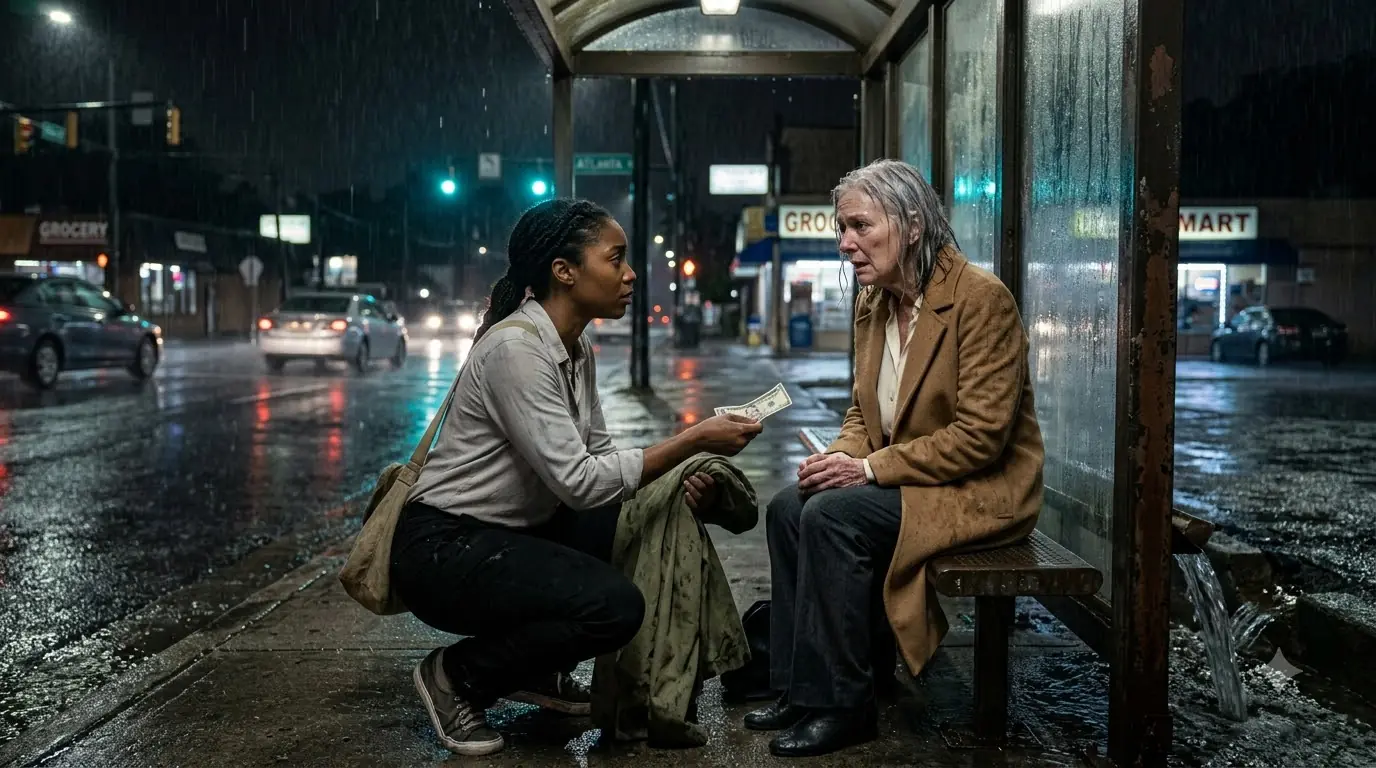
Faith Carter had been dismissed from her job that morning. Her daughter had eaten almost nothing, and the five-dollar bill inside Faith’s pocket was the last money she possessed.
Still, Faith pressed it into the trembling stranger’s hand. Then she removed her thin coat and placed it over the woman’s shaking shoulders.
“You can come home with me tonight,” Faith said. “My place is not large, but it is warm. Come on.”
The poorest woman in the neighborhood had just given away everything she had.
The following morning, five limousines arrived outside Faith’s apartment, causing the entire street to come alive.
Eight hours earlier, the day had begun the way nearly every day began, with Faith pretending that everything was going to be fine.
“Ow, you are pulling!”
Lily squirmed on the kitchen chair, all elbows, laughter, and restless energy.
“Hold still, baby. One more braid.”
Faith guided the comb through her daughter’s hair with hands that had learned how to remain gentle even when everything else hurt.
Lily was four years old. She had two missing socks, one unstoppable smile, and more faith in her mother than Faith sometimes had in herself.
“There,” Faith announced. “The prettiest girl in Georgia.”
“The prettiest girl in the world,” Lily corrected.
“My mistake.”
Some corrections were worth allowing your daughter to win.
Faith slid half a peanut butter sandwich across the table. She wrapped the other half inside a napkin and placed it in her bag.
That would be her lunch.
Faith had learned long ago that the child ate first. A mother could call her own hunger a diet and continue moving.
The apartment was small enough to cross in nine steps. Faith knew because she had counted them during a night when sleep would not come.
The curtains did not match. The radiator knocked like a fist against the wall, and an unopened notice remained taped to the front door where Faith could not avoid seeing it.
She had not found the courage to open it.
Faith already knew what it contained. She did not need to read the words to feel the cold waiting inside the envelope.
She left it sealed, kissed Lily’s forehead, and walked her downstairs to a neighbor’s apartment.
“Miss Della is going to watch you while I work. Be good for her.”
Lily held up her smallest finger.
“Promise you will bring dinner?”
Faith linked her pinky with Lily’s.
“I promise.”
She would spend the remainder of the day trying to keep that promise.
At the distribution center, the air smelled of cardboard and floor cleaner. Faith moved quickly, stacked neatly, and never complained.
She was good at the work and had hoped that being good would be enough.
It was not.
“Carter.”
The shift manager did not look up from his clipboard.
“Corporate is reducing hours. Last hired, first released. I am sorry.”
Faith kept her voice steady, although the floor seemed to tilt beneath her.
“I have perfect attendance. I cover other employees’ shifts. I have never called out.”
“I know.”
“I have a daughter. Rent is due Friday.”
“I know, Faith.”
He finally looked at her, and the worst part was that he meant it.
“This is not about your performance. It is a number on a spreadsheet inside some tower downtown. None of us are people to the people up there. We are expenses they are cutting.”
A tower downtown.
A number instead of a name.
Faith would remember those words later, when she discovered exactly whose tower it was.
She did not cry.
Faith budgeted tears the way she budgeted everything else, carefully and never in public.
On her way out, while her own world quietly collapsed, she stopped to steady a coworker’s toppling stack of boxes.
“You were just dismissed, and you are helping me?” the woman asked.
Faith shrugged.
“Boxes do not know whose bad week it is.”
That was simply who Faith was when no one kept score, and when everyone did.
Outside, the sky had turned the color of wet concrete.
Faith walked because riding the bus cost money, and money had suddenly become a creature she would have to feed one coin at a time.
She passed Ruby’s Diner, where warm light spread across the sidewalk. The smell of fried potatoes reached toward her, and her empty stomach tightened.
Inside, Nora, the cashier, noticed her through the window and lifted a coffee pot in invitation.
Faith smiled, shook her head, and continued walking.
She did not accept things she could not pay for.
Not coffee.
Not pity.
Not anything.
At the corner store, Faith slipped her hand into her pocket and counted by touch. She hoped, in the irrational way desperate people sometimes hoped, that the money might multiply if she needed it badly enough.
One five-dollar bill.
That was the entire amount.
Bread, Faith decided.
Bread stretched.
It became toast, the bottom of a bowl of soup, and three more days of telling Lily that her mother had already eaten.
Faith was rehearsing the lie in her head.
“Mama already ate, baby.”
Then the rain opened over Atlanta.
Six blocks away, beneath a bus shelter, a woman in a soaked designer coat began to cry.
Faith did not know her yet.
She did not know that the woman owned the tower where an unseen executive had reduced Faith’s life to a line on a spreadsheet that morning.
She did not know that the five-dollar bill folded inside her pocket would become, before the night ended, the most important money in the city.
Faith only knew that rain was falling, she was cold, and her little girl waited at home for a promise.
She pulled her thin coat tighter, lowered her head, and walked directly toward the moment that would change everything.
The bus shelter was the only partially dry space on the block, and even it was losing the fight.
Rain came from the side and poured through the broken gutter above. Beneath it, folded into herself on the bench, sat the woman.
She had a promise to keep, a daughter to feed, and a five-dollar plan with no space inside it for anyone else.
Then a sound stopped her.
It was not loud or theatrical.
It was a small, broken sound, the kind a person made after no longer expecting anyone to hear.
“Ma’am?”
Faith stepped beneath the shelter.
“Ma’am, are you hurt anywhere?”
The woman lifted her face.
She appeared to be in her early seventies. Silver hair clung to her cheeks, and the coat she wore was worth more than everything Faith owned.
Her eyes were what Faith noticed most.
Faith had seen the same expression in her own mirror, the look of someone calculating the value of her life and arriving at a number too small to bear.
“I am fine,” the woman said in a voice that clearly was not.
She reached for a purse that was no longer beside her.
Her hands began shaking harder.
“My phone and wallet. A young man came near me after I sat down.”
Understanding crossed her face like another cold front.
“He took everything. I did not even feel it.”
“Okay.”
Faith crouched until they were at the same level.
“Is there someone I can call? Family?”
The word landed badly.
The woman released a wet and terrible laugh.
“Family? No. Not the kind you mean.”
She wiped rain and tears from her face.
“I heard them tonight. My sons did not know I was still on the line.”
Faith waited.
“They were discussing arrangements. What happens afterward.”
The woman’s breathing caught.
“One of them said life would be easier if I would only…”
She could not finish.
She did not need to.
Something tightened inside Faith’s chest.
Faith knew what it felt like to become a line item. She had not known the same thing happened to people wearing coats like this.
“What is your name?” Faith asked.
“Eleanor.”
“I am Faith.”
Down the empty street, the last bus disappeared into the rain.
Eleanor had no telephone, no wallet, and no money. She shook with the deep, dangerous trembling of a body beginning to surrender its heat.
Faith thought about the bread.
She thought about Lily’s small finger linked around hers.
“Promise you will bring dinner?”
Faith took the five-dollar bill from her pocket and pushed it into Eleanor’s shaking hand.
“It is not much, but it can buy hot coffee, a phone call, and a few minutes to think. Take it.”
Eleanor stared at the crumpled money.
“You do not even know me.”
“You are cold, frightened, and alone,” Faith said. “I know enough.”
Then Faith did the thing she could never fully explain afterward.
It cost her more than the money.
She unzipped her thin coat, the only barrier between her body and the freezing rain, and draped it over Eleanor’s shoulders.
Cold water immediately soaked through Faith’s shirt.
She did not take the coat back.
Eleanor’s composure collapsed.
She seized Faith’s wrist with both hands.
“Please do not leave me here. Please.”
“I am not leaving you. There is a diner two blocks away.”
Eleanor leaned against Faith during the entire walk.
Ruby’s Diner glowed ahead like a lighthouse.
At the entrance, the night doorman from the hotel across the street stopped in the middle of a step when he saw them.
Walter Briggs was broad-shouldered and gray at the temples.
“Mrs. Whitmore, my God. Security has been searching everywhere for you. Where is your protection detail?”
Eleanor shook her head.
She was too cold to answer.
Faith did not understand the name or its significance. She was already guiding Eleanor toward the warmth.
“She was robbed. They took her telephone, wallet, and everything else. She needs to warm up and contact someone she trusts. Can you help her?”
“Of course.”
Walter took Eleanor’s other arm.
Then he looked at Faith, who was drenched, trembling, and without a coat.
“Miss, you are soaked. Let me bring you a towel and arrange a ride home.”
“I am all right.”
Faith was already moving backward toward the door, her teeth chattering.
“She is the person who needs help. Please take care of her.”
“At least tell me your name,” Walter called.
Faith had already stepped back into the rain.
She walked home empty-handed, carrying the knowledge that she had broken her promise to Lily.
Behind her, beneath the diner’s warm light, Eleanor Whitmore, chairwoman of Whitmore Realty and a woman worth more than many small nations, held a stranger’s five dollars and worn coat.
She cried for an entirely different reason now.
Across the street, the Whitmore-owned hotel received Eleanor beneath marble, brass, and the effortless warmth that wealth purchased without consideration.
Employees gathered around her.
A physician was summoned.
Someone placed a cashmere blanket over the inexpensive, wet coat Eleanor refused to remove.
“Mrs. Whitmore, we need to contact your sons,” her assistant, Nora Bishop, said gently, already holding a telephone.
“No.”
The word came out more sharply than Eleanor intended.
She softened her voice.
“No. Not them. Not tonight.”
Nora lowered the telephone.
Nineteen years of working for Eleanor had taught her the difference between a command and an open wound.
What Nora did not know, what nobody knew, was how Eleanor had arrived at the bus shelter.
Three hours earlier, inside her penthouse, Eleanor had answered the wrong extension at the worst possible moment.
Her sons were speaking freely because they believed she could not hear them.
“She is seventy-one, and she still will not sign,” Spencer said in the smooth boardroom voice Eleanor had taught him to use. “The physicians say her mind is functioning properly, which is the problem.”
He continued.
“We either have her declared incompetent or wait for nature to handle it, and nature is taking too long.”
Bradley, her younger son, laughed.
It was nervous and uncomfortable, but it was still laughter.
“Do not say it that way, Spence.”
“Say what? That we both know it is true?”
Eleanor placed the receiver down with a steadiness that surprised her.
She walked past her security detail and told her driver that she needed air. At the corner, she dismissed all of them.
For once, she wanted to stand in the world as an ordinary woman rather than a fortune wearing a coat.
She wanted to be no one’s inheritance.
Eleanor walked until the rain found her.
She sat on a stranger’s bench and discovered that ordinary women were robbed in darkness and left to freeze.
Then another ordinary woman stopped.
Faith gave Eleanor five dollars and removed the coat from her own body without asking for anything in return.
Now, inside a suite costing more per night than Faith earned in a month, Eleanor turned the worn coat over in her hands.
A name had been written in faded marker on the inside collar, the way parents labeled children’s belongings.
F. Carter.
Inside one pocket, Eleanor found half a peanut butter sandwich wrapped inside a napkin.
Someone’s lunch.
Perhaps someone’s entire dinner.
Eleanor pressed the napkin against her mouth and wept.
These were not the frightened tears she had shed at the bus stop.
They came from somewhere deeper.
It felt almost like grief and almost like awakening.
“Nora,” she said eventually, “I want you to find her.”
“The woman who helped you?”
“The young woman who brought me here. F. Carter.”
Eleanor’s voice steadied into the voice that had built an empire.
“Tonight. Review street cameras, speak with Walter, and do whatever is necessary.”
She folded Faith’s coat carefully.
“I do not want to thank her with a card. I want to look her in the eyes.”
“And your sons?” Nora asked. “They will learn you disappeared. They will come.”
Eleanor looked through the window at rain falling over her city, her towers, her properties, and her name placed across half the skyline.
For the first time in years, almost none of it felt as though it belonged to her.
“Let them come.”
Her tone was quiet.
“I have several questions for my sons. Before that, I want to meet the only person in this city who treated me as though I was worth saving when I had nothing.”
Eleanor did not yet know Faith’s address.
She did not know that the eviction notice taped to Faith’s door carried a corporate symbol she would recognize immediately.
Her own.
She only knew she would locate Faith before morning.
She would arrive with five vehicles because Eleanor Whitmore had never done anything on a small scale.
Faith did not sleep.
She returned home soaked, removed her wet clothing, and stood beside Lily’s bed for a long time, watching the child’s chest rise and fall.
There had been no dinner.
There had been a broken promise and a mother lying awake while calculations repeatedly failed to balance.
By dawn, Faith decided to pawn her grandmother’s ring, the final valuable object she owned.
It might purchase three days.
Three days to find work.
Three days to keep the apartment.
Faith was tying her shoes when the street outside began to rumble.
Lily reached the window first.
“Mama! Mama, come look!”
Faith looked.
Her stomach dropped.
Five limousines had turned onto the street. They were long, polished, and impossibly out of place among chain-link fences and leaning mailboxes.
Neighbors emerged onto their porches wearing robes and house shoes.
Telephones rose to record the spectacle.
On a block where one expensive vehicle usually meant repossession or trouble, five meant catastrophe.
Faith’s first reaction was not wonder.
It was fear.
The eviction.
They had come to remove her.
Someone had sent an army to place a mother and child onto the street.
Faith took Lily’s hand.
“Stay behind me, baby.”
The lead vehicle stopped.
Its doors opened.
A driver stepped out, followed by an assistant carrying a tablet. Then a silver-haired woman emerged wearing a fresh wool coat.
Faith’s entire body became still.
She knew that face.
She had watched it cry in the rain twelve hours earlier.
“You,” Faith whispered.
“Me,” Eleanor replied.
For a moment, the two women simply looked at one another across the cracked pavement.
The chairwoman and the unemployed single mother.
A fortune and five dollars.
Two worlds never expected to share the same sidewalk.
Faith’s mind raced to understand.
The hotel.
Walter using the name Mrs. Whitmore.
Then recognition struck.
“Oh, my God. You are Eleanor Whitmore. Whitmore Realty.”
Faith glanced toward the limousines.
“Your name is on buildings everywhere. You own half the…”
She stopped.
“And I gave you five dollars.”
“You gave me everything you had,” Eleanor said. “There is a difference.”
She moved closer.
“I have spent fifty years around people who give from the top of their pile. You are the first person in longer than I can remember who gave from the bottom.”
Eleanor glanced at the vehicles with an almost embarrassed expression.
“I apologize for the cars. We were uncertain which house was yours. I have been told I occasionally overdo things.”
A nervous laugh escaped Faith before she could prevent it.
“May I come inside?” Eleanor asked. “I would like to repay your kindness properly.”
The apartment required nine steps to cross.
Now it contained a billionaire.
Eleanor did not react to the knocking radiator or mismatched curtains.
She crouched until she was level with Lily.
“And who might this be?”
“I am Lily. Are you a queen?”
“No,” Eleanor said. “But your mother is the closest person to royalty I have met in a long time.”
She stood, opened her handbag, and placed a checkbook on the kitchen table.
“I would like to resolve this simply. Whatever you owe, rent, utilities, and every other bill, I will pay it.”
Eleanor opened the checkbook.
“I will provide enough beyond that to ensure you and Lily never experience another night like the one you just endured.”
She looked at Faith.
“Name the amount. Do not be modest.”
Then Faith did the thing Eleanor would recount for the remainder of her life.
She pushed the checkbook back across the table.
“No.”
Eleanor blinked.
“I beg your pardon?”
“I did not help you to receive this.”
Faith’s voice remained steady, although her hands trembled.
“If I accept payment now, then last night had a price. It did not.”
She held Eleanor’s eyes.
“I stopped because you were a person, and you were freezing. That was all.”
Faith swallowed.
“I am not pretending I do not need help, Mrs. Whitmore. I am frightened, unemployed, and do not know how I will feed my daughter next week.”
She touched the checkbook.
“But I will not accept payment for behaving decently. That is the one thing I have left that still belongs entirely to me.”
The room became silent.
Eleanor Whitmore had negotiated with senators and defeated hostile corporate boards.
She had absolutely nothing prepared to say.
“Then allow me to ask differently,” she said eventually.
She closed the checkbook.
“Not a gift. A fair opportunity.”
Faith listened.
“You lost your job. Let me offer you honest work, properly earned, where you can look me in the eyes every day and know you owe me nothing.”
Eleanor placed both hands on the table.
“Will you allow me to do that?”
Faith hesitated.
During that hesitation, her eyes drifted toward the front door and the notice she still had not opened.
Eleanor followed her gaze.
“May I?”
Before Faith answered, Eleanor crossed the room and removed the envelope from the door.
She opened it and read the notice.
Faith watched the older woman’s expression change in a way she did not yet understand.
Color disappeared from Eleanor’s face.
The warmth inside her became something cold and exact.
Eleanor read the page twice.
At the top, above the threat to remove Faith and Lily within thirty days, was a logo.
It was a small navy crest Eleanor had personally approved ten years earlier.
Vance Property Group.
Beneath it, in fine gray print, were the words:
A Whitmore Realty Company.
“Mrs. Whitmore?” Faith asked. “What is it?”
Eleanor lowered the notice.
When she spoke, her voice was quiet and dangerous.
“Faith, the company attempting to place you and your daughter on the street belongs to me.”
She turned the document so Faith could see the crest.
“This is my company.”
Faith stared at the logo.
“You gave your last five dollars to the woman whose name appears on the paper throwing you away.”
“I did not know,” Faith whispered.
“I know you did not.”
Eleanor looked at the notice again.
“Neither did I, which is its own kind of crime.”
She folded the paper and placed it inside her coat as though preserving evidence.
“I am going to discover exactly who authorized this.”
Eleanor looked toward the door.
“I am also going to determine how many doors in this city carry my name like a threat.”
Her gaze moved to Lily and then back to Faith.
“You refused my money. Fine.”
She straightened.
“But you are going to allow me to repair what my company did to you.”
Faith started to speak.
“That is not charity,” Eleanor said. “It is a debt. The debt belongs to me, not to you.”
Outside, five engines continued idling.
Inside, something far larger than five dollars had begun changing hands.
For several days, the world became quiet in the best possible way.
Eleanor made one telephone call, and the eviction stopped.
“Frozen pending review,” she explained.
The knot Faith had carried inside her chest for months loosened enough for her to breathe.
She began legitimate work at the Whitmore Community Office, organizing tenant complaints into files Eleanor insisted on reviewing personally.
Faith was good at the job.
She recognized the names.
She had lived their circumstances.
During the evenings, something more unexpected occurred.
Eleanor began visiting Faith’s apartment.
She did not arrive as chairwoman.
Now, she left the vehicles two blocks away and walked the remaining distance like an ordinary visitor with nowhere else she preferred to be.
Eleanor sat on Faith’s secondhand sofa and allowed Lily to braid her silver hair into crooked and joyful disasters.
“Hold still,” Lily ordered.
“I am holding still.”
Eleanor laughed.
The sound surprised her, like a language she had forgotten how to speak.
One evening, after Lily fell asleep, Faith and Eleanor sat together with tea cooling between them.
Eleanor finally spoke the truth aloud.
“I have two sons. Spencer and Bradley.”
She turned the cup in her hands.
“I gave them everything. Trust funds, positions, and every advantage money could purchase.”
Faith waited.
“The night you found me, I had just heard them discussing how much easier their lives would become after my death.”
Eleanor’s voice thickened.
“They were not grieving or frightened. They were planning, as though I were a property they expected to inherit.”
Faith did not rush to fill the silence with comfort.
She listened in the way a person listened when someone offered the truest thing she possessed.
“Then a stranger with five dollars treated me as though I mattered,” Eleanor continued. “You gave me everything when you had nothing.”
She looked up.
“They would take everything and still believe I owed them more.”
Eleanor stared into the tea.
“I spent my entire life constructing an empire to leave behind. I never asked whether I was leaving anything worth inheriting.”
“You still have time,” Faith said gently, “to leave the right thing.”
Eleanor studied the young woman who refused checks and asked for nothing.
Something settled inside her, quiet and certain.
“Yes,” she said. “I believe I do.”
Neither woman knew that two floors above them, inside a glass tower across the city, a petition was already being prepared with Eleanor’s name on it.
The quiet was about to end.
The petition arrived on Tuesday.
It was hand-delivered and nearly as thick as a telephone directory.
In the Matter of the Competency of Eleanor M. Whitmore.
Spencer’s attorneys had prepared it carefully.
They cited Eleanor’s age.
They described her recent behavior as erratic.
The chairwoman had dismissed her security, wandered through the city alone at night, and been discovered crying and disoriented at a public bus stop.
She had then formed a close attachment to an unknown young woman without financial means and begun redirecting company resources and personal attention toward her.
Written coldly on paper, kindness looked exactly like mental collapse.
Spencer delivered the second blow personally.
He found Eleanor inside her office with Faith working at the desk beside her.
Spencer did not lower his voice.
“You humiliated us.”
Eleanor looked up.
“Do you understand what happens to company value when the chairwoman is photographed soaking wet at a bus stop?”
He glanced at Faith.
“When she begins handing jobs to…”
His eyes moved dismissively across her.
“Strays?”
“Her name is Faith,” Eleanor said.
“I do not care what her name is.”
Spencer stepped closer to the desk.
“I created half the value inside this company while you were traveling and finding yourself. I have a fiduciary responsibility to thousands of shareholders.”
He pointed toward Eleanor.
“At this moment, the greatest threat to them is sitting in that chair.”
Spencer placed the petition on the desk.
“I am not the villain, Mother. I am the only person behaving responsibly.”
He pushed the papers toward her.
“Sign the transfer documents, retire with dignity, and this disappears quietly.”
“And if I refuse?”
“A judge determines whether you remain competent to manage your affairs.”
Spencer’s expression did not change.
“Judges read newspapers.”
He left.
Bradley remained in the doorway for another moment, unable to meet his mother’s eyes.
“It does not have to become ugly, Mom.”
Something frayed at the edge of his voice.
It did not match Spencer’s certainty.
Then Bradley followed his brother.
The threat was not empty.
Within forty-eight hours, the first article appeared.
Billionaire’s Mysterious Breakdown and the Stranger Now Living From Her Fortune.
A photograph showed Faith leaving a Whitmore office. The caption made her appear predatory.
The comments completed the attack.
Gold digger.
Con artist.
A woman exploiting a confused senior.
The act of compassion that saved Eleanor’s life was rewritten overnight as a crime.
Faith and Eleanor did not yet know who supplied the story or why.
Two floors above them in the glass tower, Preston Vance read the headline and smiled.
Vance had transformed the property-management division into a profit machine.
He accomplished it the same way he accomplished everything, by applying pressure to the people least able to resist.
Inflated fees.
Repairs that existed only on invoices.
Evictions engineered to clear rent-controlled buildings for expensive redevelopment.
Faith’s apartment was one of dozens.
Now the chairwoman’s personal project was examining tenant complaints, with Faith, a former tenant and an observant one, positioned directly at the center of it.
Vance made two calls.
The first went to a contact working for the hotel’s security contractor.
“The lobby recording from the night Mrs. Whitmore arrived,” he said pleasantly. “The storm damaged the system. Unfortunately, the files were overwritten.”
The files had not been damaged.
They were erased after the call.
Vance’s second move involved Walter Briggs.
He ordered the doorman into a private office and placed a folder across the desk.
It contained Walter’s employment history, pension information, and enough personal details to make the faces of his three grandchildren nearly visible between the lines.
“You have worked with us for a long time, Walter.”
Vance smiled.
“It would be unfortunate to retire early over a misunderstanding.”
Walter looked at the folder.
“If anyone asks about that night, whether police, attorneys, or reporters, you did not observe much.”
Vance leaned back.
“It was dark. Rain was falling. The older woman appeared confused, and the younger one seemed opportunistic.”
His smile widened slightly.
“That is everything you remember. Are we clear?”
Walter looked toward the door.
He thought about his pension, his grandchildren, and the drenched young woman who refused a towel because another person needed it more.
“We are clear,” he said quietly.
He hated himself immediately.
Vance had one final move.
He delivered it personally inside a parking garage as Faith walked toward the bus stop.
He stepped from a sedan and blocked her path.
An expensive suit.
An effortless smile.
The most dangerous form of calm.
“Miss Carter. Preston Vance. I manage the company from which you rented.”
He did not offer his hand.
“I will be brief. You are going to leave the Whitmores today.”
Faith remained still.
“The older woman is going to be declared incompetent. That process has already begun.”
Vance moved slightly closer.
“When it is complete, everyone standing beside her will be buried with her. That includes you and your daughter’s housing situation, which I personally control.”
Faith’s blood became cold.
“You are threatening my child.”
“I am describing reality.”
For one moment, Vance’s smile disappeared.
Something honest showed beneath it.
“Let me explain something, since you believe you are morally superior to me.”
His voice softened.
“I grew up in a building exactly like yours. Cold radiator, eviction notices, and a mother who skipped meals so I could eat.”
Faith listened.
“Do you know what kindness gave her?”
He did not wait for an answer.
“Nothing. She died poor inside the same apartment where she had been born poor.”
Vance’s tone was almost gentle.
“The Whitmores never saved anyone. They will not save you.”
He leaned closer.
“The only people who escape are the people who stop waiting to be rescued and begin taking what they need.”
He straightened.
“I took.”
“That is not a reason,” Faith said. “It is a wound you chose to spread to everyone else.”
The smile returned to Vance’s face.
“Forty-eight hours, Miss Carter.”
He stepped aside.
“Walk away or watch what happens to people who refuse.”
That night, Faith sat on her secondhand sofa with Lily asleep against her.
For the first time, she seriously considered running.
She considered disappearing and protecting her daughter by surrendering.
Faith was still sitting there when her telephone rang.
It was Eleanor.
“Do not dare quit on me,” Eleanor said before Faith could speak. “I know that is what you are considering. I hear it in your silence.”
“He threatened Lily, Eleanor.”
“I know men like Vance.”
Eleanor drew a breath.
“I created men like Vance, God forgive me.”
Faith closed her eyes.
“They depend on decent people deciding that decency is not worth the cost.”
Eleanor’s voice hardened into the voice that had built an empire, now aimed at something more important than profit.
“We will not allow them to turn the best thing either of us has ever done into the reason we lose.”
She paused.
“Not this time. Not beneath my name.”
Faith held Lily closer.
“Sleep tonight, Faith. Tomorrow, we fight.”
Two floors above them, the petition continued forward.
The recording had been erased.
The witness had been pressured.
The public story had been established.
For the first time, the people who built their lives by taking had no understanding that the woman with five dollars was about to become extremely difficult to bury.
They expected Faith to run.
Instead, she went to work.
She did not begin inside Eleanor’s corporate office.
Faith returned to her own neighborhood, where she knew every damaged step, every cracked porch, and nearly every person behind every door.
She had realized something the attorneys had not.
Faith was not the only tenant.
Her eviction was not an isolated event.
It was a pattern, and she had spent two weeks placing evidence into folders without recognizing the full picture.
Faith began with Miss Della, the neighbor who had watched Lily more times than either of them could count.
“They increased your maintenance fee three times during one year?”
Faith spread Della’s wrinkled statements across the kitchen table.
“Look at this. It is the same fee, same language, and same date as mine.”
She pointed at the lines.
“Even the commas are identical.”
“They told me it was required by law,” Della said. “I am seventy-three. I believed them.”
“It is not required by law. They copied the same notice.”
Faith looked toward the door.
“Who else received one?”
By nightfall, she found eleven families.
By the following evening, the list included the Harris family three buildings away, with four children and a notice identical to Della’s.
Every tenant had been told the same lie.
They had been charged the same fabricated fees and pushed toward the same engineered eviction.
All of them had little money.
Most were families.
Every one of them was too exhausted or frightened to challenge a glass tower alone.
“We are not alone anymore,” Faith told them as they gathered inside Della’s crowded living room.
She held up the notices.
“Separately, we are eleven sad stories nobody reports.”
Faith placed the documents together.
“Collectively, we are a pattern. A pattern is evidence.”
Eleanor supplied what Faith could not.
Attorneys.
Forensic accountants.
Access to corporate files.
Faith knocked on the doors.
The tenants trusted her because she had lived the same experience.
Faith transformed a scattered group of frightened families into one voice.
Eleanor watched her conduct a meeting one evening.
“I have paid consultants millions of dollars to accomplish what she just did without charge,” Eleanor whispered to Nora.
“She did not merely organize them.”
Eleanor watched Faith speak with Della.
“She reminded them they were worth organizing for.”
The pattern of fabricated fees could establish fraud.
It could not, by itself, prove Faith’s original act of kindness was genuine.
The competency hearing would turn on that question.
With the hotel recording destroyed, they needed another way to prove Eleanor had been lucid, robbed, and rescued, rather than confused and exploited.
Faith reconstructed the night from fragments.
Her transit card established the exact time she had boarded a bus six blocks from the shelter.
A ride-share driver who passed slowly through the storm had a dash camera recording.
The video was incomplete and blurred by rain, but it showed two figures walking toward Ruby’s Diner.
One removed a coat and placed it over the other.
Nora obtained Eleanor’s telephone records, proving the call she overheard between her sons had occurred.
Piece by piece, the truth reassembled itself.
It did not depend upon one perfect recording.
It emerged through a dozen ordinary people who happened to be telling the truth.
One element remained missing.
A witness who had seen the events closely and could testify that Eleanor entered the hotel robbed, coherent, and entirely aware of her surroundings.
Walter Briggs.
Faith found him near the end of his shift.
She did not plead.
“They intend to claim Eleanor was confused that night and that I exploited her.”
Walter looked down.
“You were there. You know what happened.”
Faith paused.
“I will not ask you to risk your pension for me. I understand what that could cost.”
Walter said nothing.
“I only need you to understand that if you remain silent, they win. Many more families will lose their homes.”
Faith left.
That night, Walter sat at his kitchen table.
His pension folder rested on one side.
A photograph of his grandchildren rested on the other.
He remembered the young woman who walked home in freezing rain without a coat because a stranger needed it more.
Walter thought about the man who purchased his silence using a smile and a threat.
He finally understood that some things could never be bought back with a pension.
The following morning, Walter called Grace Sullivan, the reporter who had published the smear against Faith.
He spoke four words.
“I lied. I am sorry.”
Grace had felt uneasy about the original article from the beginning.
She agreed to delay her next report while verifying everything Faith had assembled.
Now the truth had a witness, a pattern, and a paper trail.
Across the city, Vance and Spencer rushed to finalize the evictions and competency decision before the evidence surfaced.
They did not know that the woman they attempted to bury had spent the week quietly preparing a grave for their lies.
The hearing took place inside a wood-paneled room on the fortieth floor of Whitmore Tower.
It was the same tower where, weeks earlier, an unseen executive had reduced Faith’s entire existence to a number.
Now she sat in the rear row wearing a borrowed blazer.
At the front, Spencer’s attorney presented the argument with clinical calm.
A chairwoman who dismissed security and disappeared into the night.
An older woman found crying and disoriented at a public bus stop.
A billionaire who formed an attachment to a stranger without financial means and redirected company resources toward her.
A pattern of unstable behavior.
“We take no pleasure in bringing this matter forward,” the attorney said. “Love sometimes requires us to protect our parents from themselves.”
He faced the panel.
“We ask that Mrs. Whitmore be declared incapable of independently managing her affairs.”
Spencer wore the expression of a man already calculating victory.
Beside him, Bradley did not look at anyone.
Then Eleanor stood.
She had declined legal representation for this portion of the hearing.
Eleanor walked to the center of the room without hurrying.
When she spoke, her voice was the same one that had constructed an empire.
Steady.
Precise.
Devastatingly clear.
“My son claims I was disoriented that night.”
She looked directly at Spencer.
“Allow me to explain exactly how disoriented I was.”
Eleanor reconstructed the evening.
She gave the exact time she left the penthouse.
She identified the telephone extension she answered and repeated the words she heard.
Spencer’s words about waiting for nature to complete its work.
She named the intersection where she dismissed her driver.
She described the bench and the young man who removed the telephone and wallet from her left coat pocket while she cried.
Eleanor listed the streets in order.
She described the temperature, the damaged gutter above the shelter, and the number of the final bus passing through the rain.
She delivered every detail without notes or hesitation.
The court reporter’s fingers moved rapidly to keep pace.
Two directors seated at the side table exchanged a look.
This was not the confused speech of a woman losing control of her mind.
It was a scalpel.
“A confused older woman does not remember an entire route,” Eleanor said. “I remember because every second became carved into me.”
She looked across the room.
“I was robbed of everything I possessed that evening.”
Eleanor’s gaze moved toward Faith.
“The only person in this city who stopped to help was a young woman who possessed less than the thief.”
She turned slowly toward her sons.
“I was not broken that night, Spencer.”
Her voice remained calm.
“I was awake for the first time in years.”
The attorney rose.
“Mrs. Whitmore, emotion is not evidence. Accurate memory of one difficult night does not establish sound judgment over a billion-dollar company.”
He opened a file.
“There is no reliable record supporting this account. The hotel recording was lost during the storm, the police report contains limited information, and the only direct witness is a young woman with every reason to create a dramatic story.”
“The recording was not lost.”
A voice came from the doorway.
“The hotel recording was destroyed.”
Walter Briggs entered with his uniform cap held between both hands.
He was frightened and certain in equal measure.
“I was the doorman working that night.”
He looked at Eleanor.
“I saw Mrs. Whitmore arrive soaking wet and without her property, but completely clear-minded.”
Walter looked toward Faith.
“I also saw the young woman who brought her inside. She refused even a towel because she believed someone else needed help more.”
He swallowed.
“Preston Vance ordered me to forget what happened. He threatened my pension.”
The room remained still.
“I obeyed him, and I have been ashamed every day since.”
Walter straightened.
“The recording was not damaged by the storm. He had it erased. I will testify to that anywhere required.”
The atmosphere shifted.
Spencer’s attorney faltered.
Faith rose from the back of the room.
“While we are correcting the record, there is something else everyone should see.”
She walked forward and placed a thick folder on the table.
“This is what Preston Vance has been doing beneath the Whitmore name.”
Faith opened the file.
“Eleven families at first. Then thirty.”
She displayed the notices.
“Identical fabricated fees, repairs that never occurred, and planned evictions targeting the poorest tenants in the city.”
Faith pointed toward herself.
“I am one of them.”
She gestured toward the entrance.
“So is she.”
Della Monroe entered with the Harris family and more than a dozen other tenants.
They had traveled by elevator into a world many of them had only ever cleaned.
Della’s voice shook, but it did not stop.
“I paid that man fees that did not exist for three years.”
She looked toward Faith.
“I nearly lost the only home my grandchildren have ever known.”
One by one, the tenants spoke.
The Harris family with four children.
A widow.
A veteran.
Real people with real names filled a room designed to keep them outside.
Some had never traveled higher than the lobby of such a building.
Now they stood on the fortieth floor and refused to make themselves small.
The directors who arrived expecting to approve a competency petition were witnessing a fraud investigation unfold in real time.
It was the public exposure Vance had spent so much money attempting to prevent.
He was not present to stop it.
Spencer’s composure finally failed.
“This is a circus. None of this has anything to do with my mother’s competency.”
“It is entirely relevant,” Eleanor said, “to yours.”
Bradley stood.
“Spence, stop.”
His voice broke on his brother’s name.
He removed a telephone from his jacket with a trembling hand.
“I cannot continue. I am sorry.”
Bradley placed the device on the table and pressed play.
Spencer’s recorded voice filled the room.
He was speaking with Preston Vance several weeks earlier about burying tenant complaints and advancing the competency petition quickly.
Once Eleanor was declared unfit, Spencer explained, Vance’s housing problem would disappear with her.
The two schemes had always been one scheme.
Bradley recorded the conversation.
“He kept telling me it was for the family,” Bradley said.
He looked at Eleanor, then the room, and finally himself.
“Mom, you were never confused. We were.”
Tears moved openly down his face.
“You gave us everything, and we still wanted more.”
Bradley glanced toward the telephone.
“That man made it sound reasonable.”
His eyes moved to Faith.
“She gave you her final five dollars.”
He faced his mother.
“I was about to help them take your entire life.”
Bradley’s voice shook.
“I do not want to become that person. I would rather possess nothing and still be able to look at myself.”
Eleanor crossed the room.
She held her younger son’s face between both hands.
He was both the young man who laughed during the telephone call and the man now choosing conscience over a fortune.
“That,” Eleanor said softly, “is the first thing you have inherited from me that was ever worth possessing.”
The petition collapsed within minutes.
Preston Vance was arrested during the following week on allegations involving fraud, tenant exploitation, and witness interference.
Spencer’s name was removed from every corporate account and office door.
Before the room emptied, Eleanor turned toward Grace Sullivan, whose recording device was already running.
“Print this,” Eleanor said.
Grace waited.
“I spent fifty years building things people could inherit.”
Eleanor looked toward Faith.
“It took a woman with five dollars to teach me the truth.”
She paused.
“Kindness is the only inheritance nobody can steal.”
At the back of the room, Faith Carter, described publicly as a gold digger, a con artist, and a stray, covered her mouth with one hand.
She allowed herself to cry.
Just once.
In public.
Faith had walked home through the rain with empty hands, believing no one had witnessed what she did.
Now the entire city had seen it.
For once, the story reached the correct side of the truth.
Spring arrived in Atlanta.
With it came keys.
The reward, when it came, looked nothing like the checkbook Faith pushed across her kitchen table months earlier.
Eleanor had learned the lesson through difficulty.
You did not give Faith Carter a gift.
You gave her a fight worth undertaking.
Eleanor first rewrote her will.
She did not do it inside an attorney’s office.
She completed it at Faith’s secondhand kitchen table while Lily drew pictures beside them.
Most of the Whitmore fortune would no longer pass directly to Eleanor’s sons because of blood.
It would finance the Whitmore Community Housing Fund, created to undo, building by building, what Preston Vance had done.
Eleanor did not choose a consultant or banker to lead it.
“I am offering you a position,” she told Faith.
Faith examined the document.
“Director of the fund. Genuine authority, a proper salary, measurable accountability, and likely the most difficult work you will ever perform.”
Eleanor looked at her.
“You will answer to me, and I will answer to you. Neither of us will owe the other anything.”
She pushed the offer across the table.
It was the same motion she once used with the checkbook, now transformed.
“This is not charity, Faith. It is the best appointment I will ever make.”
Eleanor smiled faintly.
“You already performed the work without payment. I am only catching up.”
Faith studied the offer for a long time.
Then she signed.
Her first three calls were not made to strangers.
The first went to Della Monroe.
Her fabricated fees were erased, and ownership of her home was secured.
The second went to the Harris family.
Four children now had a lease that meant exactly what it said.
The third call went to a young mother across the city who was three days away from eviction.
She answered the telephone prepared for bad news.
Instead, she heard Faith’s voice.
“This is Ms. Carter from the Whitmore Community Housing Fund.”
The mother remained silent.
“We are not removing you from your home. We are helping you remain in it.”
Bradley joined the fund too.
He began at the bottom, carrying boxes and learning the names of people his family nearly erased.
It was Faith’s condition.
Eleanor agreed immediately.
“If he wants to inherit the right thing,” Faith said, “he can earn it like everyone else.”
Slowly and awkwardly, Bradley began doing exactly that.
On a warm evening, Eleanor, Faith, and Lily sat together on Faith’s front steps.
Lily’s fingers and face were sticky from a melting ice pop.
They watched the same street where five limousines once caused a neighborhood scandal.
Now it was only a street filled with children riding bicycles and families who still had homes.
“Do you understand what you did that night in the rain?” Eleanor asked quietly.
Faith looked toward her.
“You treated me as though I mattered when I possessed nothing to offer in return.”
Eleanor watched Lily chase a drop of melting ice with her tongue.
“Nobody had done that for me in thirty years.”
Faith gently bumped her shoulder against Eleanor’s.
“Welcome to mattering.”
Eleanor Whitmore, who had owned half a city and nearly died unloved inside it, laughed as though she meant it.
One year later, on a cold evening carrying the same smell as the first, Faith stood beneath the bus shelter where everything began.
She handed a shivering teenager a hot meal, a bus card, and the scarf from her own neck.
“You do not even know me,” the teenager said.
“It does not matter.”
Faith wrapped the scarf more securely around the young person.
“You are cold and frightened. I know enough.”
Faith did not notice the young woman watching from across the street.
She was a single mother herself, tired, struggling, and learning something simply by witnessing the moment.
That was the truth Faith finally understood about kindness.
It was never truly about the five dollars.
It was about the people who watched someone give it and what they chose to do the next time it was their turn to stop or continue walking.
The loudest acts of kindness were often the smallest.
A person could never know whose life might change because someone stopped for a stranger.
Faith had given from the bottom of her pile rather than the top.
That was where real love lived.