The sun had dipped low over the small town of Cedarville, Illinois, casting long shadows across the cracked sidewalks. Marcia Bennett, sixty-four, had lived in her modest brick home on Elm Street for nearly forty years. Retired from her work as a nurse, she spent her afternoons tending to her garden, reading on the porch, and occasionally knitting scarves for the local community center. Life was quiet and predictable, and Marcia liked it that way.
That evening, as she brought in the last of the tomato plants, she heard the faint sound of sobbing coming from the alley beside her house. At first, she paused, unsure. There was rarely any disturbance in this neighborhood, but the sound tugged at her heart. Slowly, she walked toward the alley.
There, curled up beside a dumpster, was a small girl, no older than eight. Her hair was matted with dirt, and her clothes were soaked from the sudden summer rain. She hugged her knees tightly, trembling, her face buried in her arms. Marcia knelt beside her.
“Hey, sweetheart,” Marcia said softly. “It’s okay. You’re safe now.”
The girl did not look up, just shook with silent sobs. Marcia could see the scratches along her arms and the scuff marks on her shoes. She placed a hand gently on the girl’s shoulder. “I’m Marcia. What’s your name?”
The little girl hesitated, then whispered, “Lila.”
Marcia scooped her into her arms, feeling the child’s body relax ever so slightly against her. “Come with me. I’ll get you warm, and we’ll figure this out together.”
Inside, Marcia laid Lila on the sofa, wrapped her in a thick blanket, and made a cup of warm milk. She sat beside her, rubbing her back slowly. “You’re safe now. Nobody is going to hurt you here.”
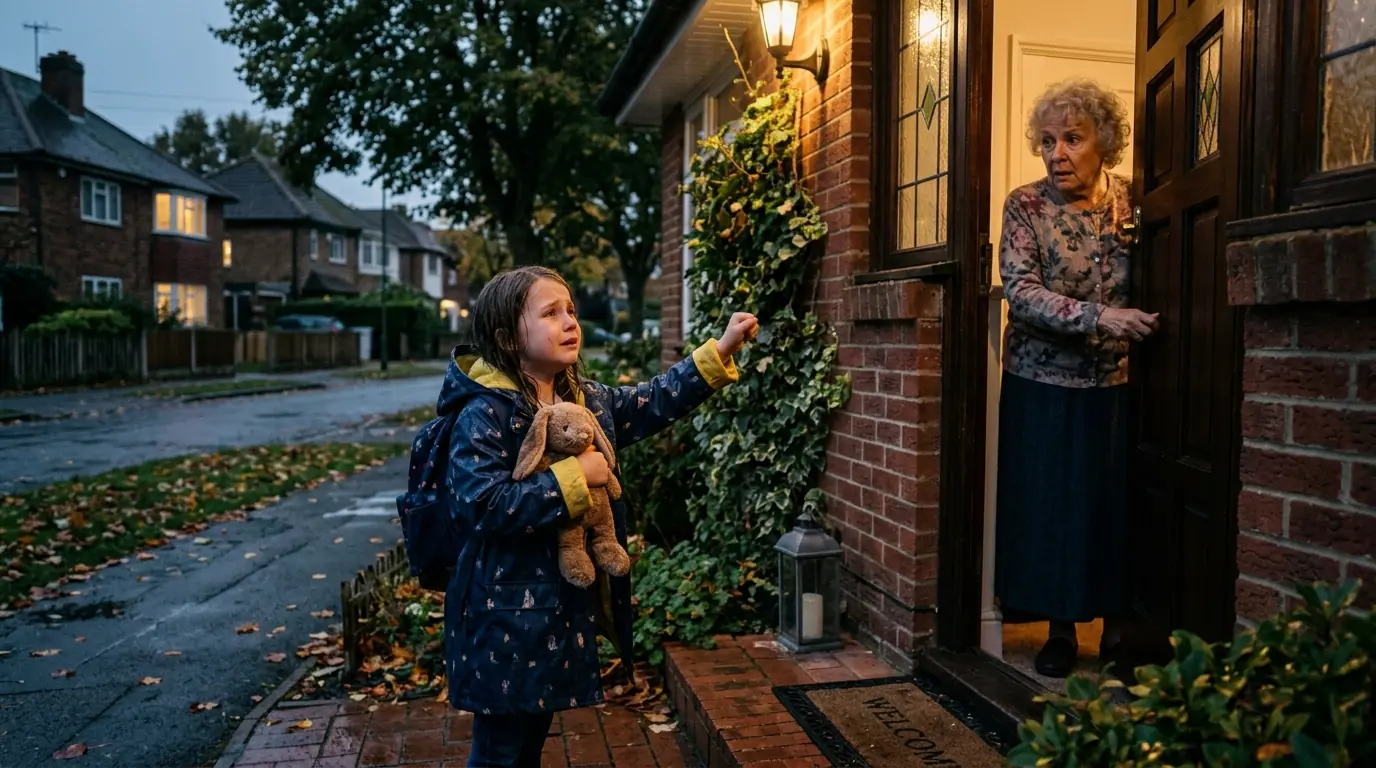 Lila’s eyes flickered nervously around the room, lingering on the worn furniture and the soft glow of the lamp. She finally spoke, her voice barely audible. “My mom… she… she’s not home.”
Marcia nodded. “We’ll find her, I promise. But first, let’s get you something to eat.” She cut a piece of bread, spread some peanut butter on it, and handed it to Lila, who took it in tiny bites, still shivering.
While Lila ate, Marcia called the local police and child services. The dispatcher informed her that a few streets were flooded from recent storms, and it would take some time for officers to reach them. Marcia was not discouraged. She had spent decades caring for those in need. She would keep Lila safe until help arrived.
To keep Lila occupied, Marcia pulled out a box of crayons and blank paper. “Draw me a picture,” she suggested. Lila hesitated, then slowly began sketching. The first drawing showed a small white house with smoke curling from the chimney. The second depicted a woman lying on the floor, reaching toward a fallen phone. The third showed a girl standing outside a locked gate, rain pouring down. Marcia’s throat tightened.
“Is this your mom?” she asked gently. Lila nodded and pointed urgently at the first drawing.
Marcia called her neighbor, Daniel Price, a delivery driver in his forties who knew every backstreet of Cedarville. Together, they studied the sketch. Daniel’s eyes widened. “I think I know that house. There’s a mailbox shaped like a cardinal. It’s on Brookside Avenue.”
Marcia didn’t hesitate. She helped Lila into a raincoat and boots, then joined Daniel in his truck as they drove carefully through the flooded streets. The rain had softened the soil, creating puddles that glistened in the dim streetlights. Lila clutched a small stuffed rabbit, her lifeline through the storm.
They reached the white house before dawn. The front door was slightly ajar. Inside, a woman lay on the bedroom floor, pale and barely conscious, one hand reaching for the phone that had slipped out of reach. Lila cried out, her voice breaking the silence. Marcia called 911 while Daniel covered the woman with a blanket and spoke to her in soothing tones until the paramedics arrived. The woman’s blood sugar had dropped dangerously low, and without Lila’s intervention, she might not have survived the night.
The truth emerged slowly. Amelia Davis, Lila’s mother, was a single parent working late shifts cleaning offices. She had hidden her illness, afraid it might jeopardize her custody. She had no family nearby and little savings. Lila had found her collapsed, tried the phone, and when it failed, walked through the storm alone until she saw Marcia’s porch light glowing.
Marcia could have stepped back once Amelia was in the ambulance, but she did not. She brought Lila home, cleaned her muddy clothes, packed her meals, and stayed by her side until her mother could be discharged. Daniel repaired the broken door lock, dropped off groceries without fuss, and allowed Marcia’s quiet house to become a temporary sanctuary. Lila’s shy smiles returned as she left drawings on the kitchen table: flowers, Marcia holding her blanket, Daniel carrying bags, and small moments of warmth.
When Amelia returned home, she wept and offered thanks she could not measure. Marcia shook her head. “You don’t repay a porch light,” she said. “You keep it burning for someone else one day.”
Months later, the local school counselor saw Lila’s drawings and recognized her extraordinary artistic gift. She was offered a place in a special arts program, while her mother received housing support, medical care, and a daytime job at the school cafeteria.
Years passed, and one afternoon, Marcia was sitting on her porch when a fleet of black SUVs rolled up the street, their tires crunching over the gravel. The windows lowered, and dozens of well-dressed adults, many with professional cameras, smiled at her. Lila, now a teenager, stepped forward with her mother beside her.
“Marcia,” Lila said softly, “you saved us. You gave me a second chance.”
Inside the lead SUV, an art curator extended a folder. “We’ve collected your work, Lila. It’s going to be featured in a city-wide exhibition. We wanted the woman who gave you hope to see it first.”
Marcia’s eyes filled with tears as she saw the collection: vibrant sketches, vivid portrayals of streets, homes, and the small acts of kindness that had shaped her childhood. The porch light she had kept burning, the quiet meals and gentle guidance, had grown into something that extended far beyond her neighborhood.
She reached for Lila’s hand. “You’ve made this old house feel alive again. You’ve reminded me what it means to hope.”
And in that moment, the years of quiet kindness, fear, and perseverance converged. The fleet of SUVs represented not wealth or power, but recognition: the lives she had touched, the futures she had safeguarded, the courage she had nurtured.
Marcia smiled, watching Lila stand tall and confident. She knew the porch light would continue to shine, not only as a beacon for those in need but as a symbol that sometimes, the simplest acts—offering warmth, opening a door, seeing someone who felt invisible—can change the course of a life, and sometimes, many lives.