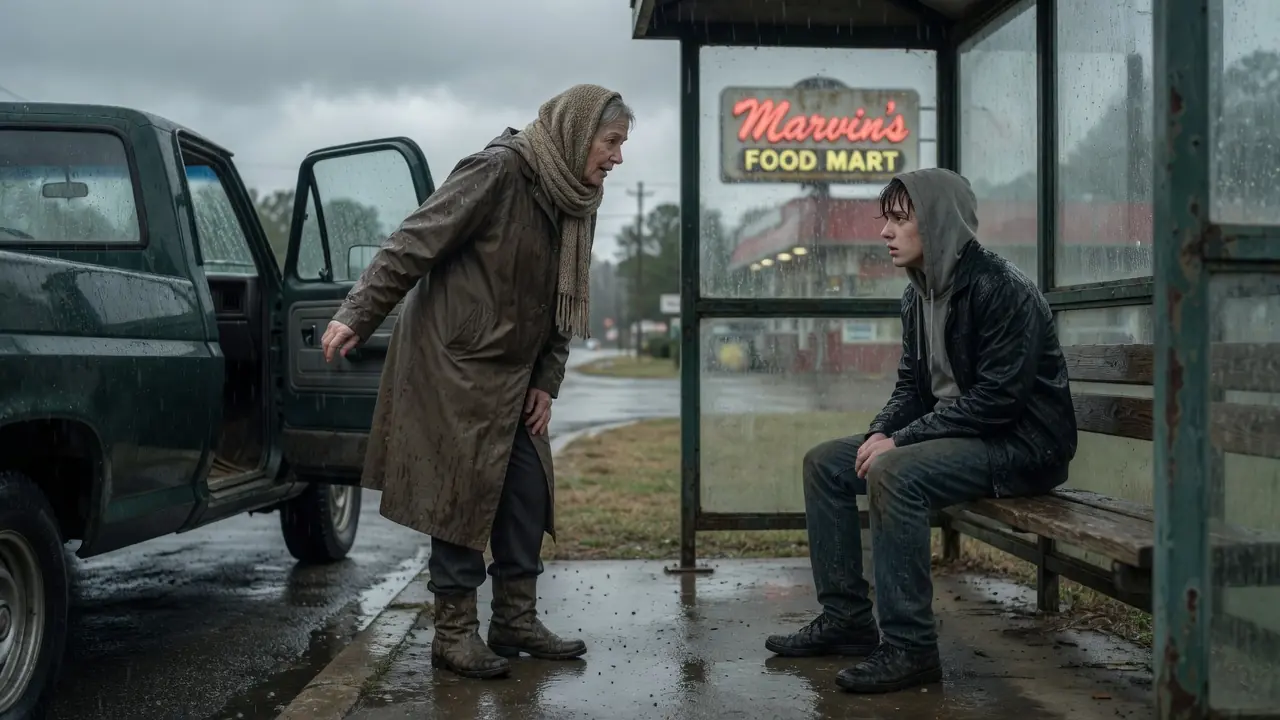
In a storm of cold rain, an old woman found a teenage boy huddled at a bus stop, soaked through, barely able to stand, with nothing but a torn backpack pressed against his chest.
She did not ask questions.
She did not demand his story.
She simply opened the passenger door of her old truck and said, “Get in before this rain takes the rest of your strength.”
But what began as a rescue on a lonely road soon became something much deeper.
A bond built from silence, grief, second chances, and the kind of mercy that changes two broken lives forever.
It was the kind of December evening that made the Georgia mountains feel older than memory.
Gray clouds rested low over the ridges, heavy with rain, and the wind moved through the pine trees like something restless and half-forgotten.
Highway 49 curved gently through Monroe County, not far from Forsyth, where the last town lights blurred behind sheets of water.
About fifteen miles down a winding, unpaved road, tucked behind spruce, oak, and wet red clay, stood a small cabin with a stone chimney still breathing out the remains of the afternoon fire.
It was quiet there.
Deliberately quiet.
A place chosen by a woman who had spent years convincing herself that quiet was safer than company.
Inside that cabin, Evelyn Mayfield folded a heavy wool blanket with slow, methodical care.
Her fingers were thin and bent slightly at the knuckles from arthritis, but they still moved with discipline. Her nails were clean and trimmed short. Her hands carried the marks of someone who had spent a lifetime doing necessary things without waiting to be thanked.
She was seventy-two years old.
Once tall and straight-backed, though age had softened her shoulders and slowed her steps. Her hair was white, thick, and pinned neatly behind her head, though a few stubborn strands always escaped near her temples before noon.
Her face was lined, but not harsh.
It was the kind of face made by hard years, held grief, and a stubborn refusal to collapse.
Her eyes were dark, steady, and tired in a way that made people lower their voices around her, even when she gave them no reason to.
Evelyn did not get visitors.
She told herself she preferred it that way.
The world, with all its noise, demands, and disappointments, had been packed away long ago.
But that day, she had gone into town.
Into light.
Into voices.
Into the possibility of being seen.
Her old Ford pickup rattled as she drove back from Forsyth, windshield wipers struggling against the rain. The radio whispered warnings about flash flooding, falling temperatures, and dangerous roads in the high country.
Stay home, the announcer urged.
Check on elderly neighbors.
Evelyn gave a dry little laugh at that.
No one checked on her.
And she preferred it that way.
At least, that was what she kept telling herself.
Three boxes of supplies sat in the truck bed under a cracked tarp.
Canned soup, rice, flour, candles, batteries, medicine, extra socks, and two folded blankets she had bought even though she already had enough blankets at home.
Not for herself, of course.
That was what she told herself.
Just preparation.
Just old habit.
Just the instinct of a woman who had spent half her life caring for other people and never fully learned how to stop.
She had no one to feed now but an old photograph and the silence that sat across from her at every meal.
At the edge of town, Evelyn pulled into a gas station where the wind carried the smell of wet asphalt, frying oil, and cigarette smoke.
She paid cash.
She did not talk more than necessary.
The cashier, a young man with tired eyes, asked if she needed help carrying anything.
“No,” she said.
Not sharply.
But firmly enough that he did not ask again.
She hated needing help.
Needing help felt like the beginning of losing control, and Evelyn had already lost enough in one lifetime.
Back behind the wheel, with the town shrinking behind her, she exhaled slowly.
One more winter.
One more storm.
One more year of pretending she had chosen loneliness because it suited her.
She had chosen the cabin.
She had chosen the quiet.
She reminded herself of that every morning, the way she reminded herself to take her blood pressure pill, stack firewood by the back door, and latch the pantry window before dark.
She had earned this solitude.
That was what she told herself.
Yet as she turned off the main road and drove past the old public bus stop near County Road 22, something made her foot ease off the gas.
At first, she thought the shape beneath the shelter was a pile of discarded clothes.
Then it moved.
Evelyn slowed the truck.
Under the narrow metal roof sat a teenage boy, hunched over against the cold rain, both arms wrapped around a torn backpack as if it held the last piece of him still worth protecting.
His hoodie was soaked through.
His jeans were wet to the knees.
His shoes were muddy and split near one toe.
His face was pale beneath the weak yellow bus stop light, and his lips had lost nearly all color.
When Evelyn’s truck slowed, his eyes darted toward the road.
Not curious.
Not hopeful.
Afraid.
He looked like a boy deciding whether he had enough strength left to run.
Evelyn tightened her grip on the wheel.
For a moment, she did not move.
She sat with the engine idling, rain hammering against the roof of the truck, staring through the windshield at a child too young to be that cold and that alone.
Something painful stirred in her chest.
Recognition.
Not of him.
Of the shape of the moment.
A child carrying more than any child should carry.
Evelyn closed her eyes for one brief second.
Then she pulled over.
Her boots splashed into muddy gravel when she stepped down from the truck. Rain struck her face and ran beneath the collar of her coat.
She approached slowly, hands visible at her sides.
The boy stiffened.
Evelyn stopped a few feet away.
“You waiting for a bus?” she asked.
Her voice was not sweet.
It was steady.
The boy looked at her, then down at the backpack clutched in his lap.
“I missed it,” he said.
His voice cracked on the last word.
Evelyn glanced at the road.
The bus would not come again for hours, if it came at all in this weather.
The rain was getting colder.
The sky had already darkened into a low, wet dusk.
“You got someone coming?”
Then shook his head.
“No, ma’am.”
“What’s your name?”
Another hesitation.
“Ethan.”
“Ethan what?”
He looked down.
“Taylor.”
Evelyn watched him carefully.
“How old are you, Ethan Taylor?”
“Seventeen.”
Too young, she thought.
Too young for that voice.
Too young for those eyes.
Too young to be sitting alone in the rain with nowhere to go.
She did not ask why he was there.
Not yet.
Some questions were doors.
And frightened people did not always need doors first.
Sometimes they needed warmth.
Evelyn tilted her head toward the truck.
“I’ve got a cabin up the road. Fire’s going. You can dry off, eat something, and decide what comes next when your teeth stop chattering.”
The boy looked toward the open passenger door.
His hands tightened around the backpack.
“I don’t have money.”
“I didn’t ask if you did.”
“I can’t pay you back.”
“Didn’t say you had to.”
His eyes searched her face.
He did not trust kindness.
That told Evelyn more than any explanation could have.
“I’m not getting in trouble,” he whispered.
Evelyn’s gaze sharpened.
“With the law?”
“No. I didn’t steal anything. I didn’t hurt anybody. I just…”
He stopped.
The rain filled the silence.
Evelyn waited.
“I just couldn’t go back,” he said.
That was enough for now.
She turned and walked back to the truck, leaving the passenger door open.
The boy stared at it as if it were a miracle he did not trust.
Then the wind shifted, pushing rain under the shelter roof and across his face.
He stood slowly.
Too slowly.
His knees buckled once.
Evelyn stepped forward, but did not touch him.
“Easy now,” she said. “One step at a time.”
Ethan crossed the gravel, climbed into the passenger seat, and kept his backpack against his chest.
Evelyn shut the door gently, walked around the truck, got in, and turned the heater up as high as it would go.
For the first few minutes, neither of them spoke.
The heater wheezed, then warmed.
Ethan’s hands shook around the backpack straps.
The forest swallowed the truck as Evelyn drove toward the cabin.
Rain ran down the windshield in thick streams. The gravel road had turned slick and dark beneath the headlights. Once, a deer’s eyes flashed between trees before vanishing into the wet brush.
Evelyn said nothing.
The boy said nothing.
But in that silence, something small began to shift.
The cabin came into view through the rain, a modest wooden structure with smoke curling from the chimney and a porch light flickering as though unsure it should welcome anyone anymore.
Evelyn parked near the steps.
“Stay put,” she said.
Ethan’s eyes widened slightly.
“I’m just opening the door,” she added.
She climbed out, unlocked the cabin, and pushed the door wide.
Warmth spilled into the rain.
Only then did Ethan move.
He stepped inside and stopped just over the threshold.
Water dripped from his clothes onto the mat.
His backpack remained locked in both arms.
Evelyn closed the door behind him.
The cabin smelled of cedarwood, old books, iron skillets, dried herbs, and the steady smoke of a real fire.
It was not large.
A kitchen along one wall.
A round wooden table with two chairs.
A sitting area near the fireplace with a worn sofa and a rocking chair.
A hallway leading to one bedroom and a small spare room Evelyn had not used in years.
Everything was neat.
Too neat.
The kind of neatness that came from a life without visitors.
Ethan stood like he was afraid to touch anything.
Evelyn pointed toward the sofa.
“Sit before you fall.”
He obeyed.
Slowly.
Carefully.
As if the furniture might change its mind about holding him.
Evelyn went to the kitchen without making a fuss.
She filled a kettle.
Set it on the stove.
Then pulled one of the new blankets from the supply box and tossed it toward him.
“Wrap up.”
Ethan caught it awkwardly.
His fingers were stiff from cold.
“Thank you,” he whispered.
Evelyn nodded once.
She made tea first.
Then soup.
Chicken, rice, carrots, onion.
Simple food.
Warm food.
Food that asked nothing from the person eating it.
When the tea was ready, she placed a mug on the low table in front of him.
“No milk,” she said. “Little sugar if you need it.”
“I don’t need sugar.”
“Need and want are different things.”
He looked confused.
She put a spoonful of sugar beside the mug anyway.
Ethan wrapped both hands around the cup, letting the heat seep into his fingers.
His knuckles were red from cold.
Evelyn noticed.
She noticed everything, though she had spent years pretending not to.
When the soup was done, she gave him a bowl.
He stared at it.
“I’m not hungry.”
His stomach answered for him.
Evelyn raised one eyebrow.
“My hearing still works.”
His face flushed.
He picked up the spoon.
At first, he ate politely.
Then faster.
Then he stopped suddenly, ashamed of wanting food too much.
Evelyn turned away and busied herself with the sink, giving him privacy from the hunger he did not want witnessed.
He finished the bowl.
Then she gave him another without asking.
He finished that too.
Hours passed.
Rain kept beating against the cabin roof.
The fire burned steady.
They did not talk much.
Evelyn found him dry clothes from an old cedar chest, clothes that had belonged to her husband before he died. Sweatpants too large, wool socks, a flannel shirt that hung loose on Ethan’s thin frame.
He changed in the bathroom and returned looking smaller somehow.
Younger.
The wet clothes had hidden how little of him there was.
His backpack stayed with him.
Always within reach.
Evelyn noticed that too.
“You can sleep in the spare room,” she said later, setting folded sheets and a quilt on the cot.
Ethan stood in the doorway, uncertain.
“I can sleep on the floor.”
“I said spare room.”
“I don’t want to be trouble.”
“You’re already trouble,” Evelyn said.
His face fell.
She glanced at him.
“Question is whether you’re useful trouble or foolish trouble. We’ll find out tomorrow.”
For half a second, something like a smile touched his mouth.
Then disappeared.
At the door, he paused.
“Mrs. Mayfield?”
“Evelyn.”
He swallowed.
“Why are you helping me?”
The question came out small.
Not suspicious exactly.
More wounded than that.
Evelyn looked at him for a long moment.
Then she said, “Because you were sitting in the rain.”
He waited.
As if there had to be more.
There was more.
But she was not ready to give it.
“That’s enough reason for tonight,” she said.
He nodded slowly.
Then entered the spare room and closed the door almost all the way.
Evelyn sat by the fire long after the cabin went quiet.
She could hear him moving in the spare room.
Not sleeping.
Not yet.
A floorboard creaked.
Then silence.
Then another creak.
A boy checking whether a room was safe.
Evelyn closed her eyes.
Memory came, unwelcome.
Another seventeen-year-old.
Her daughter, Ruth.
Standing in this same cabin years earlier with tears in her eyes and anger in her voice.
“You don’t listen,” Ruth had said. “You just decide what people should be and punish them when they aren’t.”
Evelyn had been angry then.
Afraid too, but mostly angry.
Ruth had left that night in the rain.
Evelyn had let her.
Three months later, a state trooper knocked on the door.
Accident.
Wet road.
No survivors.
Evelyn opened her eyes and stared into the fire.
She had spent sixteen years alone because she believed she had failed the one child who needed her most.
Now another child was sleeping under her roof.
And Evelyn did not know whether mercy had found her or accused her.
Morning came gray and wet.
The rain had softened but not stopped.
Water dripped steadily from the eaves.
Mist hung between the trees.
Evelyn woke early out of habit and found Ethan already in the kitchen, washing the bowl he had used the night before.
He startled when he saw her.
“I was just cleaning it.”
“I can see that.”
“I didn’t take anything.”
“I didn’t say you did.”
His shoulders stayed tense.
Evelyn moved past him toward the stove.
“You know how to make coffee?”
“Sort of.”
“Then make some.”
He blinked.
She pointed to the tin.
“Coffee. Filter. Water. Nothing mystical.”
He followed instructions carefully, as if getting it wrong might cost him his place.
When the coffee brewed, Evelyn cracked eggs into a skillet.
Ethan stood near the counter, unsure whether to sit, help, or disappear.
“Toast,” she said.
He moved quickly.
They worked in silence.
Not comfortable yet.
But less sharp than the night before.
When they sat at the table, Evelyn slid a plate toward him.
He stared.
“You feed every stranger who wanders into your life?”
“No.”
“Then why me?”
Evelyn took a sip of coffee.
“You planning to ask that every meal?”
His ears reddened.
“No, ma’am.”
“Good. Eat.”
He ate.
Slowly at first.
But he ate everything.
After breakfast, Evelyn nodded toward his backpack.
“You carry that like there’s gold in it.”
Ethan’s hand moved to the strap.
“It’s just my stuff.”
“What stuff?”
He hesitated.
Then opened it.
Inside was a folded sweatshirt, a notebook, a cracked phone with no charge, a toothbrush, a small plastic bag with two crackers, and a photograph bent at the corner.
Evelyn said nothing.
Ethan saw her looking at the photograph.
He lifted it carefully.
It showed a younger Ethan standing beside a woman in front of a small brick house. She had one arm around him and a tired smile on her face.
“My mom,” he said.
Evelyn’s expression softened before she could stop it.
“Where is she?”
“Gone.”
The word carried too much.
“Dead?”
He nodded.
“Two years ago. Cancer.”
“And your father?”
“Never knew him.”
“Family?”
“My aunt Carol. Her husband. Their house.”
The way he said it told Evelyn enough.
She waited.
Ethan looked at the table.
“I lived with them after Mom died. It was fine at first. Then not fine.”
“Did they hit you?”
His hands tightened.
“Raymond did sometimes. My aunt said I should stop provoking him.”
Evelyn’s jaw clenched.
Ethan continued quickly, like he had to explain before she misunderstood.
“I tried. I really did. I worked after school. I helped around the house. I kept my grades up. But he said I ate too much, cost too much, looked at him wrong, breathed too loud.”
His voice cracked.
“Last night, he got drunk. He threw my backpack into the yard and told me if I wanted to act grown, I could live grown. My aunt cried but she didn’t stop him.”
Rain tapped the window.
Evelyn felt old anger rise in her bones.
Not loud.
Not hot.
Deep and steady.
“What did you do?”
“I walked. Then got on a bus. I thought I could reach Macon. Maybe find a shelter. But I missed the transfer, and my phone died.”
He looked down.
“I didn’t know where else to go.”
Evelyn sat very still.
A boy in the rain.
A mother gone.
A relative who looked away.
A door closing when it should have opened.
History had cruel ways of returning with a different face.
“You got school records?” she asked.
He blinked.
“What?”
“Grades. ID. Anything useful.”
He looked confused by the practical turn.
“In my backpack. Some papers.”
“Good.”
“Why?”
“Because you’re not vanishing into the cracks if I can help it.”
His eyes lifted.
Hope appeared there for one dangerous second.
Then fear crushed it down.
“You don’t have to do anything.”
“I know.”
“I can leave today.”
“Road’s half washed out.”
“Tomorrow then.”
Evelyn looked at him over her coffee cup.
“Boy, if I wanted you gone, you’d know.”
He stared at her.
Then, very slowly, he looked down at his plate.
A small breath left him.
Not relief fully.
But something near it.
That afternoon, Evelyn called the county office.
Then the school.
Then a retired friend named Carl Hensley who worked student support at the technical college in town.
She had not spoken to him in years.
When he answered, he sounded startled enough to drop the phone.
“Evelyn Mayfield?”
“Don’t sound like I’m dead, Carl.”
“I wasn’t sure.”
“I need a favor.”
He was silent for half a second.
Then his voice softened.
“If you’re asking, I’m listening.”
Evelyn glanced toward the living room, where Ethan sat near the fire with his notebook open but his pencil unmoving.
“There’s a boy here,” she said. “Seventeen. Smart, scared, and trying not to show either one. He needs options before the world teaches him not to expect any.”
Carl exhaled.
“Tell me what you need.”
Over the next few days, the cabin became something Evelyn had not allowed it to be in years.
Alive.
Not noisy exactly.
Ethan was too cautious for noise.
But there were sounds now.
The kettle in the morning.
A second chair scraping at the kitchen table.
Pencil against paper.
Boots by the door.
The spare room floor creaking at night.
At first, Ethan apologized for everything.
For using soap.
For eating.
For asking where towels were.
For coughing.
For sleeping too late when he finally slept more than three hours.
Evelyn endured the apologies for two days before she snapped.
“If you say sorry one more time for needing basic human things, I’m making you clean the chimney.”
He froze.
Then realized she was not truly angry.
“Yes, ma’am.”
“And stop calling me ma’am like I’m the school principal.”
“What should I call you?”
“Evelyn.”
He tried.
The word felt strange in his mouth.
“Evelyn.”
“See? Nobody died.”
He almost smiled.
On the third evening, the rain finally stopped.
The world outside remained soaked and muddy, but the silence afterward felt clean.
Ethan helped Evelyn bring firewood onto the porch.
He carried more than she asked.
She noticed.
“You showing off?”
“No.”
“You always work like someone’s watching to see if you’re worth keeping?”
The piece of wood in his hand went still.
Evelyn regretted the sharpness immediately.
But Ethan answered quietly.
“Yes.”
That answer hollowed something out in her.
She took the wood from him and stacked it.
“Well,” she said after a moment, “I’m not Raymond.”
He looked at her.
“I know.”
“Do you?”
He did not answer.
She sighed.
“I suppose you will.”
That night, Ethan left the spare room door cracked open.
Evelyn noticed.
She did not mention it.
The next morning, she found him at the kitchen table writing in the notebook.
He closed it quickly when she entered.
“Schoolwork?” she asked.
“No.”
“A confession?”
His eyes widened.
“That was a joke,” she said.
“Oh.”
He looked embarrassed.
After breakfast, he left the notebook near his plate.
Not handed to her.
Not offered.
Just left.
Evelyn understood the difference.
She waited until he went outside to split kindling.
Then she opened it.
The first page was a list of expenses.
Bus ticket.
Food.
Phone charger.
School records.
Secondhand boots.
The second page was a rough plan.
Find shelter.
Finish senior year.
Work.
Save.
Do not go back.
The third page was different.
A paragraph.
Then another.
Then a full page.
He had written about rain.
About how it sounded different depending on whether you were inside or outside.
About how a porch light could look like judgment if you believed the people inside would not open the door.
About how hunger made pride quiet.
Evelyn read the page twice.
When Ethan returned, she set the notebook down.
“You write well.”
His face flushed.
“It’s nothing.”
“Don’t say foolish things in my kitchen.”
He blinked.
She tapped the notebook.
“That is not nothing.”
He looked at it, then at her.
“My mom used to say I had a way with words.”
“Your mother was right.”
The compliment landed heavily.
He looked away fast.
Evelyn pretended not to see his eyes fill.
Later that week, Carl drove up to the cabin.
He was in his late sixties, round-faced, with a gray mustache and the gentle patience of someone who had spent decades helping people fill out forms they were ashamed to need.
He brought folders.
Applications.
School contacts.
A list of youth housing resources.
Ethan sat stiffly across from him at the kitchen table.
Evelyn stood nearby, arms crossed, watching like a guard dog in cardigan sleeves.
Carl asked questions.
Not too many at once.
He explained options.
Emergency youth services.
A legal advocate.
A path to stay enrolled in school.
A possible scholarship program if Ethan finished his diploma.
A part-time work placement through the college’s community program.
Ethan listened with his hands clasped tightly.
At one point, he said, “I don’t want charity.”
Carl nodded.
“Good. This isn’t charity. It’s infrastructure.”
Ethan frowned.
“What does that mean?”
“It means people who already have support call it normal. People who don’t have support call it charity because they’ve been taught to feel ashamed.”
Evelyn looked at Carl.
“Still talking too much, I see.”
Carl smiled.
“Still terrifying children, I see.”
“I am not terrified,” Ethan said quickly.
Both older adults looked at him.
He lowered his eyes.
“Okay. A little.”
Evelyn gave a satisfied nod.
“Honesty. Good start.”
The legal advocate helped Ethan report what had happened without forcing him to return to the house. His aunt Carol called twice. Ethan did not answer.
Evelyn did not push him.
But she did say, “Not answering today is a choice. Not answering forever is also a choice. Just make sure it’s yours, not fear’s.”
Ethan thought about that for a long time.
Days became weeks.
Ethan stayed at the cabin while the county worked through temporary arrangements. Because he was seventeen and close to finishing school, the solution became a patchwork of paperwork, emergency support, Carl’s program, and Evelyn’s stubborn insistence that no one was sending him back where he had been thrown out.
“You can’t just take in a minor indefinitely,” one woman from the office said over the phone.
Evelyn replied, “Then make it definite with paperwork.”
The woman tried to explain procedure.
Evelyn outlasted her.
Three days later, a caseworker came to the cabin.
She inspected the spare room.
Checked the pantry.
Asked Ethan whether he felt safe.
He looked at Evelyn before answering.
Then said, “Yes.”
The caseworker approved a temporary safety placement while longer-term options were explored.
Evelyn signed every paper put in front of her.
After the caseworker left, Ethan stood in the kitchen holding a copy of the form.
“So I can stay?”
“For now,” Evelyn said.
His shoulders lowered.
“For now is good.”
“It is not forever.”
“I know.”
But he smiled anyway.
For now was more than he had expected.
Christmas came quietly.
Evelyn had not decorated in sixteen years.
Ethan found the old box in the hall closet while searching for extra blankets.
He opened it and froze.
Inside were ornaments wrapped in tissue, a string of lights, a small wooden angel, and a red stocking with the name Ruth stitched in white thread.
“I’m sorry,” Ethan said immediately. “I didn’t mean to look.”
Evelyn stood in the hallway behind him.
For a moment, her face went still in a way that made him wish he could disappear.
Then she stepped closer.
“That box used to come out every December.”
He started to close it.
She stopped him.
“Leave it.”
“Are you sure?”
“No.”
The honesty surprised them both.
Then she added, “But leave it.”
That evening, they decorated a small pine branch Ethan cut from a fallen limb.
Not a full tree.
Not yet.
But something.
Evelyn unwrapped ornaments with careful hands.
A painted bird.
A cracked glass bell.
A little wooden horse Ruth had made in second grade.
Ethan hung each one gently.
When they reached the stocking, he looked at Evelyn.
She took it from him.
Held it for a long time.
Then hung it near the fireplace.
Not because grief was gone.
Because love had not been erased by loss.
On Christmas morning, Ethan found a pair of work boots by the door.
Used, but sturdy.
Polished clean.
Beside them was a note in Evelyn’s neat handwriting.
Feet that plan to stay need proper shoes.
He stared at the boots for a long time.
Then put them on.
They fit.
He did not ask how she knew his size.
Evelyn did not explain that she had checked his old shoes while he slept.
In return, Ethan gave her a notebook.
Hardbound.
Dark green.
On the first page, he had written:
For the stories you stopped telling.
Evelyn read that line three times.
Then closed the notebook carefully.
“I don’t write.”
“You might.”
“I’m old.”
“You’re alive.”
She looked at him sharply.
He looked nervous, but did not take it back.
The truth hung between them.
Then Evelyn nodded once.
“Maybe.”
Spring arrived slowly.
The rain softened.
The red clay dried.
Green returned to the edges of the road.
Ethan enrolled in the local high school’s alternative completion program with Carl’s help. He worked part-time at a hardware store in town, where his quiet manner and careful attention made him popular with older customers who needed patience more than speed.
He still returned to the cabin every evening.
Sometimes with homework.
Sometimes with groceries he bought with his own wages, even when Evelyn told him to save his money.
Sometimes with stories from work.
Evelyn listened while pretending not to.
He knew.
She knew he knew.
Their routines became ordinary.
Coffee in the morning.
Schoolwork at night.
Sunday soup.
Laundry on Wednesdays.
Firewood stacked before rain.
Ethan fixed the porch railing without being asked.
Evelyn corrected his grammar without mercy.
He complained.
She ignored him.
It was, in every practical sense, family.
Neither of them said that word.
Not yet.
The past returned in April.
A letter came from Carol.
Ethan’s aunt.
The handwriting on the envelope made his face go pale.
He held it for an hour before opening it.
Inside were two pages of apology.
Carol wrote that Raymond had left. That she had been ashamed of not protecting Ethan. That she had told herself he was nearly grown because it was easier than admitting she had allowed a child to be thrown into the rain.
She did not ask him to come back.
She asked only if she could see him and apologize in person.
Ethan folded the letter and sat very still.
Evelyn sat across from him.
“You don’t have to see her.”
“I know.”
“You don’t have to forgive her.”
“I know.”
“You don’t have to decide today.”
His eyes lifted.
“What would you do?”
Evelyn looked toward the window.
Rain clouds gathered again over the trees.
“I would think about whether not seeing her protects you or keeps you tied to that night.”
Ethan swallowed.
“Did you ever get to say what you needed to say to Ruth?”
Evelyn’s mouth tightened.
“No.”
“Do you wish you had?”
Every day, she thought.
But she only said, “Yes.”
Two weeks later, Carol came to the cabin.
She arrived in a small gray car and stood in the yard with both hands clasped in front of her like she was waiting to be judged.
Ethan stood on the porch.
Evelyn stood just inside the door, close enough to be present, far enough to let the moment belong to him.
Carol looked thinner than Ethan remembered.
Older too.
She began crying before she reached the steps.
“I failed you,” she said.
Ethan’s jaw tightened.
Carol stopped at the bottom step.
“I keep trying to find a better way to say it, but there isn’t one. I failed you. You were a child grieving your mother, and I let my fear make me cruel. I let Raymond’s anger become the weather of the house. I should have stopped him. I didn’t.”
Ethan’s hands shook.
“You watched him throw my backpack outside.”
Carol nodded, tears running down her face.
“Yes.”
“You didn’t come after me.”
“I know.”
“I waited at the bus stop thinking maybe you would.”
Carol covered her mouth.
Ethan’s eyes filled, but his voice stayed steady.
“You didn’t.”
“No,” she whispered. “I didn’t.”
The silence after that was long.
Then Ethan said, “I’m not coming back.”
Carol nodded quickly.
“I’m not asking you to.”
“I don’t know if I forgive you.”
“I understand.”
“But I don’t want to hate you forever.”
Carol broke then.
Not loudly.
Just bent under the weight of what she had lost.
Ethan did not hug her.
But he stepped down from the porch and stood closer.
That was enough for one day.
After Carol left, Ethan sat on the porch steps until dark.
Evelyn sat beside him without speaking.
Finally, he said, “That hurt.”
“Yes.”
“But I think it hurt clean.”
Evelyn glanced at him.
“What does that mean?”
“I don’t know. Like pulling glass out.”
She nodded slowly.
“That is a good kind of hurt, if there is one.”
In May, Ethan graduated.
The ceremony was held in the high school gym because rain threatened again.
Evelyn sat in the second row wearing her best navy dress and a cardigan with pearl buttons.
Carl sat beside her.
Carol sat three rows back, invited but not yet close.
When Ethan’s name was called, he walked across the stage with his shoulders straight.
He received his diploma.
For a second, he looked out at the audience.
His eyes found Evelyn.
She did not wave.
She simply nodded once.
Proud.
Firm.
Certain.
That nearly undid him.
Afterward, in the hallway crowded with families and flowers, Ethan found Evelyn standing near the trophy case.
He handed her the diploma.
She frowned.
“What are you doing?”
“You helped me get it.”
“I did not attend classes for you.”
“You opened the door.”
Her expression shifted.
He continued.
“I don’t think I ever said thank you properly.”
“You said it enough.”
“No,” he said. “I didn’t.”
He swallowed.
“Thank you for stopping. Thank you for not asking everything before helping. Thank you for letting me stay long enough to remember I could still become someone.”
Evelyn looked down at the diploma because looking at him directly had become too difficult.
“You were already someone.”
He blinked fast.
She handed the diploma back.
“You just needed dry clothes and a witness.”
That summer, Ethan began classes at the technical college.
Writing first.
Then carpentry basics because Evelyn insisted everyone should know how to build a shelf that does not embarrass the wall.
He worked at the hardware store and saved money for a small apartment in town.
When he moved, Evelyn pretended to be practical about it.
She brought cleaning supplies.
Inspected the windows.
Complained about the lock.
Bought him a secondhand table.
Told him the curtains were ugly.
Then cried in her truck before driving home.
Ethan knew because she returned the next day with red eyes and a toolbox.
Neither of them mentioned it.
He visited every Sunday.
Then Wednesdays too.
Then whenever the cabin seemed too quiet in his mind.
Evelyn began writing in the green notebook.
At first, only lists.
Weather.
Meals.
Bills.
Then memories.
Ruth at six, missing her front tooth.
Ruth at twelve, reading under the kitchen table.
Ruth at nineteen, angry and scared, standing in the rain.
The pages were not easy.
But they were honest.
One evening, Evelyn let Ethan read one.
When he finished, he was silent.
“She sounds like she was bright,” he said.
“She was.”
“And stubborn.”
“Worse than you.”
“Impossible.”
A smile touched Evelyn’s mouth.
It was small.
But real.
Years passed.
Ethan became the kind of young man people trusted with locked doors and unfinished stories.
He finished his program, then transferred into social work with a focus on youth crisis support. He said it was because the system needed people who understood what it felt like to sit under a bus stop roof and wonder whether anyone would stop.
Evelyn said he was getting dramatic.
But she kept every article he wrote.
Every certificate.
Every letter.
She kept them in the same cedar chest that once held only old grief.
Ethan started a community program with Carl’s help.
It began small.
A room at the technical college.
A coffee pot.
A shelf of donated coats.
A list of emergency contacts.
A sign on the wall that said:
Open Door Hours.
No appointment needed.
Students came.
Then teenagers from the county.
Then young people living in cars, couch surfing, aging out of foster care, fleeing homes that had become dangerous.
Ethan listened to them the way Evelyn had listened to him.
Food first.
Warmth first.
Questions later.
That became the rule.
Evelyn volunteered once a week.
She claimed it was only because Ethan did not know how to make proper soup.
But everyone knew better.
The students were afraid of her at first.
Then devoted.
She corrected their resumes with brutal honesty.
Hemmed pants for interviews.
Taught them how to cook rice without burning the pot.
Sat silently beside the ones who could not talk yet.
One girl asked her, “Why do you help us?”
Evelyn looked at Ethan across the room.
Then answered, “Because somebody should have helped sooner.”
The program grew.
A church donated space.
A local mechanic offered apprenticeships.
A doctor provided free clinic hours once a month.
Carol, slowly rebuilding her relationship with Ethan, began helping with intake forms. It was her way of making amends, not with speeches, but with service.
Ethan let her.
Carefully.
With boundaries.
With time.
On the tenth anniversary of the rainy night, the county dedicated a new youth support center.
They named it Mayfield House.
Evelyn refused at first.
Flatly.
“No building needs my name on it.”
Ethan handed her a letter.
It was signed by forty-three young people who had passed through the program.
Some wrote only their names.
Some wrote paragraphs.
One sentence appeared again and again in different handwriting.
You made me feel like I could come inside.
Evelyn read the letters at her kitchen table.
Then folded them carefully.
“All right,” she said.
Ethan smiled.
“All right?”
“But no portrait.”
“Agreed.”
“And no speech.”
“There has to be a speech.”
“Then you give it.”
“I am.”
“Good.”
At the dedication, rain threatened but did not fall.
Evelyn sat in the front row wearing the same navy dress she had worn to Ethan’s graduation.
Her hair was fully white now.
Her body smaller.
Her cane rested beside her chair.
But her eyes were steady.
Ethan stood at the podium in front of Mayfield House and looked at the crowd.
Students.
Teachers.
Former runaways.
Social workers.
Neighbors.
Carol.
Carl.
People who had found help because one old woman had once stopped in the rain.
“I was seventeen when I met Evelyn Mayfield,” Ethan said.
The crowd quieted.
“I was soaked through, hungry, ashamed, and certain I had become the kind of problem adults step around. She did not ask me to prove I deserved help. She opened the truck door first.”
Evelyn looked down.
Ethan continued.
“That order matters. Warmth first. Food first. Safety first. The story can come later.”
Several people wiped their eyes.
“Mayfield House exists because too many young people are asked to explain their pain before anyone offers them a chair. We are here to do it differently. We are here because one woman taught me that mercy is not soft. Mercy is strong enough to interrupt the storm.”
The applause rose slowly.
Then fully.
Evelyn hated applause.
But she sat still and accepted it because Ethan had once told her that rejecting love too quickly could become its own kind of pride.
That evening, they returned to the cabin.
The same road.
The same trees.
The same porch light.
But everything was different.
Ethan parked beside Evelyn’s truck and helped her up the steps.
She swatted his hand away once, then took it anyway.
Inside, the cabin was warm.
The table was set for two.
Soup waited on the stove.
On the wall near the fireplace hung three framed things.
A photograph of Ruth, young and laughing, before grief and anger pulled her story away.
A photo of Ethan in his graduation gown, standing beside Evelyn with his diploma in hand.
And the opening announcement for Mayfield House.
Beneath them was a small wooden sign Ethan had carved himself.
Open the door first.
Evelyn stood before it for a long moment.
Then she touched Ruth’s photograph.
“I’m still trying,” she whispered.
Ethan heard her.
He did not interrupt.
Some prayers were not meant to be answered by anyone in the room.
Later, they sat on the porch with mugs of tea as a light rain began to fall.
Not a violent storm.
Just rain.
Soft and steady.
Ethan looked toward the road that led down to County Road 22.
“Do you ever think about what would have happened if you hadn’t stopped?”
Evelyn did not answer immediately.
Then she said, “Every December.”
“Me too.”
“You were stubborn enough to survive either way.”
“I don’t think so.”
She looked at him.
He looked back.
“I think some nights change everything,” he said. “That was one of them.”
Evelyn’s eyes softened.
“I thought I was saving you from the rain.”
“You were.”
He smiled.
“But not just that.”
The rain tapped gently against the porch roof.
For years, Evelyn had believed the cabin was where she went to disappear.
But it had become something else.
A shelter.
A beginning.
A place where grief did not end, but learned to share space with purpose.
Years later, people would tell the story in different ways.
They would say an old woman saved a teenage boy from a rainstorm.
They would say the boy grew up and built a program that helped hundreds of young people.
They would say Mayfield House became a place where scared teenagers found food, warmth, paperwork, advocates, and a chance to begin again.
All of that was true.
But it was not the whole truth.
The whole truth was quieter.
An old woman drove past a bus stop and saw a boy sitting alone in the rain.
She could have kept driving.
She had reasons.
Age.
Pain.
Regret.
Fear.
A lifetime of telling herself not to get involved.
Instead, she stopped.
She opened her truck door.
And from that one act of mercy came a life neither she nor Ethan could have imagined.
A boy learned he was not a burden.
A woman learned her heart had not closed, only waited.
A cabin that had belonged to silence became a home again.
The world had sent Ethan Taylor into the rain with nothing but a backpack and a broken hope.
Evelyn Mayfield opened the door.
And from that moment on, neither of them had to survive the storm alone.