At twenty-four, Marisol Vega had learned to notice people other drivers passed without seeing.
She was a young Latina American woman with warm brown skin, dark curly hair usually tied into a loose bun, deep brown eyes, and a calm voice that made people feel less embarrassed when life caught them at their weakest. She lived in San Antonio, Texas, in a small apartment above her aunt’s bakery, where the morning smelled of coffee, sugar, and fresh bread before the streets were fully awake.
Marisol worked as a mobile hairdresser.
She did not have a salon of her own yet. Instead, she drove across the city in her small blue sedan with a trunk full of scissors, combs, towels, capes, a portable mirror, styling sprays, shampoo bottles, and a folding chair. She cut hair in kitchens, apartment living rooms, nursing home activity rooms, church basements, and sometimes under shaded porches when the Texas heat was not too cruel.
Her dream was to open a small neighborhood salon called **Rosa’s Chair**, named after her grandmother.
Abuela Rosa had been the first person who taught Marisol that hair was never only hair. In their old neighborhood, women came to Rosa’s back room with tired faces and left standing a little taller. Widows came in saying they only needed a trim, then stayed for coffee and cried into napkins. Working mothers came with children tugging at their sleeves. Elderly men came after losing wives who had cut their hair for decades.
Rosa treated every person like they were still worth careful hands.
“People sit in the chair because they want to feel like themselves again,” Rosa used to say.
Marisol carried those words everywhere.
But a dream needed rent money, salon chairs, mirrors, permits, shampoo stations, insurance, and time. Marisol had none of those in abundance. She had skill, patience, an old sedan, and a notebook full of ideas she kept in her glove compartment.
Most days, that had to be enough.
One Thursday afternoon in late September, Marisol finished cutting hair for an elderly client recovering from surgery on the north side of the city. The sky had been gray all morning, low and heavy, but by the time she packed her tools into the trunk, thunder had begun rolling over the rooftops.
Her client, Mrs. Navarro, stood in the doorway with a towel around her shoulders.
“You better drive safe, mija,” she said. “That rain is coming mean.”
Marisol smiled. “I will.”
“You always say that like the weather listens to you.”
“I’m very persuasive.”
Mrs. Navarro laughed and waved her away.
Ten minutes later, the rain arrived.
It hit the windshield hard, turning the road into a blur of silver lines and red brake lights. Water rushed along the curbs. Cars slowed. The radio crackled with a storm warning. Marisol tightened her hands on the wheel and leaned forward, trying to see through the heavy downpour.
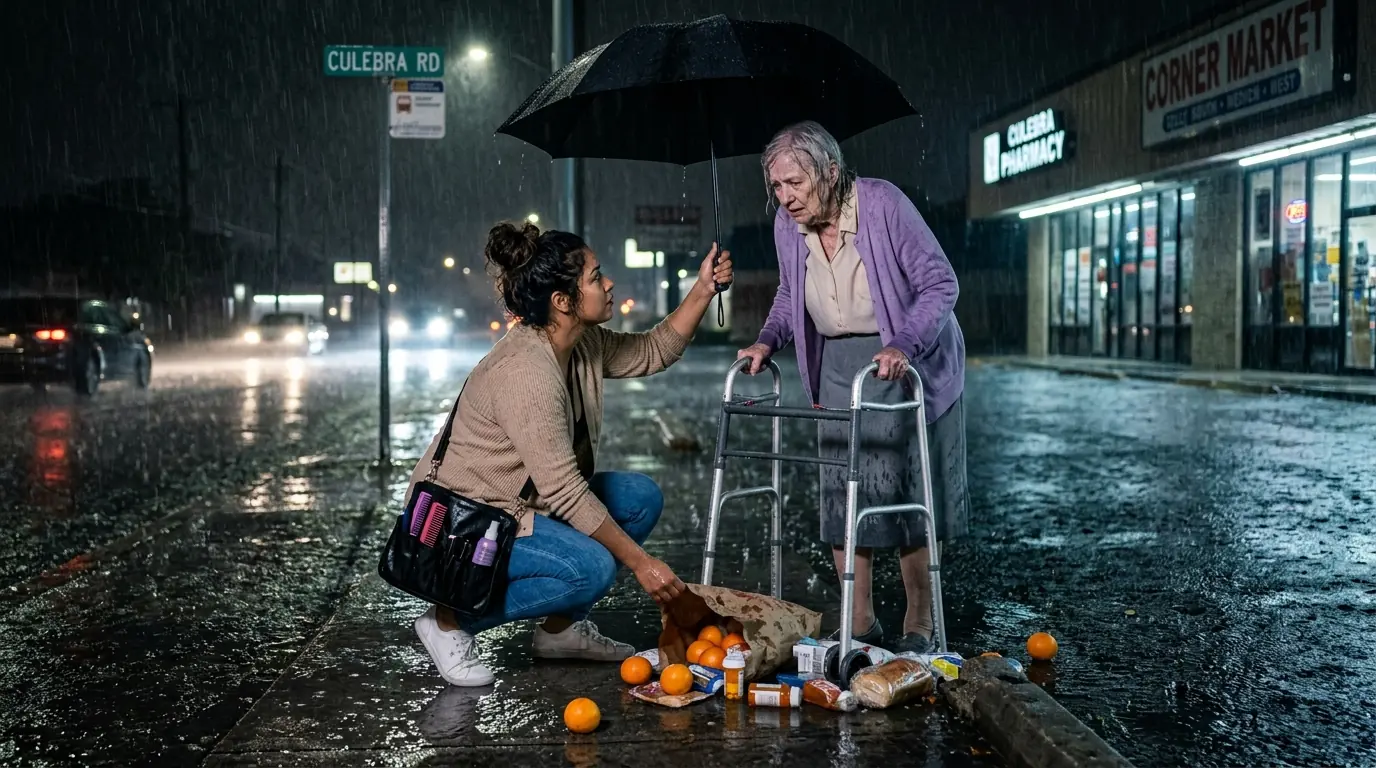
She was passing a small strip of shops near a bus stop on Culebra Road when she saw the elderly woman.
The woman stood on the sidewalk beneath a narrow awning that barely protected her from the rain. She was small and fragile-looking, wearing a soaked lavender cardigan over a pale blouse, a long gray skirt, and soft shoes that were clearly not made for wet pavement. Her silver hair had fallen loose from its pins and stuck to her cheeks. One hand clutched a canvas grocery bag. The other pressed against a walker that had one front wheel stuck in a crack near the curb.
Rain poured around her.
A paper bag had split open at her feet. Oranges rolled into the gutter. A carton of milk lay on its side. A loaf of bread was getting soaked in the rushing water.
People hurried past with umbrellas.
No one stopped.
The woman tried to bend for the groceries, but the walker shifted. She grabbed the handle and froze, frightened.
Marisol pulled over immediately.
She turned on her hazard lights, grabbed the large umbrella from her back seat, and ran into the rain.
“Ma’am!” she called. “Please don’t bend down. I’ll get them.”
The elderly woman looked up, startled.
“Oh, no, dear. I’m fine.”
Marisol glanced at the stuck walker, the ruined groceries, the rain dripping from the woman’s chin.
“No, ma’am,” she said gently. “You’re not.”
The woman’s face tightened with embarrassment.
“I just need to get the wheel loose.”
“I’ll do it.”
Marisol opened the umbrella over the woman first, then crouched near the walker. The front wheel had jammed between broken pavement and a raised strip of concrete. Marisol tugged once, but it would not move. She shifted the walker slightly, lifted the front carefully, and freed the wheel.
“There,” she said. “Try not to move yet. The ground is slippery.”
Then she gathered what groceries she could save.
The oranges were wet but still good. The milk carton was sealed. The bread was ruined. A small package of medicine from the pharmacy had fallen near the curb, its paper sleeve soaked but the bottle inside dry. Marisol picked it up quickly and placed it inside her own dry tote bag.
The old woman watched with shining eyes.
“I know.”
“Then why are you?”
Marisol looked up at her through the rain.
“Because you’re standing in a storm.”
The woman’s lips trembled.
“My name is Eleanor Whitaker.”
“I’m Marisol Vega.”
“That’s a beautiful name.”
“My grandmother thought so.”
“She must have been right.”
Marisol smiled, then looked at the street. The rain was getting heavier. Water had begun pooling near the curb. Eleanor’s cardigan was soaked through, and her hands were trembling on the walker.
“Mrs. Whitaker, where are you going?”
“Home.” Eleanor looked down the street. “It’s not far.”
“How far?”
“Four blocks.”
“With the walker?”
“Yes.”
“In this rain?”
“I didn’t know it would get this bad.”
Marisol looked at the sky, then at Eleanor’s wet shoes.
“You can’t walk four blocks like this.”
“I have done harder things.”
“I believe you. But today, let me help.”
Eleanor shook her head immediately.
“Oh, no. I don’t get into cars with strangers.”
“That’s smart,” Marisol said. “So we’ll do this safely. You can call someone and tell them my name, my license plate, and where I’m taking you. Or I can call them for you.”
Eleanor looked away.
“I don’t want to worry anyone.”
“Who would worry?”
“My daughter, Angela. She works at the hospital. She already has enough on her mind.”
“That sounds like someone who would want to know you’re safe.”
Eleanor’s eyes filled, but she still hesitated.
“I don’t want to be trouble.”
Marisol softened her voice.
“My abuela used to say people are not trouble just because they need help in the rain.”
Eleanor looked at her then, really looked.
The rain hammered on the umbrella above them.
Finally, the old woman whispered, “I don’t think I can walk home.”
Marisol nodded as if Eleanor had simply told her the weather.
“Then I’ll drive you.”
She brought her car closer to the curb, opened the passenger door, and helped Eleanor move slowly from the walker to the seat. She folded the walker carefully and placed it in the back. Then she put the salvaged groceries in the trunk with her hair kit, wrapped the medicine bottle in a clean towel, and got into the driver’s seat.
Inside the car, Eleanor shivered.
Marisol turned the heater on high and pulled a clean salon towel from her kit.
“Here. Put this around your shoulders.”
“I’ll get it wet.”
“It’s a towel. That’s its job.”
Eleanor gave a soft, surprised laugh.
Marisol handed her phone over.
“Call your daughter.”
Eleanor sighed.
“She’ll scold me.”
“Probably because she loves you.”
“That’s what I used to tell her when she was little and hated rules.”
“See? Now she gets to return the favor.”
Eleanor smiled reluctantly and dialed.
A woman answered almost immediately.
“Mom?”
“Angela, don’t panic.”
That sentence, of course, made Angela panic.
“What happened?”
“I got caught in the rain. I’m all right.”
Marisol kept her eyes on the road but listened enough to make sure Eleanor did not minimize too much.
Angela’s voice rose through the phone. “Where are you? Are you still at the store?”
“A young woman is driving me home.”
“A what?”
Eleanor glanced at Marisol. “A very bossy angel with an umbrella.”
Marisol laughed under her breath.
Angela demanded details. Marisol spoke with her calmly, gave her full name, read her license plate number, and explained exactly what had happened: Eleanor’s walker got stuck, groceries fell, the rain was too heavy, and she was driving her home.
Angela’s voice softened with gratitude and fear.
“Please take her home. I’m leaving work as soon as I can.”
“I’ll stay with her until you arrive,” Marisol said.
“No, you don’t have to do that.”
“I know. But I will.”
Eleanor looked at Marisol with surprise.
When the call ended, the car was quiet except for the heater and the rain.
“You really don’t have to stay,” Eleanor said.
“You’re soaked. Your groceries are wet. Your daughter is worried. I’m not dropping you at the door and driving away.”
Eleanor’s eyes lowered.
“I used to be the one who helped everyone else.”
Marisol kept her voice gentle.
“I believe that.”
“I don’t like being the one people have to stop for.”
Marisol glanced at her.
“Maybe people aren’t stopping because they have to. Maybe they stop because you matter.”
Eleanor turned toward the window, blinking fast.
Her house was a small cream-colored bungalow on a quiet street lined with old mesquite trees. Rain ran down the driveway. A porch light glowed above the front door. Potted plants sat along the steps, some knocked sideways by the wind.
Marisol parked as close as she could.
“Stay here. I’ll get the walker.”
She opened the umbrella, unfolded the walker, checked that the wheel moved properly, and helped Eleanor out slowly. Instead of rushing, she matched Eleanor’s pace step by step.
The walkway was slick.
The porch step was low but wet.
Marisol stood beside Eleanor and kept one hand near her elbow without gripping too tightly.
“You’re doing fine.”
“I know how to walk.”
“I know. I’m just narrating supportively.”
Eleanor laughed, and that laugh seemed to loosen some of the fear.
Inside, the house was warm but dim, filled with photographs, books, crocheted blankets, and the faint smell of lavender soap. A framed picture near the hallway showed Eleanor as a younger woman standing beside a man in a white shirt and tie. He had one hand on her shoulder and the expression of someone trying not to laugh.
“That’s my husband, Thomas,” Eleanor said, noticing Marisol looking.
“He looks kind.”
“He was.” Her voice softened. “He died six years ago.”
“I’m sorry.”
“So am I.”
Marisol brought the walker inside and placed it near the kitchen table. Then she carried in the groceries, threw away the ruined bread, dried the oranges, checked the medicine bottle, and placed everything where Eleanor could reach without bending.
Eleanor stood helplessly in the kitchen doorway.
“You really don’t need to do all this.”
“You said that already.”
“I mean it every time.”
“I know.”
Marisol found a clean dish towel and wiped rainwater from the floor so Eleanor would not slip. Then she noticed Eleanor’s soaked shoes.
“Do you have dry slippers?”
“In the bedroom.”
“Sit down. I’ll get them.”
Eleanor hesitated.
Marisol stopped.
“I’ll only go where you tell me.”
Eleanor gave a small nod.
“First door on the right. Blue slippers by the bed.”
Marisol retrieved them, along with a dry cardigan from the chair. She helped Eleanor change out of the wet one without making a fuss. Then she made tea because Eleanor’s hands were still trembling too much to manage the kettle safely.
The scene was simple, clear, and visual.
A young Latina woman brings an elderly woman out of the rain, dries the floor, saves her medicine, changes her wet cardigan for a dry one, makes tea, and waits until the daughter arrives.
When Angela rushed in twenty minutes later, her hospital badge still clipped to her jacket, she stopped in the kitchen doorway and covered her mouth.
“Mom.”
Eleanor sat at the table wrapped in a dry cardigan, both hands around a mug of tea. Marisol stood near the counter folding the wet towel.
Angela hurried to her mother and knelt beside her.
“You scared me.”
“I scared myself,” Eleanor admitted.
Angela looked up at Marisol.
“Thank you. I don’t even know what to say.”
“You don’t have to say anything.”
“She would have tried to walk home,” Angela said.
“I know,” Marisol said.
Eleanor frowned. “I am sitting right here.”
“Yes,” Angela said, tears in her voice. “And I’m grateful.”
After Angela checked her mother over and called a nurse friend for advice, Marisol prepared to leave.
Eleanor looked almost panicked.
“You’re going?”
“You’re safe now.”
“Yes, but…” Eleanor looked embarrassed. “You never told me what you do.”
“I’m a mobile hairdresser.”
Eleanor touched her damp silver hair self-consciously.
“Oh dear. Then you must think I look like a drowned pigeon.”
Marisol smiled. “A dignified pigeon.”
Angela laughed.
Eleanor did not.
She looked toward the hallway mirror, then away.
“Thomas used to help me pin my hair when my hands got stiff,” she said quietly. “After he died, I stopped bothering much.”
Marisol’s heart softened.
“I do house calls,” she said. “If you ever want help with your hair, I can come here.”
Eleanor shook her head. “I don’t go anywhere special.”
“That’s not the only reason to feel good.”
Angela looked at her mother. “Mom, you used to love having your hair done.”
“That was a long time ago.”
“Then maybe it’s time.”
Eleanor looked at Marisol, uncertain.
“How much?”
Marisol named a low price.
Angela immediately said, “I’ll pay.”
Eleanor gave her daughter a sharp look.
“I can pay for my own hair.”
Marisol smiled.
“I’ll leave my card. No pressure.”
But Eleanor called three days later.
Her voice was softer on the phone.
“Miss Vega?”
“Marisol is fine.”
“This is Eleanor Whitaker. The wet pigeon.”
Marisol laughed. “I remember.”
“I wondered if you might come by Saturday. For my hair.”
“I’d be happy to.”
“It has been a while.”
“That’s okay.”
“And I may be difficult.”
“I work with curls, toddlers, and retired schoolteachers. I’m prepared.”
Eleanor laughed.
That Saturday, Marisol returned to the cream-colored bungalow with her hair kit.
The rain was gone. Sunlight touched the wet leaves outside. Eleanor sat in the kitchen wearing a pale blue blouse, clearly nervous. Angela had made coffee and set out cookies as if preparing for a ceremony.
Marisol set up carefully.
She placed a cape around Eleanor’s shoulders, arranged her tools on a clean towel, and asked to see an old photograph of how Eleanor liked her hair. Angela found one from a family Christmas years earlier: Eleanor with soft silver waves pinned back neatly, smiling beside Thomas.
Marisol studied it.
“I can do something like this.”
Eleanor’s eyes flickered with hope and fear.
“Not too fancy.”
“Not too fancy.”
“And not too short.”
“Not too short.”
“And don’t make me look like I’m trying to be twenty.”
Marisol smiled. “I promise.”
As she worked, Eleanor relaxed.
The sound of scissors filled the kitchen. Marisol trimmed the uneven ends, shaped the soft waves, dried the hair gently, and pinned it back in a way that looked elegant but natural. Angela stood in the doorway silently crying.
When Marisol finished, she held up the mirror.
Eleanor stared.
For a long moment, she said nothing.
Then she whispered, “Oh.”
Angela stepped closer. “Mom?”
Eleanor touched her hair with trembling fingers.
“Thomas used to say I looked like this when I was about to win an argument.”
Angela laughed through tears.
“You did. A lot.”
Eleanor looked at Marisol in the mirror.
“I look like myself again.”
Marisol swallowed hard.
“That’s the goal.”
After that, Eleanor became one of Marisol’s regular clients.
Every four weeks, Marisol came to the bungalow. Sometimes she only trimmed Eleanor’s hair. Sometimes she helped wash and style it when Eleanor’s hands hurt. Sometimes Angela joined them. Sometimes Marisol and Eleanor sat at the kitchen table afterward drinking tea and talking long after the appointment was over.
Eleanor had once owned a small dress shop downtown with her husband. Whitaker Dresses & Alterations. She designed simple dresses, altered wedding gowns, repaired hems, and helped women choose clothes for important days.
“Thomas handled the register,” Eleanor said. “Badly. He gave discounts to anyone who looked sad.”
“Sounds like my kind of man.”
“He was impossible.”
“You loved him.”
“Terribly.”
The dress shop had closed after Thomas became ill. The building still stood downtown, empty and unused. Eleanor said it was too full of memories to sell and too painful to enter.
Marisol understood that kind of place.
Her grandmother’s old back-room salon had been rented to someone else after Rosa died. The chair was gone. The mirror was gone. Sometimes Marisol drove past the house and felt like part of her own future had been painted over.
Months passed.
Marisol’s business slowly grew through Eleanor and Angela’s referrals. Elderly clients loved that she came to them. Daughters trusted her. Sons appreciated that she treated their mothers with patience. She began cutting hair for several residents in Eleanor’s church group, then at a senior center once a week.
But the dream of Rosa’s Chair still felt far away.
Her car needed repairs constantly. Gas cost too much. Her equipment wore down. She had no salon space, no deposit money, and no investor. Some nights she sat in her car after appointments and cried from exhaustion before driving to the next client.
One afternoon, Eleanor noticed.
Marisol had just finished styling her hair when Eleanor looked at her through the mirror.
“You look tired in a way sleep won’t fix.”
Marisol forced a smile.
“I’m fine.”
“I am old, not foolish.”
Marisol sat down at the kitchen table.
“I found a salon chair for sale. A good one. Used, but beautiful. I wanted to buy it for the salon I don’t have yet. Isn’t that ridiculous?”
“No.”
“It is. I don’t even have walls for it.”
“You have the room in your mind.”
“That doesn’t count.”
Eleanor looked at her gently.
“It counts more than you think.”
Marisol told her everything then. About Rosa’s Chair. About her grandmother. About wanting a salon where older women could feel cared for, not rushed. A place with wide aisles for walkers, soft chairs, coffee, Spanish and English conversation, patient appointments, and home-visit days for people who could not leave their houses.
Eleanor listened without interrupting.
When Marisol finished, Eleanor said, “You already know exactly what it should be.”
“That’s the problem. I can see it, but I can’t reach it.”
“Maybe you are closer than you think.”
“I’m not.”
Eleanor smiled faintly.
“You sound very certain for someone who was wrong about the rain.”
Marisol laughed despite herself.
The following spring, Eleanor’s health declined.
She had good days and hard days. Her hands stiffened more. Walking became slower. Marisol kept coming, not only for hair appointments but sometimes to help Angela when Eleanor needed washing and styling before doctor visits or family gatherings.
One day, Eleanor asked Marisol to drive downtown with her and Angela.
“Where are we going?” Marisol asked.
“You’ll see.”
Angela looked emotional but said nothing.
They stopped in front of an old brick storefront with tall front windows and a faded sign above the door.
Whitaker Dresses & Alterations
Marisol stared.
The glass was dusty. The door paint had chipped. But the inside, visible through the window, was larger than she expected. A front room full of light. A side area where fitting rooms had once been. A counter near the back. Old mirrors still mounted on the walls.
Eleanor held out a key.
“Open it.”
Marisol turned to her.
“Eleanor.”
“Open it, dear.”
Inside, the shop smelled of dust, fabric, and old wood. Sunlight fell across the floor in pale rectangles. A few dress racks remained. The fitting room curtains were faded but still hanging. In the back, a sewing table sat beneath a covered window.
Eleanor stood in the middle of the room, holding Angela’s arm.
“This was my dream once,” she said.
Marisol could barely breathe.
“It’s beautiful.”
“It was.” Eleanor looked around. “Then it became storage for grief.”
Angela touched her mother’s shoulder.
Eleanor turned to Marisol.
“I do not want it to stay closed.”
Marisol’s heart began pounding.
“No.”
“You don’t even know what I’m going to say.”
“I think I do.”
“Then listen anyway.”
Eleanor reached into her purse and pulled out an envelope.
“Angela and I spoke with an attorney. I am not giving you the building outright today. That would make you panic and argue for six hours.”
Marisol gave a tearful laugh.
“But I am offering you a long-term lease for one dollar a month for the first three years. After that, a fair rent based on what Rosa’s Chair can truly afford. If the business survives and you still want the space, the building will eventually transfer into a trust connected to your salon’s community work.”
Marisol stared at her.
“I can’t accept that.”
“You can.”
“It’s too much.”
“No,” Eleanor said, voice trembling but firm. “Too much was standing in the rain with my walker stuck while strangers walked around me. Too much was feeling useless because I could not get groceries home. Too much was looking in the mirror and seeing only age and loss.”
She stepped closer.
“You stopped. You helped me without making me feel small. You brought me home. You dried my floor, saved my medicine, made tea, and waited for my daughter. Then you gave me back the face Thomas used to love.”
Marisol covered her mouth.
Eleanor placed the key in her hand.
“Let this old dress shop become the chair your grandmother dreamed through you.”
Marisol cried then.
Not politely.
Not softly.
She cried in the empty shop while Eleanor held her hand and Angela cried beside them.
The renovation took five months.
Marisol’s family helped. Angela helped. Eleanor’s church friends helped. Former clients donated furniture, mirrors, towels, plants, and coffee mugs. A retired plumber inspected the pipes. A young painter offered a discount after hearing Eleanor’s story. Marisol bought the used salon chair she had wanted and placed it near the front window.
She kept one of the old dress shop mirrors.
She also kept the original sign, but moved it inside and hung it on the back wall as a memory.
The new sign outside read:
Rosa’s Chair
Neighborhood Hair Studio
Underneath, in smaller letters:
For Everyone Who Wants To Feel Like Themselves Again
Opening day arrived on a bright Saturday morning.
Eleanor was the first client.
She wore a lavender blouse and pearl earrings. Her walker stood nearby. Angela helped her into the first chair, the used chair Marisol had once thought she would never own. Marisol placed the cape around Eleanor’s shoulders and began styling her silver hair with careful hands.
The salon was full of people watching quietly.
Marisol’s mother stood near the reception desk, crying. Her younger brothers pretended they were not emotional. Angela held her phone up, recording. Elderly clients sat in the waiting area with coffee. Children peered through the front window.
When Marisol finished, she turned the chair gently toward the mirror.
Eleanor looked at herself.
Then she smiled.
“Thomas would say I look ready to win an argument.”
Everyone laughed through tears.
Marisol leaned down and whispered, “Then go win one.”
Eleanor squeezed her hand.
“You already did.”
Rosa’s Chair grew slowly, then steadily.
It was never fancy. It was better than fancy.
It was warm, patient, and alive.
The aisles were wide enough for walkers. The chairs were sturdy. Appointments were not rushed. There was coffee, tea, pan dulce from Marisol’s aunt’s bakery, and a small corner where grandchildren could color while waiting. Marisol offered one day a week for home visits, because she never forgot the people who could not come to her.
Older women came in nervous and left smiling.
Widowers came in after years of cutting their own hair badly.
Working mothers came with tired shoulders and left feeling seen.
Teenagers came for haircuts and stayed for advice from the grandmothers in the waiting area.
Eleanor came every month as long as she could.
She sat in the first chair, always.
Even when she became weaker, Marisol adjusted the cape gently, styled her hair with care, and held the mirror at just the right angle.
One rainy afternoon, nearly three years after they met, Eleanor asked Marisol to stay after closing.
The salon was quiet. Rain tapped against the front windows, softer than the storm from their first day but familiar enough to make both women notice.
Eleanor sat in the first chair, a blanket over her knees.
“I need to give you something,” she said.
“You already gave me this place.”
“No. I opened a door. You built the room.”
Marisol sat beside her.
Eleanor handed her a small velvet pouch.
Inside was a pair of silver hairpins shaped like leaves.
“They were mine,” Eleanor said. “Thomas bought them for me the first year we opened the dress shop. I wore them whenever I needed courage.”
Marisol held them carefully.
“I can’t take these.”
“You can. I have less hair now and more courage than I need.”
Marisol laughed through sudden tears.
Eleanor smiled.
“When I got caught in the rain, I thought I was only losing groceries and dignity. But that day brought you into my life. You helped me home, yes. But more than that, you helped me return to myself.”
Marisol’s eyes filled.
“You did the same for me.”
Eleanor nodded toward the salon.
“Then promise me something.”
“Anything.”
“Keep a chair for women who think they no longer matter.”
Marisol closed her hand around the hairpins.
“I promise.”
Eleanor passed away the following winter.
Her memorial was held in the old dress shop turned salon because Angela said that was where Eleanor felt most alive in her final years. The first chair was left empty, with a lavender scarf draped across it and the silver hairpins placed on the seat.
People told stories.
Angela spoke of a mother who had lost much but found joy again.
Marisol spoke last.
She told the story of the rain exactly as it happened.
The stuck walker.
The split grocery bag.
The oranges rolling toward the gutter.
The soaked cardigan.
The medicine bottle nearly lost.
The old woman too proud to ask for help.
The young hairdresser who stopped because someone had to.
Then she looked around the room and said, “I thought I was helping Mrs. Whitaker get out of the rain. I did not know she was leading me to the place my dream would finally have walls.”
Years later, Rosa’s Chair became one of the most loved neighborhood salons in San Antonio.
People knew the story.
They knew it began on a rainy sidewalk, with a young Latina woman holding an umbrella over an elderly woman who had almost been ignored.
They knew kindness had become a haircut.
A haircut had become trust.
Trust had become a key.
And a key had become a room where people came to feel like themselves again.
Every September, when the heavy rains returned, Marisol placed Eleanor’s silver hairpins beside Abuela Rosa’s photograph near the first chair.
Then she opened the salon door, turned on the lights, and prepared the chair.
Because someone always came in carrying more than wet hair.
And Marisol was ready to see them.