A wealthy woman ridiculed a man she thought was staff, loud enough for the whole table to hear.
Moments later, her world turned upside down when the guest of honor revealed the man she mocked was the reason he ever had a future.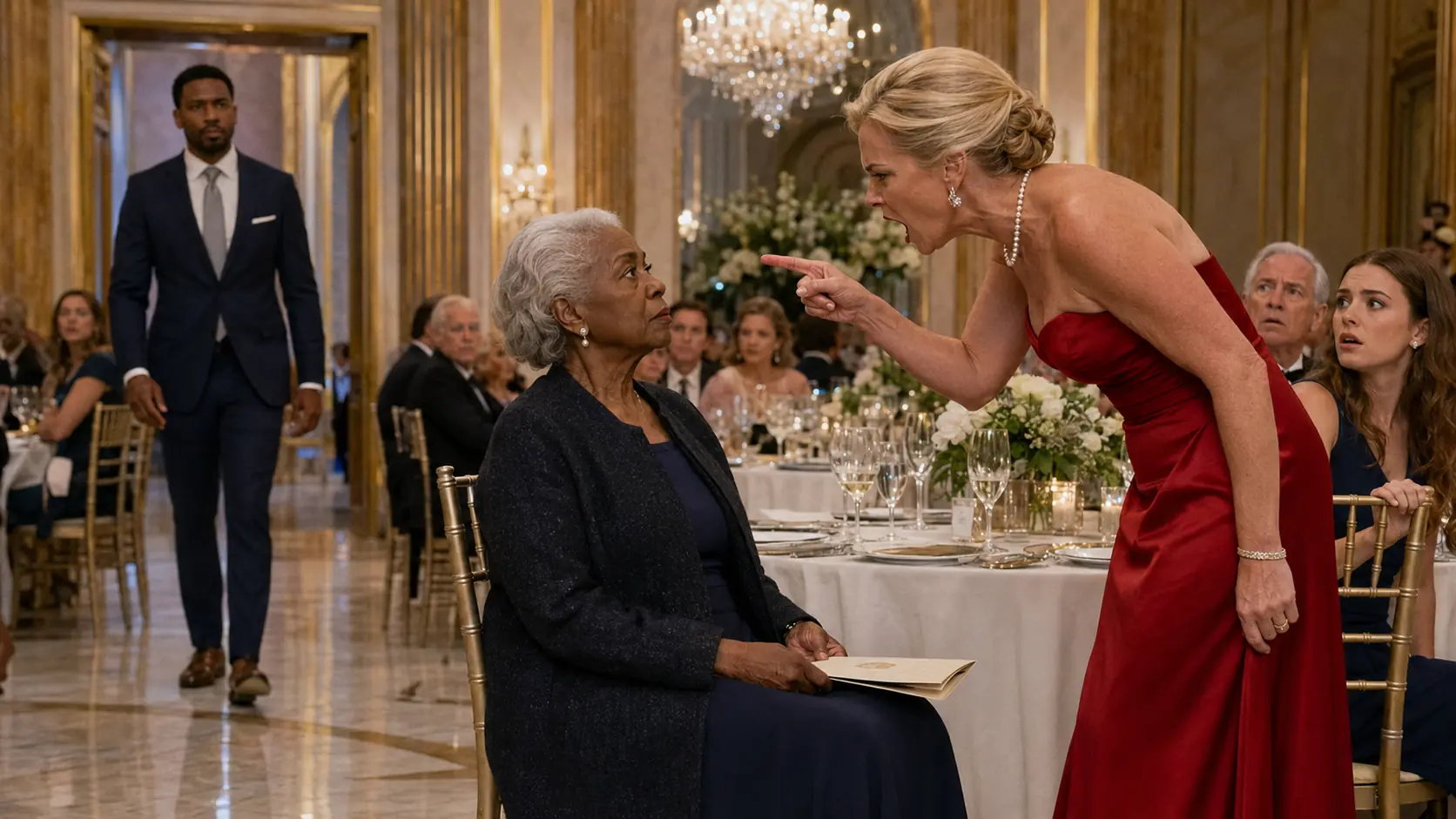
The ballroom at the Plaza Astoria Hotel in Manhattan was dressed to impress. Gilded columns, marble floors, chandeliers dripping in crystal. But no amount of sparkle could cover up what was about to happen.
People were clinking glasses, shaking hands, pretending to laugh harder than they meant to. It was one of those nights where every smile looked like a business card.
Waiters weaved between the guests with trays of champagne flutes and lobster puffs, careful not to brush the arms of gowns that cost more than their yearly salary.
Near the center of the room stood Celeste Whitfield, platinum blonde, tailored in scarlet silk and wearing pearls like they were her birthright. Most people recognized her from real estate billboards across Long Island.
She was the kind of woman who whispered loudly when she wanted attention.
That was when her gaze landed on Walter Jennings.
He was seated near the back, close to the large floral centerpiece no one really paid attention to. Mid-seventies, maybe. Brown skin, dignified posture, hair a soft mix of silver and white.
He wore a dark suit, clean and well-fitted, but clearly not couture.
He looked calm.
Almost too calm for the space he was in.
Celeste raised an eyebrow, tilted her head, then nudged the woman beside her.
“Who let the waitstaff sit in the guest section?” she said, her voice high and crisp enough to cut glass.
A few nearby guests froze.
One man glanced over at Walter, then quickly turned back toward the bar. Someone let out an awkward laugh, half-hearted and full of discomfort.
Walter did not react.
He heard her, no doubt, but he stayed seated, hands folded neatly on his lap, eyes fixed ahead.
Not on her.
Not on anyone.
Just forward.
Celeste was not done.
“I mean, it’s a gala. Isn’t there a uniform policy? Because he missed the memo,” she added, smirking, swirling the champagne in her glass like it made her important.
A young woman nearby, Norah Hastings, looked up from her table. She had heard the comment. Her lips pressed together.
Her husband leaned in and whispered, “Just let it go, Norah.”
But Norah did not want to let it go.
She stared at Walter, then back at Celeste.
There was something about how he held himself.
Something unshakable.
Norah turned in her seat slightly, facing him more directly, like she knew he deserved that much at least.
Meanwhile, Celeste kept talking.
“This is why you need curated invites. Standards have slipped since Lillian stepped down from organizing,” she scoffed, sipping again. “Next thing you know, they’ll be letting in people off the street.”
Walter finally moved.
Slowly, he reached into his inner jacket pocket, pulled out a folded program for the evening, and adjusted it with steady hands.
No words.
No reaction.
Just calm, measured, like a man who had weathered far worse than an arrogant woman in high heels.
A few seats down, an older gentleman in a tux turned toward Celeste.
“Maybe you should sit down and worry about your own shoes,” he muttered, low enough to stay polite, loud enough for her to hear.
Celeste blinked, taken off guard, but quickly plastered on another fake smile and glanced around to see who had noticed.
Murmurs had started.
Walter remained still.
Someone on the mic called for everyone’s attention.
The MC, a short man with a velvet voice, thanked everyone for attending the charity gala for the St. Elias Foundation. Applause echoed through the room. Glasses clinked.
But that moment, the comment, the silence that followed it, the way people glanced sideways at each other, sat heavy in the air.
No one was talking about it.
But everyone felt it.
Walter did not need to speak.
His silence had already said more than Celeste’s words ever could.
But the night was not done showing people who Walter Jennings really was.
Walter Jennings had not always been the quiet man in the back of the room.
Once upon a time, he filled rooms with his laughter, and before that, with his music.
Back in the late sixties, he was known as Walt the Keys in a small jazz bar in Baton Rouge, long before the city got swallowed by chain hotels and parking decks.
He played piano like it was part of his soul.
People would say his left hand told stories and his right hand answered back.
But life took a turn, as it often does.
He moved to Newark in 1973 with his young wife, Lillian, after their apartment in Louisiana was flooded beyond repair. No insurance, no family to lean on, just a suitcase each and a baby on the way.
The music had to stop.
Bills did not accept melodies.
He found work cleaning offices at night, then sweeping floors at the community college, and finally he landed a job as a janitor at the children’s hospital downtown, St. Elias Medical Center.
That was where he stayed.
For thirty-one years, most people never asked his name.
Some nodded.
A few doctors made a point to say thank you.
But mostly, Walter became part of the background, mopping up messes, fixing flickering lights, quietly offering tissues to weeping parents who had run out of tears.
He was never late.
Not once.
And he never missed a day, except the morning Lillian passed.
Even then, he called in to apologize.
Back at the gala, Celeste still had not connected any of this.
To her, Walter was just someone who did not belong.
But near the catering table, an older nurse named Patrice Duval had recognized him the moment she walked in.
She had not seen him in over a decade, but his face was burned into her memory.
The nights she had stayed late with kids too sick to sleep, Walter would hum soft jazz under his breath while sweeping the floor.
Same tune every time.
It calmed the whole wing.
He used to bring coloring books out of his own pocket and hand them to the siblings who sat in waiting rooms for hours, sometimes days.
Patrice made her way across the room, slowly pushing past conversation circles and martini glasses.
“Mr. Jennings,” she said, tapping his shoulder.
He turned, gentle surprise washing over his face.
“Miss Duval,” he said softly, then stood up.
She hugged him without asking.
“You look good,” she said, eyes glistening.
“You still got that badge from ’92?” he asked.
“Still pinned on my bulletin board,” she laughed.
People nearby watched.
Whispers floated.
Some began piecing it together.
But Celeste had not noticed a thing.
She was too busy scanning the room for anyone higher on the food chain.
She did not even see the way Walter’s hands trembled slightly when he sat back down.
Not out of weakness.
Out of memory.
It had been years since anyone in a room like this had greeted him like an equal.
Meanwhile, Patrice moved to her table, leaned over, and started whispering to a couple of younger guests.
“That man,” she said, pointing to Walter, “used to keep extra granola bars in his cart for kids who came in hungry. He used to bring warm socks from home when we ran out.”
“No way,” one of them muttered, glancing over.
“Yes, way,” Patrice replied. “That man kept that hospital going in ways no one saw.”
There is something about truth.
It does not need a microphone.
It spreads in glances, inside conversations, in shifting postures.
People who had ignored Walter earlier were now watching him with new eyes.
Not pity.
Not guilt.
Just something different.
Respect.
He had not asked for attention.
He never had.
But the spotlight was already moving his way, and someone important was about to step into it.
By the time dessert plates were cleared and the string quartet switched to a softer medley, the atmosphere in the room had shifted.
It was not loud, not outwardly, but conversations had changed direction. People at table nine kept glancing toward the back, toward Walter.
Others leaned in, whispering things like, “Did you hear who he is?” and “I think he used to work at St. Elias.”
No one was raising their voice anymore.
Not even Celeste.
But she noticed the change.
She had spent decades mastering the art of reading a room, and right now, the room was not orbiting around her. It was tilting toward a man in a plain black suit who had not said a single word all night.
She could not understand it.
And it bothered her.
Across the room, Patrice was still talking, this time to a young finance guy named Theo Marman, who had donated six figures earlier that evening and was now sipping ginger ale like it was whiskey.
“He once sat in the hallway with a kid who was too scared to go into surgery,” she told him. “Held his hand for two hours straight. No one asked him to.”
Theo raised his eyebrows.
“And this is the same guy she mocked earlier?”
“The same one.”
Theo looked down at his name tag, then glanced toward Walter.
“Funny how the people who do the most are the ones who never ask for credit.”
At the center table, Celeste crossed her legs and leaned toward a couple she had been trying to impress all evening.
Barrett and Angela Crowley, legacy donors with a reputation for speaking up when something did not sit right.
“I think people are being dramatic,” Celeste said, tone clipped. “It’s just standards. These events used to be elegant. Now you have people who clearly don’t fit the dress code.”
Angela did not reply.
Barrett reached for a breadstick without looking at her.
Celeste doubled down.
“Don’t tell me you’re buying into the whole mystery guest with a golden heart bit. This isn’t a movie.”
Angela finally turned to her.
“No,” she said. “But it is real life. And in real life, sometimes people are good and decent without needing an audience.”
That shut Celeste up for a moment.
She blinked, turned her attention to her phone, and began scrolling like she was bored, but her knuckles were tight around the stem of her wine glass.
In the far corner of the room, Walter was still sitting quietly.
He had been watching the evening play out without saying a word, like a man used to being looked past, looked over.
But his eyes, deep and alert, missed nothing.
He glanced at Patrice and gave her a nod of thanks.
Then he looked toward a man walking briskly through the doors near the main stage.
Younger.
Tall.
Suit perfectly tailored.
Not flashy, just sharp.
He carried a quiet confidence like he belonged in the room, but did not need it to define him.
Walter smiled.
Just a little.
Because that was his son.
Dr. Ellis Jennings.
Board-certified cardiothoracic surgeon.
Harvard graduate.
Keynote speaker for the evening.
Recipient of the humanitarian medical achievement award.
He was not a stranger to events like this. He had stood behind podiums from Los Angeles to Boston.
But this night was different.
This night, he was not here just as a doctor.
He was here as a son.
People began to stir.
Some noticed him entering.
The MC adjusted his mic and announced, “And now it is my honor to welcome our keynote speaker, a man whose impact reaches far beyond the operating room.”
The room straightened.
Chairs scooted forward.
Phones were tucked away.
Walter looked up again, still calm.
But if you looked closely, you would notice the tiniest flicker of pride behind his eyes.
Celeste leaned forward, suddenly interested.
“Finally,” she whispered to herself, “someone who matters.”
But the next words from the stage were going to crack her world open.
The lights dimmed slightly as the MC’s voice filled the room.
“Please welcome Dr. Ellis Jennings.”
Polite applause followed. A few people clapped harder than others, eager to show they knew who he was. Some stood, not for him, but for the idea of him.
Harvard-trained.
Nationally awarded.
A man who saved lives for a living.
Ellis walked in with calm precision.
No swagger.
No dramatic pauses.
Just a quiet, direct presence.
He stepped onto the stage in a crisp navy suit, adjusted the mic, and took a long moment before speaking.
Celeste watched from her seat, eyes locked on him. She straightened her posture, fluffed her hair, already crafting a compliment in her mind to toss his way if she bumped into him after the speech.
“Good evening,” Ellis said.
His voice was steady, but carried weight, like it was not used to being interrupted.
“I want to start tonight by thanking the St. Elias Foundation for this honor. I’ve received awards before, but this one, this one’s personal.”
The room settled.
The clinking of glasses stopped.
Even the servers paused at the perimeter.
Ellis looked out across the tables, then fixed his eyes on one person.
Walter.
“Before we talk about modern medicine, I want to talk about history. My history.”
He stepped away from the podium, letting the mic catch his natural tone.
“I was born in Newark. My mother passed when I was eight. My father worked nights at the children’s hospital. Some of you may have met him tonight. He’s seated near the back.”
Heads turned.
Celeste looked over, confused.
“My father,” Ellis continued, “used to come home with his hands cracked from chemicals and his shoes soaked through from mopping floors. And yet every morning, he woke up before the sun to quiz me on spelling words. Every weekend, he borrowed books from the library and read them aloud while I sat at the kitchen table, eating cereal and pretending not to listen.”
He smiled at the memory.
“There’s a myth we like to tell ourselves in rooms like this, that success is built by talent, discipline, and drive. But that’s only part of the truth. The rest of it, the foundation, that was built by someone else.”
He paused again.
“Someone who scrubbed floors while his kid studied organic chemistry. Someone who took night shifts so I could attend early morning pre-med lectures. Someone who gave everything and asked for nothing in return.”
Walter did not move.
He just looked back at his son, eyes soft, shoulders still.
Ellis stepped aside and gestured toward him.
“Ladies and gentlemen, meet Walter Jennings, the reason I’m standing here, the man who saved my life before I ever saved anyone else’s.”
No one clapped at first.
Not out of disrespect.
Out of something deeper.
Reverence, maybe.
Realization.
Ellis stood in silence for a second longer, letting it sink in.
Celeste blinked.
Her jaw did not drop, but her eyes told the story.
Recognition and regret mingling behind mascara and pride.
She sat back in her chair slowly, realizing her earlier words now hung in the air like smoke that would not clear.
Near her, Barrett Crowley folded his hands and leaned toward his wife.
“That’s his father,” he whispered.
Angela nodded once.
“And she mocked him.”
All around the room, people were re-evaluating what they thought they knew.
The gala was not just another night of catered praise.
It had turned into something else.
Something real.
And Walter, who had been invisible just an hour ago, was now the centerpiece of the entire event.
But the night still had one more voice that needed to be heard.
Ellis remained at the side of the stage for a moment, giving space to the silence.
It was not awkward.
It was heavy with meaning.
Then he returned to the podium, adjusted the mic, and continued.
“I’ve been asked to talk about innovation tonight, but I think we confuse innovation with convenience. What’s more powerful is sacrifice, the kind that doesn’t make headlines.”
He glanced toward Walter again.
“When I got my acceptance letter from Harvard, my dad didn’t say much. He just nodded once, then went back to ironing his uniform for his shift. I didn’t realize until years later that he had sold his car to help cover my books and travel.”
There were stirrings across the room.
One woman at table three dabbed her eyes with a cloth napkin. Another man cleared his throat, suddenly remembering a time he had judged someone for not wearing designer shoes.
Ellis continued, his voice even.
“We talk a lot about mentorship in the medical field, how doctors pass down knowledge. But sometimes, the greatest teacher doesn’t wear a white coat. Sometimes he wears work boots and carries keys.”
That got a few gentle smiles.
The kind people give when they recognize truth they had overlooked.
Celeste sat like stone.
Not defensive.
Not angry.
Just still.
Her hands were folded neatly in her lap now. Her eyes flicked between Walter and Ellis, as if trying to rewrite the memory of her comment, trying to wish it had not happened.
But it had.
And now it lived in everyone’s memory of the evening.
Ellis shifted gears.
“Every life I’ve helped save was because someone else gave up everything so I could be in that operating room. That’s the real story behind tonight’s award.”
He paused, then took a deep breath.
“I wanted my father to be here because he’s never asked for recognition, but I think it’s time he got it.”
With that, Ellis stepped away from the podium again and walked off the stage.
Not toward the VIP table.
Not toward the press booth.
Straight to Walter.
He bent down, whispered something into his father’s ear, and helped him to his feet.
There was a quiet strength in Walter’s movement.
No dramatics.
Just presence.
The room erupted in applause.
Not the polite kind.
The real kind.
The kind that rises in waves and does not stop.
Walter did not raise his arms.
He did not bow.
He simply placed his hand on his son’s shoulder and offered the crowd a soft smile.
The kind that says thank you, I see you, and this is not about me, all at once.
Ellis gestured for a nearby staff member, whispered something, and in seconds, a second microphone appeared near Walter.
Walter hesitated for a moment.
Then he stepped up.
“I wasn’t planning to speak tonight,” Walter said, his voice deep but steady. “But I’d like to say just one thing.”
Every eye in the room was locked in.
“There’s no such thing as a small job. Only small minds that think value comes from a title.”
Silence.
He continued.
“I cleaned floors so my son could walk across them in confidence. I sacrificed not because I had to, but because I wanted to. And I never once saw that as weakness.”
He looked around the room.
“But I’ve been in enough rooms like this to know some folks see a man in a uniform and think that’s all he is.”
His eyes found Celeste’s, not with hostility.
Just truth.
“And that’s okay, because a man’s worth isn’t decided by who notices him. It’s shown in what he builds.”
He stepped back.
The applause returned slower this time.
Heavier.
More personal.
But before the night ended, the woman who started it all would have to face something she had not expected.
Celeste stayed seated as the room continued to applaud, but she felt like she was shrinking by the second.
She had always known how to navigate crowds, when to laugh, when to flatter, when to steer a conversation.
But this was not a situation she could charm her way out of.
Walter had not even looked at her directly when he spoke, but the weight of his words landed squarely in her lap.
The faces around her were different now.
More alert.
More thoughtful.
Less willing to excuse the kind of comment she had made without hesitation just an hour ago.
When the applause finally quieted and the MC returned to thank the guests, Celeste stood and quietly excused herself from her table.
She moved through the crowd like someone looking for fresh air.
But instead of heading toward the exits, she made her way toward Walter.
He was still standing near the stage, speaking softly with Ellis. His son had one hand on his back, not as a prop, but as a quiet sign of respect, like a boy reminding the world who the real man was in the room.
Celeste approached slowly.
She hesitated, then stepped forward.
“Mr. Jennings,” she said.
Walter turned.
His expression was neutral.
He did not smile.
He did not frown.
“I owe you an apology,” she continued, her voice quieter than usual. “What I said earlier was ignorant.”
He nodded once, letting the silence do the heavy lifting.
“I made an assumption, and I was wrong. Deeply wrong.”
Walter took a moment before replying.
“I appreciate the apology,” he said simply. “But you didn’t just assume something about me. You showed people who you are.”
Celeste’s breath caught slightly.
“I know,” she said, swallowing hard. “And I have to live with that.”
He studied her, not cruelly.
Just honestly.
“Then maybe do something better with it,” he said.
She nodded, not because she wanted to look good, but because it was the only thing left to do.
She stepped back and let the two men return to their conversation.
Across the room, people were talking differently now.
Not louder.
Just with more intention.
A few guests approached Walter to shake his hand. Others simply watched, clearly moved by what they had witnessed.
Angela Crowley, standing near the dessert table, turned to her husband and said, “You know what I’ll remember most about tonight?”
“What?”
“That a man who spoke fewer than two hundred words managed to teach a hundred of us more than we’ve learned all year.”
Barrett nodded.
“We needed it.”
Back at his table, Walter eventually sat back down, sipping water, not champagne.
His suit still looked modest.
His posture still calm.
But now he was not invisible.
Ellis stood by his side, refusing to bask in the praise.
He knew what tonight was really about.
And so did everyone else.
The gala’s tone had shifted permanently, not because of a scandal or a viral moment, but because truth, once spoken plainly, cannot be ignored.
There were no fireworks.
No dramatic walkouts.
Just quiet change.
And for a room full of people who thought they had it all figured out, that change hit deeper than anything else could.
The valet line outside the Plaza Astoria stretched down the block, a trail of conversations floating into the night.
Inside, the ballroom was clearing out. Tables were half empty, chairs askew, napkins abandoned.
Yet Walter stayed seated, taking his time.
His son stood beside him, one hand in his pocket, the other resting lightly on the back of Walter’s chair.
“You okay, Pop?” Ellis asked.
Walter chuckled softly.
“Tired, but fine.”
He looked around the room one last time, as if collecting memories he had not expected to make.
Not because of the speeches or the applause.
But because of the shift.
The quiet kind.
The kind that does not announce itself, but you feel it in how people look at you, how they hold themselves differently afterward.
They stepped outside together into the cooler night air.
A few attendees still lingered near the exit, talking in hushed voices, coats draped over their arms.
One of them was Norah Hastings, the woman who had held her tongue earlier when Celeste made her comments.
She walked up to Walter.
“I didn’t say anything when I should have,” she said. “And I’ve been thinking about that all night.”
Walter looked at her and offered a kind smile.
“Takes more strength to reflect than to speak in anger. You did fine.”
Norah smiled back, visibly relieved.
“I won’t stay quiet next time,” she said.
Walter nodded.
“That’s what matters.”
As she walked away, Ellis turned to his father.
“You know, I’ve given speeches at national conferences, but that one was different.”
Walter raised an eyebrow.
“Because this time I was in the room?”
“No,” Ellis said. “Because this time they were finally listening.”
They walked slowly toward their car.
No red carpet.
No flashbulbs.
Just two men side by side.
A father who had once mopped the floors of a hospital.
And the son who would one day lead one back inside.
Celeste sat alone at her table, staring at the half-empty wine glass in front of her.
Her driver had been waiting for twenty minutes, but she had not moved.
It was not guilt exactly.
It was something harder to name.
She reached for her phone and opened the gala’s program.
There, under the keynote section, she read Ellis’s bio again, this time with new eyes.
At the bottom, there was a small line.
Special Guest: Walter Jennings.
She closed the booklet and stood up.
She would not forget his name again.
A week later, St. Elias Foundation posted the full video of Ellis’s speech online.
It spread quickly, not because of the title or his accolades, but because of Walter.
His face.
His words.
His quiet strength.
People started sharing their own stories in the comments about janitors who encouraged them, parents who gave everything, and strangers who believed in them when no one else did.
Walter did not see most of it.
He did not even use social media.
But Ellis printed a few of the comments and read them aloud over Sunday breakfast.
Walter listened, then chuckled.
“Funny how people pay attention once the music stops.”
Ellis smiled.
“Yeah. But sometimes that’s when they hear the clearest.”
Some moments do not end with a bang.
They end with a lesson.
That night at the gala did not change the world, but it changed something else.
It reminded a room full of people that worth does not shimmer or shine.
It does not come in the form of a title or a tailored suit.
It can look like a quiet man with a folded program and steady hands.
A man who raised a son with his back bent and his head high.
A man who, without ever asking, reminded everyone that greatness does not always need to speak loudly.
Sometimes it just needs to be seen.