Silas Mercer had chosen the loneliest trading post in Colorado because he believed it was the kind of place where a man could disappear without troubling anyone.
The building leaned against the wind like an old drunk, its porch boards warped by sun and snow, its windows clouded with dust.
Inside, men muttered over tobacco, cards, and cheap whiskey, while outside the prairie stretched wide and pitiless beneath a hard blue sky.
Silas sat with his back against the wall, one hand pressed beneath his coat, waiting for the sun to fall behind the mountains.
His black horse, Gideon, stood tied to the rail nearby, head lowered and reins hanging loose.
The animal had carried him through storms, hunger, and long roads where no one asked a stranger’s name.
Now even Gideon looked tired, as if he knew his rider had come to the end of more than one trail.
Silas closed his eyes and listened to the wind move through the loose boards above him.
Three weeks earlier, near a river crossing, a bullet had torn close enough to leave him weak and fevered.
He had cleaned the wound himself, wrapped it himself, and lied to himself that men like him could heal by will alone.
But the road had a way of punishing pride, and fever had begun to burn through him like a hidden coal.
By the time he reached the trading post, every breath felt borrowed.
Silas had survived battlefields, prison camps, snow passes, and enough lonely nights to harden any man.
He had watched friends fall, buried names in the earth, and carried messages that should have reached homes years before.
Yet now, seated in the dust with his shoulder throbbing and the world tilting at the edges, he felt undone by a wound no wider than two fingers.
It seemed almost funny, but he no longer had the strength to laugh.
“You look like somebody waiting for the night to swallow him.”
The voice was small, clear, and far too close.
Silas opened his eyes slowly and saw a barefoot girl standing at the edge of the boardwalk.
She was maybe nine years old, wearing a patched cream dress that had known hard washing and harder roads.
Her brown hair was tangled from wind, her face dusty, and her green eyes steady as lantern glass.
“I’m fine,” Silas said.
“No, you’re not.”
The girl took one cautious step closer, not afraid exactly, but careful in the way children become when life teaches them too early.
Silas almost smiled at the stubborn tilt of her chin.
“You always argue with strangers?” he asked.
“Only the ones who lie badly,” she answered.
This time, he did smile, though it was faint and brief.
“What’s your name?” she asked.
“Silas Mercer.”
“I’m Elsie Vale,” she said, as if the name itself carried weight enough to steady the world.
Silas felt something inside him tighten, but fever blurred the thought before he could catch it.
Elsie came nearer and looked at the way his fingers clutched his coat.
“My ma fixes things,” she said.
“Horses, dogs, people sometimes.”
“I don’t need fixing.”
“Yes, you do.”
She said it without cruelty, only certainty.
Silas looked away toward the mountains, where the sun was lowering in slow copper light.
“Run along, Elsie.”
Instead, she crouched in front of him as if she had every right to be there.
“My ma says people who say they don’t need help are usually the ones who need it most.”
“Your ma sounds dangerous.”
Elsie nodded proudly. “She is, mostly when men are stupid.”
Silas closed his eyes against another wave of heat.
The child did not move, and he could feel her watching him with a patience that made him uneasy.
For years, Silas had trained himself not to need tenderness, because tenderness was what got buried.
Tenderness wrote letters that never reached home, remembered names nobody else spoke, and made a man weak enough to keep living.
“Why are you helping me?” he asked.
Elsie’s face softened in a way that made her seem both younger and older.
“Because you looked like nobody had.”
The words struck deeper than the wound.
Silas turned his face away, but there was nowhere to hide from a child who had already seen too much.
“How far is your place?” he asked at last.
Elsie stood quickly, triumph brightening her face.
“Two miles west. Ma made stew.”
“For you?”
“For whoever needs it,” Elsie said.
Getting onto Gideon nearly split Silas in two.
He gripped the saddle horn so hard his knuckles whitened, and for a moment he feared he would fall before the horse even moved.
Elsie took the reins with solemn care, leading Gideon as if she were guiding a king instead of a half-conscious stranger.
One step, then another, then another; that was how she carried mercy across the prairie.
The land widened around them, gold grass bending under the wind and mountains standing blue in the distance.
Silas drifted in and out of awareness, sometimes seeing Elsie ahead of him, sometimes seeing another child in another place.
The fever made old memories walk beside him.
He heard Thomas Vale laughing by a campfire, saying his wife could mend a saddle better than most men could mend a fence.
The name came back with force.
Vale.
Silas tried to speak, but his mouth was too dry.
He had carried that name through prison, mud, and burned towns, always meaning to return what had been entrusted to him.
But years had passed, then shame had grown teeth, and he had told himself the living were better off without old ghosts at their door.
Now a barefoot girl with Thomas Vale’s eyes was leading him home.
The cabin appeared just as the light began to thin.
It sat low against the land, with a small corral, a vegetable patch, and smoke rising from a stone chimney.
A warm square of lamplight glowed in the window.
To Silas, it looked less like a house than a promise he had no right to enter.
“Wait,” Elsie said.
“Ma doesn’t like surprises.”
She ran ahead, bare feet flashing through the dust.
Silas tried to sit straighter in the saddle, tried to prove he was not another burden left at a woman’s door.
Then his strength vanished.
He pitched forward, the world turning sideways.
Voices blurred as Gideon shifted under him, and a woman shouted Elsie’s name.
Strong arms caught Silas before he hit the ground.
A firm voice close to his ear said, “I’ve got you. Don’t fight me.”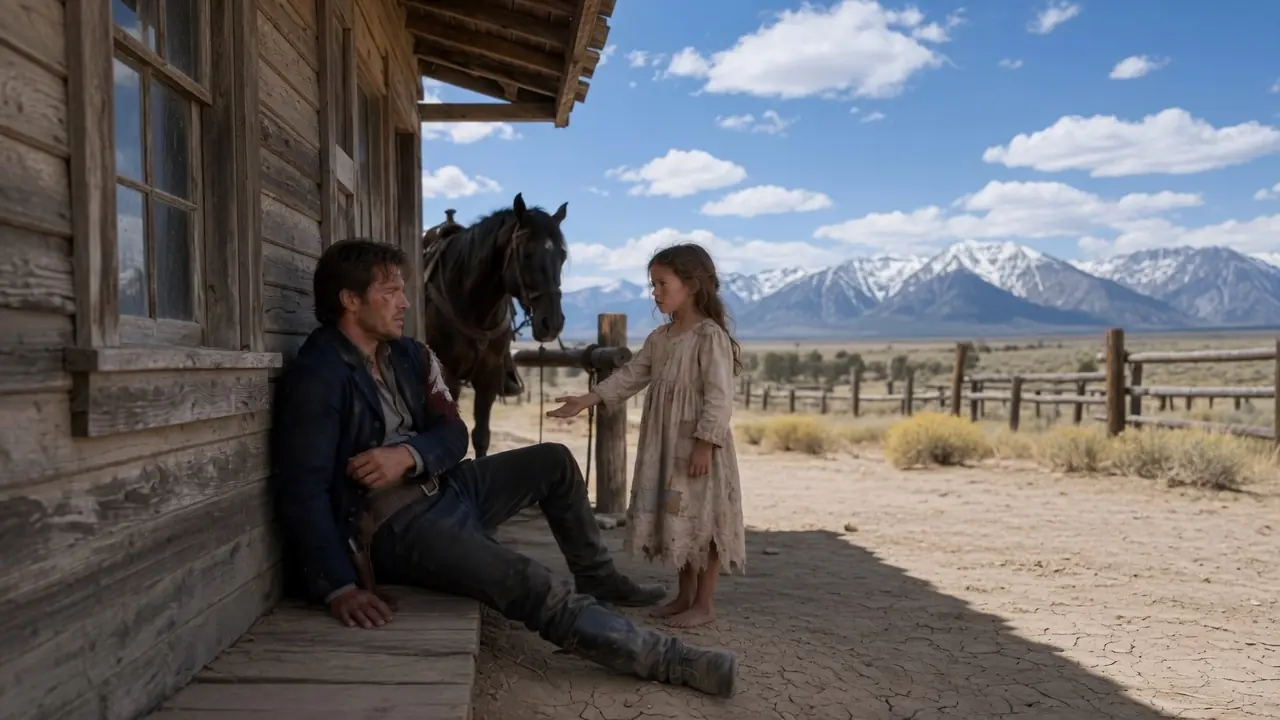
Silas wanted to answer, but darkness closed over him.
When he woke, the first thing he smelled was lavender, smoke, and boiled cloth.
He lay on a narrow bed in a cabin room lit by lamplight, his coat gone and his shirt cut away from his shoulder.
Pain pulsed through him, but the fever no longer felt like a wildfire in his bones.
A woman sat beside him, threading a needle with practiced hands.
She had chestnut hair loosely tied back, sharp cheekbones, and tired eyes that missed nothing.
Her blue dress was faded, her apron stained, and her face carried the guarded strength of someone who had learned early that kindness needed a backbone.
She was not delicate, and nothing about her seemed breakable.
When she saw his eyes open, she set the needle down.
“You’re awake,” she said.
Silas tried to rise, but she placed one hand on his chest and pushed him down with humiliating ease.
“No.”
“I should go,” he said.
“You should breathe,” she replied. “That is your only assignment.”
“Where’s the girl?”
“Asleep,” the woman said.
“After confessing she dragged home a dying cavalryman like a stray dog.”
“I’m sorry.”
“So am I, mostly because she was right.”
Silas looked at her properly then.
“Mara Vale,” she said. “Elsie’s mother.”
The name struck him like thunder rolling through an empty valley.
She continued before he could speak. “You have infection in the wound, fever, and a talent for surviving longer than sense allows.”
“Silas Mercer,” he said.
“I know. You said your name twice while you were delirious.”
“What else did I say?”
Her face changed, almost invisibly.
“Enough to know you’ve been carrying more than a bullet.”
Silas turned his eyes toward the ceiling.
Mara did not press him, and somehow that made the silence heavier.
She cleaned the wound, stitched what needed stitching, and poured bitter medicine between his lips.
When the fever rose again that night, she stayed beside him with a damp cloth and a quiet voice.
For three days, he drifted in and out.
Sometimes he heard Elsie whispering from the doorway, asking if he was going to die.
Mara always answered the same way.
“Not if he listens.”
Sometimes Silas dreamed of cannon smoke and a young man named Thomas Vale falling beside him.
Thomas had been younger than Silas, with laughing eyes, quick hands, and faith that home was always waiting.
He carried a tin locket in his pocket and touched it before every march.
Inside it was a violet pressed by his wife and a scrap of paper with words he read when the camp went quiet.
On the fourth morning, Silas woke fully.
Sunlight poured through the small window, and the cabin smelled of stew, wood smoke, and fresh bread.
Elsie sat at the table, swinging her bare feet and peeling potatoes with terrifying confidence.
When she saw him watching, she narrowed her eyes.
“You snore,” she announced.
“I was wounded,” Silas said.
“You still snore.”
Mara stood at the stove, stirring a pot.
“Be kind, Elsie.”
“I am,” Elsie said. “I didn’t say loud.”
Silas laughed before he could stop himself.
The sound surprised him, rough and rusty from disuse.
Mara turned slightly, and for the first time, he saw warmth soften her face.
“You should eat,” she said.
He ate slowly, ashamed of how badly his hands shook.
Elsie pretended not to notice, which told Silas she had been raised well.
Mara noticed everything and said nothing, which told him more.
The stew was plain, but it tasted like something made by hands that understood hunger.
For a week, Silas remained in the cabin.
He learned the rhythm of the place, how Mara rose before dawn, fed the animals, checked traps, boiled herbs, and treated whoever came to her door.
A ranch hand came with a sprained wrist, a boy brought a sick dog, and a neighbor arrived with a mule that refused to eat.
Mara answered each need with the same steady patience, while Elsie followed her everywhere like a small determined shadow.
Silas told himself he would leave as soon as he could sit a horse without swaying.
He told himself Gideon needed the road, that Mara had enough burdens, that Elsie did not need another man vanishing after growing kind to him.
But each day, leaving felt less like duty and more like cowardice.
The cabin was becoming dangerous because it made him want to live.
One evening, Mara found him outside near the corral, staring west.
The sky was bruised purple over the mountains, and Gideon grazed quietly beyond the fence.
“You’re thinking of running,” she said.
“Riding,” he corrected.
“Men call it many things.”
Silas glanced at her.
“You don’t trust me.”
“I don’t trust wounds that walk before they heal.”
He looked toward the mountains again. “Your husband was a soldier.”
Mara went still.
Inside the cabin, Elsie hummed softly over her chores, unaware of the weight that had entered the yard.
“Yes,” Mara said at last.
“Thomas Vale.”
Silas felt the name like a hand closing around his throat.
“I knew him,” he said.
Mara’s face drained of color, but she did not step back.
Silas walked slowly to the porch where his coat hung near the door, took the small tin locket from the inner pocket, and held it out.
His hand trembled, though not from fever this time.
“He gave this to me outside Red Creek.”
Mara took the locket with both hands.
Her fingers recognized it before her mind did, and the breath left her in a broken sound.
Inside lay the pressed violet and the faded line written in Thomas’s hand.
Mara, I am still walking toward you.
For a long moment, Mara did not move.
Then she closed the locket and held it against her heart.
“You had this all this time?”
Silas lowered his eyes. “I tried to come sooner.”
“Why didn’t you?”
“After the battle, I was taken prisoner,” Silas said.
“Then the war ended in confusion. I heard your town had burned, and I looked for Vales in three counties.”
He swallowed. “After a while, shame walked faster than I did.”
“Shame for what?”
Silas looked at her then, and the truth came out rough.
“Thomas died pulling me away from the fire. I lived because he didn’t.”
The words opened a place in him that had never healed.
Mara watched him, grief and understanding moving across her face like weather over the prairie.
“My husband made his choices,” she said quietly.
“You did not steal his life by keeping yours.”
“You don’t know that.”
“No,” Mara said. “But I know grief. It lies with confidence.”
Silas turned away, unable to meet her eyes.
That night, he told her everything he could remember.
He told her how Thomas had spoken of a wife with clever hands and a child he had not yet met.
He told her how Thomas had laughed even when the rations were bad, how he had kept men from despair by describing Mara’s stew as if it were a feast fit for kings.
Mara listened without interrupting.
When Silas finished, the room felt changed, as if Thomas had stepped through it and left the lamp burning brighter.
“Elsie was born three months after he left,” Mara said.
Silas looked toward the sleeping loft. “She has his eyes.”
“And my temper,” Mara added.
“She saved my life.”
“Yes,” Mara said. “She does that when people are foolish enough to need it.”
Silas smiled, but the smile faded when he heard hoofbeats outside.
Three riders appeared at sunset two days later, dust rising behind them like a warning.
Their coats were too clean for ranch hands, and their guns sat too visible for travelers.
Mara saw them from the garden and immediately sent Elsie into the cabin.
Silas stepped onto the porch, still not fully healed, but standing.
The man in front was broad, blond, and smiling without kindness.
“Evening,” he called. “Mara Vale?”
Mara lifted her chin. “Who’s asking?”
“Caleb Rusk,” the man said. “I represent Mr. Alden Pike of Pike Land Company.”
Mara’s jaw tightened.
Silas noticed it.
Rusk dismounted slowly, looking around at the cabin, corral, and garden with the greedy eye of a man measuring someone else’s life.
“Mr. Pike holds a claim note on this property.”
“He holds nothing but a lie,” Mara said.
Rusk’s smile widened.
“Paper says otherwise.”
He pulled a folded document from his coat and waved it lazily.
“Your late husband borrowed against this land before he rode off. Debt unpaid means the claim reverts.”
Mara’s face went pale with anger. “Thomas would never sign away our home.”
Rusk shrugged.
“Dead men don’t argue well.”
Silas stepped forward, and Gideon lifted his head near the rail.
“Careful,” Silas said.
Rusk looked him over with amusement.
“You her hired gun?”
“No.”
“Then sit down before that shoulder reminds you you’re half-dead.”
Silas did not move.
Elsie appeared in the doorway behind Mara, clutching the edge of the frame.
Rusk’s eyes shifted to the child, and his smile turned colder.
“Would be a shame for a girl to grow up watching her mother fight battles she can’t win.”
Mara stepped in front of Elsie instantly.
Silas felt something old and fierce rise in him.
He had seen men like Rusk before, men who mistook quiet homes for easy prey.
He had once believed he was too tired to stand between anyone and danger again.
Now, looking at Elsie’s frightened face, he realized tired men could still choose where to spend their last strength.
“You’ll leave now,” Silas said.
Rusk laughed.
“We’ll leave when Mrs. Vale understands she has seven days.”
He folded the paper and tucked it back into his coat.
“After that, Pike’s men come with wagons.”
Then he leaned slightly toward Mara. “And mercy gets expensive after a deadline.”
The riders left in a storm of dust.
For a while, nobody spoke.
Mara stood still, one hand gripping the porch rail so hard her knuckles whitened.
Elsie looked from her mother to Silas.
“Are they taking our house?”
“No,” Mara said, though her voice shook.
Silas turned to her.
“Who is Alden Pike?”
“A land shark,” Mara answered. “He wants the water line that runs under the north pasture.”
“And the note?”
“Forged,” she said.
“Thomas never signed anything without showing me. Pike tried once before, after the town burned, but I had the deed.”
“Where is it?” Silas asked.
Mara’s face darkened.
“Stolen from the county office last winter.”
Silas understood then.
Pike had waited, prepared, and struck when Mara had only herself and a child to defend the claim.
That night, Silas sat at the table while Mara unfolded every scrap of paper she had kept.
Tax receipts, trading records, letters from Thomas, a faded survey map, and one old receipt from the original land office.
It was not enough to beat a forged note in front of a crooked judge.
But Silas kept staring at Thomas’s locket.
“What is it?” Mara asked.
“Thomas mentioned a deed copy,” Silas said slowly.
“During Red Creek, when he knew he might not see home again, he told me he had hidden the safest paper in the place no thief would search.”
Mara leaned forward. “Where?”
Silas closed his eyes, chasing memory through years of smoke and fever.
“He said, ‘Tell Mara the proof is where Elsie first heard my voice.’”
Mara covered her mouth.
Elsie, who had been pretending to sleep by the hearth, sat up.
“What does that mean?”
Mara rose so suddenly the chair scraped the floor.
“The cradle,” she whispered.
Silas followed her to the loft storage, where old blankets, a cracked washbasin, and a small wooden cradle sat beneath a canvas sheet.
Mara touched the cradle like it might disappear.
“Thomas built this before he left,” she said.
Silas lifted the cradle carefully.
One runner was thicker than the other, and the joinery bore the mark of a hidden compartment.
Mara brought a lamp close while Silas worked a knife beneath the wood.
A narrow panel came loose.
Inside, wrapped in oilcloth, lay a deed copy, a survey statement, and a letter signed by the original land clerk.
Mara sank to her knees.
Elsie threw her arms around her mother.
Silas stood holding the papers, feeling Thomas Vale’s promise pass from his hands into the home it had been meant to protect.
For the first time in years, the weight he carried felt lighter.
He had not come too late.
The next morning, Mara rode into town with Silas beside her and Elsie seated proudly behind him on Gideon.
At the county office, Alden Pike was already there with Caleb Rusk, smiling as if victory had arrived early.
The clerk avoided Mara’s eyes, and the judge who heard land disputes tapped his fingers impatiently.
Pike stood when Mara entered, his silver vest gleaming in the dusty room.
“Mrs. Vale,” Pike said smoothly.
“I had hoped you’d spare the child this embarrassment.”
Mara placed the oilcloth packet on the table.
“I brought her to watch a thief lose.”
The room went silent.
Pike’s smile faltered when Silas unfolded the deed copy.
The judge leaned forward, irritated at first, then suddenly interested.
Mara presented the survey, the clerk’s signed statement, and Thomas’s letter explaining the hidden duplicate.
When the current clerk was asked to compare the signatures, his hands began to shake.
Silas watched Caleb Rusk edge toward the door.
Gideon stood outside with a deputy’s boy holding the reins, but Silas did not need a horse to stop a coward.
He stepped into Rusk’s path.
“You’re not leaving before the judge reads Pike’s note aloud.”
Rusk looked toward Pike.
Pike’s face had gone the color of old ash.
Under pressure, the clerk finally admitted the original deed had vanished after Pike paid him to “misplace” several records.
The forged note collapsed under its own lies.
By noon, Alden Pike was no longer smiling, and Caleb Rusk was giving names to save his own skin.
Mara walked out of the office with her land secure and Elsie’s hand in hers.
For a moment, she stood on the boardwalk, breathing like a woman who had held her breath for years.
Silas waited beside her, unsure whether victory gave him the right to stay or only made leaving easier.
Mara turned to him.
“You found Thomas’s last gift,” she said.
“No,” Silas replied. “Elsie did.”
Elsie grinned. “I told you my ma fixes people.”
Mara looked at Silas. “Sometimes little girls do too.”
They rode home slowly beneath a sky washed clean by wind.
When the cabin came into view, Silas felt something in his chest ache with a hope he had not granted himself in years.
He had come to Colorado looking for a quiet place to disappear.
Instead, a barefoot girl had found him, a widow had healed him, and a dead friend had led him back to the living.
Weeks turned into months.
Silas stayed to repair the roof before winter, then the corral, then the well pulley, and after that, there always seemed to be one more thing needing his hands.
Mara never asked him to stay outright, and he never said he was leaving.
Elsie solved the matter by setting a plate for him every night and naming him Gideon’s official second favorite person.
One evening, after the first snow dusted the mountains, Silas and Mara stood by the fence watching Elsie chase chickens she had no chance of catching.
Mara wore Thomas’s locket around her neck now, not as a chain to the past, but as proof that love could travel through grief and still arrive.
Silas looked at it, then at her face.
“I thought bringing that locket would end what I owed him.”
Mara’s eyes softened.
“And did it?”
“No,” Silas said. “It changed the debt into something I want to keep paying.”
Mara studied him for a long moment, then placed her hand over his where it rested on the fence.
“Then stay, Silas Mercer. Not because you owe the dead, but because the living have room.”
His breath caught.
Elsie shouted from the yard, “Does this mean he’s staying?”
Mara laughed, and the sound moved through Silas like spring thaw.
“Yes,” she called. “If he has sense enough.”
Silas looked toward the mountains, then back at the cabin, the child, and the woman who had given him back his name.
“I reckon I can learn sense,” he said.
That winter, the trading post men still told stories about the wounded soldier who had been waiting for darkness.
Some said a barefoot girl had saved him.
Others said a widow’s herbs had pulled him back from the edge.
Silas knew the truth was larger and simpler than that.
He had been saved because someone small had refused to look away.
Years later, when Elsie was taller and no longer barefoot unless she wanted to annoy her mother, she would ask Silas why he had looked so sad that day.
He would tell her that some men carry messages so long they begin to think they are the message.
Then Mara would shake her head and tell him not to make sorrow sound wiser than it was.
Elsie would laugh, and Silas would laugh too, because the house had taught him how.
The black horse grew old in the corral.
The cabin gained new boards, new shelves, and eventually a room Silas built with his own hands.
Thomas Vale’s locket remained near Mara’s heart, but Silas no longer felt like a thief standing in another man’s place.
He understood at last that love did not vanish when life changed shape.
The dying soldier had waited for darkness, believing nothing remained for him but silence.
But a barefoot girl had stepped into the light with an outstretched hand and a secret name.
She had led him not only to a cabin, but to forgiveness, purpose, and a family that needed him.
And in the wide Colorado frontier, where men often disappeared without a trace, Silas Mercer finally learned the bravest thing a broken man could do was stay.