Rain had been falling over Cleveland since before dawn, turning the sidewalks silver and pushing most people toward coffee shops, bus shelters, and anywhere else with a roof. Inside Miller’s Corner Bakery, twenty-six-year-old Hannah Miller stood behind the glass counter and counted the morning’s sales for the third time. The total did not improve simply because she looked at it again. By eleven o’clock, she had sold six loaves of bread, four muffins, and one cup of coffee.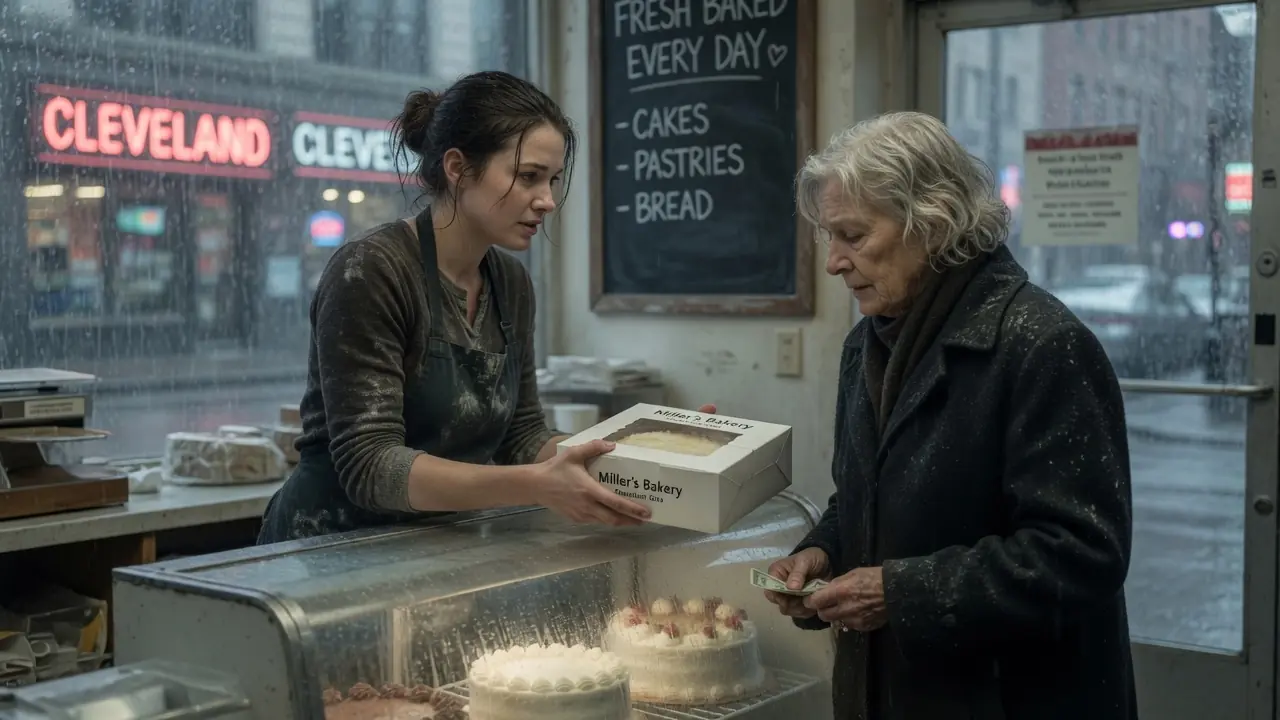
The bakery had belonged to Hannah’s parents before it belonged to her. Robert and Diane Miller had opened it when Hannah was a baby, using money borrowed from relatives and a second mortgage on a house that never stopped needing repairs. The place had survived recessions, rising flour prices, and the construction project that closed half the street for nine months. It had not survived her father’s illness without leaving Hannah buried beneath debt.
Robert died eighteen months earlier after a long battle with heart failure. Her mother moved to Arizona to live with Hannah’s older sister, leaving Hannah with the bakery, the loans, and the impossible feeling that closing would mean losing her father a second time. She worked before sunrise, stayed after dark, and paid herself only when every other bill had been handled. Some months, that meant she received nothing.
The rain made the bakery feel even quieter than usual. Water traced crooked paths down the front window while the pendant lights reflected against the empty tables. Fresh cinnamon rolls sat beneath glass, untouched since morning, and two birthday cakes waited inside the refrigerated display. If they did not sell, Hannah would donate them to the neighborhood shelter before closing.
Her part-time assistant, Emma Lawson, had called in sick with a fever. Hannah did not mind covering the counter, but working alone meant she could not begin the afternoon bread until customers stopped arriving. That did not appear to be a problem. The only person inside was a retired schoolteacher drinking coffee beside the window.
The bell above the door rang softly.
An elderly woman entered carrying a dark brown handbag and a small black umbrella. She wore a clean gray coat that looked too thin for the weather, sensible shoes darkened by rain, and silver hair pinned neatly at the back of her head. She paused just inside the doorway, wiping her feet carefully as though afraid of leaving water on the floor.
Hannah smiled. “Good morning.”
The woman returned the smile but did not approach immediately. She walked slowly along the display, studying each pastry through the glass. Her eyes passed over the fruit tarts, chocolate cake, lemon squares, and small vanilla birthday cake decorated with pale yellow roses.
Hannah had learned to recognize hunger in many forms. Some customers stared openly at food and asked whether anything was discounted. Others entered with confidence, examined prices, then suddenly remembered an appointment when they realized they could not afford what they wanted. This woman carried her need quietly.
She stopped in front of the vanilla cake.
The cake was six inches wide, large enough for four generous slices. Hannah had layered it with vanilla bean buttercream and filled the center with strawberry preserves. A small sugar flower rested on top beside a blank chocolate plaque where a name could be written.
“How much is that one?” the woman asked.
“Twenty-eight dollars.”
The woman opened her handbag.
She removed a small wallet, counted the bills inside, then counted them again. There were two tens, one five, and several coins. Her fingers trembled slightly when she returned everything to the wallet.
“Thank you,” she said.
She moved toward the door.
Hannah stepped from behind the counter. “Why are you leaving after staring at that cake for so long?”
The woman stopped with one hand on the umbrella.
For a moment, pride and honesty struggled across her face. Then she looked back at the cake.
“It is my husband’s birthday,” she said quietly. “But my money will not cover it.”
Hannah glanced toward the empty ring finger on the woman’s left hand. A pale line remained where a wedding band had once rested.
“Is he at home?” Hannah asked.
The woman’s eyes lowered. “He died seven years ago.”
Hannah did not speak immediately.
The woman returned to the counter and looked at the cake once more. “His name was Thomas. Every year on his birthday, we bought a vanilla cake with strawberry filling. We ate one slice together after dinner, then he had another for breakfast even though his doctor told him not to.”
A small smile touched her face before disappearing.
“This morning, I thought I could keep the tradition,” she continued. “But my prescription cost more than expected.”
Hannah looked at the twenty-eight-dollar cake, then at the nearly empty bakery. She had a utility payment due in three days and less than half the amount needed. Giving away fresh merchandise was not something she could afford to do often.
Still, she reached for a white cake box.
The woman shook her head immediately. “No, dear. I did not tell you so you would feel sorry for me.”
“I don’t.”
Hannah lifted the cake carefully from the display.
“Then what are you doing?”
“Making sure Thomas gets his birthday cake.”
The woman’s expression tightened with emotion. “I cannot accept that.”
“You can.”
“I have twenty-five dollars.”
“Keep it for groceries.”
The woman looked almost offended. “I am not asking for charity.”
Hannah closed the box and tied it with yellow string. “Then don’t call it charity. Call it one baker refusing to let a good tradition end because medicine became expensive.”
The elderly woman stared at her.
Hannah placed the box on the counter. “No one should remember love with an empty table.”
The retired teacher beside the window lowered his coffee cup. He had been pretending not to listen, but his eyes had filled with tears.
The woman touched the box gently. “What is your name?”
“Hannah Miller.”
“I’m Margaret Hayes.”
Hannah wrote Thomas across the small chocolate plaque and secured it to the cake. Margaret watched every movement as though Hannah were restoring something more important than dessert.
“Thank you,” Margaret whispered.
Hannah placed the cake inside a paper bag to protect it from the rain. Before leaving, Margaret removed one of the five-dollar bills from her wallet and pushed it across the counter.
“For coffee,” she said.
“You didn’t have coffee.”
“Then save it for someone who will.”
Hannah considered refusing, then understood that accepting mattered to Margaret.
She placed the bill inside a jar near the register labeled COMMUNITY COFFEE. Customers occasionally added change so anyone short on money could receive a drink without explanation. The jar had been almost empty that morning.
Margaret left with the cake held carefully beneath her coat.
Hannah watched through the window as the elderly woman crossed the street and waited beneath the bus shelter. The yellow string around the box remained visible until the bus arrived. Then Margaret disappeared into the rainy city.
The bakery closed at six that evening.
Hannah donated the unsold chocolate cake to the shelter and carried the remaining bread to a church pantry. When she returned, an envelope had been pushed beneath the front door. Inside was a handwritten note.
Dear Hannah, Thomas would have liked you. Tonight, I set two plates on the table for the first time in seven years. I ate one slice for myself and one for him. Thank you for allowing grief to feel like love again.
Hannah read the letter twice.
She taped it inside the cupboard above the mixer where only she could see it. During difficult mornings, she opened the door and read the final sentence. The note did not pay rent, but it reminded her why the bakery mattered.
Life continued without becoming easier.
The following year, a national café chain opened two blocks away. Its prices were lower, its seating was modern, and its marketing budget exceeded everything Hannah earned in a decade. Several regular customers returned only for holidays.
Hannah reduced her staff, shortened business hours, and began delivering wholesale bread to restaurants before sunrise. She learned to repair mixers, negotiate flour contracts, and survive on less sleep than any doctor would recommend. Each month ended with the same question.
Should she close?
Every time Hannah considered it, someone entered with a story tied to the bakery. A widower ordered the same cookies his wife once loved. A college student purchased a birthday cupcake because her family lived overseas. A mother asked Hannah to recreate the cake her daughter had missed while receiving cancer treatment.
The bakery was not profitable enough.
It was meaningful enough to make leaving difficult.
Three years after Margaret’s visit, Hannah received an offer from a property developer. The company wanted to buy the entire block and replace the old buildings with luxury apartments. The payment would clear her debts and leave enough money to begin another life.
Her mother urged her to accept.
Her sister called the bakery an expensive memorial.
Even Emma, who had become full-time manager, admitted that selling might be sensible.
Hannah refused.
The developer purchased two neighboring buildings instead, and construction began. Dust covered the sidewalks, parking disappeared, and customers avoided the area for months. Revenue fell another twenty percent.
Hannah stopped paying herself completely.
She moved from her small apartment into the room above the bakery, where the heating system rattled and the bathroom sink leaked. At night, she listened to delivery trucks pass and wondered whether loyalty to her father had become fear of change.
On the fifth anniversary of Margaret’s visit, Hannah nearly closed.
A burst pipe damaged the back storage room during a January freeze. Insurance covered only part of the repairs because the plumbing had been classified as outdated. The bakery’s main oven also began losing heat, leaving bread unevenly baked.
Hannah sat alone at the front table after closing.
Bills covered the wood in front of her. The total amount needed to continue operating was almost eighty thousand dollars. She had three weeks before the bank reviewed her loan.
Emma entered carrying two mugs of tea.
“We can still walk away,” she said.
Hannah looked around the dark bakery. “And do what?”
“You are talented. Every large hotel in the city needs pastry chefs.”
“I don’t want to spend my life following someone else’s recipes.”
“Then create new ones somewhere that can afford butter.”
Hannah smiled weakly.
Emma sat across from her. “Your father loved this place, but he loved you more.”
“I know.”
“Do you?”
Before Hannah could answer, headlights swept across the rain-darkened window.
A black car stopped outside.
A driver opened the rear door, and an elderly woman stepped onto the sidewalk wearing a long camel-colored coat. Her silver hair was shorter than Hannah remembered, but the careful way she held her handbag remained unchanged.
Hannah stood.
“Margaret?”
The woman entered beneath the ringing bell.
For several seconds, neither spoke. Then Margaret crossed the room and embraced Hannah with surprising strength.
“You remembered me,” Margaret said.
“You gave me one of the best letters I’ve ever received.”
Margaret looked toward the cupboard. “Do you still have it?”
Hannah nodded.
Margaret smiled. “Good.”
A man and woman entered behind her carrying folders. The man appeared to be in his fifties and introduced himself as Daniel Hayes, Margaret’s nephew. The woman was Rachel Kim, director of culinary operations for Hayes Hospitality Group.
Hannah recognized the name.
Hayes Hospitality owned thirty-eight hotels across the United States, including several luxury properties in Chicago, Boston, New York, and Seattle. Its founder, Thomas Hayes, had begun with one roadside motel and built the company over forty years.
Hannah looked at Margaret.
“Thomas?”
“My husband.”
Hannah sat slowly.
The elderly woman she had believed unable to afford a cake was connected to one of the most successful private hotel groups in the country. Margaret seemed to understand the question forming in Hannah’s mind.
“I was not pretending to be poor,” she said. “After Thomas died, his children challenged the estate. My accounts were temporarily frozen, and I refused to ask anyone for help because pride can make lonely people very foolish.”
The legal dispute lasted nearly nine months. Margaret survived on a small pension account and whatever cash remained in her apartment. Her prescription cost that morning had truly left her three dollars short of buying the cake.
“When the estate settled, I thought about returning immediately,” Margaret continued. “But I worried that bringing money back too quickly would turn your kindness into a transaction.”
“You didn’t owe me anything.”
“I know.”
That answer surprised Hannah.
Margaret looked around the bakery. “That is why I waited until I had something that was not repayment.”
Rachel opened the largest folder.
Hayes Hospitality was redesigning its food program. Instead of using frozen desserts shipped from industrial suppliers, the company wanted regional bakery partners to provide cakes, pastries, and breads unique to each market.
They wanted Miller’s Corner Bakery as their first partner.
The proposed contract covered five hotels in Ohio, Pennsylvania, and Michigan. It guaranteed minimum weekly orders large enough to triple Hannah’s current revenue. If the first year succeeded, the agreement could expand nationally.
Hannah read the first page, then the second.
The numbers did not feel real.
“This would require a larger kitchen,” she said.
“We would finance the necessary equipment through an advance against future orders,” Rachel replied. “You would retain full ownership of your bakery and recipes.”
“Why me?”
Margaret answered before anyone else.
“Because I did not return for one cake, Hannah. I returned because I watched what you built.”
She explained that Hayes Hospitality had quietly ordered from the bakery several times during the previous year. Staff visited as ordinary customers, evaluated the products, reviewed sanitation records, and tested how well the pastries traveled.
The decision had not been made from sentiment alone.
Hannah’s work was good enough.
The cake had simply made Margaret look closely.
Emma leaned over the contract. “This could save the bakery.”
Hannah wanted to believe her.
Then she reached the production requirements.
Five hotels meant nearly three thousand pastries, four hundred loaves, and dozens of specialty cakes every week. The bakery currently produced less than one-third of that volume. Hannah would need staff, refrigeration, delivery vans, insurance, and quality systems she had never managed.
“This could also destroy it,” she said.
Rachel nodded. “Yes.”
Margaret did not contradict her.
The honesty made the offer more frightening and more trustworthy.
Hannah requested ten days to review everything. She hired an independent attorney, spoke with an accountant, and toured one of the hotels. The more she learned, the clearer the risk became.
The contract would stabilize the bakery only if Hannah expanded carefully.
A rushed launch could bury her beneath debt, staffing problems, and penalties for missed deliveries. She also feared becoming dependent on one wealthy client. If Hayes Hospitality changed direction later, Miller’s Corner could collapse again.
Hannah returned with revised terms.
She asked for a smaller opening volume, permission to serve independent customers first during major holidays, and a clause limiting hotel orders to forty percent of total bakery production. She also requested that the company fund training rather than simply purchasing larger machines.
Rachel considered the changes reasonable.
Daniel did not.
He argued that Hayes Hospitality was offering an extraordinary opportunity and should receive priority. Hannah listened politely before closing the folder.
“I am grateful,” she said. “But gratitude is not the same as surrender.”
Margaret’s eyes brightened.
Daniel looked toward his aunt. “The hotels need reliability.”
“So does Hannah,” Margaret replied.
Negotiations continued for three days.
The final agreement protected both sides.
Hayes Hospitality provided a low-interest equipment advance, guaranteed minimum purchases for three years, and funded food-safety training. Hannah agreed to delivery standards, transparent pricing, and gradual expansion.
No clause gave Margaret control.
No clause turned kindness into ownership.
The contract was signed at the same table where Hannah had once counted five-dollar sales.
Renovation began the following month.
The damaged storage room became a modern production kitchen. New ovens arrived, refrigeration was installed, and the old mixer Hannah’s father bought secondhand was moved near the front as a reminder of where the bakery began.
Hannah hired twelve people.
Two were single mothers returning to work. One was a former hotel baker who wanted regular daytime hours. Another was a young man recently released from prison who had learned baking through a vocational program and could shape bread faster than anyone Hannah had ever seen.
The first hotel order left the bakery at four-thirty on a Monday morning.
Hannah stood beside the delivery van with a clipboard, checking every crate twice. Inside were croissants, sourdough loaves, blueberry muffins, cinnamon rolls, and six vanilla cakes with strawberry filling.
Margaret had requested that recipe specifically.
The launch was not perfect.
One van broke down during the second week. A new employee added salt instead of sugar to two trays of muffins. A refrigeration sensor failed overnight, forcing Hannah to discard hundreds of dollars in cream.
Each problem frightened her.
None destroyed the business.
Rachel treated mistakes as operational challenges rather than personal betrayals. Margaret visited only occasionally and never interfered with daily decisions. She ordered tea, sat beside the window, and paid for everything she purchased.
Within six months, the contract expanded to seven hotels.
Within two years, Miller’s Corner opened a second kitchen in Columbus. Hannah refused offers to franchise nationally because she did not want the bakery’s name attached to products she could not supervise.
Growth became a choice rather than a rescue.
The original Cleveland bakery remained open.
It still had the same front bell, wooden tables, and community coffee jar. The only visible sign of success was the steady line of customers and the number of employees moving behind the counter.
One rainy afternoon, Hannah noticed an elderly man counting coins beside the bread display. His coat was clean but worn, and embarrassment made him speak too quickly when Emma asked whether he needed help.
Hannah placed a loaf, soup, and two pastries inside a bag.
The man protested.
Hannah pointed toward the community coffee jar. “Someone already paid.”
The jar contained far more money than one meal required. Hotel guests, employees, and customers had learned its purpose and contributed regularly.
Kindness had developed its own accounting system.
Margaret celebrated her eightieth birthday at Miller’s Corner.
She requested no private room, decorations, or expensive meal. She sat at the largest table with Hannah, Emma, Rachel, Daniel, and employees from the first hotel team.
Hannah brought out a vanilla cake filled with strawberry preserves.
Across the top, she had written two names.
Margaret and Thomas.
Margaret touched the lettering with one finger.
“He still gets half?” Hannah asked.
“Always.”
They cut the cake into more slices than seemed possible. One slice remained untouched at the center of the table until Margaret quietly moved it onto her own plate beside the first.
“For breakfast,” she explained.
Everyone laughed.
Later, after the guests left, Margaret and Hannah sat together beside the rain-streaked window. The bakery had grown quiet again, though it no longer felt empty.
“I spent years believing I had returned to change your life,” Margaret said.
“You did.”
“So did you.”
Hannah looked toward her.
Margaret explained that after Thomas died, wealth became something she guarded rather than used. Family lawsuits taught her to view every request as manipulation. She gave money to institutions but rarely allowed herself to trust individuals.
The free cake had changed that.
“You did not know my surname, my company, or whether I could ever help you,” Margaret said. “You saw only an old woman who could not afford one tradition.”
Hannah smiled. “You were three dollars short.”
“Three dollars and several years of courage.”
Margaret reached into her handbag and removed the original yellow string from the cake box. She had kept it folded inside the letter Hannah wrote on the receipt that day.
Hannah stared at it.
“I thought I was the sentimental one.”
“You gave me permission.”
After Margaret died four years later, she left no controlling interest in the hotel company to Hannah and no sudden fortune that could turn their friendship into a fairy tale about money. Instead, she established the Thomas and Margaret Hayes Small Bakery Fund.
The fund provided equipment loans, training, and emergency grants to independent bakers facing closure. Every recipient retained ownership. No business was required to rename itself, surrender recipes, or prove gratitude through publicity.
Hannah served as its first chairperson.
The fund’s guiding rule came from the lesson Margaret believed mattered most.
Help should create room, not control.
Miller’s Corner continued supplying Hayes hotels, though the company never represented more than forty percent of its production. Hannah opened a training kitchen above the bakery and taught young bakers how to price products, read contracts, and protect themselves from opportunities that looked generous but demanded too much.
The original note from Margaret remained inside the cupboard.
Years of steam had curled the edges, and the ink had faded slightly. Hannah eventually placed it behind glass, but she kept it hidden from customers.
It did not belong to the bakery’s marketing.
It belonged to the moment before anyone knew what the kindness would become.
People often repeated the story incorrectly.
They said Hannah gave a poor elderly woman a cake and was rewarded with a fortune. That version made generosity sound like an investment and Margaret’s return feel like payment.
Hannah always corrected them.
She had given Margaret the cake because Margaret needed it.
Margaret offered the contract because Hannah’s bakery had earned it.
Everything meaningful came from keeping those two truths separate.
On difficult mornings, Hannah still arrived before sunrise. She opened the ovens, checked the dough, and listened as rain or snow touched the front window. The bakery had changed, but the purpose had not.
Sometimes hunger entered loudly.
Sometimes it arrived wearing a clean but thin coat, holding a worn handbag with both hands.
And whenever Hannah recognized it, she remembered that the smallest gift was not always the cake, the money, or the opportunity that came later.
Sometimes the greatest gift was allowing another person to receive kindness without losing dignity.