The grease stain on table six had been there for three days.
Malik Johnson pressed the rag harder against the laminate surface, his knuckles turning pale from the pressure.
The chemical smell of cheap cleaner mixed with the burnt-oil haze that permanently hung in the air at Tony’s Burger House.
Somewhere behind him, an old radio crackled out classic rock, the same five songs on repeat since Malik had started working there after school and on weekends.
He scrubbed until his wrist hurt.
The stain barely changed.
That was how most things felt in Malik’s life lately.
No matter how hard he tried, nothing seemed to move.
He was sixteen years old, a Black boy with tired brown eyes, thin shoulders, and a serious face that made him look older than he was. His dark curls were tucked under a paper diner cap, and his faded red uniform shirt hung loose on his frame. His name tag sat crooked over his heart because the pin had bent weeks ago, and he had never found time to fix it.
His sneakers were old but clean.
His apron had two small tears near the pocket.
His hands smelled like dish soap, coffee, and floor cleaner no matter how many times he washed them.
On school days, Malik carried textbooks in the morning and coffee pots in the afternoon. On Saturdays, he opened the diner before sunrise, worked until his feet burned, then went home to help his mother with laundry, medication reminders, and dinner. On Sundays, he worked the breakfast shift, did homework in the bus station, and tried not to fall asleep over algebra.
He did not complain.
Complaining cost energy.
Malik needed every piece of energy he had.
His phone buzzed in his apron pocket.
He froze in the middle of scrubbing.
The screen showed a message from his mother.
Mama: Baby, don’t worry, but the pharmacy called again. They said the refill is still not covered.
Malik closed his eyes for one second.
Just one.
Then he opened them and typed quickly.
Malik: I’ll figure it out after work. Please eat something.
The reply came slowly.
Mama: I don’t want you carrying all this.
Malik stared at the words.
Too late, he thought.
Then he typed:
Malik: I love you. Rest.
He slid the phone back into his pocket before the tears could rise.
His mother, Denise Johnson, had once worked full-time at a nursing home and part-time cleaning offices on weekends. She had been strong then, strong in the way mothers could be when they had no choice. She could lift patients, cook dinner, help Malik with homework, and still sing while folding laundry.
Then her body began betraying her.
At first, it was fatigue.
Then pain.
Then missed shifts.
Then doctor visits, prescriptions, unpaid days, insurance arguments, and bills that seemed to grow like weeds through every crack in their life.
Now Denise worked only when she could, and Malik worked whenever Tony would give him hours.
Not legally too many hours, at least on paper.
Tony was very good at paper.
He wrote down one thing and demanded another.
“Hey, Prince Charming.”
Malik jumped.
Tony Russo’s voice cut through his thoughts like a dull knife.
He stood near the kitchen pass, thick arms folded across his stained white shirt. His face was always red, as if anger lived close beneath his skin. He owned Tony’s Burger House, though he treated the place less like a business and more like a kingdom built from grease, coffee, and other people’s exhaustion.
“You going to polish that table into a mirror, or are you going to finish prepping before the rush?”
Malik straightened quickly.
“I’m almost done.”
“You’re always almost done. That’s the problem.”
A laugh came from the coffee station.
Brent, the cook’s helper, leaned against the counter with a smirk. He was twenty-seven, loud, lazy when Tony was not looking, and cruel whenever he thought it might get a laugh. Beside him, Carla, the morning waitress, was filling sugar containers and watching Malik with the tired amusement of someone glad the joke was pointed elsewhere.
“He’s probably thinking about prom,” Brent said. “Or whatever high school boys think about.”
“I think about rent,” Malik said before he could stop himself.
The diner went quiet for half a second.
Tony narrowed his eyes.
“What was that?”
Malik lowered his gaze.
“Nothing.”
“That’s what I thought.” Tony pointed toward the windows. “Wipe those down. They look like somebody sneezed grease on them.”
“Yes, sir.”
“And don’t call me sir like you’re in church. Move.”
Malik picked up the spray bottle and walked to the front windows.
Outside, Baltimore was waking beneath a cold gray sky. Tony’s Burger House sat on a tired block between a pawn shop and a laundromat, across from a bus stop where people waited with their shoulders hunched and their hands buried deep in coat pockets. A check-cashing place blinked red neon near the corner. A boarded-up bakery still had faded flowers painted on the glass from better years.
Malik had grown up ten blocks away.
He knew this neighborhood.
He knew which sidewalks iced over first, which bus drivers waited if they saw you running, which corner stores let customers pay later, and which ones watched poor kids like poverty was a crime waiting to happen.
The clock on the wall clicked to 8:00 a.m.
Tony flipped the sign from CLOSED to OPEN.
The door chimed almost immediately.
A delivery driver came in first, ordered black coffee and a sausage biscuit, then complained about the price even though it had not changed in months. Two construction workers followed, both loud and hungry, smelling like cold air and cigarettes. Then came Mr. Alvarez from the laundromat, who always ordered eggs over easy and always left exactly one dollar and twenty-five cents as a tip.
Malik moved through the room with practiced speed.
Coffee.
Menus.
Water.
Refills.
Toast.
Napkins.
More coffee.
“Table three’s waiting,” Tony barked from the kitchen.
“I’m on it.”
“Table four wants more cream.”
“Got it.”
“Table two says their eggs are cold.”
“I don’t care. Smile and fix it.”
So Malik smiled.
He fixed it.
He smiled when customers snapped their fingers at him.
He smiled when Brent called him “college boy” because Malik once told Carla he wanted to become a nurse.
He smiled when Tony said, “Don’t mess this up, Prince Charming,” in front of customers.
He smiled because tips meant medicine.
He smiled because anger did not pay the pharmacy.
He smiled because his mother still believed he was a child, and Malik was afraid that if he stopped smiling, everyone would see he had become something else too soon.
By 9:15, the diner was half full.
The grease stain on table six still showed beneath the shine of cleaner.
Malik was refilling ketchup bottles when the door opened again.
At first, nobody paid attention.
Then the room shifted.
Not dramatically.
Just enough.
The kind of pause people create when someone enters who does not seem to belong.
Malik looked up.
An elderly woman stood in the doorway.
She was old in a way that made time seem visible. Her back was slightly bent, and one hand gripped a black wooden cane with a silver handle. Her other hand held the doorframe for balance. She wore a dark wool coat worn thin at the cuffs but clearly once expensive, and beneath it, a simple gray dress. Her soft canvas shoes were practical, almost plain, but carefully polished.
Her face was lined and weathered, yet her eyes were sharp and clear as cut glass.
She stood there for a moment, breathing through the effort of the walk from the curb to the door.
A few customers glanced at her.
Then looked away.
Carla leaned toward Malik and whispered, “Oh great. Tea lady.”
Malik frowned.
“What?”
“That’s what Tony calls her,” Carla said. “She comes in every few days. Orders the cheapest tea we have, sits forever, tips in coins.”
“She has a name?”
Carla shrugged.
“Probably.”
Tony noticed the old woman then and groaned loudly enough for the front counter to hear.
“Not her again.”
The elderly woman moved slowly across the diner floor.
Tap.
Step.
Tap.
Step.
Her cane struck the tile with a careful rhythm.
She did not look at Tony.
She did not look at Carla.
She simply made her way toward table six, as if she had chosen it long before stepping inside.
Malik saw how much effort every step cost her.
He moved forward automatically.
“Good morning, ma’am,” he said. “Can I help you to the table?”
The woman stopped.
Her eyes lifted to Malik’s face.
For one second, Malik felt strangely examined, not judged, but seen.
“That would be kind,” the woman said.
Her voice was soft but steady.
Malik offered his arm.
Behind him, Brent muttered, “Careful, she might tip you a penny.”
Carla snickered.
Malik ignored them.
The woman placed her thin hand lightly on Malik’s forearm. Her fingers trembled, not from fear or cold, but from something deeper, something her body could no longer fully control.
Malik guided her to table six.
“Slowly,” he said. “No rush.”
“I am afraid slow is all I have left,” the woman replied.
Malik smiled gently.
“Then we’ll make slow work.”
The woman looked at him again.
A flicker of surprise crossed her face.
Most people, Malik guessed, did not answer her like that.
He helped the woman sit, then adjusted the table slightly so she would not have to reach too far.
“Would you like tea today?”
“Yes, please.”
“Hot tea with lemon?”
“No lemon. Honey, if you have it.”
“We have honey.”
Tony’s voice cut across the diner.
“Malik, don’t waste the good honey on tea.”
The whole room heard him.
The elderly woman lowered her eyes.
Malik felt heat rise in his chest.
He turned toward the counter.
“I’ll pay for the honey.”
Tony barked a laugh.
“With what? Your lunch money?”
A few customers chuckled.
Malik kept his voice even.
“With my tips.”
For a second, Tony looked almost annoyed that he had not given him a bigger reaction.
“Fine. Throw away your money.”
Malik brought the tea in a clean mug, not one of the chipped ones Tony kept for customers he did not care about. He added two packets of honey on the saucer and a small spoon wrapped in a napkin.
The old woman touched the mug with both hands.
“Thank you…”
“Malik.”
“Thank you, Malik.”
“You’re welcome, ma’am.”
“Evelyn,” she said.
“Miss Evelyn, then.”
Her mouth softened.
“That will do.”
Malik turned to leave, but Evelyn’s voice stopped him.
“Do you still serve breakfast toast?”
Malik glanced at the menu.
“Yes, ma’am.”
“With butter?”
“Yes.”
“And jam?”
“Yes.”
Evelyn opened her purse slowly, as if every movement required planning. Malik saw coins inside, a folded tissue, a small notebook, and a photograph worn white at the edges.
“I will have toast,” Evelyn said. “Just toast.”
Malik looked toward the kitchen.
Toast cost $2.49.
It was ridiculous.
Two pieces of bread, butter, and jam.
But at Tony’s Burger House, even dignity came with a price.
“Would you like eggs with that?” Malik asked gently.
Evelyn gave a small smile.
“Can’t afford eggs today.”
The words were not self-pitying.
That made them hurt more.
Malik nodded as if Evelyn had simply expressed a preference.
“Toast it is.”
He placed the order.
Tony looked at the ticket and rolled his eyes.
“Toast. Of course. Big spender.”
Brent laughed.
Malik stood at the pass, jaw tight.
“Could you make it fresh, please?”
Tony stared at him.
“What?”
“Fresh toast. Not the dry pieces from the warmer.”
Tony leaned forward.
“You running my kitchen now, kid?”
“No,” Malik said. “I’m serving my customer.”
The diner went quiet enough for him to hear the grill hiss.
Tony’s face darkened.
For a second, Malik thought he might send him home on the spot.
Then Mr. Alvarez from table two cleared his throat.
“I’d like my toast fresh too, Tony.”
A construction worker lifted his coffee.
“Same here.”
Tony looked around, realizing customers were watching.
He slammed two fresh slices into the toaster.
“There. Fresh toast. Everybody happy?”
Malik said nothing.
When the toast came up, he buttered it himself before Tony could smear it carelessly. He added strawberry jam in a small cup, then carried it to Evelyn’s table.
“There you go,” he said.
Evelyn looked at the plate as if it were something finer than toast.
“Thank you.”
Malik moved to check on another table, but a few minutes later, he noticed Evelyn had not eaten.
The toast sat untouched.
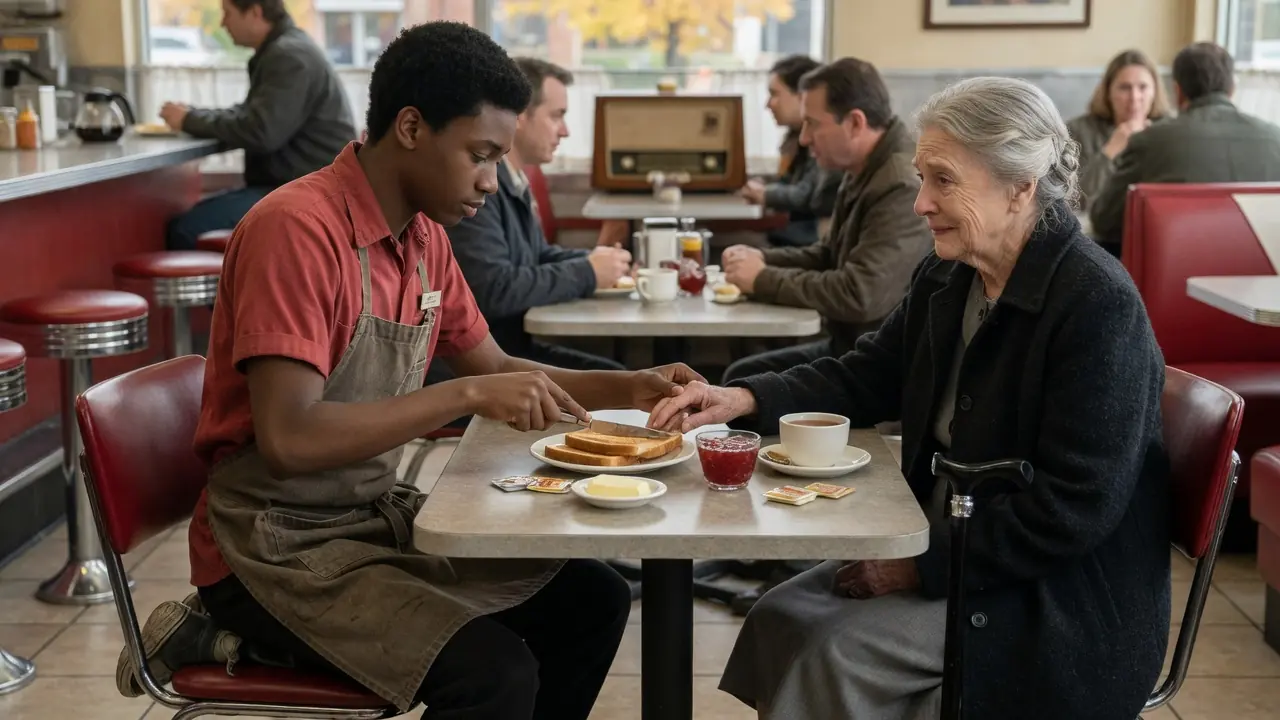
Evelyn’s hands hovered near the knife, trembling badly now. She tried to grip it, but her fingers jerked. The knife tapped against the plate once, then again. Her cheeks flushed with embarrassment.
At the next table, Brent walked by carrying dishes and muttered, “Need instructions for toast too?”
Evelyn’s face tightened.
Malik saw it.
That was the moment something inside him changed.
Not because it was the cruelest thing he had ever heard.
It was not.
Tony said worse every day.
Customers said worse without thinking.
But there was something unbearable about seeing an elderly woman ashamed because illness had made breakfast difficult.
Malik walked over to the table.
He did not make a show of it.
He did not speak loudly.
He simply stood beside the booth and said softly, “Miss Evelyn, may I help?”
Evelyn looked up quickly.
Her pride rose before her answer.
“No, no. I can manage.”
“I know you can,” Malik said. “But you don’t have to.”
Evelyn’s eyes searched his face.
There was no pity there.
That mattered.
Only patience.
Only respect.
Her hands trembled harder.
“I used to be able to do everything myself,” Evelyn whispered.
Malik pulled out the chair across from her and sat for just a moment, ignoring Tony’s glare from the kitchen.
“My mama says needing help is not the same thing as being helpless.”
Evelyn swallowed.
“Your mother sounds wise.”
“She is.”
Evelyn looked down at the toast.
“I hate when people watch me struggle.”
“Then I won’t let them.”
Malik reached for the plate.
“Would you like it cut into smaller pieces?”
After a long pause, Evelyn nodded.
“Please.”
Malik cut the toast carefully.
Not like feeding a child.
Like preparing food for someone deserving care.
He spread the jam evenly, trimmed the crusts from one piece after noticing how hard Evelyn had been trying to bite through them, and turned the plate so the easiest pieces faced her dominant hand.
Then he placed the fork in Evelyn’s hand and gently steadied her wrist without gripping too tightly.
“Take your time,” Malik said.
Around them, the diner continued.
Forks clinked.
Coffee poured.
Tony barked orders.
The radio crackled.
But for Evelyn, the world seemed to narrow to one piece of toast, one trembling hand, and one teenage waiter who did not make her feel foolish for needing help.
Evelyn lifted the bite slowly.
Her hand shook.
Jam threatened to slide.
Malik steadied her just enough.
The toast reached her mouth.
Evelyn closed her eyes as she chewed.
A tear slipped down one wrinkled cheek.
Malik pretended not to see it until Evelyn reached for a napkin.
Then he handed her one.
“Thank you,” Evelyn whispered.
“You’re welcome.”
“No,” she said, voice breaking. “Not for the toast.”
Malik understood.
He nodded once.
Behind them, Tony shouted, “Malik! You got tables!”
Malik stood.
“I’ll be right back, Miss Evelyn.”
“You don’t have to.”
“I know.”
But he came back anyway.
Between refills, orders, complaints, and Tony’s insults, Malik returned to Evelyn’s table every few minutes. He cut another piece. Refilled her tea. Added a little more honey. Moved the plate closer when Evelyn’s elbow tired. Never rushed her. Never sighed. Never spoke to her like she was taking up space.
Customers noticed.
Some watched with curiosity.
Some with discomfort.
One older man at the counter looked down at his own plate for a long time, then quietly left five dollars under his coffee mug.
Carla rolled her eyes at first.
Then, when Evelyn dropped her napkin, Carla picked it up without making a joke.
Small things can shame a room into remembering its humanity.
Tony, however, did not remember anything.
When Evelyn had finished most of the toast and half her tea, Tony came out from behind the counter with the check.
He slapped it onto the table.
“All right, Miss Evelyn. Table’s needed soon.”
The diner was only half full.
Everyone knew it.
Evelyn looked at the check.
Her trembling hand moved toward her purse.
Coins spilled onto the table.
Pennies.
Nickels.
Three dimes.
One quarter.
Her face flushed with humiliation.
“I have enough,” she whispered.
Tony folded his arms.
“You sure? Because we don’t run a charity.”
Malik stepped forward.
“I’ve got it.”
Tony turned.
“You’ve got what?”
“Her check.”
Evelyn shook her head.
“No, Malik. Please.”
“I’ve got it,” Malik said again.
Tony laughed.
“You’re sixteen years old and already buying breakfast for people who can’t pay?”
The words hit the air hard.
Evelyn went still.
Malik felt something hot rise inside him, but he held it down.
Not because Tony deserved restraint.
Because Evelyn deserved dignity.
“She is a customer,” Malik said.
Tony stepped closer.
“She is a waste of a table.”
Several customers looked up.
Tony pointed toward the door.
“Lady, if you can’t pay without dumping a coin jar on my table, maybe eat somewhere else next time.”
Evelyn’s eyes glistened.
Malik reached into his apron pocket and took out his tip money from the morning.
Four dollars and thirty-five cents.
It was supposed to help pay for his mother’s medication.
He placed three dollars on the table anyway.
“Paid.”
Tony sneered.
“Look at that. Hero waiter.”
Malik looked at him.
For once, he did not lower his eyes.
“If kindness bothers you that much, maybe you are in the wrong business.”
The diner fell silent.
Even the radio seemed to crackle lower.
Tony’s face turned a deeper red.
“What did you say?”
Malik’s heart pounded.
He thought of his mother.
The pharmacy.
The electric bill.
The fact that losing this job could make everything worse.
Still, he repeated himself.
“I said if kindness bothers you, maybe you are in the wrong business.”
Tony stepped close enough for Malik to smell smoke on his breath.
“You want to be unemployed today, kid?”
Evelyn spoke before Malik could answer.
“No.”
Her voice was soft.
Not loud.
But the sharpness in it cut through the room.
Everyone turned.
Evelyn slowly picked up her cane and stood.
Her body trembled, but her eyes were clear.
“No,” she said again. “You will not threaten a child for treating me like a human being.”
Tony gave a mean laugh.
“Lady, sit down before you fall down.”
Something changed in Evelyn’s face.
Not anger exactly.
Authority.
The kind that had been sleeping beneath age, poverty, and trembling hands.
“I have been spoken down to by men far more important than you,” she said. “They were at least intelligent enough to be afraid afterward.”
Tony blinked.
A few customers shifted in their seats.
Malik stared at her.
For the first time, he wondered who Evelyn had been before she became an old woman counting coins for toast.
Tony recovered quickly.
“You done?”
Evelyn looked at Malik.
“May I borrow your pen?”
Malik handed it to her.
Evelyn’s hand shook as she took it, but she managed to open the small notebook from her purse. She wrote slowly, each letter requiring effort. Then she tore out the page, folded it once, and handed it to Malik.
“Give this to your mother tonight,” Evelyn said.
Malik blinked.
“My mother?”
“Yes.”
Tony laughed.
“What, you writing permission slips now?”
Evelyn looked at him.
“No,” she said. “I am giving this young man a door.”
She placed her coins neatly beside the check, though Malik had already paid.
Then she looked at Malik one more time.
“You helped me eat when everyone else enjoyed watching me struggle,” she said. “I do not forget such things.”
Malik swallowed.
“Miss Evelyn, it was just toast.”
“No,” Evelyn said. “It was not.”
Then she turned and made her slow way toward the door.
Tap.
Step.
Tap.
Step.
This time, half the diner watched her leave.
Not with annoyance.
With silence.
Malik stood frozen with the folded paper in his hand.
Tony snatched it before he could react.
“Let me see.”
“Tony—”
He unfolded the paper and read aloud with a mocking voice.
“Whitmore Community Foundation. Ask for Grace. Urgent family assistance review.”
The laughter died in his throat.
His face changed.
Not much.
But enough.
Carla leaned over.
“Whitmore?”
Brent frowned.
“As in Whitmore Hospital?”
Mr. Alvarez looked up from his eggs.
“Whitmore Foundation owns half the clinics on the east side.”
Tony read the paper again.
His mouth opened.
Closed.
Malik took the note gently from his hand.
“You know her?” Carla asked.
Tony did not answer.
But Malik could see the truth forming behind his eyes.
Evelyn Whitmore was not the tea lady.
Not really.
She was the widow of Harold Whitmore, the man whose name was on hospitals, clinics, scholarship programs, senior homes, and community buildings across the city.
She was one of the most quietly powerful women in Maryland.
And Tony had just called her a waste of a table.
For the rest of the shift, Tony barely spoke to Malik.
That alone felt like a holiday.
Malik kept the note folded in his pocket, checking it every few minutes as if the ink might disappear. By noon, the breakfast rush had ended. By two, his feet ached so badly each step felt borrowed. By three, Tony finally snapped at him to mop the back hallway, more out of habit than courage.
When his shift ended, Malik walked to the bus stop holding the note in his coat pocket.
He did not call the number himself.
He was sixteen.
He still needed his mother, even if life often made him forget that.
Their apartment was on the third floor of a brick building with unreliable heat and hallway lights that flickered. Malik unlocked the door and found his mother sitting at the small kitchen table, wearing a sweater over her robe and sorting medical papers into piles.
Denise looked up immediately.
“Baby, you look worn out.”
Malik dropped his backpack near the door.
“I’m okay.”
Denise gave him a look.
A mother’s look.
The kind that said she had known her son before the son learned how to pretend.
“Come here,” Denise said softly.
Malik crossed the kitchen and placed the folded note on the table.
“What’s this?”
“An old woman at the diner gave it to me.”
Denise unfolded the paper slowly.
Her eyes moved across the words.
Then stopped.
“Whitmore Community Foundation,” she whispered.
Malik sat across from her and told her everything.
The tea.
The honey.
Tony’s insults.
Evelyn’s trembling hands.
The toast.
The coins.
The way Evelyn stood up and spoke like someone powerful had finally remembered she was powerful.
Denise listened without interrupting.
When Malik finished, his mother covered her mouth with one hand.
“Oh, baby.”
“I paid for her breakfast,” Malik said quickly. “I know I shouldn’t have. I know we needed that money for the refill, but she was just sitting there trying not to be embarrassed, and Tony was so mean, and I couldn’t—”
Denise reached across the table and took her son’s hand.
“Stop.”
Malik’s voice cracked.
“I’m sorry.”
“Do not apologize for being kind.”
“But the medicine—”
“We will figure out the medicine.”
“That’s what we always say.”
Denise’s face tightened with pain.
“I know.”
Malik looked down.
“I’m tired, Mama.”
The words came out before he could stop them.
Denise’s eyes filled.
“I know you are.”
“I don’t want to be tired like this.”
“You should not have to be.”
Malik began to cry then, quietly at first, then harder, the kind of tears he usually saved for the shower where no one could hear.
Denise stood with effort and pulled her son into her arms.
“You are sixteen,” she whispered into Malik’s hair. “You hear me? Sixteen. You are not supposed to be carrying the whole world.”
“But somebody has to.”
“No,” Denise said, voice trembling. “We need help. And maybe this note is the door.”
Denise called the number.
A woman answered on the second ring.
“Whitmore Community Foundation. This is Grace.”
Denise explained who she was, her voice polite, nervous, and proud all at once.
Grace’s tone changed immediately.
“Yes, Mrs. Johnson. Mrs. Whitmore asked us to expect your call.”
Malik sat very still.
Denise listened.
Then her eyes widened.
“She did?”
A pause.
“Yes. Yes, we can come tomorrow.”
Another pause.
“Thank you.”
Denise hung up slowly.
Malik stared at her.
“What did she say?”
Denise looked at the note again.
“She said Mrs. Whitmore requested an emergency family assistance review. They want us to come to the foundation office tomorrow morning.”
“What does that mean?”
Denise shook her head, overwhelmed.
“I don’t know yet.”
But for the first time in months, there was something in her voice that sounded almost like hope.
The Whitmore Community Foundation sat inside a restored brick building downtown, with polished floors, high ceilings, and a lobby that smelled faintly of coffee and fresh flowers.
Malik felt out of place the second he walked in.
He wore his cleanest jeans, his school sweater, and the old coat his mother had patched near the sleeve. Denise wore a navy dress she had not worn since a church banquet two years earlier, with a scarf around her shoulders and medical papers tucked carefully inside a folder.
A security guard greeted them politely.
A receptionist smiled without looking them up and down.
No one asked if they were lost.
No one treated their presence like an inconvenience.
That alone made Malik uneasy.
Grace, the woman from the phone, led them into a quiet office where Evelyn Whitmore sat near a window, wrapped in a cream-colored shawl. Without her worn black coat, she looked different. Still fragile, still elderly, still visibly affected by the tremor in her hands, but surrounded now by the proof of a life larger than Tony’s diner could imagine.
Photographs lined the shelves.
Evelyn with doctors.
Evelyn cutting ribbons at clinics.
Evelyn beside children holding scholarship certificates.
Evelyn shaking hands with mayors, pastors, teachers, and people Malik vaguely recognized from local news.
She looked up when they entered.
“Malik.”
Malik stopped near the door.
“Miss Evelyn.”
Evelyn smiled.
“I prefer that from you.”
Denise placed a hand gently on Malik’s shoulder.
“Mrs. Whitmore, thank you for seeing us.”
Evelyn looked at Denise with warmth.
“Your son protected my dignity yesterday. Seeing you is the least I can do.”
Denise’s eyes filled instantly.
Malik looked at the floor.
Grace brought tea, water, and a small plate of toast with jam.
Malik noticed the toast.
So did Evelyn.
The old woman smiled softly.
“I thought we should have it properly this time.”
They sat.
For a moment, nobody spoke.
Then Evelyn said, “Mrs. Johnson, I asked you here because your son saw me clearly when everyone else chose not to. I believe families who raise children like that should not be left to drown quietly.”
Denise’s lips trembled.
“We are not asking for charity.”
“I know,” Evelyn said. “That is why I prefer the word support.”
Grace opened a folder.
“We reviewed what we could with your permission this morning,” she said gently. “Your medical treatment is through Whitmore East Clinic’s network. There are hardship programs and medication assistance options that were never properly explained to you.”
Denise stared.
“I asked about help.”
“I believe you,” Grace said. “But systems often fail the people they are supposed to serve.”
Malik’s hands tightened in his lap.
Grace continued.
“We can assign a patient advocate today. Your outstanding medication issue can be addressed immediately. The foundation will cover the refill while the longer-term assistance is processed.”
Denise began to cry silently.
Malik turned to his mother.
“Mama?”
Denise pressed a hand to her mouth.
“I’m okay.”
But she was not okay.
She was relieved.
And relief, when it comes after too much fear, can look like breaking.
Evelyn waited.
She did not rush them.
After a moment, she turned to Malik.
“And you.”
Malik straightened.
“Yes, ma’am.”
“You are sixteen.”
Malik nodded.
“You should be in school, eating lunch, complaining about homework, and sleeping enough to dream.”
Malik gave a small, watery laugh.
“I do complain about homework.”
“Good. Keep at least one normal thing.”
Denise laughed through tears.
Evelyn opened another folder.
“I cannot hire you full-time. Nor should I. You are a child, even if life has asked you to act older.”
Malik swallowed.
“But,” Evelyn continued, “the foundation runs a youth service program for high school students interested in healthcare, caregiving, food service, and community work. It includes a paid weekend stipend, tutoring, transportation support, and scholarship eligibility.”
Malik stared at her.
“A program?”
“Yes.”
Grace smiled.
“It would not interfere with school. In fact, staying in school is required. You would volunteer a few supervised hours at our community café once a week, learn food safety, patient support basics, and customer care. You would be paid through the youth stipend.”
Malik’s voice came out small.
“How much?”
Grace gave a number.
Malik’s eyes widened.
It was more than he made at Tony’s in a full week of being snapped at, hurried, and humiliated.
Evelyn watched him carefully.
“I would like you to join,” she said. “Not because you owe me. Because the way you treated me yesterday tells me you already understand the heart of the work.”
Malik’s eyes filled.
“I just helped you eat toast.”
“No,” Evelyn said. “You helped me keep my dignity.”
Malik looked at his mother.
Denise was crying again, but this time she was smiling.
“Can I?” Malik whispered.
Denise reached for his hand.
“Yes, baby. You can.”
That afternoon, Malik returned to Tony’s Burger House with his mother beside him.
He had not planned to go back so soon, but Denise insisted that her son would not quit alone.
Tony was behind the counter counting cash.
Brent leaned near the kitchen.
Carla stood by the coffee station.
When Malik walked in, Tony looked up and smirked.
“Well, look who brought his mommy.”
Denise’s hand tightened around Malik’s.
Malik placed his folded apron on the counter.
Tony stared at it.
“What’s that supposed to be?”
“I’m quitting,” Malik said.
Brent laughed.
“You’re sixteen. You can’t quit like you’re a CEO.”
Malik kept his eyes on Tony.
“I’m done.”
Tony’s face flushed.
“You don’t quit. I take you off the schedule.”
“Then take me off.”
Tony leaned forward.
“You think that old lady is going to save you? People like that get bored. You’ll be back asking for shifts.”
Denise stepped forward.
“My son will not be back.”
Tony glanced at her.
“Lady, this is between me and my employee.”
“No,” Denise said. “This is between an adult man and the child he has been bullying because he thought he had no other choice.”
The diner went quiet.
Malik looked at his mother in shock.
Denise’s voice trembled, but she did not stop.
“He worked hard for you. He came early. He stayed late. He smiled when you disrespected him. And you mistook his need for this job as permission to treat him badly.”
Tony opened his mouth, but the door chimed before he could speak.
Everyone turned.
Evelyn Whitmore entered with Grace beside her.
Behind them came two people in suits, both carrying folders.
Tony’s mouth closed.
Evelyn moved slowly to the counter.
Tap.
Step.
Tap.
Step.
She looked at Tony.
“Mr. Russo.”
He swallowed.
“Mrs. Whitmore.”
So he had learned her name.
Good.
Evelyn’s eyes moved around the diner.
The dirty windows.
The greasy floor.
The cracked booths.
The old stain still visible on table six.
Then she looked back at Tony.
“My office reviewed several concerns associated with this establishment,” she said. “Health concerns. Wage concerns. Scheduling concerns involving minors. Mistreatment of staff.”
Tony went pale.
“You can’t just—”
“I have not just anything,” Evelyn said calmly. “I also took the liberty of purchasing the building from the current landlord.”
Tony’s face turned gray.
“The building?”
“The building,” Evelyn repeated. “Not your business. Yet.”
One of the suited people handed Tony a folder.
“These are notices regarding required inspections and lease compliance. You will want counsel.”
Tony looked as if he might choke.
Malik stared at Evelyn.
She did not smile.
This was not revenge.
This was consequence.
Evelyn turned to Malik.
“Are you ready?”
Malik looked around the diner one last time.
The place where he had been mocked.
Underpaid.
Overworked.
Reduced.
The place where he had also found the moment that opened a door.
His eyes stopped on table six.
An elderly woman had sat there with trembling hands, trying to eat toast while people laughed.
Malik had helped her.
That was all.
And somehow, that was everything.
“Yes,” Malik said. “I’m ready.”
Carla stepped forward suddenly.
“Malik.”
Malik looked at her.
Carla seemed embarrassed.
“I’m sorry,” she said quietly. “For laughing.”
Malik studied her face.
Then nodded.
“I hope you stop.”
Carla swallowed.
“I will.”
Malik believed she might.
Brent said nothing.
Tony said even less.
Malik walked out with his mother and Evelyn.
Outside, the air felt cold and clean.
For the first time in months, he was not leaving Tony’s Burger House exhausted and afraid of returning.
He was leaving free.
The months that followed were not magical.
Life did not become easy overnight.
Denise still had medical appointments.
Bills still came.
Malik still went to school, still had homework, still worried when his mother coughed too hard or slept too long.
But they were no longer alone in the fight.
The foundation’s patient advocate helped Denise apply for medication support, transportation services, and treatment assistance. Malik joined the youth service program at the Whitmore East Clinic community café. He worked supervised Saturday mornings, not long illegal shifts, not late nights, not under a boss who mocked him for needing money.
He learned how to prepare simple breakfasts for patients and families.
Oatmeal.
Toast.
Tea.
Soup.
Coffee.
He learned how to label food safely, how to track inventory, how to speak to people who were scared without making them feel small.
He was awkward at first.
He spilled tea once.
He burned toast twice.
He cried in the storage room when a patient’s daughter thanked him for bringing a chair without being asked.
Grace found him there and said, “That means you’re doing the work with your heart. Just remember to bring your head too.”
Malik laughed through tears.
At school, things changed slowly.
He had more time for homework.
He stopped falling asleep in first period.
His guidance counselor helped him apply for a healthcare summer program through the foundation. A math tutor helped him raise his grade from a C-minus to a B. For the first time, becoming a nurse did not feel like a fantasy he whispered to himself while carrying coffee.
It felt like a path.
Evelyn visited the clinic café every Thursday morning.
She always ordered toast.
With butter.
With jam.
With honey tea.
And every Thursday, if Malik was not in school, he cut the toast into neat pieces, turned the plate toward Evelyn’s hand, and sat with her for exactly three minutes.
One morning, Evelyn said, “You know, I can afford better food.”
Malik smiled.
“I know.”
“Then why do you never suggest eggs?”
“Because toast is our thing.”
Evelyn laughed.
Her hands still trembled.
Her body still fought her.
But she did not look embarrassed anymore.
Not with Malik.
A year later, the Whitmore Foundation held a community breakfast at the clinic.
Doctors came.
Patients came.
Families came.
Local business owners came.
Reporters came too, though Evelyn disliked cameras and Malik hated attention.
Denise sat in the front row wearing a blue dress and the proud expression of a mother who had told three strangers already, “That’s my son.”
Malik stood near the podium, nervous enough to feel his knees shaking.
He had written a speech on index cards.
His hands trembled almost as much as Evelyn’s had that first morning.
When it was his turn, he stepped forward.
“I used to think kindness was what you gave people after you had enough,” he began.
The room quieted.
“I thought you had to be stable first. Secure first. Grown first. I thought if I was tired, scared, broke, and barely keeping up with school, then maybe I had no business trying to help anybody else.”
He looked toward Evelyn.
“Then one morning, an elderly woman came into the diner where I worked. People looked down on her because she ordered tea and toast. Her hands were shaking, and she needed help eating. That was all. She needed help with toast.”
His voice grew rough.
“I didn’t have much to give her. I didn’t have money. I didn’t have power. I didn’t even have enough sleep. But I had time. I had respect. I had two hands steady enough to cut bread.”
Evelyn’s eyes filled.
Malik continued.
“That small moment changed my life. Not because I knew who she was. I didn’t. Not because I expected anything. I didn’t. It changed my life because it reminded me that dignity is not expensive, but it is valuable.”
Denise wiped her eyes.
“So if you come into this café hungry, tired, sick, scared, or embarrassed, I want you to know something. You are not a waste of a table. You are not a problem. You are not invisible.”
Malik paused.
“You are a person. And breakfast is ready.”
The room rose in applause.
Malik lowered his head.
He did not know what to do with that much love pointed in his direction.
Afterward, Evelyn found him near the kitchen.
“That was a fine speech.”
“I was nervous.”
“I noticed.”
Malik laughed.
Evelyn held out her trembling hand.
Malik took it carefully.
“You have done well,” Evelyn said.
“You gave me a chance.”
“No, Malik. You gave me toast.”
Malik smiled through tears.
“That still doesn’t feel like enough.”
“It was exactly enough.”
Tony’s Burger House closed months later after inspections and lease issues finally caught up with it. The building did not stay empty. The Whitmore Foundation helped convert it into a youth training kitchen for teenagers who needed safe work, fair pay, mentorship, and a place where no one would call them lazy for being tired.
Malik returned to the building on opening day.
The grease smell was gone.
The windows were clean.
Table six had been replaced.
But Evelyn had saved one small square of the old laminate surface, the part where the stain had never fully scrubbed away.
Grace thought it was strange.
Malik understood.
They mounted it in a frame near the entrance with a brass plaque beneath it.
A reminder, it read, that no person is a waste of a table.
Years later, Malik Johnson became a registered nurse.
He worked first at Whitmore East Clinic, then helped run a patient support program for families who could not afford meals between appointments. He never became rich in the way Tony would have understood. But his mother received care. Their apartment became warmer. Their life became steadier. Malik graduated high school, earned scholarships, and walked across a college stage with Denise crying in the front row.
Every year, on the anniversary of the morning Evelyn walked into Tony’s Burger House, Malik visited the community café.
He always ordered toast.
With butter.
With jam.
With honey tea.
And if Evelyn was well enough to come, they sat together near the window, where the morning light fell softly across the table.
Evelyn would look at him and say, “Still taking care of me, Malik?”
And Malik would answer the same way every time.
“You started it, Miss Evelyn.”
Because in the end, the thing that changed Malik’s life was not money, power, or luck.
It was a small act of kindness in a cramped diner.
A sixteen-year-old waiter saw an old woman struggling with her toast while everyone else looked away.
He stepped forward.
He helped her eat.
And without knowing it, he opened the door to a future he had almost stopped believing he deserved.