The storm arrived in northern Ohio like it had a grudge against every roof, road, and lonely soul beneath it.
By five in the evening, the sky had turned the color of old steel, and the wind dragged sheets of freezing rain across the empty county road like claws scraping glass.
Houses along the two-lane highway glowed with soft yellow lights, families gathered around dinner tables, televisions murmuring behind curtained windows.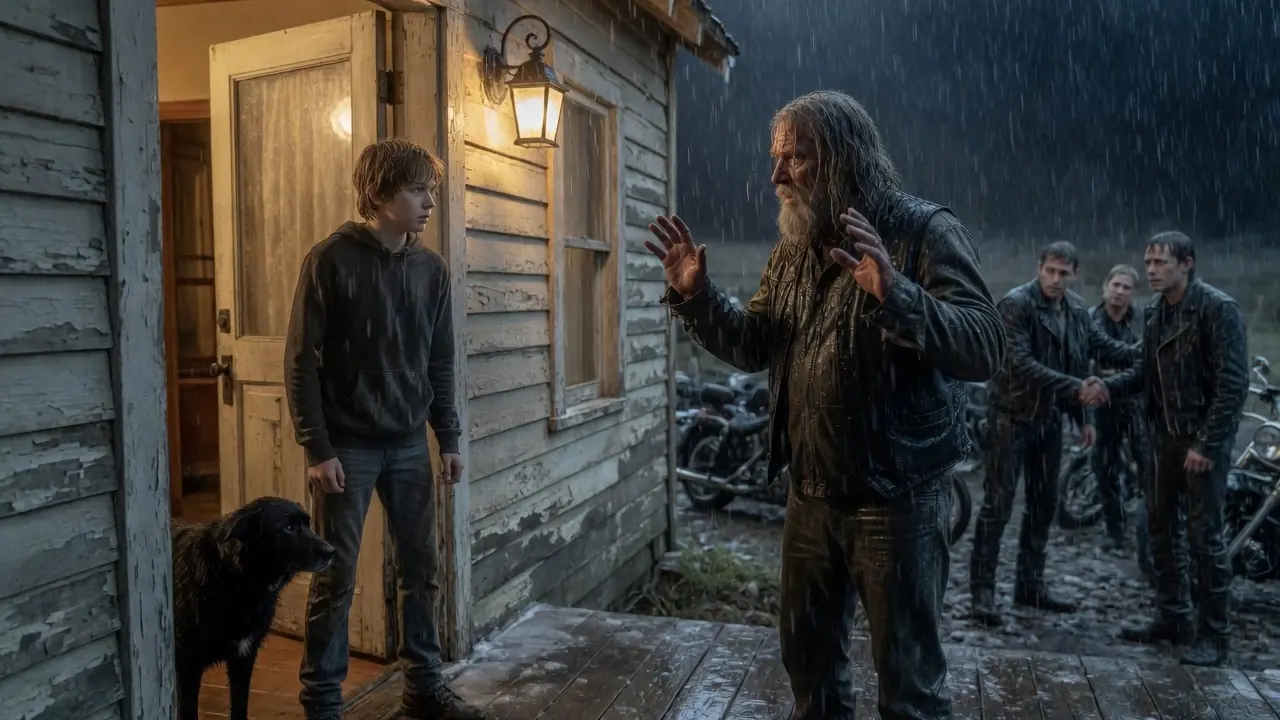
But at the very end of Blackpine Road, inside a small weather-beaten farmhouse with peeling white paint and a porch that sagged on one side, fourteen-year-old Caleb Mercer sat alone at a kitchen table, eating canned soup from a chipped blue bowl.
He had made the soup himself. He made everything himself now.
The little farmhouse had once belonged to his grandmother, and before that, to her parents. It smelled faintly of old wood, dust, and kerosene, no matter how often Caleb opened the windows in summer or scrubbed the floor when he got angry at the silence. The kitchen light flickered whenever the wind pushed too hard against the house, but Caleb never flinched. He had learned not to flinch at noises, not to run to windows, not to call out for someone who was not coming.
On the table beside his soup sat a stack of schoolbooks, a dull pocketknife, a flashlight, and a half-finished repair manual for an old generator in the shed. Caleb read repair manuals the way other kids read comic books. He liked things that made sense. Engines made sense. Wires made sense. Pipes, screws, cracked boards, loose hinges, busted locks, those things all had problems a person could fix if they were stubborn enough.
People were harder.
People asked questions. People promised things. People left.
Caleb had been living alone for seven months, though not everybody in town knew the truth. Some thought he stayed with an aunt from another county. Some believed a family friend checked on him regularly. Some knew something was wrong, but small towns had a way of pretending not to see things that made them uncomfortable.
His mother had disappeared from his life long before she officially left. His father had been gone since Caleb was ten, chasing work, trouble, and excuses from one town to another. His grandmother, the only person who had ever made the house feel like a home, had passed away the winter before. Since then, Caleb had built a life out of stubbornness, silence, and careful lies.
He paid the electric bill with money he earned doing odd jobs. He shoveled snow. He stacked firewood. He repaired screen doors. He cleaned out gutters for elderly neighbors who called him “that tough Mercer boy” and never asked too many questions. He stretched every dollar until it nearly snapped. He knew which store discounted bread after six. He knew how to make a jar of peanut butter last two weeks. He knew how to smile just enough at school so teachers would stop watching him too closely.
The thing Caleb hated most was pity.
He would rather go hungry than have someone look at him with soft eyes and say, “You poor thing.” He would rather sleep under three coats than admit he needed a heater repaired. He would rather walk five miles through snow than ask for a ride.
So when the storm worsened that evening, he only pulled his hoodie tighter, stood up, and checked the front door latch.
The wind slammed against the porch hard enough to rattle the windowpanes.
“Quit whining,” Caleb muttered to the house.
It was something his grandmother used to say to stubborn furniture, old pipes, and radios that refused to tune. Caleb said it now because the house felt less empty when he borrowed her words.
He walked to the stove, turned the flame low, and stirred the soup again even though it did not need stirring. It was chicken noodle, mostly broth, with a few tired pieces of carrot floating near the top. In the corner of the kitchen, an old black dog named Rusty lifted his head from a folded blanket.
Rusty was not really Caleb’s dog. He had belonged to the previous neighbor, Mr. Albright, who moved into assisted living two years earlier. Rusty had simply wandered over one morning, placed himself on Caleb’s porch, and never left. Caleb pretended not to care about him. He also warmed Rusty’s food before putting it down and let him sleep near the stove when nights got cold.
“Don’t look at me like that,” Caleb said. “You already ate.”
Rusty thumped his tail once.
Outside, thunder rolled low across the fields. The rain had begun turning into sleet, pinging against the glass. Caleb glanced toward the road. Blackpine Road was mostly invisible now, swallowed by storm and early darkness. Nobody with sense would be driving through this. Nobody would be riding anything through this.
Then he heard it.
At first, it sounded like thunder trapped beneath the ground.
Caleb froze with the spoon in his hand.
The sound grew louder, uneven and rough, rising beneath the storm. Engines. More than one. Motorcycles, maybe. Caleb moved to the window and wiped condensation from the glass with his sleeve.
Headlights appeared through the blowing sleet, wavering like ghosts.
Three motorcycles rolled slowly down the road, their riders hunched low, struggling against the wind. Behind them came two more. One bike swerved slightly, corrected, then kept moving. They were not speeding. They were crawling, fighting to stay upright on a road that had turned slick and dangerous under the freezing rain.
Caleb’s first instinct was to step back from the window.
He had seen bikers before at the gas station outside town. Big men with leather vests, heavy boots, beards, tattoos, loud engines, and voices that filled rooms. Adults lowered their eyes when they walked past them. Store clerks got nervous. Mothers pulled children closer. Caleb had learned early that a person could avoid a lot of trouble by not inviting it to the door.
The motorcycles slowed near his driveway.
Caleb’s hand tightened around the spoon.
“Keep going,” he whispered.
But they did not keep going.
The first bike rolled into his gravel drive, followed by the others. Their tires crunched over ice and loose stone. One rider nearly tipped getting off his bike, catching himself on the handlebar with a heavy, awkward stumble. Another leaned forward, both hands braced against the tank, his shoulders shaking.
Caleb backed away from the window.
Rusty stood now, ears raised, a low growl building in his throat.
“Easy,” Caleb said, though he was not sure if he meant the dog or himself.
A fist pounded on the front door.
The sound cracked through the house like a board snapping.
Caleb did not move.
Another knock came, harder this time.
“Hey!” a man’s voice called from outside, rough and strained. “Anybody home?”
Caleb looked toward the back door. He could run out through the mudroom and disappear into the shed if he had to. He knew every dark corner of the property. He knew where the axe was. He knew where his grandmother had kept the old baseball bat. He knew how to make himself smaller than a shadow.
The knock came again.
“Please!” the voice called. “We got a man freezing out here!”
That word changed something.
Freezing.
Caleb stared at the door.
He hated needing help. He hated being helpless even more. But he knew cold. Cold was not like hunger, which crept and complained. Cold was quiet and mean. Cold got into your fingers first, then your thoughts. Cold made proud people clumsy. Cold made strong people sit down and stop fighting.
He looked at Rusty.
The dog stared back, growling low.
“Stay,” Caleb whispered.
Then he grabbed the baseball bat from behind the coat rack, unlocked the door, and opened it just enough for the chain to catch.
The storm shoved icy air into his face.
On the porch stood five bikers, soaked through, steam rising faintly from their bodies into the freezing air. They were huge in their leather jackets and vests, their faces red from cold, their beards dripping with ice water. The man closest to the door had gray in his beard and a scar over one eyebrow. On his vest was a patch Caleb recognized from gas station whispers and old town gossip.
Hells Angels.
Caleb’s stomach tightened.
The man lifted both hands slowly, palms open.
“We’re not here to scare you, kid,” he said. His voice shook, though whether from cold or exhaustion, Caleb could not tell. “Storm came faster than the forecast said. One of my brothers is in bad shape. We just need shelter for a bit.”
Caleb said nothing.
The man glanced toward the bat in Caleb’s hand.
“Smart,” he said. “Keep holding that if it makes you feel better.”
Caleb narrowed his eyes. “How many of you?”
“Five.”
“You armed?”
The man paused, then gave a tired half-smile. “You ask questions like an old man.”
“I asked how many and if you’re armed.”
The smile faded into something more respectful. “Five. And we’re not looking for trouble.”
“That’s not an answer.”
Behind him, another biker coughed hard, bending forward. His lips had a faint bluish tint, and his fingers shook so badly he could not unzip his own jacket.
The gray-bearded man looked back at him, then at Caleb.
“Some of us carry pocketknives. Tools. Nothing we’re reaching for. You can make us leave anything by the door if that’s what it takes.”
Caleb studied them through the gap.
He had learned that fear often dressed itself as anger. He had also learned that some men sounded dangerous because they were dangerous, and others sounded dangerous because the world had never given them a reason to speak softly.
The biker who was coughing swayed.
The gray-bearded man put an arm around him.
“Kid,” he said, lower now. “He needs heat.”
Caleb kept his jaw tight.
His grandmother’s voice rose in his memory, not as a ghost, not as magic, but as a habit left behind in his bones.
Never be stupid, Caleb. But never let fear make you cruel.
He shut the door.
For one second, the porch went silent.
Then Caleb slid off the chain, opened the door wider, and stepped back with the bat still in his hand.
“Boots off by the mat,” he said. “Jackets on the hooks. Don’t touch the dog. Don’t go past the kitchen unless I say.”
The gray-bearded biker blinked.
Then he nodded once.
“Yes, sir.”
Caleb almost told him not to mock him, but the man’s face did not look mocking.
The bikers entered one by one, bringing the storm with them. Rainwater dripped from their sleeves. Their boots thudded heavily on the entry rug. The house seemed to shrink around them. They were too big for the narrow hallway, too loud even when quiet, too alive for a place that had spent months listening only to wind, pipes, and Caleb’s careful footsteps.
Rusty barked once.
The youngest biker, a broad-shouldered man with a shaved head and silver rings on his fingers, raised both hands.
“Hey, old man,” he said gently to the dog. “I respect your house.”
“Kitchen,” Caleb ordered.
They obeyed.
That surprised him.
Adults did not usually obey fourteen-year-old boys, especially not boys in faded jeans with a baseball bat and a hoodie two sizes too small. But these men moved carefully, watching him for instructions. The gray-bearded man helped the shivering biker into a chair near the stove.
Caleb pointed at the others. “Sit where I can see you.”
One of them, a tall man with a long black braid and a face weathered like old leather, let out a soft laugh.
The gray-bearded man looked at him.
The laugh stopped.
Caleb went to the stove, turned the flame higher, and pulled down the second pot. He filled it with water and set it to boil. His hands moved quickly, confidently. This was his house. This was his kitchen. He knew which cabinet stuck, which drawer had matches, which towel was clean enough to use on guests, and which one was for wiping Rusty’s paws.
He tossed towels toward the bikers.
“Dry your heads. Not with the blue one. That’s for dishes.”
The shaved-headed biker caught a towel and looked at it like it was a gift.
“Thank you.”
Caleb did not answer.
He opened the pantry and stared at what he had. Two cans of beans. Half a loaf of bread. Oatmeal. Crackers. A bag of potatoes with eyes starting to grow. Four packets of instant cocoa he had been saving for the coldest week of winter.
He glanced at the bikers.
Then at the cocoa.
Then back at the bikers.
His mouth tightened.
“Don’t get used to it,” he muttered, pulling the packets down.
The gray-bearded man watched him quietly. “What’s your name, kid?”
Caleb ripped open the first cocoa packet with his teeth. “What’s yours?”
“Marcus. Folks call me Bear.”
“Of course they do.”
One of the bikers chuckled under his breath.
Marcus, or Bear, smiled faintly. “And you?”
“Caleb.”
“Nice to meet you, Caleb.”
“No, it’s not. You’re freezing and I’ve got cheap soup.”
Bear’s smile deepened, but not in a teasing way. “Best invitation I’ve had all week.”
Caleb poured hot water into mugs, stirred in cocoa, and passed them around. The biker in the chair with shaking hands tried to hold his mug but nearly dropped it. Caleb noticed, cursed softly under his breath, and wrapped a towel around the mug before handing it back.
“Use both hands,” Caleb said.
The man looked at him with tired eyes. “Yes, sir.”
Again with that.
Caleb turned away before they could see that it affected him.
The storm beat against the windows. The house, which usually felt too empty, now felt almost crowded with breath and dripping leather and the faint smell of gasoline, rain, and cold road. Caleb added water to the soup to stretch it, then opened the beans and potatoes. He worked without asking whether they were hungry. People did not ride motorcycles through freezing rain and then turn down hot food.
The bikers sat quietly, warming their hands around mugs.
For several minutes, nobody spoke except the storm.
Caleb liked that. Silence was easier than conversation.
But the silence in the room had changed. It was not the dead, hollow silence he knew. This silence had weight. It had men breathing, a dog settling back down, water simmering, chairs creaking under heavy bodies. It was a silence that belonged to people waiting together, not one person being forgotten.
He did not know what to do with that.
When the soup was ready, Caleb ladled it into every bowl he owned. There were only four proper bowls, so he used mugs for the rest. He set crackers in the middle of the table and put the bread on a plate.
“It’s not much,” he said.
The braided biker looked down at the bowl like Caleb had placed a feast in front of him.
“It’s heat,” he said. “Heat counts.”
The shivering biker, whose name Caleb learned was Danny, took a slow spoonful and closed his eyes.
“Man,” Danny whispered. “That’s good.”
“It’s canned.”
“Still good.”
Caleb sat at the end of the table with his own bowl, the bat leaning against his chair within reach. He ate quickly, out of habit. When food was uncertain, slow eating felt foolish. But the bikers ate slowly, with a kind of respect that made him uncomfortable.
Bear noticed everything. Caleb could feel it.
The gray-bearded man did not stare rudely, but his eyes moved around the kitchen. He saw the single plate in the drying rack. The unpaid bill tucked under a magnet on the refrigerator. The schoolbooks stacked beside repair tools. The patched sleeve on Caleb’s hoodie. The old photograph taped near the stove of a younger Caleb standing beside an elderly woman with silver hair and bright eyes.
Caleb saw Bear notice the photograph.
His shoulders stiffened.
“Don’t,” Caleb said.
Bear looked back at him. “I didn’t say anything.”
“Good.”
The shaved-headed biker, whose name was Luis, lifted his spoon halfway. “You always feed strangers with a bat beside you?”
“Only the ugly ones.”
Danny laughed so suddenly he coughed, and the whole table shifted toward him with concern. Caleb stood, grabbed the kettle, and refilled Danny’s cocoa.
“Don’t die in my kitchen,” Caleb said.
Danny smiled weakly. “I’ll try not to disrespect the place.”
“You better.”
Bear leaned back slightly, watching Caleb with an expression Caleb did not like. It was not pity, exactly. Caleb knew pity. Pity made people tilt their heads and speak like every word was wrapped in cotton. Bear’s look was sharper than that. Sadder too, but not soft.
It looked like recognition.
Caleb hated that even more.
They ate. The storm continued. Outside, the motorcycles sat in the driveway under a growing coat of ice. The windows fogged. Rusty eventually rose, sniffed each man’s boots from a careful distance, then sat beside Caleb’s chair like a guard.
“You trained him well,” Luis said.
“He trained himself.”
“Dogs don’t do that.”
“This one did.”
Rusty leaned against Caleb’s leg.
Luis smiled into his bowl. “Sure.”
When the first hunger had passed, Bear placed his spoon down carefully.
“Caleb,” he said.
The boy did not look up. “What?”
“Where are your folks?”
The room changed.
It happened quietly, but Caleb felt it. The spoons slowed. Danny lowered his mug. Luis looked down at the table. The braided biker, whose name was Ronan, stared toward the window as though giving Caleb privacy while still listening.
Caleb kept eating.
“Not here,” he said.
Bear waited.
Caleb scraped the bottom of his bowl with the spoon. “That answer usually works.”
“I’m not usually people.”
Caleb looked up then. His eyes were gray, his face thin, his hair too long around the ears because he had cut it himself badly and then given up. He had the kind of expression a boy gets when childhood has been taken from him, but he refuses to let anyone see the empty space it left behind.
“My mom left,” he said. “My dad left before that. Grandma died. I live here.”
No one spoke.
Caleb hated the silence immediately.
He shrugged, too hard and too fast. “It’s fine.”
Bear’s brow tightened. “You live here alone?”
“I just said that.”
“You’re fourteen.”
“So?”
“That’s young.”
“Not when nobody else is around.”
The words came out sharper than he intended. Caleb set his spoon down and leaned back like he did not care. Like his chest had not suddenly gone tight. Like the simple act of saying the truth aloud had not made the kitchen feel colder.
Luis looked at Bear, but Bear did not look away from Caleb.
“Who checks on you?” Bear asked.
Caleb gave a short laugh. “You applying for the job?”
“I’m asking.”
“And I’m answering. Nobody. I’m fine.”
“Kid.”
“Don’t call me that.”
“Caleb.”
“What?”
Bear spoke gently, and somehow that was worse. “A person can get used to something and still deserve better.”
Caleb’s face hardened.
“I don’t need better.”
“That’s not what I said.”
“I don’t need anybody.”
The sentence came fast, practiced, almost automatic. It was the wall he had built brick by brick since his grandmother’s funeral, every brick made of pride, anger, and days survived alone. He had said it to teachers, neighbors, store clerks, and once to himself in the bathroom mirror when the water had been shut off for two days.
I don’t need anybody.
Bear nodded slowly.
“I used to say that too.”
Caleb looked at him with open suspicion. “Yeah? You live in a farmhouse alone when you were fourteen?”
“No,” Bear said. “I lived in worse places with more people.”
That answer stopped Caleb from snapping back.
Bear folded his hands on the table. They were large hands, scarred from work and weather, the kind of hands that looked capable of fixing things and breaking things, though in Caleb’s kitchen they only rested around a chipped mug of cocoa.
“My father was there,” Bear said. “But being there and being a father aren’t the same thing. My mother worked double shifts until she wore herself thin. I learned early not to ask for anything. Then I got good at pretending I didn’t want anything either.”
Caleb stared at the table.
“I don’t care,” he said.
“I know.”
“Then why are you talking?”
“Because sometimes a man talks to the boy he used to be, even if the boy doesn’t want to hear it.”
Caleb pushed his chair back so hard Rusty lifted his head.
“I’m not some sad little project,” he said. “I opened the door because your friend was freezing. That’s it. Eat your soup. Warm up. When the storm lets up, leave.”
Nobody moved.
The words sounded strong. Caleb wanted them to sound strong. But the last word cracked just enough to betray him, and he hated himself for it.
Leave.
That was the word every person in his life seemed to understand best.
Bear did not argue. He simply nodded.
“Fair enough.”
Caleb stood, grabbed the empty bowls, and carried them to the sink. His hands shook once, and he shoved them under the water so nobody would see. He scrubbed too hard. The sponge squeaked against ceramic. Behind him, the bikers remained quiet.
He expected whispers. He expected pity. He expected someone to say there had to be an adult, a school counselor, a neighbor, a relative, some system that should have caught him before he became a boy living alone on soup and stubbornness.
But no one said any of that.
Instead, Ronan rose and said, “Where’s your woodpile?”
Caleb turned. “What?”
“Your stove’s gonna need more wood before morning.”
Caleb frowned. “I can get it.”
Ronan nodded toward the window. “In that?”
“I’ve done it before.”
“Not tonight.”
Caleb’s grip tightened on the bowl.
“I said I can get it.”
Ronan did not argue either. He only looked at Bear.
Bear sighed, stood slowly, and reached for his wet jacket.
Caleb stiffened. “What are you doing?”
“Getting wood.”
“I didn’t ask you to.”
“No, you fed us.”
“That doesn’t mean you get to act like you own the place.”
Bear looked at him, and for the first time, his voice carried a little iron.
“No one owns kindness once it’s given, Caleb. It goes where it’s needed next.”
The words settled heavily in the kitchen.
Caleb had no answer.
So the bikers went outside into the storm.
Not all of them. Danny stayed by the stove, wrapped in two towels, with Rusty watching him like a suspicious nurse. But Bear, Luis, and Ronan pulled on their boots and stepped into the freezing rain. Caleb followed to the porch, angry and confused, holding a flashlight.
“You don’t even know where it is,” he called.
“Then show us,” Bear said.
Caleb stood there for a moment.
Then, muttering under his breath, he grabbed his coat and led them around the side of the house.
The storm had turned the yard into a silver blur. Sleet struck Caleb’s face, sharp as thrown sand. The woodpile sat under a sagging tarp beside the shed. Caleb had meant to bring in more before dark, but the latch on the back window had broken, then the generator had sputtered, then dinner had become soup, and then bikers had appeared on his porch like a fever dream.
The men moved fast. Ronan held the tarp down while Luis stacked logs in his arms. Bear took the heaviest pieces without comment. Caleb tried to grab as much as they did and nearly slipped on the icy ground.
Bear caught his elbow.
Caleb yanked away.
“I had it.”
“I know.”
“No, you don’t.”
Bear looked down at him in the storm. Rain ran through his beard. His leather vest was soaked, his shoulders broad under the porch light’s weak glow. He looked like someone the world would step around carefully.
But his eyes were steady.
“You’re allowed to almost fall,” Bear said. “Doesn’t mean you’re weak.”
Caleb swallowed.
The sleet hid whatever crossed his face.
“I hate when people say things like that,” he muttered.
Bear smiled faintly. “Then I’ll say it again later.”
“Don’t.”
They carried the wood inside.
Then the men kept moving.
Without asking permission, but without taking over, they began fixing little things. Luis noticed the towel stuffed beneath the back door to stop the draft and adjusted the loose hinge with a screwdriver from his saddlebag. Ronan found the breaker that kept flickering and checked the panel with Caleb standing beside him, arms crossed, ready to correct him. Bear hauled wood and stacked it neatly by the stove, then cleaned the mud from the entryway with an old mop.
Caleb kept saying, “I can do that.”
Each time, one of the men answered, “We know.”
That was what confused him most.
They did not act like he was helpless. They did not laugh at his repairs, even the ugly ones. Ronan complimented the wire patch Caleb had made on the generator. Luis said the door hinge had been “a decent temporary fix.” Bear asked where Caleb kept tools, then put them back exactly where he found them.
They treated him less like a child in trouble and more like the owner of a place they were honored to be invited into.
That made something ache in Caleb’s chest.
Around nine, the storm worsened again. The radio signal crackled with county warnings. Roads were icing over. Travel was discouraged until morning. Bear listened, jaw tight, then looked at Caleb.
“We’ll stay in the mudroom if you allow it,” he said. “Not in the bedrooms. Not anywhere you don’t want us. Soon as daylight comes and roads clear, we go.”
Caleb glanced at the window.
Part of him wanted them gone. Their presence disturbed the order of his loneliness. They asked too many questions by noticing too much. They brought warmth with them, and warmth was dangerous because a person could miss it after it left.
Another part of him looked at the dark hallway, the empty rooms, the old photograph near the stove, and the chair where his grandmother used to sit.
He shrugged.
“Don’t snore loud.”
Danny raised one hand weakly. “No promises.”
Caleb found blankets in the hall closet. Most were old, some smelled like cedar, and one had a burn hole near the corner from when his grandmother dropped ash from a cigarette she always claimed she did not smoke. He handed them out like it was nothing.
But when Bear took the blanket from him, he held it for a second before speaking.
“Thank you, Caleb.”
The boy looked away.
“Don’t make it weird.”
Bear nodded. “Wouldn’t dream of it.”
That night, Caleb lay awake in his bedroom, listening.
He heard the men settle in the mudroom and kitchen. He heard low voices. He heard Danny cough less often. He heard Rusty’s nails click on the floor as the dog moved between Caleb’s door and the strangers downstairs.
He waited for fear to come.
It did, at first. Fear was familiar. Fear told him he was stupid for letting strangers in. Fear reminded him of every warning he had ever heard, every story people told about bikers and trouble. Fear told him to sleep with the bat under his arm.
So he did.
But beneath the fear was something worse.
Comfort.
The house did not creak as loudly with other people inside. The storm did not feel as enormous. The darkness did not press so close. For the first time in seven months, Caleb was not the only human breathing under that roof.
He hated how much that mattered.
At some point near midnight, he got up for water.
He stepped quietly into the hallway, bat in hand. Downstairs, the stove glowed softly. Bear sat awake at the kitchen table, one arm folded under his head but his eyes open, watching the back door.
Caleb froze on the stairs.
Bear looked up.
“Couldn’t sleep?” Bear asked.
“I needed water.”
Bear nodded.
Caleb came down slowly, filled a glass at the sink, and drank. He expected Bear to say something else. Adults always ruined quiet by filling it.
But Bear said nothing.
That made Caleb speak first.
“Why are you awake?”
“Habit.”
“Because you don’t trust me?”
Bear’s expression softened just slightly. “Because I’m responsible for my brothers.”
Caleb leaned against the counter. “They’re grown men.”
“So am I. Still need people watching out sometimes.”
Caleb looked into his glass.
“I watched out for my grandma,” he said before he could stop himself.
Bear stayed still.
Caleb did not know why he kept talking. Maybe the hour was too late. Maybe the storm had worn him down. Maybe it was easier to speak in the dark where no one’s eyes had to catch every piece of pain.
“She got sick last year,” Caleb said. “She kept saying she was fine. I knew she wasn’t. I cooked and cleaned and helped her get to the chair. She’d get mad if I fussed too much. Said I had the face of a worried old widow.”
A small smile touched his mouth, then vanished.
“She died in that chair.”
Bear lowered his eyes.
Caleb gripped the glass with both hands.
“After that, everybody wanted to decide things. Social worker came once. Some woman from my mom’s side called and said maybe she could take me in, but she had three kids and a boyfriend who didn’t want trouble. Then people stopped calling. I figured it out.”
“You shouldn’t have had to.”
Caleb’s head snapped up. “Don’t.”
Bear’s voice stayed calm. “Don’t what?”
“Say the obvious like it helps.”
Bear nodded slowly. “Fair.”
Caleb breathed hard through his nose, angry at himself now more than Bear.
“I’m not weak,” he said.
“I never thought you were.”
“I’m not scared.”
“I think you are.”
Caleb’s face burned.
Bear continued before the boy could explode. “And I think you keep moving anyway. That’s not weakness. That’s courage.”
Caleb stared at him.
No one had ever said courage like that before. People used it for firefighters on television, soldiers in old stories, heroes in books. They did not use it for boys who lied about lunch money and repaired their grandmother’s house with borrowed tools.
Caleb looked away first.
“You don’t know me.”
“No,” Bear said. “But I know the look of someone who learned too young that needing people can cost too much.”
The kitchen went quiet.
Rusty padded in from the mudroom, sniffed Bear’s boot, then leaned against Caleb’s leg.
Caleb rubbed the dog’s head.
“My grandma said I was born stubborn,” he muttered.
“Sounds like a smart woman.”
“She was bossy.”
“Smart women usually are.”
Caleb gave a small laugh despite himself. It surprised him so much that he immediately stopped.
Bear pretended not to notice.
“Go sleep,” Bear said. “I’ve got the door.”
Caleb wanted to argue. He wanted to say he did not need anyone watching doors for him. He wanted to say this was his house and his problem and his night to survive.
Instead, he whispered, “Don’t steal anything.”
Bear smiled faintly. “Wouldn’t dare. Dog looks mean.”
“Dog is mean.”
Rusty wagged his tail.
Caleb went back upstairs.
This time, when he lay down, he still held the bat. But he slept deeper than he had in months.
Morning came pale and quiet.
The storm had passed, leaving the world coated in ice. Trees glittered under a white sky. The road looked glassy and dangerous, but the wind had stopped. Caleb woke to the smell of coffee and something frying.
For one wild second, he thought his grandmother was downstairs.
Then he remembered.
He sat up sharply.
The bat fell off the bed.
By the time he got downstairs, his kitchen had been invaded by breakfast. Luis stood at the stove, cooking eggs from a carton Caleb did not recognize. Ronan was slicing bread. Danny, looking alive again, sat at the table peeling potatoes. Bear was outside with a shovel, clearing the porch steps.
Caleb stopped in the doorway.
“What is this?”
Luis turned, wearing one of Caleb’s grandmother’s aprons. It barely covered his leather vest.
“Breakfast.”
“With what food?”
“Our food.”
“You had food?”
“Saddlebags,” Danny said, holding up a potato. “Emergency supplies.”
Caleb stared at them.
“You cooked in my kitchen?”
Luis looked down at the pan, then back at Caleb. “Yes.”
“Without asking?”
Luis winced. “Also yes.”
Caleb crossed his arms.
The men braced themselves.
Then Caleb said, “You’re burning the eggs.”
Luis spun back to the stove. “No, I’m not.”
“You are.”
“I am absolutely not.”
Ronan leaned over, looked into the pan, and said, “He is.”
Danny laughed.
Caleb took the spatula from Luis with exaggerated disgust. “Move.”
Luis stepped aside.
The bikers watched as Caleb rescued the eggs, lowered the heat, added a little milk from the cooler they had brought in, and stirred with sharp, efficient movements.
“You cook?” Danny asked.
“I eat, don’t I?”
Bear came in then, stamping snow from his boots. He saw Caleb at the stove and the others sitting around like guilty schoolboys.
“What’d you do?” Bear asked.
“Burned eggs,” Caleb said.
Luis pointed at him. “Nearly burned.”
“Burned.”
“Nearly.”
Caleb ignored him.
Breakfast felt strange.
Not bad. Strange.
There were too many plates, too many voices, too many hands reaching for toast. Danny told a story about once getting stuck for three hours at a rest stop because Ronan lost a bike key in a vending machine. Ronan denied every detail except the vending machine. Luis argued with Caleb about whether pepper belonged on eggs. Bear ate quietly, but Caleb noticed he kept placing food near the boy’s plate without making it obvious.
Caleb noticed everything too.
He noticed when Danny’s hand stopped shaking. He noticed how Ronan wiped the counter after slicing bread. He noticed how Luis asked before opening a cabinet the second time. He noticed how Bear took out the trash without announcing it, as though doing small chores was not charity but respect.
After breakfast, the men checked the bikes.
One would not start.
Caleb tried not to be interested.
He failed.
He stood on the porch while Bear crouched beside the motorcycle, testing the ignition. The engine clicked but refused to turn. Caleb watched for exactly forty seconds before stepping down.
“Battery connection,” he said.
Bear looked over his shoulder. “You sure?”
“No.”
“Then why say it?”
“Because I’m probably right.”
Luis laughed from the other bike. “I like him.”
Caleb crouched beside Bear, pointed under the seat, and explained what he thought had happened. Moisture, loose terminal, maybe corrosion. Bear listened without interrupting. Then he handed Caleb a tool.
“You want to check?”
Caleb hesitated.
Adults usually took tools from him. They did not hand them to him.
He accepted the wrench.
Ten minutes later, the bike started.
The engine roared to life, loud enough to send birds bursting from the icy trees.
Caleb tried not to smile.
He failed at that too, but only a little.
Ronan clapped once. “Kid knows his machines.”
Caleb stood, wiping grease on his jeans. “Machines tell you what’s wrong if you listen.”
Bear looked at him. “People do too.”
Caleb rolled his eyes. “That sounded smarter in your head.”
“It really did,” Bear admitted.
The morning stretched.
The road crews did not come early. The county plow passed once around noon but did not fully clear the road. The bikers could not safely leave yet, and Caleb pretended this annoyed him more than it did. He showed Ronan the generator. Ronan showed him how to clean a carburetor more efficiently. Luis tightened the loose porch railing. Danny helped stack wood, though Caleb told him twice to sit down.
By afternoon, the farmhouse looked less tired.
Not fixed. Not new.
Just less alone.
Caleb hated that he noticed.
Around three, Bear asked if he could use the phone. Cell service had been poor, but the landline still worked when the weather allowed. Caleb nodded, and Bear made a call from the kitchen while Caleb pretended to read at the table.
“Yeah, we’re safe,” Bear said. “Blackpine Road. Farmhouse at the end. Kid here took us in.”
Caleb’s pencil stopped.
Bear listened, then said, “No. Don’t make a scene. I mean it. We leave when roads clear.”
A pause.
“Because I said don’t make a scene.”
Another pause.
Bear pinched the bridge of his nose. “I know what club I’m talking to, Eddie.”
Caleb looked up. “Who’s Eddie?”
Bear covered the receiver. “Trouble.”
“I heard that!” a loud voice crackled faintly through the phone.
Caleb raised an eyebrow.
Bear sighed.
The roads were passable by late afternoon. The sky remained gray, but the ice had begun dripping from the trees. Caleb stood on the porch as the bikers loaded their saddlebags and put on their helmets.
He told himself he was relieved.
The house would go back to normal. The kitchen would be quiet. The bowls would return to the cabinet. The chair beside the stove would be empty. No one would ask where his parents were. No one would look at him like he was both strong and breakable.
Good.
That was good.
Bear walked up the porch steps last.
Caleb shoved his hands into his hoodie pocket.
“Thanks for not dying,” he said.
Bear smiled. “Thanks for not letting us.”
Caleb shrugged.
Luis stepped forward and offered a fist bump.
Caleb stared at it.
Then, after a long moment, he bumped it quickly.
Luis grinned like he had won a prize.
Danny crouched slightly so he and Caleb were closer to eye level. “You saved me last night.”
Caleb looked uncomfortable. “I gave you cocoa.”
“Sometimes cocoa saves a man.”
“Don’t make it dramatic.”
Danny nodded solemnly. “Never.”
Ronan handed Caleb a small folding multi-tool. “For the generator.”
Caleb immediately shook his head. “No.”
“Take it.”
“I don’t take charity.”
“It’s not charity. It’s payment.”
“For soup?”
“For hospitality under hostile conditions.”
Caleb frowned. “That sounds fake.”
“It is. Take the tool.”
Caleb looked at Bear.
Bear said nothing.
Finally, Caleb accepted it.
The weight of the tool in his palm felt heavier than it should have.
Bear stepped closer, but not too close.
“You got a number here?”
Caleb stiffened. “Why?”
“So we can check that you’re breathing.”
“I’ve been breathing fine.”
“Caleb.”
The boy looked away toward the road.
Bear waited.
The waiting was what got him. Not pressure. Not pity. Just patience.
Caleb gave him the number.
Bear wrote it on a folded receipt and tucked it inside his vest.
“If you need anything,” Bear said, “you call.”
“I won’t.”
“I know you won’t. Call anyway.”
Caleb’s jaw moved.
“Why do you care?”
Bear looked at the house, then at the boy standing too straight on a porch he had defended like a fortress.
“Because somebody should have cared sooner,” he said.
Caleb had no defense against that.
The bikers mounted their machines. Engines rumbled to life, deep and thunderous, but no longer frightening in the same way. Bear raised two fingers in farewell. Caleb lifted one hand halfway, then shoved it back into his pocket.
He watched them leave.
The sound faded slowly down Blackpine Road until only dripping ice remained.
Inside, the house felt enormous.
Caleb stood in the kitchen for a long time after they were gone. The mugs were washed. The floor was cleaner than before. The woodpile by the stove was stacked high. On the table sat the multi-tool.
He picked it up, opened and closed it, then set it down.
Rusty nudged his hand.
“Don’t start,” Caleb said.
That night, Caleb ate leftover potatoes and eggs. He did his homework. He repaired the back window latch. He checked the phone once for no reason and got angry at himself for doing it.
Nobody called.
He told himself that was better.
The next day, at school, everything went on like normal. Teachers talked. Kids laughed. Someone spilled milk near the cafeteria door. Caleb sat in the back of math class and fixed the spring inside a broken mechanical pencil while pretending to take notes.
But something inside him had shifted just enough to irritate him.
When a teacher asked if he had eaten breakfast, he almost snapped the usual answer. Instead, he said, “Yeah.”
Because he had.
When a boy in the hallway bumped his shoulder and said, “Watch it, Mercer,” Caleb almost shoved him. Instead, he kept walking. Not because he was scared. Because Bear’s voice had followed him into the school somehow.
Fear makes you cruel if you let it.
Bear had not said those exact words, but Caleb heard them anyway.
Three days passed.
Then the phone rang.
Caleb stared at it from across the kitchen like it was a wild animal.
It rang again.
Rusty barked.
“I hear it,” Caleb said.
He picked up.
“Hello?”
“Caleb Mercer?” a voice boomed.
Caleb frowned. “Who’s this?”
“Eddie.”
“Trouble Eddie?”
A delighted laugh exploded through the receiver. “He told you about me?”
“He said one word.”
“That’s Bear. Emotionally constipated.”
Caleb blinked. “What do you want?”
“Bear told us what you did. Club wants to say thank you.”
“No.”
There was a pause.
“You don’t know what I’m asking.”
“Still no.”
Another laugh. “You are exactly how he described.”
“What did he describe?”
“Mean little scarecrow with a hero complex.”
Caleb’s grip tightened. “I do not have a hero complex.”
“I’ll inform the committee.”
“There’s no committee.”
“Oh, kid, there is always a committee.”
Caleb looked toward the door, suddenly suspicious. “What are you doing?”
“Nothing today.”
“That’s not comforting.”
“Good. Keeps your reflexes sharp.”
Caleb almost smiled, which annoyed him.
Eddie’s voice softened slightly. “We’re not trying to embarrass you. Bear said you don’t like pity.”
“I don’t.”
“This isn’t pity. It’s respect.”
“I don’t need that either.”
“Everybody needs respect.”
Caleb was quiet.
Eddie continued, “Sunday afternoon. Two o’clock. We’re riding through. We’ll leave something on the porch if you don’t want company.”
“What something?”
“Wouldn’t be a surprise if I told you.”
“I hate surprises.”
“Noted and ignored.”
Then Eddie hung up.
Caleb stared at the phone.
“No,” he said to the empty kitchen.
Sunday came cold and bright.
Caleb spent the morning pretending not to care. He cleaned the kitchen. Then he got mad because cleaning made it look like he cared, so he messed up the table with schoolbooks. Then he got mad because the table looked messy, so he stacked them neatly again.
Rusty watched from his blanket, unimpressed.
At one-thirty, Caleb put on his coat and went outside to check the mailbox.
There was no mail on Sundays.
At one-forty, he checked the generator.
It was fine.
At one-fifty, he stood on the porch with his arms crossed, glaring down the road.
At two exactly, he heard thunder.
Not sky thunder.
Engines.
Many engines.
The sound rose from beyond the bend in Blackpine Road, low and rolling, growing until the air itself seemed to tremble. Caleb stepped off the porch. Rusty barked once, then stood beside him.
The first motorcycles appeared over the hill.
Then more.
Then more.
Rows of headlights rolled toward the farmhouse, chrome flashing under the pale winter sun. Black leather, denim, helmets, patches, flags, headlights, boots, gloves, wheels turning in slow formation. The line stretched farther than Caleb could see, bending along the road like a river of steel.
His mouth fell open.
Motorcycles filled the road in front of the farmhouse. They did not roar into the yard or tear across the grass. They parked carefully along the shoulder, in the driveway, beside the fence, anywhere they could fit without damaging the property. Men and women climbed off bikes, some old, some young, some broad and tattooed, some gray-haired and smiling, all moving with surprising respect.
Caleb stepped backward.
“What the heck,” he whispered.
Bear appeared near the front of the line, walking beside a shorter man with a huge mustache and a grin that looked permanently guilty.
Eddie.
Caleb knew immediately.
Bear climbed the porch steps slowly.
Caleb pointed at the road. “You said five.”
“I said five that night.”
“You knew about this?”
Bear glanced back. “I told them not to make a scene.”
Eddie spread his arms. “This is not a scene. This is a modest expression of gratitude.”
“There are like a hundred people here,” Caleb said.
“One hundred fifty-three,” Eddie said proudly. “But a few are shy.”
Caleb looked at Bear in betrayal.
Bear sighed. “I tried.”
The crowd did not rush him. That was the only reason Caleb did not bolt into the house. They stayed back, giving him space. Some held grocery bags. Others carried boxes. A few leaned against bikes, watching with curious, kind eyes that made Caleb feel exposed.
Eddie stepped forward but stopped at the bottom of the porch.
“Caleb Mercer,” he said loudly, and the whole crowd quieted. “We heard that when our brothers were caught in a storm, you opened your door. We heard that you fed them, warmed them, and watched over them even though you had every reason to be scared.”
Caleb’s face went hot.
“I didn’t watch over them.”
Danny, standing near the fence, called, “He did!”
Caleb glared at him.
Eddie continued, “We also heard you don’t like charity.”
“I don’t.”
“Good. Because this isn’t charity.”
Several riders stepped forward and placed boxes on the porch. Groceries. Firewood vouchers. A new winter coat. Work gloves. Dog food. A toolbox. A stack of repair manuals. A prepaid card for the hardware store. Caleb stared at the growing pile, overwhelmed and angry and something else he did not want to name.
“This is too much,” he said.
Bear answered quietly, “You gave what you had.”
“I gave soup.”
“You gave shelter.”
“I had extra.”
“No,” Bear said. “You didn’t.”
The truth landed hard.
Caleb looked away.
Eddie’s voice softened. “A lot of us know what it means to be alone too young. Some of us had houses but no homes. Some of us had families but no safety. Some of us found brotherhood late and held onto it like a lifeline. So when we heard about a fourteen-year-old boy standing in a storm with a baseball bat, letting cold men into his kitchen because he refused to let them freeze, we understood something.”
Caleb stared at the porch floor.
Eddie removed a small patch from inside his jacket. It was not a club patch. Not a member patch. Just a simple cloth emblem with stitched wings around a small house.
He held it out.
“This doesn’t make you one of us,” Eddie said. “You’re a kid. You’ve got school, homework, and probably a long list of people to annoy before adulthood.”
A few riders laughed softly.
“But this means you’re under our roof now. Not because you owe us. Because every kid deserves someone who answers when he calls.”
Caleb did not take the patch.
His hands stayed in his pockets.
Bear watched him, saying nothing.
The whole crowd waited.
Caleb hated crowds. He hated attention. He hated the feeling in his throat, tight and burning. He hated that he wanted to grab the patch. He hated that wanting it made him feel small.
“What happens when you get tired of me?” he asked.
The question came out before he could stop it.
The bikers went quiet.
Bear’s expression changed. Not pity. Pain.
Eddie lowered the patch slightly.
“Then Bear gets tired of me first,” he said. “And he’s been trying for twenty years.”
A few people chuckled, but Caleb did not.
Bear stepped forward and crouched in front of him, right there on the porch, so Caleb had to look at him.
“Listen to me,” Bear said. “People leaving you taught you to expect the door to close. I understand that. We’re not asking you to trust one hundred fifty strangers today. That would be stupid.”
Caleb gave a weak snort.
Bear continued, “Trust one thing. Just one. When you call, someone answers. That’s all. You don’t have to call us family. You don’t have to need us out loud. You don’t even have to be nice.”
“He’s already good at that part,” Luis called.
Caleb shot him a look, but his eyes were wet now, and the glare did not work.
Bear held his gaze.
“You opened the door for us,” Bear said. “Let us keep one open for you.”
Caleb’s jaw trembled once.
He bit down hard to stop it.
For seven months, he had survived by making himself hard enough that loneliness could not chew through him. He had told himself needing people was a trap. He had told himself homes were just buildings people left behind. He had told himself he was fine so many times that the words had become a kind of cage.
But now there were motorcycles lining the road, strangers standing in the cold, groceries on his porch, dog food for Rusty, tools for his hands, and a gray-bearded biker kneeling in front of him like his answer mattered.
Caleb pulled one hand from his pocket.
He took the patch.
The crowd did not cheer wildly. Somehow they understood that would break the moment. Instead, a low wave of applause moved through them, soft at first, then stronger, like rain beginning again but gentler this time.
Caleb stared at the patch in his palm.
“Still not joining a club,” he muttered.
Eddie grinned. “Wouldn’t let you. You’re too bossy.”
“I am not.”
Bear stood. “You are.”
Caleb looked around at the riders, the bikes, the boxes, the road, the house. He wanted to say thank you, but the words felt too small and too dangerous. So he did what he knew how to do.
He pointed at the porch railing.
“Don’t lean on that. It’s still weak.”
Three bikers immediately stepped back.
Eddie laughed so hard he bent over.
The afternoon became something Caleb would remember for the rest of his life.
The bikers did not invade the house. They formed a careful line, bringing supplies to the porch and asking where things should go. Some carried groceries into the kitchen only after Caleb allowed it. Others stacked wood, fixed the shed door, patched the porch steps, cleared brush from the side yard, and checked the roof where rain had been leaking into the attic.
Caleb tried to supervise like a foreman.
To his surprise, they let him.
A woman named Marla, who rode a blue motorcycle and had silver hair braided down her back, helped organize the pantry. She did not fuss over him. She only asked, “Beans on the left or right?”
Caleb stared at her.
“What?”
“Your pantry. Your rules.”
“Left,” he said slowly.
“Good choice.”
A man named Tiny, who was not tiny at all, repaired the loose porch railing while Caleb held the screws. A quiet rider named Sam showed him how to sharpen a handsaw safely. Luis brought Rusty a bag of treats, then asked the dog’s permission before offering one.
Rusty accepted.
“Traitor,” Caleb said.
Rusty ate another treat.
Danny looked healthier now, his color back, his smile easy. He found Caleb near the shed and held up a red thermos.
“Cocoa,” Danny said. “Figured I owed you better than packets.”
Caleb took it.
“You don’t owe me.”
“I know.” Danny smiled. “Still brought it.”
That answer was becoming familiar.
By late afternoon, a long folding table had appeared in the yard. Someone set out sandwiches, coffee, soup, and cookies. Caleb had no idea where half of it came from. People ate standing around motorcycles, sitting on logs, leaning against fence posts. The farmhouse that had once seemed abandoned now looked like the center of a strange, roaring village.
Caleb stood near the porch, watching.
Bear came beside him.
“Too much?” he asked.
“Yes.”
“You want them gone?”
Caleb looked at the riders.
Eddie was arguing with Marla about whether oatmeal cookies counted as dessert. Luis was losing a staring contest with Rusty. Ronan was explaining something about engine oil to two younger riders. Tiny was carefully rehanging the porch swing Caleb thought nobody would ever use again.
“No,” Caleb said quietly.
Bear nodded.
A few minutes passed.
Then Caleb asked, “Why Hells Angels?”
Bear looked at him. “What do you mean?”
“Why join?”
Bear leaned against the porch post.
“Because when I was young, I thought being feared was better than being forgotten,” he said. “Later, I learned brotherhood can be more than that. Depends on what kind of men choose to stand beside you. Some people only wear a patch. Some people try to become worthy of one.”
Caleb thought about that.
“Are you worthy?”
Bear smiled a little. “Depends who you ask.”
“I’m asking.”
Bear looked across the yard at the men and women working around the farmhouse.
“I’m trying,” he said.
Caleb respected that answer more than a perfect one.
As the sun lowered, the riders began to leave in smaller groups. They did not make a dramatic exit all at once. They shook Caleb’s hand, nodded, or simply lifted a palm in farewell. Some gave him phone numbers written on scraps of paper. Marla handed him a small notebook with emergency contacts, grocery schedules, and names labeled by skill.
Tiny: carpentry.
Sam: tools.
Marla: food, school forms, common sense.
Eddie: nuisance, emergencies, loud encouragement.
Bear: anything.
Caleb stared at the last line for a long time.
Bear: anything.
When most riders were gone, Bear stayed behind with Eddie, Luis, Danny, and Ronan. The yard was quieter now, though tire tracks marked the snow and the porch was crowded with proof that the day had happened.
Eddie looked around proudly.
“Subtle,” he said.
Caleb gave him a look. “You don’t know what that word means.”
“Not personally, no.”
Eddie pulled an envelope from his jacket and handed it to Caleb.
Caleb immediately refused. “No money.”
“It’s not money.”
Caleb eyed him. “Open it.”
Eddie looked offended. “You don’t trust me?”
“No.”
“Healthy.”
He opened the envelope and showed Caleb the contents.
A photograph.
It had been taken earlier that day without Caleb noticing. He stood on the porch, arms crossed, face stubborn, with Bear beside him and more than a hundred motorcycles lining the road behind them. Rusty sat at Caleb’s feet like a king.
On the back, someone had written:
For Caleb Mercer. The boy who opened the door.
Caleb swallowed.
“You can keep it or throw it away,” Eddie said. “Your call.”
Caleb took the photo.
“I’m not throwing it away.”
Eddie’s grin softened. “Good.”
After they left, Bear remained a few minutes longer.
The house was quiet again, but not like before. The pantry shelves were full. The stove had wood stacked beside it. The porch railing was strong. The kitchen table held a notebook of names. The phone had numbers taped beside it.
Caleb stood in the doorway, unsure how to end the day.
Bear seemed to understand.
“I’ll call Wednesday,” he said.
Caleb frowned. “Why Wednesday?”
“To annoy you.”
“That’s stupid.”
“Then Saturday too.”
Caleb looked down at the patch in his hand.
“You really think people can just decide to belong somewhere?”
Bear considered this.
“No,” he said. “I think belonging is built. One answered call. One shared meal. One repaired railing. One person staying when it would be easier to leave.”
Caleb’s throat tightened again.
Bear placed a hand briefly on the doorframe, not on Caleb’s shoulder, not forcing comfort where it had not been invited.
“You don’t have to believe all of it today,” Bear said. “Just don’t lock the door on the possibility.”
Caleb looked up.
“I locked the door last time,” he said.
Bear smiled. “Then unlock it when you’re ready.”
He walked down the porch steps.
Caleb watched him go.
At the bottom, Bear turned back.
“And Caleb?”
“What?”
“You’re not fine because you’re alone.”
Caleb’s face tightened.
Bear continued, “You’re fine because you’re brave. There’s a difference.”
Then he got on his motorcycle and rode away.
That night, Caleb did something he had not done since his grandmother died.
He set two places at the table.
One for himself.
One for the memory of the woman who had taught him not to let fear make him cruel.
He warmed soup, not from a can this time, but from the large pot Marla had left in the refrigerator. It had vegetables, chicken, noodles, and enough seasoning to taste like someone had made it while thinking of him. Caleb ate slowly.
Rusty slept near the stove.
The house creaked in the cold, but the sound no longer seemed like complaint. It sounded like an old place stretching, making room for new life.
After dinner, Caleb took the photo Eddie had given him and taped it beside the one of his grandmother. He stood back and looked at them together.
In one picture, he was younger, smiling beside the woman who had loved him fiercely.
In the other, he was older, trying not to smile, surrounded by motorcycles and people who had arrived like thunder but left behind something gentler.
Caleb touched the small patch with the house and wings.
He did not cry.
Not exactly.
But he stood there for a long time, breathing through something that felt too big for his chest.
On Wednesday, the phone rang.
Caleb answered on the second ring.
“What?” he said.
Bear’s voice came through, amused. “That how you answer a phone?”
“It is when I know it’s you.”
“You doing alright?”
Caleb glanced at the pantry, the repaired railing through the window, Rusty chewing happily on a treat, and the photo by the stove.
He almost said, “I’m fine.”
The old answer rose automatically.
But he stopped.
He thought of Bear’s words. A person can get used to something and still deserve better. He thought of Danny warming his hands around cocoa. Luis stepping away from burned eggs. Ronan handing him a tool. Eddie holding out a patch. One hundred fifty-three riders standing in the cold because a boy had opened a door.
Caleb leaned against the counter.
“I’m okay,” he said.
It was a smaller sentence.
A truer one.
Bear was quiet for a moment.
Then he said, “Good. You eat?”
Caleb rolled his eyes. “Yes.”
“Real food?”
“Yes.”
“School?”
“Annoying.”
“Homework?”
“More annoying.”
“Need anything?”
Caleb looked toward the notebook.
His pride rose like a guard dog.
Then, slowly, he said, “The sink drips.”
Bear did not make a big deal of it.
That mattered.
“I’ll send Marla,” he said. “She’s better with plumbing than all of us.”
“I can fix it.”
“I know. She can show you a trick.”
Caleb was quiet.
“Fine,” he said.
Bear chuckled. “See? Practically friendly.”
“Don’t push it.”
After they hung up, Caleb stood holding the receiver for a second longer.
The lesson did not arrive all at once. Life rarely gives lessons like signs nailed to a wall. It came slowly, through ordinary days that followed.
It came when Marla showed up with a toolbox and made Caleb do the repair himself while she talked him through it. It came when Luis brought spare bike parts and taught him how to clean them. It came when Eddie called every Sunday with a ridiculous joke and pretended not to hear when Caleb laughed. It came when Danny sent cocoa every month like it was a sacred debt.
It came when Bear attended Caleb’s school meeting, not as a father, not as a savior, but as “an emergency contact,” standing at the back of the room with crossed arms while Caleb’s math teacher suddenly remembered to speak respectfully.
It came when Caleb’s grades improved because he was sleeping better.
It came when he stopped hiding overdue bills and let Marla help him set up a proper plan.
It came when winter loosened into spring, and the farmhouse at the end of Blackpine Road no longer looked abandoned. The porch swing hung straight. The shed door closed properly. The garden beds were cleared. Rusty gained weight. Caleb’s hoodie was replaced by a winter coat that actually fit, though he still wore the old hoodie underneath because change had to be negotiated slowly.
The bikers never became perfect angels.
They were loud. They argued. Eddie once brought a birthday cake three weeks early because he had written the date wrong. Luis tried to teach Rusty to sit on command and failed completely. Ronan gave speeches about oil maintenance that could put a person into a coma. Bear still had a way of seeing too much, which irritated Caleb endlessly.
But they showed up.
Again and again.
And showing up, Caleb learned, was the language of love for people who did not always know how to speak gently.
Months later, on a warm evening in June, Caleb stood in the yard while motorcycles gathered again, not one hundred fifty this time, only a dozen. They had come to help repaint the farmhouse. White paint covered the porch railings, the steps, and half of Eddie’s beard because Luis had terrible aim with a brush.
Caleb stood with a paint roller in hand, watching the house transform one careful stroke at a time.
Bear came to stand beside him.
“Looks good,” Bear said.
Caleb nodded. “Grandma would say we missed a spot.”
“Where?”
“Anywhere. She liked saying it.”
Bear smiled.
Caleb looked at the porch, the yard, the people laughing near the fence, the dog asleep in the grass.
“I used to think being alone meant nobody could take anything else from me,” Caleb said.
Bear listened.
“But it just meant nobody could bring anything either.”
Bear turned toward him, but Caleb kept looking at the house.
“I still don’t like needing people.”
“Nobody said you had to like it.”
Caleb nodded slowly.
“But I guess needing people doesn’t mean you’re weak.”
Bear’s voice was quiet. “No. It means you’re human.”
Caleb let that settle.
Then he lifted the paint roller and pointed toward Eddie.
“He missed a spot.”
Bear laughed.
Eddie shouted from the porch, “I heard that, scarecrow!”
Caleb smiled, full and unguarded for once.
The farmhouse stood under the evening light, no longer just a shelter, no longer just the place where people had left him. It had become something else. A place where a frozen biker had been warmed. A place where a stubborn boy had been seen. A place where one act of courage had opened a door wider than Caleb ever intended.
He had thought he was only saving strangers from a storm.
But sometimes, kindness does not end where we give it.
Sometimes it circles back with engines roaring, grocery bags in hand, tools ready, and one hundred fifty-three people standing outside your lonely house to prove that you were never meant to survive life by yourself.
Caleb Mercer still became stubborn. He still answered the phone rudely. He still hated pity, refused help too often, and pretended not to care when people cared about him.
But he no longer ate every meal alone.
He no longer believed silence was the only safe sound.
And whenever storms rolled over Blackpine Road, shaking the windows of the old farmhouse, Caleb would look toward the repaired front door and remember the night he opened it with a baseball bat in his hand.
That was the night he learned the difference between being tough and being closed.
Being tough had helped him survive.
But opening the door had given him a life.
And that became the lesson he carried forward: courage is not only standing alone against the storm. Sometimes, real courage is letting the right people step inside.