"Get out of that chair, old man," the lance corporal sneered.
The chow hall fell silent as his hand closed around the faded red jacket of the elderly janitor sitting alone near the back wall.
"This table is for warriors, not washed-up civilians."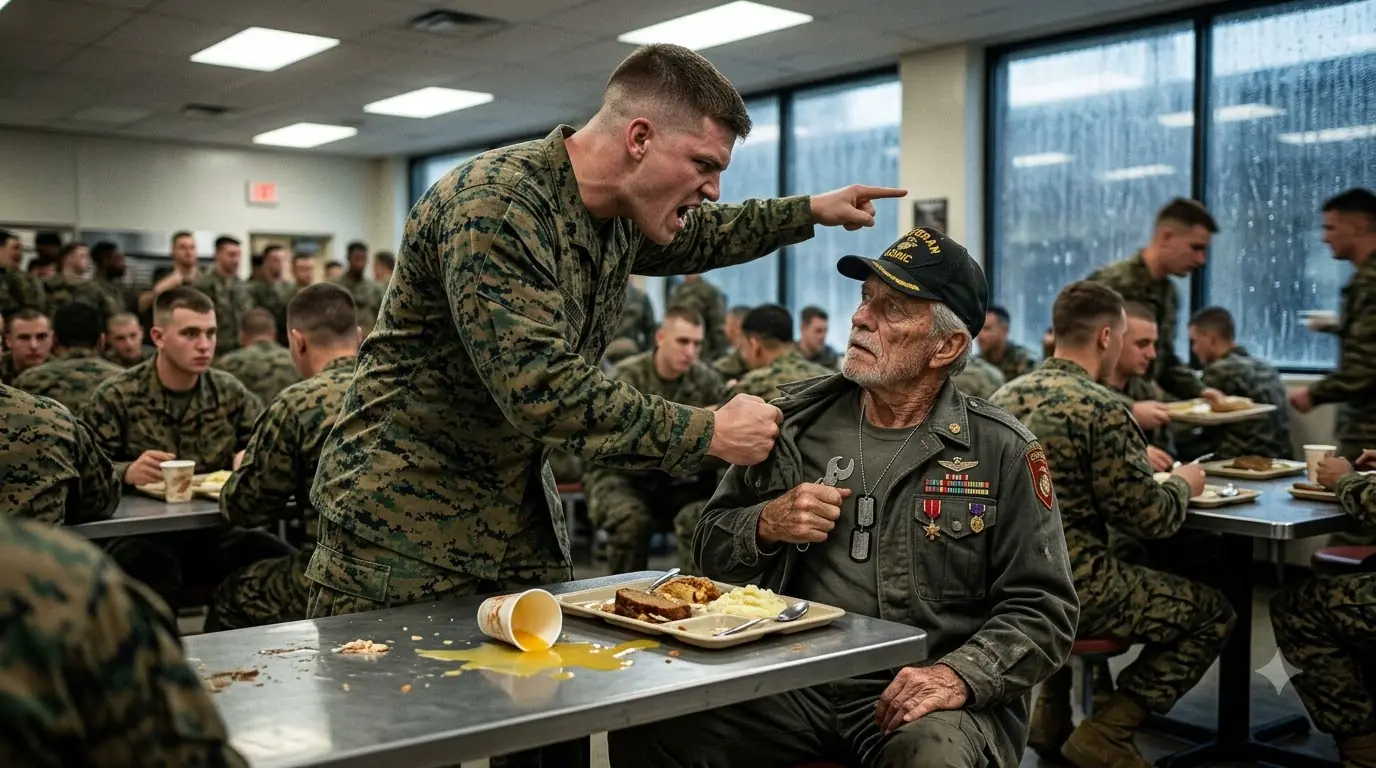
Elias Thorne did not look up at first. His knuckles whitened around the small P-38 can opener hanging beneath his shirt as the young Marine tugged him forward.
For a heartbeat, the fluorescent lights vanished.
In their place came mortar fire, wet stone, burning diesel, and the remembered voice of a terrified radio operator calling his name inside the Citadel at Hue.
The arrogant young man had no idea he was assaulting the Marine who had once saved a trapped squad and carried a wounded brother through enemy fire.
He did not know he had awakened Iron Haze.
The rain at Camp Lejeune did not wash anything clean. It only made everything heavier.
Outside Mess Hall 404, the sky was bruised purple, pouring water across the base and turning the manicured grass into shallow swamps.
Inside, the air carried wet wool, industrial floor wax, coffee, and the grease of a thousand hurried military lunches.
Elias sat alone at a table near the rear, far from the serving line and with his back against a solid wall.
It was an old habit, one he had brought home from war and never managed to surrender.
At seventy-six, he moved carefully because damp weather woke the fragments buried near his right hip. The pain gnawed at the bone in slow, familiar pulses.
He pulled his vintage red leather jacket tighter around his shoulders.
The jacket was older than most of the Marines in the room, its leather softened and cracked by decades of use, its crimson color faded almost to brick.
Under it, Elias wore a gray facilities-maintenance shirt with his name stitched above the pocket.
He had been on the base since 0400, mopping corridors, cleaning restrooms, checking drains, and polishing the memorial plaque in the foyer.
On his lunch break, he always wore the red jacket. It kept out the air-conditioning chill and carried memories he did not explain to anyone.
He lifted a forkful of mashed potatoes, but his hand trembled slightly before it reached his mouth.
The tremor came from Parkinson's disease, not fear.
He wanted five quiet minutes before his afternoon shift began at 1300.
"Hey, are you deaf?"
The voice was loud, young, and much too close.
Elias stopped with the fork halfway raised. He knew that tone.
He had heard it in boot camp in 1966, in officers' clubs decades later, and in men who believed rank and respect were the same thing.
"I said move," the voice demanded.
Elias lowered his fork and turned his head.
A broad-shouldered lance corporal stood over him, no more than twenty years old, with a high-and-tight haircut and a scowl that looked practiced in a mirror.
His name tape read MILLER.
Three other Marines stood behind him holding trays, their expressions uneasy as they shifted from foot to foot.
"This is an eight-person table," Miller said, gesturing toward the empty seats. "You're one old civilian taking up the whole thing, and my squad wants the window."
Elias glanced toward the rain-streaked glass. The view consisted of a dumpster, a wet parking lot, and water streaming from a gutter.
"There are plenty of other tables, son," Elias said.
His voice was rough and quiet, like dry leaves moving over gravel.
Miller's face flushed.
He slammed his tray onto the table, sending utensils rattling across the metal surface and knocking over a cup of orange juice.
The juice spread toward Elias's elbow.
"Do not call me son," Miller hissed. "I am a United States Marine, and you are a guest on my base."
Elias looked down at the gray work shirt beneath his jacket.
He had scrubbed these floors before dawn, cleaned the restrooms these young Marines used, and polished a plaque bearing names he still remembered without needing to read them.
"I am finishing my meal," he said, blotting the juice with a paper napkin. "I will be gone in five minutes."
Conversation died across the mess hall. Forks paused, chairs stopped moving, and dozens of faces turned toward the confrontation.
Miller struck the front of his own camouflage blouse with one finger.
"This is service. This is sacrifice."
"We train to defend your freedom, and the least you can do is show some gratitude by getting out of our way."
Elias studied him.
He saw insecurity dressed as strength, a boy who had not yet learned that war did not preserve uniforms, reward pride, or care who believed himself brave.
"You do not know what service costs," Elias whispered.
The sentence broke whatever restraint Miller had left.
He reached forward and grabbed the collar of the red leather jacket, bunching the old material in his fist and jerking Elias toward him.
Pain flashed through Elias's damaged hip and stole his breath.
"You listen to me," Miller shouted, his face inches away. "I will throw you into the rain myself."
A tray struck the floor somewhere behind them.
Elias barely heard it.
As the jacket collar shifted, his hand rose instinctively to the chain beneath his shirt.
His fingers found the small piece of stamped steel resting beside two dog tags worn smooth by time.
It was not a cross or a medal.
It was a dented P-38 can opener, no larger than a matchbook, darkened by age and carbon that had never fully disappeared.
The cold metal touched his thumb.
The smell of bleach and meatloaf vanished.
The fluorescent lights became muzzle flashes, the floor became mud, and the rain against the windows became the pounding monsoon of another continent.
Elias was no longer an old janitor at Camp Lejeune.
He was twenty-four years old, trapped inside the Citadel at Hue, and the enemy was coming through the walls.
The transition was not gentle. It was a collision.
One moment he breathed recycled air in North Carolina, and the next his lungs burned with wet heat, smoke, dust, and the bitter taste of pulverized stone.
Hue City, February 1968.
The rain came sideways through a sky the color of a bruise. It turned centuries-old walls into gray slurry that coated skin, rifles, teeth, and open wounds.
Staff Sergeant Elias Thorne, known to Second Battalion as Iron Haze, crouched behind the broken remains of a marble altar.
At twenty-four, he was lean, sleepless, and hard from weeks of fighting, his eyes scanning through a gap in the shattered church wall.
"Sergeant, I cannot feel my toes."
The voice came from the darkness to his left.
Private First Class Robert Sterling was nineteen, a radio operator from Ohio who normally smiled through anything.
That night there was no smile, only the wide eyes of a young man who had finally understood that glory was a story told by people far from the fighting.
"Check your weapon, Sterling," Elias said. "Your toes are not the priority."
"Your rifle is."
Sterling hugged the PRC-25 radio against his chest.
"They are coming, are they not?"
"Yes," Elias answered. "They are coming."
The six Marines were trapped in the ruins of a Catholic church at the edge of an enemy-held sector.
The roof had been blown away, the pews reduced to splintered wood, and the stone saints left headless with their hands still raised above the wreckage.
Six Marines remained, cut off from the main force and surrounded by far more soldiers than they could count.
The silence before the assault was worse than the gunfire.
In the distance, a heavy machine gun beat against the night with a slow, mechanical rhythm.
"Check in," Elias ordered.
"Dutch, green," came a voice near the heavy oak doors.
Dutch was the machine gunner, a large farm boy holding an M60 as if it weighed nothing.
"Miller, green. Ski, green."
They had not slept in three days. Their fatigues were soaked, their skin raw, and their bodies close to exhaustion.
"Sterling, get on the radio," Elias said. "Tell command we need extraction."
"Tell them we cannot hold this church past sundown."
Sterling raised the handset with shaking hands.
"Dragon Six, this is Iron One-Nine. Do you copy?"
"Over."
Only static answered.
"Dragon Six, this is Iron One-Nine. Do you copy?"
"Over."
The radio hissed under the rain.
"Batteries are wet, Sergeant," Sterling said. Panic climbed into his voice.
"I cannot get through."
Elias crawled across the mud and checked the connections.
"Keep trying. Do not stop until someone answers."
The world exploded.
A B-40 rocket struck the outer wall, tearing open a gap large enough for men to enter and throwing Elias face-first into the mud.
Dust and stone fragments filled the ruined church.
"Here they come!" Dutch shouted.
The M60 opened with a deep, tearing roar.
Elias pushed himself up and wiped mud from his eyes.
Dark figures moved through the rain beyond the breach, dozens of enemy soldiers climbing over rubble toward the church.
"Contact front!"
Elias raised his M16 and fired controlled bursts through the opening.
Green tracers crossed the nave, snapping against pillars and cutting through the rain.
The church filled with gunfire, shouted warnings, and the echo of explosions against stone.
"They are moving left!" Ski yelled.
A burst struck the masonry beside him, and he dropped behind a broken pew clutching his shoulder.
"Suppressive fire!" Elias ordered.
He moved toward the breach, firing as two soldiers tried to climb through.
"Dutch, hold that wall!"
"Trying, Sergeant!"
The M60 continued hammering, spilling hot brass into muddy water.
As long as that weapon spoke, they had a chance.
Then came the worst sound on a battlefield.
Click.
The machine gun went silent.
"Jam!" Dutch shouted, hauling at the charging handle.
"Ruptured case. It is stuck in the chamber."
The incoming fire intensified immediately.
The enemy had heard the silence and understood that the weapon guarding the breach was down.
"Fix it!" Elias shouted as he fired his final magazine toward the opening.
"I cannot get a grip on it!"
The broken casing was wedged deep inside the hot chamber. Fingers could not reach it, and a combat knife was too large.
Enemy soldiers were already climbing the wall.
Elias moved without thinking.
He sprinted across the exposed nave while bullets struck mud and stone around his boots.
He dropped beside Dutch and shoved him aside.
The chamber radiated heat, and the torn brass case was buried beyond the reach of their tools.
For a moment, Elias saw the end clearly.
They would die in a ruined church in a city most people back home could not pronounce.
His hand flew to his neck.
He tore the chain free and closed his fingers around the P-38 can opener carried by every Marine who had ever opened a field ration in the rain.
He drove the tiny hooked blade into the chamber and caught the rim of the ruptured casing.
The metal burned his thumb, but he twisted until the case came free.
"Feed!"
Dutch slammed the feed tray shut and racked the bolt.
The M60 came alive again.
Its heavy fire struck the assault at point-blank range and forced the enemy away from the breach.
The attack faltered, then withdrew into the storm.
Elias collapsed against the sandbags, breathing hard.
The P-38 lay blackened and hot in his palm.
"We move now," he said. "They will mortar this position next."
Sterling called from the radio corner.
"I have command. Helicopters are inbound to Landing Zone Bravo, three kilometers south."
"Three kilometers through hell," Elias muttered.
He rose on shaking legs.
"Marines, on your feet. We are checking out of this hotel."
They left the church as a ragged column of exhausted men.
The movement toward the landing zone became a blur of narrow alleys, flooded streets, and sudden gunfire from windows and rooftops.
Rain filled their boots and made the mud clutch at every step.
They were about two hundred yards from the landing zone, a waterlogged field near the Perfume River, when the ambush began.
Fire struck from both sides above them.
"Ambush!" Elias shouted, diving behind a low wall.
Rounds tore into the ground where the squad had been standing.
"I am hit!"
Sterling had fallen in the center of the street, gripping his leg as blood spread through the rainwater around him.
"Sterling!"
"Leave him!" Dutch shouted while firing at the rooftops.
"Sergeant, the helicopters are coming!"
Rotors thundered above the buildings.
Elias could see the open field, the approaching Hueys, and the possibility of survival.
Then he looked at Sterling lying alone in the exposed street.
The young radio operator was pale and reaching toward him.
"My boy," Sterling murmured. "Tell Marcus..."
Elias did not hesitate.
"Cover me."
"Sergeant, no!"
Elias ran into the street.
Bullets cracked past his head and struck the walls behind him.
He slid through the mud beside Sterling.
The boy's leg was badly wounded, and shock was already draining the color from his face.
"I have you," Elias said, grabbing the webbing of Sterling's flak jacket.
"Go, Sergeant. Leave me."
"Be quiet. Nobody goes alone in my squad."
Elias pulled Sterling up and threw the young man's arm across his shoulders.
The weight drove him deep into the mud, but he took one step and then another.
An impact struck Elias near the right hip with the force of a hammer.
He spun and fell, Sterling collapsing beside him.
Pain arrived a moment later, fierce and blinding, and Elias knew he could no longer stand.
Dutch appeared through the rain and grabbed Sterling.
"Take him!" Elias shouted.
"I am not leaving you!"
"I cannot walk. Get him to the helicopter."
"That is an order."
Dutch looked from Elias to the wounded radio operator.
Then he lifted Sterling across his shoulders and ran.
Elias stayed on the ground and fired toward the rooftops, covering them until his rifle ran empty.
He watched Dutch reach the Huey and saw the door gunners pour fire across the street.
Sterling was pulled aboard.
As the helicopter lifted, the young man stretched one hand toward Elias through the open door.
Rotor wash blasted rain and mud across Elias's face.
The aircraft banked away.
Elias was alone.
Enemy voices drew closer through the flooded street.
His rifle was empty, and his sidearm had disappeared somewhere in the mud.
He lay back, the rain cooling his face as his strength drained away.
His hand found the chain against his chest.
He gripped the P-38 can opener.
"Come on, then," he whispered to the gray sky. "Come and get it."
Darkness crept inward from the edge of his vision.
The shouting faded, the rain became distant applause, and Elias thought of home before everything went black.
The mess hall returned with the violence of a collision.
Cordite became meatloaf, rotor thunder became the refrigerator hum, and the wet street at Hue became a metal chair beneath Elias's aching body.
Only three seconds had passed.
Lance Corporal Miller still held the red jacket in his fist, unaware that the old man in front of him had just lived through an entire lifetime.
Elias's heart hammered against his ribs.
His hand still clutched the P-38 beneath his shirt.
He looked up at Miller.
The hesitation in his eyes was gone.
The young Marine no longer appeared large to him. He looked like a frightened child wearing authority he did not understand.
"Take your hand off my jacket," Elias said.
His voice was no longer frail. It was cold, controlled, and edged with steel.
Miller stared at him, unsettled by the sudden change.
"Are you threatening me, old man?"
He tried to laugh, but the sound came out thin.
Miller tightened his grip.
"I could break you in half. Now get up, or I am going to..."
"Attention on deck!"
The command thundered from the front of the mess hall.
Every Marine in the room moved at once.
Forks hit trays, chairs scraped across linoleum, and two hundred people rose to attention.
Miller released Elias's jacket as though the leather had burned him.
His heels snapped together, and his eyes fixed on the wall ahead.
Elias remained seated because his hip would not permit a quick rise.
The adrenaline from the flashback faded into tremors, leaving his hands shaking around the P-38.
The double doors stood open between two military police officers.
A tall man entered with graying hair cut close and three silver stars on his collar.
Lieutenant General Marcus Sterling, the Marine Corps commander responsible for the installation, walked into the mess hall with a slight limp that mirrored Elias's own.
He was followed by his sergeant major and several officers, but the room saw only him.
Sterling moved down the center aisle with deliberate steps.
His eyes took in the spilled food, the standing Marines, and the disturbance at the back table.
Miller began to sweat.
He told himself that he was active duty, that Elias was only a civilian employee, and that the general would understand his effort to maintain order.
Sterling stopped several feet from the table.
"Report."
The single word carried through the room.
"Sir, Lance Corporal Miller reporting," Miller shouted. "I was clearing a table for squad use when this civilian refused to vacate an area intended for active-duty personnel."
He risked a quick glance toward Elias.
"I was escorting him out to maintain order, sir."
The general did not look at Miller.
His gaze moved across the spilled juice, the wrinkled red jacket, and the old man's trembling hand.
Then he saw the P-38 can opener.
Sterling's expression changed.
He stepped closer.
"At ease," he said softly.
Miller relaxed slightly, believing the order was meant for him.
Sterling walked around the table until he stood directly in front of Elias.
He studied the old man's face, the scar along his neck, and the tiny object resting in his palm.
"That is a P-38," Sterling said.
It was not a question.
Elias looked up at the name tape on the general's uniform.
STERLING.
The air left his lungs.
"Best piece of equipment the government ever issued," Elias rasped. "Opens cans, cleans boots, and fixes jams."
The general went rigid.
"Fixes jams," he repeated.
His voice lost its official polish.
He looked again at the scar on Elias's neck and at the red jacket.
"My father told me about a man who cleared a ruptured casing with a P-38 inside a church in Hue City."
Elias stared into the general's face.
He saw the same jaw and stubborn brow he remembered beneath a rain-soaked helmet in 1968.
"Robert," Elias whispered. "His name was Robert Sterling."
A quiet gasp moved through the nearest tables.
The general's eyes filled.
The ceremonial cane in his hand slipped and struck the floor.
"He told me he begged you to leave him," Sterling said. "He told me you ran back into the street, carried him under fire, and kept moving after you were hit."
"He was my radio operator," Elias answered. "You do not leave your radio operator."
"He came home," Sterling said.
Tears ran openly down the general's face.
"He married my mother, raised me, and lived long enough to know his grandchildren. He died four years ago in his own bed with all of us beside him."
Elias closed his eyes for a moment.
The image of Robert disappearing inside the Huey had lived in him for half a century, frozen at the moment of uncertainty.
Now he knew the young man had survived.
"I am glad," Elias whispered.
Sterling drew a slow breath.
"My father said the man who saved him was Staff Sergeant Elias Thorne, call sign Iron Haze. The report listed you missing in action and presumed killed after the Citadel fighting."
A faint smile touched Elias's face.
"I have always been difficult to kill."
Sterling wiped his face and straightened.
Then he turned toward Miller.
The lance corporal was shaking so badly that the fabric at his shoulders moved.
"You," Sterling said.
The word landed like a shot.
"Sir, I did not know," Miller stammered.
"You did not know," Sterling repeated.
His voice dropped to a near whisper, which was more frightening than a shout.
"You saw an elderly man in a red jacket and decided he was worthless. I see a Marine who walked through fire so that my father could live, so that I could be born, and so that I could stand here today."
Miller's face crumpled.
Sterling turned back to Elias.
Two hundred Marines watched as their commander snapped his heels together.
He raised his right hand and rendered a slow, formal salute.
The salute held.
Five seconds passed, then ten.
Elias tried to rise, bracing one hand against the table, but his hip failed beneath him.
"Remain seated, Staff Sergeant," Sterling said gently. "You have stood enough."
The officers behind the general saluted.
Then the military police officers did the same.
Across the mess hall, chairs scraped and boots struck the floor.
One table after another came to attention until every Marine in Mess Hall 404 stood saluting the elderly maintenance worker in the faded jacket.
Even Miller raised his hand.
Tears of shame moved down his face as his salute trembled.
Elias looked across the sea of uniforms.
The silence no longer felt hostile. It carried recognition, grief, and a kind of honor too heavy for applause.
He rubbed his thumb over the old can opener and tucked it beneath his shirt.
"Your father was a good Marine," Elias said.
"He was," Sterling replied. "But he always said you were the best one he ever knew."
The general lowered his hand.
The others followed, and the room released a collective breath.
"As you were," Sterling said.
No one immediately returned to lunch.
Miller stood with his arms at his sides, looking smaller than he had minutes earlier.
The swagger was gone, leaving a frightened young man suddenly aware of the uniform he had disgraced.
Sterling retrieved his cane from the floor.
He did not look angry when he faced Miller again.
He looked disappointed, and that was worse.
"Lance Corporal, you appear deeply concerned with the order and cleanliness of this facility."
"Sir," Miller managed.
"You also appear to believe that physical labor is beneath the dignity of a warrior. It is time to correct that misunderstanding."
Sterling turned toward his sergeant major.
"Pull Lance Corporal Miller from his current squad assignment. Effective immediately, he is reassigned to facilities maintenance on the early shift at this mess hall."
Miller's eyes widened.
"For the next thirty days, you will report to Mr. Thorne at 0400 every morning."
"You will learn to mop these floors, clean the grease traps, scrub tables, and respect every person whose labor keeps this base operating."
Sterling stepped closer.
"Every duty in this Corps matters. Rifleman, cook, mechanic, clerk, and janitor all depend on discipline and respect."
His voice became quiet enough that only Elias and Miller could hear clearly.
"If you show this man anything less than the respect he has earned, I will remove those stripes before you have time to understand what happened."
"Yes, General," Miller shouted.
His voice broke.
Sterling faced Elias, and the hardness left his expression.
"My vehicle is outside. There is paperwork that should have been completed fifty years ago, and there is a debt my family has waited a lifetime to acknowledge."
Elias looked toward the mop bucket near the rear wall and then at his unfinished meal.
He glanced at Miller.
"He is only a boy, Marcus," Elias said, using the general's first name. "We were all foolish at twenty."
"We all thought we were immortal."
"The Corps has no room for bullies," Sterling answered.
"Then teach him," Elias said. "Do not destroy him."
Elias pushed himself away from the table.
Pain crossed his face as he placed weight on his right leg.
Miller reacted before thinking and reached out to steady him.
Elias stopped.
He looked at the offered hand and then at the young Marine's face.
Miller expected rejection.
Elias accepted the support with a small nod.
It was not forgiveness, but it was the beginning of a path toward it.
"Let us go," Elias told Sterling. "My break ended several minutes ago."
The recognition ceremony took place three days later in the general's private office.
There were no television cameras, marching bands, or politicians searching for a speech.
Rain still struck the windows.
Elias stood as straight as his hip allowed, wearing a charcoal suit Sterling had arranged for him.
The suit was tailored carefully, but the red jacket remained folded over a nearby chair.
An adjutant opened the citation.
"For extraordinary heroism in action against an armed enemy, Staff Sergeant Elias Thorne, United States Marine Corps, Hue City, February 1968..."
The words described the ruined church, the disabled machine gun, the P-38 used to clear its chamber, the withdrawal through enemy-held streets, and the decision to return for a wounded radio operator.
They described valor beyond the call of duty and a man reported missing before his actions could be properly recognized.
General Sterling stepped forward holding a velvet box.
Inside rested the Navy Cross, approved after a review of battlefield reports, recovered witness statements, and the clerical error that had left Elias listed as presumed killed.
The dark blue ribbon seemed almost too clean beside the lines and scars of the old Marine's face.
Sterling pinned it to Elias's lapel.
His hands were gentle as he straightened the ribbon.
"This is more than fifty years late," Sterling said. "But the Marine Corps has not forgotten."
Elias looked down at the medal.
It was beautiful, but it had never been the reason he crossed the street under fire.
He had gone back because Robert Sterling had been nineteen, terrified, wounded, and alone.
A Marine did not leave a brother to die afraid.
"Thank you, sir," Elias whispered.
Sterling stepped back.
"You can retire now. Your military status has been corrected, and arrangements are being made for the benefits and compensation denied to you because of the reporting error."
"You never need to lift another mop."
Elias turned toward the office window.
Outside, a platoon ran through the rain in formation, young voices calling cadence while their boots struck the wet pavement.
He watched the young faces, full of confidence and uncertainty, preparing for dangers they could not yet imagine.
"With respect, General, I would like to keep my job."
Sterling smiled as if he had expected the answer.
"Why?"
"Because they do not know who I am," Elias said, gesturing toward the Marines outside. "To them, I am simply the old man working in the background."
He touched the P-38 beneath his shirt.
"Someone still has to keep the floors dry so they do not fall. Someone has to remember their names."
"Someone has to remind them that the war ends, but the responsibility to one another does not."
Sterling nodded.
"Besides," Elias added, a faint spark returning to his eyes, "I have a new trainee reporting tomorrow at 0400. His name is Miller, and I think he may have potential if someone teaches him patience."
The next morning, Mess Hall 404 was quiet at 0415.
The overhead lights were dim, and the first coffee of the day had begun to brew.
Elias moved the mop across the floor in long, even strokes.
The sound was soft and rhythmic.
Behind him, Lance Corporal Miller scrubbed a table.
He was sweating, but he did not complain.
His movements were focused, and each time he finished an area, he checked it again before moving on.
"Miller," Elias said without turning.
"Yes, Mr. Thorne."
"You missed a spot at the corner of table four."
"On it."
Miller moved quickly and corrected the mistake.
Elias stopped beside the mop bucket and studied his reflection in the wet floor.
He did not see a janitor.
He did not see a legend.
He saw a Marine completing the duty in front of him.
Elias reached beneath his shirt and removed the P-38 can opener from its chain.
He weighed it in his palm for a moment, feeling the old dents, the worn edge, and the small burn mark left from the church at Hue.
Then he tossed it across the room.
Miller caught it against his chest.
He opened his hand and stared at the tiny rusted tool.
"Keep it," Elias said. "Put it on your dog tags."
"You never know when something important will get jammed."
Miller closed his fingers around it.
A mixture of gratitude and shame moved across his face.
"Thank you, Staff Sergeant."
"Do not call me Staff Sergeant while I am holding a mop," Elias grumbled. "Call me Eli."
Miller nodded.
"Yes, Eli."
"Now get back to work. Breakfast is in two hours, and these Marines need a clean place to eat."
Outside, the rain finally stopped.
Sunlight began to rise over the base, turning the low clouds gold along their edges.
The storm was over.
The silence remained, but it was no longer empty.
It held memory, humility, brotherhood, and the promise that a young Marine could still learn what an old one had paid dearly to understand.