On a bleak winter morning in the suburbs, an eighteen-year-old cashier met an elderly widow buying four items, but she was short by eighty-five cents.
Behind her, impatient customers crowded in, their anxious eyes heavy with judgment.
She quietly took out her wallet, covered the shortage, and handed the woman the can of soup.
Suddenly, people in line began paying for one another, turning the tension into a wave of kindness that spread through the store and changed their lives forever.
The air that morning carried a damp chill, the kind that crept under coats and lingered in the bones.
Outside, late January snow had melted into patchy, grimy slush, pooling in uneven puddles that reflected the dull gray of a sky unwilling to clear.
The automatic doors of Maple and Company groaned as they slid open, letting in a draft of cold air that swirled around the small aisles lined with neatly stocked shelves.
The bell above the entrance gave its tired chime, and Marissa Johnson glanced up from her register.
It was 10:30 a.m., the quiet stretch before the midday rush, and she liked this time when the store wasn’t yet loud, when she could hear the low hum of the refrigerators and the faint shuffle of carts across the worn linoleum.
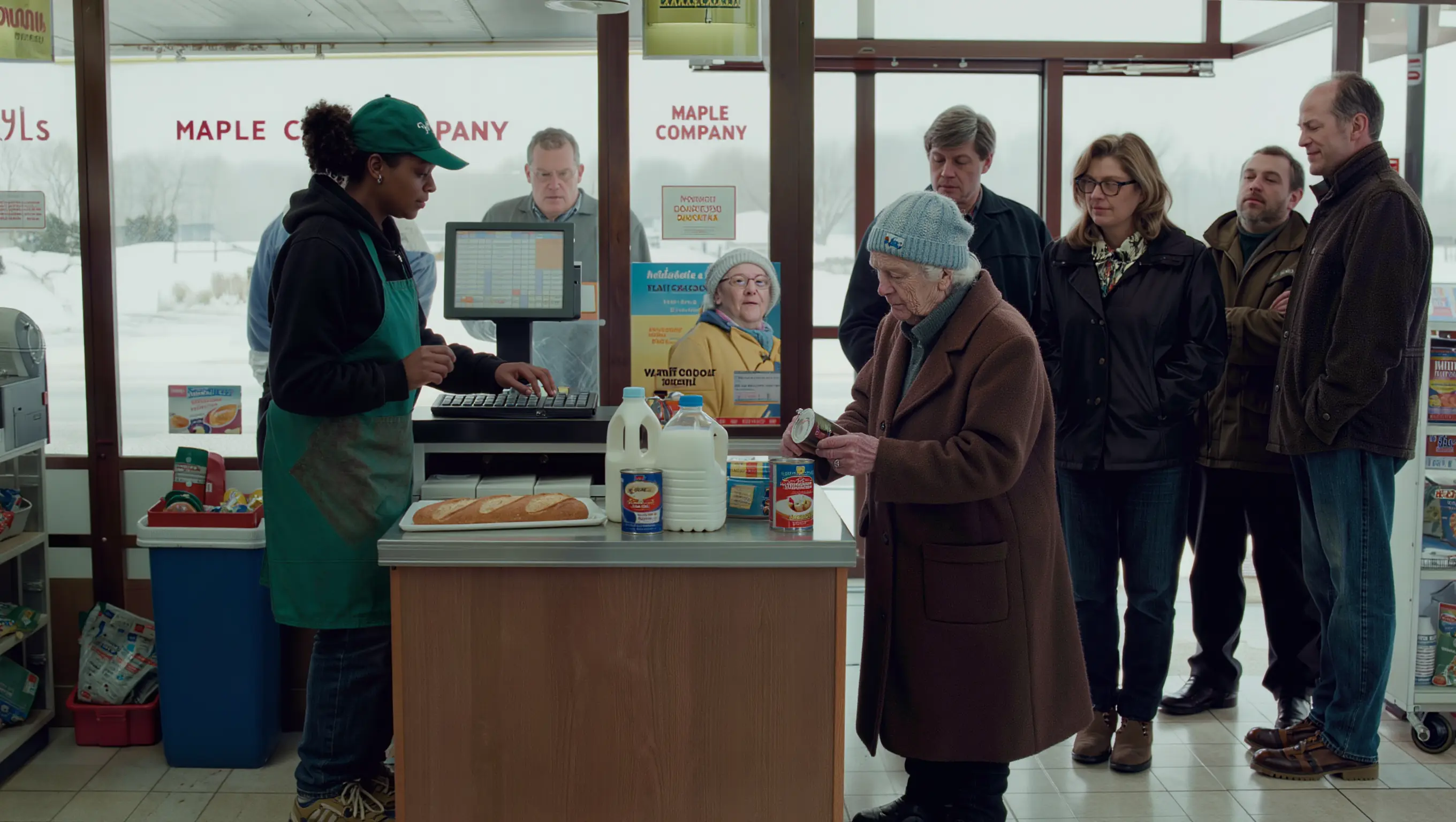
Marissa, eighteen, stood straight behind the counter, scanning items for a young mother ahead of the line.
Her uniform, a faded green apron over a hoodie, fit snugly across her shoulders.
Her eyes were warm but reserved. Her movements measured.
She was a quiet presence in the store, the kind customers remembered not for what she said, but for how she made them feel acknowledged.
Every shift she clocked in on time, her phone tucked away, her mind on the work and on the bills waiting back home.
Home meant a small second-floor apartment three bus stops away, where her grandmother, Lorraine Johnson, kept the heat low to save on the electric bill.
She had raised Marissa since she was nine, after her mother’s sudden passing and her father’s absence became permanent.
Marissa had grown into the kind of young woman who understood responsibility not as a choice but as the air she breathed.
Helping cover the utility bills, picking up her grandmother’s prescriptions, cooking simple dinners—these were her normal.
The young mother paid, gathered her grocery bags, and left.
Marissa reached for the next customer.
Margaret Thompson moved toward the counter with deliberate, careful steps.
Her wool coat hung a little loose on her frame, and the faint scent of lavender and old paper followed her.
A knitted hat, pale blue and frayed at the edges, sat slightly askew on her white hair.
She set a small wire basket on the conveyor belt, her hands trembling just enough to make the items inside clink softly.
Marissa offered her standard greeting.
“Good morning, ma’am. Staying warm out there?”
Margaret’s pale eyes lifted to meet hers, and a faint smile touched her lips.
“Trying too,” she said, her tone a mix of weariness and politeness.
She placed her items on the belt: one loaf of wheat bread, a quart of milk, a small pack of butter, and a single can of chicken noodle soup.
The arrangement looked careful, almost ceremonial, as if each item had been considered before being chosen.
Marissa began scanning them, the familiar beeps punctuating the quiet space.
The total flashed on the small display: $6.12.
She glanced at Margaret, expecting her to pull out a wallet.
Instead, Margaret reached into her oversized purse and drew out a small cloth pouch, faded with age.
She placed it on the counter and untied the drawstring with slow, deliberate fingers.
Out spilled a handful of coins, quarters, dimes, nickels, and a scattering of pennies, along with three worn one-dollar bills, folded neatly but creased from years of use.
Marissa noticed the way her hands hesitated, the faint stiffness in her fingers as she began to count.
She spoke softly under her breath, naming each amount as if to steady herself.
Marissa stood still, watching her work through the pile.
Something in her recognized the ritual, the careful stretch of every cent.
She thought of the small jar on her grandmother’s counter, where loose change collected until there was enough for bus fare or a bag of rice.
Margaret counted once, then again.
She pushed the coins into neat stacks, her breath visible in the cold draft from the nearby door.
Finally, she looked up at Marissa.
Her expression, a mix of apology and resignation, broke slightly.
“I’m eighty-five cents short,” she said quietly, almost as if admitting something shameful.
Before Marissa could respond, a noise broke the moment.
The man behind her, a broad-shouldered figure in a heavy parka, began tapping his fingers against the counter in a steady, impatient rhythm.
Tap tap tap.
The sound was sharp, louder than it should have been, filling the space between them.
Margaret’s shoulders tightened.
She glanced over her shoulder briefly, then back to Marissa, her eyes dropped to the can of soup, the last item on the belt.
“Maybe… maybe we can put this one back,” she murmured, her voice fading under the weight of the room’s attention.
Marissa felt the shift in the air, the subtle tension, the way the other customers adjusted their stances, some pretending not to watch, others openly curious.
In her chest, something tightened.
She could see the way Margaret’s fingers lingered on the can, not ready to let go, and the quiet plea hidden in her voice, even though she hadn’t asked for help.
The register screen still glowed: $6.12.
The man’s tapping grew a little faster.
Somewhere near the entrance, a cartwheel squeaked against the floor.
Marissa realized that everyone was waiting for something, waiting to move on, waiting for her to decide what she could afford to give up.
She didn’t move yet, but her mind was already turning, weighing the scene in front of her, like a scale tipped just slightly toward a choice she hadn’t made out loud.
And in that moment, with the cold air still drifting in from the street and the faint smell of coffee from the breakroom behind her, Marissa knew this wasn’t just another transaction.
This was the kind of moment that could pass in silence or change the way someone carried their day.
She didn’t take her eyes off Margaret, and Margaret didn’t take hers off the can of soup.
The distance between them was only the width of the counter, but it held an entire conversation.
Neither of them had spoken yet.
Margaret’s voice trembled as she looked down at the can of soup resting on the counter, her fingers brushing the label as if it were something fragile.
“Maybe you can just take this one off for me, dear. I’ll come back for it another time,” she said softly, the words carrying more than just the weight of the missing eighty-five cents.
There was a pause, just long enough for the sound of a deep sigh to escape from a woman in line.
The kind of sigh that made it clear she thought the morning had already been delayed too long.
A young man leaning against his cart gave a small shake of his head, the impatient twitch in his jaw suggesting he had somewhere else to be.
The tapping fingers of the man in the parka had stopped, but now the silence in the line felt sharper, like the air just before a storm.
Marissa kept her eyes on Margaret, noticing the way her shoulders had curled inward, the way her lips pressed together as though she were trying to make herself smaller to disappear from the moment.
She could almost see the decades in her posture, years of giving without asking, of doing so others could have.
That thought tightened something deep in Marissa’s chest.
She glanced at the can again, its bright red label standing out against the dull tones of the counter, and then her gaze shifted to Margaret’s purse, the small cloth pouch still lying open with the few coins left inside.
The decision rose in her before she even realized she’d made it.
She hesitated for just a breath, enough to feel the room still watching, then reached into the pocket of her apron and pulled out her worn leather wallet.
She thumbed past a few crumpled bills and slid out a single dollar.
Without a word at first, she set it on the counter, the soft slap of the paper breaking the tension like the first drop of rain on a still pond.
She picked up the can of soup and scanned it with the same steady hand she used for every customer, the beep sounding louder than it should have.
“This one’s on me, ma’am,” she said, her tone calm, free of any flourish or show.
“Consider it a gift.”
She kept her focus on the register, not seeking thanks, just finishing the transaction as though it were the most ordinary thing in the world.
Margaret’s eyes widened, a flicker of confusion passing before they softened with recognition.
“Oh no, I can’t let you,” she began, but her voice caught in her throat.
Her hands fluttered for a moment, unsure whether to push the dollar back toward her or to hold on to the bag that was slowly filling with her groceries.
Marissa lifted her eyes to hers and gave a small, reassuring smile, the kind that carried quiet certainty.
“You used to read to us at the library, didn’t you?” she asked, her voice low enough that it felt like a conversation just between them, even though every ear in line was listening.
“Now I remember you sat in the corner by the big window, reading those mystery stories. We’d all crowd around and listen.
She saw the recognition spark in her eyes, the faintest ghost of that part of her life returning to her face.
“Today,” she continued gently, “it’s my turn to give something back.”
Margaret’s lips parted as if she wanted to speak, but no words came.
Instead, her eyes brimmed with tears that she blinked away quickly, as though afraid they might spill over in front of strangers.
The sigh from the woman in line had vanished.
The young man who’d been shaking his head now stood still, his gaze fixed on the counter.
Even the man in the parka had stopped shifting his weight.
The restless energy that had filled the space a moment ago was gone, replaced by a quiet that felt almost sacred, like the hush that falls in a church before a hymn begins.
Marissa handed Margaret her bag, her fingers brushing hers for just an instant.
It was enough for her to feel the warmth in her touch, the sincerity in the simple gesture.
She turned back to the register, moving on to close the sale, but the moment lingered in the air, held in the eyes of everyone who had witnessed it.
No one spoke. No one seemed in a hurry anymore.
It was as if the room itself had exhaled, the tension dissolving into something softer, something rare.
The can of soup was now tucked safely in Margaret’s bag, but the real transaction had already happened in a currency that couldn’t be measured on the glowing numbers of the register.