The old silver Ford F-150 looked completely out of place beside the polished SUVs and late-model pickups parked outside the auto-parts store on Fort Campbell Boulevard.
Gabriel Hutchinson liked it that way.
The truck belonged to his friend Earl Benson, a seventy-one-year-old retired machinist who refused to replace anything that still started on the first turn of the key.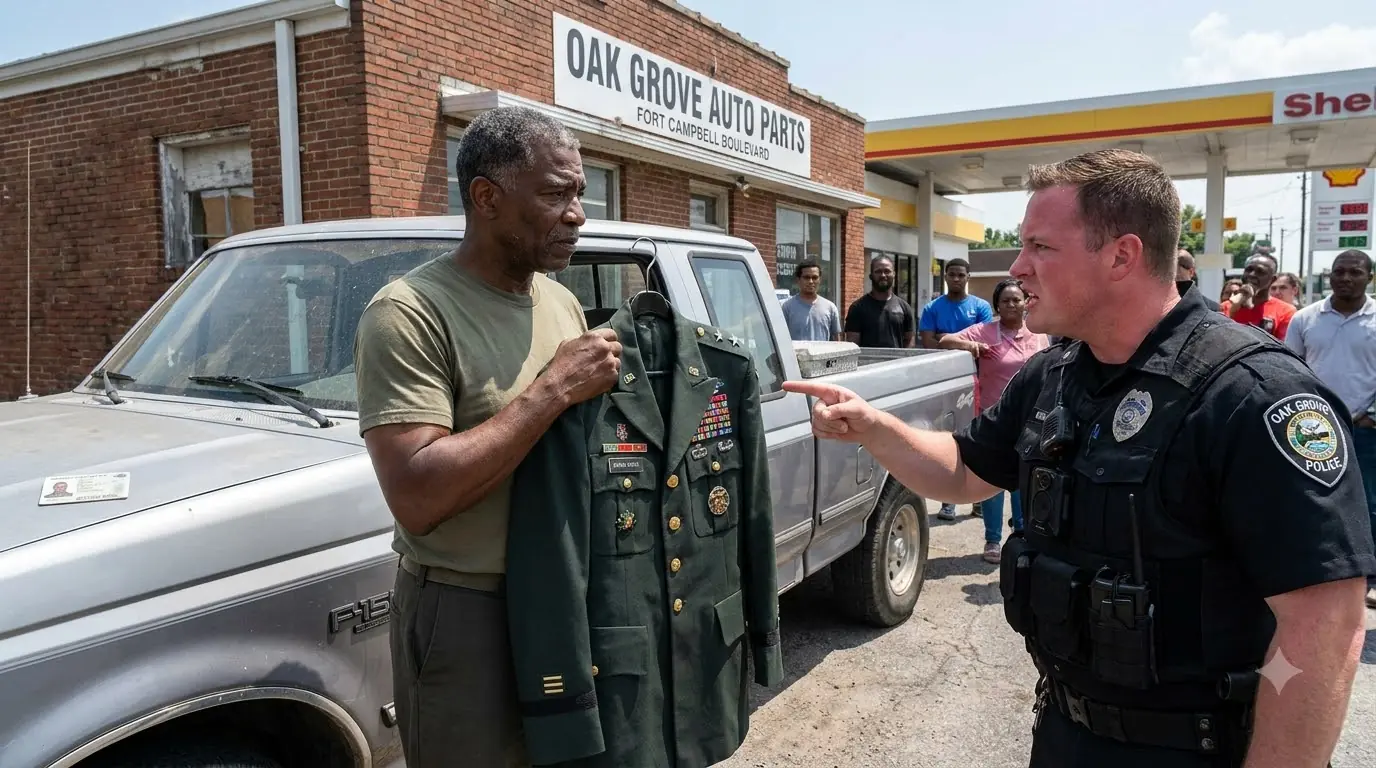
The Ford had faded paint, light rust along the wheel wells, a cracked vinyl bench seat, and a passenger window that needed to be lifted slightly with one hand before the crank would close it completely.
Gabriel had driven far more expensive vehicles.
That morning, however, the old truck suited him perfectly.
He had spent the first half of the day at a formal public-service ceremony in Nashville, where he had accepted an award on behalf of a national transportation-safety initiative.
The dark green ceremonial jacket he had worn was now hanging from a wooden hanger behind the truck seat.
Three public-service medals were pinned neatly against the left side.
Two silver organizational stars sat near the collar, symbols of senior executive responsibility within the federal transportation-integrity program Gabriel had directed for nearly nine years.
They had no police authority.
They were not meant to impress strangers.
To Gabriel, they represented decades of audits, investigations, accident-prevention reforms, procurement reviews, and painful meetings with families whose lives had been changed because somebody somewhere had treated a safety rule as optional.
He did not wear them casually.
He certainly did not expect to spend the afternoon defending them to a patrol officer outside an auto-parts store.
At 2:16 p.m., Gabriel turned Earl’s truck into the parking lot because the temperature gauge had begun climbing.
Nothing dramatic.
The needle simply sat higher than Gabriel liked.
He pulled into a space beside the building, switched off the engine, waited, then opened the hood.
Steam did not rise.
No coolant sprayed.
No belt had snapped.
Gabriel leaned over the engine and inspected the upper hose.
Behind him, the store door opened.
A teenage employee stepped outside carrying a cardboard box toward a customer.
Two men stood beside the gas station next door.
A woman loaded oil containers into the back of a crossover.
Ordinary afternoon.
Gabriel loosened nothing.
Touched nothing dangerous.
He simply watched the engine cool.
Then a marked Oak Grove police cruiser turned into the lot.
Gabriel noticed because the red and blue lights were already flashing.
The cruiser stopped diagonally behind the truck.
Not blocking it completely.
Close enough.
Officer Philip Briggs stepped out.
He was twenty-eight, white American, broad through the shoulders, with short sandy-brown hair and the restless energy of someone who seemed to walk faster than situations required.
His black uniform was covered by a tactical vest.
Body camera centered high on his chest.
Radio.
Badge.
Duty belt.
Gabriel watched him approach.
“Sir.”
Gabriel straightened.
“Afternoon.”
“What are you doing?”
Gabriel looked at the open hood.
“Checking an overheating problem.”
“This your vehicle?”
“No.”
Briggs stopped.
“No?”
“Belongs to a friend.”
“Which friend?”
“Earl Benson.”
Briggs looked through windshield.
“You have permission to drive it?”
“Yes.”
“Registration?”
“Glove box.”
“License?”
“My wallet.”
Briggs stared at him for a second.
Gabriel noticed the officer’s gaze moving slowly over his faded olive-green T-shirt, dark trousers, silver watch, and polished black shoes.
The shoes were a little formal for an auto-parts parking lot.
Gabriel knew that.
He had changed out of most ceremonial clothing but had not bothered with shoes.
“Why are you dressed like that?”
Gabriel looked down.
“Like what?”
“Those pants. Shoes.”
Gabriel almost smiled.
“I had an event.”
“What kind of event?”
“Professional.”
Briggs stared.
“That answer supposed to mean something?”
“No.”
“Where are you coming from?”
“Nashville.”
“Where are you going?”
“Hopkinsville.”
“Why?”
Gabriel looked at him.
“Officer, am I being detained?”
Briggs’s expression changed slightly.
“That depends.”
“On what?”
“Whether you answer simple questions.”
Gabriel folded his arms loosely.
“That isn’t usually what determines whether someone is detained.”
Briggs stepped closer.
“You a lawyer?”
“No.”
“Then don’t explain my job to me.”
Gabriel studied him.
He had spent thirty-four years inside government systems.
He knew a conversation could go bad long before anyone raised a voice.
The first warning was usually not aggression.
It was certainty.
A person decided what the situation was, then began treating every new fact as either confirmation or resistance.
Gabriel had learned to pay attention when people stopped being curious.
Briggs was no longer curious.
He had already built a story.
Old truck.
Black man.
Not the owner.
Formal shoes.
Vague answers.
Something did not fit.
Therefore something must be wrong.
Gabriel kept his voice calm.
“My license is in my wallet. Registration is in glove box. You’re welcome to verify both.”
Briggs looked toward truck.
“What’s under seat?”
Gabriel glanced through open driver door.
“A jacket.”
“What kind?”
“Formal jacket.”
“Take it out.”
Gabriel frowned.
“Why?”
“I want to see it.”
“That isn’t relevant to the truck.”
Briggs stepped closer.
“I didn’t ask whether you thought it was relevant.”
Gabriel remained still.
“Are you ordering me to retrieve it?”
“Yes.”
Gabriel looked at the body camera.
The indicator appeared active.
Good.
He walked slowly toward driver door.
Briggs followed two steps behind.
Gabriel reached behind seat and removed wooden hanger.
The dark green jacket unfolded as he pulled it free.
Sunlight hit the polished buttons and the three decorations pinned to the chest.
Briggs stopped.
His face changed immediately.
“What the hell is that?”
Gabriel looked at jacket.
“My formal coat.”
Briggs pointed.
“Those real?”
“Yes.”
“Where’d you get it?”
Gabriel looked at him.
“I told you. It’s mine.”
Briggs laughed.
Not loudly.
Not yet.
“Come on.”
Gabriel said nothing.
The officer stepped closer and pointed toward the decorations.
“You expect me to believe you just happen to drive around in an old pickup carrying something like that?”
Gabriel looked at truck.
“It isn’t my pickup.”
“Exactly.”
Gabriel’s eyebrows lifted.
“How does that help your argument?”
Briggs’s face tightened.
“Don’t get smart.”
“I asked a question.”
“You’re holding a jacket covered in official-looking decorations, driving somebody else’s truck, and you won’t even tell me where you’re going.”
“I told you where I’m going.”
Briggs pointed toward medals.
“Where did you buy those?”
Gabriel stared at him.
“I didn’t.”
“Online?”
“No.”
“Surplus store?”
“No.”
“Costume shop?”
Gabriel’s eyes narrowed.
“No.”
A few people near the store had begun watching.
The woman beside crossover stopped loading her vehicle.
One of the gas-station customers raised a phone, pretending to check screen.
Briggs noticed audience.
His voice became louder.
“Then explain them.”
Gabriel held jacket by shoulders.
“They’re public-service decorations.”
“For what?”
“My work.”
“What work?”
Gabriel considered how much to say.
Very little.
He was scheduled to meet a regional oversight team at four that afternoon in Hopkinsville.
The meeting concerned a six-month review of towing contracts, roadside property seizures, and unusually frequent “vehicle authenticity holds” issued by three departments along the Kentucky-Tennessee corridor.
Oak Grove was one.
No officer was individually accused yet.
That distinction mattered.
The review existed because data looked strange.
Not because investigators had reached conclusions.
Gabriel had personally insisted that the team not announce visits prematurely.
People behave differently when they know they are being observed.
Today had been intended as travel day.
Nothing more.
“My work involves transportation oversight.”
Briggs laughed again.
“Transportation oversight.”
“Yes.”
“What, you inspect buses?”
“Sometimes.”
That answer was technically true.
Briggs shook his head.
“You people really think saying vague official words makes everyone back down.”
Gabriel became still.
“You people?”
Briggs realized phrase.
Then shrugged.
“People pretending to be more important than they are.”
Gabriel looked at him for a long moment.
“I haven’t asked you to treat me as important.”
“You’re standing there holding that thing.”
“You ordered me to get it.”
That silenced Briggs for half a second.
Then anger replaced embarrassment.
“Identification.”
Gabriel pointed toward hood.
“I’ll put it there.”
He reached slowly into back pocket.
“Easy.”
Briggs’s hand moved toward belt.
Gabriel stopped.
“My wallet.”
“Use two fingers.”
Gabriel did.
He removed black leather wallet.
Opened it.
Pulled driver license.
Then another government identification card.
He placed both flat on the warm silver hood.
“There.”
Briggs did not look.
Instead his attention stayed on jacket.
“Take those decorations off.”
Gabriel looked up sharply.
“What?”
“You heard me.”
“No.”
Briggs’s jaw tightened.
“You don’t walk around displaying decorations you can’t verify.”
“My identification is six inches from your hand.”
“I’m talking about the jacket.”