“Walk away, farm boy—you can’t afford this rusted junk.”
Richard Davenport spoke loudly enough for the entire auction crowd to hear. He stood beside the faded red 1951 Farmall M in an expensive green barn coat, polished boots, and leather gloves that had never touched soil. His silver watch probably cost more than Caleb Turner earned during an entire harvest season. Yet the wealthy collector looked at the young farmer as though Caleb were the poorest thing in the yard.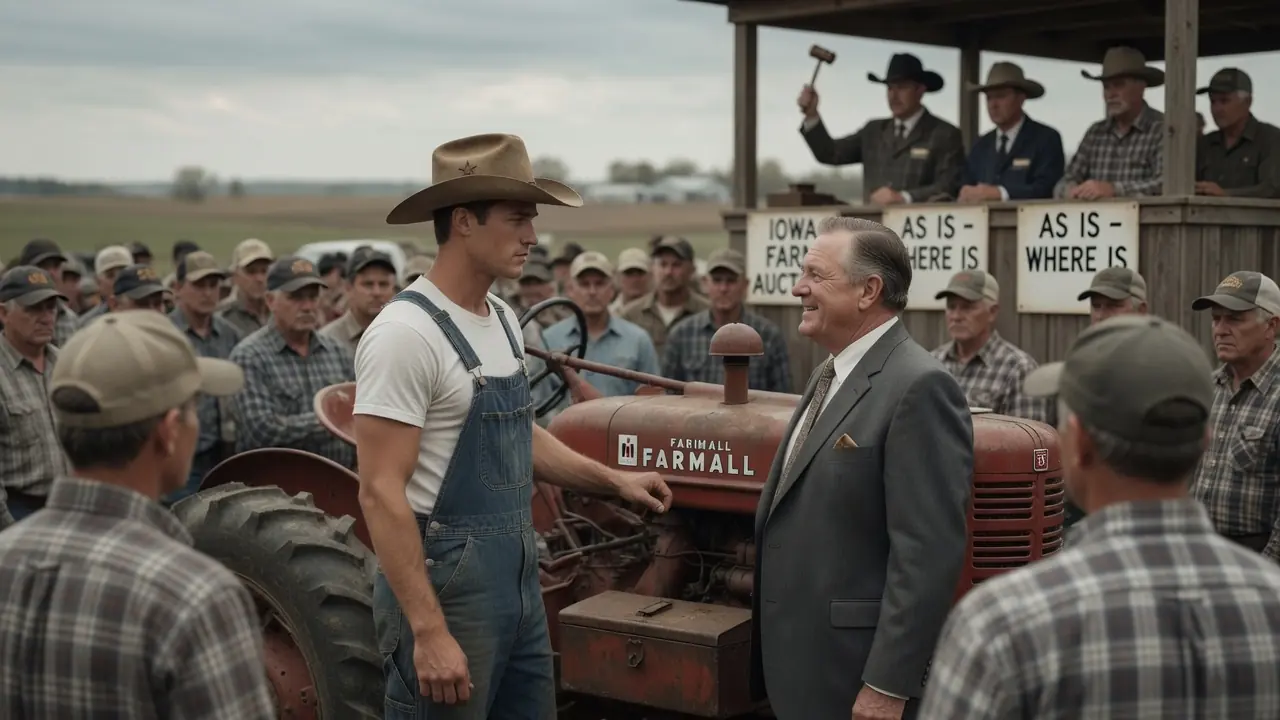
Caleb was twenty-five, tall and athletic, with short light-brown hair beneath a tan cowboy hat marked by a small metal star. A fitted white T-shirt showed beneath his faded blue denim overalls, and dried Iowa mud clung to his sturdy brown work boots. He looked young enough for strangers to assume he knew little about tractors, auctions, or loss. They did not know he had been running the Turner farm alone since his grandfather’s funeral eighteen months earlier.
Caleb rested one hand against the Farmall’s dented hood. “You see scrap. I see the last thing my grandfather refused to lose.”
Richard gave a dismissive laugh. “I’ll outbid you, restore it, and erase every ugly mark.”
Caleb looked toward the dented toolbox welded to the tractor’s left fender. “Win it first—then open that toolbox and learn why money can’t make it yours.”
The auctioneer raised his microphone and called for the crowd to gather closer. Men in seed-company caps moved around the tractor, examining its tires, checking the engine block, and discussing the likely cost of rebuilding the magneto. Most of them saw a common machine in rough condition, worth perhaps fifteen hundred dollars on a generous day. Only Caleb understood why his grandfather had protected it when banks, drought, and grief took nearly everything else.
The tractor had belonged to Arthur Turner since 1951. Arthur purchased it at twenty-three with money saved from repairing fences and harvesting corn for neighboring farms. He drove it thirty miles home from the dealership because he could not afford delivery. According to the story he told Caleb a hundred times, the engine sounded stronger with every mile.
That Farmall helped build the Turner farm from sixty rented acres into two hundred owned acres. It pulled plows through hard spring soil, carried wagons during autumn harvests, and powered the belt that ran the old grain elevator behind the red barn. Arthur taught his son, Caleb’s father, to drive it before the boy could reach the pedals without stretching. Decades later, he placed six-year-old Caleb on the seat and wrapped the child’s hands around the enormous steering wheel.
“Machines remember how you treat them,” Arthur had said. “So do people.”
Caleb’s father never loved farming the way Arthur did. Thomas Turner wanted city work, regular hours, and a life that did not depend on rain. When Caleb was nine, Thomas moved to Chicago after a bitter argument and rarely returned. Caleb’s mother followed two years later, leaving Caleb with Arthur because she claimed the farm offered stability.
Arthur never spoke badly about either parent. He simply taught Caleb to feed cattle before breakfast, recognize a storm by the taste of the air, and repair machinery before buying something new. By the time Caleb graduated from high school, he understood the farm better than men twice his age. He chose to stay even when his friends left for college, construction jobs, and military service.
The decision did not make him rich.
By the time Arthur became ill, the Turner farm had shrunk to seventy-eight acres. Medical bills consumed their savings, grain prices weakened, and two seasons of flooding damaged the lower fields. Caleb worked nights repairing equipment for neighboring farmers while managing the Turner land during the day. He often slept four hours and told Arthur he felt fine.
Arthur knew better.
Three months before his death, the old man asked Caleb to wheel him into the machinery shed. The Farmall sat beneath a gray canvas cover, its red paint faded nearly pink and one rear tire cracked along the sidewall. Arthur reached toward the toolbox but lacked the strength to open it. His hand remained suspended in the dusty air.
“There’s something inside for you,” Arthur said.
Caleb assumed he meant wrenches or an old photograph. “I’ll check later.”
“Not yet.” Arthur gripped his wrist. “Only when someone tries to take her from you.”
“No one’s taking her.”
“Promise me you’ll open that box before she leaves the family.”
Caleb promised.
Arthur died six weeks later in the farmhouse bedroom where he had been born. Caleb sat beside him through the final night, holding the hand that had taught him nearly everything worth knowing. At dawn, Arthur’s breathing stopped as rain touched the windows. The silence afterward felt larger than the house.
Caleb inherited the remaining land, the farmhouse, and more debt than he expected. He sold cattle, canceled plans to repair the roof, and leased twenty acres to a neighboring farmer. The Farmall remained beneath its cover because restoring it would cost money he did not have. Still, Caleb believed it was safely his.
Then Arthur’s younger brother, Vernon Turner, challenged the estate.
Vernon claimed Arthur had verbally promised him several pieces of equipment in exchange for helping during the farm crisis of the 1980s. No written agreement existed, but Vernon produced an old ledger showing payments he had made toward property taxes. Rather than risk an expensive legal fight, the probate court ordered several disputed items sold at auction so the proceeds could be divided.
The Farmall was included.
Caleb’s attorney told him the court’s decision was unfair but legal. He could bid like anyone else, though the farm’s finances made that almost impossible. Caleb obtained a small loan against his truck and arrived at the Boone County auction with a firm limit of twenty-two hundred dollars. He told himself no one would pay that much for a tractor needing so much work.
Then Richard Davenport arrived from Chicago.
Richard owned commercial properties, hotels, and a private collection of restored agricultural equipment displayed inside a climate-controlled barn in Wisconsin. He did not farm and had never needed a tractor for anything practical. He bought them because rarity impressed his guests, and because winning auctions gave him the pleasure of taking home something another man desperately wanted.
He noticed Caleb studying the Farmall and immediately sensed emotional value.
“Family machine?” Richard asked before the auction began.
Caleb ignored him.
Richard walked around the tractor, photographing its serial plate. “Not especially rare. Wrong rear wheels, replacement seat, and terrible paint.”
“It still runs.”
“So do cheap watches.”
Caleb turned toward him. “Then buy yourself a watch.”
Richard smiled as though Caleb had provided entertainment.
When the bidding started, a local mechanic opened at five hundred dollars. Another farmer raised it to seven. Richard entered at nine hundred without removing his phone from his hand. Caleb waited until the bidding reached twelve hundred before lifting his number.
The auctioneer called thirteen.
Richard answered fourteen.
Caleb went to fifteen.
The crowd began noticing the contest. Some recognized Caleb and understood the tractor’s history. Others simply enjoyed watching the handsome young farmer challenge the wealthy stranger with polished boots. Richard appeared amused until Caleb continued past eighteen hundred.
“Two thousand,” Caleb called.
The auctioneer looked toward Richard.
“Twenty-one hundred,” the collector said.
Caleb’s stomach tightened. His absolute limit was twenty-two, including auction fees and transportation. He raised his number.
“Twenty-two hundred.”
Richard examined him carefully. Caleb knew what the man saw: worn overalls, an old truck, and the fear of someone who had reached the edge of his money. Richard could end the contest with one more bid. He likely spent more than twenty-three hundred dollars on weekend dinners.
“Twenty-five hundred,” Richard said.
The crowd murmured.
Caleb lowered his number.
The auctioneer began the count. “Twenty-five hundred, going once.”
Caleb heard Arthur’s voice in memory.
Only when someone tries to take her from you.
“Going twice.”
Caleb looked toward Vernon, who stood near the estate administrator with his arms crossed. His great-uncle would receive part of the proceeds and appeared satisfied by the rising price. He had not spoken to Caleb since the court case began.
“Sold.”
The auctioneer’s hammer fell.
Richard smiled.
For several seconds, Caleb felt nothing. Then grief arrived so quickly it nearly bent him forward. He had lost the tractor not because he failed to value it, but because a stranger could spend without consequence.
Richard approached him while assistants prepared transportation papers. “You made me pay above market.”
“I noticed.”
“Sentiment makes people irrational.”
“So does arrogance.”
Richard looked toward the tractor. “I’ll restore it properly. Original red paint, new tires, polished metal. It will be worth four times what I paid.”
Caleb’s eyes settled on the toolbox. “You haven’t opened it.”
“Why would I?”
“Because I told you to.”
Richard laughed. “You really believe there’s treasure inside?”
“I don’t know what’s inside.”
That answer captured his attention.
Caleb explained Arthur’s final instruction without revealing every detail. Richard listened with increasing curiosity, then called the auction employee responsible for transferring the equipment. The tractor now legally belonged to him, and whatever remained attached to it would normally transfer with the sale.
“Open the box,” Richard ordered.
The latch had rusted shut.
An employee brought penetrating oil and a pry bar. Caleb stopped him before he forced the metal. “There’s a release beneath the rear edge.”
Richard raised an eyebrow. “You know the secret latch?”
“My grandfather built it.”
Caleb pressed upward beneath the toolbox and pulled the latch sideways. The lid opened with a dry metallic groan. Inside lay several old wrenches, a grease-stained cloth, two spark plugs, and a red Maxwell House coffee can sealed with tan electrical tape.
Richard’s disappointment was immediate. “That’s it?”
Caleb lifted the can.
His hands trembled when he touched the tape. Arthur had wrapped every damaged handle, cracked hose, and loose connector with the same tan material. Seeing it again felt like finding his grandfather’s fingerprint.
Richard reached for the can. “It came with the tractor.”
Caleb pulled it back. “The tractor came from my family.”
“You lost the auction.”
“This is a personal letter.”
“You don’t know that.”
Richard turned toward the auction manager. “Tell him.”
The manager looked uncomfortable. “Items stored in attached compartments are generally included unless specifically excluded.”
Caleb’s face hardened. “Then let me open it here. If it’s money or a tractor part, you can claim it.”
“And if it’s something valuable?”
“You just said the whole machine was worthless rust.”
Richard stared at him before finally nodding. “Open it.”
Caleb removed the tape slowly. Inside the coffee can was a folded oilcloth packet. He unwrapped it and found four handwritten pages, a small brass key, and an old black-and-white photograph.
The photograph showed Arthur at twenty-three, standing beside the Farmall on the day he brought it home. A young woman stood on the running board beside him, smiling beneath a light summer dress. Caleb recognized his grandmother, Margaret, who died before he was born.
On the back, Arthur had written:
The first thing we owned together.
Caleb unfolded the letter.
The first line stopped him.
Dear Caleb, if you are reading this, somebody believed money gave him a stronger claim to this tractor than memory did.
Richard shifted beside him.
Caleb continued silently. Arthur wrote about purchasing the Farmall before marrying Margaret. He described using it to clear the field where they built their first home and driving her to the county hospital during a snowstorm when their truck would not start. Their first child was born that night.
Arthur wrote about losing land during the farm crisis and the shame of watching equipment leave beneath an auctioneer’s hammer. He admitted that he once considered selling the Farmall to save forty additional acres. Margaret stopped him.
“She told me land could be earned again,” Arthur wrote. “But a life needs at least one witness that cannot lie about what happened.”
The tractor became that witness.
It carried their children, survived droughts, and remained after Margaret died. Every dent marked a day Arthur remembered. The crease in the left fender came from the summer Thomas learned to reverse. A burn mark near the toolbox came from Margaret setting down a hot preserving kettle during a harvest picnic.
Arthur had refused to repaint it because restoration would erase the evidence.
Caleb reached the final page.
I know you think staying means you lacked the courage to leave. That is not true. Some men run because the world is wide. Others stay because one small place needs someone brave enough to keep loving it.
Caleb stopped reading when tears blurred the words.
The crowd around them had fallen silent.
Richard no longer appeared amused.
Caleb forced himself to continue.
If you had to bid for this tractor, I am sorry. Vernon believes I cheated him during the bad years, and perhaps in some ways I did. The brass key opens a box at First County Bank. Inside are records proving I repaid every dollar he gave the farm, along with a signed transfer placing the Farmall solely in your name before my death.
Vernon’s face went pale.
The estate administrator stepped closer. “A signed transfer?”
Caleb held up the brass key.
Arthur’s letter explained that he deposited the original transfer document, loan receipts, and maintenance records in a safe-deposit box six months before his death. He had intended to retrieve them but became too ill. The letter itself included the box number and the name of the bank manager who witnessed the signature.
Richard stared at Vernon. “You knew the tractor wasn’t part of the estate?”
Vernon shook his head. “Arthur never told me.”
“You claimed it anyway,” Caleb said.
“I claimed what I was owed.”
“The letter says he repaid you.”
“He was confused near the end.”
“The bank records will decide that.”
The auction manager immediately suspended the transfer. Richard protested that he had purchased the tractor in good faith, but even he understood a prior legal transfer could invalidate the sale. The manager contacted the estate attorney, who ordered everyone involved to preserve the tractor and documents until the bank records were reviewed.
Caleb drove to First County Bank that afternoon with the brass key.
The manager, Susan Bell, remembered Arthur. She verified Caleb’s identification and opened the safe-deposit box in a private room. Inside were meticulously organized receipts showing every payment Vernon made during the farm crisis and every repayment Arthur later sent him. The final document transferred full ownership of the 1951 Farmall M to Caleb six months before Arthur died.
It was notarized.
The tractor had never legally belonged to the disputed estate.
By the next morning, the auction was voided. Richard received his money back, and Vernon faced questions about whether he knowingly omitted Arthur’s repayments from his court claim. The judge later removed the Farmall from probate and ordered Vernon to reimburse part of Caleb’s legal expenses.
Caleb expected never to see Richard again.
Instead, the collector arrived at Turner Farm two weeks later.
He drove a black luxury SUV along the gravel lane and stepped out wearing the same expensive barn coat. The Farmall rested inside the open machinery shed, still covered in dust from the auction yard. Caleb was replacing a fuel line when Richard approached.
“I came to make an offer,” Richard said.
“It isn’t for sale.”
“You haven’t heard the number.”
“It still isn’t for sale.”
Richard looked over the faded paint. “I’ll pay fifteen thousand.”
Caleb laughed softly.
“Twenty.”
“No.”
“I can preserve it. Climate control, professional restoration, proper display.”
Caleb wiped his hands on a rag. “That letter explained why restoration would destroy its value.”
“It would increase its financial value.”
“That isn’t the value my grandfather protected.”
Richard walked around the tractor. “You cannot afford to maintain this farm. I checked the property records. You have loans, unpaid repairs, and less acreage every year.”
Caleb’s expression cooled. “You investigated me?”
“I make informed offers.”
“You still think knowing the price of my trouble tells you the price of everything I love.”
Richard stopped.
Caleb pointed toward the dented fender. “My grandfather made that crease teaching my father to drive. That burn mark came from my grandmother. The worn steering wheel carries four generations of hands. Your restoration crew would polish away the only things that make this tractor irreplaceable.”
Richard looked at the Farmall differently.
For the first time, he did not see an investment.
He saw a record.
“I’ve spent years collecting machines,” he admitted. “Most of them have no history beyond the seller’s description.”
“Because you bought the object without earning the story.”
Richard nodded slowly.
He withdrew a business card but did not hand it to Caleb. “There is a preservation foundation in Des Moines. They offer grants for historic working equipment with documented family history. I could introduce you.”
“Why?”
“Because I was prepared to erase every ugly mark.”
Caleb studied him.
Richard continued. “And because your grandfather’s letter was right. I believed money gave me the stronger claim.”
Caleb accepted the card.
The foundation did not purchase the Farmall. It provided a small preservation grant covering mechanical repairs while requiring Caleb to keep the original paint, dents, and toolbox intact. A retired International Harvester mechanic rebuilt the magneto and repaired the cracked tire. Caleb contributed labor and documented every part.
By the following spring, the tractor ran again.
Caleb started it on Arthur’s birthday.
The engine coughed twice, released a cloud of gray exhaust, and settled into the deep rhythm Caleb remembered from childhood. He sat behind the steering wheel wearing his tan hat, white shirt, overalls, and brown boots. For a moment, he felt Arthur standing beside him.
Richard attended the first public showing months later. He arrived without assistants, bidding advisers, or polished boots. The event took place at a county heritage fair, where Caleb displayed the tractor without ropes or barriers.
Children climbed onto the seat.
Older farmers touched the faded hood and shared stories about machines their own families had lost. Richard stood quietly near the toolbox, listening to histories no price guide could measure.
Caleb eventually placed a copy of Arthur’s letter inside a clear protective case beside the tractor. He kept the original at home, along with the photograph of Arthur and Margaret. The brass key hung from a nail above his kitchen table.
The farm remained difficult.
One tractor could not erase debt, repair fences, or guarantee rain. Caleb continued working long days and taking equipment jobs at night. Yet the preservation attention brought new opportunities, including paid demonstrations, repair work, and a partnership with a local agricultural-history program.
He did not become wealthy.
He became secure enough to stay.
Years later, Caleb still refused to repaint the Farmall. The red faded further, and new scratches appeared through honest work. He used it for light hauling, parades, and occasional field demonstrations, insisting that preservation did not mean turning a machine into something lifeless.
Whenever someone asked what the tractor was worth, Caleb gave the same answer.
“To you or to me?”
Most people laughed.
The ones who understood did not.
Arthur had hidden no gold, secret stock certificate, or fortune inside the toolbox. He had left something more useful: proof, memory, and words Caleb needed at the moment the world tried to convince him that staying made him small.
The wealthy collector had nearly purchased the tractor.
But he could never have bought the crease in the fender, the burn beside the toolbox, or the sound Arthur listened to on the first morning he brought it home.
Those belonged to the people who had lived them.
And as Caleb drove the old Farmall across the Turner field beneath a wide Iowa sky, every turn of its wheels carried the same quiet truth:
Money could win the bidding.
It could never own the story.